tire type FIAT 500X 2014 2.G User Guide
[x] Cancel search | Manufacturer: FIAT, Model Year: 2014, Model line: 500X, Model: FIAT 500X 2014 2.GPages: 476, PDF Size: 5.32 MB
Page 395 of 476
Snow Tires
Some areas of the country require the use of snow tires
during the Winter. Snow tires can be identified by a
“mountain/snowflake” symbol on the tire sidewall.If you need snow tires, select tires
equivalent in size and type to the
original equipment tires. Use snow
tires only in sets of four; failure to do
so may adversely affect the safety
and handling of your vehicle.
Snow tires generally have lower speed ratings than
what was originally equipped with your vehicle and
should not be operated at sustained speeds over 75 mph
(120 km/h). For speeds above 75 mph (120 km/h), refer
to original equipment or an authorized tire dealer for
recommended safe operating speeds, loading and cold
tire inflation pressures.
While studded tires improve performance on ice, skid
and traction capability on wet or dry surfaces may be
poorer than that of non-studded tires. Some states
prohibit studded tires; therefore, local laws should be
checked before using these tire types.
Run Flat Tires — If Equipped
Run Flat tires allow you the capability to drive 50 miles
(80 km) at 50 mph (80 km/h) after a rapid loss of
inflation pressure. This rapid loss of inflation is referred
to as the Run Flat mode. A Run Flat mode occurs when
the tire inflation pressure is of/or below 14 psi (96 kPa).
Once a Run Flat tire reaches the Run Flat mode, it has
limited driving capabilities and needs to be replaced
immediately. A Run Flat tire is not repairable.
It is not recommended to drive a vehicle loaded at full
capacity, or to tow a trailer while a tire is in the Run Flat
mode.
See the tire pressure monitoring section for more infor-
mation.
Spare Tires — If Equipped
NOTE: For vehicles equipped with Tire Service Kit
instead of a spare tire, please refer to “Tire Service Kit”
in “In Case Of Emergency” for further information.
9
MAINTAINING AND CARING FOR YOUR VEHICLE 393
Page 399 of 476
TIRE CHAINS (TRACTION DEVICES)
Use of traction devices require sufficient tire-to-body
clearance. Follow these recommendations to guard
against damage.
•Traction device must be of proper size for the tire, as
recommended by the traction device manufacturer.
• Install on Front Tires Only.
• Only 215/60 R16 and 215/55 R17 tire sizes can be
chained using 9 mm tire chains.
• No other tire sizes can be chained.
WARNING!
Using tires of different size and type (M+S, Snow)
between front and rear axles can cause unpredict-
able handling. You could lose control and have a
collision.
CAUTION!
To avoid damage to your vehicle or tires, observe
the following precautions:
•Because of restricted traction device clearance
between tires and other suspension components,
it is important that only traction devices in good
condition are used. Broken devices can cause
serious damage. Stop the vehicle immediately if
noise occurs that could indicate device breakage.
Remove the damaged parts of the device before
further use.
• Install device as tightly as possible and then
retighten after driving about ½ mile (0.8 km).
• Do not exceed 30 mph (48 km/h).
• Drive cautiously and avoid severe turns and large
bumps, especially with a loaded vehicle.
• Do not drive for a prolonged period on dry
pavement.
• Observe the traction device manufacturer ’s in-
structions on the method of installation, operat-
ing speed, and conditions for use. Always use the
suggested operating speed of the device manufac-
turer ’s if it is less than 30 mph (48 km/h).
•
Do not use traction devices on a compact spare tire.
9
MAINTAINING AND CARING FOR YOUR VEHICLE 397
Page 401 of 476
tires must meet under the Federal Motor Vehicle
Safety Standard No. 109. Grades B and A represent
higher levels of performance on the laboratory test
wheel, than the minimum required by law.
WARNING!
The temperature grade for this tire is established
for a tire that is properly inflated and not over-
loaded. Excessive speed, under-inflation, or ex-
cessive loading, either separately or in combina-
tion, can cause heat buildup and possible tire
failure.
TIRE ROTATION RECOMMENDATIONS
The tires on the front and rear of your vehicle operate at
different loads and perform different steering, han-
dling, and braking functions. For these reasons, they
wear at unequal rates.
These effects can be reduced by timely rotation of tires.
The benefits of rotation are especially worthwhile with
aggressive tread designs such as those on On/Off Road
type tires. Rotation will increase tread life, help to
maintain mud, snow, and wet traction levels, and
contribute to a smooth, quiet ride. Refer to the “Maintenance Plan” in this section for the
proper maintenance intervals. The reasons for any rapid
or unusual wear should be corrected prior to rotation
being performed.
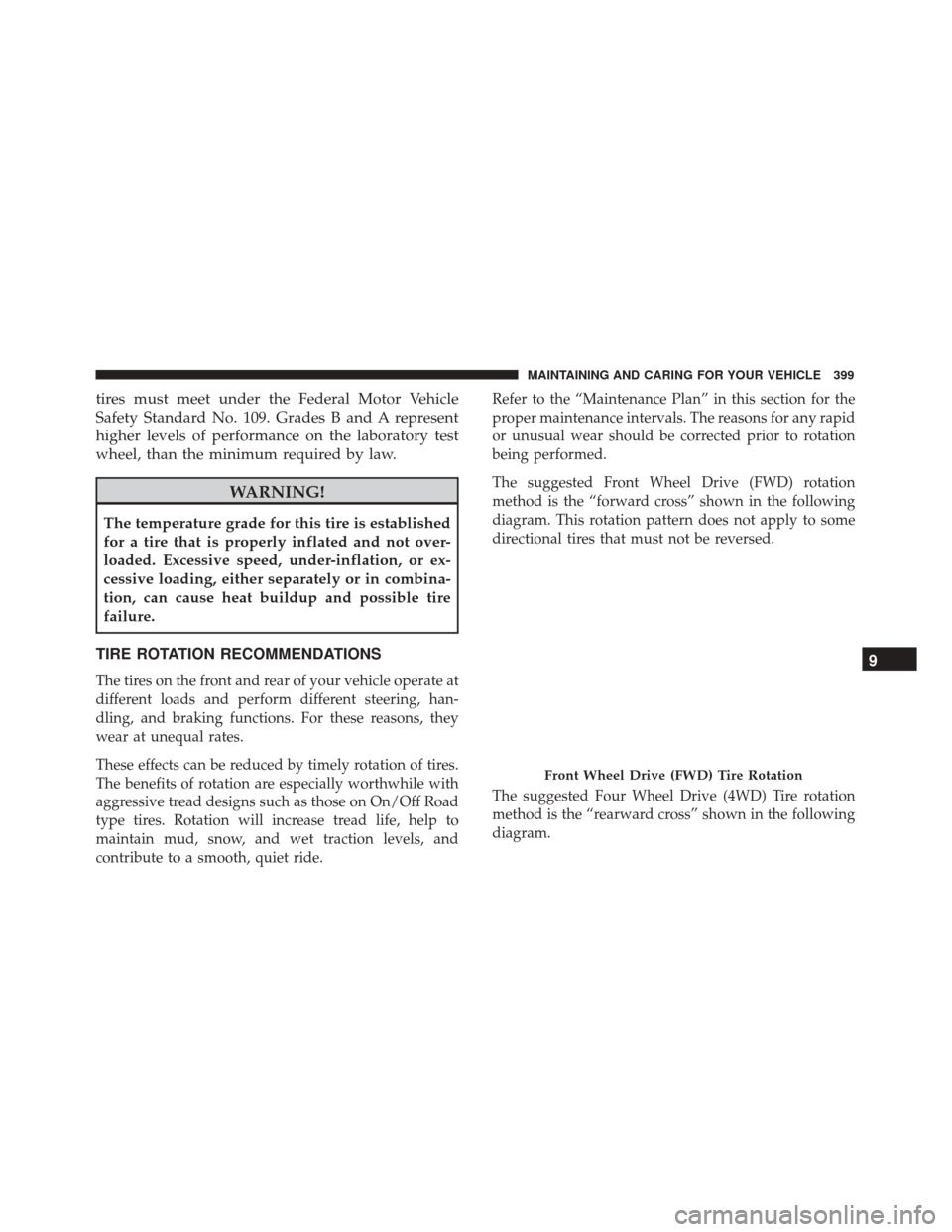
The suggested Front Wheel Drive (FWD) rotation
method is the “forward cross” shown in the following
diagram. This rotation pattern does not apply to some
directional tires that must not be reversed.
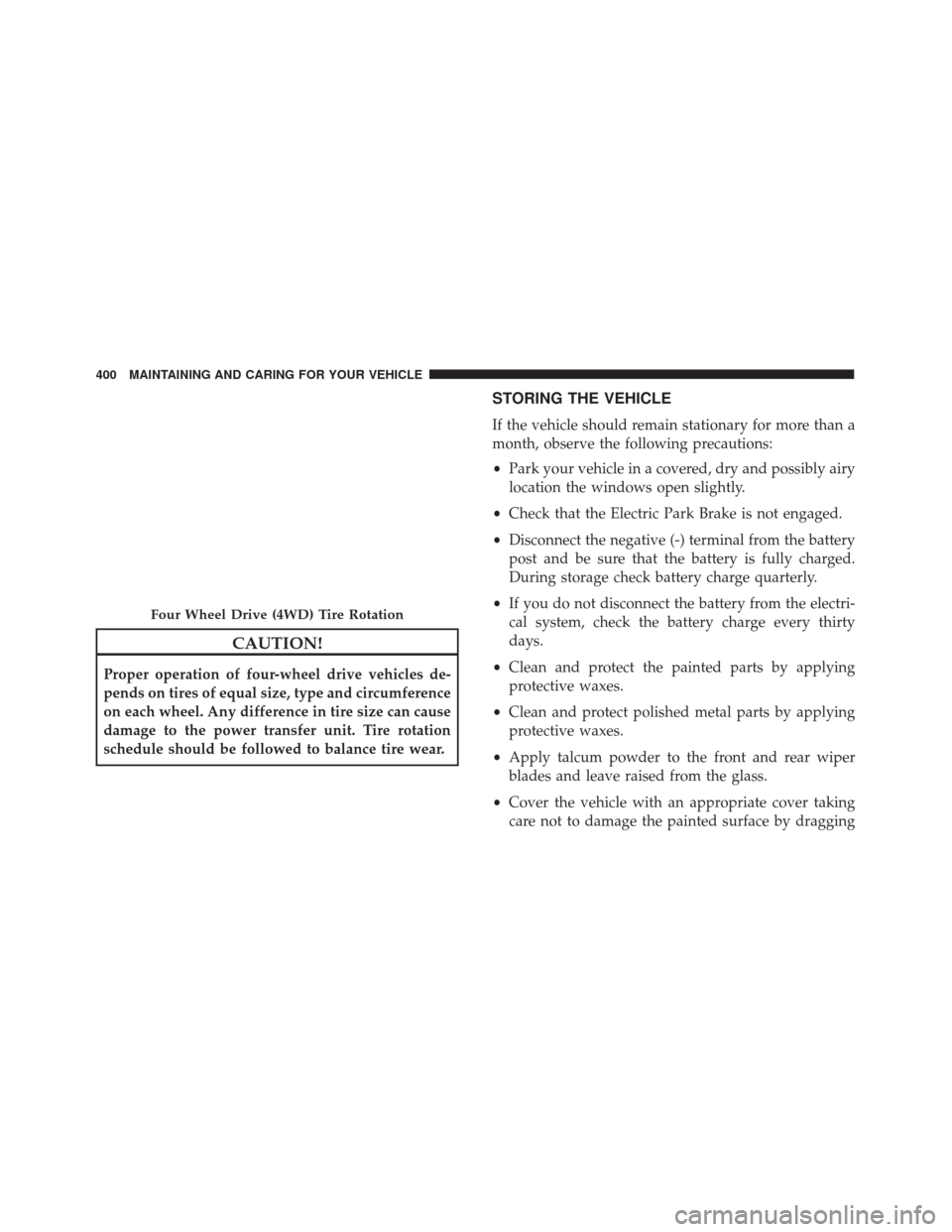
The suggested Four Wheel Drive (4WD) Tire rotation
method is the “rearward cross” shown in the following
diagram.
Front Wheel Drive (FWD) Tire Rotation
9
MAINTAINING AND CARING FOR YOUR VEHICLE 399
Page 402 of 476
CAUTION!
Proper operation of four-wheel drive vehicles de-
pends on tires of equal size, type and circumference
on each wheel. Any difference in tire size can cause
damage to the power transfer unit. Tire rotation
schedule should be followed to balance tire wear.
STORING THE VEHICLE
If the vehicle should remain stationary for more than a
month, observe the following precautions:
•Park your vehicle in a covered, dry and possibly airy
location the windows open slightly.
• Check that the Electric Park Brake is not engaged.
• Disconnect the negative (-) terminal from the battery
post and be sure that the battery is fully charged.
During storage check battery charge quarterly.
• If you do not disconnect the battery from the electri-
cal system, check the battery charge every thirty
days.
• Clean and protect the painted parts by applying
protective waxes.
• Clean and protect polished metal parts by applying
protective waxes.
• Apply talcum powder to the front and rear wiper
blades and leave raised from the glass.
• Cover the vehicle with an appropriate cover taking
care not to damage the painted surface by dragging
Four Wheel Drive (4WD) Tire Rotation
400 MAINTAINING AND CARING FOR YOUR VEHICLE
Page 406 of 476
VEHICLE IDENTIFICATION NUMBER
The chassis number (VIN) and stamped on the plate
illustrated in, located on the left front corner of the
instrument panel cover, visible from the outside vehicle
through the windshield.
This number is also stamped on the floor of the passen-
ger compartment, in front of the right front seat.The stamp includes:
•
Type of the vehicle
• Sequential production number of the chassis
WHEEL AND TIRE TORQUE SPECIFICATIONS
Proper lug nut/bolt torque is very important to ensure
that the wheel is properly mounted to the vehicle. Any
time a wheel has been removed and reinstalled on the
vehicle, the lug nuts/bolts should be torqued using a
properly calibrated torque wrench.
Vehicle Identification Number (VIN)
Vehicle Identification Number (VIN)
404 TECHNICAL DATA
Page 462 of 476
About Your Brakes...................... .154
Adding Engine Coolant (Antifreeze) ...........366
Adding Fuel ........................... .265
Adding Washer Fluid .....................362
Additives, Fuel ......................... .264
AirBag .............................. .176
Advance Front Air Bag ..................176
Air Bag Operation .....................178
Enhanced Accident Response ..............340
Event Data Recorder (EDR) ...............340
FrontAirBag ........................ .176
If A Deployment Occurs .................184
Knee Impact Bolsters ....................179
Maintaining Your Air Bag System ...........187
Redundant Air Bag Warning Light ..........176
Side Air Bags ........................ .179
Transporting Pets ..................... .205
Air Bag Light ....................... .132, 207
Air Bag Maintenance ..................... .187
Air Cleaner, Engine (Engine Air Cleaner Filter) . . .357
Air Conditioner Maintenance ................358
Air Conditioning Filter ..................96, 359
Air Conditioning, Operating Tips ..............95
Air Conditioning Refrigerant .............358, 359
Air Conditioning System ................94, 358 Air Pressure, Tires
....................... .390
Alarm Arm The System .......................34
Alarm (Security Alarm) ....................139
All Wheel Drive (AWD) ....................238
Alterations/Modifications, Vehicle ..............6
Antifreeze (Engine Coolant) ..............365, 407
Disposal ............................ .367
Anti-Lock Brake System (ABS) ...............155
Anti-Lock Warning Light ...............147, 148
Appearance Care ....................... .372
Assist, Hill Start ........................ .157
Audio Systems (Radio) ....................445
Automatic
Headlights ......................67
Automatic Temperature Control (ATC) ..........94
Automatic Transmission .............226, 371, 372
Adding Fluid ..................... .372, 409
Fluid And Filter Changes .................372
Fluid Change ........................ .372
Fluid Level Check ..................... .372
Fluid Type ....................... .371, 409
Special Additives ..................... .371
Auxiliary Electrical Outlet (Power Outlet) .......112
Auxiliary Power Outlet ....................112
Axle Fluid ............................ .409
460 INDEX
Page 470 of 476
Radio Operation........................ .447
Rain Sensitive Wiper System .................76
Rear Camera .......................... .255
Rear Cross Path ..........................64
Rear ParkSense System ....................246
Rear Window Defroster .....................78
Rear Wiper/Washer .......................78
Recreational Towing ..................... .284
Reformulated Gasoline ....................262
Refrigerant ............................ .359
Reminder, Lights On .......................68
Reminder, Seat Belt ...................... .164
Remote Control Starting System ........................29
Remote Keyless Entry ......................23
Arm The Alarm ........................34
Keyless Enter-N-Go .....................38
Remote Sound System (Radio) Controls ........446
Remote Starting Exit Remote Start Mode ..................31
Uconnect Customer Programmable Features ....32
Uconnect Settings .......................32
Remote Starting System ....................29
Replacement Keys ........................26
Replacement Parts ....................... .344Replacement Tires
....................... .395
Reporting Safety Defects ....................11
Restraint, Head ..........................53
Restraints, Child ........................ .188
Roll Over Warning .........................6
Roof Type Carrier ........................117
Rotation, Tires ......................... .399
Safety Checks Inside Vehicle ................207
Safety Checks Outside Vehicle ...............209
Safety Defects, Reporting ....................11
Safety, Exhaust Gas ...................... .206
Safety Information, Tire ....................380
Safety Tips ............................ .205
Schedule, Maintenance ....................344
Seat Belt Adjustable Upper Shoulder Belt Anchorage . . . .169
Automatic Locking Retractor (ALR) .........172
Energy Management Feature ..............172
Lap/Shoulder
Belt Operation ..............167
Lap/Shoulder Belts .....................165
Lap/Shoulder Belt Untwisting .............169
Pregnant Women ..................... .171
Seat Belt Pretensioner ...................172
Seat Belt Reminder .....................164
468 INDEX