battery FIAT 500X 2014 2.G Owner's Manual
[x] Cancel search | Manufacturer: FIAT, Model Year: 2014, Model line: 500X, Model: FIAT 500X 2014 2.GPages: 476, PDF Size: 5.32 MB
Page 218 of 476
CAUTION!
To prevent damage to the starter, do not continu-
ously crank the engine for more than 25 seconds at
a time. Wait 60 seconds before trying again.
Cold Weather Operation
To ensure reliable starting under extreme cold condi-
tions an externally powered electric block heater (avail-
able from your authorized dealer) is required for the
1.4L Turbo engine below -20°F (-29°C) and for the 2.4L
engine below -31°F (-35°C) and is recommended for the
2.4L engine below -20°F (-29°C).
To prevent possible engine damage while starting at
low temperatures, this vehicle will inhibit engine crank-
ing when the ambient temperature is less than -20°F
(-29°C) for the 1.4L Turbo engine, and -31°F (-35°C) for
the 2.4L engine, and the oil temperature sensor reading
indicates an engine block heater has not been used. The
message “plug in engine heater” will be displayed in
the instrument cluster when the ambient temperature is
below -4°F (-20°C) at the time the engine is shut off as a
reminder to avoid possible crank delays at the next cold
start.
Extended Park Starting
NOTE:Extended Park condition occurs when the ve-
hicle has not been started or driven for at least 30 days.
1. Install a battery charger or jumper cables to the battery to ensure a full battery charge during the
crank cycle.
2. Cycle the ignition to the START mode and release it when the engine starts.
3. If the engine fails to start within 10 to 15 seconds, cycle the ignition to the OFF mode, wait five seconds
to allow the starter to cool, then repeat the Extended
Park Starting procedure.
4. If the engine fails to start after eight attempts, allow the starter to cool for at least 10 minutes, then repeat
the procedure.
CAUTION!
To prevent damage to the starter, do not crank
continuously for more than 10 seconds at a time.
Wait 10 to 15 seconds before trying again.
216 STARTING AND OPERATING
Page 284 of 476
Four-Pin Connector
1 — Female Pins
2—MalePin
3 — Ground4 — Park
5 — Left Stop/Turn
6 — Right Stop/Turn
Seven-Pin Connector
1 — Battery
2 — Backup Lamps
3 — Right Stop/Turn
4 — Electric Brakes5 — Ground
6 — Left Stop/Turn
7 — Running Lamps
282 STARTING AND OPERATING
Page 291 of 476
HAZARD WARNING FLASHERS
The Hazard Warning flasher switch is located on the
switch bank below the radio.Push the switch to turn on the Hazard Warning
Flasher. When the switch is activated, all direc-
tional turn signals will flash on and off to warn oncom-
ing traffic of an emergency. Push the switch a second
time to turn off the Hazard Warning flashers.
This is an emergency warning system and it should not
be used when the vehicle is in motion. Use it when your
vehicle is disabled and it is creating a safety hazard for
other motorists.
When you must leave the vehicle to seek assistance, the
Hazard Warning flashers will continue to operate even
though the ignition is placed in OFF mode.
NOTE: With extended use the Hazard Warning flashers
may wear down your battery.
BULB REPLACEMENT
General Information
• Before you replace a bulb, check the contacts to be
sure they are not oxidized.
• Replace the bulbs with the same type and wattage.
• After replacing a light bulb, always check the correct
orientation.
• Before replacing a bulb that is not functioning, check
that the fuse is intact.
NOTE: Lens fogging can occur under certain atmo-
spheric conditions. This will usually clear as atmo-
spheric conditions change to allow the condensation to
change back into a vapor. Turning the lamps on will
usually accelerate the clearing process.
8
IN CASE OF EMERGENCY 289
Page 308 of 476
Also please be aware that when using power outlets for
extended periods of time with the engine off may result
in vehicle battery discharge.Fuse Removal
To replace a fuse use the extractor attached to the fuse
cover (located on the inside of the engine compartment
fuse cover.
Blade Fuses
1 — Electrical Circuit
2 — Blade Fuse With Good Electrical Circuit
3 — Blade Fuse With Bad Electrical Circuit
Fuse Extractor Location
306 IN CASE OF EMERGENCY
Page 310 of 476
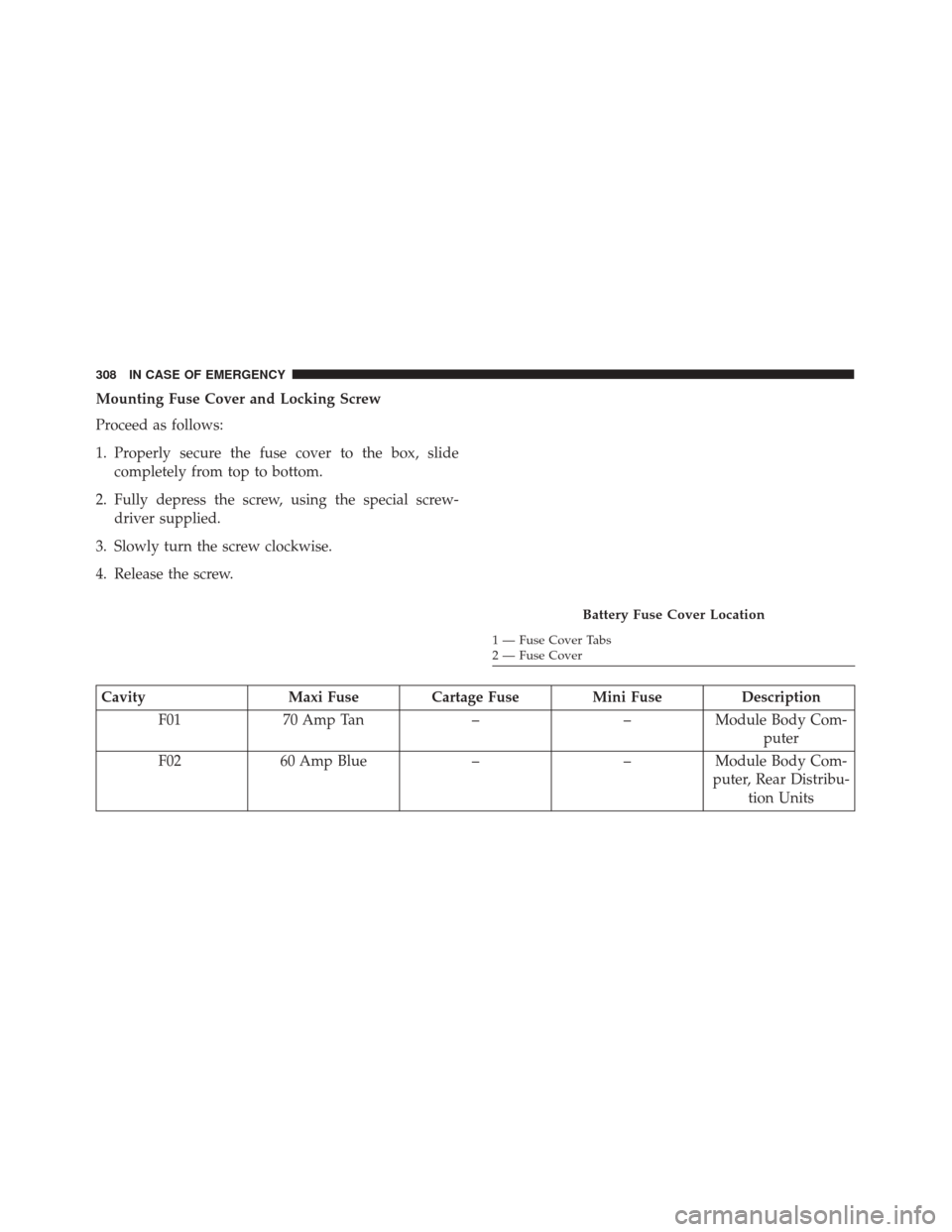
Mounting Fuse Cover and Locking Screw
Proceed as follows:
1. Properly secure the fuse cover to the box, slidecompletely from top to bottom.
2. Fully depress the screw, using the special screw- driver supplied.
3. Slowly turn the screw clockwise.
4. Release the screw.
Cavity Maxi Fuse Cartage Fuse Mini Fuse Description
F01 70 Amp Tan ––Module Body Com-
puter
F02 60 Amp Blue ––Module Body Com-
puter, Rear Distribu- tion Units
Battery Fuse Cover Location
1 — Fuse Cover Tabs
2 — Fuse Cover
308 IN CASE OF EMERGENCY
Page 313 of 476
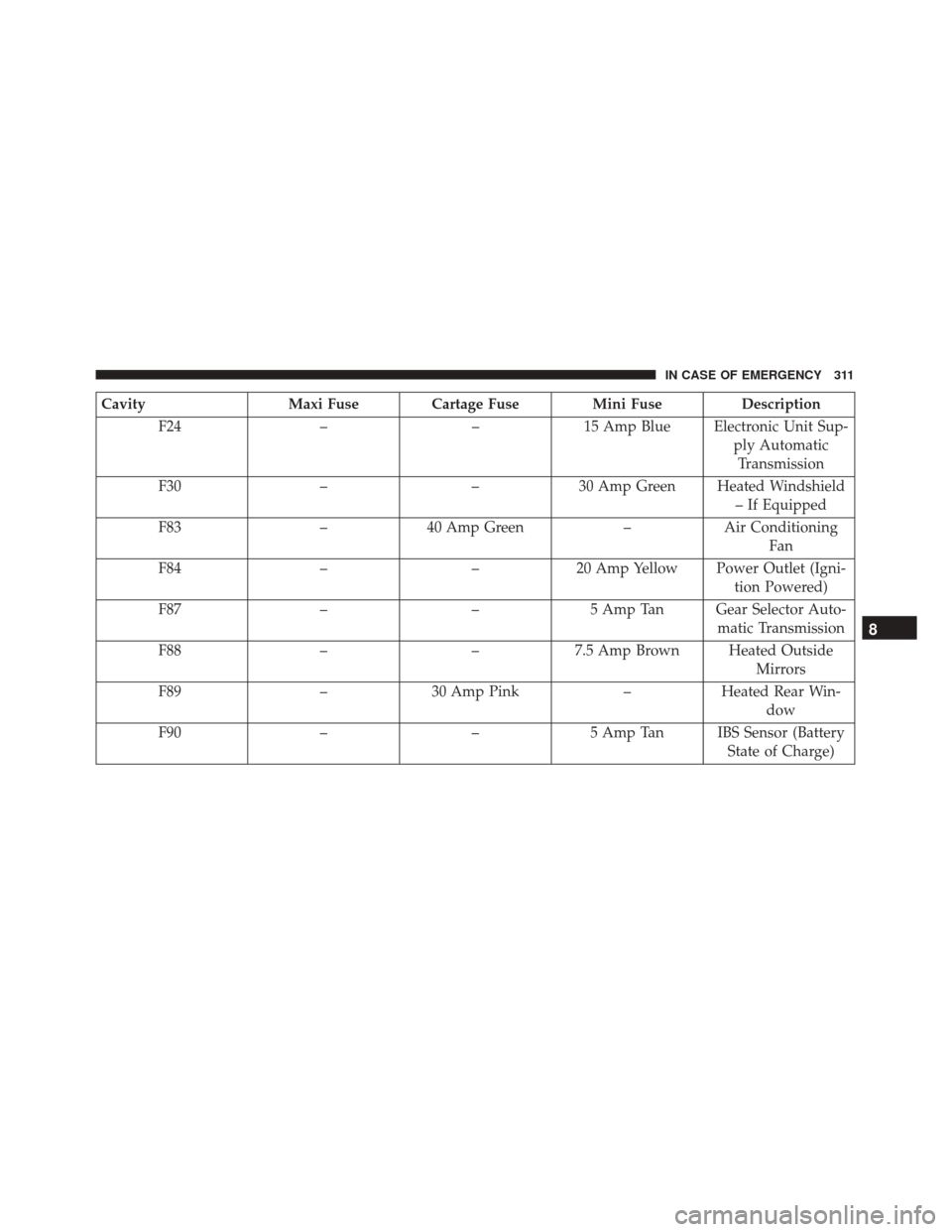
CavityMaxi Fuse Cartage Fuse Mini Fuse Description
F24 ––15 Amp Blue Electronic Unit Sup-
ply AutomaticTransmission
F30 ––30 Amp Green Heated Windshield
– If Equipped
F83 –40 Amp Green –Air Conditioning
Fan
F84 ––20 Amp Yellow Power Outlet (Igni-
tion Powered)
F87 ––5 Amp Tan Gear Selector Auto-
matic Transmission
F88 ––7.5 Amp Brown Heated Outside
Mirrors
F89 –30 Amp Pink –Heated Rear Win-
dow
F90 ––5 Amp Tan IBS Sensor (Battery
State of Charge)
8
IN CASE OF EMERGENCY 311
Page 329 of 476
JUMP STARTING
If your vehicle has a discharged battery it can be
jump-started using a set of jumper cables and a battery
in another vehicle or by using a portable battery booster
pack. Jump starting can be dangerous if done improp-
erly so please follow the procedures in this section
carefully.
NOTE:When using a portable battery booster pack
follow the manufacturer ’s operating instructions and
precautions.
WARNING!
Do not attempt jump-starting if the battery is fro-
zen. It could rupture or explode and cause personal
injury.
CAUTION!
Do not use a portable battery booster pack or any
other booster source with a system voltage greater
than 12 Volts or damage to the battery, starter motor,
alternator or electrical system may occur.
Preparations For Jump Start
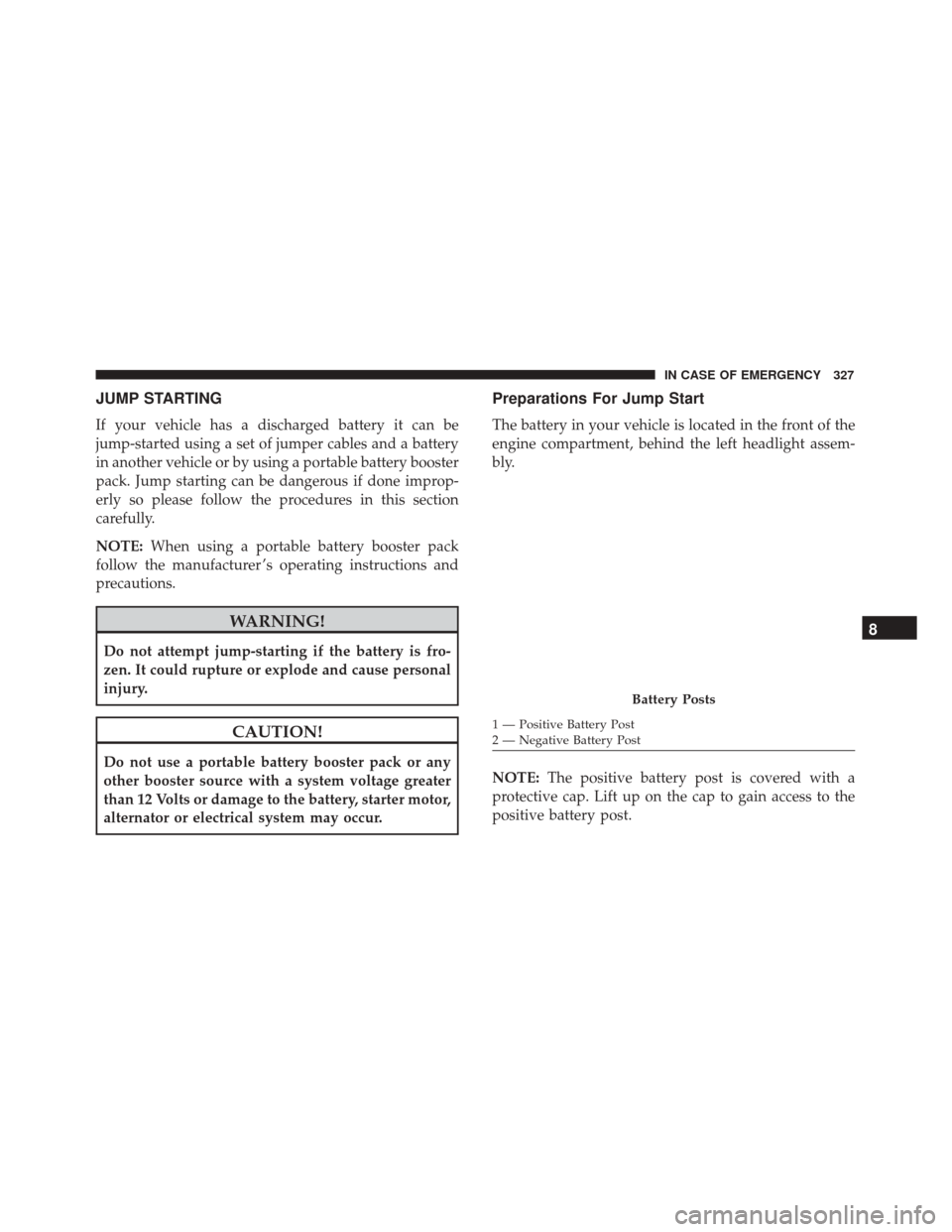
The battery in your vehicle is located in the front of the
engine compartment, behind the left headlight assem-
bly.
NOTE: The positive battery post is covered with a
protective cap. Lift up on the cap to gain access to the
positive battery post.
Battery Posts
1 — Positive Battery Post
2 — Negative Battery Post
8
IN CASE OF EMERGENCY 327
Page 330 of 476
WARNING!
•Take care to avoid the radiator cooling fan when-
ever the hood is raised. It can start anytime the
ignition switch is ON. You can be injured by
moving fan blades.
• Remove any metal jewelry such as rings, watch
bands and bracelets that could make an inadver-
tent electrical contact. You could be seriously
injured.
• Batteries contain sulfuric acid that can burn your
skin or eyes and generate hydrogen gas which is
flammable and explosive. Keep open flames or
sparks away from the battery.
Proceed as follows:
1. Set the Electric Park Brake, shift the automatic trans- mission into PARK (manual transmission in NEU-
TRAL) and place the ignition OFF.
2. Turn off the heater, radio, and all unnecessary elec- trical accessories. 3. If using another vehicle to jump start the battery,
park the vehicle within the jumper cables reach, set
the parking brake and make sure the ignition is OFF.
WARNING!
Do not allow vehicles to touch each other as this
could establish a ground connection and personal
injury could result.
Jump Starting Procedure
WARNING!
Failure to follow this jump-starting procedure
could result in personal injury or property damage
due to battery explosion.
CAUTION!
Failure to follow these procedures could result in
damage to the charging system of the booster ve-
hicle or the discharged vehicle.
328 IN CASE OF EMERGENCY
Page 331 of 476
Connecting The Jumper Cables
1. Connect the positive(+)end of the jumper cable to
the positive (+)post of the discharged vehicle.
2. Connect the opposite end of the positive (+)jumper
cable to the positive (+)post of the booster battery.
3. Connect the negative (-)end of the jumper cable to
the negative (-)post of the booster battery.
4. Connect the opposite end of the negative (-)jumper
cable to a good engine ground (exposed metal part of
the discharged vehicle’s engine) away from the bat-
tery and the fuel injection system.
WARNING!
Do not connect the jumper cable to the negative (-)
post of the discharged battery. The resulting elec-
trical spark could cause the battery to explode and
could result in personal injury. Only use the spe-
cific ground point, do not use any other exposed
metal parts. 5. Start the engine in the vehicle that has the booster
battery, let the engine idle a few minutes, and then
start the engine in the vehicle with the discharged
battery.
6. Once the engine is started, remove the jumper cables in the reverse sequence:
Disconnecting The Jumper Cables
1. Disconnect the negative (-)end of the jumper cable
from the engine ground of the vehicle with the
discharged battery.
2. Disconnect the opposite end of the negative (-)
jumper cable from the negative (-)post of the booster
battery.
3. Disconnect the positive (+)end of the jumper cable
from the positive (+)post of the booster battery.
4. Disconnect the opposite end of the positive (+)
jumper cable from the positive (+)post of the vehicle
with the discharged battery.
If frequent jump starting is required to start your
vehicle you should have the battery and charging
system inspected at your authorized dealer.
8
IN CASE OF EMERGENCY 329
Page 332 of 476
CAUTION!
Accessories plugged into the vehicle power outlets
draw power from the vehicle’s battery, even when
not in use (i.e., cellular devices, etc.). Eventually, if
plugged in long enough without engine operation,
the vehicle’s battery will discharge sufficiently to
degrade battery life and/or prevent the engine from
starting.
REFUELING IN EMERGENCY
The fuel filling procedure in case of emergency is
described in the “Emergency Refueling Procedure”.
Refer to “Adding Fuel” in “Starting And Operating” for
further information.
IF YOUR ENGINE OVERHEATS
In any of the following situations, you can reduce the
potential for overheating your engine by taking the
appropriate action.
•On the highways — slow down.
• In city traffic — while stopped, put transmission in
NEUTRAL, but do not increase engine idle speed.
CAUTION!
Driving with a hot cooling system could damage
your vehicle. If the temperature gauge reads “H,”
pull over and stop the vehicle. Idle the vehicle with
the air conditioner turned off until the pointer
drops back into the normal range. If the pointer
remains on the “H” and you hear continuous
chimes, turn the engine off immediately and call for
service.
NOTE: There are steps that you can take to slow down
an impending overheat condition:
• If your air conditioner (A/C) is on, turn it off. The
A/C system adds heat to the engine cooling system
and turning the A/C off can help remove this heat.
• You can also turn the temperature control to maxi-
mum heat, the mode control to floor and the blower
control to high. This allows the heater core to act as a
supplement to the radiator and aids in removing heat
from the engine cooling system.
330 IN CASE OF EMERGENCY