check engine FIAT 500X 2014 2.G Owner's Manual
[x] Cancel search | Manufacturer: FIAT, Model Year: 2014, Model line: 500X, Model: FIAT 500X 2014 2.GPages: 476, PDF Size: 5.32 MB
Page 357 of 476
CAUTION!
•Failure to properly maintain your vehicle or per-
form repairs and service when necessary could
result in more costly repairs, damage to other
components or negatively impact vehicle perfor-
mance. Immediately have potential malfunctions
examined by an authorized dealer or qualified
repair center.
• Your vehicle has been built with improved fluids
that protect the performance and durability of
your vehicle and also allow extended mainte-
nance intervals. Do not use chemical flushes in
these components as the chemicals can damage
your engine, transmission, or air conditioning.
Such damage is not covered by the New Vehicle
Limited Warranty. If a flush is needed because of
component malfunction, use only the specified
fluid for the flushing procedure.
Engine Oil
Checking Oil Level
To assure proper engine lubrication, the engine oil must
be maintained at the correct level. Check the oil level at
regular intervals, such as every fuel stop. The best time to check the engine oil level is approximately five
minutes after a fully warmed engine is shut off. Do not
check oil level before starting the engine after it has sat
overnight. Checking engine oil level when the engine is
cold will give you an incorrect reading.
Checking the oil while the vehicle is on level ground,
and approximately five minutes after a fully warmed
engine is shut off, will improve the accuracy of the oil
level readings. Maintain the oil level between the range
markings on the dipstick. The safe range is indicated by
a crosshatch zone. Adding 1 quart (0.9 Liters) of oil
when the reading is at the low end of the indicated
range will result in the oil level at the full end of the
indicator range.
CAUTION!
Do not overfill the engine with oil. Overfilling the
engine with oil will cause oil aeration, which can
lead to loss of oil pressure and an increase in oil
temperature. This loss of oil pressure and increased
oil temperature could damage your engine.
9
MAINTAINING AND CARING FOR YOUR VEHICLE 355
Page 364 of 476
4. Install the wiper blade and firmly push the wiperblade until it snaps into place.
Rear Wiper Blade Removal/Installation
1. Carefully lift the rear wiper arm upward to raise thewiper blade off of the liftgate glass.
2. Grab and hold the wiper arm closest to the wiper blade end while pushing the wiper blade towards
the liftgate glass to unsnap the blade pivot pin from
the wiper blade holder on the wiper arm.
3. Install the wiper blade pivot pin into the wiper blade holder at the end of the wiper arm, and firmly push
the wiper blade until it snaps into place.
Adding Washer Fluid
The windshield washer fluid reservoir is located in the
engine compartment, and the fluid level should be
checked at regular intervals. Fill the reservoir with
windshield washer solvent (not engine coolant/ anti-
freeze). Refer to “Engine Compartment” in this section
for further information.
WARNING!
Commercially available windshield washer sol-
vents are flammable. They could ignite and burn
you. Care must be exercised when filling or work-
ing around the washer solution.
Exhaust System
The best protection against carbon monoxide entry into
the vehicle body is a properly maintained engine ex-
haust system.
If you notice a change in the sound of the exhaust
system; or if the exhaust fumes can be detected inside
the vehicle; or when the underside or rear of the vehicle
is damaged; have an authorized technician inspect the
complete exhaust system and adjacent body areas for
broken, damaged, deteriorated, or mispositioned parts.
Open seams or loose connections could permit exhaust
fumes to seep into the passenger compartment. In
addition, have the exhaust system inspected each time
the vehicle is raised for lubrication or oil change.
Replace as required.
362 MAINTAINING AND CARING FOR YOUR VEHICLE
Page 366 of 476
To minimize the possibility of catalytic converter dam-
age:
•Do not shut off the engine or interrupt the ignition,
when the transmission is in gear and the vehicle is in
motion.
• Do not try to start the engine by pushing or towing
the vehicle.
• Do not idle the engine with any spark plug wires
disconnected or removed, such as when diagnostic
testing, or for prolonged periods during very rough
idle or malfunctioning operating conditions.
Cooling System
WARNING!
• Turn vehicle off and disconnect the fan motor
lead before working near the radiator cooling fan.
• You or others can be badly burned by hot engine
coolant (antifreeze) or steam from your radiator. If
you see or hear steam coming from under the
hood, do not open the hood until the radiator has
had time to cool. Never open a cooling system
(Continued)
WARNING! (Continued)
pressure cap when the radiator or coolant bottle is
hot.
• Keep hands, tools, clothing, and jewelry away
from the radiator cooling fan when the hood is
raised. The fan starts automatically and may start
at any time, whether the engine is running or not.
• When working near the radiator cooling fan,
disconnect the fan motor lead or turn the ignition
switch to the OFF position. The fan is temperature
controlled and can start at any time the ignition
switch is in the ON position.
• You or others can be badly burned by hot engine
coolant (antifreeze) or steam from your radiator. If
you see or hear steam coming from under the
hood, do not open the hood until the radiator has
had time to cool. Never try to open a cooling
system pressure cap when the radiator is hot.
Coolant Checks
Check engine coolant (antifreeze) protection every 12
months (before the onset of freezing weather, where
applicable). If the engine coolant (antifreeze) is dirty or
rusty in appearance, the system should be drained,
364 MAINTAINING AND CARING FOR YOUR VEHICLE
Page 367 of 476
flushed and refilled with fresh engine coolant (anti-
freeze). Check the front of the A/C condenser for any
accumulation of bugs, leaves, etc. If dirty, clean by
gently spraying water from a garden hose vertically
down the face of the condenser.
Cooling System — Drain, Flush And Refill
NOTE:Some vehicles require special tools to add
coolant properly. Failure to fill these systems properly
could lead to severe internal engine damage. If any
coolant is needed to be added to the system, please
contact your local authorized dealer.
If the engine coolant (antifreeze) is dirty or contains
visible sediment, have an authorized dealer clean and
flush with OAT coolant (antifreeze) (conforming to
MS.90032).
Refer to the “Maintenance Schedule” for the proper
maintenance intervals.
Selection Of Coolant
Refer to “Fluids, Lubricants, And Genuine Parts” in the
“Technical Data” section for further information.
CAUTION!
• Mixing of engine coolant (antifreeze) other than
specified Organic Additive Technology (OAT)
engine coolant (antifreeze), may result in engine
damage and may decrease corrosion protection.
Organic Additive Technology (OAT) engine cool-
ant is different and should not be mixed with
Hybrid Organic Additive Technology (HOAT)
engine coolant (antifreeze) or any “globally com-
patible” coolant (antifreeze). If a non-OAT engine
coolant (antifreeze) is introduced into the cooling
system in an emergency, the cooling system will
need to be drained, flushed, and refilled with
fresh OAT coolant (conforming to MS.90032), by
an authorized dealer as soon as possible.
• Do not use water alone or alcohol-based engine
coolant (antifreeze) products. Do not use addi-
tional rust inhibitors or antirust products, as they
may not be compatible with the engine coolant
and may plug the radiator.
• This vehicle has not been designed for use with
propylene glycol-based engine coolant (anti-
freeze). Use of propylene glycol-based engine
coolant (antifreeze) is not recommended.
9
MAINTAINING AND CARING FOR YOUR VEHICLE 365
Page 369 of 476
If HOAT and OAT coolant are mixed in an emer-
gency, have a authorized dealer drain, flush, and
refill with OAT coolant (conforming to MS.90032) as
soon as possible.
Cooling System Pressure Cap
The cap must be fully tightened to prevent loss of
engine coolant (antifreeze) and to ensure that engine
coolant (antifreeze) will return to the radiator from the
coolant recovery tank.
The cap should be inspected and cleaned if there is any
accumulation of foreign material on the sealing sur-
faces.
WARNING!
•Do not open hot engine cooling system. Never
add engine coolant (antifreeze) when the engine
is overheated. Do not loosen or remove the cap to
cool an overheated engine. Heat causes pressure
to build up in the cooling system. To prevent
scalding or injury, do not remove the pressure cap
while the system is hot or under pressure.
(Continued)
WARNING! (Continued)
•Do not use a pressure cap other than the one
specified for your vehicle. Personal injury or
engine damage may result.
Disposal Of Used Engine Coolant
Used ethylene glycol-based engine coolant (antifreeze)
is a regulated substance requiring proper disposal.
Check with your local authorities to determine the
disposal rules for your community. To prevent ingestion
by animals or children, do not store ethylene glycol-
based engine coolant in open containers or allow it to
remain in puddles on the ground. If ingested by a child
or pet, seek emergency assistance immediately. Clean
up any ground spills immediately.
Coolant Level
The coolant expansion bottle provides a quick visual
method for determining that the coolant level is ad-
equate. With the engine off and cold, the level of the
engine coolant (antifreeze) in the bottle should be
between the “MIN” and “MAX” marks.
9
MAINTAINING AND CARING FOR YOUR VEHICLE 367
Page 370 of 476
As long as the engine operating temperature is satisfac-
tory, the coolant bottle need only be checked once a
month.
When additional engine coolant (antifreeze) is needed
to maintain the proper level, it should be added to the
coolant bottle. Do not overfill.
Points To Remember
NOTE:When the vehicle is stopped after a few miles/
kilometers of operation, you may observe vapor coming
from the front of the engine compartment. This is
normally a result of moisture from rain, snow, or high
humidity accumulating on the radiator and being va-
porized when the thermostat opens, allowing hot en-
gine coolant (antifreeze) to enter the radiator.
If an examination of your engine compartment shows
no evidence of radiator or hose leaks, the vehicle may
be safely driven. The vapor will soon dissipate.
• Do not overfill the coolant expansion bottle.
• Check the coolant freeze point in the radiator and in
the coolant expansion bottle. If engine coolant (anti-
freeze) needs to be added, the contents of the coolant
expansion bottle must also be protected against freez-
ing. •
If frequent engine coolant (antifreeze) additions are
required, the cooling system should be pressure
tested for leaks.
• Maintain engine coolant (antifreeze) concentration at
a minimum of 50% OAT coolant (conforming to
MS.90032) and distilled water for proper corrosion
protection of your engine which contains aluminum
components.
• Keep the front of the radiator clean. If your vehicle is
equipped with air conditioning, keep the front of the
condenser clean.
• Do not change the thermostat for Summer or Winter
operation. If replacement is ever necessary, install
ONLY the correct type thermostat. Other designs
may result in unsatisfactory engine coolant (anti-
freeze) performance, poor gas mileage, and increased
emissions.
Brake System
In order to assure brake system performance, all brake
system components should be inspected periodically.
Refer to the “Maintenance Schedule” for the proper
maintenance intervals.
368 MAINTAINING AND CARING FOR YOUR VEHICLE
Page 372 of 476
WARNING!(Continued)
original factory installed hydraulic master cylin-
der reservoir.
• To avoid contamination from foreign matter or
moisture, use only new brake fluid or fluid that
has been in a tightly closed container. Keep the
master cylinder reservoir cap secured at all times.
Brake fluid in a open container absorbs moisture
from the air resulting in a lower boiling point.
This may cause it to boil unexpectedly during
hard or prolonged braking, resulting in sudden
brake failure. This could result in a collision.
• Overfilling the brake fluid reservoir can result in
spilling brake fluid on hot engine parts, causing
the brake fluid to catch fire. Brake fluid can also
damage painted and vinyl surfaces, care should
be taken to avoid its contact with these surfaces.
• Do not allow petroleum-based fluid to contami-
nate the brake fluid. Brake seal components could
be damaged, causing partial or complete brake
failure. This could result in a collision.
CAUTION!
Use of improper brake fluids will affect overall
clutch system performance. Improper brake fluids
may damage the clutch system resulting in loss of
clutch function and the ability to shift the transmis-
sion.
Manual Transmission — If Equipped
Lubricant Selection
Use only the manufacturers recommended transmis-
sion fluid. Refer to “Fluids, Lubricants, And Genuine
Parts” in “Technical Data” for further information.
Please see your authorized dealer for service.
Fluid Level Check
Check the fluid level by removing the fill plug. The
fluid level should be between the bottom of the fill hole
and a point not more than 3/16 inch (4.7 mm) below the
bottom of the hole.
Add fluid, if necessary, to maintain the proper level.
Please see your authorized dealer for service.
370 MAINTAINING AND CARING FOR YOUR VEHICLE
Page 403 of 476
across dirty surfaces. Do not use plastic sheeting
which will not allow the evaporation of moisture
present on the surface of the vehicle.
• Inflate the tires at a pressure of +7.25 psi (+0.5 bar)
higher than recommended on the tire placard and
check it periodically.
• Do not drain the engine cooling system.
• Whenever you leave the vehicle is stationary for two
weeks or more, idle the engine for approximately five
minutes with the air conditioning system on and
high fan speed. This will ensure a proper lubrication
of the system, thus minimizing the possibility of
damage to the compressor when the vehicle is put
back into operation.
NOTE: When the vehicle has not been started or driven
for at least 30 days, an Extended Park Start Procedure is
required to start the vehicle. Refer to “Starting The
Engine” in “Starting And Operating” for further infor-
mation.CAUTION!
Before removal of the positive and negative termi-
nals to the battery, wait at least a minute with
ignition switch in the OFF position and close the
drivers door. When reconnecting the positive and
negative terminals to the battery be sure the igni-
tion switch is in the OFF position and the drivers
door is closed.
9
MAINTAINING AND CARING FOR YOUR VEHICLE 401
Page 462 of 476
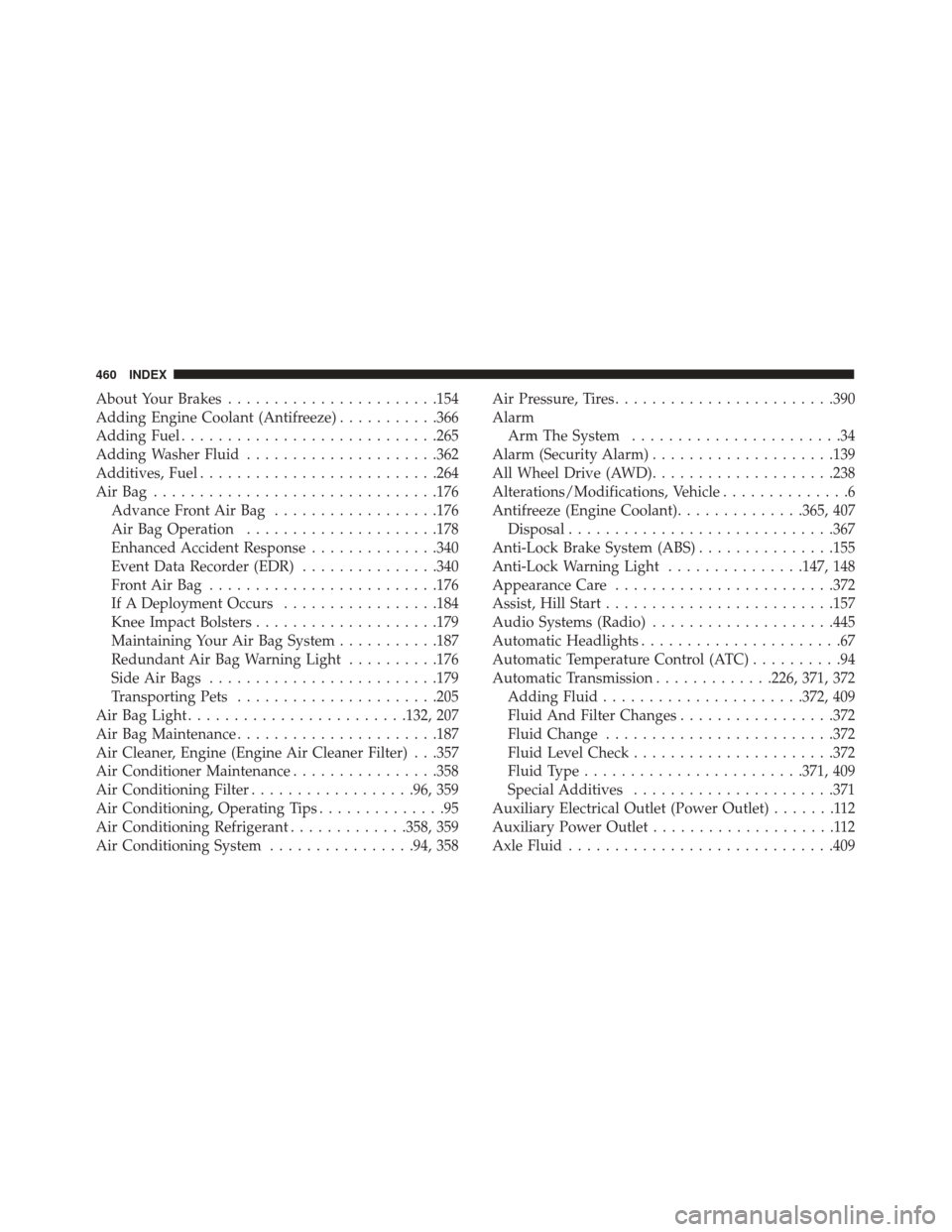
About Your Brakes...................... .154
Adding Engine Coolant (Antifreeze) ...........366
Adding Fuel ........................... .265
Adding Washer Fluid .....................362
Additives, Fuel ......................... .264
AirBag .............................. .176
Advance Front Air Bag ..................176
Air Bag Operation .....................178
Enhanced Accident Response ..............340
Event Data Recorder (EDR) ...............340
FrontAirBag ........................ .176
If A Deployment Occurs .................184
Knee Impact Bolsters ....................179
Maintaining Your Air Bag System ...........187
Redundant Air Bag Warning Light ..........176
Side Air Bags ........................ .179
Transporting Pets ..................... .205
Air Bag Light ....................... .132, 207
Air Bag Maintenance ..................... .187
Air Cleaner, Engine (Engine Air Cleaner Filter) . . .357
Air Conditioner Maintenance ................358
Air Conditioning Filter ..................96, 359
Air Conditioning, Operating Tips ..............95
Air Conditioning Refrigerant .............358, 359
Air Conditioning System ................94, 358 Air Pressure, Tires
....................... .390
Alarm Arm The System .......................34
Alarm (Security Alarm) ....................139
All Wheel Drive (AWD) ....................238
Alterations/Modifications, Vehicle ..............6
Antifreeze (Engine Coolant) ..............365, 407
Disposal ............................ .367
Anti-Lock Brake System (ABS) ...............155
Anti-Lock Warning Light ...............147, 148
Appearance Care ....................... .372
Assist, Hill Start ........................ .157
Audio Systems (Radio) ....................445
Automatic
Headlights ......................67
Automatic Temperature Control (ATC) ..........94
Automatic Transmission .............226, 371, 372
Adding Fluid ..................... .372, 409
Fluid And Filter Changes .................372
Fluid Change ........................ .372
Fluid Level Check ..................... .372
Fluid Type ....................... .371, 409
Special Additives ..................... .371
Auxiliary Electrical Outlet (Power Outlet) .......112
Auxiliary Power Outlet ....................112
Axle Fluid ............................ .409
460 INDEX
Page 463 of 476
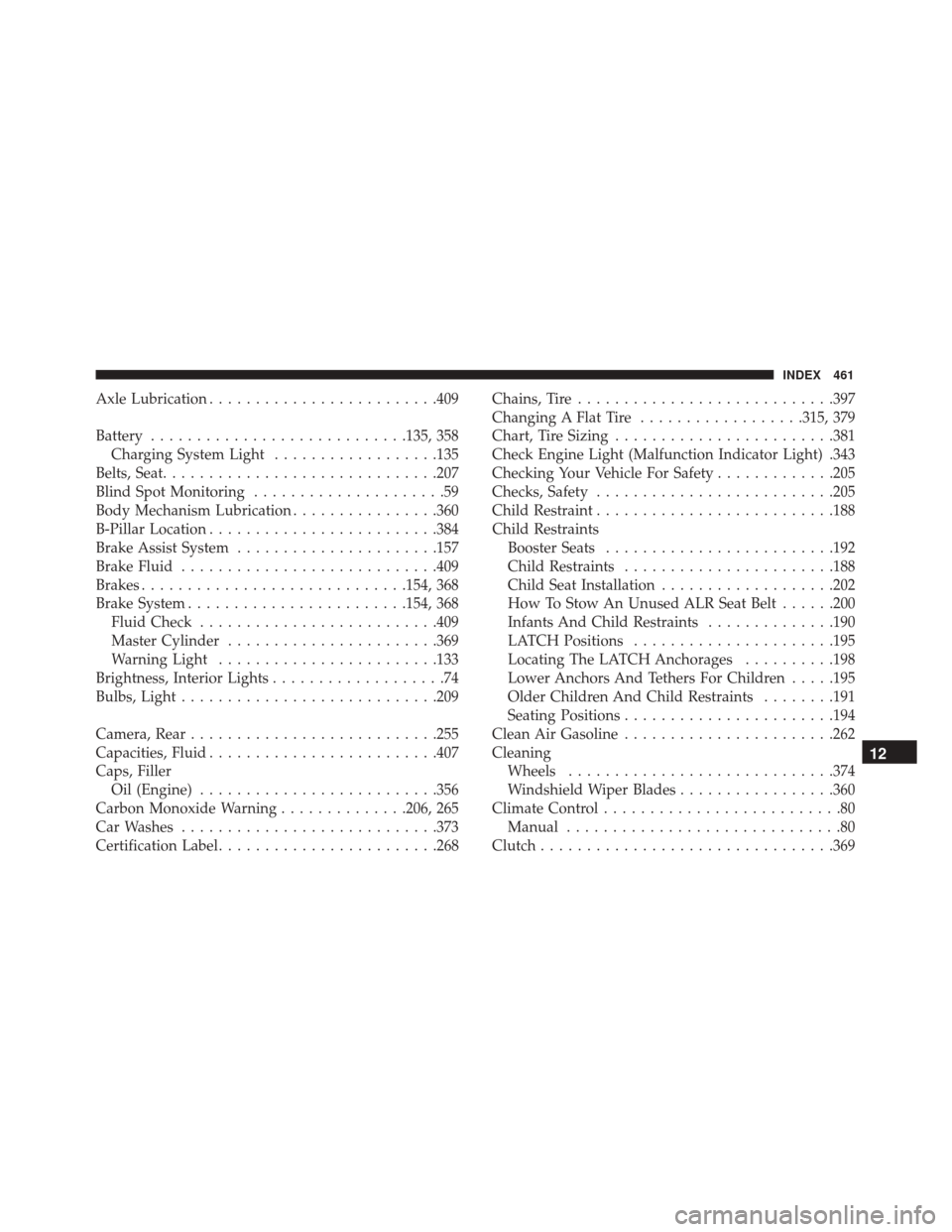
Axle Lubrication........................ .409
Battery ........................... .135, 358
Charging System Light ..................135
Belts, Seat ............................. .207
Blind Spot Monitoring .....................59
Body Mechanism Lubrication ................360
B-Pillar Location ........................ .384
Brake Assist System ..................... .157
Brake Fluid ........................... .409
Brakes ............................ .154, 368
Brake System ....................... .154, 368
Fluid Check ......................... .409
Master Cylinder ...................... .369
Warning Light ....................... .133
Brightness, Interior Lights ...................74
Bulbs, Light ........................... .209
Camera, Rear .......................... .255
Capacities, Fluid ........................ .407
Caps, Filler Oil (Engine) ......................... .356
Carbon Monoxide Warning ..............206, 265
Car Washes ........................... .373
Certification Label ....................... .268Chains, Tire
........................... .397
Changing A Flat Tire ..................315, 379
Chart, Tire Sizing ....................... .381
Check Engine Light (Malfunction Indicator Light) .343
Checking Your Vehicle For Safety .............205
Checks, Safety ......................... .205
Child Restraint ......................... .188
Child Restraints Booster Seats ........................ .192
Child Restraints ...................... .188
Child Seat Installation ...................202
How To Stow An Unused ALR Seat Belt ......200
Infants And Child Restraints ..............190
LATCH Positions ..................... .195
Locating
The LATCH Anchorages ..........198
Lower Anchors And Tethers For Children .....195
Older Children And Child Restraints ........191
Seating Positions ...................... .194
Clean Air Gasoline ...................... .262
Cleaning Wheels ............................ .374
Windshield Wiper Blades .................360
Climate Control ..........................80
Manual ..............................80
Clutch ............................... .369
12
INDEX 461