towing FIAT 500X 2014 2.G Owner's Manual
[x] Cancel search | Manufacturer: FIAT, Model Year: 2014, Model line: 500X, Model: FIAT 500X 2014 2.GPages: 476, PDF Size: 5.32 MB
Page 336 of 476
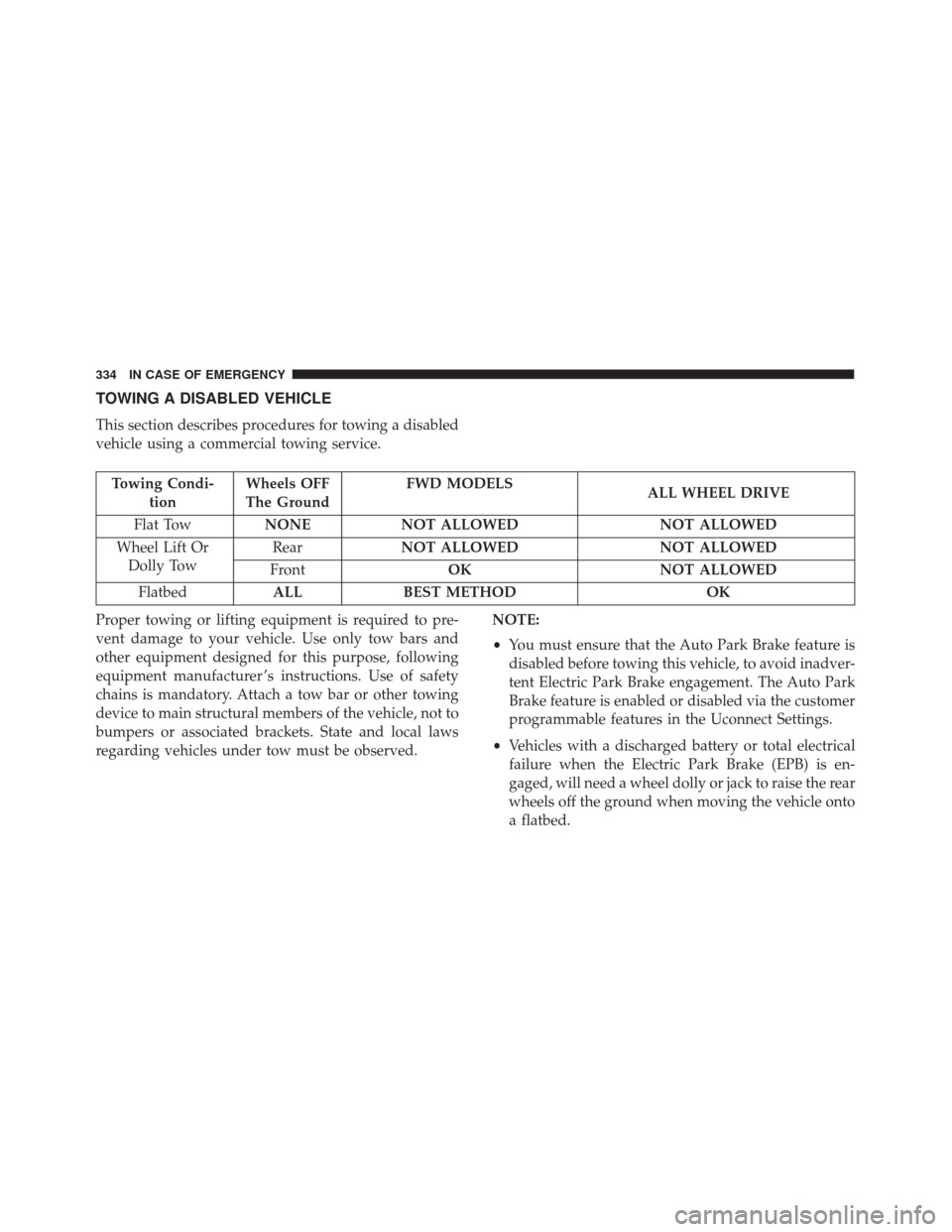
TOWING A DISABLED VEHICLE
This section describes procedures for towing a disabled
vehicle using a commercial towing service.
Towing Condi-tion Wheels OFF
The Ground FWD MODELS
ALL WHEEL DRIVE
Flat Tow NONE NOT ALLOWED NOT ALLOWED
Wheel Lift Or Dolly Tow Rear
NOT ALLOWED NOT ALLOWED
Front OK NOT ALLOWED
Flatbed ALLBEST METHOD OK
Proper towing or lifting equipment is required to pre-
vent damage to your vehicle. Use only tow bars and
other equipment designed for this purpose, following
equipment manufacturer ’s instructions. Use of safety
chains is mandatory. Attach a tow bar or other towing
device to main structural members of the vehicle, not to
bumpers or associated brackets. State and local laws
regarding vehicles under tow must be observed. NOTE:
•
You must ensure that the Auto Park Brake feature is
disabled before towing this vehicle, to avoid inadver-
tent Electric Park Brake engagement. The Auto Park
Brake feature is enabled or disabled via the customer
programmable features in the Uconnect Settings.
• Vehicles with a discharged battery or total electrical
failure when the Electric Park Brake (EPB) is en-
gaged, will need a wheel dolly or jack to raise the rear
wheels off the ground when moving the vehicle onto
a flatbed.
334 IN CASE OF EMERGENCY
Page 337 of 476
If you must use the accessories (wipers, defrosters, etc.)
while being towed, the ignition must be in the RUN
position.
NOTE:The Safehold feature will engage the Electric
Park Brake whenever the driver’s door is opened (if the
ignition is RUN, transmission is not in PARK, and brake
pedal is released). If you are towing this vehicle with
the ignition in the RUN position, you must manually
disable the Electric Park Brake each time the driver’s
door is opened, by pressing the brake pedal and then
releasing the EPB.
If the key fob is unavailable, or the vehicle’s battery is
discharged, refer to “Gear Selector Override” in this
section for instructions on shifting the transmission out
of PARK so that the vehicle can be moved.
CAUTION!
• Do not use sling type equipment when towing.
Vehicle damage may occur.
• When securing the vehicle to a flat bed truck, do
not attach to front or rear suspension components.
Damage to your vehicle may result from improper
towing.
Front Wheel Drive (FWD) Models
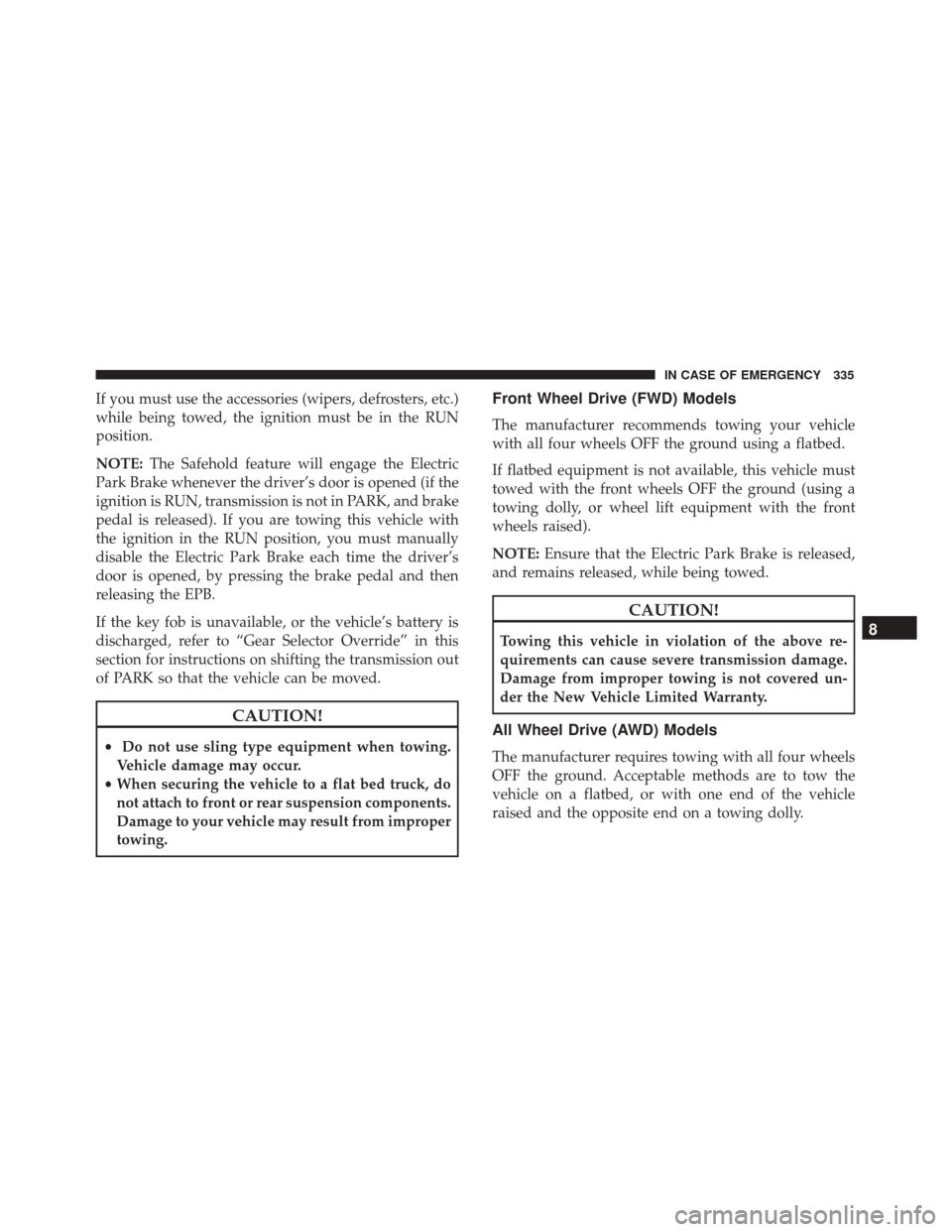
The manufacturer recommends towing your vehicle
with all four wheels OFF the ground using a flatbed.
If flatbed equipment is not available, this vehicle must
towed with the front wheels OFF the ground (using a
towing dolly, or wheel lift equipment with the front
wheels raised).
NOTE: Ensure that the Electric Park Brake is released,
and remains released, while being towed.
CAUTION!
Towing this vehicle in violation of the above re-
quirements can cause severe transmission damage.
Damage from improper towing is not covered un-
der the New Vehicle Limited Warranty.
All Wheel Drive (AWD) Models
The manufacturer requires towing with all four wheels
OFF the ground. Acceptable methods are to tow the
vehicle on a flatbed, or with one end of the vehicle
raised and the opposite end on a towing dolly.
8
IN CASE OF EMERGENCY 335
Page 338 of 476
CAUTION!
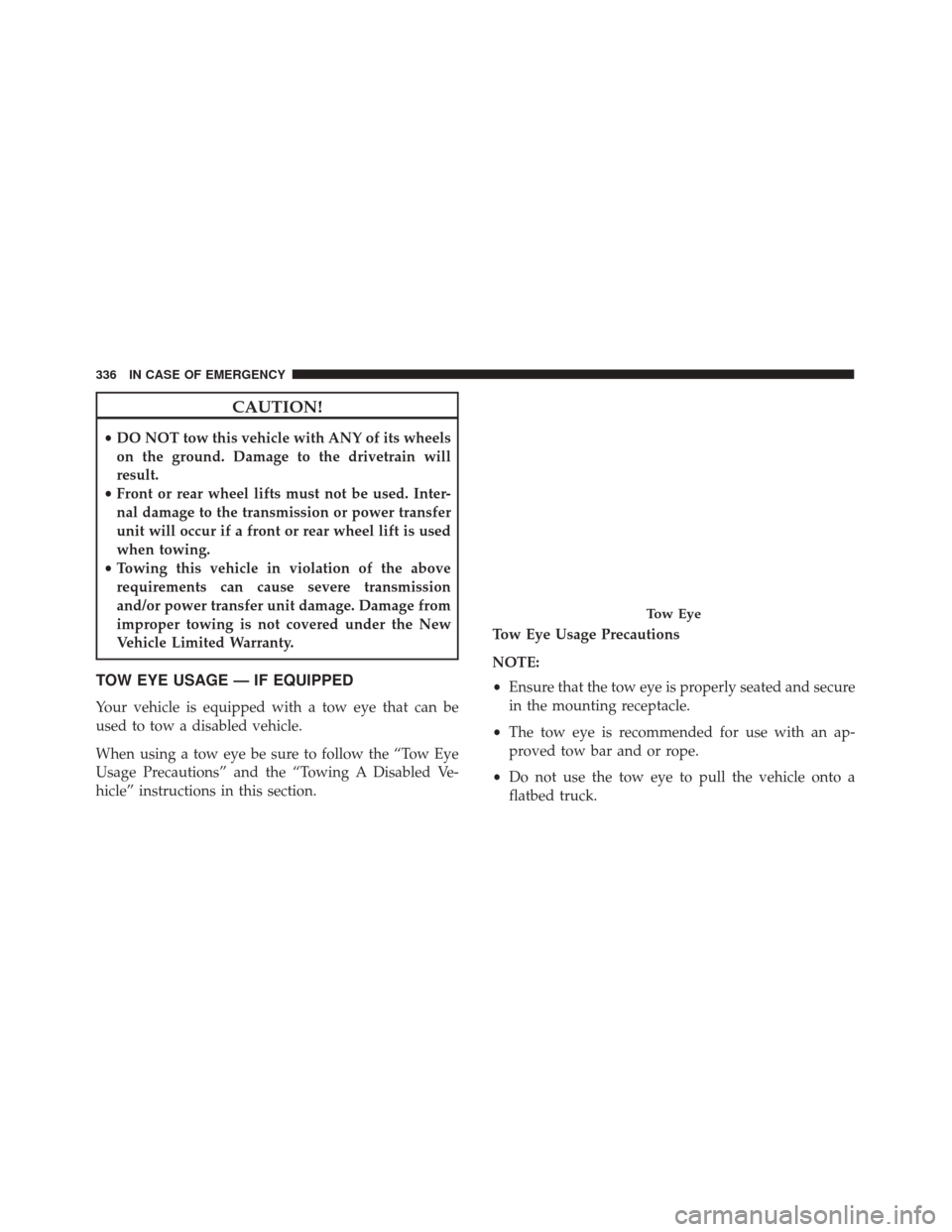
•DO NOT tow this vehicle with ANY of its wheels
on the ground. Damage to the drivetrain will
result.
• Front or rear wheel lifts must not be used. Inter-
nal damage to the transmission or power transfer
unit will occur if a front or rear wheel lift is used
when towing.
• Towing this vehicle in violation of the above
requirements can cause severe transmission
and/or power transfer unit damage. Damage from
improper towing is not covered under the New
Vehicle Limited Warranty.
TOW EYE USAGE — IF EQUIPPED
Your vehicle is equipped with a tow eye that can be
used to tow a disabled vehicle.
When using a tow eye be sure to follow the “Tow Eye
Usage Precautions” and the “Towing A Disabled Ve-
hicle” instructions in this section. Tow Eye Usage Precautions
NOTE:
•
Ensure that the tow eye is properly seated and secure
in the mounting receptacle.
• The tow eye is recommended for use with an ap-
proved tow bar and or rope.
• Do not use the tow eye to pull the vehicle onto a
flatbed truck.
Tow Eye
336 IN CASE OF EMERGENCY
Page 340 of 476
CAUTION!(Continued)
•In compliance with the above conditions, towing
with a tow eye must take place with two vehicles
(one towing, the other towed) aligned as much as
possible along the same center line. Damage to
your vehicle may occur if these guidelines are not
followed.
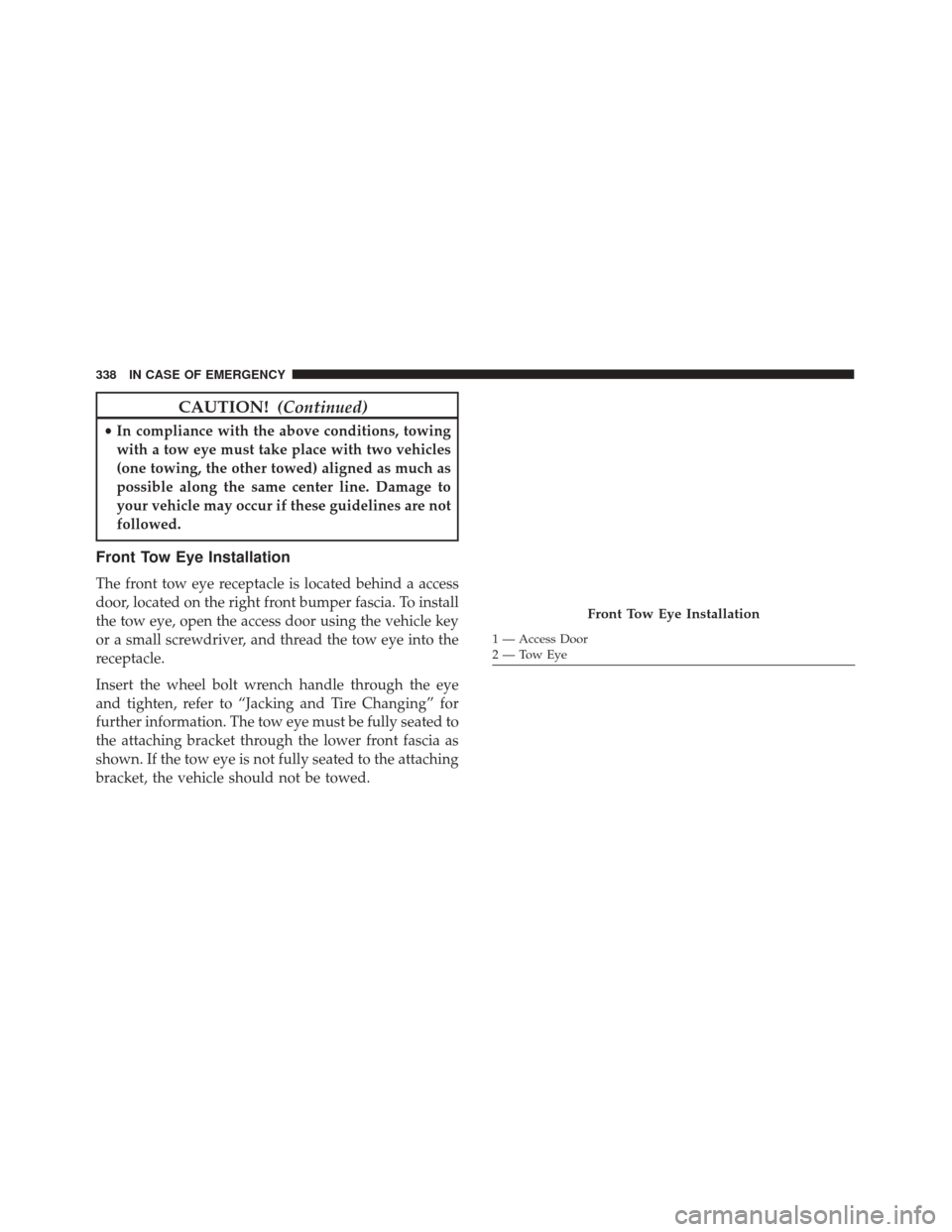
Front Tow Eye Installation
The front tow eye receptacle is located behind a access
door, located on the right front bumper fascia. To install
the tow eye, open the access door using the vehicle key
or a small screwdriver, and thread the tow eye into the
receptacle.
Insert the wheel bolt wrench handle through the eye
and tighten, refer to “Jacking and Tire Changing” for
further information. The tow eye must be fully seated to
the attaching bracket through the lower front fascia as
shown. If the tow eye is not fully seated to the attaching
bracket, the vehicle should not be towed.
Front Tow Eye Installation
1 — Access Door
2—TowEye
338 IN CASE OF EMERGENCY
Page 352 of 476
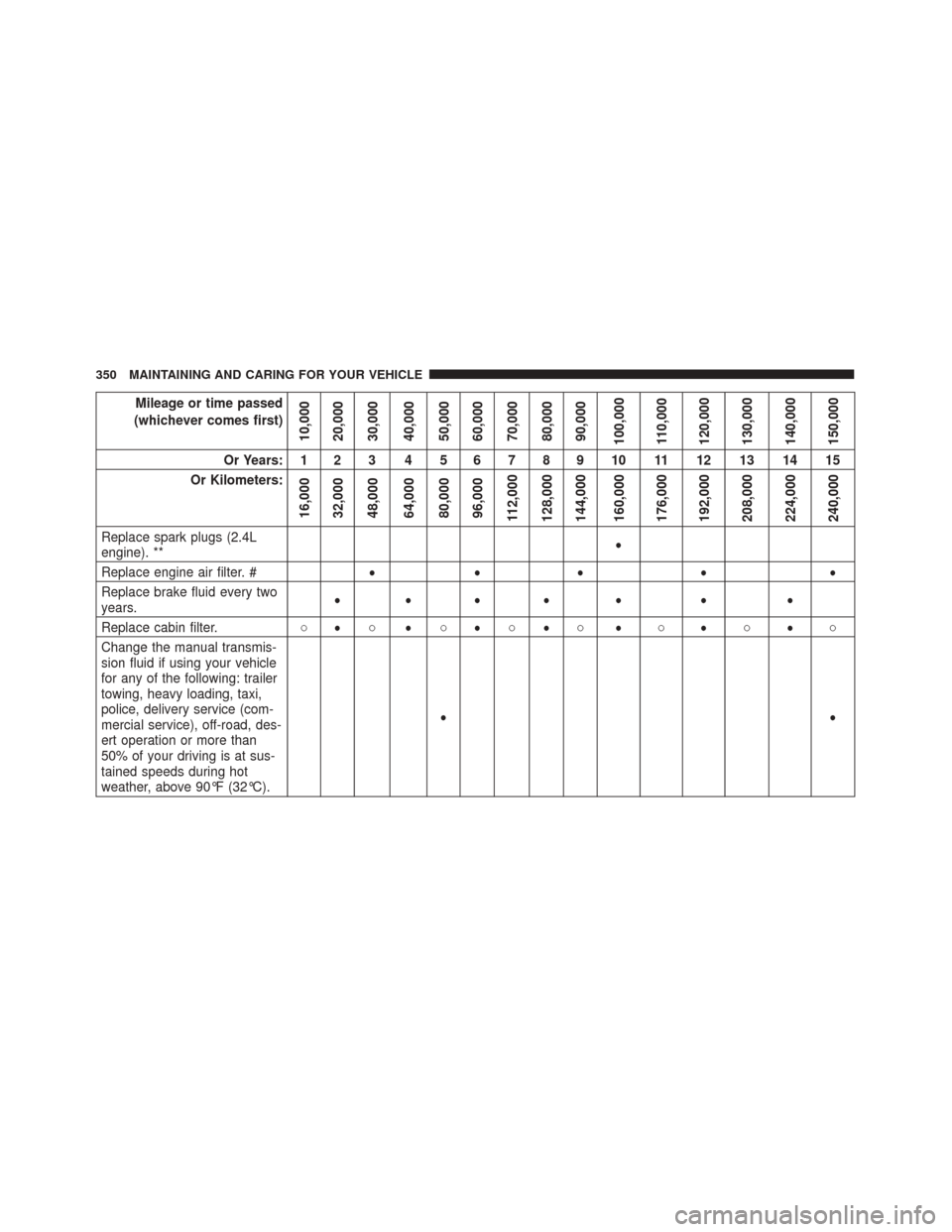
Mileage or time passed
(whichever comes first)
10,000
20,000
30,000
40,000
50,000
60,000
70,000
80,000
90,000
100,000
110,000
120,000
130,000
140,000
150,000
Or Years: 1 2 3 4 5 6 7 8 9 10 11 12 13 14 15
Or Kilometers:
16,000
32,000
48,000
64,000
80,000
96,000
112,000
128,000
144,000
160,000
176,000
192,000
208,000
224,000
240,000
Replace spark plugs (2.4L
engine). ** •
Replace engine air filter. # ••• • •
Replace brake fluid every two
years. •••• • • •
Replace cabin filter. ○• ○ •○• ○•○ • ○• ○•○
Change the manual transmis-
sion fluid if using your vehicle
for any of the following: trailer
towing, heavy loading, taxi,
police, delivery service (com-
mercial service), off-road, des-
ert operation or more than
50% of your driving is at sus-
tained speeds during hot
weather, above 90°F (32°C). ••
350 MAINTAINING AND CARING FOR YOUR VEHICLE
Page 366 of 476
To minimize the possibility of catalytic converter dam-
age:
•Do not shut off the engine or interrupt the ignition,
when the transmission is in gear and the vehicle is in
motion.
• Do not try to start the engine by pushing or towing
the vehicle.
• Do not idle the engine with any spark plug wires
disconnected or removed, such as when diagnostic
testing, or for prolonged periods during very rough
idle or malfunctioning operating conditions.
Cooling System
WARNING!
• Turn vehicle off and disconnect the fan motor
lead before working near the radiator cooling fan.
• You or others can be badly burned by hot engine
coolant (antifreeze) or steam from your radiator. If
you see or hear steam coming from under the
hood, do not open the hood until the radiator has
had time to cool. Never open a cooling system
(Continued)
WARNING! (Continued)
pressure cap when the radiator or coolant bottle is
hot.
• Keep hands, tools, clothing, and jewelry away
from the radiator cooling fan when the hood is
raised. The fan starts automatically and may start
at any time, whether the engine is running or not.
• When working near the radiator cooling fan,
disconnect the fan motor lead or turn the ignition
switch to the OFF position. The fan is temperature
controlled and can start at any time the ignition
switch is in the ON position.
• You or others can be badly burned by hot engine
coolant (antifreeze) or steam from your radiator. If
you see or hear steam coming from under the
hood, do not open the hood until the radiator has
had time to cool. Never try to open a cooling
system pressure cap when the radiator is hot.
Coolant Checks
Check engine coolant (antifreeze) protection every 12
months (before the onset of freezing weather, where
applicable). If the engine coolant (antifreeze) is dirty or
rusty in appearance, the system should be drained,
364 MAINTAINING AND CARING FOR YOUR VEHICLE
Page 388 of 476
Tire And Loading Information Placard
This placard tells you important information about the:
1. Number of people that can be carried in the vehicle.
2. Total weight your vehicle can carry.
3. Tire size designed for your vehicle.
4. Cold tire inflation pressures for the front, rear, andspare tires.
Loading
The vehicle maximum load on the tire must not exceed
the load carrying capacity of the tire on your vehicle.
You will not exceed the tire’s load carrying capacity if
you adhere to the loading conditions, tire size, and cold
tire inflation pressures specified on the Tire and Load-
ing Information placard in “Vehicle Loading” in “Start-
ing And Operating”, or the Tire Information Supple-
ment, located in your Owner ’s Information kit.
NOTE: Under a maximum loaded vehicle condition,
gross axle weight ratings (GAWRs) for the front and
rear axles must not be exceeded. Refer to “Vehicle
Loading” in “Starting And Operating”, or the Tire
Information Supplement located in your Owner ’s Infor-
mation kit, for further information on GAWRs, vehicle
loading, and trailer towing.
To determine the maximum loading conditions of your
vehicle, locate the statement “The combined weight of
occupants and cargo should never exceed XXX kg or
XXX lbs” on the Tire and Loading Information placard.
The combined weight of occupants, cargo/luggage and
trailer tongue weight (if applicable) should never ex-
ceed the weight referenced here.
Tire And Loading Information Placard
386 MAINTAINING AND CARING FOR YOUR VEHICLE
Page 389 of 476
Steps For Determining Correct Load Limit—
(1) Locate the statement “The combined weight of
occupants and cargo should never exceed XXX kg or
XXX lbs.” on your vehicle’s placard.
(2) Determine the combined weight of the driver and
passengers that will be riding in your vehicle.
(3) Subtract the combined weight of the driver and
passengers from XXX kg or XXX lbs.
(4) The resulting figure equals the available amount
of cargo and luggage load capacity. For example, if
“XXX” amount equals 1400 lbs. and there will be five
150 lb passengers in your vehicle, the amount of
available cargo and luggage load capacity is 650 lbs.
(1400-750 (5x150) = 650 lbs.)
(5) Determine the combined weight of luggage and
cargo being loaded on the vehicle. That weight may
not safely exceed the available cargo and luggage
load capacity calculated in Step 4.
(6) If your vehicle will be towing a trailer, load from
your trailer will be transferred to your vehicle.Consult this manual to determine how this reduces
the available cargo and luggage load capacity of your
vehicle.
Metric Example For Load Limit
For example, if “XXX” amount equals 635 kg, and there
will be five 68 kg passengers in your vehicle, the
amount of available cargo and luggage load capacity is
295 kg (635-340 (5x68) = 295 kg) as shown in step 4.
NOTE:
•
If your vehicle will be towing a trailer, load from
your trailer will be transferred to your vehicle. The
following table shows examples on how to calculate
total load, cargo/luggage, and towing capacities of
your vehicle with varying seating configurations and
number and size of occupants. This table is for
illustration purposes only and may not be accurate
for the seating and load carry capacity of your
vehicle.
• For the following example, the combined weight of
occupants and cargo should never exceed 865 lbs
(392 kg).
9
MAINTAINING AND CARING FOR YOUR VEHICLE 387
Page 464 of 476
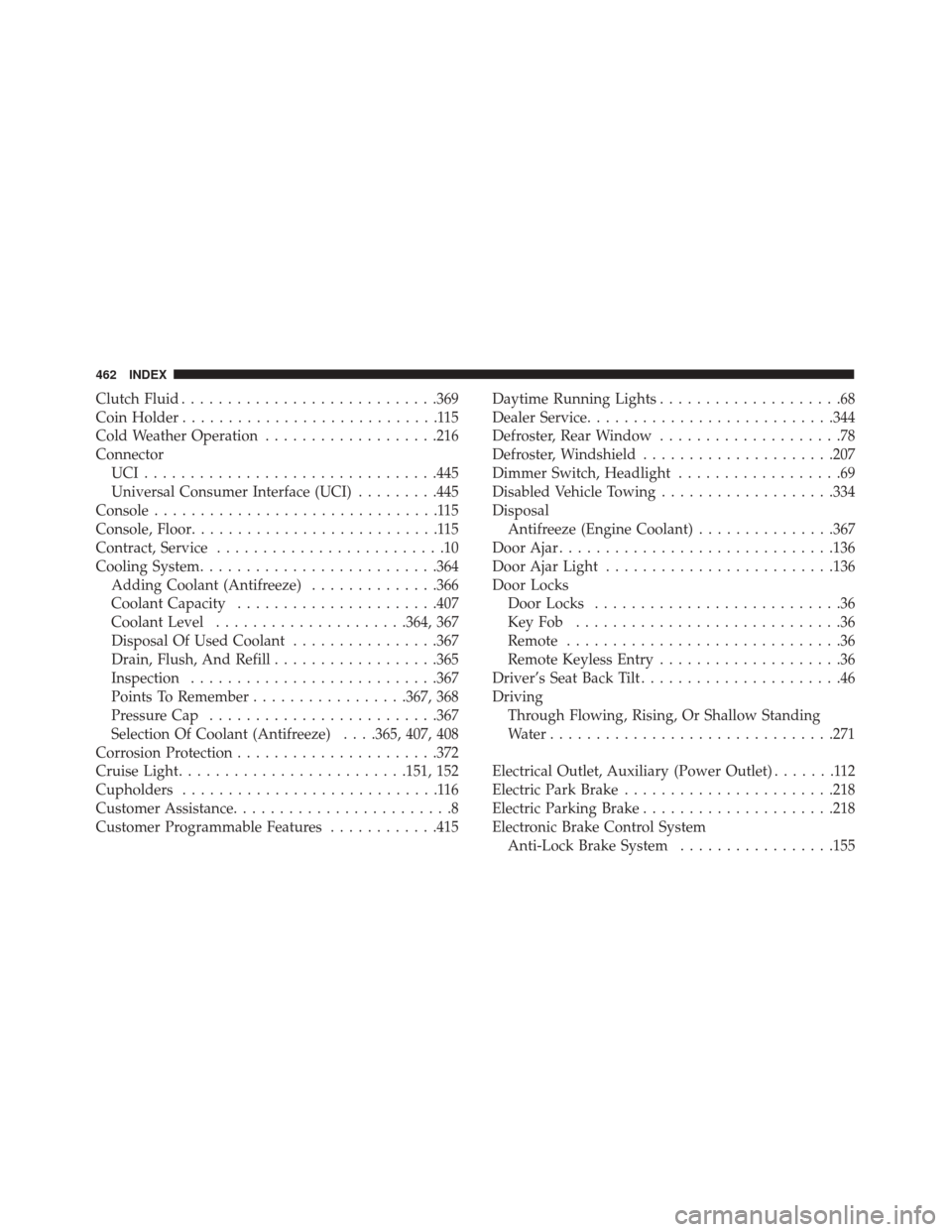
Clutch Fluid........................... .369
Coin Holder ............................115
Cold Weather Operation ...................216
Connector UCI............................... .445
Universal Consumer Interface (UCI) .........445
Console ...............................115
Console, Floor ...........................115
Contract, Service .........................10
Cooling System ......................... .364
Adding Coolant (Antifreeze) ..............366
Coolant Capacity ..................... .407
Coolant Level .....................364, 367
Disposal Of Used Coolant ................367
Drain, Flush, And Refill ..................365
Inspection .......................... .367
Points To Remember .................367, 368
Pressure Cap ........................ .367
Selection Of Coolant (Antifreeze) . . . .365, 407, 408
Corrosion Protection ..................... .372
Cruise Light ........................ .151, 152
Cupholders ............................116
Customer Assistance ........................8
Customer Programmable Features ............415Daytime Running Lights
....................68
Dealer Service .......................... .344
Defroster, Rear Window ....................78
Defroster, Windshield .....................207
Dimmer Switch, Headlight ..................69
Disabled Vehicle Towing ...................334
Disposal Antifreeze (Engine Coolant) ...............367
Door Ajar ............................. .136
Door Ajar Light ........................ .136
Door Locks Door Locks ...........................36
KeyFob .............................36
Remote ..............................36
Remote Keyless Entry ....................36
Driver’s Seat Back Tilt ......................46
Driving Through Flowing, Rising, Or Shallow Standing
Water .............................. .271
Electrical Outlet, Auxiliary (Power Outlet) .......112
Electric
Park Brake ...................... .218
Electric Parking Brake .....................218
Electronic Brake Control System Anti-Lock Brake System .................155
462 INDEX
Page 465 of 476
Electronic Roll Mitigation................161
Traction Control System .................159
Electronic Speed Control (Cruise Control) .......235
Electronic Throttle Control Warning Light .......139
Emergency, In Case Of Hazard Warning Flasher .................289
Jacking ......................... .315, 379
Jump Starting ........................ .327
Overheating ......................... .330
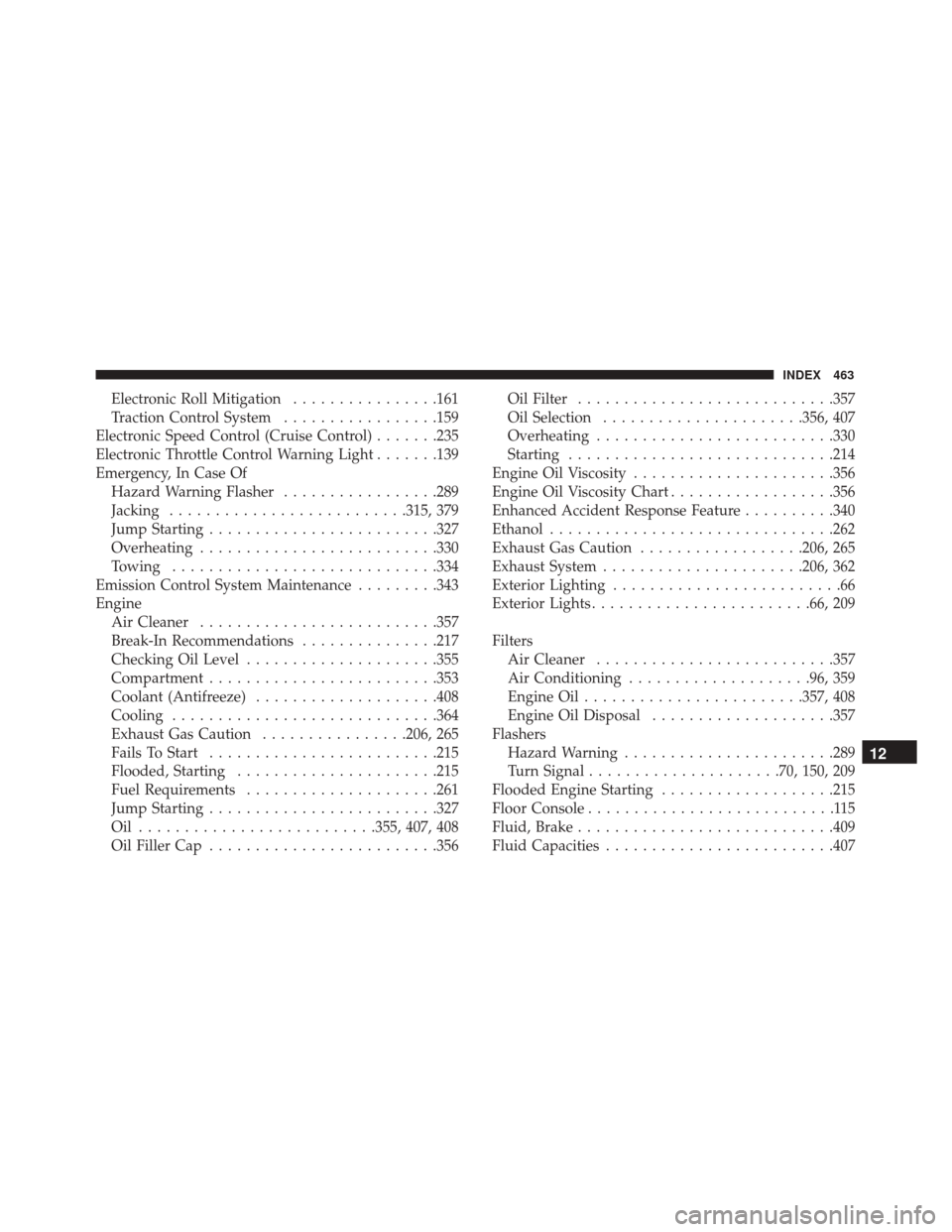
Towing ............................ .334
Emission Control System Maintenance .........343
Engine Air Cleaner ......................... .357
Break-In Recommendations ...............217
Checking Oil Level .....................355
Compartment ........................ .353
Coolant (Antifreeze) ....................408
Cooling ............................ .364
Exhaust Gas Caution ................206, 265
Fails To Start ........................ .215
Flooded, Starting ..................... .215
Fuel Requirements .....................261
Jump Starting ........................ .327
Oil ......................... .355, 407, 408
Oil Filler Cap ........................ .356Oil Filter
........................... .357
Oil Selection ..................... .356, 407
Overheating ......................... .330
Starting ............................ .214
Engine Oil Viscosity ..................... .356
Engine Oil Viscosity Chart ..................356
Enhanced Accident Response Feature ..........340
Ethanol .............................. .262
Exhaust Gas Caution ..................206, 265
Exhaust System ..................... .206, 362
Exterior Lighting .........................66
Exterior
Lights ....................... .66, 209
Filters Air Cleaner ......................... .357
Air Conditioning ....................96, 359
Engine Oil ....................... .357, 408
Engine Oil Disposal ....................357
Flashers Hazard Warning ...................... .289
Turn Signal .....................70, 150, 209
Flooded Engine Starting ...................215
Floor Console ...........................115
Fluid, Brake ........................... .409
Fluid Capacities ........................ .407
12
INDEX 463