air condition FIAT 500X 2014 2.G Owner's Guide
[x] Cancel search | Manufacturer: FIAT, Model Year: 2014, Model line: 500X, Model: FIAT 500X 2014 2.GPages: 476, PDF Size: 5.32 MB
Page 361 of 476
include cleaning of the condenser fins and a perfor-
mance test. Drive belt tension should also be checked at
this time.
WARNING!
•Use only refrigerants and compressor lubricants
approved by the manufacturer for your air condi-
tioning system. Some unapproved refrigerants are
flammable and can explode, injuring you. Other
unapproved refrigerants or lubricants can cause
the system to fail, requiring costly repairs. Refer
to Warranty Information Book for further war-
ranty information.
• The air conditioning system contains refrigerant
under high pressure. To avoid risk of personal
injury or damage to the system, adding refriger-
ant or any repair requiring lines to be discon-
nected should be done by an experienced techni-
cian.
CAUTION!
Do not use chemical flushes in your air condition-
ing system as the chemicals can damage your air
conditioning components. Such damage is not cov-
ered by the New Vehicle Limited Warranty.
Refrigerant Recovery And Recycling HFO 1234yf
HFO 1234yf Air Conditioning Refrigerant is a hydro-
fluoolefine HFO that is endorsed by the Environmental
Protection Agency and is an ozone-saving product. The
manufacturer recommends that air conditioning service
be performed by authorized dealer using recovery and
recycling equipment.
NOTE: Use only manufacturer approved A/C system
PAG compressor oil, and refrigerants.
A/C Air Filter
See your Authorized Dealer for service.
9
MAINTAINING AND CARING FOR YOUR VEHICLE 359
Page 370 of 476
As long as the engine operating temperature is satisfac-
tory, the coolant bottle need only be checked once a
month.
When additional engine coolant (antifreeze) is needed
to maintain the proper level, it should be added to the
coolant bottle. Do not overfill.
Points To Remember
NOTE:When the vehicle is stopped after a few miles/
kilometers of operation, you may observe vapor coming
from the front of the engine compartment. This is
normally a result of moisture from rain, snow, or high
humidity accumulating on the radiator and being va-
porized when the thermostat opens, allowing hot en-
gine coolant (antifreeze) to enter the radiator.
If an examination of your engine compartment shows
no evidence of radiator or hose leaks, the vehicle may
be safely driven. The vapor will soon dissipate.
• Do not overfill the coolant expansion bottle.
• Check the coolant freeze point in the radiator and in
the coolant expansion bottle. If engine coolant (anti-
freeze) needs to be added, the contents of the coolant
expansion bottle must also be protected against freez-
ing. •
If frequent engine coolant (antifreeze) additions are
required, the cooling system should be pressure
tested for leaks.
• Maintain engine coolant (antifreeze) concentration at
a minimum of 50% OAT coolant (conforming to
MS.90032) and distilled water for proper corrosion
protection of your engine which contains aluminum
components.
• Keep the front of the radiator clean. If your vehicle is
equipped with air conditioning, keep the front of the
condenser clean.
• Do not change the thermostat for Summer or Winter
operation. If replacement is ever necessary, install
ONLY the correct type thermostat. Other designs
may result in unsatisfactory engine coolant (anti-
freeze) performance, poor gas mileage, and increased
emissions.
Brake System
In order to assure brake system performance, all brake
system components should be inspected periodically.
Refer to the “Maintenance Schedule” for the proper
maintenance intervals.
368 MAINTAINING AND CARING FOR YOUR VEHICLE
Page 373 of 476
Frequency Of Fluid Change
Under normal operating conditions, the fluid installed
at the factory will give satisfactory lubrication for the
life of the vehicle. Fluid changes are not necessary
unless lubricant has become contaminated with water.
NOTE:If contaminated with water, the fluid should be
changed immediately.
Automatic Transmission — If Equipped
Selection Of Lubricant
It is important to use the proper transmission fluid to
ensure optimum transmission performance and life.
Use only the manufacturer ’s specified transmission
fluid. Refer to “Fluids, Lubricants, And Genuine Parts”
in “Technical Data” for fluid specifications. It is impor-
tant to maintain the transmission fluid at the correct
level using the recommended fluid.
NOTE: No chemical flushes should be used in any
transmission; only the approved lubricant should be
used.
CAUTION!
Using a transmission fluid other than the manufac-
turer ’s recommended fluid may cause deterioration
in transmission shift quality and/or torque con-
verter shudder. Refer to “Fluids, Lubricants, And
Genuine Parts” in “Technical Data” for fluid speci-
fications.
Special Additives
The manufacturer strongly recommends against using
any special additives in the transmission. Automatic
Transmission Fluid (ATF) is an engineered product and
its performance may be impaired by supplemental
additives. Therefore, do not add any fluid additives to
the transmission. Avoid using transmission sealers as
they may adversely affect seals.
CAUTION!
Do not use chemical flushes in your transmission as
the chemicals can damage your transmission com-
ponents. Such damage is not covered by the New
Vehicle Limited Warranty.
9
MAINTAINING AND CARING FOR YOUR VEHICLE 371
Page 374 of 476
Fluid Level Check
The fluid level is preset at the factory and does not
require adjustment under normal operating conditions.
Routine fluid level checks are not required, therefore the
transmission has no dipstick. Your authorized dealer
can check your transmission fluid level using special
service tools. If you notice fluid leakage or transmission
malfunction, visit your authorized dealer immediately
to have the transmission fluid level checked. Operating
the vehicle with an improper fluid level can cause
severe transmission damage.
CAUTION!
If a transmission fluid leak occurs, visit your autho-
rized dealer immediately. Severe transmission dam-
age may occur. Your authorized dealer has the
proper tools to adjust the fluid level accurately.
Fluid And Filter Changes
Under normal operating conditions, the fluid installed
at the factory will provide satisfactory lubrication for
the life of the vehicle.Routine fluid and filter changes are not required. How-
ever, change the fluid and filter if the fluid becomes
contaminated (with water, etc.), or if the transmission is
disassembled for any reason.
Appearance Care And Protection From
Corrosion
Protection Of Body And Paint From Corrosion
Vehicle body care requirements vary according to geo-
graphic locations and usage. Chemicals that make roads
passable in snow and ice and those that are sprayed on
trees and road surfaces during other seasons are highly
corrosive to the metal in your vehicle. Outside parking,
which exposes your vehicle to airborne contaminants,
road surfaces on which the vehicle is operated, extreme
hot or cold weather and other extreme conditions will
have an adverse effect on paint, metal trim, and under-
body protection.
The following maintenance recommendations will en-
able you to obtain maximum benefit from the corrosion
resistance built into your vehicle.
372 MAINTAINING AND CARING FOR YOUR VEHICLE
Page 378 of 476
•For grease stains, apply Mopar Multi-Purpose
Cleaner to a clean, damp cloth and remove stain. Use
a fresh, damp towel to remove soap residue.
• Do not use any harsh solvents or any other form of
protectants on Stain Repel products.
Interior Care
Use Mopar Total Clean to clean fabric upholstery and
carpeting.
Use Mopar Total Clean to clean vinyl upholstery.
Mopar Total Clean is specifically recommended for
leather upholstery.
Your leather upholstery can be best preserved by regu-
lar cleaning with a damp soft cloth. Small particles of
dirt can act as an abrasive and damage the leather
upholstery and should be removed promptly with a
damp cloth. Stubborn soils can be removed easily with
a soft cloth and Mopar Total Clean. Care should be
taken to avoid soaking your leather upholstery with
any liquid. Please do not use polishes, oils, cleaning
fluids, solvents, detergents, or ammonia-based cleaners
to clean your leather upholstery. Application of a leather conditioner is not required to maintain the
original condition.
WARNING!
Do not use volatile solvents for cleaning purposes.
Many are potentially flammable, and if used in
closed areas they may cause respiratory harm.
CAUTION!
•
Direct contact of air fresheners, insect repellents,
suntan lotions, or hand sanitizers to the plastic,
painted, or decorated surfaces of the interior may
cause permanent damage. Wipe away immedi-
ately.
• Damage caused by these type of products may not
be covered by your New Vehicle Limited War-
ranty.
• Do not use Alcohol and Alcohol-based and/or
Keton based cleaning products to clean leather
seats, as damage to the seat may result.
376 MAINTAINING AND CARING FOR YOUR VEHICLE
Page 394 of 476
Tire Repair
If your tire becomes damaged, it may be repaired if it
meets the following criteria:
•The tire has not been driven on when flat.
• The damage is only on the tread section of your tire
(sidewall damage is not repairable).
• The puncture is no greater thana¼ofaninch (6
mm).
Consult an authorized tire dealer for tire repairs and
additional information.
Damaged Run Flat tires, or Run Flat tires that have
experienced a loss of pressure should be replaced
immediately with another Run Flat tire of identical size
and service description (Load Index and Speed Sym-
bol).
Tire Types
All Season Tires — If Equipped
All season tires provide traction for all seasons (Spring,
Summer, Fall and Winter). Traction levels may vary
between different all season tires. All season tires can be
identified by the M+S, M&S, M/S or MS designation on the tire sidewall. Use all season tires only in sets of four;
failure to do so may adversely affect the safety and
handling of your vehicle.
Summer Or Three Season Tires — If Equipped
Summer tires provide traction in both wet and dry
conditions, and are not intended to be driven in snow or
on ice. If your vehicle is equipped with Summer tires, be
aware these tires are not designed for Winter or cold
driving conditions. Install Winter tires on your vehicle
when ambient temperatures are less than 40°F (5°C) or
if roads are covered with ice or snow. For more infor-
mation, contact an authorized dealer.
Summer tires do not contain the all season designation or
mountain/snowflake symbol on the tire sidewall. Use
Summer tires only in sets of four; failure to do so may
adversely affect the safety and handling of your vehicle.
WARNING!
Do not use Summer tires in snow/ice conditions.
You could lose vehicle control, resulting in severe
injury or death. Driving too fast for conditions also
creates the possibility of loss of vehicle control.
392 MAINTAINING AND CARING FOR YOUR VEHICLE
Page 403 of 476
across dirty surfaces. Do not use plastic sheeting
which will not allow the evaporation of moisture
present on the surface of the vehicle.
• Inflate the tires at a pressure of +7.25 psi (+0.5 bar)
higher than recommended on the tire placard and
check it periodically.
• Do not drain the engine cooling system.
• Whenever you leave the vehicle is stationary for two
weeks or more, idle the engine for approximately five
minutes with the air conditioning system on and
high fan speed. This will ensure a proper lubrication
of the system, thus minimizing the possibility of
damage to the compressor when the vehicle is put
back into operation.
NOTE: When the vehicle has not been started or driven
for at least 30 days, an Extended Park Start Procedure is
required to start the vehicle. Refer to “Starting The
Engine” in “Starting And Operating” for further infor-
mation.CAUTION!
Before removal of the positive and negative termi-
nals to the battery, wait at least a minute with
ignition switch in the OFF position and close the
drivers door. When reconnecting the positive and
negative terminals to the battery be sure the igni-
tion switch is in the OFF position and the drivers
door is closed.
9
MAINTAINING AND CARING FOR YOUR VEHICLE 401
Page 450 of 476
The internal wireless radio operates within guidelines
found in radio frequency safety standards and recom-
mendations, which reflect the consensus of the scientific
community.
The radio manufacturer believes the internal wireless
radio is safe for use by consumers. The level of energy
emitted is far less than the electromagnetic energy
emitted by wireless devices such as mobile phones.
However, the use of wireless radios may be restricted in
some situations or environments, such as aboard air-
planes. If you are unsure of restrictions, you are encour-
aged to ask for authorization before turning on the
wireless radio.
This device complies with Part 15 of the FCC Rules and
with Industry Canada license-exempt RSS standard(s).
Operation is subject to the following two conditions:
1. This device may not cause harmful interference.
2. This device must accept any interference received,including interference that may cause undesired
operation. NOTE:
•
This equipment has been tested and found to comply
with the limits for a Class B digital device, pursuant
to Part 15 of the FCC Rules. These limits are designed
to provide reasonable protection against harmful
interference in a residential installation. This equip-
ment generates, uses and can radiate radio frequency
energy and, if not installed and used in accordance
with the instructions, may cause harmful interference
to radio communications. However, there is no guar-
antee that interference will not occur in a particular
installation.
• If this equipment does cause harmful interference to
radio or television reception, which can be deter-
mined by turning the equipment off and on, the user
is encouraged to try to correct the interference by one
or more of the following measures:
• Increase the separation between the equipment and
receiver.
• Consult the dealer or an experienced radio technician
for help.
448 MULTIMEDIA
Page 462 of 476
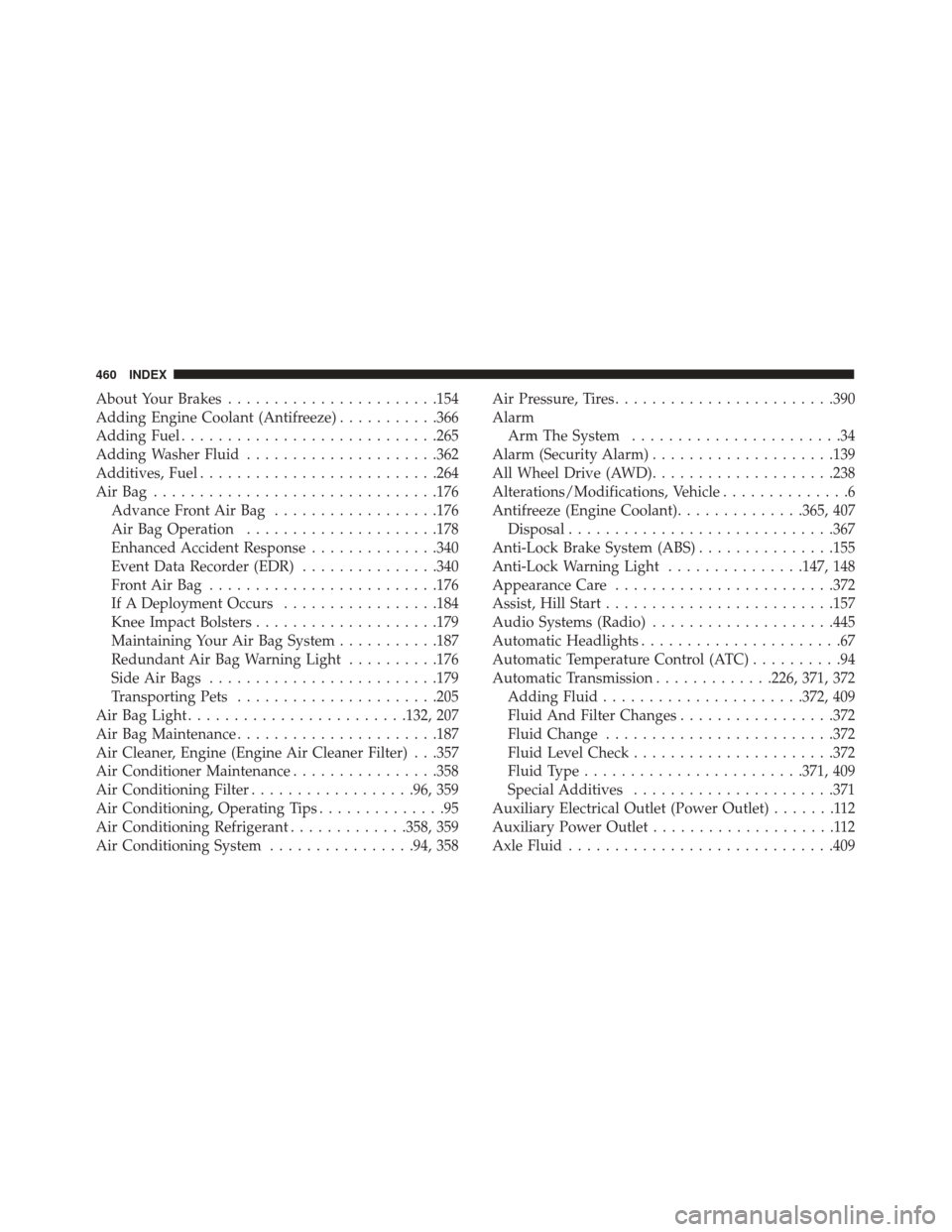
About Your Brakes...................... .154
Adding Engine Coolant (Antifreeze) ...........366
Adding Fuel ........................... .265
Adding Washer Fluid .....................362
Additives, Fuel ......................... .264
AirBag .............................. .176
Advance Front Air Bag ..................176
Air Bag Operation .....................178
Enhanced Accident Response ..............340
Event Data Recorder (EDR) ...............340
FrontAirBag ........................ .176
If A Deployment Occurs .................184
Knee Impact Bolsters ....................179
Maintaining Your Air Bag System ...........187
Redundant Air Bag Warning Light ..........176
Side Air Bags ........................ .179
Transporting Pets ..................... .205
Air Bag Light ....................... .132, 207
Air Bag Maintenance ..................... .187
Air Cleaner, Engine (Engine Air Cleaner Filter) . . .357
Air Conditioner Maintenance ................358
Air Conditioning Filter ..................96, 359
Air Conditioning, Operating Tips ..............95
Air Conditioning Refrigerant .............358, 359
Air Conditioning System ................94, 358 Air Pressure, Tires
....................... .390
Alarm Arm The System .......................34
Alarm (Security Alarm) ....................139
All Wheel Drive (AWD) ....................238
Alterations/Modifications, Vehicle ..............6
Antifreeze (Engine Coolant) ..............365, 407
Disposal ............................ .367
Anti-Lock Brake System (ABS) ...............155
Anti-Lock Warning Light ...............147, 148
Appearance Care ....................... .372
Assist, Hill Start ........................ .157
Audio Systems (Radio) ....................445
Automatic
Headlights ......................67
Automatic Temperature Control (ATC) ..........94
Automatic Transmission .............226, 371, 372
Adding Fluid ..................... .372, 409
Fluid And Filter Changes .................372
Fluid Change ........................ .372
Fluid Level Check ..................... .372
Fluid Type ....................... .371, 409
Special Additives ..................... .371
Auxiliary Electrical Outlet (Power Outlet) .......112
Auxiliary Power Outlet ....................112
Axle Fluid ............................ .409
460 INDEX
Page 465 of 476
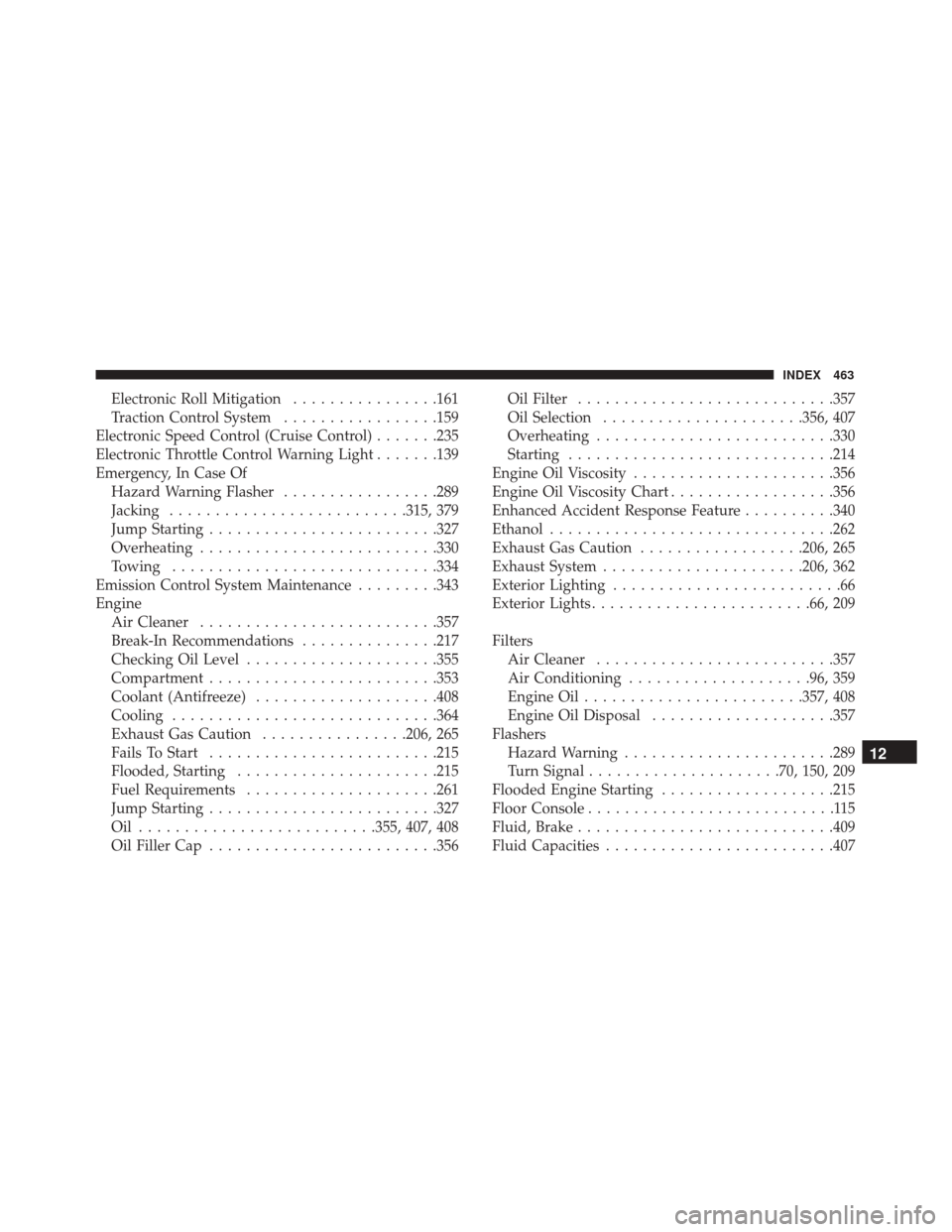
Electronic Roll Mitigation................161
Traction Control System .................159
Electronic Speed Control (Cruise Control) .......235
Electronic Throttle Control Warning Light .......139
Emergency, In Case Of Hazard Warning Flasher .................289
Jacking ......................... .315, 379
Jump Starting ........................ .327
Overheating ......................... .330
Towing ............................ .334
Emission Control System Maintenance .........343
Engine Air Cleaner ......................... .357
Break-In Recommendations ...............217
Checking Oil Level .....................355
Compartment ........................ .353
Coolant (Antifreeze) ....................408
Cooling ............................ .364
Exhaust Gas Caution ................206, 265
Fails To Start ........................ .215
Flooded, Starting ..................... .215
Fuel Requirements .....................261
Jump Starting ........................ .327
Oil ......................... .355, 407, 408
Oil Filler Cap ........................ .356Oil Filter
........................... .357
Oil Selection ..................... .356, 407
Overheating ......................... .330
Starting ............................ .214
Engine Oil Viscosity ..................... .356
Engine Oil Viscosity Chart ..................356
Enhanced Accident Response Feature ..........340
Ethanol .............................. .262
Exhaust Gas Caution ..................206, 265
Exhaust System ..................... .206, 362
Exterior Lighting .........................66
Exterior
Lights ....................... .66, 209
Filters Air Cleaner ......................... .357
Air Conditioning ....................96, 359
Engine Oil ....................... .357, 408
Engine Oil Disposal ....................357
Flashers Hazard Warning ...................... .289
Turn Signal .....................70, 150, 209
Flooded Engine Starting ...................215
Floor Console ...........................115
Fluid, Brake ........................... .409
Fluid Capacities ........................ .407
12
INDEX 463