belt FIAT 500X 2015 2.G User Guide
[x] Cancel search | Manufacturer: FIAT, Model Year: 2015, Model line: 500X, Model: FIAT 500X 2015 2.GPages: 240, PDF Size: 10.72 MB
Page 82 of 240

Each seat belt must be used by only
one person. Never travel with a child
sitting on the passenger's lap and
a single belt to protect them both fig.
71. In general, do not place any objects
between the person and the belt.
SEAT BELTS
MAINTENANCEFor keeping the seat belts in efficient
conditions, carefully observe the
following warnings:
❒always use the seat belt well
stretched and never twisted; make sure
that it is free to run without
obstructions;
❒check seat belt operation as follows:
attach the seat belt and pull it hard;
❒replace the belt after an accident of a
certain severity even if it does not
appear to be damaged. Always replace
the seat belt if the pretensioners were
deployed;
❒to clean the seat belts, wash by hand
with water and neutral soap, rinse and
leave to dry in the shade. Never use
strong detergents, bleach, paints or any
other chemical substance which could
damage the belt fibres;
❒prevent the retractors from getting
wet: their correct operation is only
guaranteed if water does not get inside;
❒replace the seat belt when it shows
wear or cuts.
WARNING
72)The pretensioner may be used only
once. Contact a Fiat Dealership to have it
replaced after it has been deployed.
73)Removing or otherwise tampering with
seat belt and pretensioner components
is strictly prohibited. Any intervention
on these components must be performed
by qualified and authorised technicians.
Always contact a Fiat Dealership.
74)For maximum safety, keep the back of
your seat upright, lean back into it and
make sure the seat belt fits closely across
your torso and pelvis. Always fasten the
seat belts for both the front and rear seats!
Travelling without wearing seat belts will
increase the risk of serious injury and even
death in the event of an accident.
75)If the belt has been subjected to heavy
strain, for example after an accident, it
must changed completely together with the
anchors, anchor fastening screws and the
pretensioner. Even if the belt has no visible
defects, it could have lost its resilience.
WARNING
32)Operations which lead to impacts,
vibrations or localised heating (over 100°C
for a maximum of six hours) in the area
around the pretensioner may damage or
deploy it. Contact a Fiat Dealership should
intervention be necessary on these
components.
70
F1B0108C
71
F1B0109C
80
SAFETY
15-12-2014 8:23 Pagina 80
Page 83 of 240
CHILD PROTECTION
SYSTEMSCARRYING CHILDREN
SAFELY
76) 77) 78) 79)
For optimal protection in the event of an
impact, all occupants must be seated
and wearing adequate restraint
systems, including newborn and other
children!
This prescription is compulsory in all EC
countries according to EC Directive
2003/20/EC.
Children below the height of 1.50
metres and up to 12 years must be
protected with suitable restraint
systems and be seated on the rear
seats.
Statistics on accidents indicate that the
rear seats offer greater safety for
children.
Compared with an adult, a child's head
is larger and heavier in proportion to
their body and the child's muscular and
bone structures are not fully developed.
Therefore, correct restraint systems
other than adult seat belts are
necessary, to reduce as much as
possible the risk of injuries in the event
of an accident, braking or sudden
manoeuvre.Children must be seated safely and
comfortably. Depending on the
characteristics of the child restraint
systems used, you are advised to keep
children in rearward facing child
restraint systems for as long as
possible (at least until 3–4 years old),
since this is the most protected position
in the event of an impact.
The choice of the most suitable child
restraint system depends on the weight
and size of the child. There are various
types of child restraint systems, which
can be secured to the vehicle by means
of the seat belts or with the ISOFIX/i-
Size anchorages.
It is recommended to always choose
the restraint system most suitable
for the child; for this reason always refer
to the Owner Handbook provided with
the child restraint system, to be sure
that it is of the right type for the children
it is intended for.
In Europe the characteristics of child
restraint systems are ruled by the
regulation ECE-R44, dividing them into
five weight groups:
Group Weight rangeGroup0 upto10kg
Group 0+ up to 13 kg
Group 1 9 - 18 kg
Group Weight rangeGroup 2 15 - 25 kg
Group 3 22 - 36 kgThe ECE-R44 standard was recently
paired with the ECE R-129 regulation,
which defines the characteristics of
the new i-Size child restraint systems
(see the "Suitability of passenger seats
for i-Size child restraint system use"
paragraph for more information).
All restraint devices must bear the
certification data, together with the
control mark, on a label solidly fixed to
the child restraint system which must
never be removed.
Lineaccessori MOPAR
®includes child
restraint systems for each weight
group. These devices are
recommended having been specifically
designed for Fiat vehicles.
FITTING A CHILD
RESTRAINT SYSTEM
WITH SEAT BELTSThe Universal child restraint systems
installed with the seat belts only are
type-approved on the basis of the ECE
R44 standard and are divided into
various weight groups.
81
15-12-2014 8:23 Pagina 81
Page 84 of 240
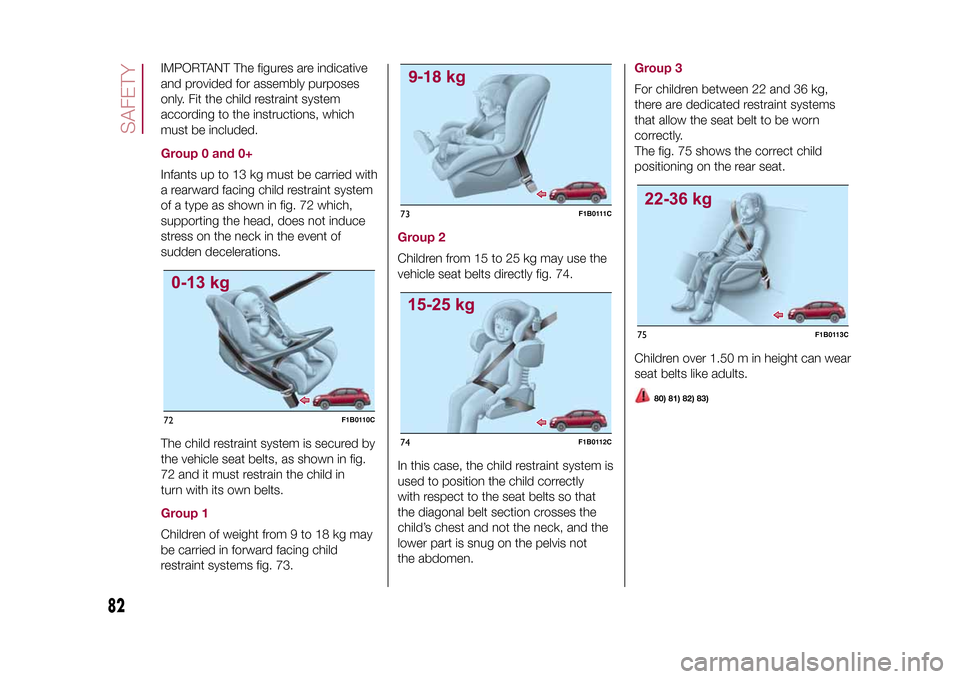
IMPORTANT The figures are indicative
and provided for assembly purposes
only. Fit the child restraint system
according to the instructions, which
must be included.Group 0 and 0+Infants up to 13 kg must be carried with
a rearward facing child restraint system
of a type as shown in fig. 72 which,
supporting the head, does not induce
stress on the neck in the event of
sudden decelerations.
The child restraint system is secured by
the vehicle seat belts, as shown in fig.
72 and it must restrain the child in
turn with its own belts.Group 1Children of weight from 9 to 18 kg may
be carried in forward facing child
restraint systems fig. 73.
Group 2Children from 15 to 25 kg may use the
vehicle seat belts directly fig. 74.
In this case, the child restraint system is
used to position the child correctly
with respect to the seat belts so that
the diagonal belt section crosses the
child’s chest and not the neck, and the
lower part is snug on the pelvis not
the abdomen.
Group 3For children between 22 and 36 kg,
there are dedicated restraint systems
that allow the seat belt to be worn
correctly.
The fig. 75 shows the correct child
positioning on the rear seat.
Children over 1.50 m in height can wear
seat belts like adults.
80) 81) 82) 83)
72
F1B0110C
73
F1B0111C
74
F1B011 2C
75
F1B0113C
82
SAFETY
15-12-2014 8:23 Pagina 82
Page 86 of 240
FITTING AN ISOFIX
CHILD RESTRAINT
SYSTEM
84) 85) 86)
The rear side seats of the vehicle are
equipped with ISOFIX attachments, for
fitting child restraint systems quickly,
simply and safely.
The ISOFIX system allows the ISOFIX
child restraint systems to be fitted,
without using the vehicle's seat belt,
but directly securing the child restraint
system to three anchorages present on
the vehicle.
Traditional child restraint systems can
be fitted alongside ISOFIX child restraint
systems on different seats in the same
vehicle.
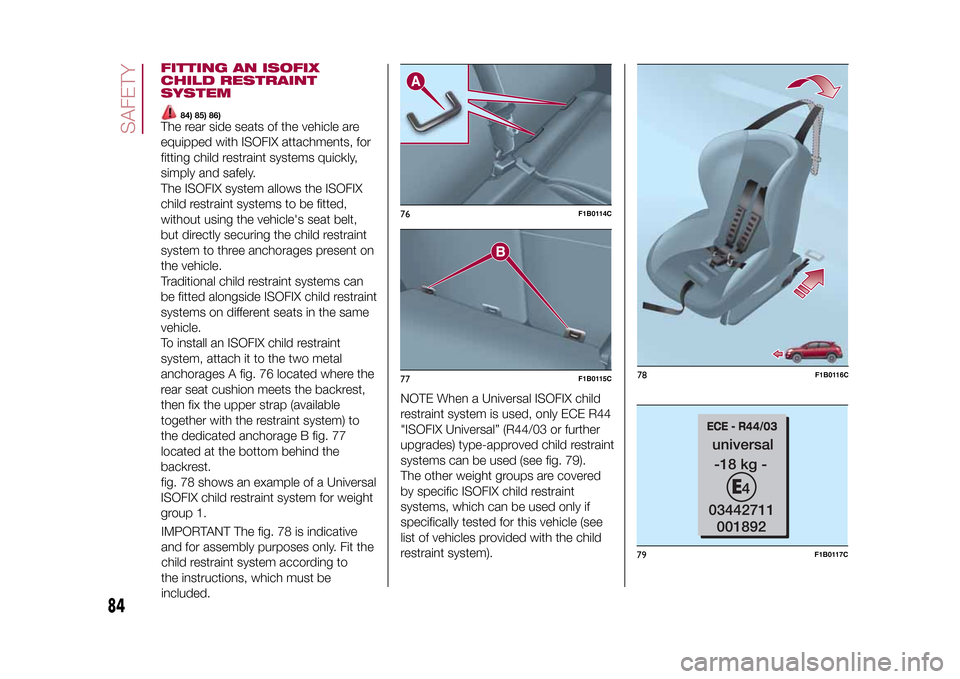
To install an ISOFIX child restraint
system, attach it to the two metal
anchorages A fig. 76 located where the
rear seat cushion meets the backrest,
then fix the upper strap (available
together with the restraint system) to
the dedicated anchorage B fig. 77
located at the bottom behind the
backrest.
fig. 78 shows an example of a Universal
ISOFIX child restraint system for weight
group 1.
IMPORTANT The fig. 78 is indicative
and for assembly purposes only. Fit the
child restraint system according to
the instructions, which must be
included.NOTE When a Universal ISOFIX child
restraint system is used, only ECE R44
"ISOFIX Universal” (R44/03 or further
upgrades) type-approved child restraint
systems can be used (see fig. 79).
The other weight groups are covered
by specific ISOFIX child restraint
systems, which can be used only if
specifically tested for this vehicle (see
list of vehicles provided with the child
restraint system).
76
F1B0114C
77
F1B0115C
78
F1B0116C
84
SAFETY
15-12-2014 8:23 Pagina 84
79
F1B0117C
Page 90 of 240
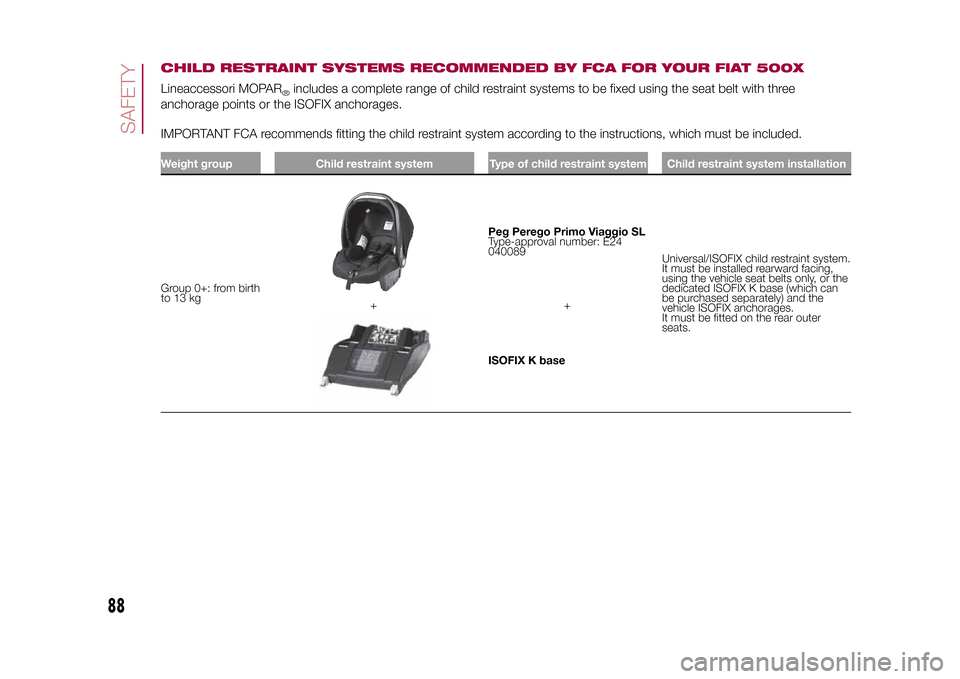
CHILD RESTRAINT SYSTEMS RECOMMENDED BY FCA FOR YOUR FIAT 500XLineaccessori MOPAR
®includes a complete range of child restraint systems to be fixed using the seat belt with three
anchorage points or the ISOFIX anchorages.
IMPORTANT FCA recommends fitting the child restraint system according to the instructions, which must be included.
Weight group Child restraint system Type of child restraint system Child restraint system installationGroup 0+: from birth
to 13 kg
Peg Perego Primo Viaggio SL
Type-approval number: E24
040089
Universal/ISOFIX child restraint system.
It must be installed rearward facing,
using the vehicle seat belts only, or the
dedicated ISOFIX K base (which can
be purchased separately) and the
vehicle ISOFIX anchorages.
It must be fitted on the rear outer
seats.ISOFIX K base
88
SAFETY
15-12-2014 8:23 Pagina 88
++
Page 91 of 240
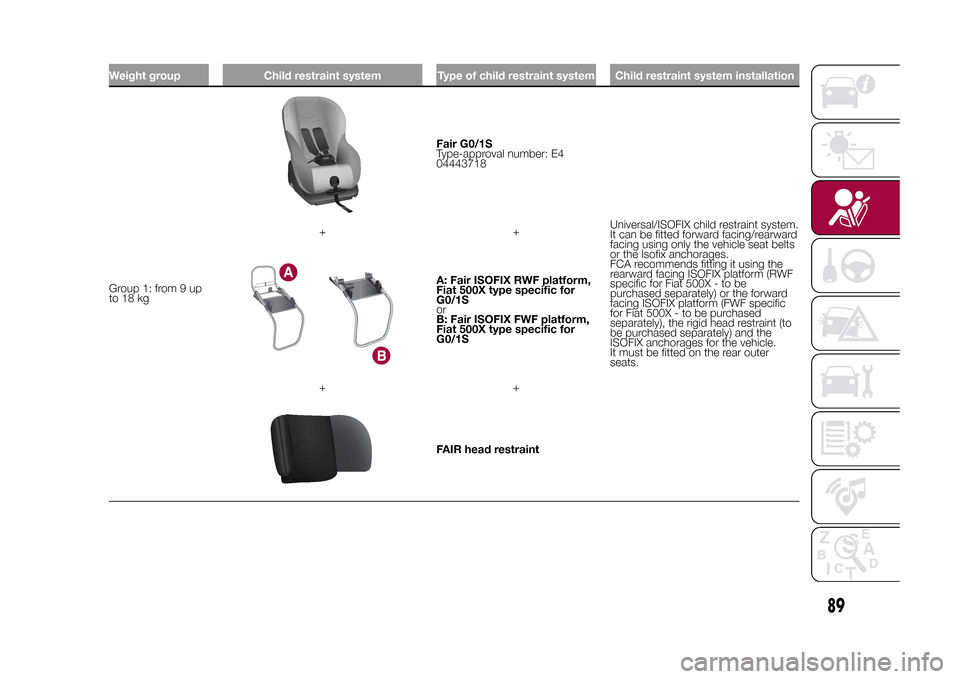
Weight group Child restraint system Type of child restraint system Child restraint system installationGroup 1: from 9 up
to 18 kg
Fair G0/1S
Type-approval number: E4
04443718
Universal/ISOFIX child restraint system.
It can be fitted forward facing/rearward
facing using only the vehicle seat belts
or the Isofix anchorages.
FCA recommends fitting it using the
rearward facing ISOFIX platform (RWF
specific for Fiat 500X - to be
purchased separately) or the forward
facing ISOFIX platform (FWF specific
for Fiat 500X - to be purchased
separately), the rigid head restraint (to
be purchased separately) and the
ISOFIX anchorages for the vehicle.
It must be fitted on the rear outer
seats. ++A: Fair ISOFIX RWF platform,
Fiat 500X type specific for
G0/1S
or
B: Fair ISOFIX FWF platform,
Fiat 500X type specific for
G0/1S
++FAIR head restraint
89
15-12-2014 8:23 Pagina 89
Page 92 of 240
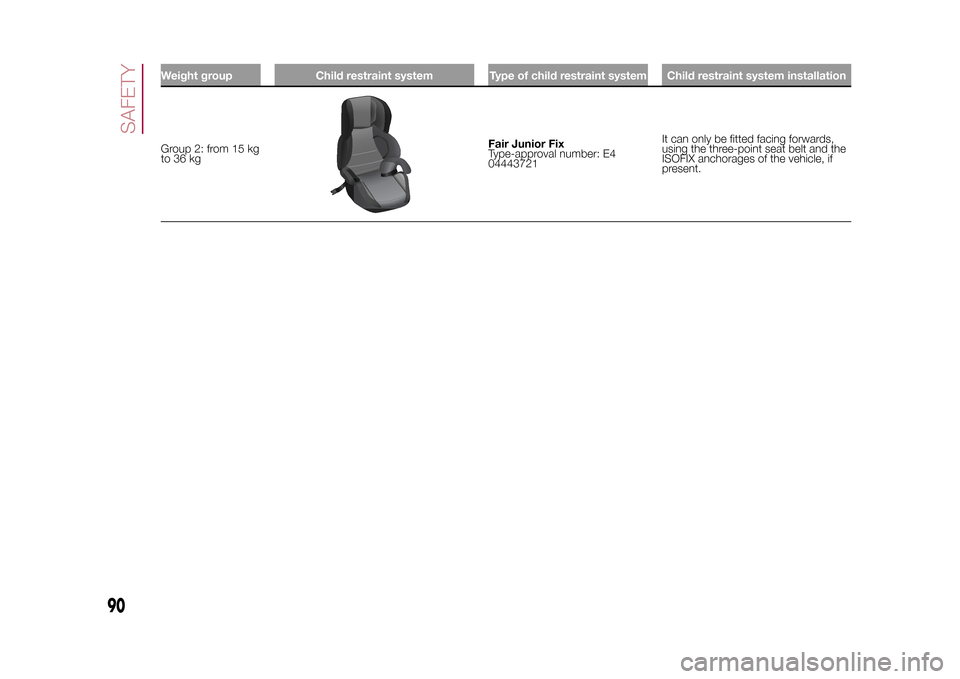
Weight group Child restraint system Type of child restraint system Child restraint system installationGroup 2: from 15 kg
to 36 kg
Fair Junior Fix
Type-approval number: E4
04443721It can only be fitted facing forwards,
using the three-point seat belt and the
ISOFIX anchorages of the vehicle, if
present.
90
SAFETY
15-12-2014 8:23 Pagina 90
Page 93 of 240
Main recommendations to carry
children safely
❒Install the child restraint systems on
the rear seat, which is the most
protected position in the event of an
impact.
❒Keep children in rearward facing child
restraint systems for as long as
possible, until 3–4 years old if possible.
❒If the passenger's front airbag is
deactivated always check the
dedicated warning light on the trim
located on the dashboard to make sure
that it has actually been deactivated.
❒Carefully follow the instructions
supplied with the child restraint system.
Keep the instructions in the vehicle
along with the other documents and
this handbook. Do not use second-
hand child restraint systems without
instructions.
❒Only one child is to be strapped into
each restraint system; never carry
two children using one child restraint
system.
❒Always check that the seat belts do
not rest on the child’s neck.
❒Always check that the seat belt is
well fastened by pulling on it.
❒While travelling, do not let the child sit
incorrectly or unfasten the belts.❒Never allow a child to put the belt's
diagonal section under an arm or
behind their back.
❒Never carry children on your lap,
even newborns. No one can hold
a child in the case of an accident.
❒In the event of an accident, replace
the child restraint system with a new
one.
WARNING
76)SEVERE DANGER When a front
passenger airbag is fitted, do not install
rearward facing child restraint systems on
the front passenger seat. Deployment of
the airbag in an accident could cause fatal
injuries to the child regardless of the
severity of the collision. It is advisable to
always carry children in a child restraint
system on the rear seat, which is the most
protected position in the event of an
impact.
77)On the sun visor there is a label with
suitable symbols reminding the user that it
is compulsory to deactivate the airbag if
a rearward facing child restraint system is
fitted. Always comply with the instructions
on the passenger's side sun visor (see
the "Supplementary Restraint System
(SRS) - Airbag" paragraph).78)Should it be necessary to carry a child
on the passenger side front seat in a rear
facing child restraint system, the passenger
side front airbag and side bag must be
deactivated through the display main menu
(see the instructions in the "Display"
paragraph, "Knowing the instrument panel"
chapter), verifying deactivation by
checking whether the
OFFLED has
switched on in the trim located on the
dashboard. Move the passenger's seat as
far back as possible to avoid contact
between the child restraint system and the
dashboard.
79)Do not adjust the front or rear seat if a
child is seated on it or on the dedicated
child restraint system.
80)Incorrect fitting of the child restraint
system may result in an inefficient
protection system. In the event of an
accident the child restraint system may
become loose and the child may be
injured, even fatally. When fitting a restraint
system for newborns or children, strictly
comply with the instructions provided
by the Manufacturer.
81)When the child restraint system is not
used, secure it with the seat belt or with
the ISOFIX anchorages, or remove it from
the vehicle. Do not leave it unsecured
inside the passenger compartment. In this
way, in the case of sudden braking or an
accident, it will not cause injuries to the
occupants.
82)After installing a child restraint system,
do not move the seat: always remove
the child restraint system before making
any adjustment.
91
15-12-2014 8:23 Pagina 91
Page 94 of 240
83)Always make sure that the diagonal
section of the seat belt does not pass
under the arms or behind the back of the
child. In the event of an accident the seat
belt will not be able to secure the child,
with the risk of injury, including fatal injury.
Therefore the child must always wear
the seat belt correctly.
84)Do not use the same lower anchorage
to install more than one child restraint
system.
85)If a Universal ISOFIX child restraint
system is not fixed to all three anchorages,
it will not be able to protect the child
correctly. In a crash, the child could be
seriously or fatally injured.
86)Fit the child restraint system only when
the vehicle is stationary. The child restraint
system is correctly fixed to the brackets
when you hear the click. Follow the
instructions for assembly, disassembly and
positioning that the manufacturer must
supply with the child restraint system.
SUPPLEMENTARY
RESTRAINT SYSTEM
(SRS) - AIRBAGThe vehicle is equipped with:
❒front driver airbag;
❒front passenger airbag;
❒driver and passenger front side bags
for pelvis, chest and shoulder
protection (Side bags);
❒front and rear side passenger side
bags for head protection (window bag)
❒driver's knee bag (where provided).
The location of the airbags on the
vehicle is marked by the word
"AIRBAG" in the middle of the steering
wheel, on the dashboard, on the side
trim or on a label placed next to the
airbag deployment area.FRONT AIRBAGSThe front driver/passenger airbags and
the driver's knee bag (where provided)
protect the front seat occupants in
the event of frontal impacts of
medium/high severity, by placing the
bag between the occupant and the
steering wheel or dashboard.
Therefore non-activation of airbags in
other types of collisions (side impacts,
rear shunts, roll-overs, etc.) does not
indicate a system malfunction.Driver and passenger front airbags are
not a replacement of but
complementary to the seat belts, which
should always be worn, as specified
by law in Europe and most non-
European countries.
In the event of impact, those not
wearing a seat belt are projected
forwards and may come into contact
with the bag which is still inflating. The
protection offered by the bag is
compromised in these circumstances.
Front airbags may not activate in the
following situations:
❒frontal impacts against highly
deformable objects not involving the
front surface of the vehicle (e.g. wing
collision against guard rail, etc.);
❒vehicle wedging under other vehicles
or protective barriers (e.g. trucks or
guard rails).
Failure to activate in the conditions
described above is due to the fact that
they may not provide any additional
protection compared with seat belts, so
their activation would be inappropriate.
In these cases, non-deployment does
not indicate a system malfunction.
Driver's side front airbagThis consists of an instantly inflating
cushion contained in a special
compartment in the centre of the
steering wheel fig. 81.
92
SAFETY
15-12-2014 8:23 Pagina 92
Page 100 of 240
102)The airbag does not replace seat
belts, but increases their efficiency.
Because front airbags are not deployed for
low-speed crashes, side collisions,
rear-end shunts or rollovers, occupants are
protected, in addition to any side bags,
only by their seat belts, which must
therefore always be fastened.
98
SAFETY
15-12-2014 8:23 Pagina 98