weight FIAT 500X 2015 2.G User Guide
[x] Cancel search | Manufacturer: FIAT, Model Year: 2015, Model line: 500X, Model: FIAT 500X 2015 2.GPages: 240, PDF Size: 10.72 MB
Page 91 of 240
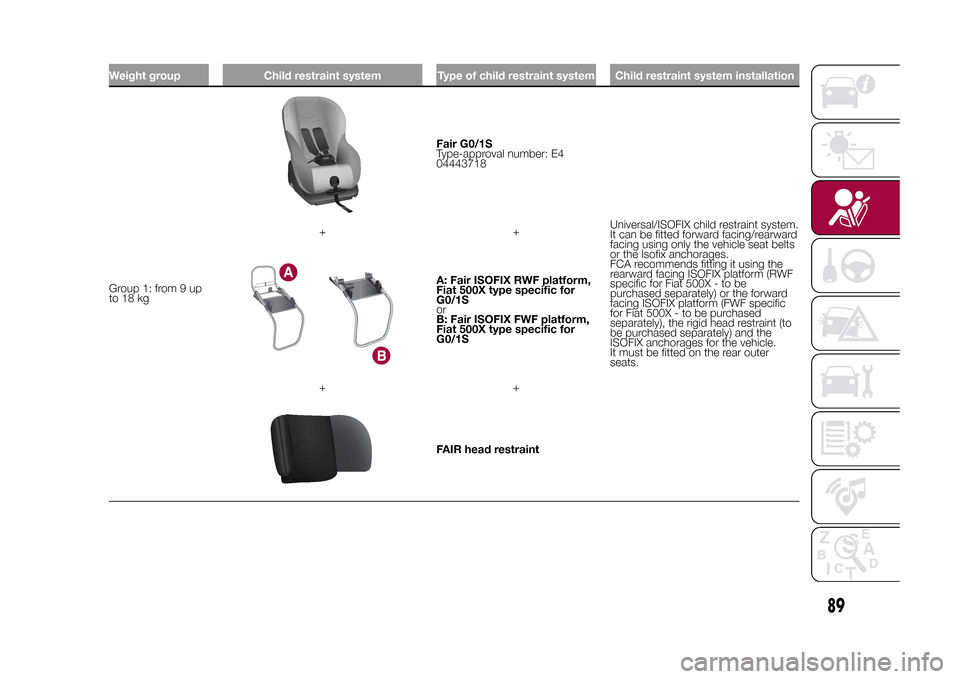
Weight group Child restraint system Type of child restraint system Child restraint system installationGroup 1: from 9 up
to 18 kg
Fair G0/1S
Type-approval number: E4
04443718
Universal/ISOFIX child restraint system.
It can be fitted forward facing/rearward
facing using only the vehicle seat belts
or the Isofix anchorages.
FCA recommends fitting it using the
rearward facing ISOFIX platform (RWF
specific for Fiat 500X - to be
purchased separately) or the forward
facing ISOFIX platform (FWF specific
for Fiat 500X - to be purchased
separately), the rigid head restraint (to
be purchased separately) and the
ISOFIX anchorages for the vehicle.
It must be fitted on the rear outer
seats. ++A: Fair ISOFIX RWF platform,
Fiat 500X type specific for
G0/1S
or
B: Fair ISOFIX FWF platform,
Fiat 500X type specific for
G0/1S
++FAIR head restraint
89
15-12-2014 8:23 Pagina 89
Page 92 of 240
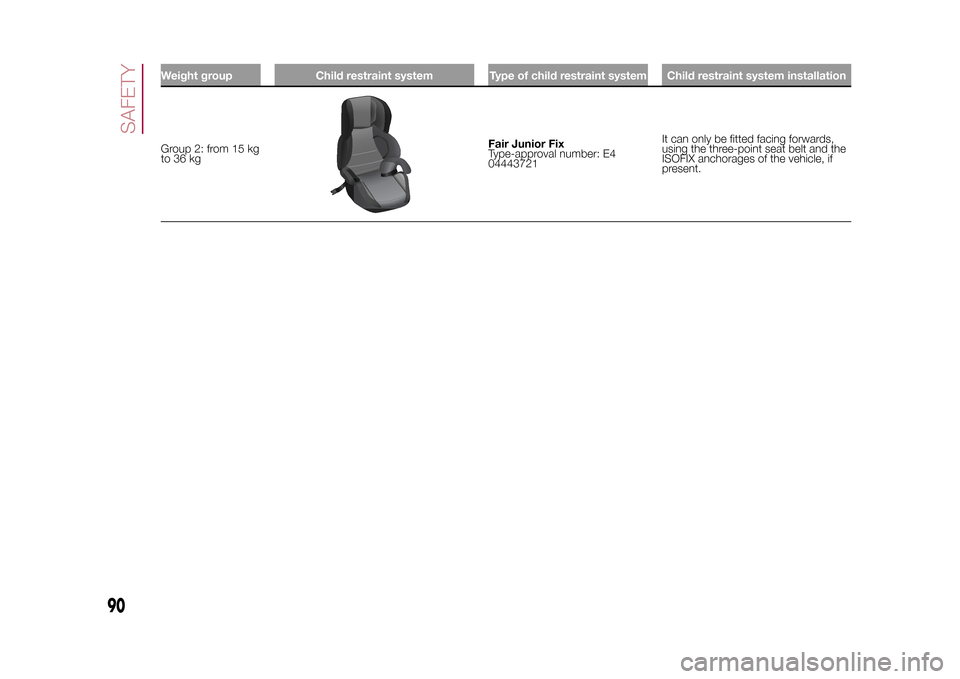
Weight group Child restraint system Type of child restraint system Child restraint system installationGroup 2: from 15 kg
to 36 kg
Fair Junior Fix
Type-approval number: E4
04443721It can only be fitted facing forwards,
using the three-point seat belt and the
ISOFIX anchorages of the vehicle, if
present.
90
SAFETY
15-12-2014 8:23 Pagina 90
Page 119 of 240
TOWING TRAILERSIMPORTANT
120) 121)
For towing caravans or trailers the
vehicle must be fitted with an approved
tow hook and an adequate electrical
system. Should aftermarket installation
be requested, this must be carried
out by specialists.
Install any specific and/or additional
door mirrors as specified by the
Highway Code.
Remember that when towing a trailer,
steep hills are harder to climb, braking
distances increase and overtaking
takes longer depending on the overall
weight of the trailer. Engage a low gear
when driving downhill, rather than
constantly using the brake. The weight
the trailer exerts on the vehicle tow
hook reduces the vehicle's loading
capacity by the same amount. To make
sure that the maximum towable weight
is not exceeded (given in the vehicle
registration document) account should
be taken of the fully laden trailer,
including accessories and luggage.
Do not exceed the speed limits specific
to each country you are driving in, in
the case of vehicles towing trailers.
In any case, the top speed must not
exceed 100 km/h.Any electric brake must be powered
directly by the battery through a cable
with a cross-section of no less than 2.5
mm
2. In addition to the electrical
branches, the vehicle electrical system
can only be connected to the supply
cable for an electric brake and to the
cable for an internal light for the trailer,
not exceeding 15 W. For connections,
use the preset control unit with a
battery cable with section not less than
2.5 mm
2. The use of auxiliary loads
other than external lights (e.g. electric
brake) must take place with engine
running.
INSTALLING A TOW
HOOKThe towing device should be fastened
to the body by specialised personnel
according to any additional and/or
integrative information supplied by the
Manufacturer of the device. It must also
meet current regulations with reference
to Directive 94/20/EC and subsequent
amendments.
For any version the towing device used
must be right for the towable weight
of the vehicle on which it is to be
installed.For the electrical connection a standard
connector should be used which is
generally placed on a special bracket
normally fastened to the towing device,
and a special ECU for external trailer
light control must be installed on the
vehicle. 7 or 13-pin 12 V DC
connections should be used (CUNA/
UNI and ISO/DIN Standards). Follow
any instructions provided by the vehicle
manufacturer and/or the towing device
manufacturer.
117
15-12-2014 8:23 Pagina 117
Page 135 of 240
CHANGING A WHEELJACKPlease note that:
❒the weight of the jack is 2.8 kg;
❒The jack requires no adjustment;
❒the jack cannot be repaired and in
the event of a fault it must be replaced
by another original one;
❒No tool other than its cranking device
may be fitted on the jack.CHANGING PROCEDURE
132) 133) 134) 135) 136) 137) 138) 139)
Proceed as follows:
❒stop the vehicle in a position that is
not dangerous for oncoming traffic
where you can change the wheel safely.
The ground should be flat if possible,
and sufficiently firm;
❒stop the engine, engage the hazard
warning lights and the electric parking
brake;
❒engage first gear or reverse or, for
versions with automatic transmission,
move the lever to position P (Park);
❒wear the reflective safety jacket
(compulsory by law in certain countries)
before getting out of the vehicle;❒open the boot and position the
reconfigurable load platform in
an inclined position (see "Boot" in the
"Knowing your vehicle" chapter);
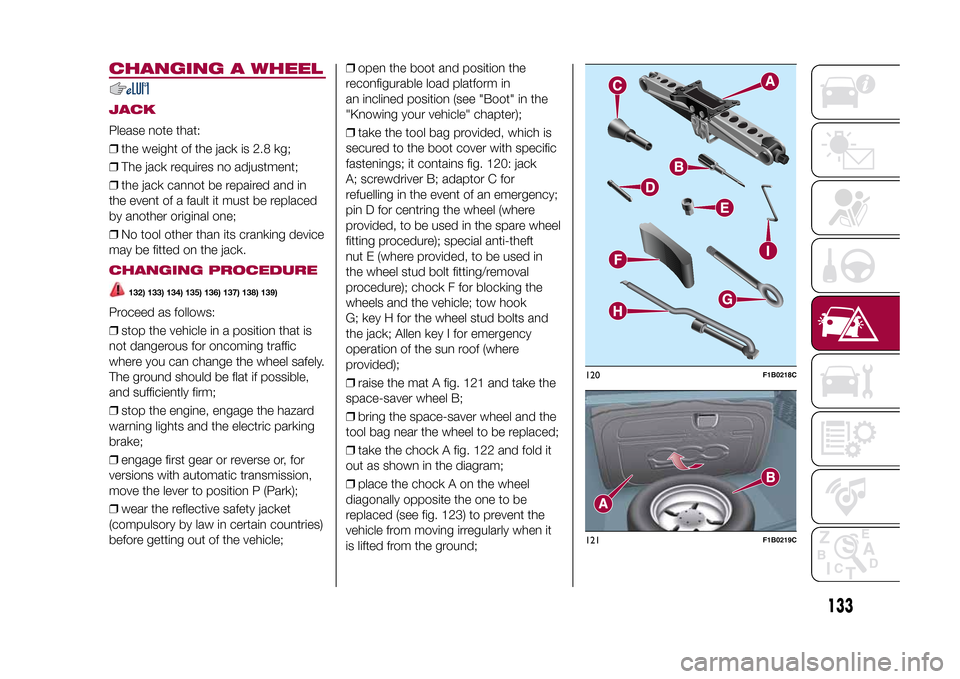
❒take the tool bag provided, which is
secured to the boot cover with specific
fastenings; it contains fig. 120: jack
A; screwdriver B; adaptor C for
refuelling in the event of an emergency;
pin D for centring the wheel (where
provided, to be used in the spare wheel
fitting procedure); special anti-theft
nut E (where provided, to be used in
the wheel stud bolt fitting/removal
procedure); chock F for blocking the
wheels and the vehicle; tow hook
G; key H for the wheel stud bolts and
the jack; Allen key I for emergency
operation of the sun roof (where
provided);
❒raise the mat A fig. 121 and take the
space-saver wheel B;
❒bring the space-saver wheel and the
tool bag near the wheel to be replaced;
❒take the chock A fig. 122 and fold it
out as shown in the diagram;
❒place the chock A on the wheel
diagonally opposite the one to be
replaced (see fig. 123) to prevent the
vehicle from moving irregularly when it
is lifted from the ground;
120
F1B0218C
121
F1B0219C
133
15-12-2014 8:23 Pagina 133
Page 174 of 240
TECHNICAL SPECIFICATIONS
Everything you may find useful for
understanding how your vehicle
is made and works is contained in this
chapter and illustrated with data, tables
and graphics. For the enthusiasts and
the technician, but also just for those
who want to know every detail of their
vehicle.IDENTIFICATION DATA....................173
ENGINE ..........................................174
WHEELS .........................................176
DIMENSIONS ..................................178
WEIGHTS........................................180
SUPPLIES .......................................182
FLUIDS AND LUBRICANTS ............184
PERFORMANCE .............................186
FUEL CONSUMPTION ....................186
CO2 EMISSIONS ............................188
PRESCRIPTIONS FOR HANDLING
THE VEHICLE AT THE END OF ITS
LIFE ................................................189
172
TECHNICAL SPECIFICATIONS
15-12-2014 8:23 Pagina 172
Page 175 of 240
IDENTIFICATION
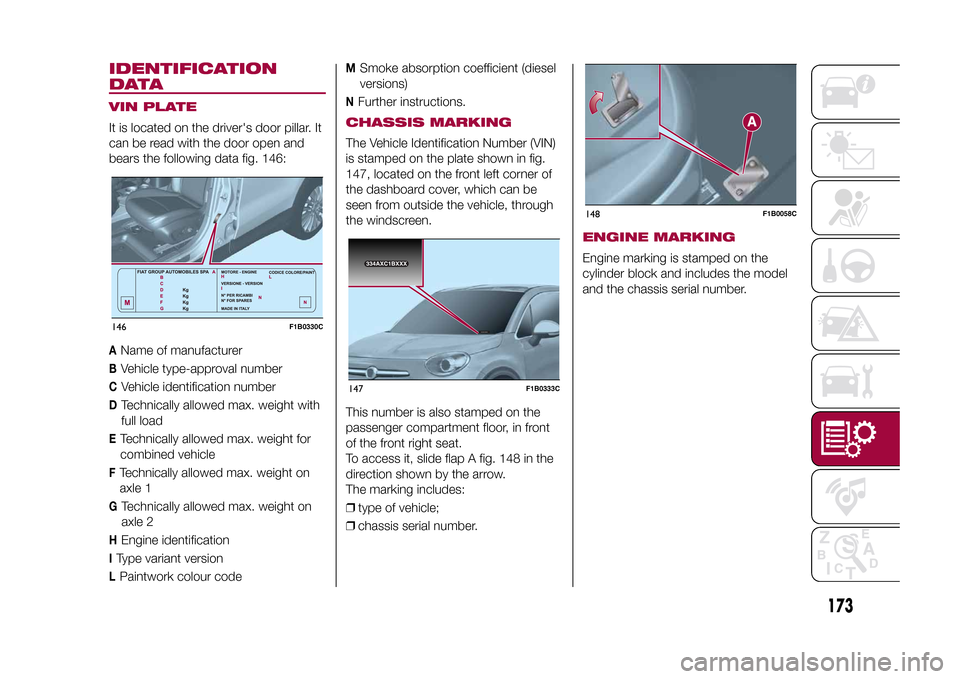
DATAVIN PLATEIt is located on the driver's door pillar. It
can be read with the door open and
bears the following data fig. 146:A
Name of manufacturer
B
Vehicle type-approval number
C
Vehicle identification number
D
Technically allowed max. weight with
full load
ETechnically allowed max. weight for
combined vehicleFTechnically allowed max. weight on
axle 1G
Technically allowed max. weight on
axle 2
H
Engine identification
IType variant versionLPaintwork colour code
M
Smoke absorption coefficient (diesel
versions)
N
Further instructions.
CHASSIS MARKINGThe Vehicle Identification Number (VIN)
is stamped on the plate shown in fig.
147, located on the front left corner of
the dashboard cover, which can be
seen from outside the vehicle, through
the windscreen.
This number is also stamped on the
passenger compartment floor, in front
of the front right seat.
To access it, slide flap A fig. 148 in the
direction shown by the arrow.
The marking includes:
❒type of vehicle;
❒chassis serial number.
ENGINE MARKINGEngine marking is stamped on the
cylinder block and includes the model
and the chassis serial number.
146
F1B0330C
334AXC1BXXX
334AXC1BXXX
147
F1B0333C
148
F1B0058C
173
15-12-2014 8:23 Pagina 173
Page 182 of 240
WEIGHTS
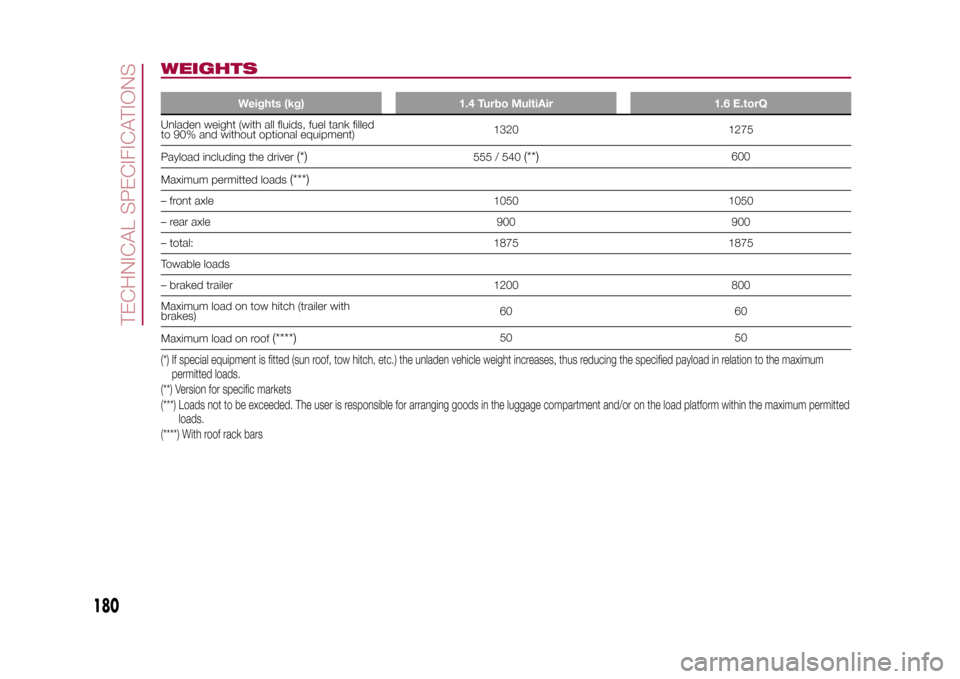
Weights (kg) 1.4 Turbo MultiAir 1.6 E.torQ
Unladen weight (with all fluids, fuel tank filled
to 90% and without optional equipment)1320 1275
Payload including the driver
(*)
555 / 540
(**)
600
Maximum permitted loads
(***)
– front axle 1050 1050
– rear axle 900 900
– total: 1875 1875
Towable loads
– braked trailer 1200 800
Maximum load on tow hitch (trailer with
brakes)60 60
Maximum load on roof
(****)
50 50
(*) If special equipment is fitted (sun roof, tow hitch, etc.) the unladen vehicle weight increases, thus reducing the specified payload in relation to the maximum
permitted loads.
(**) Version for specific markets
(***) Loads not to be exceeded. The user is responsible for arranging goods in the luggage compartment and/or on the load platform within the maximum permitted
loads.
(****) With roof rack bars
180
TECHNICAL SPECIFICATIONS
15-12-2014 8:23 Pagina 180
Page 183 of 240
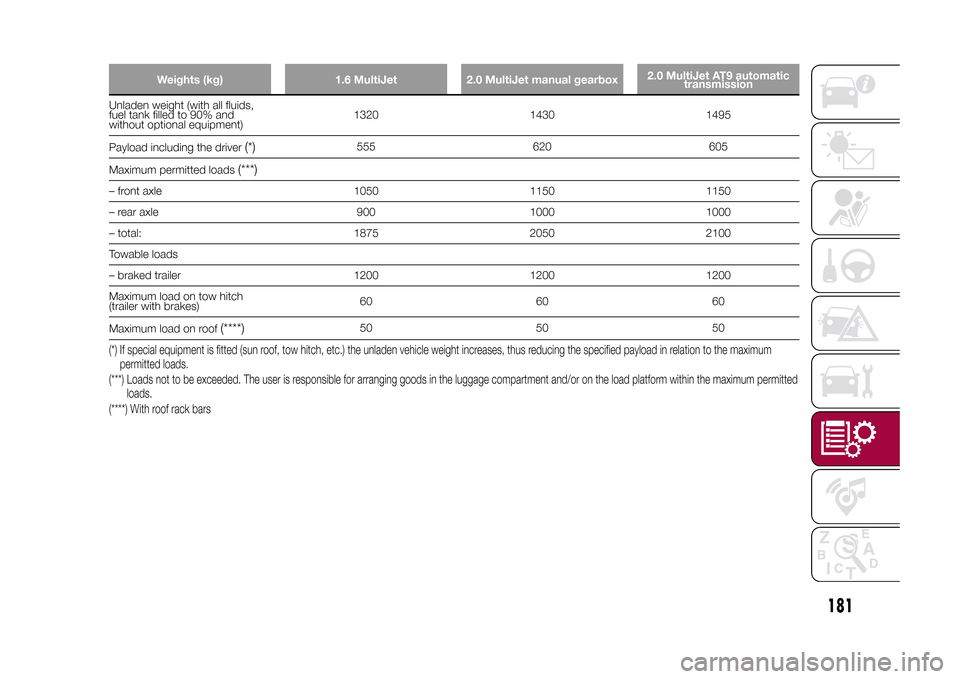
Weights (kg) 1.6 MultiJet 2.0 MultiJet manual gearbox2.0 MultiJet AT9 automatic
transmission
Unladen weight (with all fluids,
fuel tank filled to 90% and
without optional equipment)1320 1430 1495
Payload including the driver
(*)
555 620 605
Maximum permitted loads
(***)
– front axle 1050 1150 1150
– rear axle 900 1000 1000
– total: 1875 2050 2100
Towable loads
– braked trailer 1200 1200 1200
Maximum load on tow hitch
(trailer with brakes)60 60 60
Maximum load on roof
(****)
50 50 50
(*) If special equipment is fitted (sun roof, tow hitch, etc.) the unladen vehicle weight increases, thus reducing the specified payload in relation to the maximum
permitted loads.
(***) Loads not to be exceeded. The user is responsible for arranging goods in the luggage compartment and/or on the load platform within the maximum permitted
loads.
(****) With roof rack bars
181
15-12-2014 8:23 Pagina 181
Page 188 of 240
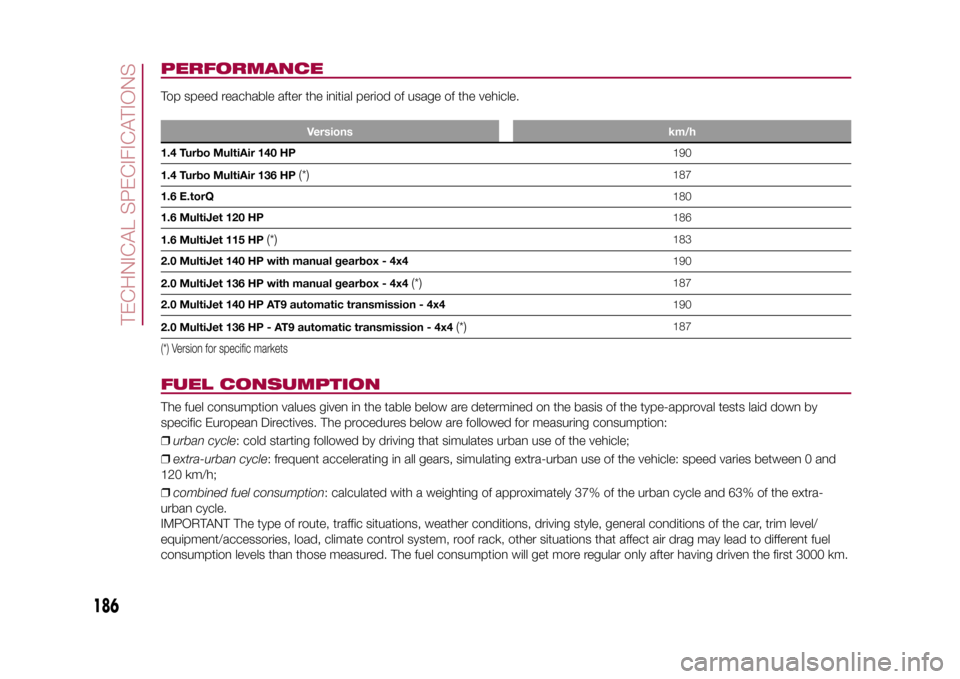
PERFORMANCETop speed reachable after the initial period of usage of the vehicle.
Versions km/h
1.4 Turbo MultiAir 140 HP190
1.4 Turbo MultiAir 136 HP
(*)
187
1.6 E.torQ180
1.6 MultiJet 120 HP186
1.6 MultiJet 115 HP
(*)
183
2.0 MultiJet 140 HP with manual gearbox - 4x4190
2.0 MultiJet 136 HP with manual gearbox - 4x4
(*)
187
2.0 MultiJet 140 HP AT9 automatic transmission - 4x4190
2.0 MultiJet 136 HP - AT9 automatic transmission - 4x4
(*)
187
(*) Version for specific marketsFUEL CONSUMPTIONThe fuel consumption values given in the table below are determined on the basis of the type-approval tests laid down by
specific European Directives. The procedures below are followed for measuring consumption:
❒urban cycle: cold starting followed by driving that simulates urban use of the vehicle;
❒extra-urban cycle: frequent accelerating in all gears, simulating extra-urban use of the vehicle: speed varies between 0 and
120 km/h;
❒combined fuel consumption: calculated with a weighting of approximately 37% of the urban cycle and 63% of the extra-
urban cycle.
IMPORTANT The type of route, traffic situations, weather conditions, driving style, general conditions of the car, trim level/
equipment/accessories, load, climate control system, roof rack, other situations that affect air drag may lead to different fuel
consumption levels than those measured. The fuel consumption will get more regular only after having driven the first 3000 km.
186
TECHNICAL SPECIFICATIONS
15-12-2014 8:23 Pagina 186
Page 238 of 240
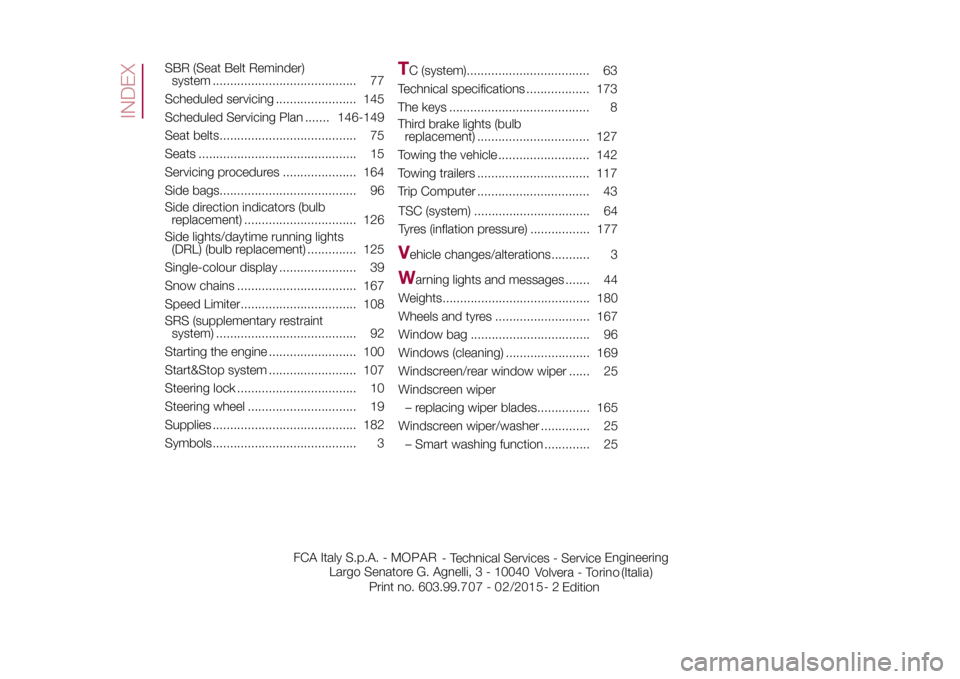
SBR (Seat Belt Reminder)
system ......................................... 77
Scheduled servicing ....................... 145
Scheduled Servicing Plan ....... 146-149
Seat belts....................................... 75
Seats ............................................. 15
Servicing procedures ..................... 164
Side bags....................................... 96
Side direction indicators (bulb
replacement) ................................ 126
Side lights/daytime running lights
(DRL) (bulb replacement) .............. 125
Single-colour display ...................... 39
Snow chains .................................. 167
Speed Limiter................................. 108
SRS (supplementary restraint
system) ........................................ 92
Starting the engine ......................... 100
Start&Stop system ......................... 107
Steering lock .................................. 10
Steering wheel ............................... 19
Supplies ......................................... 182
Symbols......................................... 3
TC (system)................................... 63
Technical specifications .................. 173
The keys ........................................ 8
Third brake lights (bulb
replacement) ................................ 127
Towing the vehicle .......................... 142
Towing trailers ................................ 117
Trip Computer ................................ 43
TSC (system) ................................. 64
Tyres (inflation pressure) ................. 177V
ehicle changes/alterations........... 3
W
arning lights and messages ....... 44
Weights.......................................... 180
Wheels and tyres ........................... 167
Window bag .................................. 96
Windows (cleaning) ........................ 169
Windscreen/rear window wiper ...... 25
Windscreen wiper
– replacing wiper blades............... 165
Windscreen wiper/washer .............. 25
– Smart washing function ............. 25
INDEX
FCA Italy S.p.A. - MOPAR
- Technical Services - ServiceEngineering
Largo Senatore G. Agnelli, 3 - 10040
Volvera - Torino (Italia)
Print no. 603.99.7 - 0 /201 5 -
Edition 07 2 2