warning light FIAT 500X 2015 2.G Owner's Manual
[x] Cancel search | Manufacturer: FIAT, Model Year: 2015, Model line: 500X, Model: FIAT 500X 2015 2.GPages: 240, PDF Size: 10.72 MB
Page 53 of 240
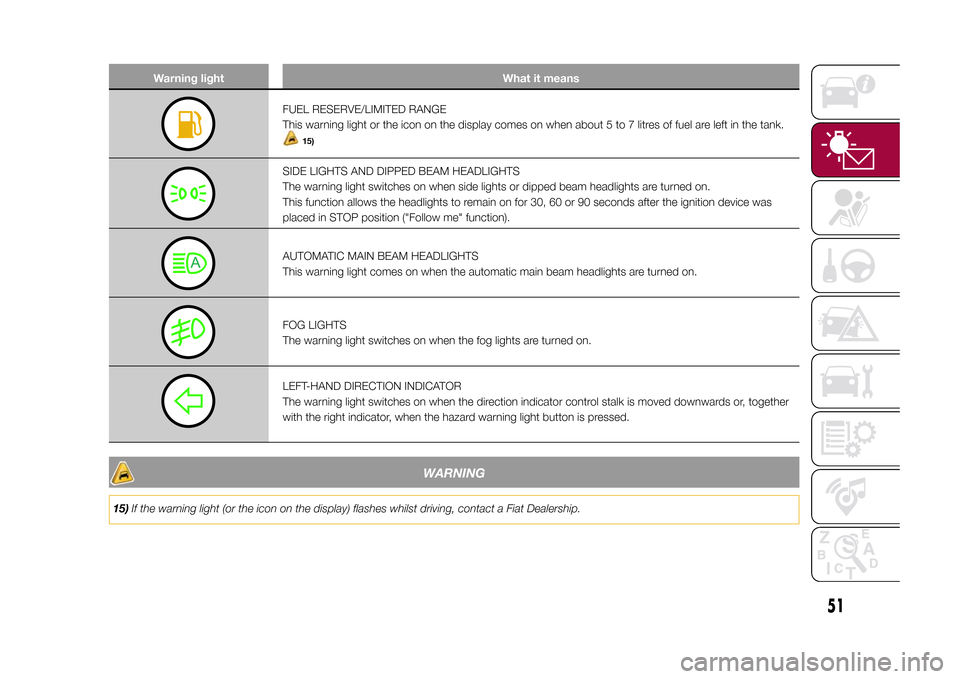
Warning light What it means
FUEL RESERVE/LIMITED RANGE
This warning light or the icon on the display comes on when about 5 to 7 litres of fuel are left in the tank.
15)
SIDE LIGHTS AND DIPPED BEAM HEADLIGHTS
The warning light switches on when side lights or dipped beam headlights are turned on.
This function allows the headlights to remain on for 30, 60 or 90 seconds after the ignition device was
placed in STOP position ("Follow me" function).AUTOMATIC MAIN BEAM HEADLIGHTS
This warning light comes on when the automatic main beam headlights are turned on.FOG LIGHTS
The warning light switches on when the fog lights are turned on.LEFT-HAND DIRECTION INDICATOR
The warning light switches on when the direction indicator control stalk is moved downwards or, together
with the right indicator, when the hazard warning light button is pressed.
WARNING
15)If the warning light (or the icon on the display) flashes whilst driving, contact a Fiat Dealership.
51
15-12-2014 8:23 Pagina 51
Page 54 of 240
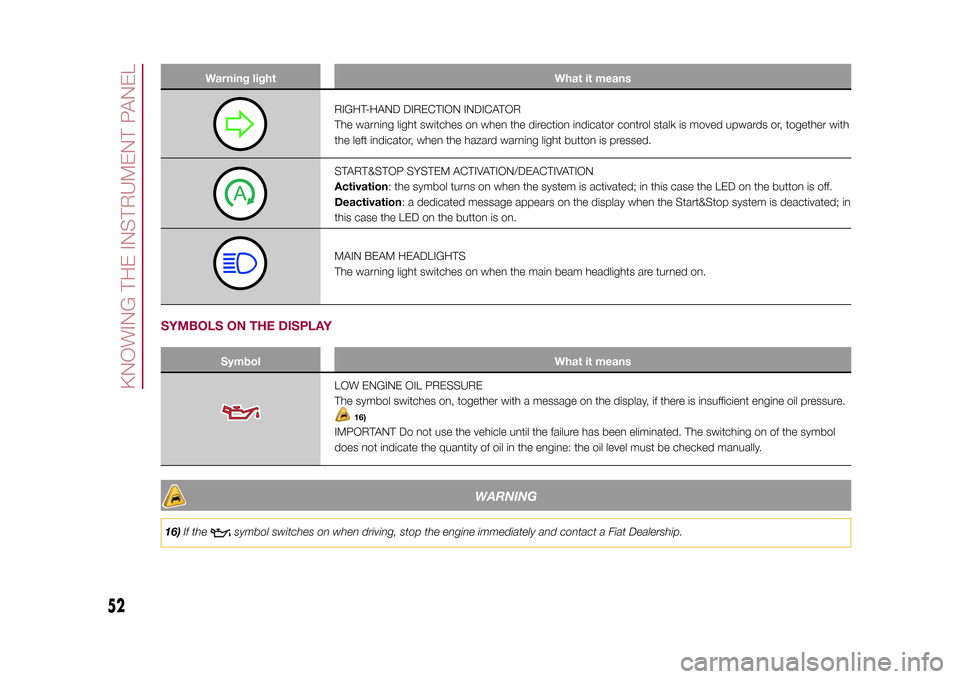
Warning light What it means
RIGHT-HAND DIRECTION INDICATOR
The warning light switches on when the direction indicator control stalk is moved upwards or, together with
the left indicator, when the hazard warning light button is pressed.START&STOP SYSTEM ACTIVATION/DEACTIVATION
Activation: the symbol turns on when the system is activated; in this case the LED on the button is off.
Deactivation: a dedicated message appears on the display when the Start&Stop system is deactivated; in
this case the LED on the button is on.MAIN BEAM HEADLIGHTS
The warning light switches on when the main beam headlights are turned on.
SYMBOLS ON THE DISPLAY
Symbol What it means
LOW ENGINE OIL PRESSURE
The symbol switches on, together with a message on the display, if there is insufficient engine oil pressure.
16)
IMPORTANT Do not use the vehicle until the failure has been eliminated. The switching on of the symbol
does not indicate the quantity of oil in the engine: the oil level must be checked manually.
WARNING
16)If the
symbol switches on when driving, stop the engine immediately and contact a Fiat Dealership.
52
KNOWING THE INSTRUMENT PANEL
15-12-2014 8:23 Pagina 52
Page 60 of 240
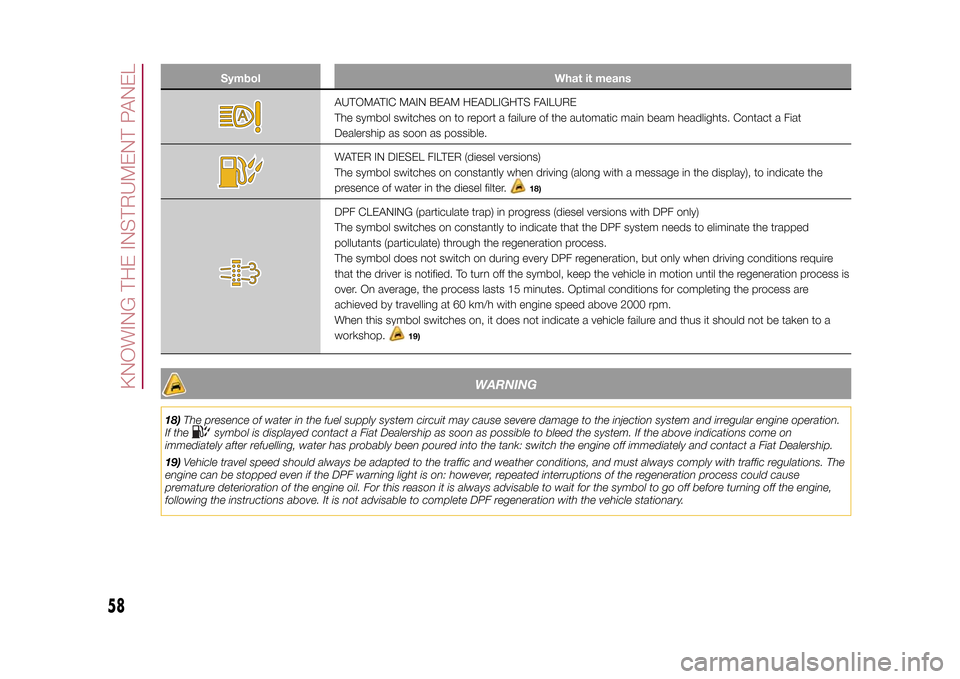
Symbol What it means
AUTOMATIC MAIN BEAM HEADLIGHTS FAILURE
The symbol switches on to report a failure of the automatic main beam headlights. Contact a Fiat
Dealership as soon as possible.WATER IN DIESEL FILTER (diesel versions)
The symbol switches on constantly when driving (along with a message in the display), to indicate the
presence of water in the diesel filter.
18)
DPF CLEANING (particulate trap) in progress (diesel versions with DPF only)
The symbol switches on constantly to indicate that the DPF system needs to eliminate the trapped
pollutants (particulate) through the regeneration process.
The symbol does not switch on during every DPF regeneration, but only when driving conditions require
that the driver is notified. To turn off the symbol, keep the vehicle in motion until the regeneration process is
over. On average, the process lasts 15 minutes. Optimal conditions for completing the process are
achieved by travelling at 60 km/h with engine speed above 2000 rpm.
When this symbol switches on, it does not indicate a vehicle failure and thus it should not be taken to a
workshop.
19)
WARNING
18)The presence of water in the fuel supply system circuit may cause severe damage to the injection system and irregular engine operation.
If the
symbol is displayed contact a Fiat Dealership as soon as possible to bleed the system. If the above indications come on
immediately after refuelling, water has probably been poured into the tank: switch the engine off immediately and contact a Fiat Dealership.
19)Vehicle travel speed should always be adapted to the traffic and weather conditions, and must always comply with traffic regulations. The
engine can be stopped even if the DPF warning light is on: however, repeated interruptions of the regeneration process could cause
premature deterioration of the engine oil. For this reason it is always advisable to wait for the symbol to go off before turning off the engine,
following the instructions above. It is not advisable to complete DPF regeneration with the vehicle stationary.
58
KNOWING THE INSTRUMENT PANEL
15-12-2014 8:23 Pagina 58
Page 65 of 240
System interventionThe intervention of the system is
indicated by the flashing of the
warning light on the instrument
panel, to inform the driver that
the vehicle is in critical stability and grip
conditions.38) 39) 40) 41) 42)
TC (Traction Control)
SYSTEMThe system automatically operates in
the event of slipping, loss of grip on wet
roads (aquaplaning) and acceleration
on slippery, snowy or icy roads, etc. on
one or more drive wheels. Depending
on the slipping conditions, two different
control systems are activated:
❒if the slipping involves both drive
wheels, the system intervenes,
reducing the power transmitted by the
engine;❒if the slipping only involves one of the
drive wheels, the BLD (Brake Limited
Differential) function is activated,
automatically braking the wheel which
is slipping (the behaviour of a
self-locking differential is simulated).
This will increase the engine torque
transferred to the wheel which isn't
slipping. This function remains active
even if the "Systems partially disabled"
and "Systems disabled" modes are
selected (see description in the
following pages).
System interventionThe intervention of the system is
indicated by the flashing of the
warning light on the instrument
panel, to inform the driver that
the vehicle is in critical stability and grip
conditions.43) 44) 45) 46) 47)
PBA (Panic Brake
Assist) SYSTEMThe PBA system is designed to
improve the vehicle’s braking capacity
during emergency braking.The system detects emergency braking
by monitoring the speed and force
with which the brake pedal is pressed,
and consequently applies the optimal
brake pressure. This can reduce the
braking distance: the PBA system
therefore completes the ABS.
Maximum assistance from the PBA
system is obtained by pressing the
brake pedal very quickly. In addition,
the brake pedal should be pressed
continuously during braking, avoiding
intermittent presses, to get the most
out of the system. Do not reduce
pressure on the brake pedal until
braking is not necessary anymore.
The PBA system is deactivated when
the brake pedal is released.
48) 49) 50)
HHC (Hill Hold Control)
SYSTEMThis is an integral part of the ESC
system and facilitates starting on
slopes, activating automatically in the
following cases:
❒uphill: vehicle stationary on a road
with a gradient higher than 5%, engine
running, brake pressed and
transmission in neutral or gear other
than reverse engaged;
63
15-12-2014 8:23 Pagina 63
Page 66 of 240
❒downhill: vehicle stationary on a road
with a gradient higher than 5%, engine
running, brake pressed and reverse
gear engaged.
When setting off, the ESC system
control unit maintains the braking
pressure on the wheels until the engine
torque necessary for starting is
reached, or in any case for a maximum
of 2 seconds, allowing your right foot
to be moved easily from the brake
pedal to the accelerator.
When two seconds have elapsed,
without starting, the system is
automatically deactivated, gradually
releasing the braking pressure. During
this release stage it is possible to hear a
typical mechanical brake release noise,
indicating the imminent movement of
the vehicle.
51) 52)
DST SYSTEM (Dynamic
Steering Torque)The DST function uses the integration
of the ESC system with the electric
power steering to increase the safety
level of the whole vehicle.In critical situations (braking on surfaces
with different grip conditions), through
the DST function the ESC system
controls the steering to implement an
additional torque contribution on the
steering wheel, to suggest the most
correct manoeuvre to the driver.
The coordinated action of the brakes
and steering increases the sensation of
safety and control of the vehicle.
53)
ERM (Electronic Rollover
Mitigation) SYSTEMThe system monitors the tendency of
the wheels to rise from the ground if the
driver performs extreme manoeuvres
like quick steering to avoid an obstacle,
especially in poor road conditions.
If these conditions occur, the system
intervenes on the brakes and engine
power to reduce the possibility that the
wheels are raised from the ground. It
is not possible to avoid tendency to roll
over if the phenomenon is due to
reasons such as driving on high side
gradients, collision with objects or other
vehicles.
54)
TSC (Trailer Sway
Control) SYSTEMThe system employs a series of
sensors located on the vehicle to
identify excessive swerving of the trailer
and take the necessary precautions
to eliminate it.
To counteract the effect of trailer sway,
the system can reduce the engine
power and intervene on the wheels
involved. The TSC system activates
automatically once excessive sway of
the trailer is detected.System interventionWhen the system is active, the
warning light flashes on the
instrument panel, the engine power is
reduced and braking can be felt on the
individual wheels, following the attempt
to eliminate the swerving of the trailer.55) 56)
WARNING
31)When the ABS intervenes and you feel
the brake pedal pulsating, do not reduce
the pressure, but hold it down firmly and
confidently; in doing so you will brake
in the shortest distance possible,
depending on the current road conditions.
64
SAFETY
15-12-2014 8:23 Pagina 64
Page 68 of 240
55)When towing trailers, the utmost
caution at the wheel is recommended.
Never exceed the maximum permitted
loads (see the description in the "Weights"
paragraph in the "Technical Specifications"
chapter).
56)The TSC system cannot prevent
swerving for all trailers. If the system
activates during driving, reduce the speed,
stop the vehicle in a safe place and arrange
the load correctly to prevent the trailer
from swerving.
DRIVING
ASSISTANCE
SYSTEMSThe vehicle can feature the following
driving assistance systems:
❒BSA (Blind Spot Assist);
❒FBC (Full Brake Control);
❒iTPMS (indirect Tyre Pressure
Monitoring System).
For the operation of the systems, see
the following pages.BSA (Blind Spot Assist)
SYSTEMThe vehicle can be equipped with the
BSA (Blind Spot Assist) system for blind
spot monitoring. The BSA system
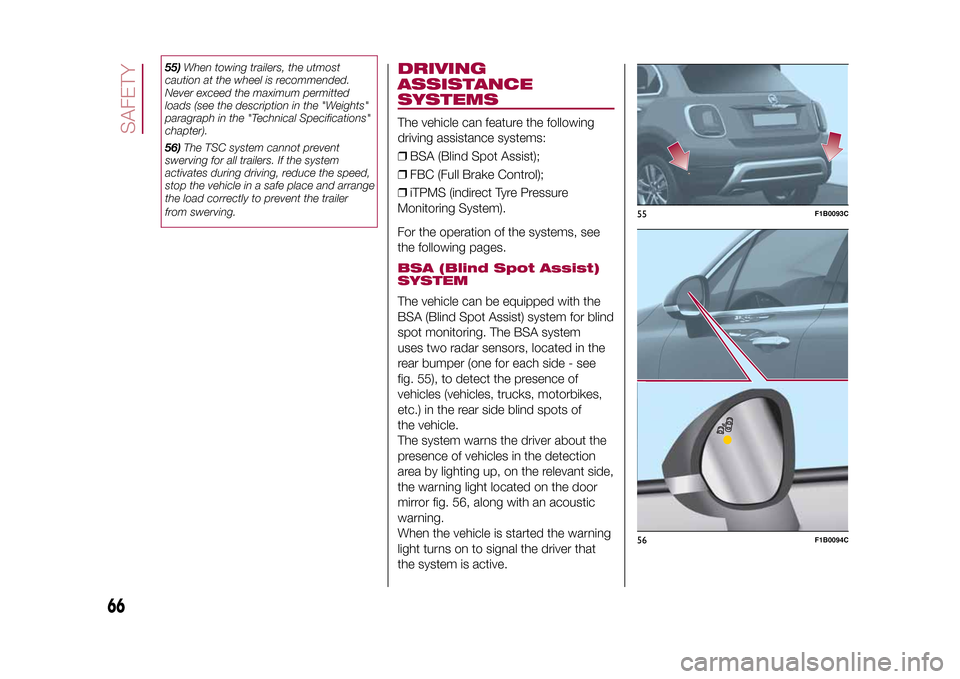
uses two radar sensors, located in the
rear bumper (one for each side - see
fig. 55), to detect the presence of
vehicles (vehicles, trucks, motorbikes,
etc.) in the rear side blind spots of
the vehicle.
The system warns the driver about the
presence of vehicles in the detection
area by lighting up, on the relevant side,
the warning light located on the door
mirror fig. 56, along with an acoustic
warning.
When the vehicle is started the warning
light turns on to signal the driver that
the system is active.
55
F1B0093C
56
F1B0094C
66
SAFETY
15-12-2014 8:23 Pagina 66
Page 69 of 240

SensorsThe sensors are activated when any
forward gear is engaged at a speed
higher than about 10 km/h, or when
reverse is engaged.
The sensors are temporarily
deactivated with vehicle at a standstill
and the gear lever in position P (Park
- versions with automatic transmission),
or with vehicle at a standstill and
electric parking brake engaged
(versions with manual gearbox).
The detection area of the system
covers about a lane on both sides of
the vehicle (around 3 metres).
This area begins from the door mirror
and extends for about 6 metres
towards the rear part of the vehicle.
When the sensors are active the system
monitors the detection areas on both
sides of the vehicle and warns the
driver about the possible presence of
vehicles in these areas.
While driving the system monitors the
detection area from three different input
points (side, rear and front) to check
whether a signal needs to be sent
to the driver. The system can detect the
presence of a vehicle in one of these
three areas.IMPORTANT The system does not
signal the presence of fixed objects
(e.g. safety barriers, poles, walls, etc.).
However, in some circumstances,
the system may activate in the
presence of these objects. This is
normal and does not indicate a system
malfunction.
IMPORTANT The system does not
warn the driver about the presence of
vehicles coming from the opposite
direction, in the adjacent lanes.
57)
ImportantIf a trailer is hitched to the vehicle, the
system must be manually deactivated
using the relevant menu, in order to
avoid false warnings.
For the system to operate correctly, the
rear bumper area where the radar
sensors are located must stay free from
snow, ice and dirt gathered from the
road surface.
Do not cover the rear bumper area
where the radar sensors are located
with any object (e.g. adhesives, bike
rack, etc.).
Rear viewThe system detects vehicles coming
from the rear part of your vehicle on
both sides and entering the rear
detection area with a difference in
speed of less than 50 km/h with
respect to your vehicle.Overtaking vehiclesIf another vehicle is overtaken slowly
(with a difference in speed of less than
about 25 km/h) and this stays in the
blind spot for about 1.5 seconds, the
warning light on the door mirror of
the corresponding side lights up.
If the difference in speed between the
two vehicles is greater than about
25 km/h, the warning light does not
light up.RCP (Rear Cross Path detection)
systemThis system helps the driver during
reverse manoeuvres in the case of
reduced visibility.
The RCP system monitors the rear
detection areas on both sides of the
vehicle, to detect objects moving
towards the sides of the vehicle at a
minimum speed between about 1 km/h
and 3 km/h and objects moving at a
maximum speed of 35 km/h, as
generally happens in parking areas.
67
15-12-2014 8:23 Pagina 67
Page 71 of 240
In the event of an imminent collision the
system intervenes by automatically
braking the vehicle to prevent the crash
or reduce its effects.
The system provides the driver with
acoustic and visual signals through
specific messages on the instrument
panel display.
The system may lightly brake to warn
the driver if a possible frontal accident
is detected (limited braking). Signals
and limited braking are intended to
allow the driver to react promptly,
in order to prevent or reduce the effects
of a potential accident.In situations with the risk of collision, if
the system detects no intervention
by the driver, it provides automatic
braking to help slow the vehicle and
mitigate the potential frontal collision
(automatic braking). If intervention
by the driver on the brake pedal
is detected but not deemed sufficient,
the system may intervene in order to
improve the reaction of the braking
system, therefore reducing vehicle
speed further (additional assistance in
braking stage).
Versions equipped with Start&Stop
system: at the end of the automatic
braking, the Start&Stop system will
activate as described in paragraph
"Start&Stop system" of the "Starting
and driving" chapter.
Versions with manual gearbox:at
the end of the automatic braking the
engine may stall and turn off, unless the
driver presses the clutch pedal.
Versions with automatic
transmission: at the end of the
braking, the latest stored gear
is engaged: the vehicle may therefore
restart after a few seconds from the
automatic stop.IMPORTANT Both on versions
equipped with manual gearbox and on
those with automatic transmission, after
the vehicle is stopped the brake
calipers may be locked for about 2
seconds for safety reasons. Make sure
you press the brake pedal if the vehicle
moves slightly forwards.
Activation/deactivationThe Full Brake Control system can be
deactivated (and then reactivated)
via theUconnect™system (see the
description in the dedicated
supplement).
The system can be deactivated even
with the ignition device at MAR.
IMPORTANT The system status can be
changed with vehicle at a standstill
only.
The Full Brake Control system can be
set to three activation levels through the
Uconnect™system:
❒System active: the system (if active),
in addition to the visual and acoustic
warnings, provides limited braking,
automatic braking and additional
assistance in braking stage, where the
driver does not brake sufficiently in
the event of a potential frontal impact;
58
F1B0096C
69
15-12-2014 8:23 Pagina 69
Page 72 of 240
❒System partially active: the system (if
active) does not provide limited braking,
but guarantees automatic braking or
additional assistance in braking stage,
where the driver does not brake at all or
not sufficiently in the event of a
potential frontal impact. The visual and
acoustic warnings are deactivated,
and will not be provided;
❒System deactivated: the system
does not provide visual and acoustic
warnings, limited braking, automatic
braking or additional assistance in
braking stage. The system will therefore
provide no indication of a possible
accident.Activation/deactivationIf the Full Brake Control system has
been correctly activated with the
Uconnect™system, this will be active
each time the engine is started.
Following a deactivation, the system will
not warn the driver about the possible
collision with the preceding vehicle,
regardless of the setting selected with
theUconnect™system.
The system deactivation status will not
be stored when the engine is switched
off: if the system is deactivated when
the engine is switched off, it will be
active when it is next started.This function is not active at a speed
lower than 7 km/h or higher than 200
km/h.
The system is only active if:
❒it is correctly activated via the
Uconnect™system;
❒the ignition device is at MAR;
❒the vehicle speed is between 7 and
200 km/h;
❒the front seat belts are fastened.
Changing the system sensitivityThe sensitivity of the system can be
changed through theUconnect™
system menu, choosing from one of the
following three options: "Near", "Med"
or "Far". See the description in the
Uconnect™supplement for how to
change the settings.
The pre-set option is "Med". With this
setting, the system warns the driver
of a possible collision with the vehicle in
front when that vehicle is at a standard
distance, between that of the other
two settings.With the system sensitivity set to "Far",
the system will warn the driver of a
possible collision with the vehicle in
front when that vehicle is at a greater
distance, thus providing the possibility
of acting on the brakes more lightly and
gradually. This setting provides the
drivers with the maximum possible
reaction time to prevent a potential
accident.
With the option set to "Near", the
system will warn the driver of a possible
collision with the vehicle in front when
that vehicle is close. This setting offers
the driver a lower reaction time
compared to the "Med" and "Far"
settings, in the event of a potential
collision, but permits more dynamic
driving of the vehicle.
The system sensitivity setting is kept in
the memory when the engine is
switched off.
System limited operation signalIf the dedicated message is displayed,
a condition limiting the system
operation may have occurred. The
possible reasons of this limitation are
something blocking the camera view or
a fault.
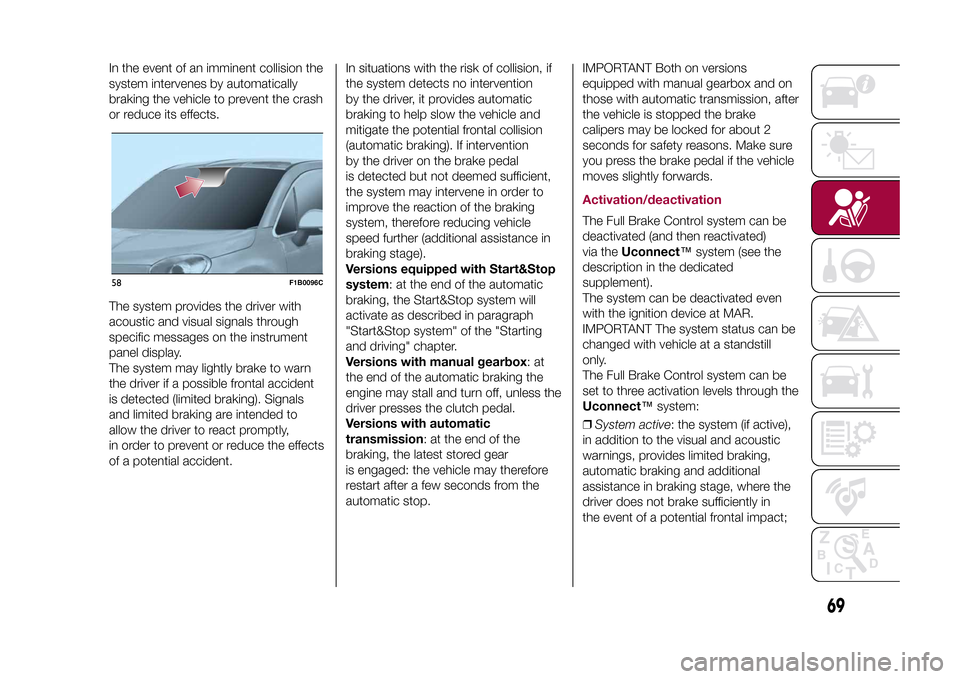
If an obstruction is signalled, clean the
area of the windscreen indicated in
fig. 58 and check that the message has
disappeared.
70
SAFETY
15-12-2014 8:23 Pagina 70
Page 74 of 240
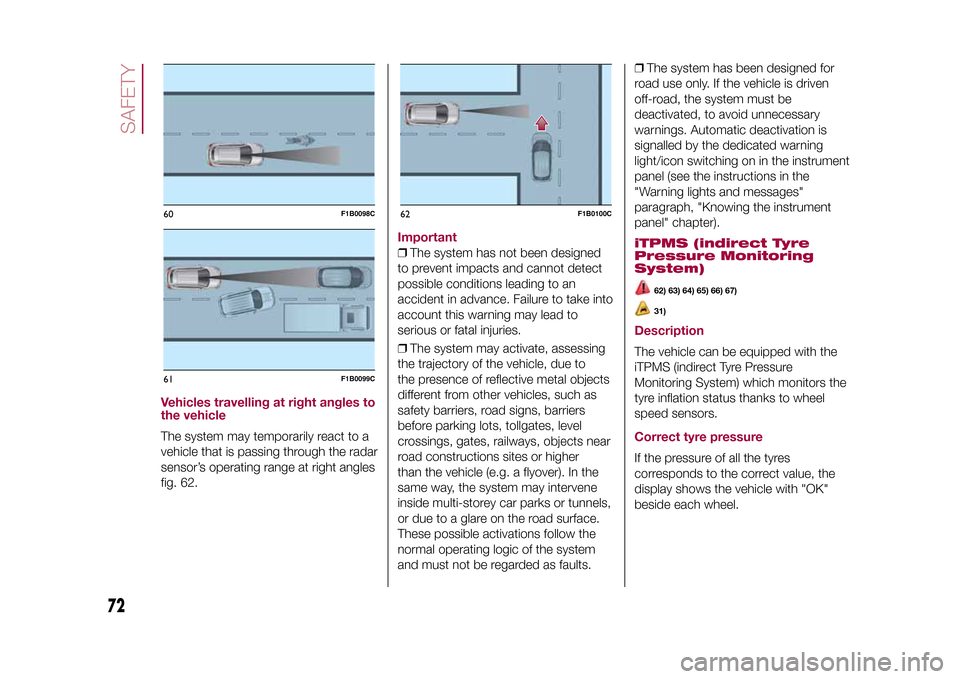
Vehicles travelling at right angles to
the vehicleThe system may temporarily react to a
vehicle that is passing through the radar
sensor’s operating range at right angles
fig. 62.
Important❒The system has not been designed
to prevent impacts and cannot detect
possible conditions leading to an
accident in advance. Failure to take into
account this warning may lead to
serious or fatal injuries.
❒The system may activate, assessing
the trajectory of the vehicle, due to
the presence of reflective metal objects
different from other vehicles, such as
safety barriers, road signs, barriers
before parking lots, tollgates, level
crossings, gates, railways, objects near
road constructions sites or higher
than the vehicle (e.g. a flyover). In the
same way, the system may intervene
inside multi-storey car parks or tunnels,
or due to a glare on the road surface.
These possible activations follow the
normal operating logic of the system
and must not be regarded as faults.❒The system has been designed for
road use only. If the vehicle is driven
off-road, the system must be
deactivated, to avoid unnecessary
warnings. Automatic deactivation is
signalled by the dedicated warning
light/icon switching on in the instrument
panel (see the instructions in the
"Warning lights and messages"
paragraph, "Knowing the instrument
panel" chapter).
iTPMS (indirect Tyre
Pressure Monitoring
System)
62) 63) 64) 65) 66) 67)31)
DescriptionThe vehicle can be equipped with the
iTPMS (indirect Tyre Pressure
Monitoring System) which monitors the
tyre inflation status thanks to wheel
speed sensors.Correct tyre pressureIf the pressure of all the tyres
corresponds to the correct value, the
display shows the vehicle with "OK"
beside each wheel.
60
F1B0098C
61
F1B0099C
62
F1B0100C
72
SAFETY
15-12-2014 8:23 Pagina 72