check engine light FIAT 500X 2016 2.G User Guide
[x] Cancel search | Manufacturer: FIAT, Model Year: 2016, Model line: 500X, Model: FIAT 500X 2016 2.GPages: 587, PDF Size: 5.18 MB
Page 269 of 587
Lights
Have someone observe the operation of brake lights and
exterior lights while you work the controls. Check turn
signal and high beam indicator lights on the instrument
panel.
Door Latches
Check for proper closing, latching, and locking.
Fluid Leaks
Check area under vehicle after overnight parking for fuel,
engine coolant, oil, or other fluid leaks. Also, if gasoline
fumes are detected, or if fuel or brake fluid leaks are
suspected, the cause should be located and corrected
immediately.
6
SAFETY 267
Page 350 of 587
Shallow Standing Water
Although your vehicle is capable of driving through
shallow standing water, consider the following Cautions
and Warnings before doing so.
WARNING!
•Driving through standing water limits your vehi-
cle’s traction capabilities. Do not exceed 5 mph
(8 km/h) when driving through standing water.
• Driving through standing water limits your vehi-
cle’s braking capabilities, which increases stopping
distances. Therefore, after driving through stand-
ing water, drive slowly and lightly press on the
brake pedal several times to dry the brakes.
• Failure to follow these warnings may result in
injuries that are serious or fatal to you, your pas-
sengers, and others around you.
CAUTION!
• Always check the depth of the standing water
before driving through it. Never drive through
standing water that is deeper than the bottom of
the tire rims mounted on the vehicle.
• Determine the condition of the road or the path
that is under water and if there are any obstacles in
the way before driving through the standing water.
• Do not exceed 5 mph (8 km/h) when driving
through standing water. This will minimize wave
effects.
• Driving through standing water may cause damage
to your vehicle’s drivetrain components. Always
inspect your vehicle’s fluids (i.e., engine oil, trans-
mission, axle, etc.) for signs of contamination (i.e.,
fluid that is milky or foamy in appearance) after
driving through standing water. Do not continue to
(Continued)
348 STARTING AND OPERATING
Page 413 of 587
•Turn off the Fuel Pump Heater.
• Turn off the HVAC Blower Motor.
• Close the HVAC Circulation Door.
ENHANCED ACCIDENT RESPONSE SYSTEM
RESET PROCEDURE
After the event occurs, when the system is active, a
message regarding fuel cutoff is displayed. Turn the
ignition switch from ignition AVV/START or MAR/
ACC/ON/RUN to ignition STOP/OFF/LOCK. Care-
fully check the vehicle for fuel leaks in the engine
compartment and on the ground near the engine com-
partment and fuel tank before resetting the system and
starting the engine.
Depending on the nature of the event the left and right
turn signal lights, located in the instrument panel, may
both be blinking and will continue to blink. In order to move your vehicle to the side of the road, you must
follow the system reset procedure.
Customer Action Customer Will See
1. Turn Ignition OFF.
(Turn Signal Switch Must Be Placed In Neutral State).
2. Turn Ignition ON. Left Turn Light Is OFF. Right Turn LightBLINKS.
3. Turn Right Turn Signal Switch ON. Right Turn Light Is ON
SOLID. Left Turn Light BLINKS.
4. Turn Left Turn Signal Switch ON. Left Turn Light Is ON
SOLID. Right Turn Signal Light BLINKS.
8
IN CASE OF EMERGENCY 411
Page 433 of 587
EMISSIONS INSPECTION AND MAINTENANCE
PROGRAMS
In some localities, it may be a legal requirement to pass
an inspection of your vehicle’s emissions control system.
Failure to pass could prevent vehicle registration.For states that require an Inspection and Mainte-
nance (I/M), this check verifies the “Malfunction
Indicator Light (MIL)” is functioning and is not
on when the engine is running, and that the OBD II
system is ready for testing.
Normally, the OBD II system will be ready. The OBD II
system may notbe ready if your vehicle was recently
serviced, recently had a dead battery or a battery replace-
ment. If the OBD II system should be determined not
ready for the I/M test, your vehicle may fail the test. Your vehicle has a simple ignition actuated test, which
you can use prior to going to the test station. To check if
your vehicle’s OBD II system is ready, you must do the
following:
1. Cycle the ignition switch to the ON position, but do
not crank or start the engine.
NOTE: If you crank or start the engine, you will have to
start this test over.
2. As soon as you cycle the ignition switch to the ON position, you will see the Malfunction Indicator Light
(MIL) symbol come on as part of a normal bulb check.
3. Approximately 15 seconds later, one of two things will happen:
• The MIL will flash for about 10 seconds and then
return to being fully illuminated until you turn OFF
9
MAINTAINING AND CARING FOR YOUR VEHICLE 431
Page 436 of 587
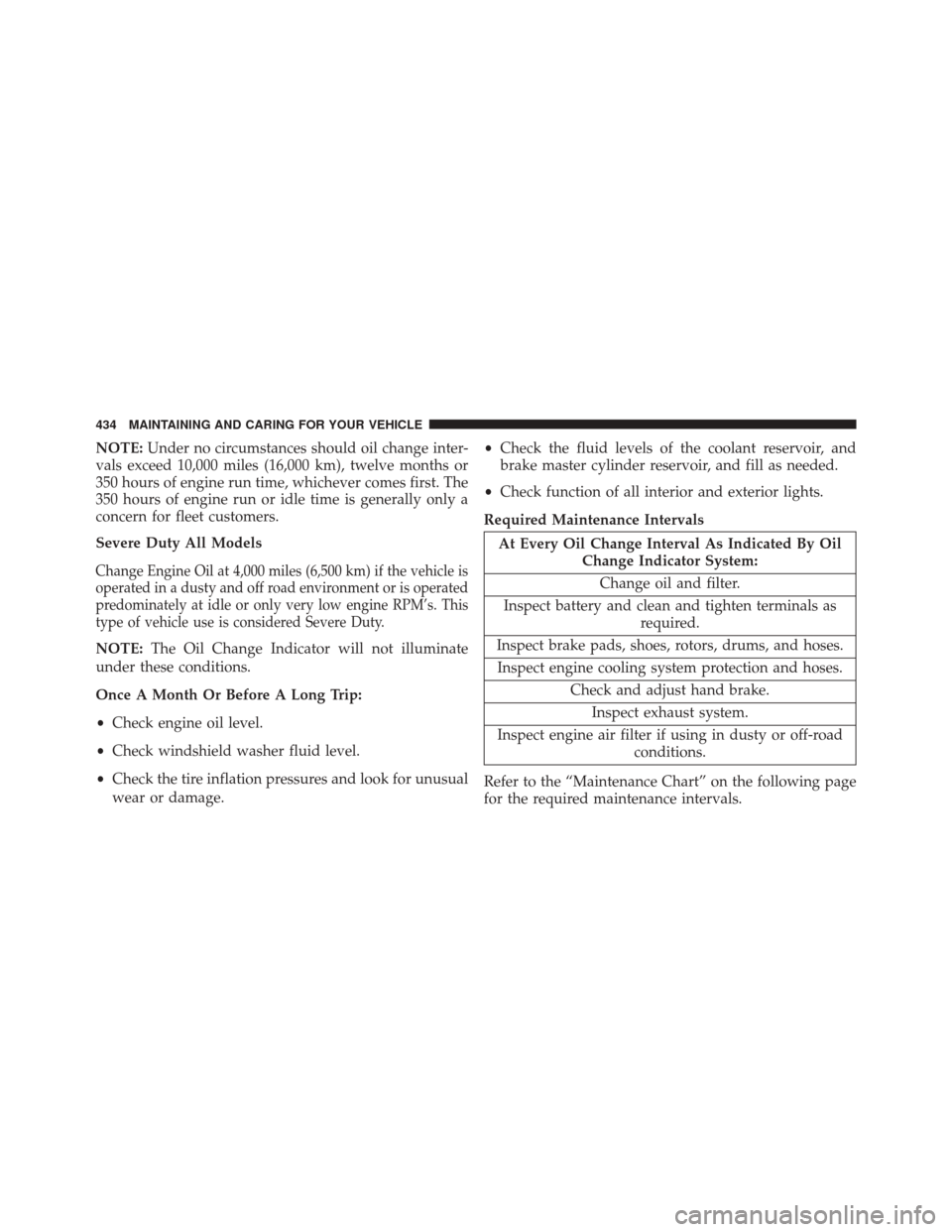
NOTE:Under no circumstances should oil change inter-
vals exceed 10,000 miles (16,000 km), twelve months or
350 hours of engine run time, whichever comes first. The
350 hours of engine run or idle time is generally only a
concern for fleet customers.
Severe Duty All Models
Change Engine Oil at 4,000 miles (6,500 km) if the vehicle is
operated in a dusty and off road environment or is operated
predominately at idle or only very low engine RPM’s. This
type of vehicle use is considered Severe Duty.
NOTE: The Oil Change Indicator will not illuminate
under these conditions.
Once A Month Or Before A Long Trip:
• Check engine oil level.
• Check windshield washer fluid level.
• Check the tire inflation pressures and look for unusual
wear or damage. •
Check the fluid levels of the coolant reservoir, and
brake master cylinder reservoir, and fill as needed.
• Check function of all interior and exterior lights.
Required Maintenance Intervals
At Every Oil Change Interval As Indicated By Oil Change Indicator System:
Change oil and filter.
Inspect battery and clean and tighten terminals as required.
Inspect brake pads, shoes, rotors, drums, and hoses. Inspect engine cooling system protection and hoses. Check and adjust hand brake.Inspect exhaust system.
Inspect engine air filter if using in dusty or off-road conditions.
Refer to the “Maintenance Chart” on the following page
for the required maintenance intervals.
434 MAINTAINING AND CARING FOR YOUR VEHICLE
Page 438 of 587
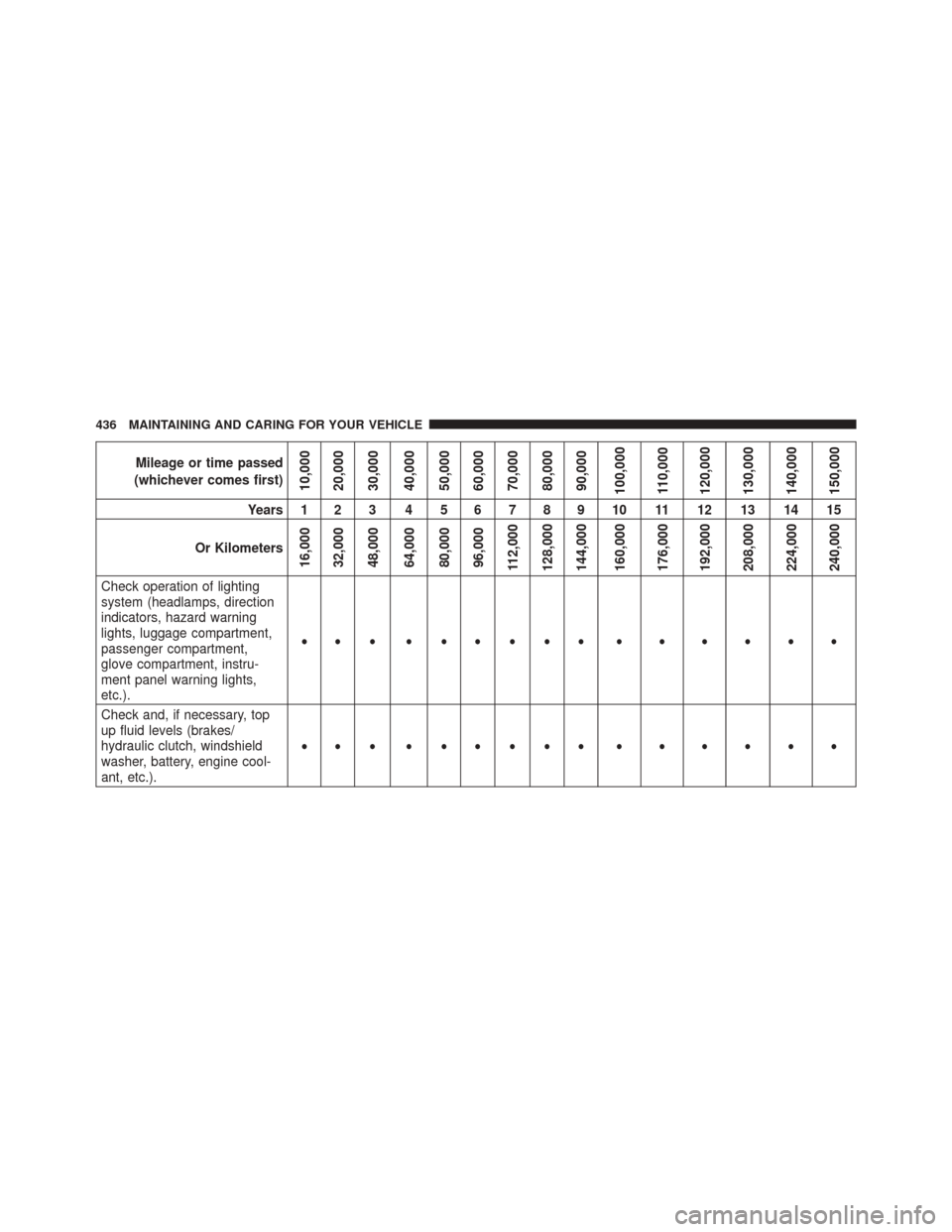
Mileage or time passed
(whichever comes first)
10,000
20,000
30,000
40,000
50,000
60,000
70,000
80,000
90,000
100,000
110,000
120,000
130,000
140,000
150,000
Years 1 2 3 4 5 6 7 8 9 10 11 12 13 14 15
Or Kilometers
16,000
32,000
48,000
64,000
80,000
96,000
112,000
128,000
144,000
160,000
176,000
192,000
208,000
224,000
240,000
Check operation of lighting
system (headlamps, direction
indicators, hazard warning
lights, luggage compartment,
passenger compartment,
glove compartment, instru-
ment panel warning lights,
etc.). •••••••••••••••
Check and, if necessary, top
up fluid levels (brakes/
hydraulic clutch, windshield
washer, battery, engine cool-
ant, etc.). •••••••••••••••
436 MAINTAINING AND CARING FOR YOUR VEHICLE
Page 466 of 587
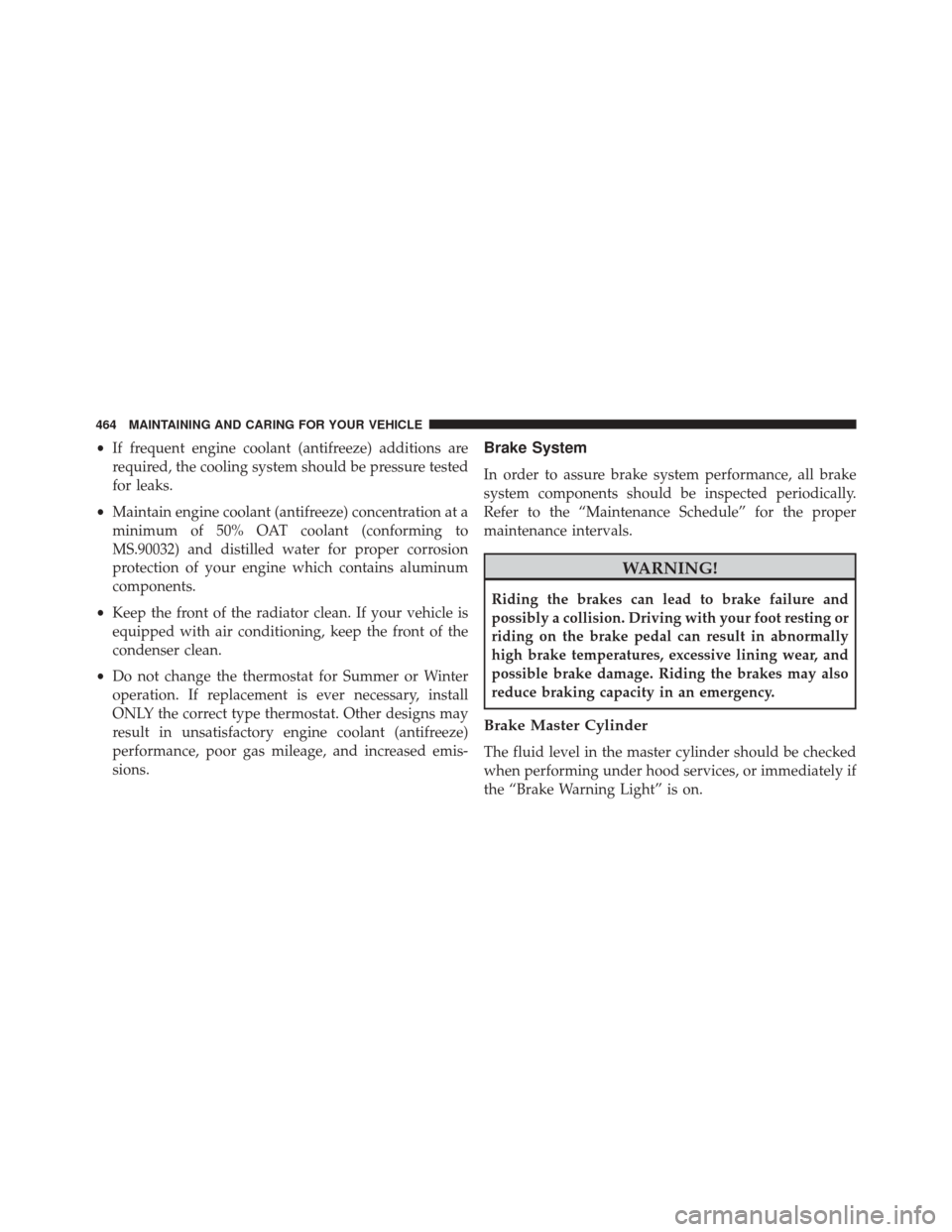
•If frequent engine coolant (antifreeze) additions are
required, the cooling system should be pressure tested
for leaks.
• Maintain engine coolant (antifreeze) concentration at a
minimum of 50% OAT coolant (conforming to
MS.90032) and distilled water for proper corrosion
protection of your engine which contains aluminum
components.
• Keep the front of the radiator clean. If your vehicle is
equipped with air conditioning, keep the front of the
condenser clean.
• Do not change the thermostat for Summer or Winter
operation. If replacement is ever necessary, install
ONLY the correct type thermostat. Other designs may
result in unsatisfactory engine coolant (antifreeze)
performance, poor gas mileage, and increased emis-
sions.Brake System
In order to assure brake system performance, all brake
system components should be inspected periodically.
Refer to the “Maintenance Schedule” for the proper
maintenance intervals.
WARNING!
Riding the brakes can lead to brake failure and
possibly a collision. Driving with your foot resting or
riding on the brake pedal can result in abnormally
high brake temperatures, excessive lining wear, and
possible brake damage. Riding the brakes may also
reduce braking capacity in an emergency.
Brake Master Cylinder
The fluid level in the master cylinder should be checked
when performing under hood services, or immediately if
the “Brake Warning Light” is on.
464 MAINTAINING AND CARING FOR YOUR VEHICLE
Page 571 of 587
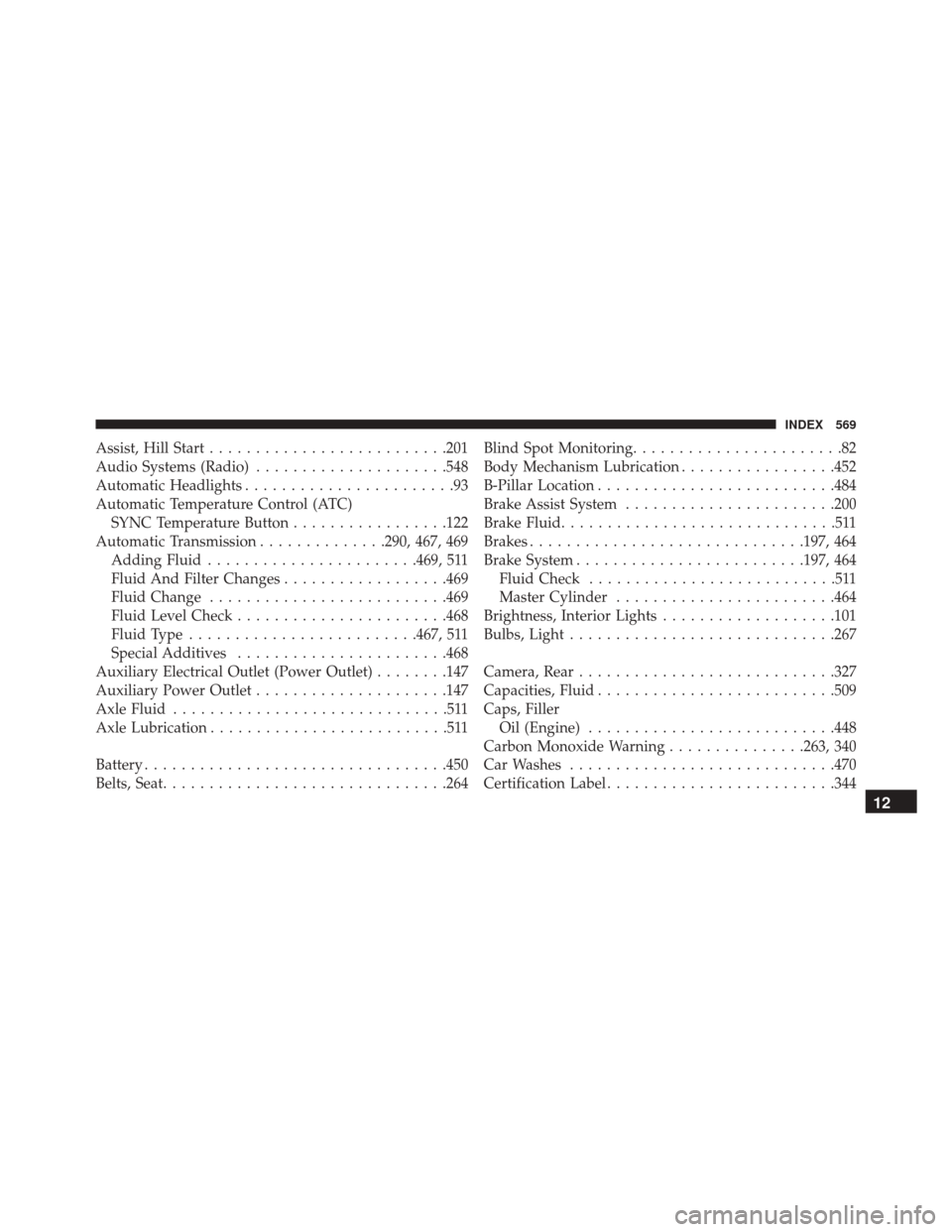
Assist, Hill Start......................... .201
Audio Systems (Radio) .....................548
Automatic Headlights .......................93
Automatic Temperature Control (ATC) SYNC Temperature Button .................122
Automatic Transmission ..............290, 467, 469
Adding Fluid ...................... .469, 511
Fluid And Filter Changes ..................469
Fluid Change ......................... .469
Fluid Level Check ...................... .468
Fluid Type ........................ .467, 511
Special Additives ...................... .468
Auxiliary Electrical Outlet (Power Outlet) ........147
Auxiliary Power Outlet .....................147
Axle Fluid ..............................511
Axle Lubrication ..........................511
Battery ................................ .450
Belts, Seat .............................. .264Blind Spot Monitoring
.......................82
Body Mechanism Lubrication .................452
B-Pillar Location ......................... .484
Brake Assist System ...................... .200
Brake Fluid ..............................511
Brakes ............................. .197, 464
Brake System ........................ .197, 464
Fluid Check ...........................511
Master Cylinder ....................... .464
Brightness, Interior Lights ...................101
Bulbs, Light ............................ .267
Camera, Rear ........................... .327
Capacities, Fluid ......................... .509
Caps, Filler Oil (Engine) .......................... .448
Carbon Monoxide Warning ...............263, 340
Car Washes ............................ .470
Certification Label ........................ .344
12
INDEX 569
Page 572 of 587
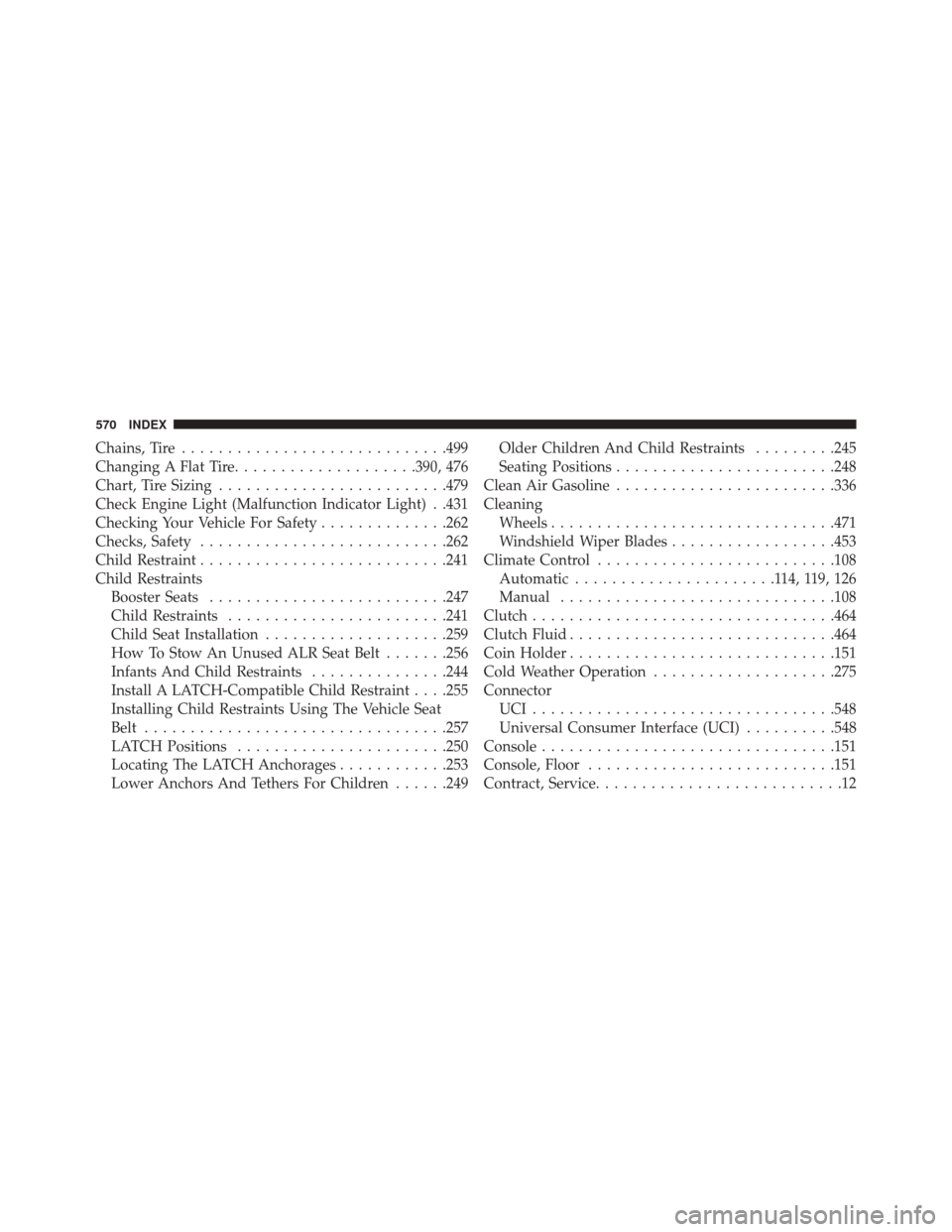
Chains, Tire............................ .499
Changing A Flat Tire ....................390, 476
Chart, Tire Sizing ........................ .479
Check Engine Light (Malfunction Indicator Light) . .431
Checking Your Vehicle For Safety ..............262
Checks, Safety .......................... .262
Child Restraint .......................... .241
Child Restraints Booster Seats ......................... .247
Child Restraints ....................... .241
Child Seat Installation ....................259
How To Stow An Unused ALR Seat Belt .......256
Infants And Child Restraints ...............244
Install A LATCH-Compatible Child Restraint . . . .255
Installing Child Restraints Using The Vehicle Seat
Belt ................................ .257
LATCH Positions ...................... .250
Locating The LATCH Anchorages ............253
Lower Anchors And Tethers For Children ......249Older Children And Child Restraints
.........245
Seating Positions ....................... .248
Clean Air Gasoline ....................... .336
Cleaning Wheels .............................. .471
Windshield Wiper Blades ..................453
Climate Control ......................... .108
Automatic ......................114,119,126
Manual ............................. .108
Clutch ................................ .464
Clutch Fluid ............................ .464
Coin Holder ............................ .151
Cold Weather Operation ....................275
Connector UCI................................ .548
Universal Consumer Interface (UCI) ..........548
Console ............................... .151
Console, Floor .......................... .151
Contract, Service ...........................12
570 INDEX
Page 574 of 587
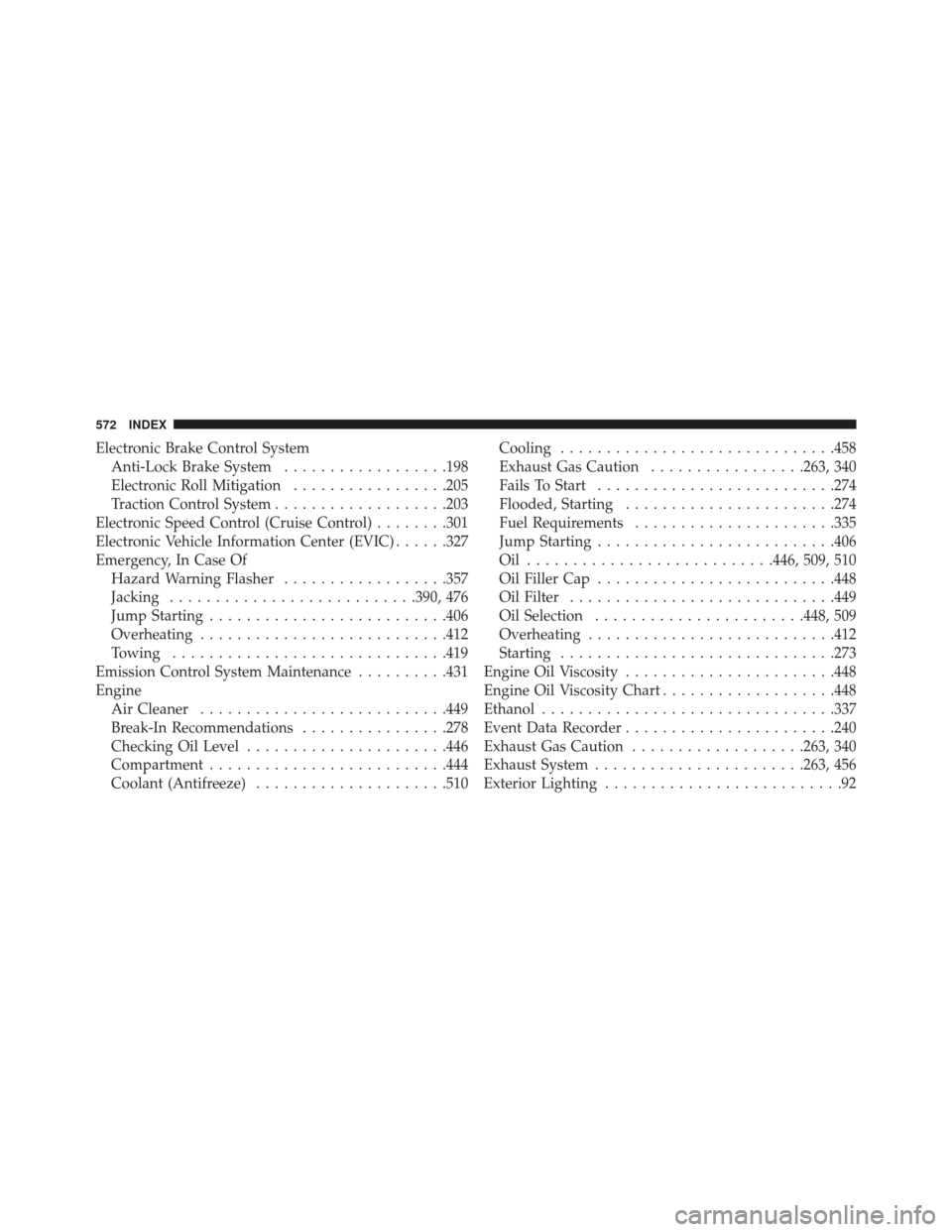
Electronic Brake Control SystemAnti-Lock Brake System ..................198
Electronic Roll Mitigation .................205
Traction Control System ...................203
Electronic Speed Control (Cruise Control) ........301
Electronic Vehicle Information Center (EVIC) ......327
Emergency, In Case Of Hazard Warning Flasher ..................357
Jacking .......................... .390, 476
Jump Starting ......................... .406
Overheating .......................... .412
Towing ............................. .419
Emission Control System Maintenance ..........431
Engine Air Cleaner .......................... .449
Break-In Recommendations ................278
Checking Oil Level ..................... .446
Compartment ......................... .444
Coolant (Antifreeze) .....................510 Cooling
............................. .458
Exhaust Gas Caution .................263, 340
Fails To Start ......................... .274
Flooded, Starting ...................... .274
Fuel Requirements ..................... .335
Jump Starting ......................... .406
Oil .......................... .446, 509, 510
Oil Filler Cap ......................... .448
Oil Filter ............................ .449
Oil Selection ...................... .448, 509
Overheating .......................... .412
Starting ............................. .273
Engine Oil Viscosity ...................... .448
Engine Oil Viscosity Chart ...................448
Ethanol ............................... .337
Event Data Recorder ...................... .240
Exhaust Gas Caution ...................263, 340
Exhaust System ...................... .263,
456
Exterior Lighting ..........................92
572 INDEX