tow FIAT 500X 2016 2.G User Guide
[x] Cancel search | Manufacturer: FIAT, Model Year: 2016, Model line: 500X, Model: FIAT 500X 2016 2.GPages: 587, PDF Size: 5.18 MB
Page 148 of 587
NOTE:
•Do not insert objects in the glove compartments that
will not allow the compartment to fully close.
• The glove compartments should be completely closed
while the vehicle is in motion.
Sun Visors “Slide-On-Rod”
Sun visors are located on both sides of the rearview
mirror. The visors can be lowered or moved to the side to
help block sunlight from entering the windshield or door
glass.
To move the sun visor against the driver or passenger
door glass, remove the sun visor from the hook and turn
it toward the side window. The visors also have illuminated vanity mirrors to allow
use in low light conditions.
Lift upward on the mirror cover to access the mirror.
Sun Visor Mirror Cover
146 GETTING TO KNOW YOUR VEHICLE
Page 149 of 587
Extendible Sun Visor
To extend the sun visor, proceed as follows:
1. Place the sun visor against the door glass by detachingit from the hook and turning it toward the side
window.
2. Slide the visor.
3. Slide out the sun visor extender.
Power Outlets
The front power outlet is located under the center stack of
the instrument panel. It only operates with the ignition in
the MAR/RUN position.
Fully Extended Sun Visor
4
GETTING TO KNOW YOUR VEHICLE 147
Page 162 of 587
ONBOARD DIAGNOSTIC SYSTEM (OBD II)
Your vehicle is equipped with a sophisticated onboard
diagnostic system called OBD II. This system monitors
the performance of the emissions, engine, and automatic
transmission control systems. When these systems are
operating properly, your vehicle will provide excellent
performance and fuel economy, as well as engine emis-
sions well within current government regulations.
If any of these systems require service, the OBD II system
will turn on the “Malfunction Indicator Light (MIL).” It
will also store diagnostic codes and other information to
assist your service technician in making repairs. Al-
though your vehicle will usually be drivable and not
need towing, see your authorized dealer for service as
soon as possible.
CAUTION!
•Prolonged driving with the MIL on could cause
further damage to the emission control system. It
could also affect fuel economy and driveability.
The vehicle must be serviced before any emissions
tests can be performed.
• If the MIL is flashing, while the engine is running,
severe catalytic converter damage and power loss
will soon occur. Immediate service is required.
160 GETTING TO KNOW YOUR INSTRUMENT CLUSTER
Page 190 of 587
Electronic Throttle Control (ETC)•What Does It Mean
The light will illuminate when the ignition
is first placed in the MAR/RUN or AVV/
START position and remain on briefly as a
bulb check. If the light does not come on during
starting, have the system checked by an authorized
dealer.
If a problem is detected, the light will come on while
the engine is running. Bring the vehicle to a complete
stop and place it into PARK. Cycle the ignition to the
STOP/OFF position; the light should turn off.
If the light remains lit with the engine running, your
vehicle will usually be drivable. However, see an
authorized dealer for service as soon as possible.
If the light is flashing when the engine is running,
immediate service is required. You may experience reduced performance, an elevated/rough idle or en-
gine stall, and your vehicle may require towing.
Automatic Transmission Failure •What Does It Mean
This light will illuminate when the system
detects a failure of the automatic transmis-
sion.
• What To Do
Contact an authorized dealer as soon as possible.
Oil Temperature Warning Light •What Does It Mean
This light indicates engine oil temperature
is high.
188 GETTING TO KNOW YOUR INSTRUMENT CLUSTER
Page 194 of 587
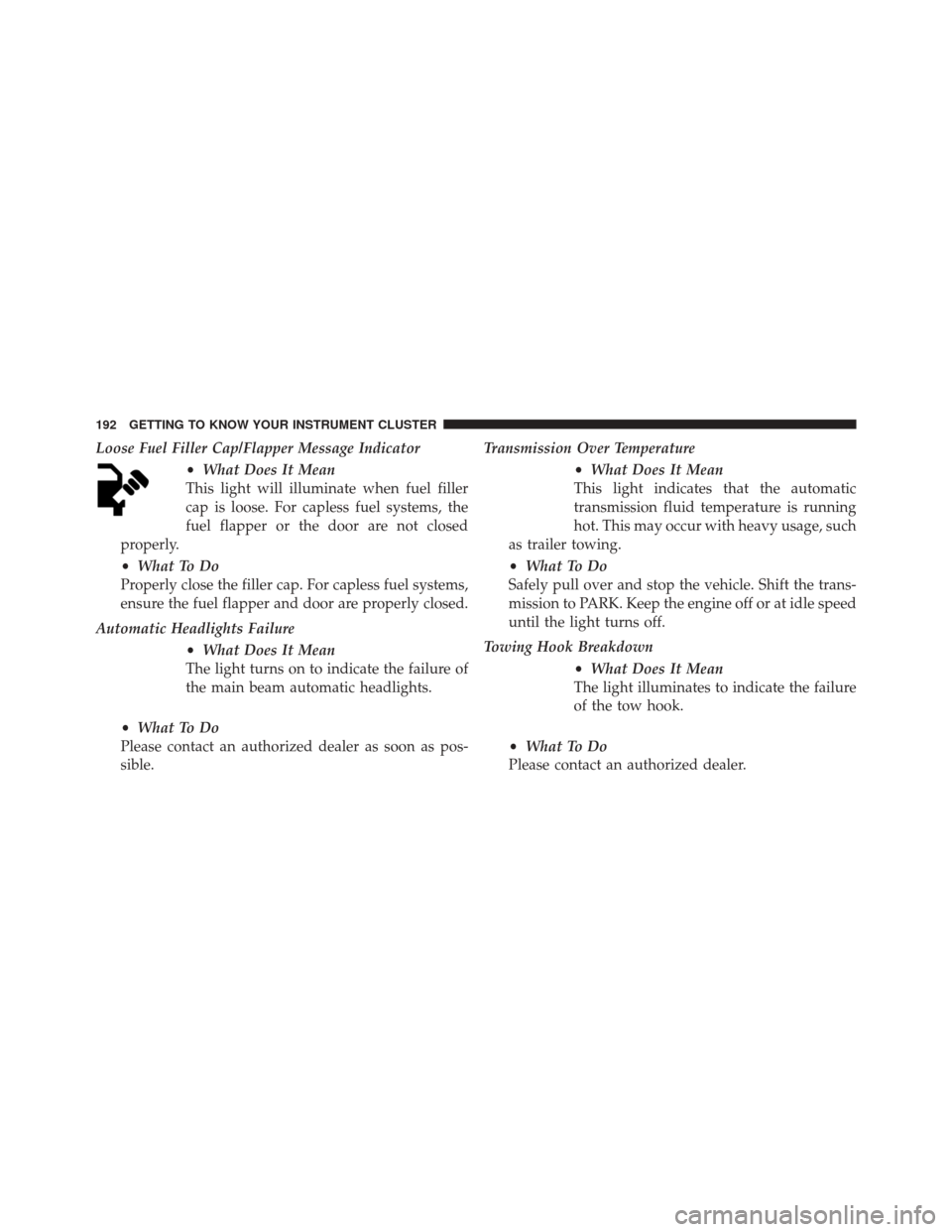
Loose Fuel Filler Cap/Flapper Message Indicator•What Does It Mean
This light will illuminate when fuel filler
cap is loose. For capless fuel systems, the
fuel flapper or the door are not closed
properly.
• What To Do
Properly close the filler cap. For capless fuel systems,
ensure the fuel flapper and door are properly closed.
Automatic Headlights Failure •What Does It Mean
The light turns on to indicate the failure of
the main beam automatic headlights.
• What To Do
Please contact an authorized dealer as soon as pos-
sible. Transmission Over Temperature
•What Does It Mean
This light indicates that the automatic
transmission fluid temperature is running
hot. This may occur with heavy usage, such
as trailer towing.
• What To Do
Safely pull over and stop the vehicle. Shift the trans-
mission to PARK. Keep the engine off or at idle speed
until the light turns off.
Towing Hook Breakdown •What Does It Mean
The light illuminates to indicate the failure
of the tow hook.
• What To Do
Please contact an authorized dealer.
192 GETTING TO KNOW YOUR INSTRUMENT CLUSTER
Page 212 of 587
BeltAlert Warning Sequence
The BeltAlert warning sequence is activated when the
vehicle is moving above a specified vehicle speed range
and the driver or outboard front seat passenger is un-
buckled (the outboard front passenger seat BeltAlert is
not active when the outboard front passenger seat is
unoccupied). The BeltAlert warning sequence starts by
blinking the Seat Belt Reminder Light and sounding an
intermittent chime. Once the BeltAlert warning sequence
has completed, the Seat Belt Reminder Light will remain
on until the seat belts are buckled. The BeltAlert warning
sequence may repeat based on vehicle speed until the
driver and occupied outboard front seat passenger seat
belts are buckled. The driver should instruct all occu-
pants to buckle their seat belts.Change Of Status
If the driver or outboard front seat passenger (if
equipped with outboard front passenger seat BeltAlert)
unbuckles their seat belt while the vehicle is traveling,
the BeltAlert warning sequence will begin until the seat
belts are buckled again. The outboard front passenger
seat BeltAlert is not active when the outboard front
passenger seat is unoccupied. BeltAlert may be triggered
when an animal or heavy object is on the outboard front
passenger seat or when the seat is folded flat (if
equipped). It is recommended that pets be restrained in
the rear seat (if equipped) in pet harnesses or pet carriers
that are secured by seat belts, and cargo is properly
stowed.
BeltAlert can be activated or deactivated by your autho-
rized dealer. FCA US LLC does not recommend deacti-
vating BeltAlert.
210 SAFETY
Page 217 of 587
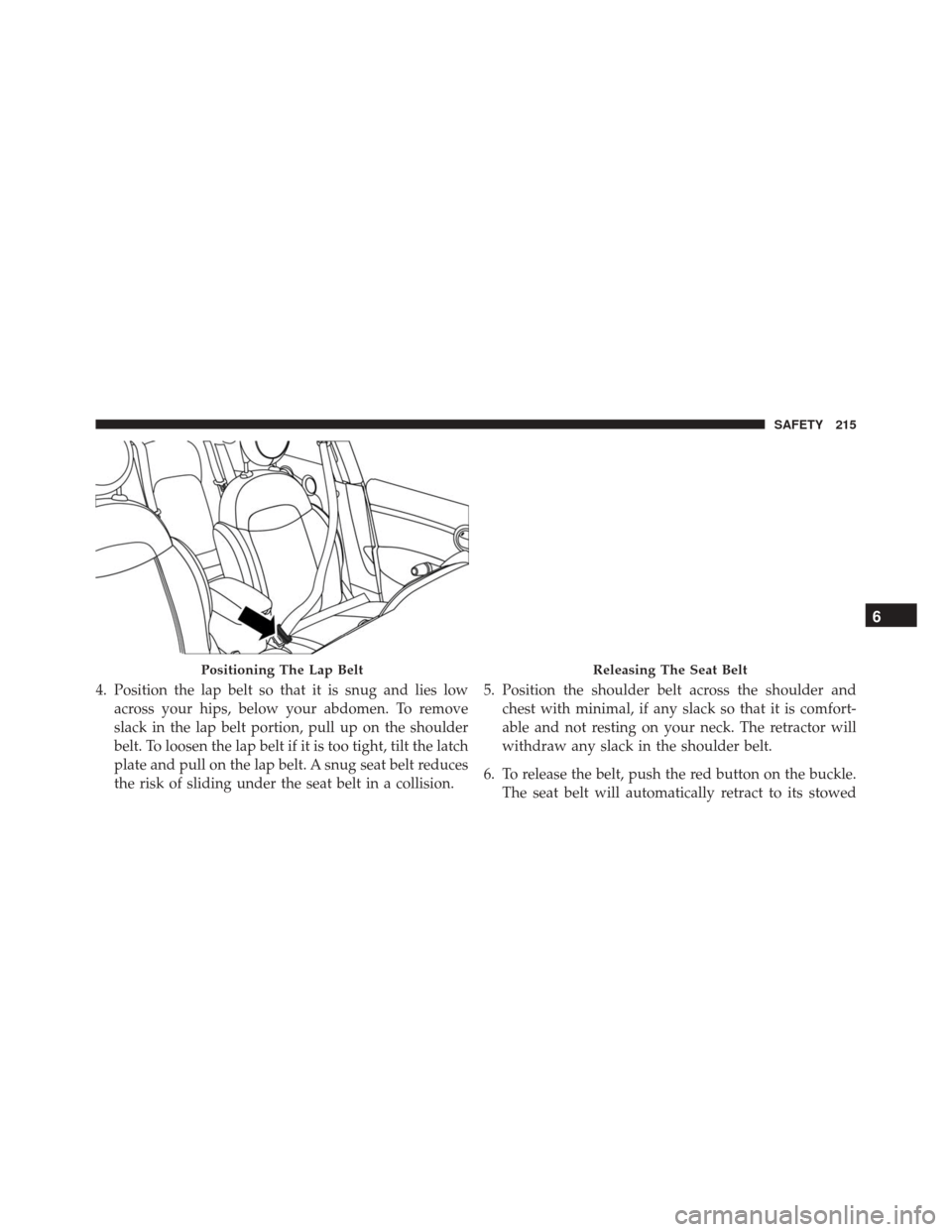
4. Position the lap belt so that it is snug and lies lowacross your hips, below your abdomen. To remove
slack in the lap belt portion, pull up on the shoulder
belt. To loosen the lap belt if it is too tight, tilt the latch
plate and pull on the lap belt. A snug seat belt reduces
the risk of sliding under the seat belt in a collision. 5. Position the shoulder belt across the shoulder and
chest with minimal, if any slack so that it is comfort-
able and not resting on your neck. The retractor will
withdraw any slack in the shoulder belt.
6. To release the belt, push the red button on the buckle. The seat belt will automatically retract to its stowed
Positioning The Lap BeltReleasing The Seat Belt
6
SAFETY 215
Page 219 of 587
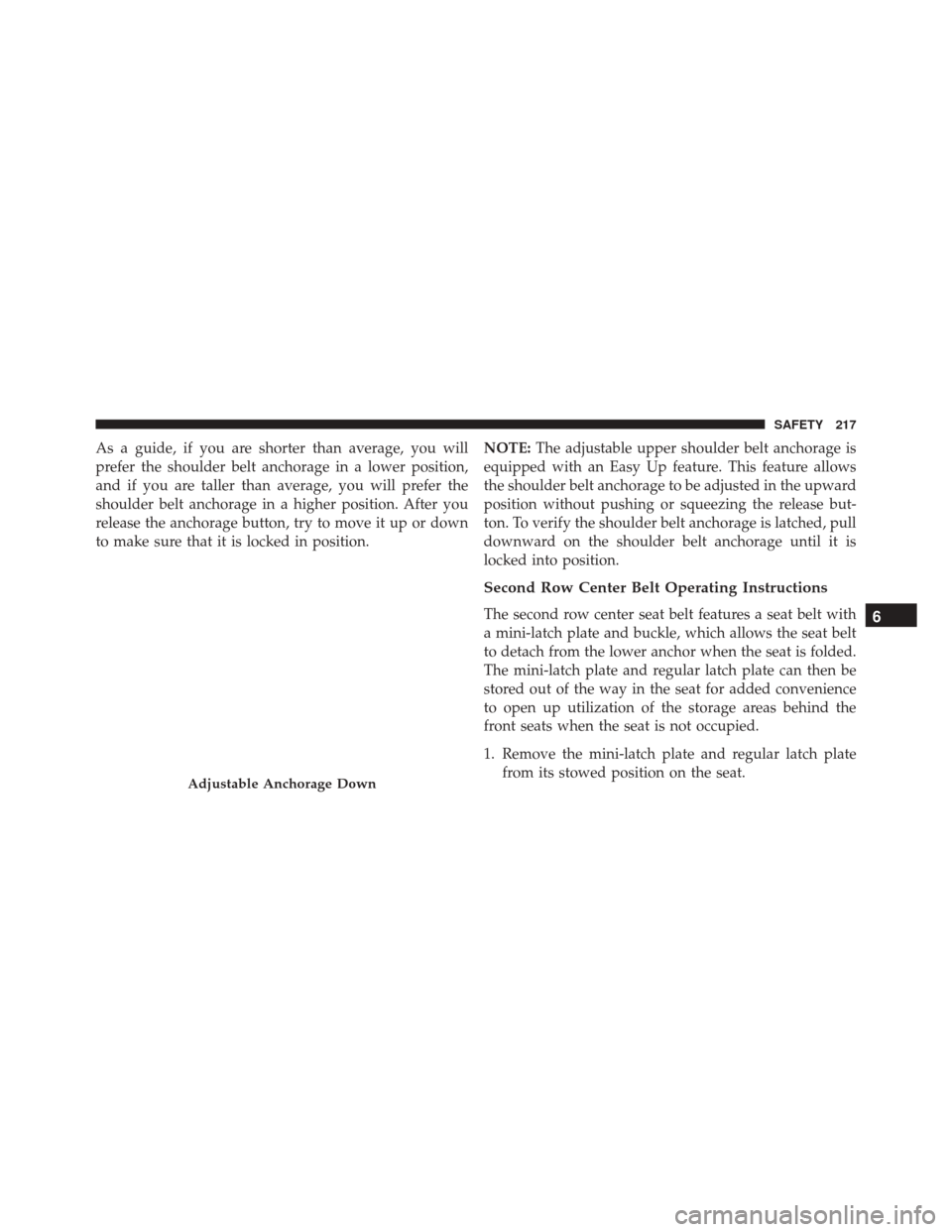
As a guide, if you are shorter than average, you will
prefer the shoulder belt anchorage in a lower position,
and if you are taller than average, you will prefer the
shoulder belt anchorage in a higher position. After you
release the anchorage button, try to move it up or down
to make sure that it is locked in position.NOTE:
The adjustable upper shoulder belt anchorage is
equipped with an Easy Up feature. This feature allows
the shoulder belt anchorage to be adjusted in the upward
position without pushing or squeezing the release but-
ton. To verify the shoulder belt anchorage is latched, pull
downward on the shoulder belt anchorage until it is
locked into position.
Second Row Center Belt Operating Instructions
The second row center seat belt features a seat belt with
a mini-latch plate and buckle, which allows the seat belt
to detach from the lower anchor when the seat is folded.
The mini-latch plate and regular latch plate can then be
stored out of the way in the seat for added convenience
to open up utilization of the storage areas behind the
front seats when the seat is not occupied.
1. Remove the mini-latch plate and regular latch plate from its stowed position on the seat.
Adjustable Anchorage Down
6
SAFETY 217
Page 221 of 587
7. Position the lap belt so that it is snug and lies lowacross your hips, below your abdomen. To remove
slack in the lap belt portion, pull up on the shoulder
belt. To loosen the lap belt if it is too tight, pull on the
lap belt. A snug seat belt reduces the risk of sliding
under the seat belt in a collision. 8. Position the shoulder belt on your chest so that it is
comfortable and not resting on your neck. The retrac-
tor will withdraw any slack in the seat belt.
9. To release the seat belt, push the red button on the buckle.
10. To disengage the mini-latch plate from the mini- buckle for storage, insert the regular latch plate into
the center red slot on the mini-buckle. The seat belt
will automatically retract to its stowed position. If
necessary, slide the latch plate down the webbing to
allow the seat belt to retract fully. Insert the mini-
latch plate and regular latch plate into its stowed
position.
Inserting Latch Plate Into Buckle
6
SAFETY 219
Page 257 of 587
Always follow the directions of the child restraint manu-
facturer when installing your child restraint. Not all child
restraint systems will be installed as described here.
To Install A LATCH-Compatible Child Restraint
If the selected seating position has a Switchable Auto-
matic Locking Retractor (ALR) seat belt, stow the seat
belt, following the instructions below. See the section
“Installing Child Restraints Using the Vehicle Seat Belt”
to check what type of seat belt each seating position has.
1. Loosen the adjusters on the lower straps and on thetether strap of the child seat so that you can more
easily attach the hooks or connectors to the vehicle
anchorages.
2. Place the child seat between the lower anchorages for that seating position. For some second row seats, you
may need to recline the seat and / or raise the head
restraint to get a better fit. If the rear seat can be moved forward and rearward in the vehicle, you may wish to
move it to its rear-most position to make room for the
child seat. You may also move the front seat forward
to allow more room for the child seat.
3. Attach the lower hooks or connectors of the child restraint to the lower anchorages in the selected seat-
ing position.
4. If the child restraint has a tether strap, connect it to the top tether anchorage. See the section “Installing Child
Restraints Using the Top Tether Anchorage” for direc-
tions to attach a tether anchor.
5. Tighten all of the straps as you push the child restraint rearward and downward into the seat. Remove slack
in the straps according to the child restraint manufac-
turer ’s instructions.
6
SAFETY 255