battery FIAT 500X 2016 2.G Owner's Manual
[x] Cancel search | Manufacturer: FIAT, Model Year: 2016, Model line: 500X, Model: FIAT 500X 2016 2.GPages: 587, PDF Size: 5.18 MB
Page 239 of 587
Customer Action Customer Will See
6. Turn Left Turn Signal Switch ON. Left Turn Light Is ON
SOLID. Right Turn Light Is ON SOLID.
7. Turn Left Turn Signal
Switch OFF. (Turn Signal
Switch Must Be Placed In Neutral State). Left Turn light Is OFF.
Right Turn Light is OFF.
8. Turn Ignition OFF.
9. Turn Hazard Flashers OFF (Manually). System is now reset and
the engine may be started.
If a reset procedure step is not completed within 60
seconds, then the turn signal lights will blink and the
reset procedure must be performed again in order to be
successful.Air Bag Warning Light
The air bags must be ready to inflate for your protection in a collision. The Occupant Restraint Control-
ler (ORC) monitors the internal circuits and
interconnecting wiring associated with air bag
system electrical components.
The ORC monitors the readiness of the electronic parts of
the air bag system whenever the ignition switch is in the
AVV/START or MAR/ACC/ON/RUN position. If the
ignition switch is in the STOP/OFF/LOCK position the
air bag system is not on and the air bags will not inflate.
The ORC contains a backup power supply system that
may deploy the air bags even if the battery loses power or
it becomes disconnected prior to deployment.
The ORC turns on the Air Bag Warning Light in the
instrument panel for approximately four to eight seconds
for a self-check when the ignition switch is first turned to
6
SAFETY 237
Page 277 of 587
floor and hold it there. Crank the engine for no more than
15 seconds. This should clear any excess fuel in case the
engine is flooded. Leave the ignition key in the MAR/
RUN position, release the accelerator pedal and repeat
the “Normal Starting” procedure.
CAUTION!
To prevent damage to the starter, do not continuously
crank the engine for more than 25 seconds at a time.
Wait 60 seconds before trying again.
WARNING!
•Never pour fuel or other flammable liquid into the
throttle body air inlet opening in an attempt to start
the vehicle. This could result in flash fire causing
serious personal injury.
(Continued)
WARNING! (Continued)
•Do not attempt to push or tow your vehicle to get it
started. Vehicles equipped with an automatic trans-
mission cannot be started this way. Unburned fuel
could enter the catalytic converter and once the
engine has started, ignite and damage the converter
and vehicle.
• If the vehicle has a discharged battery, booster
cables may be used to obtain a start from a booster
battery or the battery in another vehicle. This type
of start can be dangerous if done improperly. Refer
to “Jump-Starting” in “In Case Of Emergency” for
further information.
Cold Weather Operation
To ensure reliable starting under extreme cold conditions
an externally powered electric block heater (available
from your authorized dealer) is required for the 1.4L
7
STARTING AND OPERATING 275
Page 278 of 587
Turbo engine below -20°F (-29°C) and for the 2.4L engine
below -29°F (-34°C) and is recommended for the 2.4L
engine below -20°F (-29°C).
To prevent possible engine damage while starting at low
temperatures, this vehicle will inhibit engine cranking
when the ambient temperature is less than -34°F (-35°C)
and the oil temperature sensor reading indicates an
engine block heater has not been used. The message
“plug in engine heater” will be displayed in the instru-
ment cluster when the ambient temperature is below -4°F
(-20°C) at the time the engine is shut off as a reminder to
avoid possible crank delays at the next cold start.
Extended Park Starting
NOTE:Extended Park condition occurs when the vehicle
has not been started or driven for at least 35 days.
1. Install a battery charger or jumper cables to the battery to ensure a full battery charge during the crank cycle. 2. Cycle the ignition in the START position and release it
when the engine starts.
3. If the engine fails to start within ten seconds, cycle the ignition to the STOP (OFF/LOCK) position, wait five
seconds to allow the starter to cool, then repeat the
Extended Park Starting procedure.
4. If the engine fails to start after eight attempts, allow the starter to cool for at least 10 minutes, then repeat
the procedure.
CAUTION!
To prevent damage to the starter, do not crank con-
tinuously for more than 10 seconds at a time. Wait 10
to 15 seconds before trying again.
276 STARTING AND OPERATING
Page 303 of 587
position. Also, the transmission is locked in PARK when-
ever the ignition is in the STOP/OFF position.
Vehicles With Mechanical Key:
This vehicle is equipped with a Key Ignition Park Inter-
lock which requires the transmission to be in PARK
before the ignition can be turned to the STOP/OFF (key
removal) position. The key can only be removed from the
ignition when the ignition is in the STOP/OFF position,
and the transmission is locked in PARK whenever the
ignition is in the STOP/OFF position.
If the vehicle’s battery becomes discharged, the key will
be trapped in the ignition switch even when the shift
lever is in PARK. To extract the key, refer to “Ignition Key
Removal Override” in “In Case Of Emergency”.
Brake/Transmission Shift Interlock System
This vehicle is equipped with a Brake Transmission Shift
Interlock system (BTSI) that holds the shift lever in PARKunless the brakes are applied. To shift the transmission
out of PARK, the ignition switch must be turned to the
MAR/RUN position (engine running or not) and the
brake pedal must be pressed.
The brake pedal must also be pressed before pushing the
button on the shift lever to shift from NEUTRAL into
DRIVE or REVERSE when the vehicle is stopped or
moving at low speeds.
SPEED CONTROL — IF EQUIPPED
When engaged, the Speed Control takes over accelerator
operations at speeds greater than 25 mph (40 km/h).
The Speed Control buttons are located on the right side of
the steering wheel.7
STARTING AND OPERATING 301
Page 359 of 587
HAZARD WARNING FLASHERS
The Hazard Warning flasher switch is located on the
switch bank below the radio.Push the switch to turn on the Hazard Warning
Flasher. When the switch is activated, all direc-
tional turn signals will flash on and off to warn oncoming
traffic of an emergency. Push the switch a second time to
turn off the Hazard Warning flashers.
This is an emergency warning system and it should not
be used when the vehicle is in motion. Use it when your
vehicle is disabled and it is creating a safety hazard for
other motorists.
When you must leave the vehicle to seek assistance, the
Hazard Warning flashers will continue to operate even
though the ignition is placed in the STOP/OFF position.
NOTE: With extended use the Hazard Warning flashers
may wear down your battery.
BULB REPLACEMENT
General Information
• Before you replace a bulb check the contacts to be sure
they are not oxidized.
• Replace the bulbs with the same type and wattage.
• After replacing a light bulb always check the correct
orientation.
• Before replacing a bulb that is not functioning check
that the fuse is intact.
NOTE: Lens fogging can occur under certain atmo-
spheric conditions. This will usually clear as atmospheric
conditions change to allow the condensation to change
back into a vapor. Turning the lamps on will usually
accelerate the clearing process.
8
IN CASE OF EMERGENCY 357
Page 380 of 587
WARNING!(Continued)
•Before replacing a fuse, make sure that the ignition
is off and that all the other services are switched off
and/or disengaged.
• If the replaced fuse blows again, contact an autho-
rized dealer.
• If a general protection fuse for safety systems (air
bag system, braking system), power unit systems
(engine system, gearbox system) or steering system
blows, contact an authorized dealer.
General Information
The fuses protect electrical systems against excessive current.
When a device does not work you must check the
electrical circuit inside the fuse for a break/melt.
Also please be aware that when using power outlets for
extended periods of time with the engine off may result
in vehicle battery discharge.
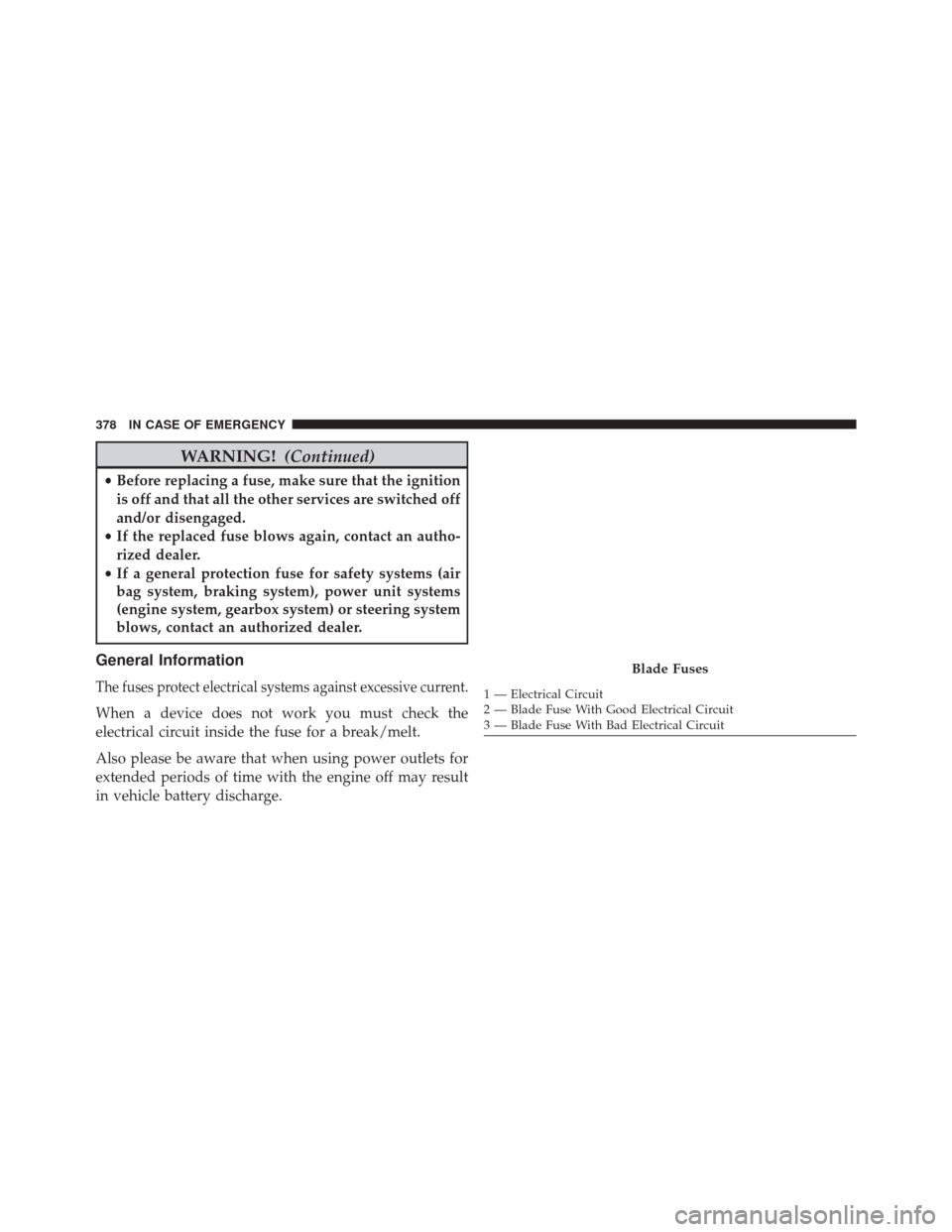
Blade Fuses
1 — Electrical Circuit
2 — Blade Fuse With Good Electrical Circuit
3 — Blade Fuse With Bad Electrical Circuit
378 IN CASE OF EMERGENCY
Page 383 of 587
Removing Fuse Cover and Locking Screw
Proceed as follows:
1. Slowly turn the screw counterclockwise.
2. Slowly release the screw.
3. Remove the fuse cover by sliding it upward.
Mounting Fuse Cover and Locking Screw
Proceed as follows:
1. Properly secure the fuse cover to the box, slide com-pletely from top to bottom.
2. Fully depress the screw, using the special screwdriver supplied.
3. Slowly turn the screw clockwise.
4. Release the screw.
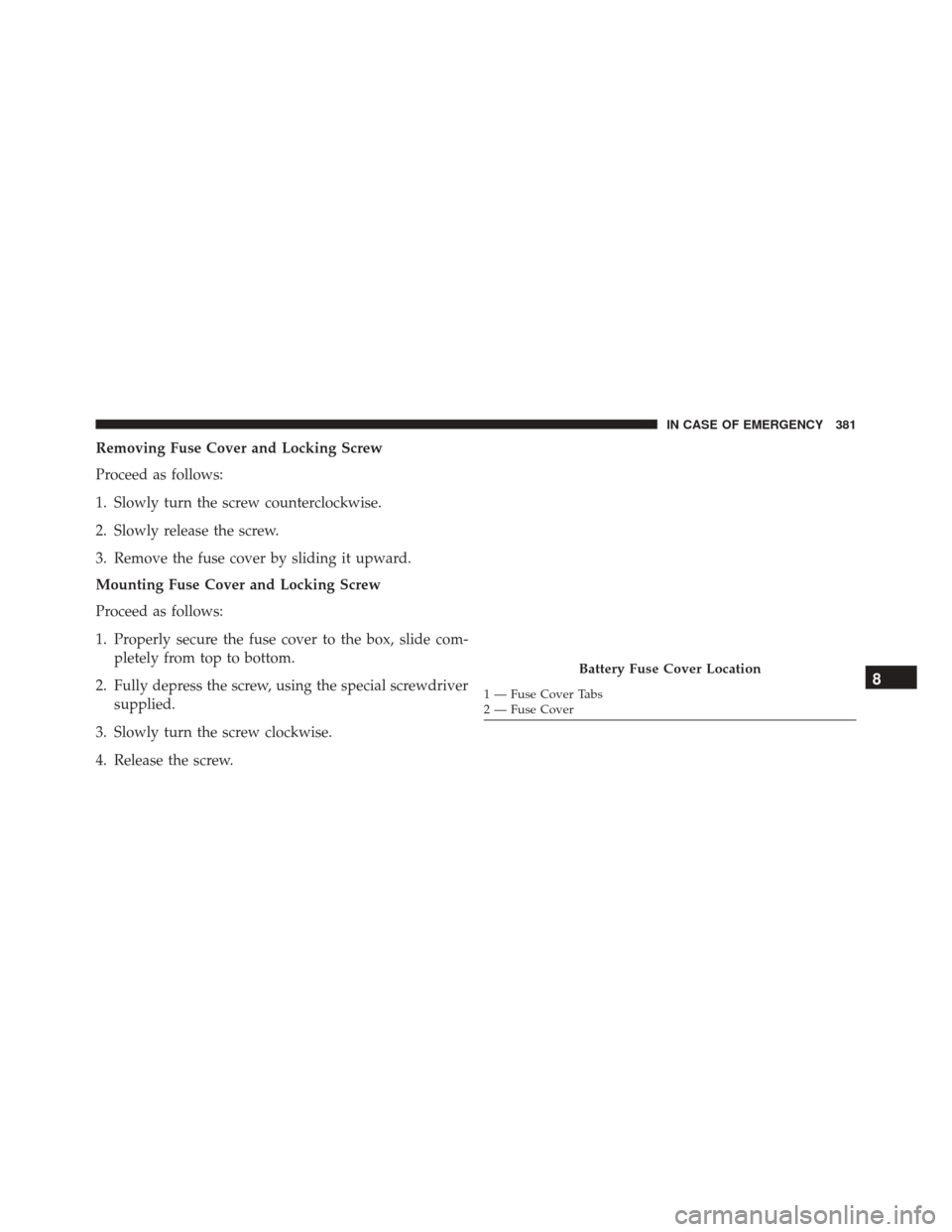
Battery Fuse Cover Location
1 — Fuse Cover Tabs
2 — Fuse Cover8
IN CASE OF EMERGENCY 381
Page 386 of 587
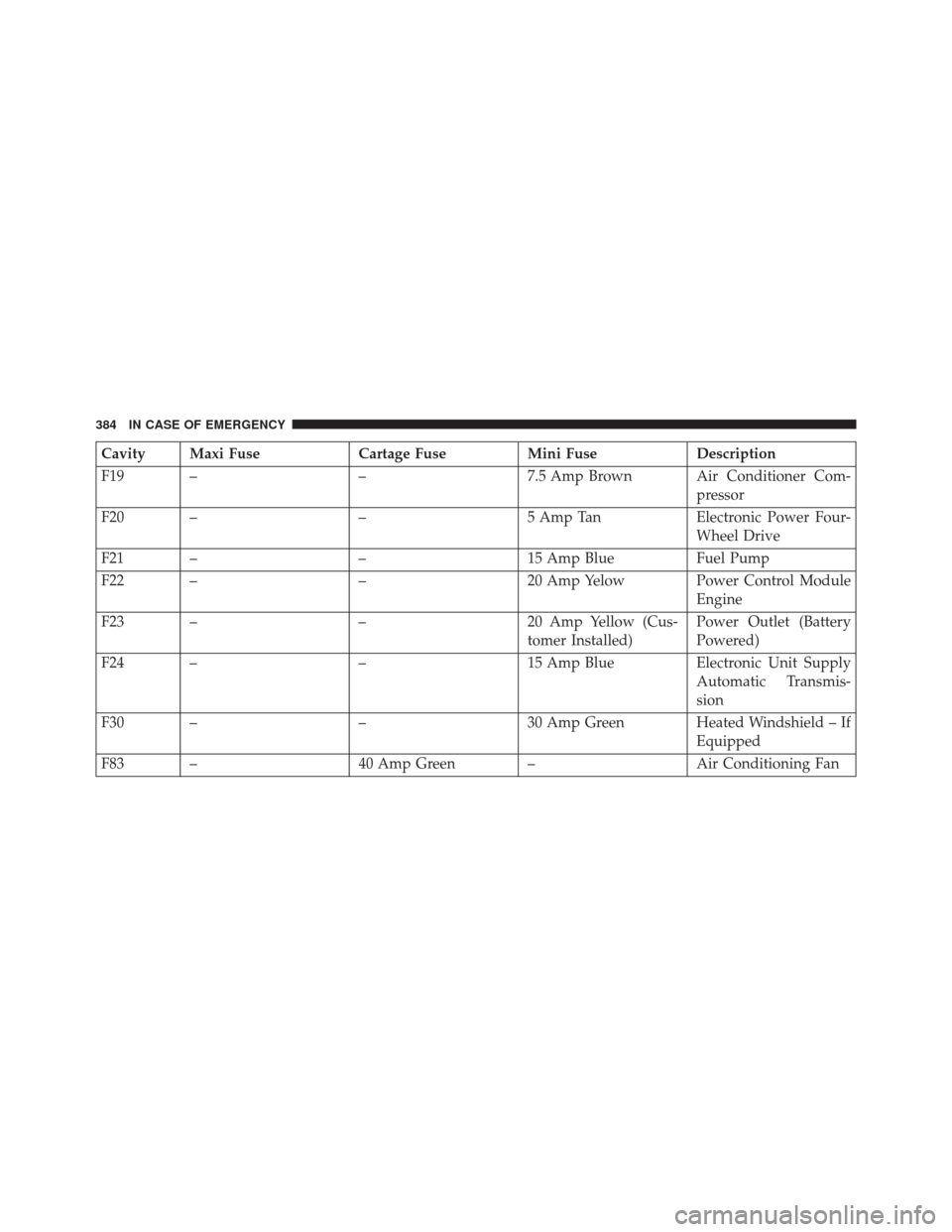
Cavity Maxi FuseCartage FuseMini FuseDescription
F19 – –7.5 Amp Brown Air Conditioner Com-
pressor
F20 – –5 Amp TanElectronic Power Four-
Wheel Drive
F21 – –15 Amp BlueFuel Pump
F22 – –20 Amp Yelow Power Control Module
Engine
F23 – –20 Amp Yellow (Cus-
tomer Installed) Power Outlet (Battery
Powered)
F24 – –15 Amp BlueElectronic Unit Supply
Automatic Transmis-
sion
F30 – –30 Amp Green Heated Windshield – If
Equipped
F83 – 40 Amp Green – Air Conditioning Fan
384 IN CASE OF EMERGENCY
Page 387 of 587
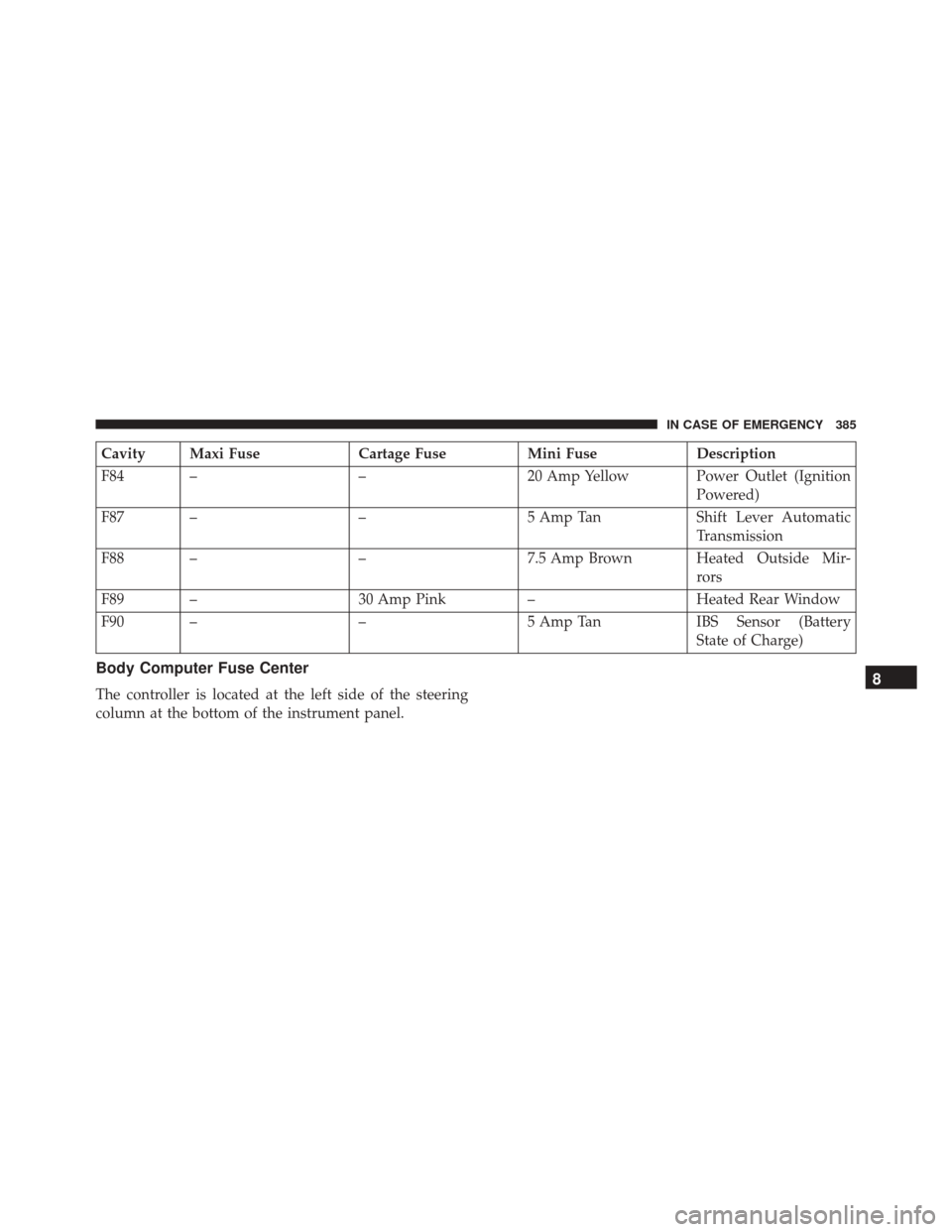
Cavity Maxi FuseCartage FuseMini FuseDescription
F84 – –20 Amp Yellow Power Outlet (Ignition
Powered)
F87 – –5 Amp TanShift Lever Automatic
Transmission
F88 – –7.5 Amp Brown Heated Outside Mir-
rors
F89 – 30 Amp Pink–Heated Rear Window
F90 – –5 Amp TanIBS Sensor (Battery
State of Charge)
Body Computer Fuse Center
The controller is located at the left side of the steering
column at the bottom of the instrument panel.8
IN CASE OF EMERGENCY 385
Page 408 of 587
JUMP STARTING
If your vehicle has a discharged battery it can be jump-
started using a set of jumper cables and a battery in
another vehicle or by using a portable battery booster
pack. Jump starting can be dangerous if done improperly
so please follow the procedures in this section carefully.
NOTE:When using a portable battery booster pack
follow the manufacturer ’s operating instructions and
precautions.
CAUTION!
Do not use a portable battery booster pack or any
other booster source with a system voltage greater
than 12 Volts or damage to the battery, starter motor,
alternator or electrical system may occur.
WARNING!
Do not attempt jump-starting if the battery is frozen.
It could rupture or explode and cause personal injury.
Preparations For Jump Start
The battery in your vehicle is located in the front of the
engine compartment, behind the left headlight assembly.
406 IN CASE OF EMERGENCY