engine FIAT 500X 2018 Owner handbook (in English)
[x] Cancel search | Manufacturer: FIAT, Model Year: 2018, Model line: 500X, Model: FIAT 500X 2018Pages: 276, PDF Size: 7.08 MB
Page 36 of 276
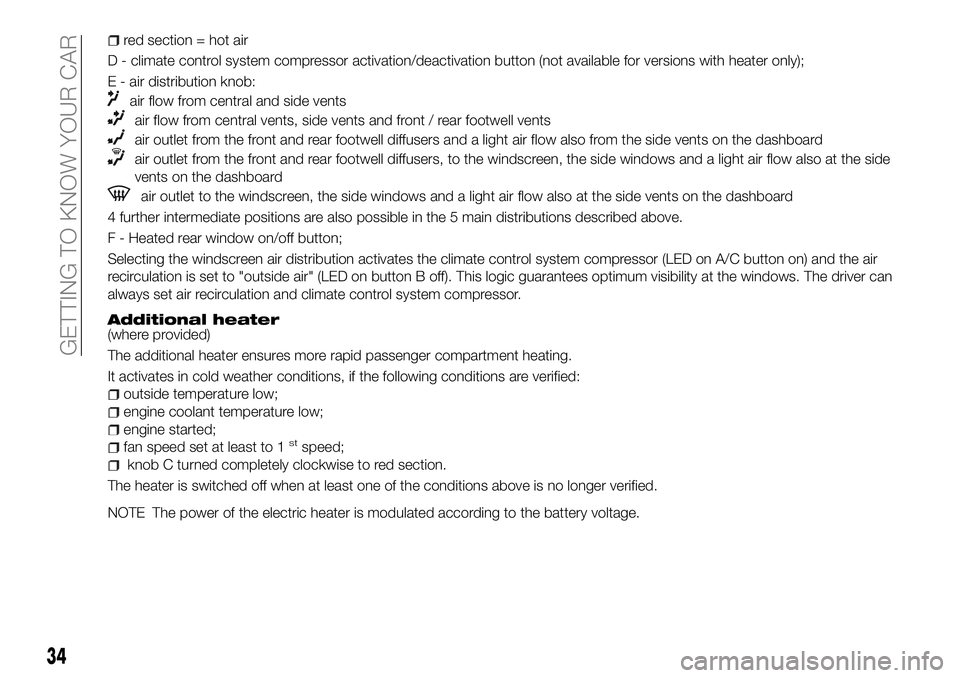
red section = hot air
D - climate control system compressor activation/deactivation button (not available for versions with heater only);
E - air distribution knob:
air flow from central and side vents
air flow from central vents, side vents and front / rear footwell vents
air outlet from the front and rear footwell diffusers and a light air flow also from the side vents on the dashboard
air outlet from the front and rear footwell diffusers, to the windscreen, the side windows and a light air flow also at the side
vents on the dashboard
air outlet to the windscreen, the side windows and a light air flow also at the side vents on the dashboard
4 further intermediate positions are also possible in the 5 main distributions described above.
F - Heated rear window on/off button;
Selecting the windscreen air distribution activates the climate control system compressor (LED on A/C button on) and the air
recirculation is set to "outside air" (LED on button B off). This logic guarantees optimum visibility at the windows. The driver can
always set air recirculation and climate control system compressor.
Additional heater(where provided)
The additional heater ensures more rapid passenger compartment heating.
It activates in cold weather conditions, if the following conditions are verified:
outside temperature low;
engine coolant temperature low;
engine started;
fan speed set at least to 1stspeed;
knob C turned completely clockwise to red section.
The heater is switched off when at least one of the conditions above is no longer verified.
NOTE The power of the electric heater is modulated according to the battery voltage.
34
GETTING TO KNOW YOUR CAR
Page 38 of 276
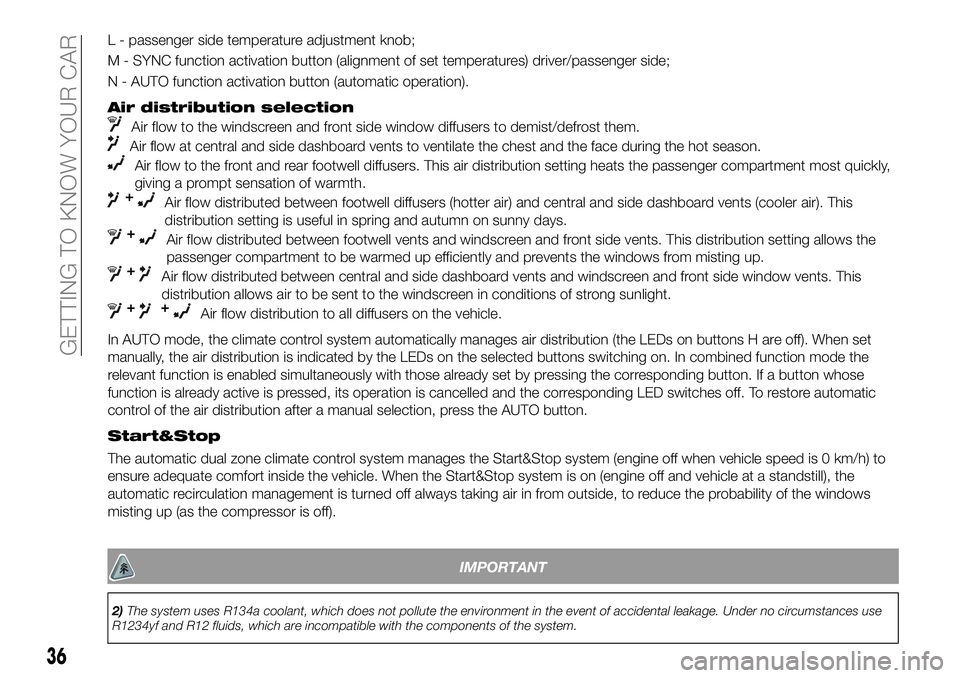
L - passenger side temperature adjustment knob;
M - SYNC function activation button (alignment of set temperatures) driver/passenger side;
N - AUTO function activation button (automatic operation).
Air distribution selection
Air flow to the windscreen and front side window diffusers to demist/defrost them.
Air flow at central and side dashboard vents to ventilate the chest and the face during the hot season.
Air flow to the front and rear footwell diffusers. This air distribution setting heats the passenger compartment most quickly,
giving a prompt sensation of warmth.
+Air flow distributed between footwell diffusers (hotter air) and central and side dashboard vents (cooler air). This
distribution setting is useful in spring and autumn on sunny days.
+Air flow distributed between footwell vents and windscreen and front side vents. This distribution setting allows the
passenger compartment to be warmed up efficiently and prevents the windows from misting up.
+Air flow distributed between central and side dashboard vents and windscreen and front side window vents. This
distribution allows air to be sent to the windscreen in conditions of strong sunlight.
++Air flow distribution to all diffusers on the vehicle.
In AUTO mode, the climate control system automatically manages air distribution (the LEDs on buttons H are off). When set
manually, the air distribution is indicated by the LEDs on the selected buttons switching on. In combined function mode the
relevant function is enabled simultaneously with those already set by pressing the corresponding button. If a button whose
function is already active is pressed, its operation is cancelled and the corresponding LED switches off. To restore automatic
control of the air distribution after a manual selection, press the AUTO button.
Start&Stop
The automatic dual zone climate control system manages the Start&Stop system (engine off when vehicle speed is 0 km/h) to
ensure adequate comfort inside the vehicle. When the Start&Stop system is on (engine off and vehicle at a standstill), the
automatic recirculation management is turned off always taking air in from outside, to reduce the probability of the windows
misting up (as the compressor is off).
IMPORTANT
2)The system uses R134a coolant, which does not pollute the environment in the event of accidental leakage. Under no circumstances use
R1234yf and R12 fluids, which are incompatible with the components of the system.
36
GETTING TO KNOW YOUR CAR
Page 42 of 276
BONNET
OPENING
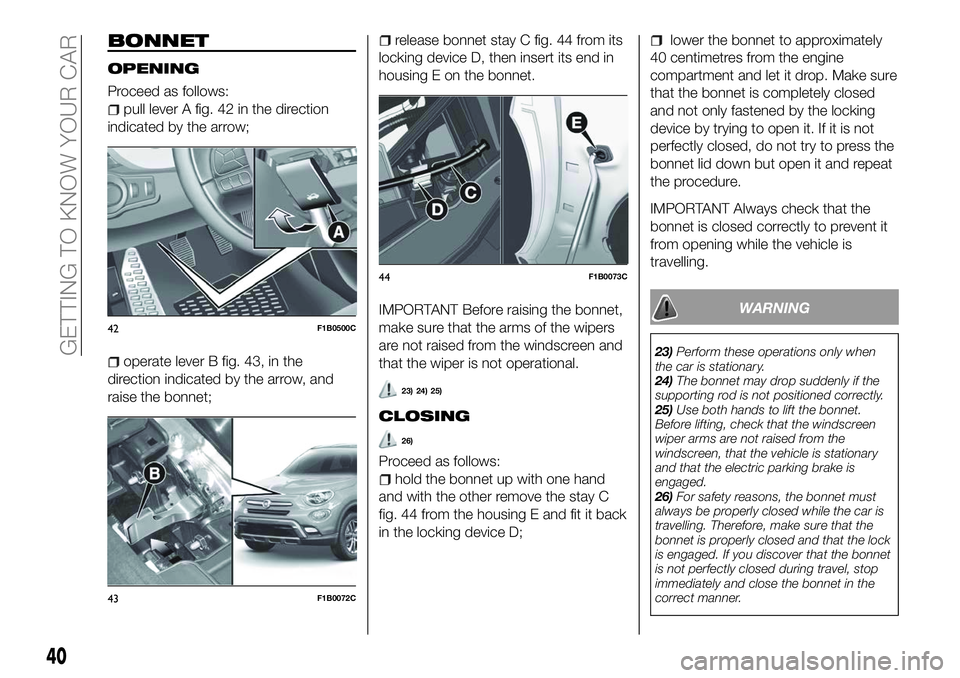
Proceed as follows:
pull lever A fig. 42 in the direction
indicated by the arrow;
operate lever B fig. 43, in the
direction indicated by the arrow, and
raise the bonnet;
release bonnet stay C fig. 44 from its
locking device D, then insert its end in
housing E on the bonnet.
IMPORTANT Before raising the bonnet,
make sure that the arms of the wipers
are not raised from the windscreen and
that the wiper is not operational.
23) 24) 25)
CLOSING
26)
Proceed as follows:
hold the bonnet up with one hand
and with the other remove the stay C
fig. 44 from the housing E and fit it back
in the locking device D;
lower the bonnet to approximately
40 centimetres from the engine
compartment and let it drop. Make sure
that the bonnet is completely closed
and not only fastened by the locking
device by trying to open it. If it is not
perfectly closed, do not try to press the
bonnet lid down but open it and repeat
the procedure.
IMPORTANT Always check that the
bonnet is closed correctly to prevent it
from opening while the vehicle is
travelling.
WARNING
23) Perform these operations only when
the car is stationary.
24) The bonnet may drop suddenly if the
supporting rod is not positioned correctly.
25) Use both hands to lift the bonnet.
Before lifting, check that the windscreen
wiper arms are not raised from the
windscreen, that the vehicle is stationary
and that the electric parking brake is
engaged.
26) For safety reasons, the bonnet must
always be properly closed while the car is
travelling. Therefore, make sure that the
bonnet is properly closed and that the lock
is engaged. If you discover that the bonnet
is not perfectly closed during travel, stop
immediately and close the bonnet in the
correct manner.
42F1B0500C
43F1B0072C
44F1B0073C
40
GETTING TO KNOW YOUR CAR
Page 46 of 276
LPG TANK
16)
The car has a pressurised tank for
storing LPG in a liquid state. It is
toroidal and is located in the spare
wheel compartment with suitable
protection.
LPG tank certification
The LPG tank is certified in
accordance with the regulations in
force.
In Italy, the tank has a life of
10 years starting from the car
registration date. If the car has
been registered in a country other
than Italy, the duration and the
testing/inspection procedures of
the LPG tank can vary depending
on the national provisions in force
in that country. In all case, when the
time limit for your country has
expired, go to a Fiat Dealer to have
the tank replaced.
LPG/PETROL SWITCH
30)
18) 19) 20)
This engine normally runs on LPG
except during starting when it runs on
petrol.
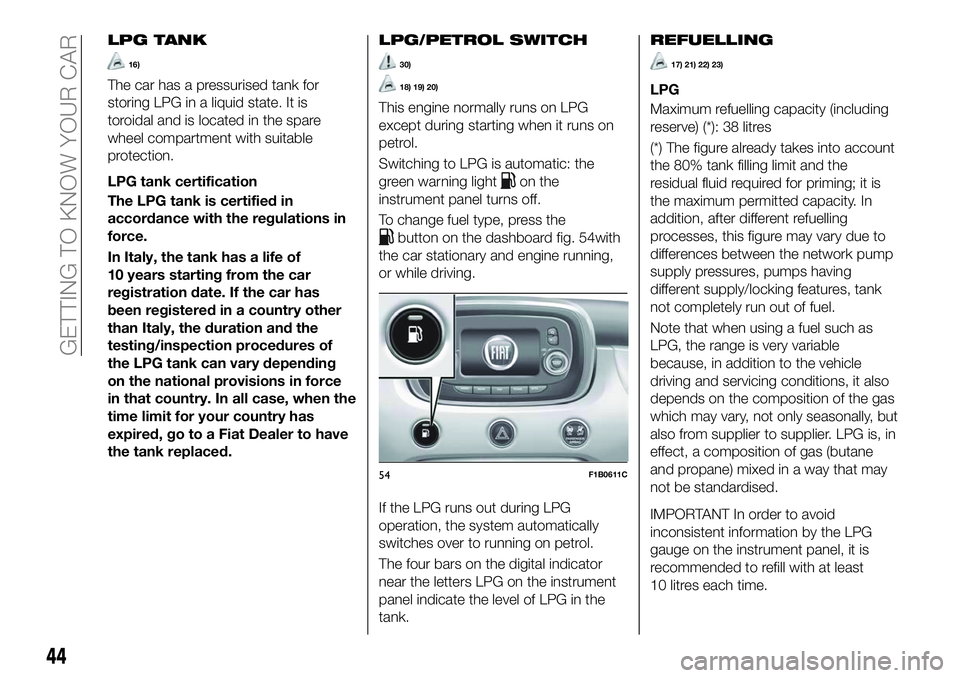
Switching to LPG is automatic: the
green warning light
on the
instrument panel turns off.
To change fuel type, press the
button on the dashboard fig. 54with
the car stationary and engine running,
or while driving.
If the LPG runs out during LPG
operation, the system automatically
switches over to running on petrol.
The four bars on the digital indicator
near the letters LPG on the instrument
panel indicate the level of LPG in the
tank.
REFUELLING
17) 21) 22) 23)
LPG
Maximum refuelling capacity (including
reserve) (*): 38 litres
(*) The figure already takes into account
the 80% tank filling limit and the
residual fluid required for priming; it is
the maximum permitted capacity. In
addition, after different refuelling
processes, this figure may vary due to
differences between the network pump
supply pressures, pumps having
different supply/locking features, tank
not completely run out of fuel.
Note that when using a fuel such as
LPG, the range is very variable
because, in addition to the vehicle
driving and servicing conditions, it also
depends on the composition of the gas
which may vary, not only seasonally, but
also from supplier to supplier. LPG is, in
effect, a composition of gas (butane
and propane) mixed in a way that may
not be standardised.
IMPORTANT In order to avoid
inconsistent information by the LPG
gauge on the instrument panel, it is
recommended to refill with at least
10 litres each time.
54F1B0611C
44
GETTING TO KNOW YOUR CAR
Page 47 of 276
WARNING
28)Note that in some countries (including
Italy) there are legal restrictions in force for
parking/garaging motor cars fuelled by gas
that is denser than air; LPG comes under
this category.
29) If gas is smelt, switch from LPG
operation to petrol operation and
immediately go to a Fiat Dealership to have
the vehicle checked and possible system
faults excluded.
30) Do not switch between the two
operating modes whilst starting the engine.
IMPORTANT
13) The car is equipped with a specifically
designed gaseous LPG injection system: it
is therefore absolutely forbidden to alter the
configuration of the system or its
components. The use of other components
or materials could cause malfunctions and
lead to a reduction in safety; therefore, in
the case of problems, contact a Fiat
Dealership. When towing or lifting the
vehicle, follow the instructions in the main
handbook under the paragraph on "Towing
the vehicle" to prevent damage to the gas
system parts.
14) When painting in an oven, the LPG tank
must be removed from the car and later
refitted by a Fiat Dealership.
15) The system operates at temperatures
ranging between -20°C and 100°C. 16)
Periodically (at least once every six
months), it is advisable to let the LPG in the
tank run out and, at the next refuelling,
check that it does not exceed the
maximum capacity of 38 litres (reserve
included) (with a tolerance of 2 litres
excess) (see instructions in the "Capacities"
paragraph of this supplement). If the level is
above 38 litres (reserve included) contact a
Fiat Dealership immediately.
17) It is strictly forbidden to use any
additive in the LPG. Periodically (at least
once every six months) it is advisable to let
the LPG in the tank run out and, at the first
refuelling, to check that it does not exceed
the maximum capacity of 42 litres (reserve
included) (with a tolerance of 1 litres
excess). If the level is above 42 litres
(reserve included) contact a Fiat Dealership
immediately.
18) Regardless of the last fuel system used,
at the following engine starting, after the
initial petrol stage, the system will
automatically switch to LPG.
19) When switching is requested, metallic
noise from the valves which pressurise the
circuit can be heard. For the switching logic
described above, a delay between the
valve ticking and the switching off of the
instrument panel indication is completely
normal. 20)
In particular usage conditions, such as
starting and operation at low ambient
temperature or LPG supply with low
propane content, the system may switch
temporarily to petrol operation, without a
visual indication of switching on the
instrument panel. In the event of low LPG
levels in the tank or request for high
performance (e.g. overtaking, car fully
laden, steep hills) the system may
automatically switch to petrol operation to
guarantee the engine power requested; the
green warning light
on the instrument
panel switches on to indicate this. When
the above conditions are no longer present,
the system automatically restores LPG
operation; the green warning light
switches off. To achieve the automatic
switching described above, make sure that
there is always enough fuel in the petrol
tank.
21) Only use LPG for motor vehicles.
22) It is strictly forbidden to use any
additive in the LPG.
23) Periodically (at least once every six
months), it is advisable to let the LPG in the
tank run out and, at the next refuelling,
check that it does not exceed the
maximum capacity of 38 litres (reserve
included) (with a tolerance of 2 litres
excess) (see instructions in the "Capacities"
paragraph of this supplement). If the level is
above 38 litres (reserve included) contact a
Fiat Dealership immediately.
45
Page 49 of 276
CONTROL PANEL AND ON-BOARD INSTRUMENTS
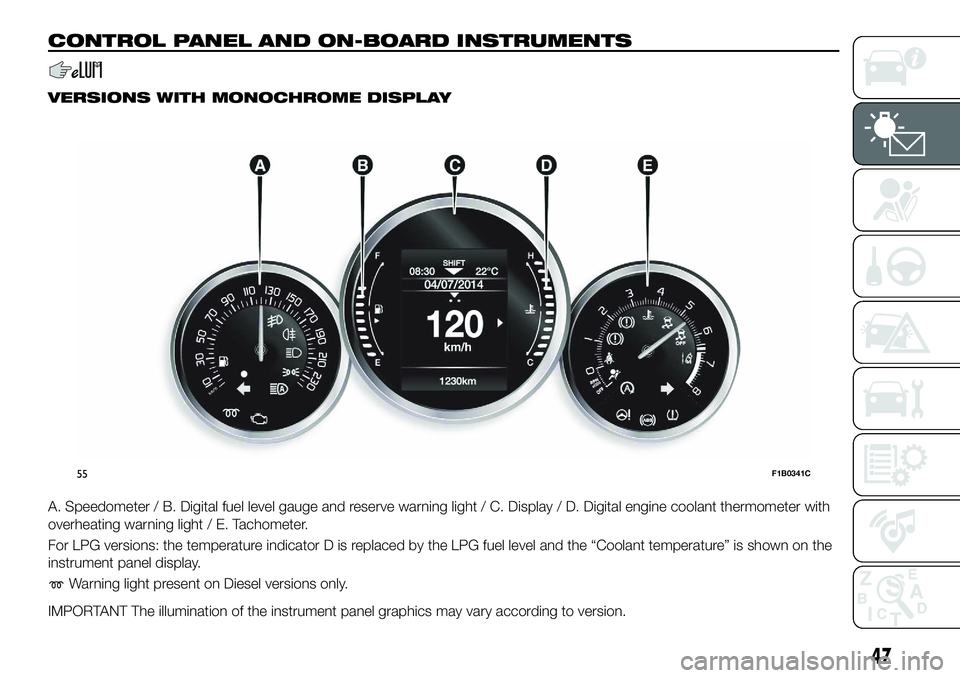
VERSIONS WITH MONOCHROME DISPLAY
A. Speedometer / B. Digital fuel level gauge and reserve warning light / C. Display / D. Digital engine coolant thermometer with
overheating warning light / E. Tachometer.
For LPG versions: the temperature indicator D is replaced by the LPG fuel level and the “Coolant temperature” is shown on the
instrument panel display.
Warning light present on Diesel versions only.
IMPORTANT The illumination of the instrument panel graphics may vary according to version.
55F1B0341C
47
Page 50 of 276
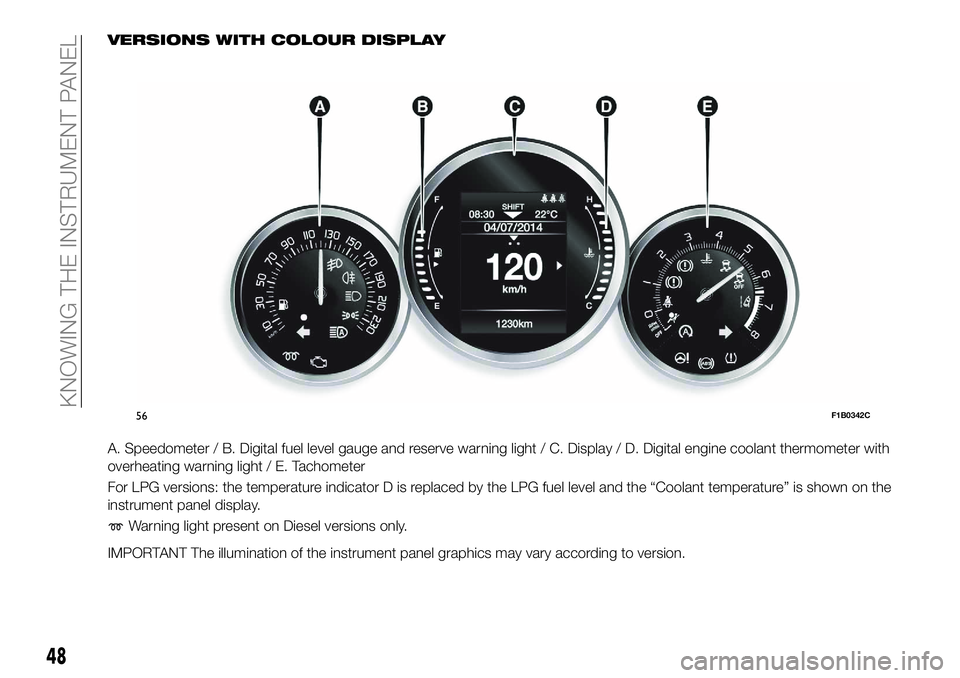
VERSIONS WITH COLOUR DISPLAY
A. Speedometer / B. Digital fuel level gauge and reserve warning light / C. Display / D. Digital engine coolant thermometer with
overheating warning light / E. Tachometer
For LPG versions: the temperature indicator D is replaced by the LPG fuel level and the “Coolant temperature” is shown on the
instrument panel display.
Warning light present on Diesel versions only.
IMPORTANT The illumination of the instrument panel graphics may vary according to version.
56F1B0342C
48
KNOWING THE INSTRUMENT PANEL
Page 52 of 276
MAIN MENU
The Menu includes the following items:
TRIP
MOOD SELECTOR (or DRIVE MODE
depending on the market) (where
provided) / GSI
VEHICLE INFO
DRIVER ASSIST
AUDIO
PHONE
NAVIGATION
ALERTS
VEHICLE SET-UP
Vehicle setup (Change car settings)
This menu item allows you to change
the settings for:
"Vehicle off" (where provided);
"Display";
"Units";
"Clock & Date";
"Security"
"Security & Assistance";
"Lights";
"Doors & Locks".
“Vehicle off” (where provided)
This is used to switch off the engine in
the event of a Keyless Enter-N-Go
system fault, following the procedure
described on the display. Display
By selecting item "Display" you can
access the settings/information
regarding: "Language", "See phone",
"See navigation", "Automatic Trip B
reset", "Drive Mode Repeat" (or “Mood
Selector Repeat” depending on the
market) (where provided), "Display
settings".
"Units"
Select item "Units" to choose the unit of
measurement between: "Imperial",
"Metric", "Custom".
"Clock & Date"
Select item "Clock & Date" to make the
following adjustments: "Set time", "Time
format", "Set date".
"Security"
Select item "Security" to make the
following adjustments: "Passenger
AIRBAG", "Speed beep", "Seat belt
buzzer", "Hill Hold Control".
"Passenger AIRBAG" adjustment allows
you to activate/deactivate the
passenger airbag:
Passenger's protection active:
the
ON LED comes on constantly in
the instrument panel dashboard.
Passenger's protection not
active: the
OFF LED comes on
constantly in the instrument panel
dashboard. "Security & Assistance"
For possible adjustments see
paragraph
Uconnect™ in the
dedicated chapter.
"Lights"
Select item "Lights" to make the
following adjustments: "Interior Ambient
lighting", "Headlight sensor", "Follow
me", "Headlights while opening", "Auto
high beams", "Daytime Lights",
"Cornering lights".
"Doors & Locks"
Select item "Doors & Locks" to make
the following adjustments: "Autoclose",
"Aut. unl. on exit", "Flsh.Light w/Lock",
"Horn with Lock", "Horn with remote
start", "Remote unlock", "Door Unlock"
(versions with Keyless Entry), "Keyless
Entry".
NOTE With the Uconnect™system,
some Menu items are shown and
managed on the display of the latter
and not on the instrument panel display
(refer to the Multimedia chapter or to
the supplement available online).
50
KNOWING THE INSTRUMENT PANEL
Page 54 of 276
WARNING LIGHTS AND MESSAGES
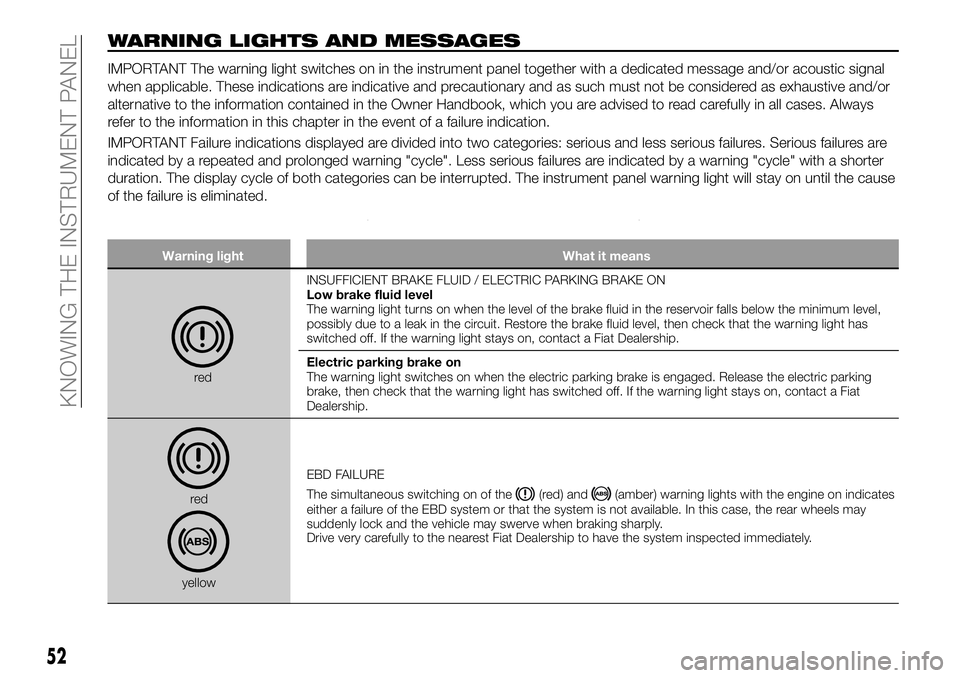
IMPORTANT The warning light switches on in the instrument panel together with a dedicated message and/or acoustic signal
when applicable. These indications are indicative and precautionary and as such must not be considered as exhaustive and/or
alternative to the information contained in the Owner Handbook, which you are advised to read carefully in all cases. Always
refer to the information in this chapter in the event of a failure indication.
IMPORTANT Failure indications displayed are divided into two categories: serious and less serious failures. Serious failures are
indicated by a repeated and prolonged warning "cycle". Less serious failures are indicated by a warning "cycle" with a shorter
duration. The display cycle of both categories can be interrupted. The instrument panel warning light will stay on until the cause
of the failure is eliminated.
Warning lightWhat it means
redINSUFFICIENT BRAKE FLUID / ELECTRIC PARKING BRAKE ON
Low brake fluid level
The warning light turns on when the level of the brake fluid in the reservoir falls below the minimum level,
possibly due to a leak in the circuit. Restore the brake fluid level, then check that the warning light has
switched off. If the warning light stays on, contact a Fiat Dealership.
Electric parking brake on
The warning light switches on when the electric parking brake is engaged. Release the electric parking
brake, then check that the warning light has switched off. If the warning light stays on, contact a Fiat
Dealership.
red
yellow EBD FAILURE
The simultaneous switching on of the
(red) and(amber) warning lights with the engine on indicates
either a failure of the EBD system or that the system is not available. In this case, the rear wheels may
suddenly lock and the vehicle may swerve when braking sharply.
Drive very carefully to the nearest Fiat Dealership to have the system inspected immediately.
52
KNOWING THE INSTRUMENT PANEL
Page 56 of 276
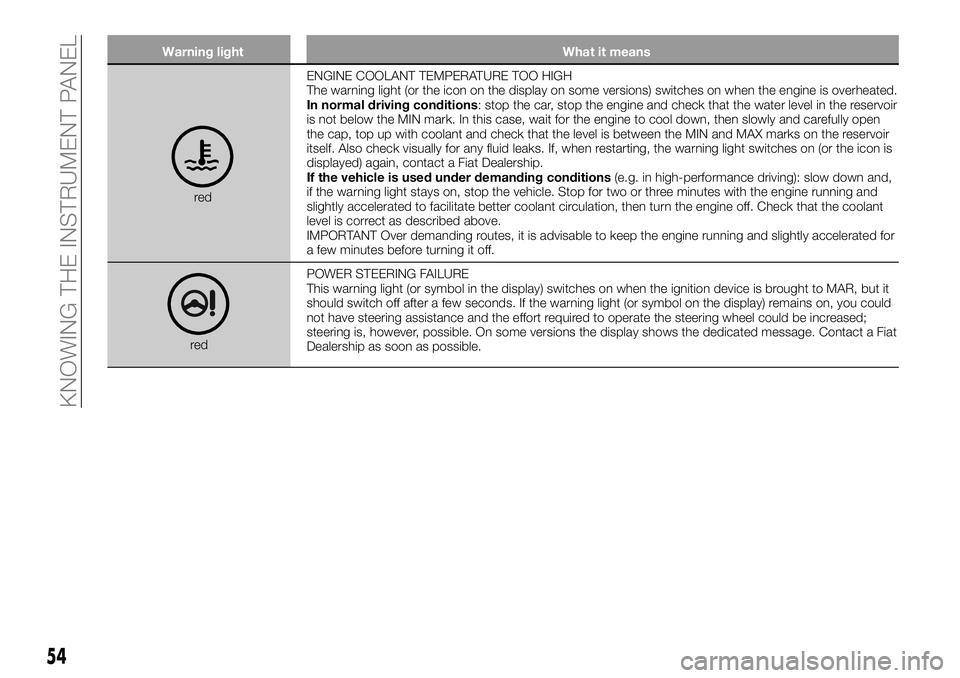
Warning lightWhat it means
redENGINE COOLANT TEMPERATURE TOO HIGH
The warning light (or the icon on the display on some versions) switches on when the engine is overheated.
In normal driving conditions: stop the car, stop the engine and check that the water level in the reservoir
is not below the MIN mark. In this case, wait for the engine to cool down, then slowly and carefully open
the cap, top up with coolant and check that the level is between the MIN and MAX marks on the reservoir
itself. Also check visually for any fluid leaks. If, when restarting, the warning light switches on (or the icon is
displayed) again, contact a Fiat Dealership.
If the vehicle is used under demanding conditions
(e.g. in high-performance driving): slow down and,
if the warning light stays on, stop the vehicle. Stop for two or three minutes with the engine running and
slightly accelerated to facilitate better coolant circulation, then turn the engine off. Check that the coolant
level is correct as described above.
IMPORTANT Over demanding routes, it is advisable to keep the engine running and slightly accelerated for
a few minutes before turning it off.
red POWER STEERING FAILURE
This warning light (or symbol in the display) switches on when the ignition device is brought to MAR, but it
should switch off after a few seconds. If the warning light (or symbol on the display) remains on, you could
not have steering assistance and the effort required to operate the steering wheel could be increased;
steering is, however, possible. On some versions the display shows the dedicated message. Contact a Fiat
Dealership as soon as possible.
54
KNOWING THE INSTRUMENT PANEL