engine FIAT 500X 2018 Owner handbook (in English)
[x] Cancel search | Manufacturer: FIAT, Model Year: 2018, Model line: 500X, Model: FIAT 500X 2018Pages: 276, PDF Size: 7.08 MB
Page 155 of 276
release the tabs shown by the arrows
and extract the bulb holder assembly D
fig. 124;
identify the bulb to be replaced
(1 Positions/Stop - 2 Direction indicator
- 3 Rear fog light (where provided) or
Reverse);
all bulbs are "bayonet-fitted"; to
replace them, press slightly and turn at
the same time: anticlockwise to extract;
clockwise to insert;
reposition the bulb holder assembly
D correctly in the headlight body;
proceed until you hear the tabs click;
fasten the two screws C fig. 123 and
reconnect the central connector B;
refit the lens by screwing the two
screws A completely;
close the tailgate.
3
rdbrake lights
The 3rdbrake lights are LED-based. To
replace them, contact a Fiat Dealership.
Number plate lights
To replace the bulbs, proceed as
follows:
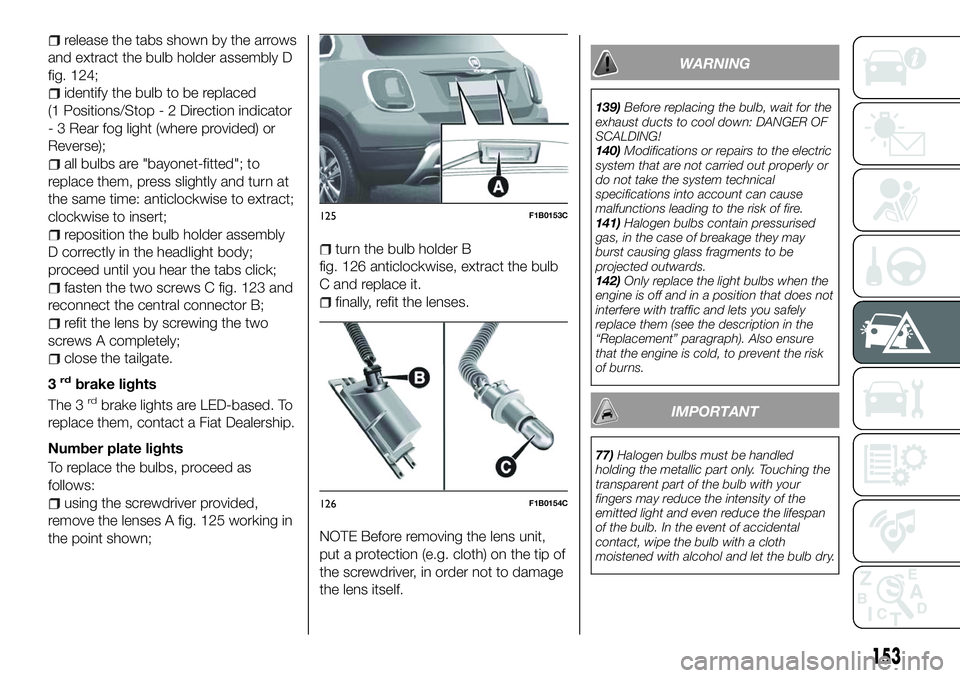
using the screwdriver provided,
remove the lenses A fig. 125 working in
the point shown;
turn the bulb holder B
fig. 126 anticlockwise, extract the bulb
C and replace it.
finally, refit the lenses.
NOTE Before removing the lens unit,
put a protection (e.g. cloth) on the tip of
the screwdriver, in order not to damage
the lens itself.
WARNING
139) Before replacing the bulb, wait for the
exhaust ducts to cool down: DANGER OF
SCALDING!
140) Modifications or repairs to the electric
system that are not carried out properly or
do not take the system technical
specifications into account can cause
malfunctions leading to the risk of fire.
141) Halogen bulbs contain pressurised
gas, in the case of breakage they may
burst causing glass fragments to be
projected outwards.
142) Only replace the light bulbs when the
engine is off and in a position that does not
interfere with traffic and lets you safely
replace them (see the description in the
“Replacement” paragraph). Also ensure
that the engine is cold, to prevent the risk
of burns.
IMPORTANT
77) Halogen bulbs must be handled
holding the metallic part only. Touching the
transparent part of the bulb with your
fingers may reduce the intensity of the
emitted light and even reduce the lifespan
of the bulb. In the event of accidental
contact, wipe the bulb with a cloth
moistened with alcohol and let the bulb dry.
125F1B0153C
126F1B0154C
153
Page 156 of 276
REPLACING FUSES
INTRODUCTION
143) 144) 145) 146)
78) 79)
Fuses protect the electrical system:
they intervene (blow) in the event of a
failure or improper action on the
system.
Fuse extracting pliers
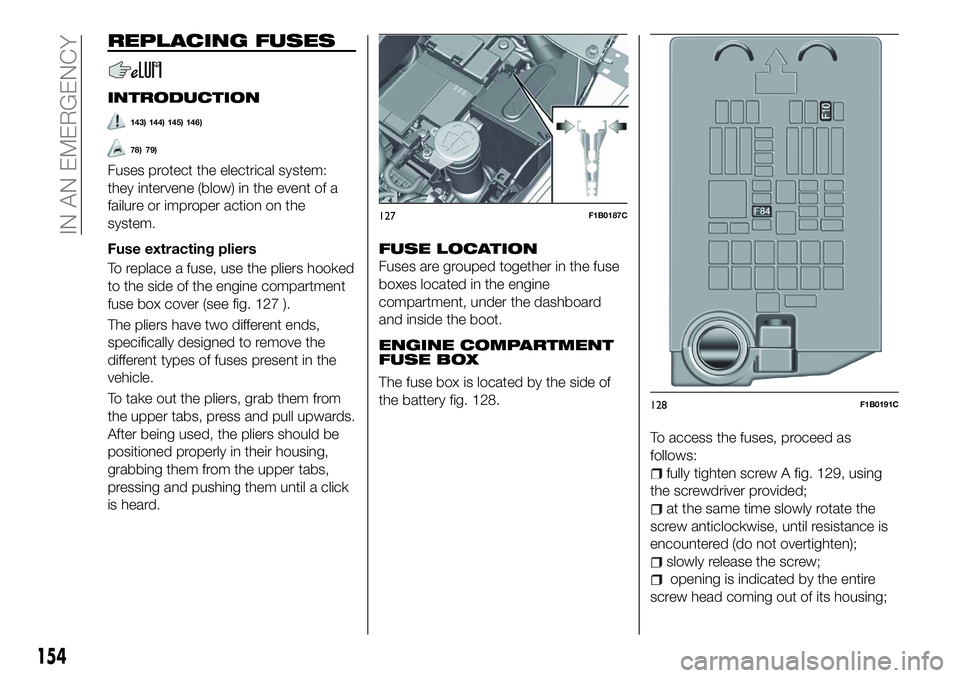
To replace a fuse, use the pliers hooked
to the side of the engine compartment
fuse box cover (see fig. 127 ).
The pliers have two different ends,
specifically designed to remove the
different types of fuses present in the
vehicle.
To take out the pliers, grab them from
the upper tabs, press and pull upwards.
After being used, the pliers should be
positioned properly in their housing,
grabbing them from the upper tabs,
pressing and pushing them until a click
is heard.
FUSE LOCATION
Fuses are grouped together in the fuse
boxes located in the engine
compartment, under the dashboard
and inside the boot.
ENGINE COMPARTMENT
FUSE BOX
The fuse box is located by the side of
the battery fig. 128.To access the fuses, proceed as
follows:
fully tighten screw A fig. 129, using
the screwdriver provided;
at the same time slowly rotate the
screw anticlockwise, until resistance is
encountered (do not overtighten);
slowly release the screw;
opening is indicated by the entire
screw head coming out of its housing;
127F1B0187C
128F1B0191C
154
IN AN EMERGENCY
Page 159 of 276
ENGINE COMPARTMENT FUSE BOX
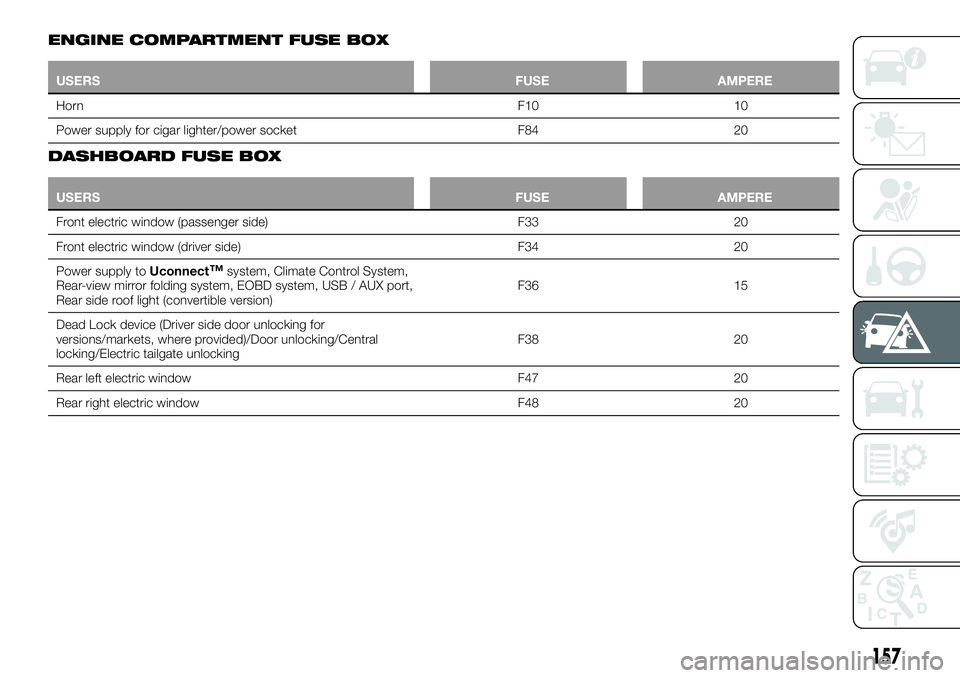
USERSFUSE AMPERE
Horn F10
10
Power supply for cigar lighter/power socket F8420
DASHBOARD FUSE BOX
USERS FUSE AMPERE
Front electric window (passenger side) F3320
Fr
ont electric window (driver side) F3420
Power supply to Uconnect
™system, Climate Control System,
Rear-view mirror folding system, EOBD system, USB / AUX port,
Rear side roof light (convertible version) F36 15
Dead Lock device (Driver side door unlocking for
versions/markets, where provided)/Door unlocking/Central
locking/Electric tailgate unlocking F38 20
Rear left electric window F47 20
Rear right electric window F48 20
157
Page 161 of 276
WARNING
143)If the replaced fuse blows again,
contact a Fiat Dealership.
144) Never replace a fuse with another
with a higher amp rating; DANGER OF
FIRE
145) If a fuse NOT indicated in this or the
previous page is used, contact a Fiat
Dealership.
146) Before replacing a fuse, make sure
that the ignition device is at STOP, that the
key, if mechanical, has been removed and
that all devices are switched off and/or
disconnected.
IMPORTANT
78) Never replace a fuse with metal wires
or anything else.
79) If it is necessary to wash the engine
compartment, take care not to directly hit
the fuse box and the window wiper motor
with the water jet.
CHANGING A WHEEL
JACK
154) 155)
Please note that:
the jack weight is 2.8 kg;
the jack requires no adjustment;
the jack cannot be repaired and in
the event of a fault it must be replaced
by another genuine one;
no tool other than its cranking device
may be fitted on the jack.
Maintenance
prevent any dirt from depositing on
the "worm screw";
keep the "worm screw" lubricated;
never modify the jack.
Conditions for non-use
temperatures below −40°C;
on sandy or muddy ground;
on uneven ground;
on steep roads;
in extreme weather conditions:
thunderstorms, typhoons, hurricanes,
blizzards, storms, etc...
in direct contact with the engine or
for repairs under the car;
on boats.
CHANGING PROCEDURE
147) 148) 149) 150) 151) 152) 153)
Proceed as follows:
stop the car in a position that is not
dangerous for oncoming traffic where
you can change the wheel safely. The
ground must be flat and sufficiently
compact;
stop the engine, engage the hazard
warning lights and the electric parking
brake;
engage first gear or reverse or, for
versions with automatic transmission,
move the lever to position P (Park);
wear the reflective safety jacket
(compulsory by law) before getting out
of the car;
open the luggage compartment and
set the adjustable load platform in the
diagonal position (see "Luggage
Compartment" section of the "Getting
to know your car" chapter);
take out the tool bag supplied,
anchored to the boot mat by special
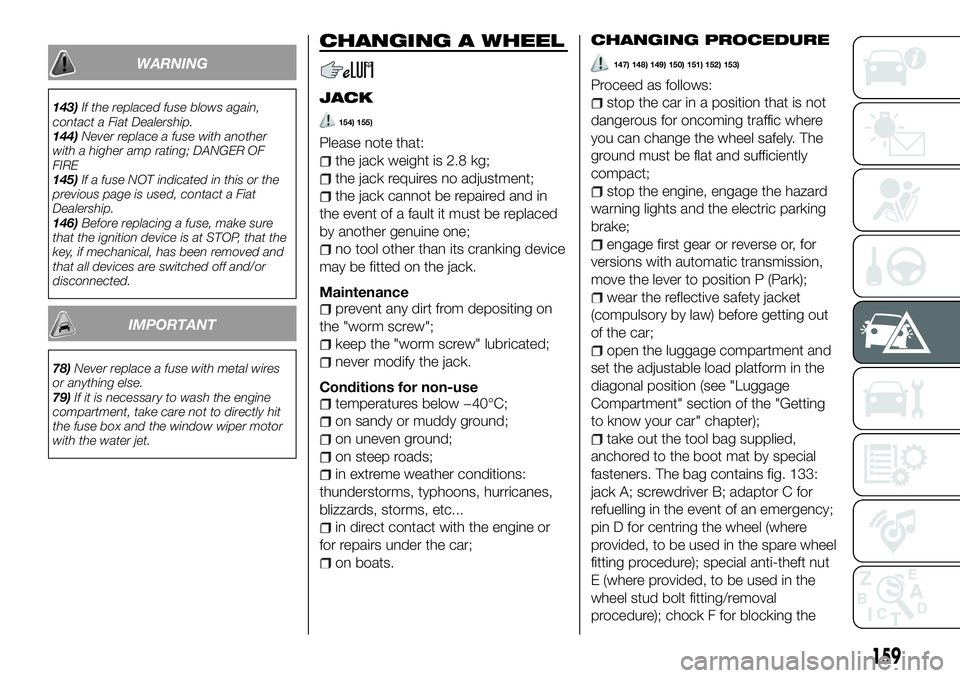
fasteners. The bag contains fig. 133:
jack A; screwdriver B; adaptor C for
refuelling in the event of an emergency;
pin D for centring the wheel (where
provided, to be used in the spare wheel
fitting procedure); special anti-theft nut
E (where provided, to be used in the
wheel stud bolt fitting/removal
procedure); chock F for blocking the
159
Page 165 of 276
153)Never tamper with the inflation valve.
Never introduce tools of any kind between
the rim and the tyre. Check tyre and
space-saver wheel pressures regularly,
complying with the values given in the
"Technical specifications" chapter.
154) The jack is a tool developed and
designed only for changing a wheel, if a
tyre gets punctured or damaged, on the
vehicle with which it is supplied or on other
vehicles of the same model. Any other use,
e.g. to jack up other vehicle models or
different things, is strictly prohibited. Never
use it to carry out maintenance or repairs
under the vehicle or to change
summer/winter wheels and vice versa: we
advise you to contact a Fiat Dealership.
Never go under the raised vehicle: use it
only in the positions indicated. Do not use
the jack for loads higher than the one
shown on its label. Never start the engine
with car raised. If the car is raised more
than necessary, everything can become
more unstable, with the risk of the car
dropping violently. Thus, lift the car only as
needed in order to access the space-saver
spare wheel.
155) When turning the jack handle make
sure that it can turn freely without scraping
your hand against the ground. The moving
components of the jack ("worm screw" and
joints) can also cause injuries: do not touch
them. If you come into contact with
lubricating grease, clean yourself
thoroughly.FIX&GO AUTOMATIC
KIT
(where provided)
156) 157)
80)
DESCRIPTION
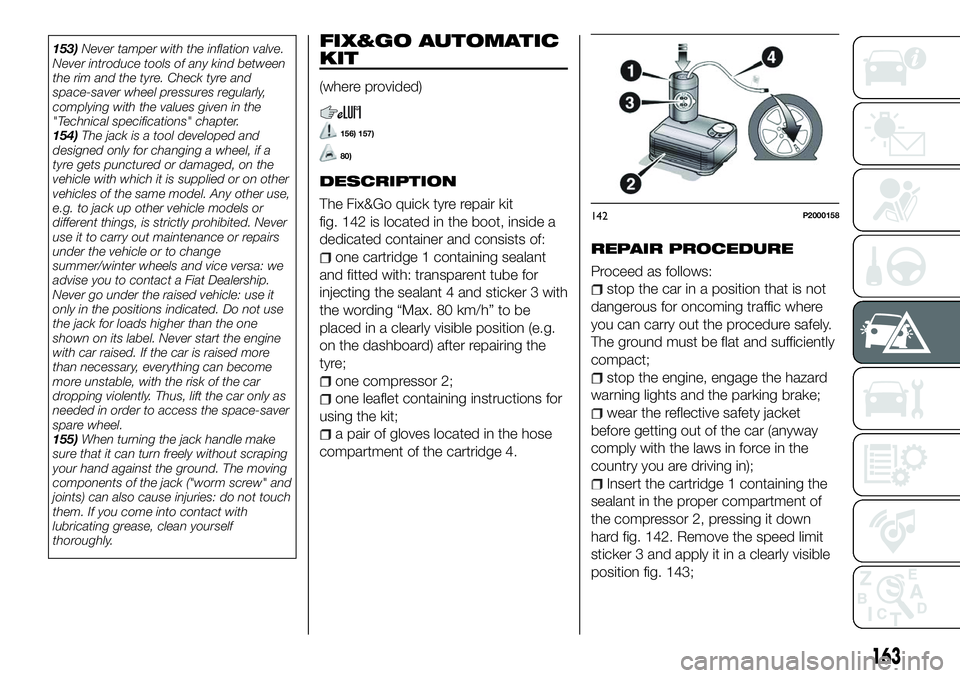
The Fix&Go quick tyre repair kit
fig. 142 is located in the boot, inside a
dedicated container and consists of:
one cartridge 1 containing sealant
and fitted with: transparent tube for
injecting the sealant 4 and sticker 3 with
the wording “Max. 80 km/h” to be
placed in a clearly visible position (e.g.
on the dashboard) after repairing the
tyre;
one compressor 2;
one leaflet containing instructions for
using the kit;
a pair of gloves located in the hose
compartment of the cartridge 4.
REPAIR PROCEDURE
Proceed as follows:
stop the car in a position that is not
dangerous for oncoming traffic where
you can carry out the procedure safely.
The ground must be flat and sufficiently
compact;
stop the engine, engage the hazard
warning lights and the parking brake;
wear the reflective safety jacket
before getting out of the car (anyway
comply with the laws in force in the
country you are driving in);
Insert the cartridge 1 containing the
sealant in the proper compartment of
the compressor 2, pressing it down
hard fig. 142. Remove the speed limit
sticker 3 and apply it in a clearly visible
position fig. 143;
142P2000158
163
Page 168 of 276
EMERGENCY
STARTING
81)
If the battery is flat, a jump starting can
be performed using the battery and the
cables of another vehicle, or using an
auxiliary battery. In all cases, the battery
used must have a capacity equal to or
a little higher than the flat one.
IMPORTANT
Do not use an auxiliary battery or any
other source of external supply with a
voltage above 12 V: the battery, the
starter, the alternator and the electrical
system of the vehicle could be
damaged.
Do not attempt jump starting if the
battery is frozen. The battery could
break and explode!
JUMP STARTING
The vehicle battery is located in the
engine compartment, behind the left
light cluster.
158) 159) 160) 161)
IMPORTANT The positive terminal (+) of
the battery is shielded by a protective
element. Raise it to access the terminal.
Proceed as follows:
operate the parking brake, move the
lever to P (Park), for versions equipped
with automatic transmission, or neutral,
for versions with manual gearbox, then
set the ignition device to STOP;
switch off all the other electrical
appliances in the vehicle;
should you be using the battery of
another vehicle, park the other vehicle
within the range of the cables used for
the connection, operate the parking
brake and ensure that its ignition is off.
IMPORTANT If the procedure below is
carried out incorrectly, it can cause
severe injury to people or damage the
recharging system of one or both
vehicles. Carefully follow the
instructions given below.
Cable connection
82)
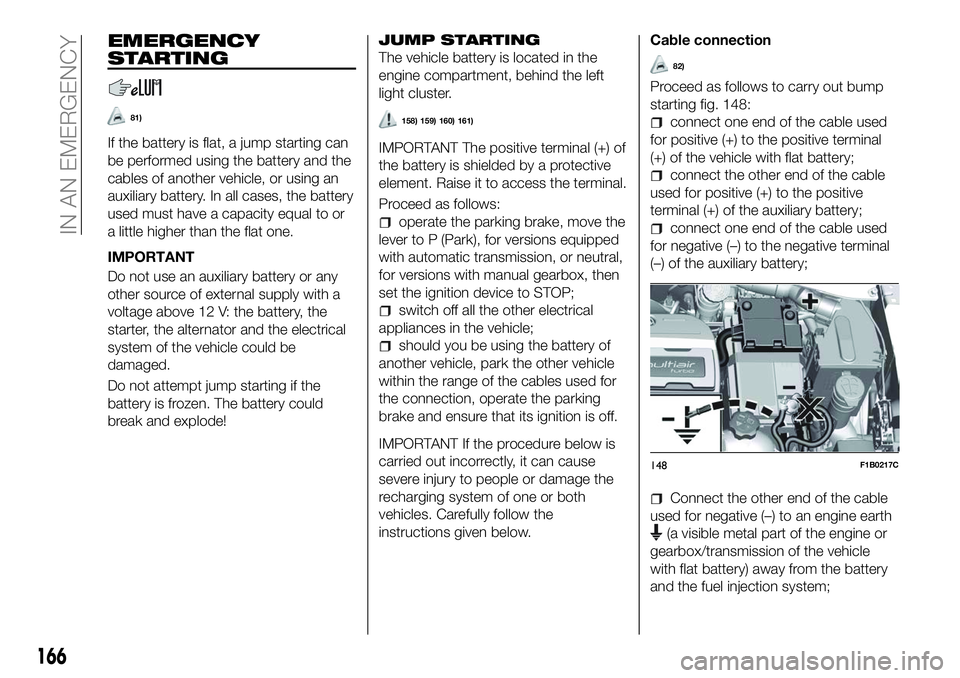
Proceed as follows to carry out bump
starting fig. 148:
connect one end of the cable used
for positive (+) to the positive terminal
(+) of the vehicle with flat battery;
connect the other end of the cable
used for positive (+) to the positive
terminal (+) of the auxiliary battery;
connect one end of the cable used
for negative (–) to the negative terminal
(–) of the auxiliary battery;
Connect the other end of the cable
used for negative (–) to an engine earth
(a visible metal part of the engine or
gearbox/transmission of the vehicle
with flat battery) away from the battery
and the fuel injection system;
148F1B0217C
166
IN AN EMERGENCY
Page 169 of 276
start the vehicle engine with the
auxiliary battery, let it run for a few
minutes at idling. Start the engine of the
vehicle with flat battery.
Cable disconnection.
Once the engine is started, remove the
leads, reversing the order above.
If after a few attempts the engine does
not start, do not persist but contact a
Fiat Dealership.
If it is often necessary to perform an
emergency starting, have the vehicle
battery and the recharging system
checked by a Fiat Dealership.
IMPORTANT Any accessories (e.g.
mobile phones, etc.) connected to the
vehicle power sockets, draw current
even if they are not used. These
devices, if left connected too much time
with engine off, may cause the battery
to drain with following reduction of its
life and/or failure to start the engine.
WARNING
158) Before opening the bonnet, make
sure that the engine is off and that the
ignition key is in the STOP position. Follow
the indications on the plate underneath the
bonnet. We recommend that you remove
the key from the ignition if other people
remain in the vehicle. The vehicle should
always be left after the key has been
removed or turned to the STOP position.
During refuelling, make sure that the engine
is off (and that the ignition key is in the
STOP position).
159) Do not get too close to the radiator
cooling fan: the electric fan may start;
danger of injury. Scarves, ties and other
loose clothing might be pulled by moving
parts.
160) Remove any metal objects (e.g. rings,
watches, bracelets), that might cause an
accidental electrical contact and cause
serious injury.
161) The batteries contain acid that can
burn skin or eyes. Batteries produce
hydrogen, which is easily flammable and
explosive. Therefore, keep away flames or
devices which may cause sparks.
IMPORTANT
81) Never use a fast battery-charger to
start the engine as this could damage the
electronic systems of your vehicle,
particularly the ignition and engine fuel
supply control units.
82) Do not connect the cable to the
negative terminal (–) of the flat battery. The
following spark could lead to battery
explosion and cause serious harm. Only
use the specific earth point; do not use any
other exposed metallic part.
167
Page 170 of 276
FUEL CUT-OFF
SYSTEM
DESCRIPTION
This intervenes in the case of an impact
causing:
the interruption of the fuel supply
with the engine consequently switching
off;
the automatic unlocking of the
doors;
turning on of the lights inside the
vehicle;
deactivation of climate control
system ventilation;
switching on of the hazard warning
lights (to deactivate the lights press the
button on the dashboard).
On some versions, the intervention of
the system is indicated by a message
shown on the display. In the same way,
a dedicated message on the display
warns the driver if system operation is
compromised.
IMPORTANT Carefully check the vehicle
for fuel leaks, for instance in the engine
compartment, under the vehicle or near
the tank area. After a collision, bring the
ignition device to STOP to prevent the
battery from running down. FUEL CUT-OFF SYSTEM
RESET
162)
To restore correct operation of the car,
carry out the following procedure (this
procedure must be started and
completed within less than 1 minute):
with direction indicator lever in
neutral position, turn the ignition device
to STOP;
turn the ignition device to MAR;
activate the right direction indicator
and then the left one;
activate the right direction indicator
and then the left one again;
deactivate the left direction indicator;
turn the ignition device to STOP and
then to MAR.
WARNING
162) If, after an impact, you smell fuel or
notice leaks from the fuel system, do not
reactivate the system to avoid the risk of
fire.
AUTOMATIC
TRANSMISSION -
LEVER UNLOCK
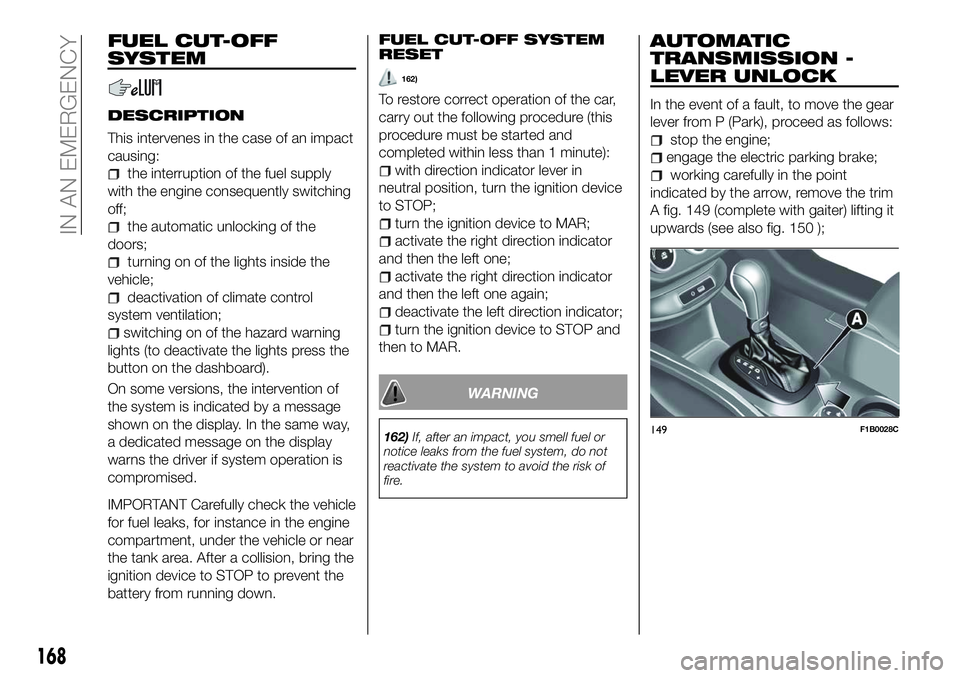
In the event of a fault, to move the gear
lever from P (Park), proceed as follows:
stop the engine;
engage the electric parking brake;
working carefully in the point
indicated by the arrow, remove the trim
A fig. 149 (complete with gaiter) lifting it
upwards (see also fig. 150 );
149F1B0028C
168
IN AN EMERGENCY
Page 171 of 276
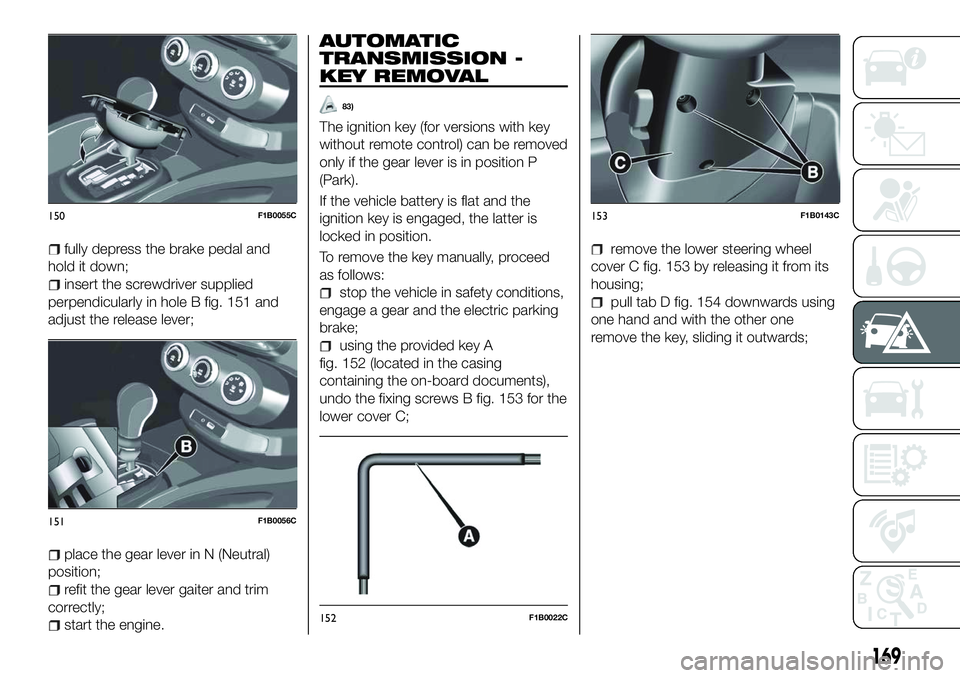
fully depress the brake pedal and
hold it down;
insert the screwdriver supplied
perpendicularly in hole B fig. 151 and
adjust the release lever;
place the gear lever in N (Neutral)
position;
refit the gear lever gaiter and trim
correctly;
start the engine.
AUTOMATIC
TRANSMISSION -
KEY REMOVAL
83)
The ignition key (for versions with key
without remote control) can be removed
only if the gear lever is in position P
(Park).
If the vehicle battery is flat and the
ignition key is engaged, the latter is
locked in position.
To remove the key manually, proceed
as follows:
stop the vehicle in safety conditions,
engage a gear and the electric parking
brake;
using the provided key A
fig. 152 (located in the casing
containing the on-board documents),
undo the fixing screws B fig. 153 for the
lower cover C;
remove the lower steering wheel
cover C fig. 153 by releasing it from its
housing;
pull tab D fig. 154 downwards using
one hand and with the other one
remove the key, sliding it outwards;
150F1B0055C
151F1B0056C
152F1B0022C
153F1B0143C
169
Page 172 of 276
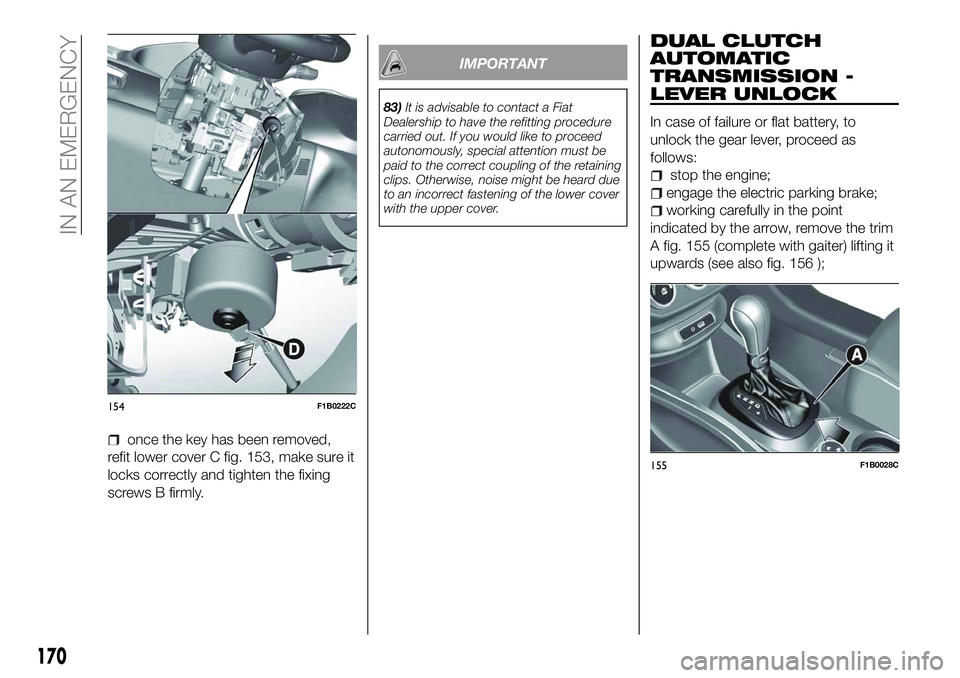
once the key has been removed,
refit lower cover C fig. 153, make sure it
locks correctly and tighten the fixing
screws B firmly.
IMPORTANT
83) It is advisable to contact a Fiat
Dealership to have the refitting procedure
carried out. If you would like to proceed
autonomously, special attention must be
paid to the correct coupling of the retaining
clips. Otherwise, noise might be heard due
to an incorrect fastening of the lower cover
with the upper cover.
DUAL CLUTCH
AUTOMATIC
TRANSMISSION -
LEVER UNLOCK
In case of failure or flat battery, to
unlock the gear lever, proceed as
follows:
stop the engine;
engage the electric parking brake;
working carefully in the point
indicated by the arrow, remove the trim
A fig. 155 (complete with gaiter) lifting it
upwards (see also fig. 156 );
154F1B0222C
155F1B0028C
170
IN AN EMERGENCY