warning FIAT 500X 2019 Owner handbook (in English)
[x] Cancel search | Manufacturer: FIAT, Model Year: 2019, Model line: 500X, Model: FIAT 500X 2019Pages: 284, PDF Size: 8.33 MB
Page 118 of 284
always be engaged (the 1stgear with
the vehicle parked uphill or the reverse
gear with the vehicle parked downhill).
On versions with automatic
transmission, place the gear lever at P
(Park).
IMPORTANT Should the vehicle battery
be faulty, to unlock the electric parking
brake the battery must be replaced.
The electric parking brake can be
engaged in two ways:
manuallypull the switch fig. 89 on
the central tunnel in the direction shown
by the arrow;
automaticallyin "Safe Hold" or "Auto
Apply" conditions.
Engaging the parking brake
manually
107) 108) 109)
Briefly pull the switch located on the
central tunnel to manually engage the
electric parking brake when the car is
stationary.
Noise may be heard from the rear of the
vehicle when engaging the electric
parking brake.
A slight movement of the brake pedal
may be detected when engaging the
electric parking brake with the brake
pedal pressed.With the electric parking brake
engaged, the warning light
on the
instrument panel and the LED on the
switch fig. 89 turn on.
IMPORTANT With the EPB failure
warning light on, some functions of the
electric parking brake are deactivated.
In this case the driver is responsible for
brake activation and vehicle parking in
complete safety conditions.
If, under exceptional circumstances, the
use of the parking brake is required with
the car in motion, keep the switch on
the central tunnel pulled as long as the
brake action is necessary.
The
warning light may switch on
with the hydraulic system temporarily
unavailable; in this case braking is
controlled by the motors.
The stop lights also automatically
switch on.
Release the switch on the central tunnel
to stop the braking action with the car
in motion.
If, through this procedure, the vehicle is
braked until a speed below 3 km/h is
reached and the switch is kept pulled,
the parking brake will definitively
engage.
IMPORTANT Driving the vehicle with
the electric parking brake engaged, or
using it several times to slow down the
vehicle, may cause severe damage to
the braking system.
Releasing the electric parking
brake manually
The ignition device must be in the MAR
position in order to manually release the
parking brake. Moreover, you need to
press the brake pedal, then press the
fig. 89 switch briefly.
Noise may be heard from the rear part
of the car and a slight movement of the
brake pedal may be detected during
release.
After disengaging the electric parking
brake, the
warning light on the
instrument panel and the LED on the
switch will turn off.
If the
warning light on the
instrument panel remains on with the
electric parking brake disengaged, this
indicates a failure: in this case contact a
Fiat Dealership.
IMPORTANT On versions with
automatic transmission never use the P
(Park) position instead of the electric
parking brake. Always engage the
electric parking brake when parking the
116
STARTING AND DRIVING
Page 119 of 284
vehicle to prevent injury or damage
caused by the unexpected movement
of the vehicle.
IMPORTANT For cars with manual
transmission, if the clutch pedal is
pressed all the way and then released
simultaneously with the press of the
accelerator, the electric parking brake
automatically releases.
OPERATING THE
ELECTRIC PARKING
BRAKE
The electric parking brake can operate
in the following ways:
"Dynamic operating mode": this
mode is activated by pulling the switch
fig. 89 repeatedly whilst driving;
"Static engagement and release
mode": with the car stationary, the
electric parking brake can be activated
by pulling the switch once. On the other
hand, press the switch and the brake
pedal at the same time to disengage
the brake;
“Drive Away Release”: the electric
parking brake will automatically
disengage with the detection of the
driver’s intention to move the car
forward or in reverse. On versions with
automatic transmission, the driver’s
safety belt has to be properly fastened.
"Safe Hold": if the car speed is lower
than 3 km/h and, for the versions withautomatic transmission, the gear lever
is not in P (Park) position and the driver
intention of leaving the car is detected,
the electric parking brake will
automatically engage to hold the car in
safety conditions;
"Auto Apply": if the car speed is
lower than 3 km/h, the electric parking
brake will automatically engage with the
gear lever moved to P (Park) position
(versions with automatic transmission),
or with the ignition device at STOP
(versions with manual transmission).
The LED on the switch will light up
together with the
warning light on
the instrument panel when the parking
brake is engaged and applied to the
wheels. Each automatic parking brake
engagement can be cancelled by
pressing the switch on the central
tunnel and at the same time moving the
gear lever for the automatic
transmission to position P (Park) or the
ignition device to STOP (versions with
manual transmission). This way can be
handled by using the system Menu
Uconnect™.
SAFE HOLD
It is a safety function that automatically
engages the electric parking brake in
the event of a dangerous condition for
the vehicle.If:
the vehicle speed is below 3 km/h;
the gear lever is not at P (Park)
(versions with automatic transmission);
the driver's seat belt is not fastened;
the driver side door is open;
no attempted operation of the brake
pedal or the accelerator pedal, or, in
versions with manual gearbox, the
clutch pedal is detected
the electric parking brake engages
automatically to prevent vehicle
movement.
The Safe Hold function can be
temporarily disabled by pressing the
switch located on the central tunnel and
the brake pedal at the same time, with
the vehicle stationary and the driver
side door open.
Once disabled, the function will activate
again when the vehicle speed reaches
20 km/h or the ignition device is moved
to STOP and then to MAR.
WARNING
107)In the case of parking manoeuvres on
roads on a gradient, steer the wheels,
engage the parking brake, the first gear if
uphill and the reverse if downhill; on
versions with automatic transmission, set
the lever to "P". If the car is parked on a
steep slope block the wheels with a wedge
or stone.
117
Page 121 of 284
WARNING
110)Depress the clutch pedal fully to
change gear correctly. It is therefore
essential that there is nothing under the
pedals: make sure the mats are lying flat
and do not get in the way of the pedals.
IMPORTANT
36)Do not drive with your hand resting on
the gear lever as the force exerted, even if
slight, could lead over time to premature
wear of the gearbox internal components.
AUTOMATIC
TRANSMISSION
(where provided)
GEAR LEVER
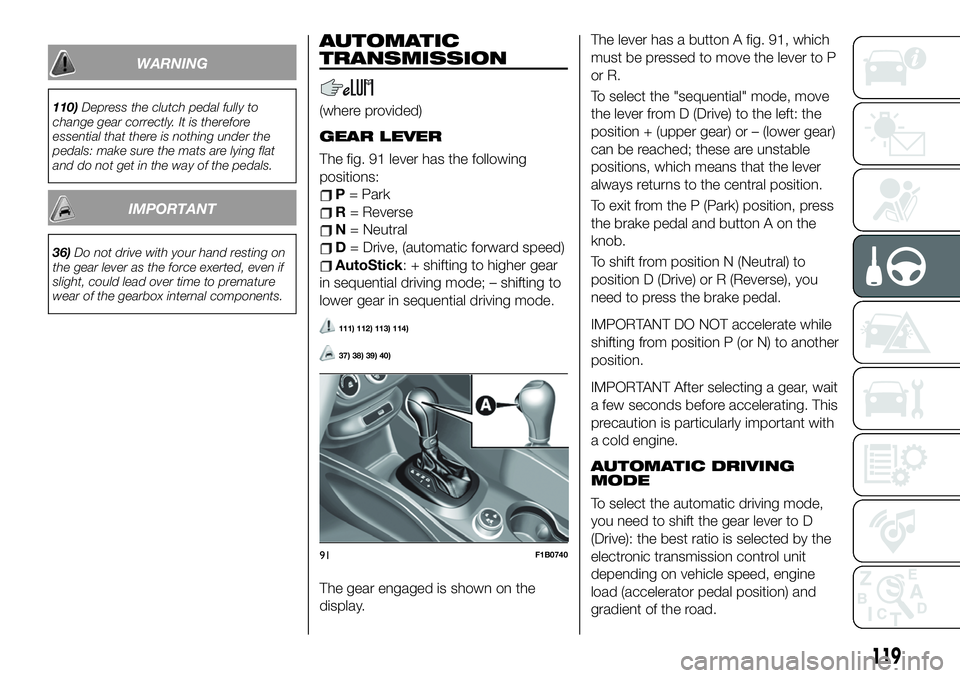
The fig. 91 lever has the following
positions:
P= Park
R= Reverse
N= Neutral
D= Drive, (automatic forward speed)
AutoStick: + shifting to higher gear
in sequential driving mode; – shifting to
lower gear in sequential driving mode.
111) 112) 113) 114)
37) 38) 39) 40)
The gear engaged is shown on the
display.The lever has a button A fig. 91, which
must be pressed to move the lever to P
or R.
To select the "sequential" mode, move
the lever from D (Drive) to the left: the
position + (upper gear) or – (lower gear)
can be reached; these are unstable
positions, which means that the lever
always returns to the central position.
To exit from the P (Park) position, press
the brake pedal and button A on the
knob.
To shift from position N (Neutral) to
position D (Drive) or R (Reverse), you
need to press the brake pedal.
IMPORTANT DO NOT accelerate while
shifting from position P (or N) to another
position.
IMPORTANT After selecting a gear, wait
a few seconds before accelerating. This
precaution is particularly important with
a cold engine.
AUTOMATIC DRIVING
MODE
To select the automatic driving mode,
you need to shift the gear lever to D
(Drive): the best ratio is selected by the
electronic transmission control unit
depending on vehicle speed, engine
load (accelerator pedal position) and
gradient of the road.
91F1B0740
119
Page 124 of 284
wait for about 10 seconds, then
restart the engine;
select the desired gear: correct
transmission operation should be
restored.
IMPORTANT In the event of a
temporary failure it is in any case
recommended to contact a Fiat
Dealership as soon as possible.
WARNING
111)Never use position P (Park) instead of
the electric parking brake. Always engage
the electric parking brake when parking the
vehicle to avoid the accidental movement
of the vehicle.
112)If the P (Park) position is not engaged,
the vehicle could move and injure people.
Before leaving the vehicle, make sure that
the gear lever is in position P and that the
electric parking brake is engaged.
113)Do not shift the gear lever to N
(Neutral) and do not stop the engine when
driving on a downhill road. This type of
driving is dangerous and reduces the
possibility of intervening in the case of
variation of the road traffic or surface. You
risk losing control of your vehicle and
causing accidents.
114)Never leave children alone in an
unattended vehicle; make sure that when
you move away from the vehicle, you have
the key with you.
IMPORTANT
37)Before moving the gear lever from
position P (Park), bring the ignition device
to position MAR and press the brake pedal.
Otherwise, the gear lever may get
damaged.
38)Engage reverse only with the car
stationary, engine at idling speed and
accelerator fully released.
39)If the car is on a gradient, always
engage the electric parking brake BEFORE
placing the gear lever in P.
40)Engage reverse only with the car
stationary, engine at idling speed and
accelerator pedal fully released.
41)Using the paddles incorrectly (paddles
pushed towards the dashboard ) could
break them.
DUAL-CLUTCH
AUTOMATIC
TRANSMISSION
(where provided)
GEAR LEVER
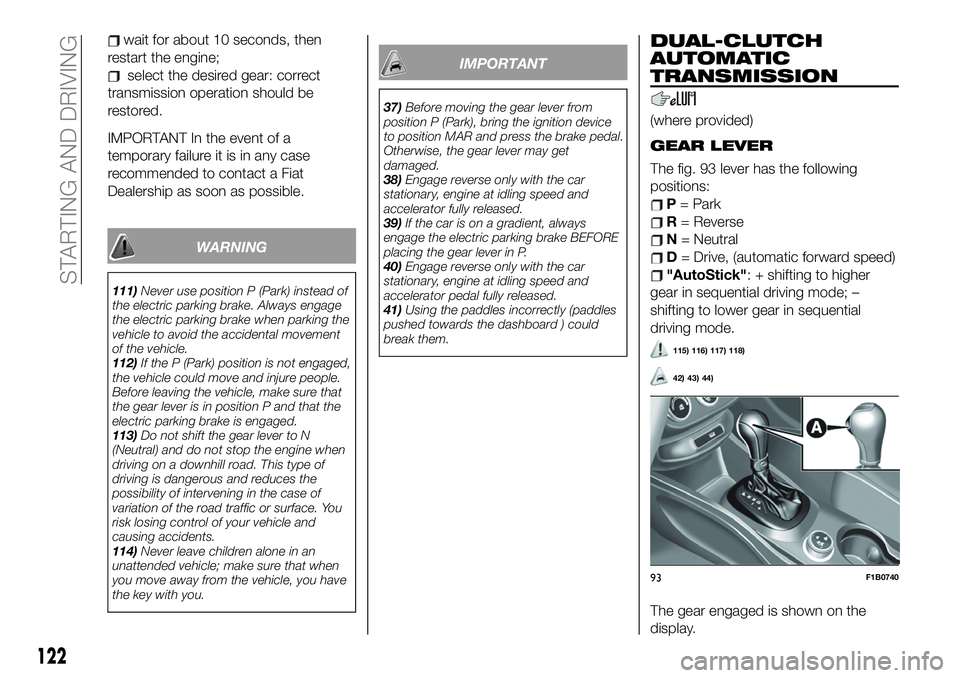
The fig. 93 lever has the following
positions:
P= Park
R= Reverse
N= Neutral
D= Drive, (automatic forward speed)
"AutoStick": + shifting to higher
gear in sequential driving mode; –
shifting to lower gear in sequential
driving mode.
115) 116) 117) 118)
42) 43) 44)
The gear engaged is shown on the
display.
93F1B0740
122
STARTING AND DRIVING
Page 127 of 284
"RECOVERY"
FUNCTIONS
In case of a gear lever failure, the
instrument panel display could show a
dedicated message recommending that
the driver continues driving without
shifting the lever to the P position.
In this case, the transmission will
maintain the forward gear (with reduced
performance) even if the lever is
positioned at R or N.
Once the lever is positioned at P, or
after shutting down the vehicle,
selecting R or any other forward gear
will no longer be possible. In this case,
contact a Fiat Dealership.
WARNING
115)Never use position P (Park) instead of
the electric parking brake. Always engage
the electric parking brake when parking the
vehicle to avoid the accidental movement
of the vehicle.
116)If the P (Park) position is not engaged,
the vehicle could move and injure people.
Before leaving the vehicle, make sure that
the gear lever is in position P and that the
electric parking brake is engaged.117)Do not shift the gear lever to N
(Neutral) and do not stop the engine when
driving on a downhill road. This type of
driving is dangerous and reduces the
possibility of intervening in the case of
variation of the road traffic or surface. You
risk losing control of your vehicle and
causing accidents.
118)Never leave children unattended in
the car. Always remove the ignition key
when leaving the car and take the key with
you.
IMPORTANT
42)Before moving the gear lever from
position P (Park), bring the ignition device
to position MAR and press the brake pedal.
Otherwise, the gear lever may get
damaged.
43)If the car is on a gradient, always
engage the electric parking brake BEFORE
placing the gear lever in P.
44)Engage reverse only with the car
stationary, engine at idling speed and
accelerator pedal fully released.
45)Using the paddles incorrectly (paddles
pushed towards the dashboard ) could
break them.
START&STOP
SYSTEM
(where provided)
The Start&Stop system automatically
stops the engine each time the car is
stationary and starts it again when the
driver wants to move off.
In this way, the vehicle efficiency is
increased, by reducing consumption,
dangerous gas emissions and sound
pollution.
IMPORTANT The system is activated
automatically whenever the engine is
started, regardless of the condition
(system on or off) present before the
engine was stopped.
119)
46)
OPERATING MODE
Stopping the engine
Versions with manual transmission
With the vehicle stopped, the engine
stops with gearbox in neutral and clutch
pedal released.
125
Page 128 of 284
Versions with automatic
transmission
With car at a standstill and brake pedal
pressed, the engine switches off if the
gear lever is in a position other than R.
NOTE On versions with automatic
transmission, when stopping uphill, the
engine stop is disabled to activate the
"Hill Start Assist" function (which works
only with running engine).
The
warning light on the instrument
panel switches on to signal that the
engine was stopped.
Restarting the engine
Versions with manual transmission
To restart the engine, press the clutch
pedal. If the vehicle does not start when
the clutch is pressed, place the gear
lever in neutral and repeat the
procedure. If the problem persists,
contact a Fiat Dealership.
Versions with automatic
transmission
To restart the engine, release the brake
pedal.
With brake pressed, if the gear lever is
in automatic mode - D (Drive) - the
engine can be restarted by moving the
lever to R (Reverse) or N (Neutral).
With brake pressed, if the gear lever is
in "AutoStick" mode, the engine can berestarted moving the lever to "+" or "–",
or R (Reverse) or N (Neutral).
When the engine has been stopped
automatically, keeping the brake pedal
pressed, the brake can be released
keeping the engine off by quickly
shifting the gear lever to P (Park).
To restart the engine, just move the
lever out of position P.SYSTEM MANUAL
ACTIVATION /
DEACTIVATION
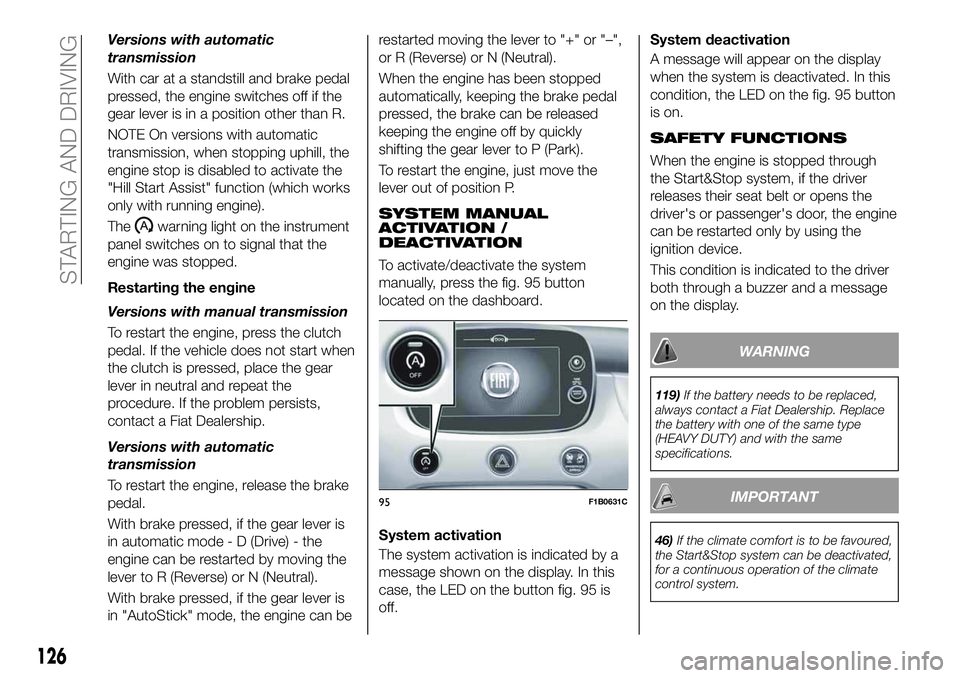
To activate/deactivate the system
manually, press the fig. 95 button
located on the dashboard.
System activation
The system activation is indicated by a
message shown on the display. In this
case, the LED on the button fig. 95 is
off.System deactivation
A message will appear on the display
when the system is deactivated. In this
condition, the LED on the fig. 95 button
is on.
SAFETY FUNCTIONS
When the engine is stopped through
the Start&Stop system, if the driver
releases their seat belt or opens the
driver's or passenger's door, the engine
can be restarted only by using the
ignition device.
This condition is indicated to the driver
both through a buzzer and a message
on the display.
WARNING
119)If the battery needs to be replaced,
always contact a Fiat Dealership. Replace
the battery with one of the same type
(HEAVY DUTY) and with the same
specifications.
IMPORTANT
46)If the climate comfort is to be favoured,
the Start&Stop system can be deactivated,
for a continuous operation of the climate
control system.
95F1B0631C
126
STARTING AND DRIVING
Page 131 of 284
DEACTIVATING THE
DEVICE
Lightly pressing the brake pedal or
pressing the CANC button deactivates
the electronic Cruise Control without
deleting the stored speed.
The Cruise Control may be deactivated
also by applying the electric parking
brake (EPB) or when the braking
system is operated (e.g. operation of
the ESC system).
DEACTIVATING THE
DEVICE
The electronic Cruise Control is
deactivated by pressing button A
fig. 97 or bringing the ignition device to
STOP.
WARNING
120)When travelling with the device active,
never move the gear lever to neutral.
121)In case of a malfunction or failure of
the device, contact a Fiat Dealership.
122)The electronic Cruise Control can be
dangerous if the system cannot keep a
constant speed. In specific conditions
speed may be excessive, resulting in the
risk of losing control of the vehicle and
causing accidents. Do not use the device
in heavy traffic or on winding, icy, snowy or
slippery roads.
ADAPTIVE CRUISE
CONTROL (ACC)
(where provided)
123) 124) 125) 126) 127) 128)
47) 48) 49) 50) 51) 52) 53)
DESCRIPTION
The Adaptive Cruise Control (ACC) is a
driver assist device which combines the
Cruise Control functions with one for
controlling the distance from the vehicle
ahead.
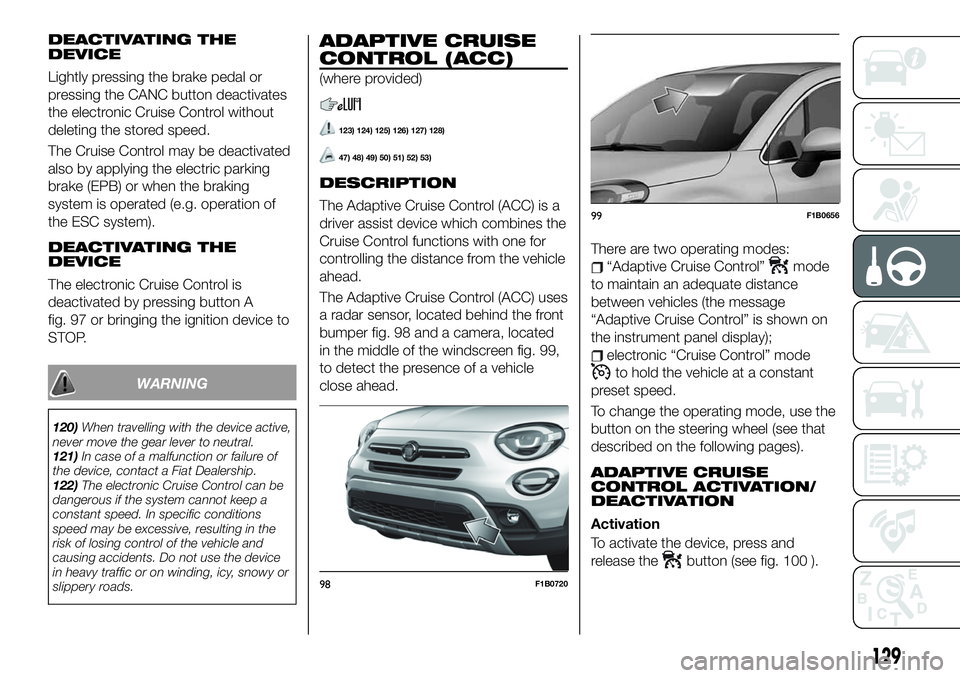
The Adaptive Cruise Control (ACC) uses
a radar sensor, located behind the front
bumper fig. 98 and a camera, located
in the middle of the windscreen fig. 99,
to detect the presence of a vehicle
close ahead.There are two operating modes:
“Adaptive Cruise Control”mode
to maintain an adequate distance
between vehicles (the message
“Adaptive Cruise Control” is shown on
the instrument panel display);
electronic “Cruise Control” mode
to hold the vehicle at a constant
preset speed.
To change the operating mode, use the
button on the steering wheel (see that
described on the following pages).
ADAPTIVE CRUISE
CONTROL ACTIVATION/
DEACTIVATION
Activation
To activate the device, press and
release the
button (see fig. 100 ).
98F1B0720
99F1B0656
129
Page 134 of 284
1-bar setting) to 2 seconds (for the
maximum distance 4-bar setting).
The setting is 4 (maximum) the first time
the device is used. After the distance
has been modified by the driver, the
new distance will be stored also after
the system is deactivated and
reactivated.
To decrease the distance
Press and release the
button to
decrease the distance setting.
The distance setting decreases by one
bar (shorter) every time the button is
pressed.
The set speed is held if there are no
cars ahead. Once the shortest distance
has been reached, a further press of
the button will set the longest distance.
The car holds the set distance until:
the vehicle ahead accelerates to a
speed higher than the set speed;
the vehicle ahead leaves the lane or
the detection field of the Adaptive
Cruise Control device sensor;
the distance setting is changed;
the Adaptive Cruise Control device is
deactivated/cancelled.
IMPORTANT The maximum breaking
applied by the device is limited. The
driver may apply the brakes in all cases
if needed.IMPORTANT If the device predicts that
the braking level is not sufficient to hold
the set distance, the driver is warned by
a message indicating that the vehicle
ahead is too close appears on the
display. An acoustic warning is also
emitted. In this case, it is advisable to
brake immediately as necessary to hold
a safe distance from the vehicle ahead.
IMPORTANT The driver is responsible
for ensuring that there are no
pedestrians, other cars or objectives
along the direction of the car. Failure to
comply with these precautions may
cause serious accidents and injuries.
IMPORTANT The driver is fully
responsible for holding a safe distance
from the vehicle ahead respecting the
highway code in force in the respective
country.
DEACTIVATION
The device is deactivated and the set
speed is cancelled if:
thebutton is pressed on the
Adaptive Cruise Control;
thebutton is pressed on the
electronic Cruise Control;
the Speed Limiter button is pressed;
the ignition device is in the STOP
position.
The device is cancelled (the set speed
and distance are stored):
when the CANC button is pressed;
when the conditions shown in the
“Setting the desired speed” paragraph
occur;
when the car speed drops under the
minimum set speed (e.g. in presence of
slow cars).
If these conditions occur while the
system is decelerating with respect to a
vehicle ahead, the system could
continue the deceleration, if necessary,
also after it is cancelled or deactivated
within the minimum speed settable on
the system.
ELECTRONIC CRUISE
CONTROL MODE
Electronic Cruise Control mode is
available for travelling at constant speed
in addition to the Adaptive Cruise
Control (ACC) mode.
If the Adaptive Cruise Control (ACC)
function is implemented on the vehicle,
the electronic Cruise Control works in
the same manner as the ACC (by
pressing the
button of the Cruise
Control) with the difference that:
it does not hold the distance from the
vehicle ahead;
the device keeps working if the radar
sensor is obstructed.
Before returning to the previously set
speed, bring the speed close to that
value, then press the RES button and
release it.
132
STARTING AND DRIVING
Page 135 of 284
WARNING
123)Pay the utmost attention while driving
at all times and be always ready to press
the brakes if needed.
124)The system is an aid for the driver,
who must always pay full attention while
driving. The responsibility always rests with
the driver, who must take into account the
traffic conditions in order to drive in
complete safety. The driver must always
maintain a safe distance from the vehicle in
front.
125)The device is not activated in
presence of pedestrians, oncoming
vehicles in the opposite direction of travel
or moving in the crosswise direction and
stationary objects (e.g. a vehicle standing
in a queue or a broken down vehicle).
126)The device cannot take account of
road, traffic and weather conditions, and
conditions of poor visibility (e.g. fog).
127)The device does not always fully
recognise complex driving conditions that
could cause it to determine the safe
distance to be held incorrectly or not at all.
128)The device cannot apply the
maximum braking force: the car will not be
stopped completely.
IMPORTANT
47)The system may have limited or absent
operation due to weather conditions such
as: heavy rain, hail, thick fog, heavy snow.48)
49)Operation can be adversely affected by
any structural change made to the vehicle,
such as a modification to the front
geometry, tyre change, or a heavier load
than the standard load of the vehicle.
50)Incorrect repairs made on the front part
of the car (e.g. bumper, chassis) may alter
the position of the radar sensor, and
adversely affect its operation. Go to a Fiat
Dealership for any operation of this type.
51)Do not tamper with or carry out any
intervention on the radar sensor or on the
camera on the windscreen. In the event of
a sensor fault, contact a Fiat Dealership.
52)Do not wash with high-pressure jets in
the bumper lower area: in particular do not
operate on the system's electrical
connector.
53)Be careful in the case of repairs and
new paintings in the area around the
sensor (panel covering the sensor on the
left side of the bumper). In the event of a
frontal impact the sensor may automatically
deactivate and display a warning to indicate
that the sensor needs to be repaired. Even
without a malfunction warning, deactivate
the system operation if you think that the
position of the radar sensor has changed
(e.g. due to low-speed frontal impact as
during parking manoeuvres). In these
cases, go to a Fiat Dealership to have the
radar sensor realigned or replaced.
DRIVE MODE
SELECTOR
(where provided)
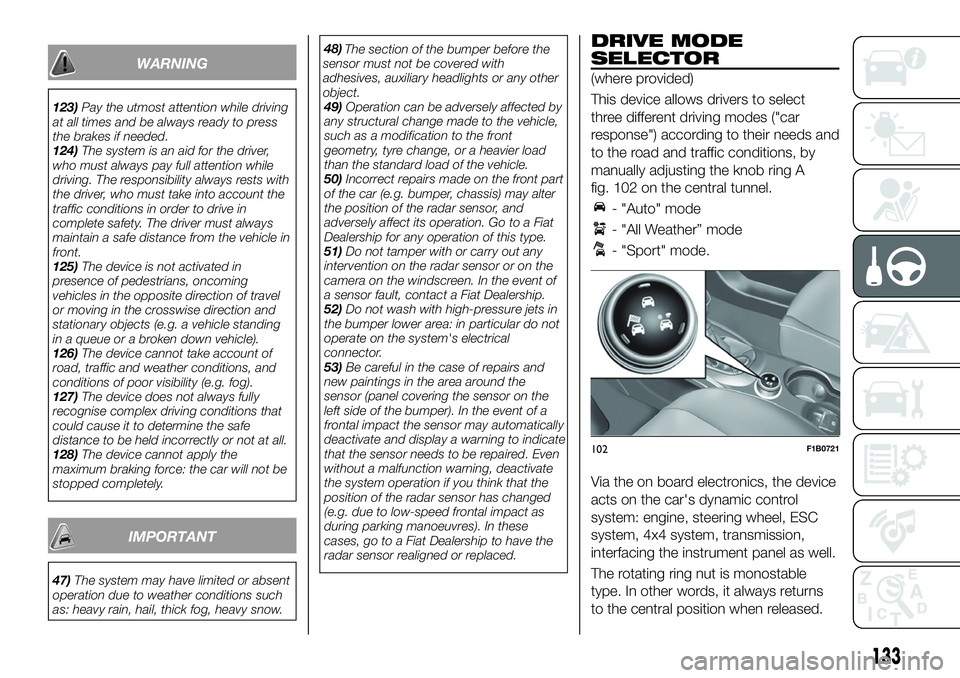
This device allows drivers to select
three different driving modes ("car
response") according to their needs and
to the road and traffic conditions, by
manually adjusting the knob ring A
fig. 102 on the central tunnel.
- "Auto" mode
- "All Weather” mode
- "Sport" mode.
Via the on board electronics, the device
acts on the car's dynamic control
system: engine, steering wheel, ESC
system, 4x4 system, transmission,
interfacing the instrument panel as well.
The rotating ring nut is monostable
type. In other words, it always returns
to the central position when released.
102F1B0721
133
The section of the bumper before the
sensor must not be covered with
adhesives, auxiliary headlights or any other
object.
Page 137 of 284
FAULT INDICATIONS
In the case of system and selector
faults, the mode change option will be
automatically disabled. The system will
automatically set itself to "Auto" mode.
In these cases the display will show a
dedicated warning. Go to a Fiat
Dealership as soon as possible to have
the system checked.
PARK ASSIST
SYSTEM
(where provided)
129)
54) 55) 56) 57)
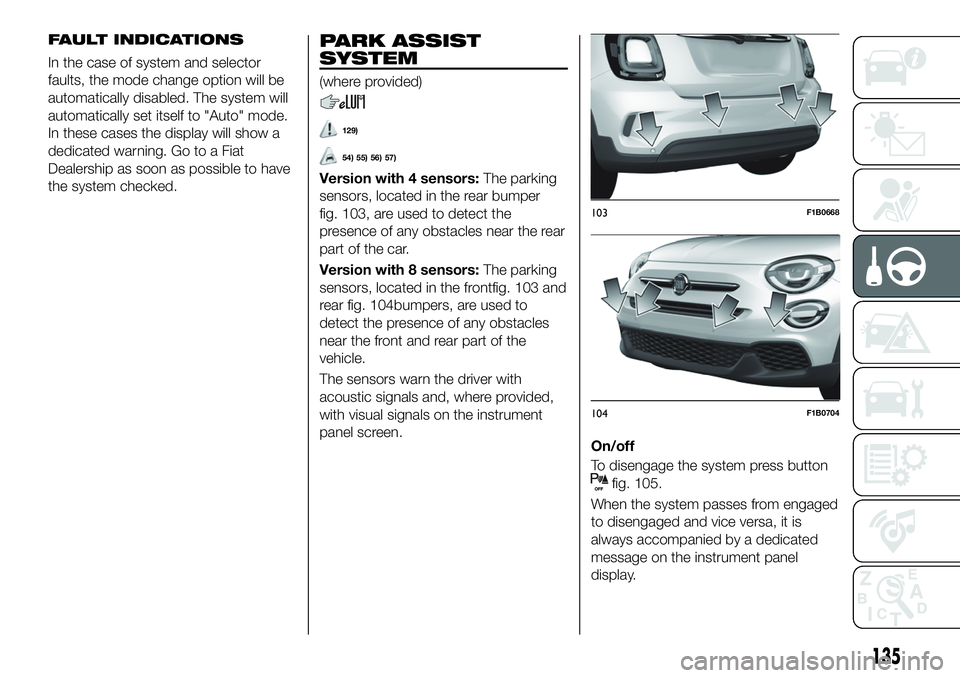
Version with 4 sensors:The parking
sensors, located in the rear bumper
fig. 103, are used to detect the
presence of any obstacles near the rear
part of the car.
Version with 8 sensors:The parking
sensors, located in the frontfig. 103 and
rear fig. 104bumpers, are used to
detect the presence of any obstacles
near the front and rear part of the
vehicle.
The sensors warn the driver with
acoustic signals and, where provided,
with visual signals on the instrument
panel screen.
On/off
To disengage the system press button
fig. 105.
When the system passes from engaged
to disengaged and vice versa, it is
always accompanied by a dedicated
message on the instrument panel
display.
103F1B0668
104F1B0704
135