engine coolant FIAT 500X 2022 User Guide
[x] Cancel search | Manufacturer: FIAT, Model Year: 2022, Model line: 500X, Model: FIAT 500X 2022Pages: 312, PDF Size: 13.26 MB
Page 241 of 312
SERVICING AND MAINTENANCE239
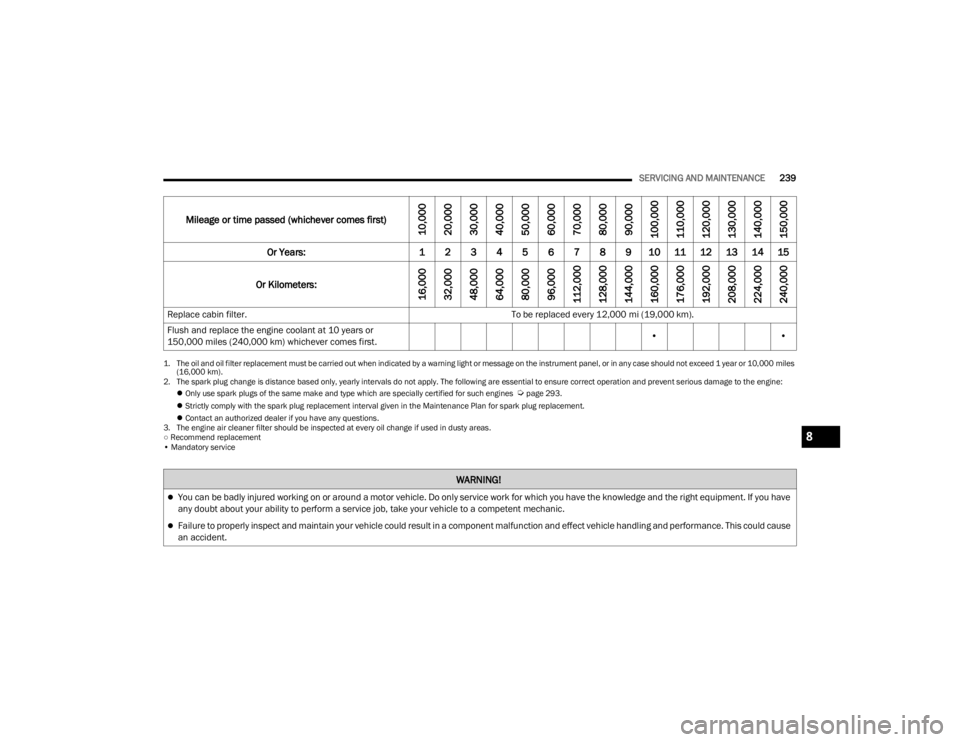
Replace cabin filter. To be replaced every 12,000 mi (19,000 km).
Flush and replace the engine coolant at 10 years or
150,000 miles (240,000 km) whichever comes first. •
•
1. The oil and oil filter replacement must be carried out when indicated by a warning light or message on the instrument panel, or in any case should not exceed 1 year or 10,000 miles
(16,000 km).
2. The spark plug change is distance based only, yearly intervals do not apply. The following are essential to ensure correct operation and prevent serious damage to the engine:
Only use spark plugs of the same make and type which are specially certified for such engines
Úpage 293.
Strictly comply with the spark plug replacement interval given in the Maintenance Plan for spark plug replacement.
Contact an authorized dealer if you have any questions.
3. The engine air cleaner filter should be inspected at every oil change if used in dusty areas.
○ Recommend replacement
• Mandatory service
Mileage or time passed (whichever comes first)
10,000
20,000
30,000
40,000
50,000
60,000
70,000
80,000
90,000
100,000
110,000
120,000
130,000
140,000
150,000
Or Years: 1 2 3 4 5 6 7 8 9 10 11 12 13 14 15
Or Kilometers:
16,000
32,000
48,000
64,000
80,000
96,000
112,000
128,000
144,000
160,000
176,000
192,000
208,000
224,000
240,000
WARNING!
You can be badly injured working on or around a motor vehicle. Do only service work for which you have the knowledge and the right equipment. If you have
any doubt about your ability to perform a service job, take your vehicle to a competent mechanic.
Failure to properly inspect and maintain your vehicle could result in a component malfunction and effect vehicle handling and performance. This could cause
an accident.
8
22_FD_OM_EN_USC_t.book Page 239
Page 242 of 312
240SERVICING AND MAINTENANCE
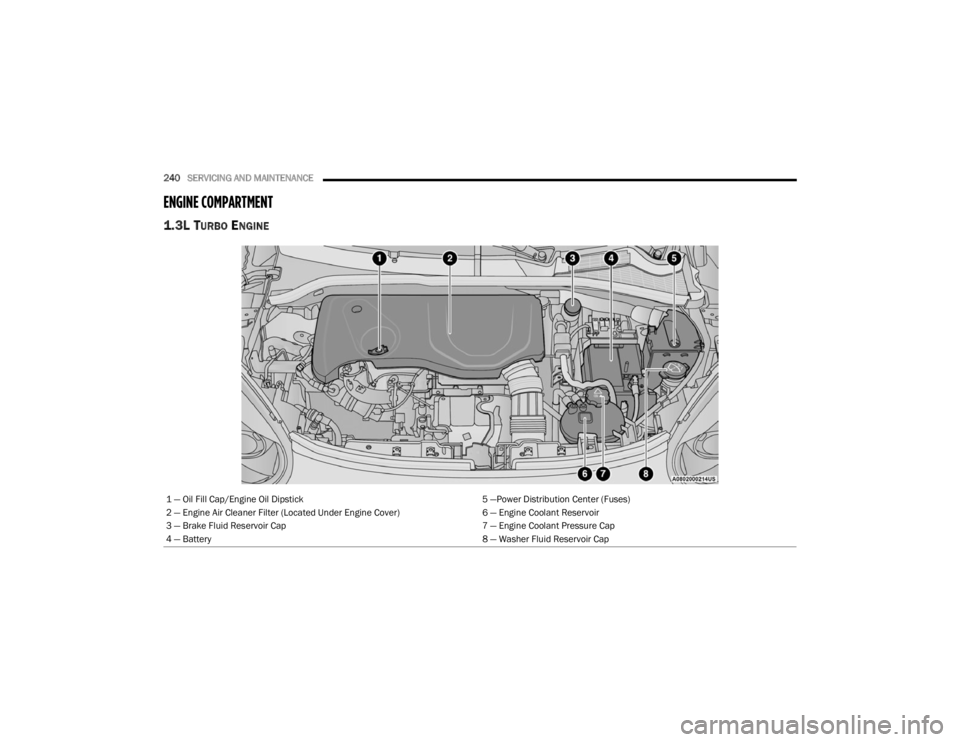
ENGINE COMPARTMENT
1.3L TURBO ENGINE
1 — Oil Fill Cap/Engine Oil Dipstick 5 —Power Distribution Center (Fuses)
2 — Engine Air Cleaner Filter (Located Under Engine Cover) 6 — Engine Coolant Reservoir
3 — Brake Fluid Reservoir Cap 7 — Engine Coolant Pressure Cap
4 — Battery 8 — Washer Fluid Reservoir Cap
22_FD_OM_EN_USC_t.book Page 240
Page 243 of 312
SERVICING AND MAINTENANCE241
CHECKING OIL LEVEL
To ensure proper engine lubrication, the engine oil
must be maintained at the correct level. Check the
oil level at regular intervals, such as every fuel
stop. The best time to check the engine oil level is
about five minutes after a fully warmed up engine
is shut off.
Checking the oil while the vehicle is on level ground
will improve the accuracy of the oil level readings.
NOTE:The dipstick is integral with the cap.
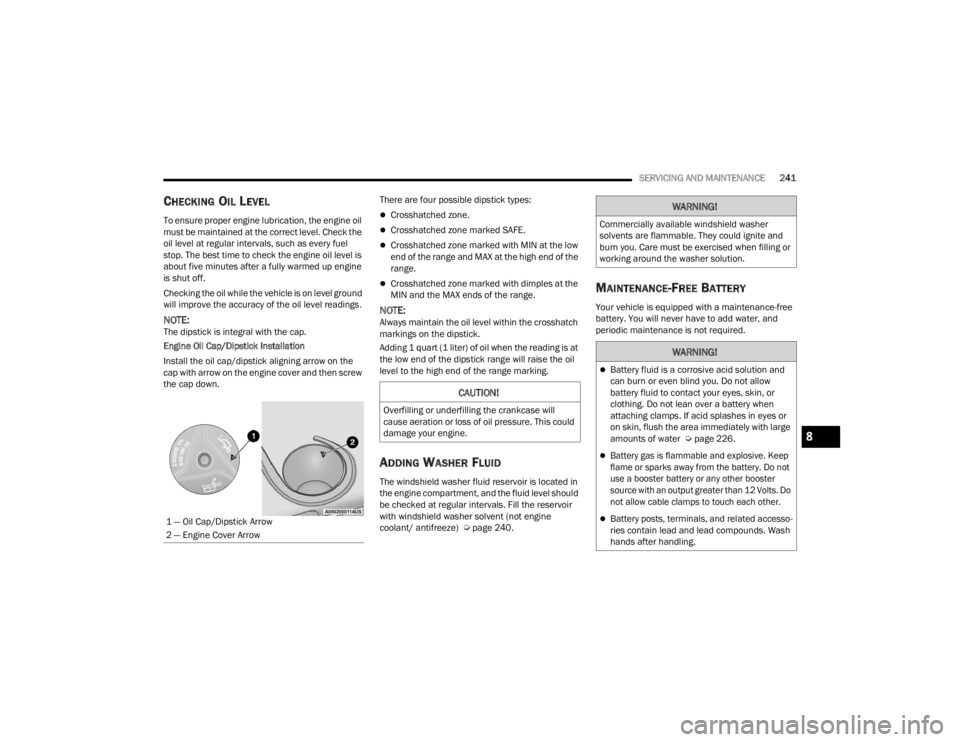
Engine Oil Cap/Dipstick Installation
Install the oil cap/dipstick aligning arrow on the
cap with arrow on the engine cover and then screw
the cap down. There are four possible dipstick types:
Crosshatched zone.
Crosshatched zone marked SAFE.
Crosshatched zone marked with MIN at the low
end of the range and MAX at the high end of the
range.
Crosshatched zone marked with dimples at the
MIN and the MAX ends of the range.
NOTE:Always maintain the oil level within the crosshatch
markings on the dipstick.
Adding 1 quart (1 liter) of oil when the reading is at
the low end of the dipstick range will raise the oil
level to the high end of the range marking.
ADDING WASHER FLUID
The windshield washer fluid reservoir is located in
the engine compartment, and the fluid level should
be checked at regular intervals. Fill the reservoir
with windshield washer solvent (not engine
coolant/ antifreeze) Ú
page 240.
MAINTENANCE-FREE BATTERY
Your vehicle is equipped with a maintenance-free
battery. You will never have to add water, and
periodic maintenance is not required.
1 — Oil Cap/Dipstick Arrow
2 — Engine Cover Arrow
CAUTION!
Overfilling or underfilling the crankcase will
cause aeration or loss of oil pressure. This could
damage your engine.
WARNING!
Commercially available windshield washer
solvents are flammable. They could ignite and
burn you. Care must be exercised when filling or
working around the washer solution.
WARNING!
Battery fluid is a corrosive acid solution and
can burn or even blind you. Do not allow
battery fluid to contact your eyes, skin, or
clothing. Do not lean over a battery when
attaching clamps. If acid splashes in eyes or
on skin, flush the area immediately with large
amounts of water Ú page 226.
Battery gas is flammable and explosive. Keep
flame or sparks away from the battery. Do not
use a booster battery or any other booster
source with an output greater than 12 Volts. Do
not allow cable clamps to touch each other.
Battery posts, terminals, and related accesso -
ries contain lead and lead compounds. Wash
hands after handling.
8
22_FD_OM_EN_USC_t.book Page 241
Page 249 of 312
SERVICING AND MAINTENANCE247
(Continued)
Under normal operating conditions, the catalytic
converter will not require maintenance. However, it
is important to keep the engine properly tuned to
ensure proper catalyst operation and prevent
possible catalyst damage.
NOTE:Intentional tampering with emissions control
systems can result in civil penalties being
assessed against you.
In unusual situations involving grossly
malfunctioning engine operation, a scorching odor
may suggest severe and abnormal catalyst
overheating. If this occurs, stop the vehicle, turn off
the engine and allow it to cool. Service, including a
tune-up to manufacturer's specifications, should
be obtained immediately. To minimize the possibility of catalytic converter
damage:
Do not interrupt the ignition when the transmis
-
sion is in gear and the vehicle is in motion.
Do not try to start the vehicle by pushing or
towing the vehicle.
Do not idle the engine with any ignition compo -
nents disconnected or removed, such as when
diagnostic testing, or for prolonged periods
during very rough idle or malfunctioning oper -
ating conditions.
COOLING SYSTEM
Engine Coolant Checks
Check the engine coolant (antifreeze) protection
every 12 months (before the onset of freezing
weather, where applicable). If the engine coolant is
dirty, the system should be drained, flushed, and
refilled with fresh Organic Additive Technology
(OAT) coolant (conforming to MS.90032) by an
authorized dealer. Check the front of the A/C
condenser for any accumulation of bugs, leaves,
etc. If dirty, clean by gently spraying water from a
garden hose vertically down the face of the
condenser.
Check the engine cooling system hoses for brittle
rubber, cracking, tears, cuts, and tightness of the
connection at the coolant recovery bottle and
radiator. Inspect the entire system for leaks. DO
NOT REMOVE THE COOLANT PRESSURE CAP
WHEN THE COOLING SYSTEM IS HOT.
Damage to the catalytic converter can result if
your vehicle is not kept in proper operating
condition. In the event of engine malfunction,
particularly involving engine misfire or other
apparent loss of performance, have your
vehicle serviced promptly. Continued opera -
tion of your vehicle with a severe malfunction
could cause the converter to overheat,
resulting in possible damage to the converter
and vehicle.
CAUTION!
WARNING!
You or others can be badly burned by hot
engine coolant (antifreeze) or steam from your
radiator. If you see or hear steam coming from
under the hood, do not open the hood until the
radiator has had time to cool. Never open a
cooling system pressure cap when the radi -
ator or coolant bottle is hot.
Keep hands, tools, clothing, and jewelry away
from the radiator cooling fan when the hood is
raised. The fan starts automatically and may
start at any time, whether the engine is
running or not.
When working near the radiator cooling fan,
disconnect the fan motor lead or turn the igni -
tion to the OFF position. The fan is tempera -
ture controlled and can start at any time the
ignition is in the ON position.
WARNING!
8
22_FD_OM_EN_USC_t.book Page 247
Page 250 of 312

248SERVICING AND MAINTENANCE
Cooling System — Drain, Flush And Refill
NOTE:Some vehicles require special tools to add coolant
properly. Failure to fill these systems properly
could lead to severe internal engine damage. If any
coolant is needed to be added to the system
please contact an authorized dealer.
If the engine coolant (antifreeze) is dirty or
contains visible sediment, have an authorized
dealer clean and flush with Organic Additive
Technology (OAT) coolant (conforming to
MS.90032).
For the proper maintenance intervals Úpage 236.
Selection Of Coolant
For further information Ú page 293.
NOTE:
Mixing of engine coolant (antifreeze) other than
specified Organic Additive Technology (OAT)
engine coolant, may result in engine damage
and may decrease corrosion protection. OAT
engine coolant is different and should not be
mixed with Hybrid Organic Additive Technology
(HOAT) engine coolant or any “globally compat -
ible” coolant. If a non-OAT engine coolant is
introduced into the cooling system in an emer -
gency, the cooling system will need to be drained, flushed, and refilled with fresh OAT
coolant (conforming to MS.90032), by an autho
-
rized dealer as soon as possible.
Do not use water alone or alcohol-based engine
coolant products. Do not use additional rust
inhibitors or anti-rust products, as they may not
be compatible with the radiator engine coolant
and may plug the radiator.
This vehicle has not been designed for use with
propylene glycol-based engine coolant. Use of
propylene glycol-based engine coolant is not
recommended.
Some vehicles require special tools to add
coolant properly. Failure to fill these systems
properly could lead to severe internal engine
damage. If any coolant is needed to be added to
the system please contact an authorized dealer.
Adding Coolant
Your vehicle has been built with an improved engine
coolant (OAT coolant conforming to MS.90032) that
allows extended maintenance intervals. This engine
coolant (antifreeze) can be used up to ten years or
150,000 miles (240,000 km) before replacement.
To prevent reducing this extended maintenance
period, it is important that you use the same engine
coolant (OAT coolant conforming to MS.90032)
throughout the life of your vehicle.
Please review these recommendations for using
Organic Additive Technology (OAT) engine coolant
that meets the requirements of the manufacturer
Material Standard MS.90032. When adding
engine coolant:
We recommend using Mopar® Antifreeze/
Coolant 10 Year/150,000 Mile (240,000 km)
Formula OAT that meets the requirements of the
manufacturer Material Standard MS.90032.
Mix a minimum solution of 50% OAT engine
coolant that meets the requirements of the
manufacturer Material Standard MS.90032
and distilled water. Use higher concentrations
(not to exceed 70%) if temperatures below
−34°F (−37°C) are anticipated. Please contact
an authorized dealer for assistance.
Use only high purity water such as distilled or
deionized water when mixing the water/engine
coolant solution. The use of lower quality water
will reduce the amount of corrosion protection
in the engine cooling system.
NOTE:
It is the owner's responsibility to maintain the
proper level of protection against freezing
according to the temperatures occurring in the
area where the vehicle is operated.
Some vehicles require special tools to add
coolant properly. Failure to fill these systems
properly could lead to severe internal engine
22_FD_OM_EN_USC_t.book Page 248
Page 251 of 312
SERVICING AND MAINTENANCE249
(Continued)
damage. If any coolant is needed to be added to
the system, please contact a local authorized
dealer.
Mixing engine coolant types is not recom
-
mended and can result in cooling system
damage. If HOAT and OAT coolant are mixed in
an emergency, have a authorized dealer drain,
flush, and refill with OAT coolant (conforming to
MS.90032) as soon as possible.
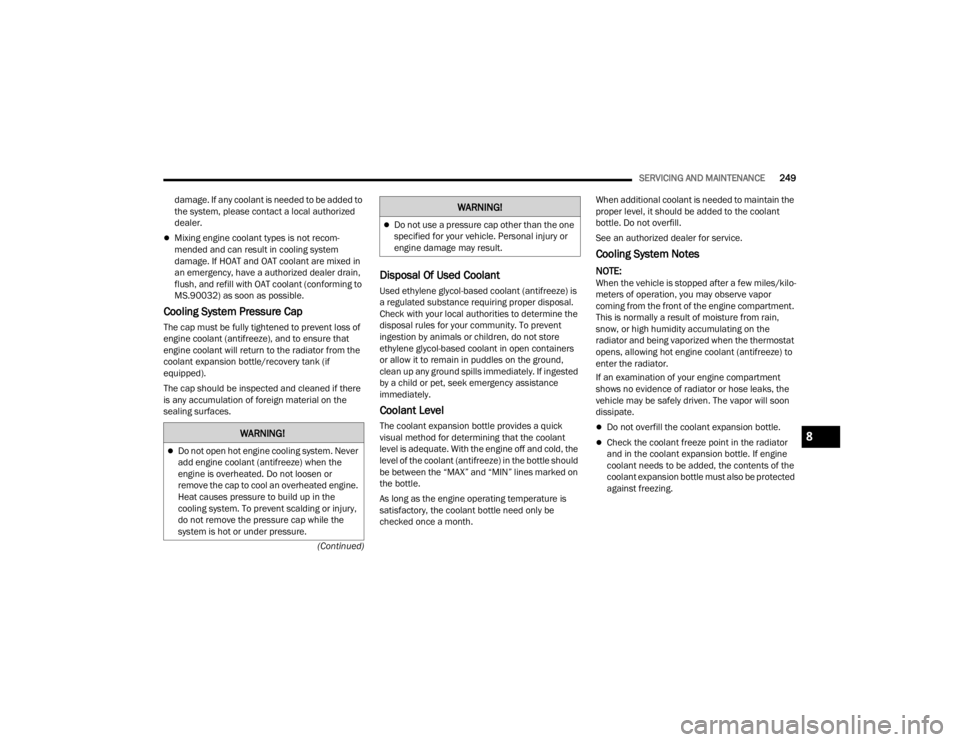
Cooling System Pressure Cap
The cap must be fully tightened to prevent loss of
engine coolant (antifreeze), and to ensure that
engine coolant will return to the radiator from the
coolant expansion bottle/recovery tank (if
equipped).
The cap should be inspected and cleaned if there
is any accumulation of foreign material on the
sealing surfaces.
Disposal Of Used Coolant
Used ethylene glycol-based coolant (antifreeze) is
a regulated substance requiring proper disposal.
Check with your local authorities to determine the
disposal rules for your community. To prevent
ingestion by animals or children, do not store
ethylene glycol-based coolant in open containers
or allow it to remain in puddles on the ground,
clean up any ground spills immediately. If ingested
by a child or pet, seek emergency assistance
immediately.
Coolant Level
The coolant expansion bottle provides a quick
visual method for determining that the coolant
level is adequate. With the engine off and cold, the
level of the coolant (antifreeze) in the bottle should
be between the “MAX” and “MIN” lines marked on
the bottle.
As long as the engine operating temperature is
satisfactory, the coolant bottle need only be
checked once a month. When additional coolant is needed to maintain the
proper level, it should be added to the coolant
bottle. Do not overfill.
See an authorized dealer for service.
Cooling System Notes
NOTE:When the vehicle is stopped after a few miles/kilo
-
meters of operation, you may observe vapor
coming from the front of the engine compartment.
This is normally a result of moisture from rain,
snow, or high humidity accumulating on the
radiator and being vaporized when the thermostat
opens, allowing hot engine coolant (antifreeze) to
enter the radiator.
If an examination of your engine compartment
shows no evidence of radiator or hose leaks, the
vehicle may be safely driven. The vapor will soon
dissipate.
Do not overfill the coolant expansion bottle.
Check the coolant freeze point in the radiator
and in the coolant expansion bottle. If engine
coolant needs to be added, the contents of the
coolant expansion bottle must also be protected
against freezing.WARNING!
Do not open hot engine cooling system. Never
add engine coolant (antifreeze) when the
engine is overheated. Do not loosen or
remove the cap to cool an overheated engine.
Heat causes pressure to build up in the
cooling system. To prevent scalding or injury,
do not remove the pressure cap while the
system is hot or under pressure.
Do not use a pressure cap other than the one
specified for your vehicle. Personal injury or
engine damage may result.
WARNING!
8
22_FD_OM_EN_USC_t.book Page 249
Page 252 of 312
250SERVICING AND MAINTENANCE
(Continued)
If frequent engine coolant additions are
required, the cooling system should be pressure
tested for leaks.
Maintain engine coolant concentration at a
minimum of 50% OAT coolant (conforming to
MS.90032) and distilled water for proper corro-
sion protection of your engine which contains
aluminum components.
Make sure that the coolant expansion bottle
overflow hoses are not kinked or obstructed.
Keep the front of the radiator clean. If your
vehicle is equipped with air conditioning, keep
the front of the condenser clean.
Do not change the thermostat for Summer or
Winter operation. If replacement is ever neces -
sary, install ONLY the correct type thermostat.
Other designs may result in unsatisfactory
engine cooling performance, poor gas mileage,
and increased emissions.
BRAKE SYSTEM
In order to ensure brake system performance, all
brake system components should be inspected
periodically Ú page 236.
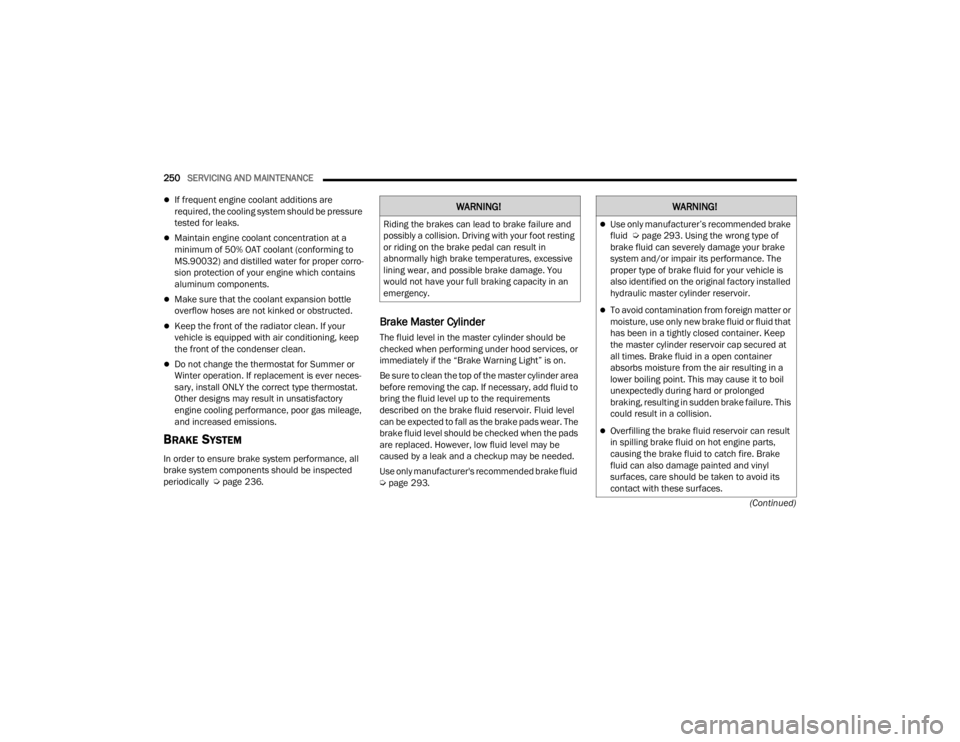
Brake Master Cylinder
The fluid level in the master cylinder should be
checked when performing under hood services, or
immediately if the “Brake Warning Light” is on.
Be sure to clean the top of the master cylinder area
before removing the cap. If necessary, add fluid to
bring the fluid level up to the requirements
described on the brake fluid reservoir. Fluid level
can be expected to fall as the brake pads wear. The
brake fluid level should be checked when the pads
are replaced. However, low fluid level may be
caused by a leak and a checkup may be needed.
Use only manufacturer's recommended brake fluid
Úpage 293.
WARNING!
Riding the brakes can lead to brake failure and
possibly a collision. Driving with your foot resting
or riding on the brake pedal can result in
abnormally high brake temperatures, excessive
lining wear, and possible brake damage. You
would not have your full braking capacity in an
emergency.
WARNING!
Use only manufacturer’s recommended brake
fluid Ú page 293. Using the wrong type of
brake fluid can severely damage your brake
system and/or impair its performance. The
proper type of brake fluid for your vehicle is
also identified on the original factory installed
hydraulic master cylinder reservoir.
To avoid contamination from foreign matter or
moisture, use only new brake fluid or fluid that
has been in a tightly closed container. Keep
the master cylinder reservoir cap secured at
all times. Brake fluid in a open container
absorbs moisture from the air resulting in a
lower boiling point. This may cause it to boil
unexpectedly during hard or prolonged
braking, resulting in sudden brake failure. This
could result in a collision.
Overfilling the brake fluid reservoir can result
in spilling brake fluid on hot engine parts,
causing the brake fluid to catch fire. Brake
fluid can also damage painted and vinyl
surfaces, care should be taken to avoid its
contact with these surfaces.
22_FD_OM_EN_USC_t.book Page 250
Page 294 of 312
292TECHNICAL SPECIFICATIONS
FUEL SYSTEM CAUTIONS
NOTE:Intentional tampering with the emissions control system can result in civil penalties being assessed against you.
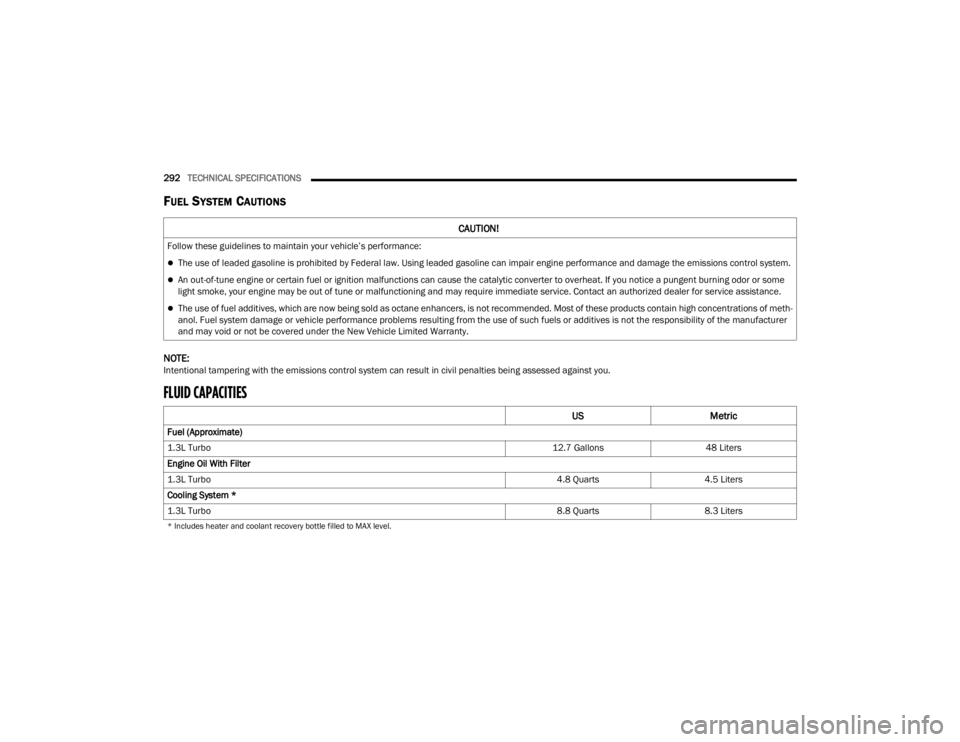
FLUID CAPACITIES
CAUTION!
Follow these guidelines to maintain your vehicle’s performance:
The use of leaded gasoline is prohibited by Federal law. Using leaded gasoline can impair engine performance and damage the emissions control system.
An out-of-tune engine or certain fuel or ignition malfunctions can cause the catalytic converter to overheat. If you notice a pungent burning odor or some
light smoke, your engine may be out of tune or malfunctioning and may require immediate service. Contact an authorized dealer for service assistance.
The use of fuel additives, which are now being sold as octane enhancers, is not recommended. Most of these products contain high concentrations of meth -
anol. Fuel system damage or vehicle performance problems resulting from the use of such fuels or additives is not the responsibility of the manufacturer
and may void or not be covered under the New Vehicle Limited Warranty.
US Metric
Fuel (Approximate)
1.3L Turbo 12.7 Gallons48 Liters
Engine Oil With Filter
1.3L Turbo 4.8 Quarts4.5 Liters
Cooling System *
1.3L Turbo 8.8 Quarts8.3 Liters
* Includes heater and coolant recovery bottle filled to MAX level.
22_FD_OM_EN_USC_t.book Page 292
Page 295 of 312
TECHNICAL SPECIFICATIONS293
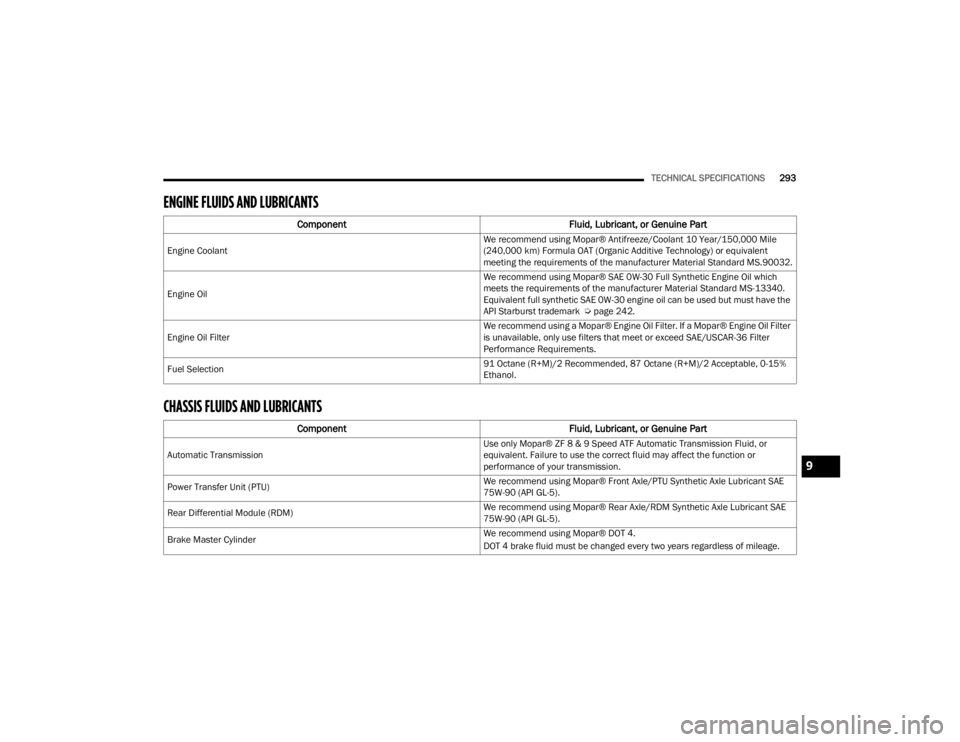
ENGINE FLUIDS AND LUBRICANTS
CHASSIS FLUIDS AND LUBRICANTS
Component Fluid, Lubricant, or Genuine Part
Engine Coolant We recommend using Mopar® Antifreeze/Coolant 10 Year/150,000 Mile
(240,000 km) Formula OAT (Organic Additive Technology) or equivalent
meeting the requirements of the manufacturer Material Standard MS.90032.
Engine Oil We recommend using Mopar® SAE 0W-30 Full Synthetic Engine Oil which
meets the requirements of the manufacturer Material Standard MS-13340.
Equivalent full synthetic SAE 0W-30 engine oil can be used but must have the
API Starburst trademark Ú
page 242.
Engine Oil Filter We recommend using a Mopar® Engine Oil Filter. If a Mopar® Engine Oil Filter
is unavailable, only use filters that meet or exceed SAE/USCAR-36 Filter
Performance Requirements.
Fuel Selection 91 Octane (R+M)/2 Recommended, 87 Octane (R+M)/2 Acceptable, 0-15%
Ethanol.
Component
Fluid, Lubricant, or Genuine Part
Automatic Transmission Use only Mopar® ZF 8 & 9 Speed ATF Automatic Transmission Fluid, or
equivalent. Failure to use the correct fluid may affect the function or
performance of your transmission.
Power Transfer Unit (PTU) We recommend using Mopar® Front Axle/PTU Synthetic Axle Lubricant SAE
75W-90 (API GL-5).
Rear Differential Module (RDM) We recommend using Mopar® Rear Axle/RDM Synthetic Axle Lubricant SAE
75W-90 (API GL-5).
Brake Master Cylinder We recommend using Mopar® DOT 4.
DOT 4 brake fluid must be changed every two years regardless of mileage.9
22_FD_OM_EN_USC_t.book Page 293
Page 301 of 312
299
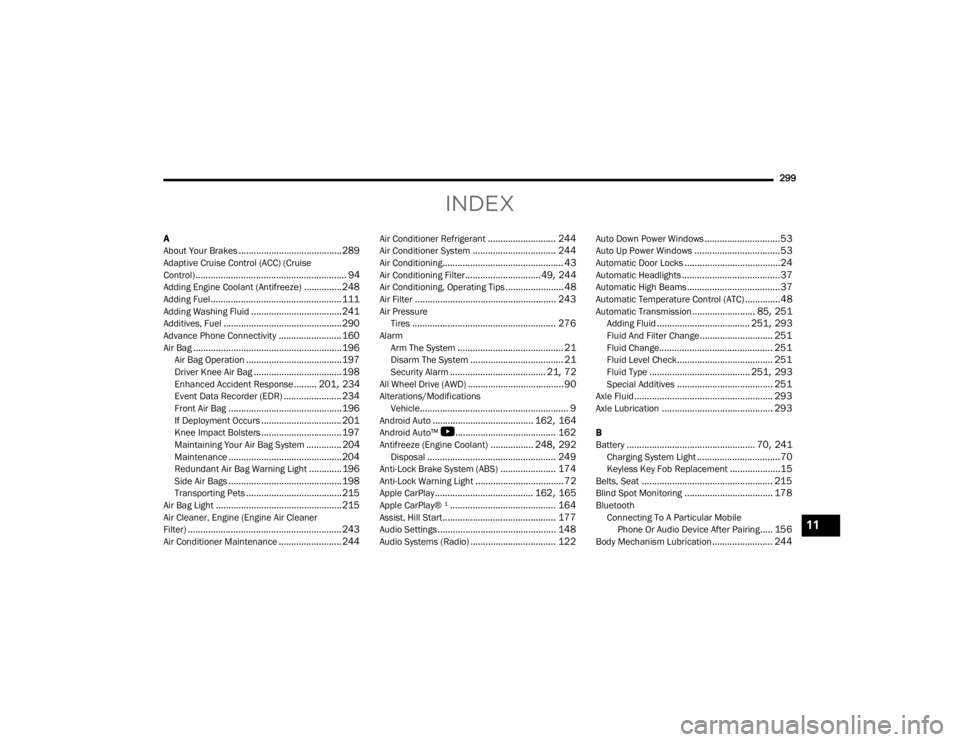
INDEX
A
About Your Brakes......................................... 289Adaptive Cruise Control (ACC) (Cruise
Control)............................................................ 94Adding Engine Coolant (Antifreeze)............... 248Adding Fuel.................................................... 111Adding Washing Fluid.................................... 241Additives, Fuel............................................... 290Advance Phone Connectivity......................... 160Air Bag........................................................... 196Air Bag Operation...................................... 197Driver Knee Air Bag................................... 198Enhanced Accident Response......... 201, 234Event Data Recorder (EDR)....................... 234Front Air Bag............................................. 196If Deployment Occurs................................ 201Knee Impact Bolsters................................ 197Maintaining Your Air Bag System.............. 204Maintenance............................................. 204Redundant Air Bag Warning Light.............196Side Air Bags............................................. 198Transporting Pets...................................... 215Air Bag Light.................................................. 215Air Cleaner, Engine (Engine Air Cleaner
Filter)............................................................. 243Air Conditioner Maintenance......................... 244
Air Conditioner Refrigerant........................... 244Air Conditioner System................................. 244Air Conditioning................................................ 43Air Conditioning Filter..............................49, 244Air Conditioning, Operating Tips....................... 48Air Filter........................................................ 243Air PressureTires......................................................... 276AlarmArm The System.......................................... 21Disarm The System..................................... 21Security Alarm...................................... 21, 72All Wheel Drive (AWD)...................................... 90Alterations/ModificationsVehicle........................................................... 9Android Auto........................................ 162, 164Android Auto™
S
........................................ 162Antifreeze (Engine Coolant)................. 248, 292Disposal................................................... 249Anti-Lock Brake System (ABS)...................... 174Anti-Lock Warning Light................................... 72Apple CarPlay....................................... 162, 165Apple CarPlay® ¹.......................................... 164Assist, Hill Start............................................. 177Audio Settings............................................... 148Audio Systems (Radio).................................. 122
Auto Down Power Windows..............................53Auto Up Power Windows..................................53Automatic Door Locks......................................24Automatic Headlights.......................................37Automatic High Beams.....................................37Automatic Temperature Control (ATC)..............48Automatic Transmission......................... 85, 251Adding Fluid..................................... 251, 293Fluid And Filter Change............................. 251Fluid Change............................................. 251Fluid Level Check...................................... 251Fluid Type........................................ 251, 293Special Additives...................................... 251Axle Fluid....................................................... 293Axle Lubrication............................................ 293
B
Battery................................................... 70, 241Charging System Light.................................70Keyless Key Fob Replacement....................15Belts, Seat.................................................... 215Blind Spot Monitoring................................... 178BluetoothConnecting To A Particular MobilePhone Or Audio Device After Pairing
..... 156Body Mechanism Lubrication........................ 244
11
22_FD_OM_EN_USC_t.book Page 299