tow FIAT 500X 2022 Owner's Guide
[x] Cancel search | Manufacturer: FIAT, Model Year: 2022, Model line: 500X, Model: FIAT 500X 2022Pages: 312, PDF Size: 13.26 MB
Page 194 of 312
192SAFETY
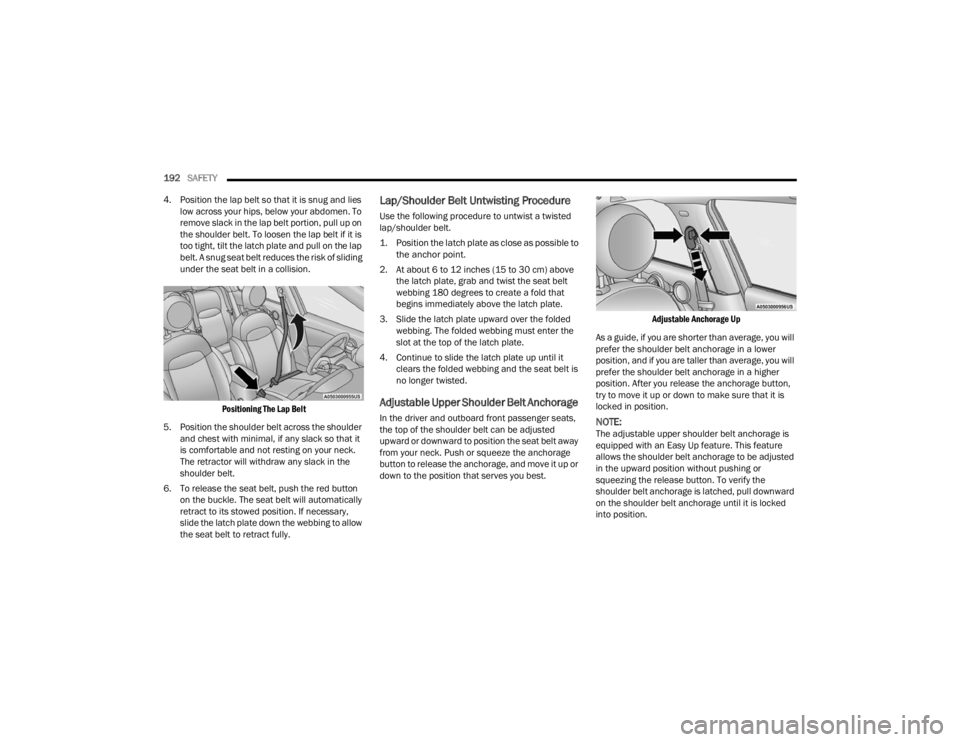
4. Position the lap belt so that it is snug and lies low across your hips, below your abdomen. To
remove slack in the lap belt portion, pull up on
the shoulder belt. To loosen the lap belt if it is
too tight, tilt the latch plate and pull on the lap
belt. A snug seat belt reduces the risk of sliding
under the seat belt in a collision.
Positioning The Lap Belt
5. Position the shoulder belt across the shoulder and chest with minimal, if any slack so that it
is comfortable and not resting on your neck.
The retractor will withdraw any slack in the
shoulder belt.
6. To release the seat belt, push the red button on the buckle. The seat belt will automatically
retract to its stowed position. If necessary,
slide the latch plate down the webbing to allow
the seat belt to retract fully.
Lap/Shoulder Belt Untwisting Procedure
Use the following procedure to untwist a twisted
lap/shoulder belt.
1. Position the latch plate as close as possible to the anchor point.
2. At about 6 to 12 inches (15 to 30 cm) above the latch plate, grab and twist the seat belt
webbing 180 degrees to create a fold that
begins immediately above the latch plate.
3. Slide the latch plate upward over the folded webbing. The folded webbing must enter the
slot at the top of the latch plate.
4. Continue to slide the latch plate up until it clears the folded webbing and the seat belt is
no longer twisted.
Adjustable Upper Shoulder Belt Anchorage
In the driver and outboard front passenger seats,
the top of the shoulder belt can be adjusted
upward or downward to position the seat belt away
from your neck. Push or squeeze the anchorage
button to release the anchorage, and move it up or
down to the position that serves you best.
Adjustable Anchorage Up
As a guide, if you are shorter than average, you will
prefer the shoulder belt anchorage in a lower
position, and if you are taller than average, you will
prefer the shoulder belt anchorage in a higher
position. After you release the anchorage button,
try to move it up or down to make sure that it is
locked in position.NOTE:The adjustable upper shoulder belt anchorage is
equipped with an Easy Up feature. This feature
allows the shoulder belt anchorage to be adjusted
in the upward position without pushing or
squeezing the release button. To verify the
shoulder belt anchorage is latched, pull downward
on the shoulder belt anchorage until it is locked
into position.
22_FD_OM_EN_USC_t.book Page 192
Page 213 of 312
SAFETY211
(Continued)
To Install A LATCH-Compatible Child
Restraint
If the selected seating position has a Switchable
Automatic Locking Retractor (ALR) seat belt, stow
the seat belt, following the instructions below. See
Ú page 211 to check what type of seat belt each
seating position has.
1. Loosen the adjusters on the lower straps and on the tether strap of the child seat so that
you can more easily attach the hooks or
connectors to the vehicle anchorages.
2. Place the child seat between the lower anchorages for that seating position. If the
second row seat can be reclined, you may
recline the seat and/or raise the head restraint
(if adjustable) to get a better fit. If the rear seat
can be moved forward and rearward in the
vehicle, you may wish to move it to its
rear-most position to make room for the child
seat. You may also move the front seat forward
to allow more room for the child seat.
3. Attach the lower hooks or connectors of the child restraint to the lower anchorages in the
selected seating position.
4. If the child restraint has a tether strap, connect it to the top tether anchorage. See
Úpage 213 for directions to attach a tether
anchor. 5. Tighten all of the straps as you push the child
restraint rearward and downward into the
seat. Remove slack in the straps according to
the child restraint manufacturer’s instructions.
6. Test that the child restraint is installed tightly by pulling back and forth on the child seat at
the belt path. It should not move more than
1 inch (25.4 mm) in any direction.
How To Stow An Unused Switchable-ALR
(ALR) Seat Belt:
When using the LATCH attaching system to install
a child restraint, stow all ALR seat belts that are not
being used by other occupants or being used to
secure child restraints. An unused belt could injure
a child if they play with it and accidentally lock the
seat belt retractor. Before installing a child
restraint using the LATCH system, buckle the seat
belt behind the child restraint and out of the child’s
reach. If the buckled seat belt interferes with the
child restraint installation, instead of buckling it
behind the child restraint, route the seat belt
through the child restraint belt path and then
buckle it. Do not lock the seat belt. Remind all
children in the vehicle that the seat belts are not
toys and that they should not play with them.
Installing Child Restraints Using The
Vehicle Seat Belt
Child restraint systems are designed to be secured
in vehicle seats by lap belts or the lap belt portion
of a lap/shoulder belt.
WARNING!
Improper installation of a child restraint to the
LATCH anchorages can lead to failure of the
restraint. The child could be badly injured or
killed. Follow the child restraint manufac -
turer’s directions exactly when installing an
infant or child restraint.
Child restraint anchorages are designed to
withstand only those loads imposed by
correctly-fitted child restraints. Under no
circumstances are they to be used for adult
seat belts, harnesses, or for attaching other
items or equipment to the vehicle.
WARNING!
Improper installation or failure to properly
secure a child restraint can lead to failure of
the restraint. The child could be badly injured
or killed.
6
22_FD_OM_EN_USC_t.book Page 211
Page 218 of 312

216SAFETY
(Continued)
(Continued)
PERIODIC SAFETY CHECKS YOU SHOULD
M
AKE OUTSIDE THE VEHICLE
Tires
Examine tires for excessive tread wear and uneven
wear patterns. Check for stones, nails, glass, or
other objects lodged in the tread or sidewall.
Inspect the tread for cuts and cracks. Inspect
sidewalls for cuts, cracks, and bulges. Check the
lug nuts/bolt torque for tightness. Check the tires
(including spare) for proper cold inflation pressure.
Lights
Have someone observe the operation of brake
lights and exterior lights while you work the
controls. Check turn signal and high beam
indicator lights on the instrument panel.
Door Latches
Check for proper closing, latching, and locking.
Fluid Leaks
Check area under the vehicle after overnight
parking for fuel, coolant, oil, or other fluid leaks.
Also, if gasoline fumes are detected or if fuel or
brake fluid leaks are suspected, the cause should
be located and corrected immediately.
EXHAUST GAS
ONLY use the driver’s side floor mat on the
driver’s side floor area. To check for interfer -
ence, with the vehicle properly parked with the
engine off, fully depress the accelerator, the
brake, and the clutch pedal (if present) to
check for interference. If your floor mat inter -
feres with the operation of any pedal, or is not
secure to the floor, remove the floor mat from
the vehicle and place the floor mat in your
trunk.
ONLY use the passenger’s side floor mat on
the passenger’s side floor area.
ALWAYS make sure objects cannot fall or slide
into the driver’s side floor area when the
vehicle is moving. Objects can become
trapped under accelerator, brake, or clutch
pedals and could cause a loss of vehicle
control.
NEVER place any objects under the floor mat
(e.g., towels, keys, etc.). These objects could
change the position of the floor mat and may
cause interference with the accelerator,
brake, or clutch pedals.
WARNING!
If the vehicle carpet has been removed and
re-installed, always properly attach carpet to
the floor and check the floor mat fasteners are
secure to the vehicle carpet. Fully depress
each pedal to check for interference with the
accelerator, brake, or clutch pedals then
re-install the floor mats.
It is recommended to only use mild soap and
water to clean your floor mats. After cleaning,
always check your floor mat has been properly
installed and is secured to your vehicle using
the floor mat fasteners by lightly pulling mat.
WARNING!
WARNING!
Exhaust gases can injure or kill. They contain
carbon monoxide (CO), which is colorless and
odorless. Breathing it can make you
unconscious and can eventually poison you. To
avoid breathing (CO), follow these safety tips:
Do not run the engine in a closed garage or in
confined areas any longer than needed to
move your vehicle in or out of the area.
22_FD_OM_EN_USC_t.book Page 216
Page 221 of 312
IN CASE OF EMERGENCY219
4. Place the gear selector into PARK (P).
5. Turn the ignition to STOP mode.
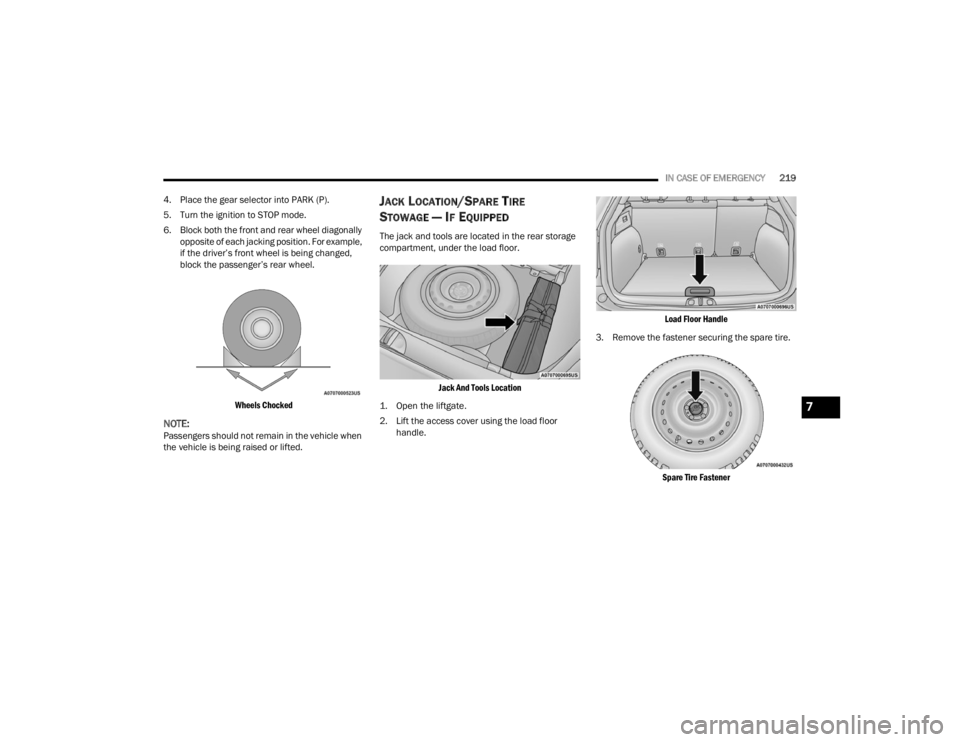
6. Block both the front and rear wheel diagonally opposite of each jacking position. For example,
if the driver’s front wheel is being changed,
block the passenger’s rear wheel.
Wheels Chocked
NOTE:Passengers should not remain in the vehicle when
the vehicle is being raised or lifted.
JACK LOCATION/SPARE TIRE
S
TOWAGE — IF EQUIPPED
The jack and tools are located in the rear storage
compartment, under the load floor.
Jack And Tools Location
1. Open the liftgate.
2. Lift the access cover using the load floor handle.
Load Floor Handle
3. Remove the fastener securing the spare tire.
Spare Tire Fastener
7
22_FD_OM_EN_USC_t.book Page 219
Page 222 of 312
220IN CASE OF EMERGENCY
(Continued)
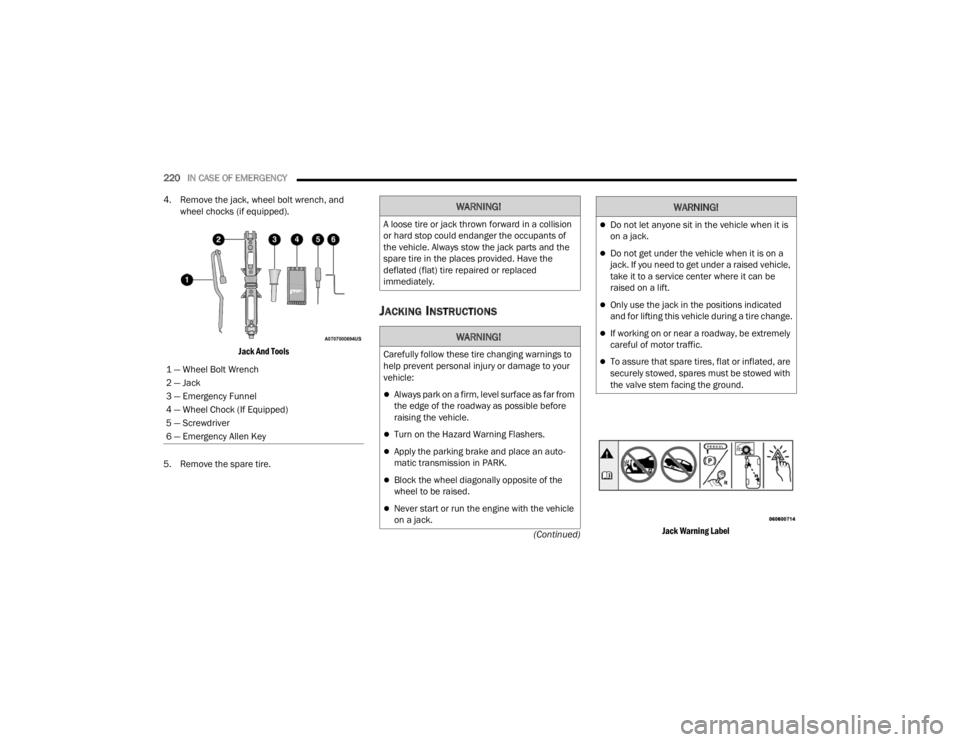
4. Remove the jack, wheel bolt wrench, and
wheel chocks (if equipped).
Jack And Tools
5. Remove the spare tire.
JACKING INSTRUCTIONS
Jack Warning Label
1 — Wheel Bolt Wrench
2 — Jack
3 — Emergency Funnel
4 — Wheel Chock (If Equipped)
5 — Screwdriver
6 — Emergency Allen Key
WARNING!
A loose tire or jack thrown forward in a collision
or hard stop could endanger the occupants of
the vehicle. Always stow the jack parts and the
spare tire in the places provided. Have the
deflated (flat) tire repaired or replaced
immediately.
WARNING!
Carefully follow these tire changing warnings to
help prevent personal injury or damage to your
vehicle:
Always park on a firm, level surface as far from
the edge of the roadway as possible before
raising the vehicle.
Turn on the Hazard Warning Flashers.
Apply the parking brake and place an auto
-
matic transmission in PARK.
Block the wheel diagonally opposite of the
wheel to be raised.
Never start or run the engine with the vehicle
on a jack.
Do not let anyone sit in the vehicle when it is
on a jack.
Do not get under the vehicle when it is on a
jack. If you need to get under a raised vehicle,
take it to a service center where it can be
raised on a lift.
Only use the jack in the positions indicated
and for lifting this vehicle during a tire change.
If working on or near a roadway, be extremely
careful of motor traffic.
To assure that spare tires, flat or inflated, are
securely stowed, spares must be stowed with
the valve stem facing the ground.
WARNING!
22_FD_OM_EN_USC_t.book Page 220
Page 224 of 312
222IN CASE OF EMERGENCY
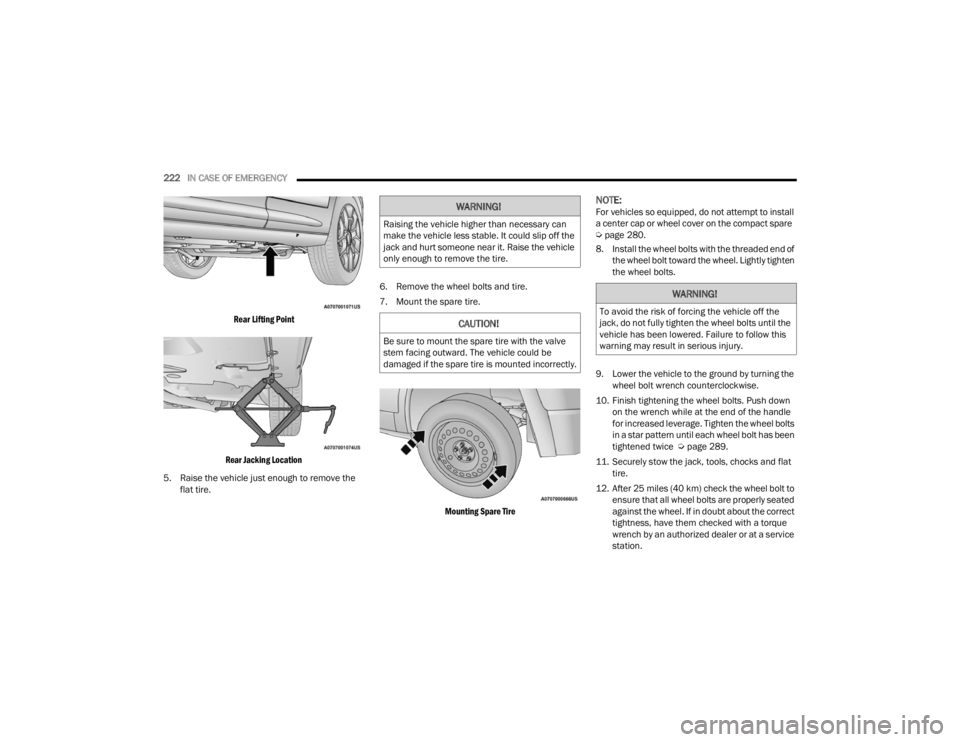
Rear Lifting Point
Rear Jacking Location
5. Raise the vehicle just enough to remove the flat tire. 6. Remove the wheel bolts and tire.
7. Mount the spare tire.
Mounting Spare Tire
NOTE:For vehicles so equipped, do not attempt to install
a center cap or wheel cover on the compact spare
Úpage 280.
8. Install the wheel bolts with the threaded end of the wheel bolt toward the wheel. Lightly tighten
the wheel bolts.
9. Lower the vehicle to the ground by turning the wheel bolt wrench counterclockwise.
10. Finish tightening the wheel bolts. Push down on the wrench while at the end of the handle
for increased leverage. Tighten the wheel bolts
in a star pattern until each wheel bolt has been
tightened twice Ú page 289.
11. Securely stow the jack, tools, chocks and flat tire.
12. After 25 miles (40 km) check the wheel bolt to ensure that all wheel bolts are properly seated
against the wheel. If in doubt about the correct
tightness, have them checked with a torque
wrench by an authorized dealer or at a service
station.WARNING!
Raising the vehicle higher than necessary can
make the vehicle less stable. It could slip off the
jack and hurt someone near it. Raise the vehicle
only enough to remove the tire.
CAUTION!
Be sure to mount the spare tire with the valve
stem facing outward. The vehicle could be
damaged if the spare tire is mounted incorrectly.
WARNING!
To avoid the risk of forcing the vehicle off the
jack, do not fully tighten the wheel bolts until the
vehicle has been lowered. Failure to follow this
warning may result in serious injury.
22_FD_OM_EN_USC_t.book Page 222
Page 225 of 312
IN CASE OF EMERGENCY223
SEMI–AUTO KIT
DESCRIPTION
If a tire is punctured, you can make an emergency
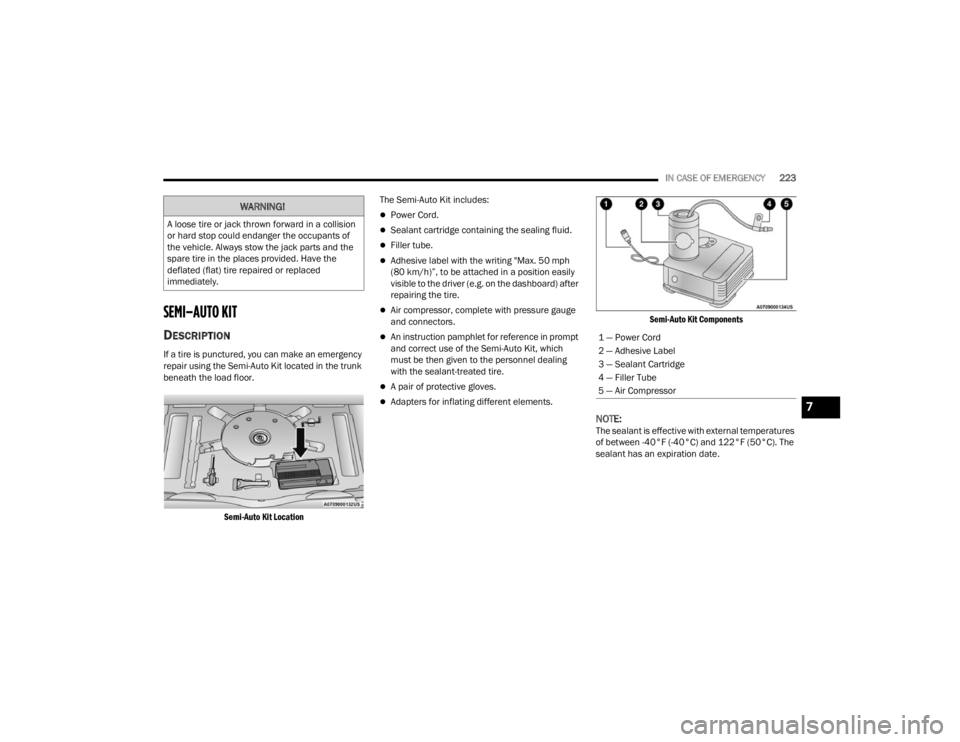
repair using the Semi-Auto Kit located in the trunk
beneath the load floor.
Semi-Auto Kit Location
The Semi-Auto Kit includes:
Power Cord.
Sealant cartridge containing the sealing fluid.
Filler tube.
Adhesive label with the writing "Max. 50 mph
(80 km/h)”, to be attached in a position easily
visible to the driver (e.g. on the dashboard) after
repairing the tire.
Air compressor, complete with pressure gauge
and connectors.
An instruction pamphlet for reference in prompt
and correct use of the Semi-Auto Kit, which
must be then given to the personnel dealing
with the sealant-treated tire.
A pair of protective gloves.
Adapters for inflating different elements.
Semi-Auto Kit Components
NOTE:The sealant is effective with external temperatures
of between -40°F (-40°C) and 122°F (50°C). The
sealant has an expiration date.
WARNING!
A loose tire or jack thrown forward in a collision
or hard stop could endanger the occupants of
the vehicle. Always stow the jack parts and the
spare tire in the places provided. Have the
deflated (flat) tire repaired or replaced
immediately.
1 — Power Cord
2 — Adhesive Label
3 — Sealant Cartridge
4 — Filler Tube
5 — Air Compressor
7
22_FD_OM_EN_USC_t.book Page 223
Page 226 of 312

224IN CASE OF EMERGENCY
(Continued)
(Continued)
To use the Semi-Auto Kit, proceed as follows:
1. Stop the vehicle in a position where you can
repair the tire safely. You should be as far as
possible from the side of the road, and in a
position that is not dangerous for oncoming
traffic. Activate the Hazard Warning Flashers,
remove the safety triangle from the trunk, and
place it at a suitable distance from the vehicle
to make other drivers aware of your presence.
2. Verify that the valve stem (on the wheel with the deflated tire) is in a position that is near to
the ground. This will allow the Semi-Auto Kit
hoses to reach the valve stem and keep the
tire repair kit flat on the ground.
3. Place the gear selector to PARK (P).
4. Apply the Electric Park Brake and cycle the engine OFF.
INFLATION PROCEDURE
WARNING!
Do not attempt to seal a tire on the side of the
vehicle closest to traffic. Pull far enough off
the road to avoid the danger of being hit when
using the Semi-Auto Kit.
Do not use the Semi-Auto Kit or drive the
vehicle under the following circumstances:
If the puncture in the tire tread is approxi -
mately 1/4 inch (6 mm) or larger.
If the tire has any sidewall damage.
If the tire has any damage from driving
with extremely low tire pressure.
If the tire has any damage from driving on
a flat tire.
If the wheel has any damage.
If you are unsure of the condition of the
tire or the wheel.
Keep the Semi-Auto Kit away from open
flames or heat sources.
A loose Semi-Auto Kit thrown forward in a colli -
sion or hard stop could endanger the occu -
pants of the vehicle. Always stow the
Semi-Auto Kit in the place provided. Failure to
follow these warnings can result in injuries
that are serious or fatal to you, your passen -
gers, and others around you.
WARNING!
Take care not to allow the contents of the
Semi-Auto Kit to come in contact with hair,
eyes, or clothing. Semi-Auto Kit sealant is
harmful if inhaled, swallowed, or absorbed
through the skin. It causes skin, eye, and
respiratory irritation. Flush immediately with
plenty of water if there is any contact with eyes
or skin. Change clothing as soon as possible,
if there is any contact with clothing.
Semi-Auto Kit sealant solution contains latex.
In case of an allergic reaction or rash, consult
a physician immediately. Keep the Semi-Auto
Kit out of reach of children. If swallowed, rinse
mouth immediately with plenty of water and
drink plenty of water. Do not induce vomiting!
Consult a physician immediately.
WARNING!
22_FD_OM_EN_USC_t.book Page 224
Page 234 of 312
232IN CASE OF EMERGENCY
(Continued)
(Continued)
TOWING A DISABLED VEHICLE
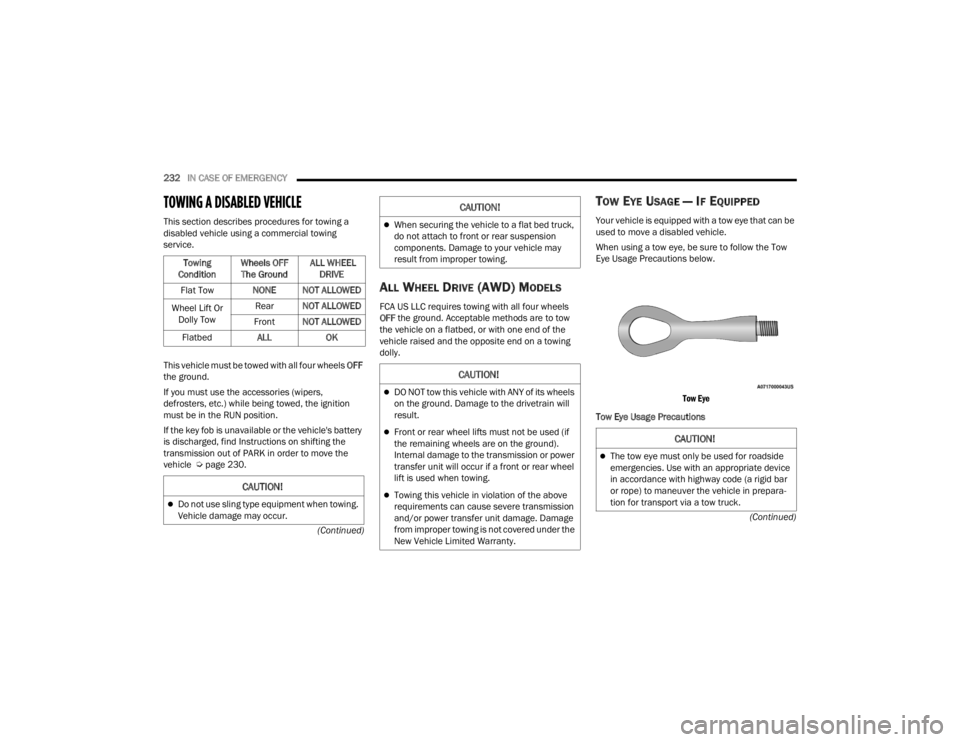
This section describes procedures for towing a
disabled vehicle using a commercial towing
service.
This vehicle must be towed with all four wheels OFF
the ground.
If you must use the accessories (wipers,
defrosters, etc.) while being towed, the ignition
must be in the RUN position.
If the key fob is unavailable or the vehicle's battery
is discharged, find Instructions on shifting the
transmission out of PARK in order to move the
vehicle Ú page 230.
ALL WHEEL DRIVE (AWD) MODELS
FCA US LLC requires towing with all four wheels
OFF the ground. Acceptable methods are to tow
the vehicle on a flatbed, or with one end of the
vehicle raised and the opposite end on a towing
dolly.
TOW EYE USAGE — IF EQUIPPED
Your vehicle is equipped with a tow eye that can be
used to move a disabled vehicle.
When using a tow eye, be sure to follow the Tow
Eye Usage Precautions below.
Tow Eye
Tow Eye Usage Precautions
Towing
Condition Wheels OFF
The Ground ALL WHEEL
DRIVE
Flat Tow NONE NOT ALLOWED
Wheel Lift Or Dolly Tow Rear
NOT ALLOWED
Front NOT ALLOWED
Flatbed ALLOK
CAUTION!
Do not use sling type equipment when towing.
Vehicle damage may occur.
When securing the vehicle to a flat bed truck,
do not attach to front or rear suspension
components. Damage to your vehicle may
result from improper towing.
CAUTION!
DO NOT tow this vehicle with ANY of its wheels
on the ground. Damage to the drivetrain will
result.
Front or rear wheel lifts must not be used (if
the remaining wheels are on the ground).
Internal damage to the transmission or power
transfer unit will occur if a front or rear wheel
lift is used when towing.
Towing this vehicle in violation of the above
requirements can cause severe transmission
and/or power transfer unit damage. Damage
from improper towing is not covered under the
New Vehicle Limited Warranty.
CAUTION!
CAUTION!
The tow eye must only be used for roadside
emergencies. Use with an appropriate device
in accordance with highway code (a rigid bar
or rope) to maneuver the vehicle in prepara -
tion for transport via a tow truck.
22_FD_OM_EN_USC_t.book Page 232
Page 235 of 312
IN CASE OF EMERGENCY233
(Continued)
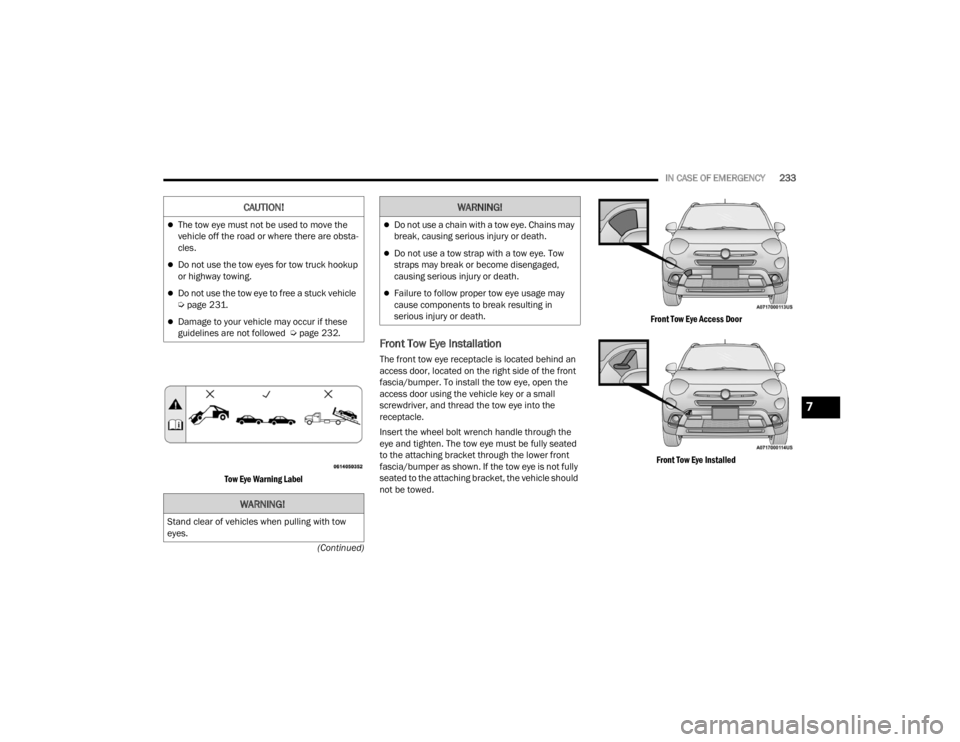
Tow Eye Warning Label
Front Tow Eye Installation
The front tow eye receptacle is located behind an
access door, located on the right side of the front
fascia/bumper. To install the tow eye, open the
access door using the vehicle key or a small
screwdriver, and thread the tow eye into the
receptacle.
Insert the wheel bolt wrench handle through the
eye and tighten. The tow eye must be fully seated
to the attaching bracket through the lower front
fascia/bumper as shown. If the tow eye is not fully
seated to the attaching bracket, the vehicle should
not be towed.
Front Tow Eye Access Door
Front Tow Eye Installed
The tow eye must not be used to move the
vehicle off the road or where there are obsta -
cles.
Do not use the tow eyes for tow truck hookup
or highway towing.
Do not use the tow eye to free a stuck vehicle
Ú page 231.
Damage to your vehicle may occur if these
guidelines are not followed Ú page 232.
WARNING!
Stand clear of vehicles when pulling with tow
eyes.
CAUTION!
Do not use a chain with a tow eye. Chains may
break, causing serious injury or death.
Do not use a tow strap with a tow eye. Tow
straps may break or become disengaged,
causing serious injury or death.
Failure to follow proper tow eye usage may
cause components to break resulting in
serious injury or death.
WARNING!
7
22_FD_OM_EN_USC_t.book Page 233