belt FIAT 500X 2022 Owners Manual
[x] Cancel search | Manufacturer: FIAT, Model Year: 2022, Model line: 500X, Model: FIAT 500X 2022Pages: 312, PDF Size: 13.26 MB
Page 7 of 312
5
OCCUPANT RESTRAINT SYSTEMS .................... 188 Occupant Restraint Systems ........................ 188
Important Safety Precautions....................... 188
Seat Belt Systems ......................................... 189
Supplemental Restraint Systems (SRS) ...... 195
Child Restraints ............................................ 204
SAFETY TIPS ......................................................... 214
Transporting Passengers .............................. 214Transporting Pets .......................................... 215
Safety Checks You Should Make Inside
The Vehicle ................................................... 215Periodic Safety Checks You Should Make
Outside The Vehicle ...................................... 216Exhaust Gas .................................................. 216
Carbon Monoxide Warnings ......................... 217
IN CASE OF EMERGENCY
HAZARD WARNING FLASHERS ......................... 218
JACKING AND TIRE CHANGING ........................ 218
Preparations For Jacking ............................. 218
Jack Location/Spare Tire Stowage —
If Equipped..................................................... 219
Jacking Instructions ...................................... 220
SEMI–AUTO KIT ................................................... 223
Description..................................................... 223
Inflation Procedure........................................ 224
Sealant Cartridge Replacement ................... 226 JUMP STARTING .................................................. 226
Preparations For Jump Start ........................ 227
Jump Starting Procedure .............................. 227
REFUELING IN EMERGENCY .............................. 229
IF YOUR ENGINE OVERHEATS ........................... 229
GEAR SELECTOR OVERRIDE ............................. 230
FREEING A STUCK VEHICLE .............................. 231
TOWING A DISABLED VEHICLE ........................ 232
All Wheel Drive (AWD) Models ...................... 232Tow Eye Usage — If Equipped ...................... 232
ENHANCED ACCIDENT RESPONSE SYSTEM
(EARS) .................................................................. 234
EVENT DATA RECORDER (EDR) ........................ 234
SERVICING AND MAINTENANCE
SCHEDULED MAINTENANCE.............................. 235
Maintenance Plan ......................................... 236
ENGINE COMPARTMENT .................................... 240
1.3L Turbo Engine ......................................... 240
Checking Oil Level ......................................... 241
Adding Washer Fluid ..................................... 241
Maintenance-Free Battery ........................... 241Pressure Washing ......................................... 242
VEHICLE MAINTENANCE..................................... 242
Engine Oil ...................................................... 242
Engine Oil Filter ............................................. 243Engine Air Cleaner Filter ............................... 243
Accessory Drive Belt Inspection ................... 243Air Conditioner Maintenance........................ 244
Body Lubrication ........................................... 244 Windshield Wiper Blades.............................. 245
Exhaust System ............................................ 246
Cooling System.............................................. 247
Brake System ............................................... 250
Automatic Transmission ............................... 251
FUSES ............................................................ 252
BULB REPLACEMENT .................................... 259
TIRES ..................................................................... 269
Tire Safety Information ................................. 269
Tires — General Information ......................... 276
Tire Types....................................................... 279Spare Tires — If Equipped............................. 280Wheel And Wheel Trim Care......................... 282
Snow Traction Devices ................................. 283
Tire Rotation Recommendations ................ 284
DEPARTMENT OF TRANSPORTATION
UNIFORM TIRE QUALITY GRADES .................... 285
Treadwear...................................................... 285
Traction Grades ............................................. 285Temperature Grades..................................... 285
STORING THE VEHICLE ....................................... 286
BODYWORK .......................................................... 286
Protection From Atmospheric Agents .......... 286
Body And Underbody Maintenance ............. 286
Preserving The Bodywork ............................. 286
INTERIORS ........................................................... 287
Seats And Fabric Parts ................................. 287
Plastic And Coated Parts .............................. 287
Leather Surfaces........................................... 288
Glass Surfaces ............................................. 288
22_FD_OM_EN_USC_t.book Page 5
Page 10 of 312
8
SYMBOLS KEY
If you do not read this entire Owner’s Manual, you may miss important
information. Observe all Cautions and Warnings.
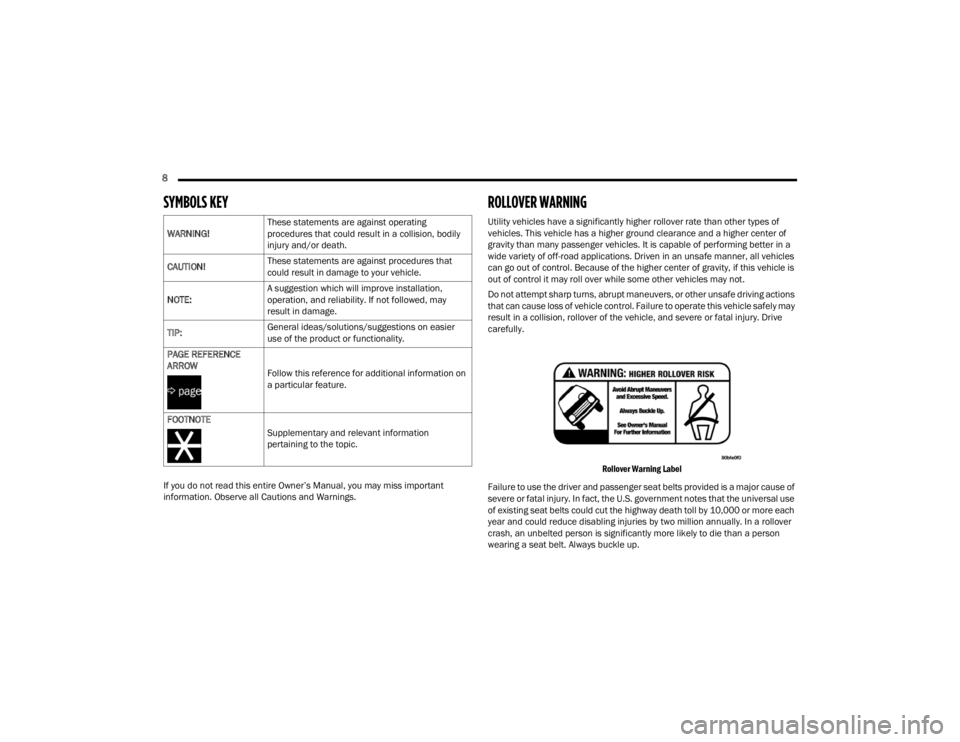
ROLLOVER WARNING
Utility vehicles have a significantly higher rollover rate than other types of
vehicles. This vehicle has a higher ground clearance and a higher center of
gravity than many passenger vehicles. It is capable of performing better in a
wide variety of off-road applications. Driven in an unsafe manner, all vehicles
can go out of control. Because of the higher center of gravity, if this vehicle is
out of control it may roll over while some other vehicles may not.
Do not attempt sharp turns, abrupt maneuvers, or other unsafe driving actions
that can cause loss of vehicle control. Failure to operate this vehicle safely may
result in a collision, rollover of the vehicle, and severe or fatal injury. Drive
carefully.
Rollover Warning Label
Failure to use the driver and passenger seat belts provided is a major cause of
severe or fatal injury. In fact, the U.S. government notes that the universal use
of existing seat belts could cut the highway death toll by 10,000 or more each
year and could reduce disabling injuries by two million annually. In a rollover
crash, an unbelted person is significantly more likely to die than a person
wearing a seat belt. Always buckle up.
WARNING!
These statements are against operating
procedures that could result in a collision, bodily
injury and/or death.
CAUTION! These statements are against procedures that
could result in damage to your vehicle.
NOTE: A suggestion which will improve installation,
operation, and reliability. If not followed, may
result in damage.
TIP: General ideas/solutions/suggestions on easier
use of the product or functionality.
PAGE REFERENCE
ARROW
Follow this reference for additional information on
a particular feature.
FOOTNOTE Supplementary and relevant information
pertaining to the topic.
22_FD_OM_EN_USC_t.book Page 8
Page 11 of 312
9
VEHICLE MODIFICATIONS/ALTERATIONS
SYMBOL GLOSSARY
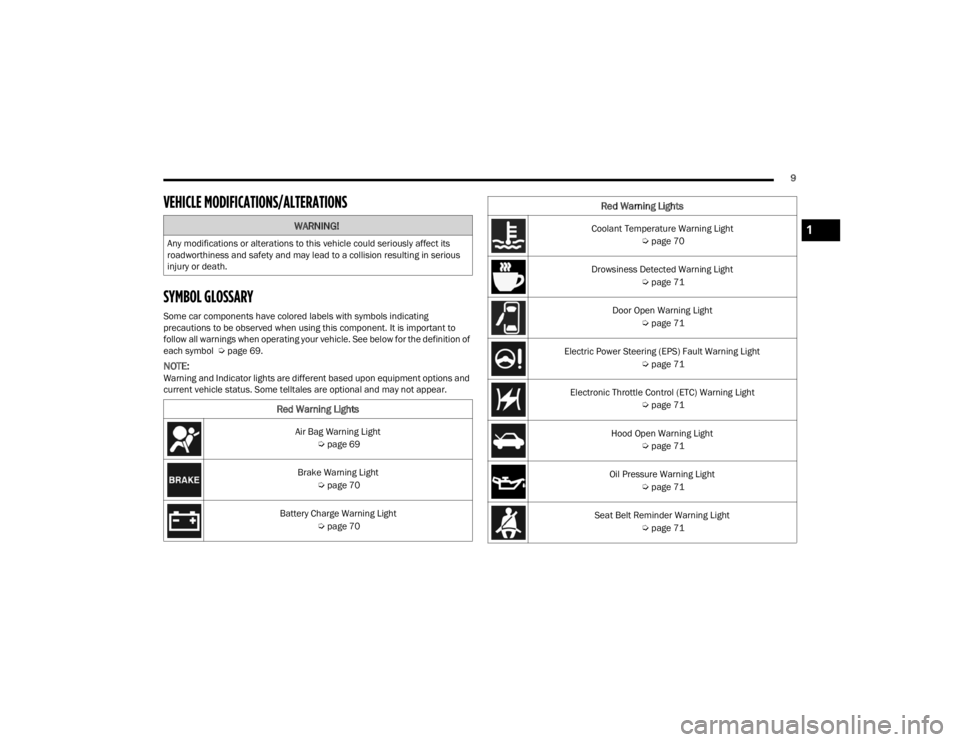
Some car components have colored labels with symbols indicating
precautions to be observed when using this component. It is important to
follow all warnings when operating your vehicle. See below for the definition of
each symbol Úpage 69.
NOTE:Warning and Indicator lights are different based upon equipment options and
current vehicle status. Some telltales are optional and may not appear.
WARNING!
Any modifications or alterations to this vehicle could seriously affect its
roadworthiness and safety and may lead to a collision resulting in serious
injury or death.
Red Warning Lights
Air Bag Warning Light
Úpage 69
Brake Warning Light Úpage 70
Battery Charge Warning Light Úpage 70
Coolant Temperature Warning Light
Úpage 70
Drowsiness Detected Warning Light Úpage 71
Door Open Warning Light Úpage 71
Electric Power Steering (EPS) Fault Warning Light Úpage 71
Electronic Throttle Control (ETC) Warning Light Úpage 71
Hood Open Warning Light Úpage 71
Oil Pressure Warning Light Úpage 71
Seat Belt Reminder Warning Light Úpage 71
Red Warning Lights
1
22_FD_OM_EN_USC_t.book Page 9
Page 28 of 312
26GETTING TO KNOW YOUR VEHICLE
(Continued)
SEATS
Seats are a part of the Occupant Restraint system
of the vehicle.
MANUAL ADJUSTMENT (FRONT SEATS)
Manual Front Seat Forward/Rearward
Adjustment
Some models may be equipped with manual seats.
The seat can be adjusted forward or rearward by
using a bar located by the front of the seat cushion,
near the floor.
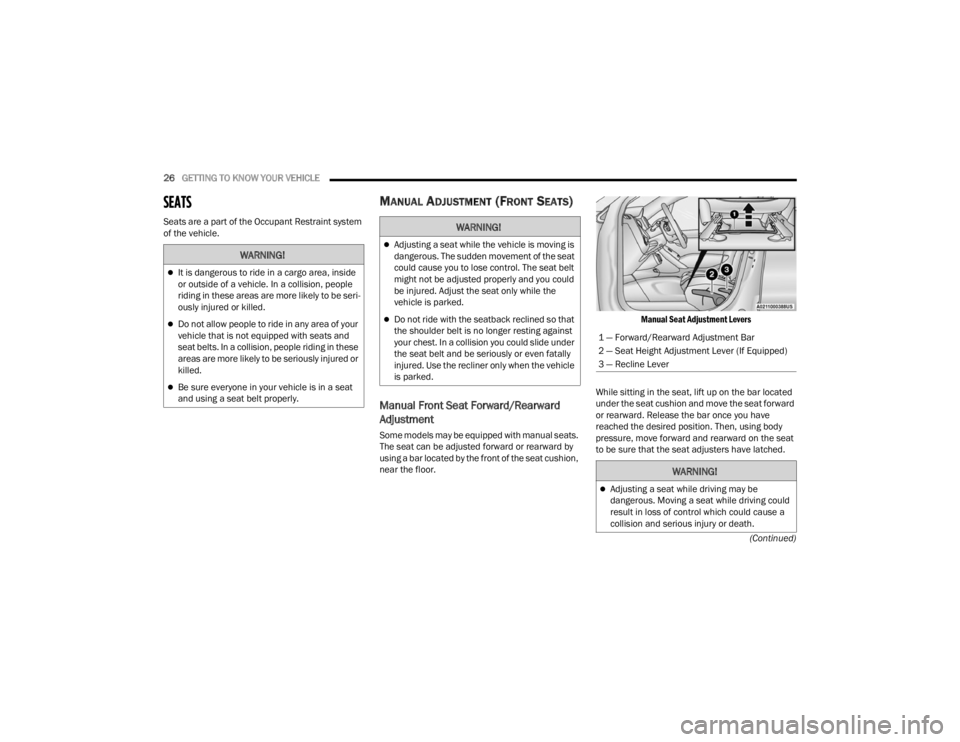
Manual Seat Adjustment Levers
While sitting in the seat, lift up on the bar located
under the seat cushion and move the seat forward
or rearward. Release the bar once you have
reached the desired position. Then, using body
pressure, move forward and rearward on the seat
to be sure that the seat adjusters have latched.
WARNING!
It is dangerous to ride in a cargo area, inside
or outside of a vehicle. In a collision, people
riding in these areas are more likely to be seri -
ously injured or killed.
Do not allow people to ride in any area of your
vehicle that is not equipped with seats and
seat belts. In a collision, people riding in these
areas are more likely to be seriously injured or
killed.
Be sure everyone in your vehicle is in a seat
and using a seat belt properly.
WARNING!
Adjusting a seat while the vehicle is moving is
dangerous. The sudden movement of the seat
could cause you to lose control. The seat belt
might not be adjusted properly and you could
be injured. Adjust the seat only while the
vehicle is parked.
Do not ride with the seatback reclined so that
the shoulder belt is no longer resting against
your chest. In a collision you could slide under
the seat belt and be seriously or even fatally
injured. Use the recliner only when the vehicle
is parked.
1 — Forward/Rearward Adjustment Bar
2 — Seat Height Adjustment Lever (If Equipped)
3 — Recline Lever
WARNING!
Adjusting a seat while driving may be
dangerous. Moving a seat while driving could
result in loss of control which could cause a
collision and serious injury or death.
22_FD_OM_EN_USC_t.book Page 26
Page 29 of 312
GETTING TO KNOW YOUR VEHICLE27
Height Adjustment — If Equipped
The front driver and passenger seats height can be
raised or lowered by using a lever, located on the
outboard side of the seat. Pull upward on the lever
to raise the seat height or push downward on the
lever to lower the seat height.
Recline Adjustment
To adjust the seatback, lift the lever located on the
outboard side of the seat, lean back to the desired
position and release the lever. To return the
seatback, lift the lever, lean forward and release
the lever.
MANUAL ADJUSTMENT (REAR SEATS)
Manual Folding Second Row Seat
The manual folding split rear seat increases the
storage of the rear cargo area.
NOTE:
Prior to folding the rear seat down, it may be
necessary to position the front seat to its
mid-track position. Be sure that the front seats
are fully upright and positioned forward, this will
allow the rear seat to fold down easily.
You may experience deformation in the seat
cushion from the seat belt buckles if the seats
are left folded for an extended period of time.
This is normal and by simply unfolding the seats
to the open position, over time the seat cushion
will return to its normal shape.
Cargo Area Enlargement
Folding both sides of the rear seat provides
additional storage in the rear cargo area.
Proceed as follows:
1. Remove the rear shelf (if equipped).
2. Fully lower the rear seat head restraints.
3. Move the safety belts to the outboard side of
the seat.
4. Pull the seatback release lever to fold both sides of the rear seatbacks completely
forward.
Partial Enlargement Of The Cargo Area
Enlargement of the left side of the cargo area
allows you to carry a single passenger on the right
side of the rear seat, while the enlargement of the
right side allows you to carry two passengers.
Proceed as follows:
1. Remove the rear shelf (if equipped).
2. Fully lower the rear seat head restraints.
3. Move the safety belts to the outboard side of the seat and rest them on the seat belt guide.
Seats should be adjusted before fastening the
seat belts and while the vehicle is parked.
Serious injury or death could result from a
poorly adjusted seat belt.
WARNING!
Do not pile luggage or cargo higher than the top
of the seatback. This could impair visibility or
become a dangerous projectile in a sudden stop
or collision.
WARNING!
WARNING!
It is extremely dangerous to ride in a cargo
area, inside or outside of a vehicle. In a colli -
sion, people riding in these areas are more
likely to be seriously injured or killed.
Do not allow people to ride in any area of your
vehicle that is not equipped with seats and
seat belts.
Be sure everyone in your vehicle is in a seat
and using a seat belt properly.
2
22_FD_OM_EN_USC_t.book Page 27
Page 30 of 312
28GETTING TO KNOW YOUR VEHICLE
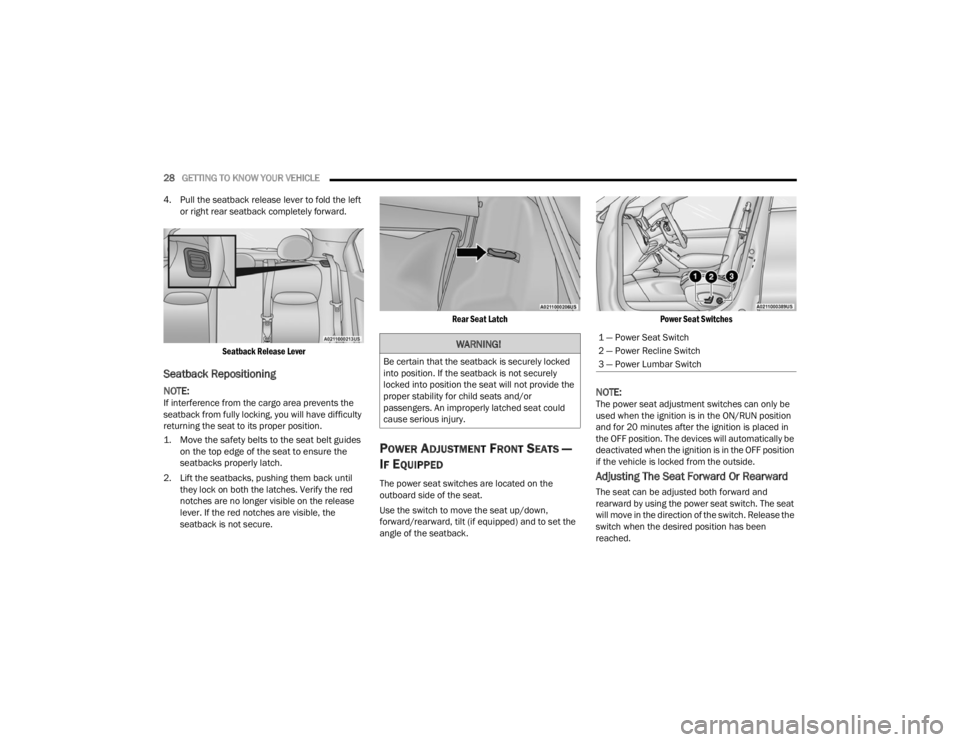
4. Pull the seatback release lever to fold the left or right rear seatback completely forward.
Seatback Release Lever
Seatback Repositioning
NOTE:If interference from the cargo area prevents the
seatback from fully locking, you will have difficulty
returning the seat to its proper position.
1. Move the safety belts to the seat belt guides on the top edge of the seat to ensure the
seatbacks properly latch.
2. Lift the seatbacks, pushing them back until they lock on both the latches. Verify the red
notches are no longer visible on the release
lever. If the red notches are visible, the
seatback is not secure.
Rear Seat Latch
POWER ADJUSTMENT FRONT SEATS —
I
F EQUIPPED
The power seat switches are located on the
outboard side of the seat.
Use the switch to move the seat up/down,
forward/rearward, tilt (if equipped) and to set the
angle of the seatback.
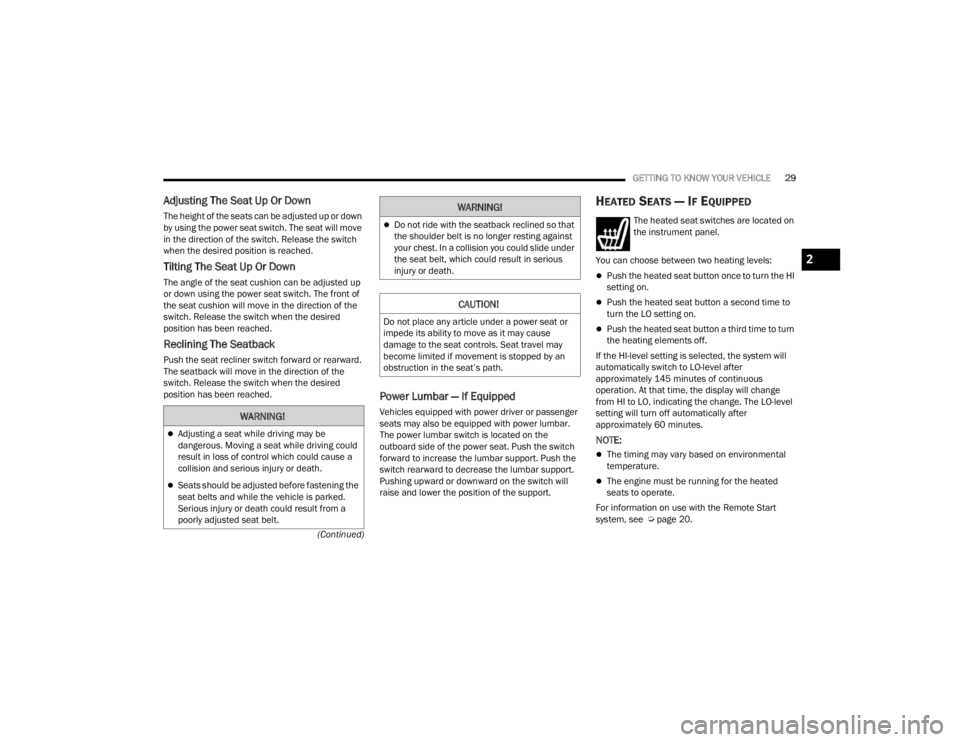
Power Seat Switches
NOTE:The power seat adjustment switches can only be
used when the ignition is in the ON/RUN position
and for 20 minutes after the ignition is placed in
the OFF position. The devices will automatically be
deactivated when the ignition is in the OFF position
if the vehicle is locked from the outside.
Adjusting The Seat Forward Or Rearward
The seat can be adjusted both forward and
rearward by using the power seat switch. The seat
will move in the direction of the switch. Release the
switch when the desired position has been
reached.
WARNING!
Be certain that the seatback is securely locked
into position. If the seatback is not securely
locked into position the seat will not provide the
proper stability for child seats and/or
passengers. An improperly latched seat could
cause serious injury.
1 — Power Seat Switch
2 — Power Recline Switch
3 — Power Lumbar Switch
22_FD_OM_EN_USC_t.book Page 28
Page 31 of 312
GETTING TO KNOW YOUR VEHICLE29
(Continued)
Adjusting The Seat Up Or Down
The height of the seats can be adjusted up or down
by using the power seat switch. The seat will move
in the direction of the switch. Release the switch
when the desired position is reached.
Tilting The Seat Up Or Down
The angle of the seat cushion can be adjusted up
or down using the power seat switch. The front of
the seat cushion will move in the direction of the
switch. Release the switch when the desired
position has been reached.
Reclining The Seatback
Push the seat recliner switch forward or rearward.
The seatback will move in the direction of the
switch. Release the switch when the desired
position has been reached.
Power Lumbar — If Equipped
Vehicles equipped with power driver or passenger
seats may also be equipped with power lumbar.
The power lumbar switch is located on the
outboard side of the power seat. Push the switch
forward to increase the lumbar support. Push the
switch rearward to decrease the lumbar support.
Pushing upward or downward on the switch will
raise and lower the position of the support.
HEATED SEATS — IF EQUIPPED
The heated seat switches are located on
the instrument panel.
You can choose between two heating levels:
Push the heated seat button once to turn the HI
setting on.
Push the heated seat button a second time to
turn the LO setting on.
Push the heated seat button a third time to turn
the heating elements off.
If the HI-level setting is selected, the system will
automatically switch to LO-level after
approximately 145 minutes of continuous
operation. At that time, the display will change
from HI to LO, indicating the change. The LO-level
setting will turn off automatically after
approximately 60 minutes.
NOTE:
The timing may vary based on environmental
temperature.
The engine must be running for the heated
seats to operate.
For information on use with the Remote Start
system, see Ú page 20.
WARNING!
Adjusting a seat while driving may be
dangerous. Moving a seat while driving could
result in loss of control which could cause a
collision and serious injury or death.
Seats should be adjusted before fastening the
seat belts and while the vehicle is parked.
Serious injury or death could result from a
poorly adjusted seat belt.
Do not ride with the seatback reclined so that
the shoulder belt is no longer resting against
your chest. In a collision you could slide under
the seat belt, which could result in serious
injury or death.
CAUTION!
Do not place any article under a power seat or
impede its ability to move as it may cause
damage to the seat controls. Seat travel may
become limited if movement is stopped by an
obstruction in the seat’s path.
WARNING!
2
22_FD_OM_EN_USC_t.book Page 29
Page 57 of 312
GETTING TO KNOW YOUR VEHICLE55
SUNROOF — IF EQUIPPED
The sunroof has two glass panels (the front one is
operational and the rear one fixed) and is
equipped with two manual operated sunshades,
front and rear.
The power sunroof can be operated only when the
ignition is placed in ON/RUN.
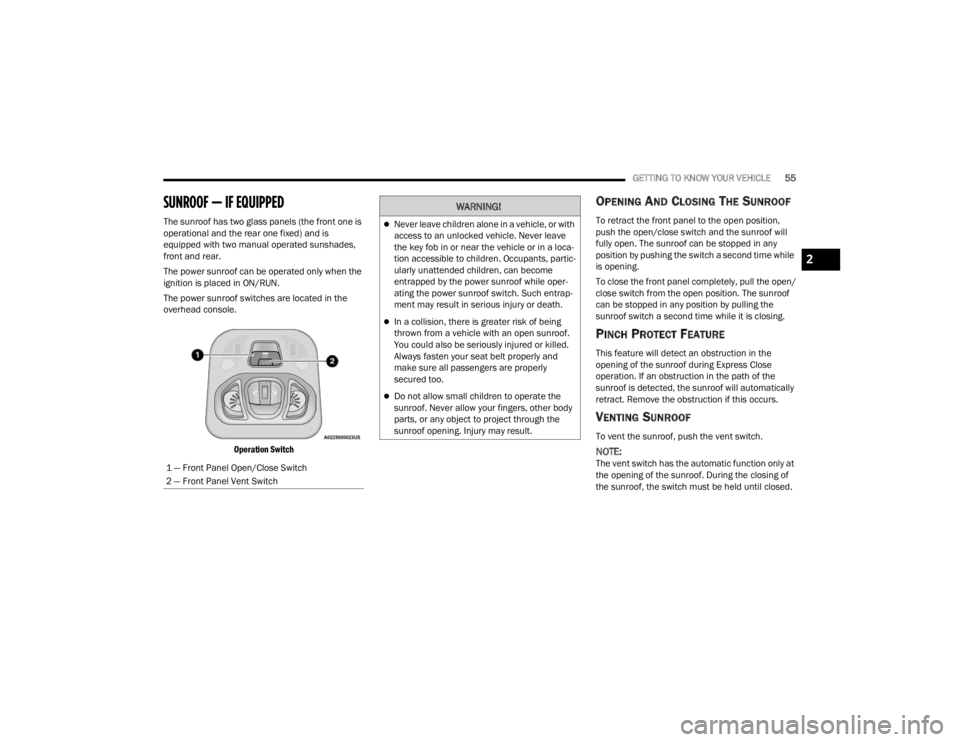
The power sunroof switches are located in the
overhead console.
Operation Switch
OPENING AND CLOSING THE SUNROOF
To retract the front panel to the open position,
push the open/close switch and the sunroof will
fully open. The sunroof can be stopped in any
position by pushing the switch a second time while
is opening.
To close the front panel completely, pull the open/
close switch from the open position. The sunroof
can be stopped in any position by pulling the
sunroof switch a second time while it is closing.
PINCH PROTECT FEATURE
This feature will detect an obstruction in the
opening of the sunroof during Express Close
operation. If an obstruction in the path of the
sunroof is detected, the sunroof will automatically
retract. Remove the obstruction if this occurs.
VENTING SUNROOF
To vent the sunroof, push the vent switch.
NOTE:The vent switch has the automatic function only at
the opening of the sunroof. During the closing of
the sunroof, the switch must be held until closed.
1 — Front Panel Open/Close Switch
2 — Front Panel Vent Switch
WARNING!
Never leave children alone in a vehicle, or with
access to an unlocked vehicle. Never leave
the key fob in or near the vehicle or in a loca
-
tion accessible to children. Occupants, partic -
ularly unattended children, can become
entrapped by the power sunroof while oper -
ating the power sunroof switch. Such entrap -
ment may result in serious injury or death.
In a collision, there is greater risk of being
thrown from a vehicle with an open sunroof.
You could also be seriously injured or killed.
Always fasten your seat belt properly and
make sure all passengers are properly
secured too.
Do not allow small children to operate the
sunroof. Never allow your fingers, other body
parts, or any object to project through the
sunroof opening. Injury may result.
2
22_FD_OM_EN_USC_t.book Page 55
Page 59 of 312
GETTING TO KNOW YOUR VEHICLE57
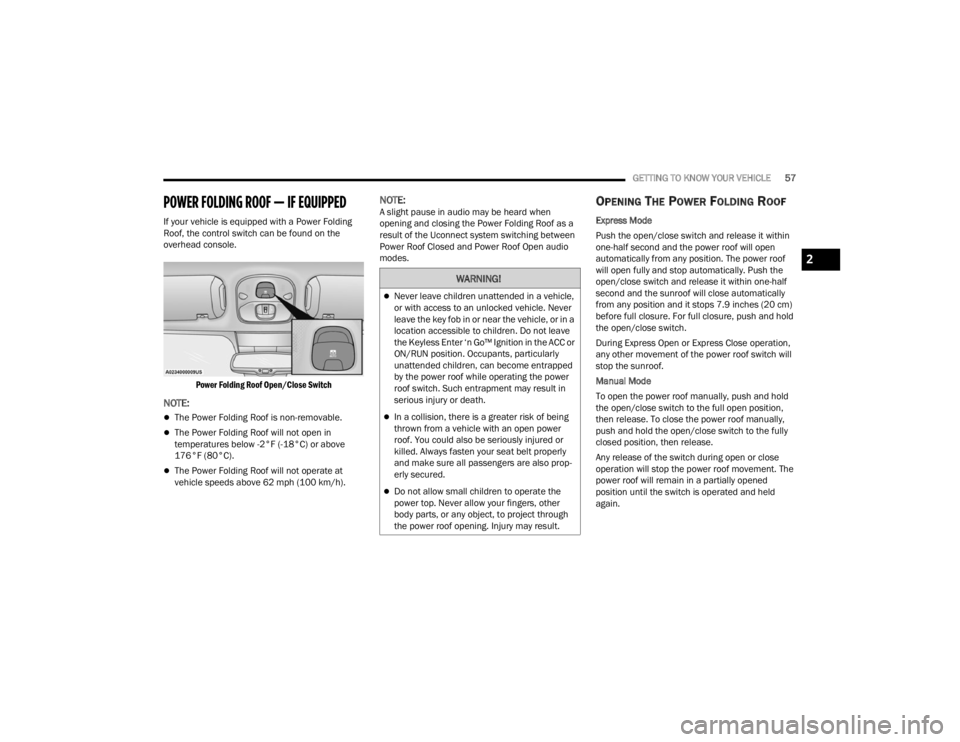
POWER FOLDING ROOF — IF EQUIPPED
If your vehicle is equipped with a Power Folding
Roof, the control switch can be found on the
overhead console.
Power Folding Roof Open/Close Switch
NOTE:
The Power Folding Roof is non-removable.
The Power Folding Roof will not open in
temperatures below -2°F (-18°C) or above
176°F (80°C).
The Power Folding Roof will not operate at
vehicle speeds above 62 mph (100 km/h).
NOTE:A slight pause in audio may be heard when
opening and closing the Power Folding Roof as a
result of the Uconnect system switching between
Power Roof Closed and Power Roof Open audio
modes.OPENING THE POWER FOLDING ROOF
Express Mode
Push the open/close switch and release it within
one-half second and the power roof will open
automatically from any position. The power roof
will open fully and stop automatically. Push the
open/close switch and release it within one-half
second and the sunroof will close automatically
from any position and it stops 7.9 inches (20 cm)
before full closure. For full closure, push and hold
the open/close switch.
During Express Open or Express Close operation,
any other movement of the power roof switch will
stop the sunroof.
Manual Mode
To open the power roof manually, push and hold
the open/close switch to the full open position,
then release. To close the power roof manually,
push and hold the open/close switch to the fully
closed position, then release.
Any release of the switch during open or close
operation will stop the power roof movement. The
power roof will remain in a partially opened
position until the switch is operated and held
again.
WARNING!
Never leave children unattended in a vehicle,
or with access to an unlocked vehicle. Never
leave the key fob in or near the vehicle, or in a
location accessible to children. Do not leave
the Keyless Enter ‘n Go™ Ignition in the ACC or
ON/RUN position. Occupants, particularly
unattended children, can become entrapped
by the power roof while operating the power
roof switch. Such entrapment may result in
serious injury or death.
In a collision, there is a greater risk of being
thrown from a vehicle with an open power
roof. You could also be seriously injured or
killed. Always fasten your seat belt properly
and make sure all passengers are also prop -
erly secured.
Do not allow small children to operate the
power top. Never allow your fingers, other
body parts, or any object, to project through
the power roof opening. Injury may result.
2
22_FD_OM_EN_USC_t.book Page 57
Page 70 of 312

68GETTING TO KNOW YOUR INSTRUMENT PANEL
Lights
Doors and Locks
Engine OFF Procedure — If Equipped
Display
By selecting "Display," you can access the following
settings:
Screen Setup: Allows you to configure the
display screen.
Language: Allows you to select the language in
which to display the information/warnings.
Automatic Reset Trip B: Allows you to set the
options to reset the Trip B (never, always, every
two hours or every eight hours).
Phone Repetition: Allows you to select “On” or
“Off”. The instrument cluster display can also
display the information concerning phone
mode. The information that can be displayed is
the connection status of the mobile phone
(phone connected or disconnected), the active
telephone calls/incoming/on hold, and the
management of double calls (first incoming
second waiting, etc.).
Navigation Repetition: Allows you to select “On”
or “Off” on the instrument cluster display, infor -
mation relating to the navigation mode.
Units
By selecting the item "Units Of Measure,” you can
select the unit of measure used in the display. Possible options are:
US
Metric
Custom
Clock And Date
By selecting the item "clock and date," you can
adjust the clock.
Possible options are:
Set Time: Adjust hours/minutes.
Set Format: Adjust the time format "12h"
(12 hours) or "24h" (24 hours).
Set Date: Adjust day/month/year.
Security
By selecting the item “Security,” you can make the
following adjustments:
Speed Warning: Set the vehicle speed limit
(mph or km/h), which the driver is notified
through a visual and acoustic signaling (display
of a message and a symbol on the display).
Seat Belt Buzzer: This function is only viewable
when the Seat Belt Reminder (SBR) system is
active.
Hill Start Assist: Activation/Deactivation of the
Hill Start Assist system. Safety And Assistance
By selecting the item "Safety & Assistance," you
can make the following adjustments:
Full Brake Control: A selection of operating
modes of the Full Brake Control system.
Full Brake Control Sensitivity: A selection of the
"readiness" of intervention of the Full Brake
Control system, based on the distance to the
obstacle.
Park Assist: A selection of the type of informa
-
tion provided by Park Assist.
Park Assist Vol.: A selection of the volume of
acoustic signals provided by Park Assist.
Rain Sensing Wipers: Enabling/disabling the
automatic operation of wipers in the event of
rain.
LaneSense Warning — If Equipped: A selection
of the "readiness" of intervention of LaneSense.
Warning Buzzer Volume: Increase or decrease
the volume of the buzzer by selecting “Low”,
“Medium”, or “High”.
Maintenance Brakes — If Equipped: Activation
of the procedure to carry out braking system
maintenance.
Auto Park Brake — If Equipped: Enable/disable
auto-insertion of the Electric Parking Brake.
22_FD_OM_EN_USC_t.book Page 68