ESP FIAT 600 2007 1.G User Guide
[x] Cancel search | Manufacturer: FIAT, Model Year: 2007, Model line: 600, Model: FIAT 600 2007 1.GPages: 146, PDF Size: 2.05 MB
Page 84 of 146
83IN AN EMERGENCY
I I
N N
A A
N N
E E
M M
E E
R R
G G
E E
N N
C C
Y Y
EMERGENCY
START-UP
If the Fiat CODE cannot deactivate
the engine immobilising system, the
¢and
Uwarning lights stay on and
the engine will not start. Follow the
emergency start-up procedure to
start the engine.
Read the whole procedure care-
fully before trying to carry it out.
If you make a mistake, you must turn
the ignition key back to STOPand
repeat the whole operation from the
beginning (step 1).
1)Read the 5-figure electronic code
given on the CODE card.
2)Turn the ignition key to MAR.3)Press and hold down the acceler-
ator pedal. The injection system warn-
ing light
Uwill come on for about 8
seconds, and then go out. At this
point release the accelerator pedal
and get ready to count the flashes of
warning light
U.
4) Count the number of flashes that
corresponds to the first figure of the
code on the CODE card, then press
the accelerator pedal and keep it there
until the
Uwarning light comes on
for four seconds and then goes out;
release the accelerator pedal.
5) The
Uwarning light will start
flashing again: after it has flashed the
number of times that corresponds to
the second figure on the CODE card,
press the accelerator pedal to the
floor and keep it there.
6) Do the same for the remaining
figures on the CODE card. 7) Once the final figure has been en-
tered, keep the accelerator pedal
pressed. The injection warning light
Uwill light up for four seconds and
then go out; release the accelerator
pedal.
8)The
Uwarning light will flash
rapidly for about 4 seconds to indicate
that the operation has been com-
pleted correctly.
9) Start the engine by turning the ig-
nition key from MARto AVV.
If, however, the
Uwarning light
stays on, turn the ignition key to
STOPand repeat the procedure
from step 1.
IMPORTANTAfter an emergency
start, you should contact a Fiat Deal-
ership, otherwise you will have to re-
peat the procedure described each
time you want to start the engine.
083-104 Seicento GB 22-11-2007 10:50 Pagina 83
Page 86 of 146
85IN AN EMERGENCY
BUMP STARTING IF A TYRE IS
PUNCTURED
General instructions
Observe the instructions on this and
the following pages to use the jack and
space-saver spare wheel correctly. The space-saver spare
wheel is vehicle-specific.
Never use the wheel on
other models. Never fit other
model spare wheels on your car.
If you change the type of wheels
(alloy rims instead of steel rims)
you will have to change the en-
tire set of fastening bolts with an-
other set of suitably sized bolts.
Only use the spare-saver wheel
for emergencies. Do not exceed
80 km/h with the spare wheel fit-
ted. When driving with a space-
saver spare wheel fitted, the dri-
ving performance of your car
may change. Avoid accelerating
or braking suddenly, steering
abruptly or fast cornering.
A space-saver spare wheel has a
maximum life of 3,000 km after
which is must be replaced with a
wheel of the same type. Do not bump start by
pushing, towing or coast-
ing downhill. This way of
starting could cause a rush of fuel
into the catalytic exhaust pipe
and damage it beyond repair.
Remember that until
the engine has started
the brake booster and
power steering systems will not
work and a greater effort will
therefore be required to press
the brake pedal or turn the
steering wheel.
Alert other drivers that
the car is stationary in
compliance with local
regulations: hazard warning
lights, warning triangle etc.
Any passengers on board should
leave the car, especially if it is
heavily laden. Passengers should
stay away from oncoming traffic
while the wheel is being changed.
If the wheel is being changed on
a steep or badly surfaced road,
place wedges or other suitable
material under the wheels to
stop the car.
083-104 Seicento GB 22-11-2007 10:50 Pagina 85
Page 89 of 146
88IN AN EMERGENCY
5) Lower the car and remove the
jack.
6)Torque the screws in the order
described above fig. 8.
After refitting the wheel:
– place the spare wheel in its recess
in the boot and fasten it with the ring
nut A-fig. 3;
– put the jack in its bag and place this
in the replaced wheel.
IMPORTANTTubeless tyres are
used.
Check the inflation pressure of the
tyres and the spare wheel regularly.
fig. 9
P4Q00099
8) Ensure that the housings for the
wheel bolts on the spare wheel are
clean and free from dirt which could
cause the wheel bolts to come loose.
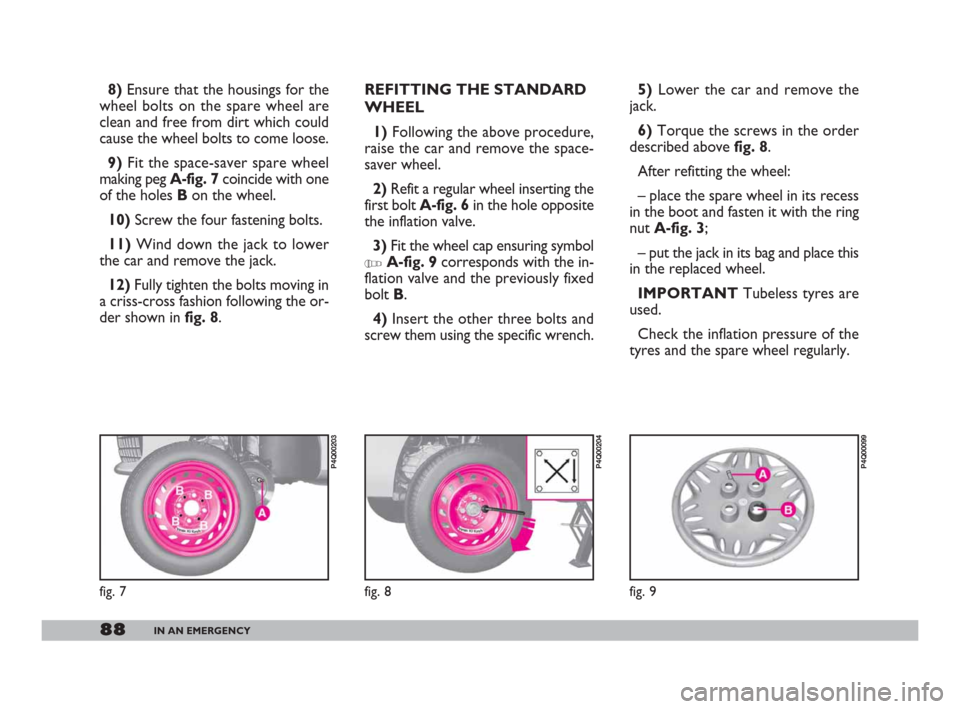
9) Fit the space-saver spare wheel
making peg A-fig. 7coincide with one
of the holes B on the wheel.
10)Screw the four fastening bolts.
11)Wind down the jack to lower
the car and remove the jack.
12)Fully tighten the bolts moving in
a criss-cross fashion following the or-
der shown in fig. 8.REFITTING THE STANDARD
WHEEL
1)Following the above procedure,
raise the car and remove the space-
saver wheel.
2)Refit a regular wheel inserting the
first bolt A-fig. 6in the hole opposite
the inflation valve.
3)Fit the wheel cap ensuring symbol
YA-fig. 9corresponds with the in-
flation valve and the previously fixed
bolt B.
4)Insert the other three bolts and
screw them using the specific wrench.
fig. 7
P4Q00203
fig. 8
P4Q00204
083-104 Seicento GB 22-11-2007 10:50 Pagina 88
Page 93 of 146
92IN AN EMERGENCY
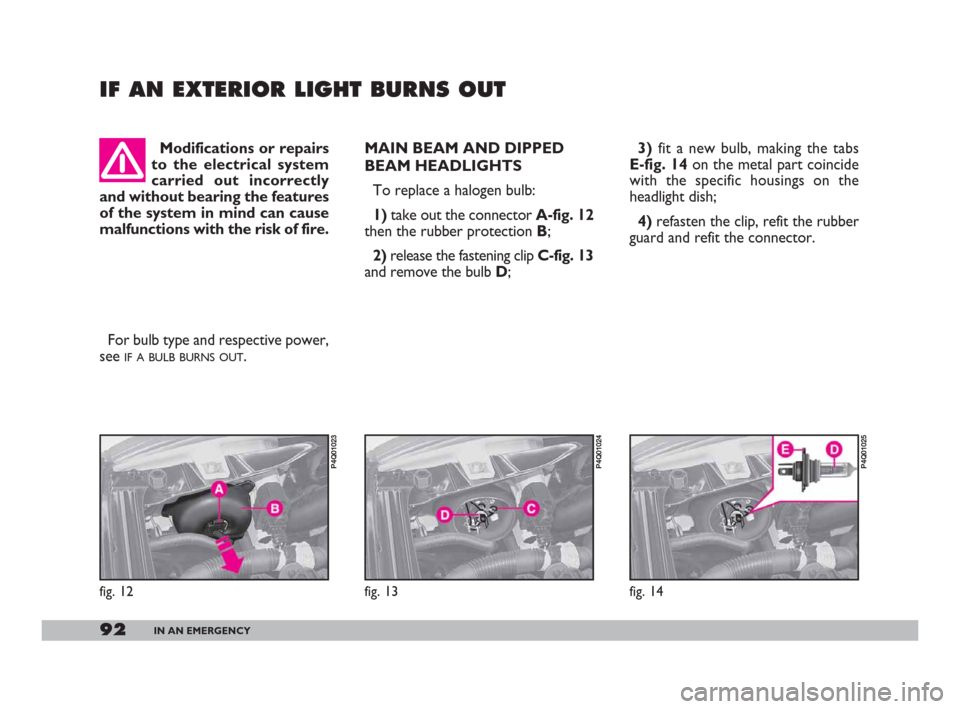
3)fit a new bulb, making the tabs
E-fig. 14 on the metal part coincide
with the specific housings on the
headlight dish;
4)refasten the clip, refit the rubber
guard and refit the connector.
IF AN EXTERIOR LIGHT BURNS OUT
MAIN BEAM AND DIPPED
BEAM HEADLIGHTS
To replace a halogen bulb:
1)take out the connector A-fig. 12
then the rubber protection B;
2)release the fastening clip C-fig. 13
and remove the bulb D;
fig. 12
P4Q01023
fig. 14
P4Q01025
Modifications or repairs
to the electrical system
carried out incorrectly
and without bearing the features
of the system in mind can cause
malfunctions with the risk of fire.
For bulb type and respective power,
see
IF A BULB BURNS OUT.
fig. 13
P4Q01024
083-104 Seicento GB 22-11-2007 10:50 Pagina 92
Page 96 of 146
95IN AN EMERGENCY
REAR LIGHT CLUSTER
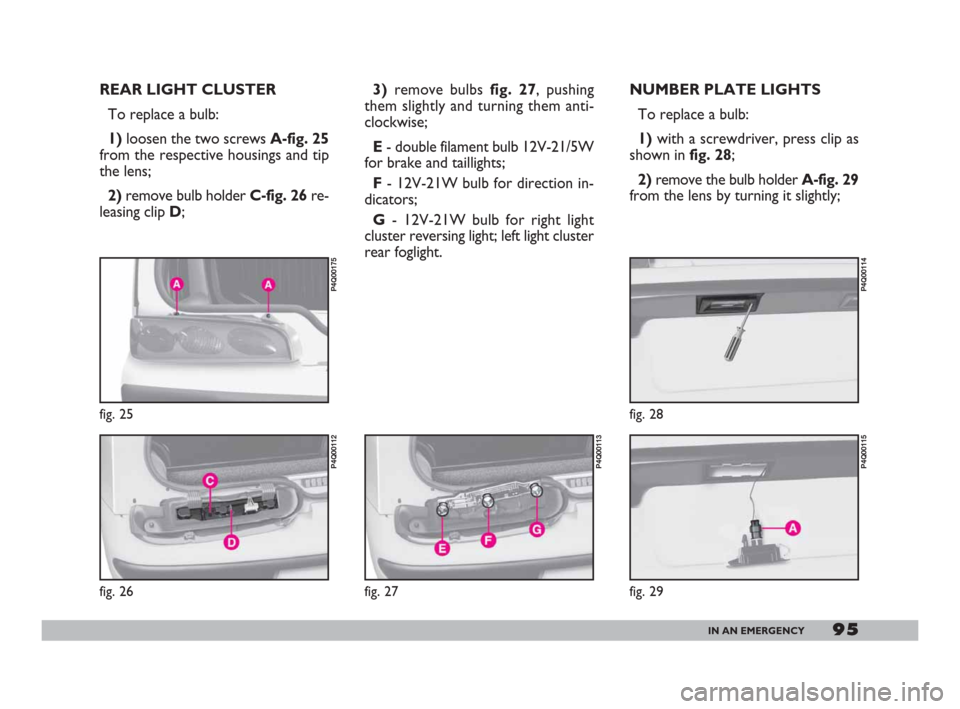
To replace a bulb:
1)loosen the two screws A-fig. 25
from the respective housings and tip
the lens;
2)remove bulb holder C-fig. 26 re-
leasing clip D; 3)remove bulbs fig. 27, pushing
them slightly and turning them anti-
clockwise;
E- double filament bulb 12V-21/5W
for brake and taillights;
F- 12V-21W bulb for direction in-
dicators;
G- 12V-21W bulb for right light
cluster reversing light; left light cluster
rear foglight. NUMBER PLATE LIGHTS
To replace a bulb:
1) with a screwdriver, press clip as
shown in fig. 28;
2) remove the bulb holder A-fig. 29
from the lens by turning it slightly;
fig. 25
P4Q00175
fig. 26
P4Q00112
fig. 27
P4Q00113
fig. 28
P4Q00114
fig. 29
P4Q00115
083-104 Seicento GB 22-11-2007 10:50 Pagina 95
Page 98 of 146
97IN AN EMERGENCY
IF AN INTERIOR
LIGHT BURNS OUT IF A FUSE BLOWS
A fuse is an element for protecting
the electrical system. A fuse will trip
(i.e. it will blow) in the event of a fail-
ure or improper interventions in the
electrical system.
If an electrical device is not working,
check whether the respective fuse is
blown. The conductor should be in-
tact. If it is not, replace the fuse with
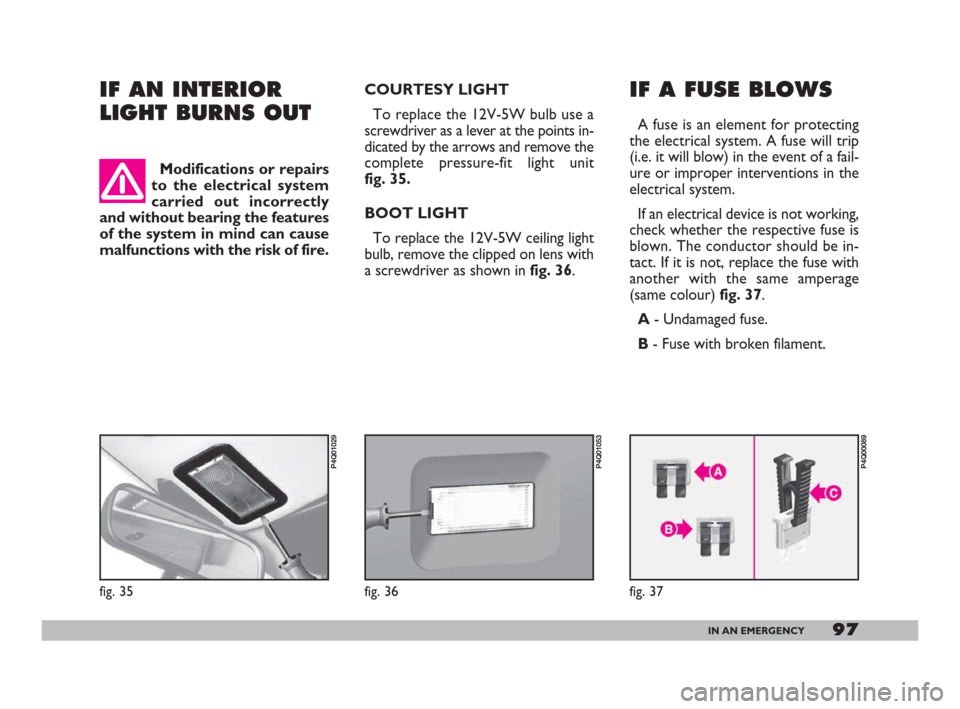
another with the same amperage
(same colour) fig. 37.
A- Undamaged fuse.
B - Fuse with broken filament. Modifications or repairs
to the electrical system
carried out incorrectly
and without bearing the features
of the system in mind can cause
malfunctions with the risk of fire. COURTESY LIGHT
To replace the 12V-5W bulb use a
screwdriver as a lever at the points in-
dicated by the arrows and remove the
complete pressure-fit light unit
fig. 35.
BOOT LIGHT
To replace the 12V-5W ceiling light
bulb, remove the clipped on lens with
a screwdriver as shown in fig. 36.
fig. 35
P4Q01029
fig. 37
P4Q00089
fig. 36
P4Q01053
083-104 Seicento GB 22-11-2007 10:50 Pagina 97
Page 99 of 146
98IN AN EMERGENCY
Never change a fuse
with another amperage:
fire risk !To locate the fuse, refer to the table
on the following pages. Do not attempt to re-
pair a blown maxi fuse.
Go to a Fiat Dealership.
If the fuse blows again,
have the car inspected at
a Fiat Dealership.
fig. 38
P4Q00121
fig. 39
P4Q01030
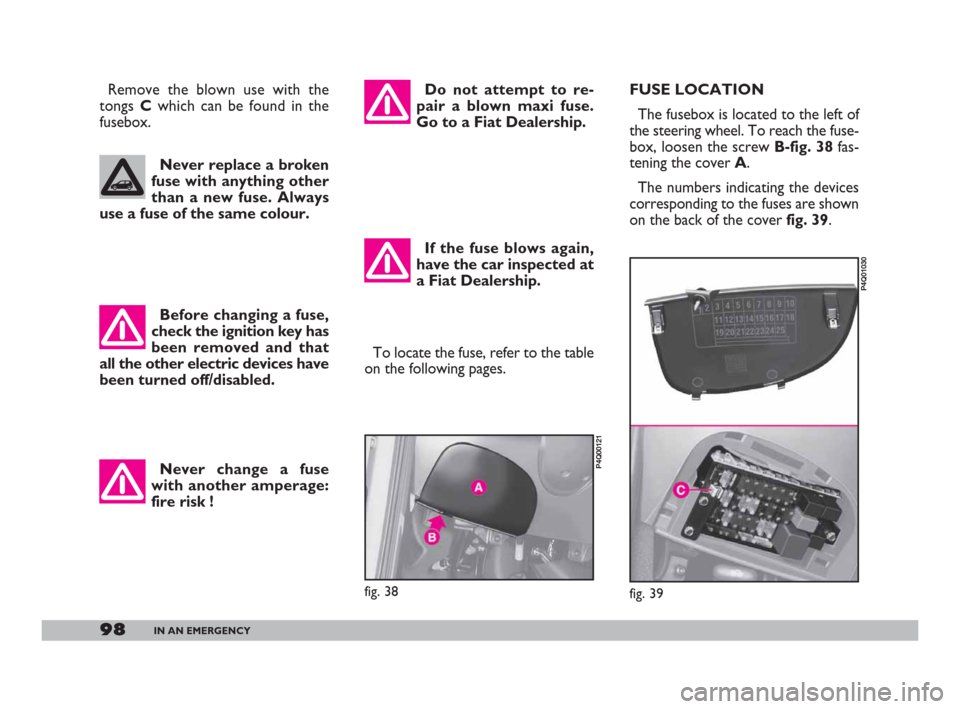
Remove the blown use with the
tongs Cwhich can be found in the
fusebox.
Never replace a broken
fuse with anything other
than a new fuse. Always
use a fuse of the same colour.
Before changing a fuse,
check the ignition key has
been removed and that
all the other electric devices have
been turned off/disabled. FUSE LOCATION
The fusebox is located to the left of
the steering wheel. To reach the fuse-
box, loosen the screw B-fig. 38 fas-
tening the cover A.
The numbers indicating the devices
corresponding to the fuses are shown
on the back of the cover fig. 39.
083-104 Seicento GB 22-11-2007 10:50 Pagina 98
Page 110 of 146
109CAR MAINTENANCE
IMPORTANT - Remote control
If when the remote control button
is pressed the doors are not
locked/unlocked or the performed
operation signal (indicator lights on)
does not appear, change the battery,
using spare batteries of the same kind.
IMPORTANT - Engine oil
Should the prevailing use of the car
be under one of the following specially
heavy conditions:
– trailer towing
– dusty roads
– short distances (less than 7-8 km)
repeated and with external tempera-
tures below zero.
– frequently idling engines or long
distance low speed driving (e.g. taxis
or door-to-door deliveries) or in case
of a long term inactivity replace engine
oil more frequently than required on
SCHEDULED MAINTENANCE PLAN.IMPORTANT - Air cleaner
Replace the air cleaner more fre-
quently if the car is used on dusty
roads.
If you are in doubt about how often
the engine oil or the air cleaner should
be changed in relation to how you use
the car, contact a Fiat Dealership.
IMPORTANT - Battery
The charge in your battery should be
checked, where possible at the start
of the winter, to limit the risk of the
battery electrolyte freezing. This
check should be carried out more fre-
quently if the car is mainly used for
short trips or if it is fitted with acces-
sories that permanently take in elec-
tricity even when the ignition key is
removed, especially in the case of af-
ter market accessories.You should check the battery fluid
(electrolyte) level more frequently
than shown in the
SERVICE SCHEDULEin
this chapter if the vehicle is used in
hot climates or particularly demand-
ing conditions.
Maintenance of your car
should be entrusted to a
Fiat Dealership. For ordi-
nary routine maintenance oper-
ations which you are able to
carry out yourself, ensure that
you have the necessary tools and
original Fiat spare parts and flu-
ids available. Do not carry out
servicing operations if you have
no experience.
105-123 Seicento GB 22-11-2007 10:51 Pagina 109
Page 126 of 146
125TECHNICAL SPECIFICATIONS
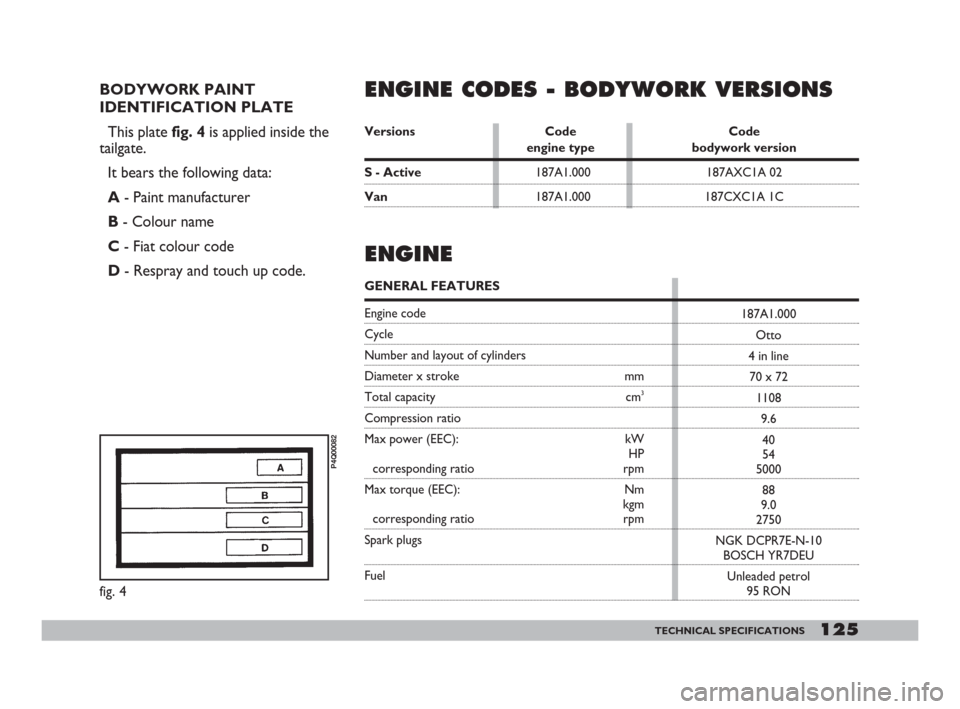
BODYWORK PAINT
IDENTIFICATION PLATE
This plate fig. 4 is applied inside the
tailgate.
It bears the following data:
A - Paint manufacturer
B - Colour name
C - Fiat colour code
D- Respray and touch up code.
fig. 4
P4Q00082
187AXC1A 02
187CXC1A 1C 187A1.000
187A1.000
Versions Code Code
engine type bodywork version
S - Active
Van
ENGINE CODES - BODYWORK VERSIONS
ENGINE
GENERAL FEATURES
Engine code
Cycle
Number and layout of cylinders
Diameter x stroke mm
Total capacity cm3
Compression ratio
Max power (EEC): kW
HP
corresponding ratio rpm
Max torque (EEC): Nm
kgm
corresponding ratio rpm
Spark plugs
Fuel
187A1.000
Otto
4 in line
70 x 72
1108
9.6
40
54
5000
88
9.0
2750
NGK DCPR7E-N-10
BOSCH YR7DEU
Unleaded petrol
95 RON
124-136 Seicento GB 22-11-2007 10:51 Pagina 125
Page 130 of 146
129TECHNICAL SPECIFICATIONS
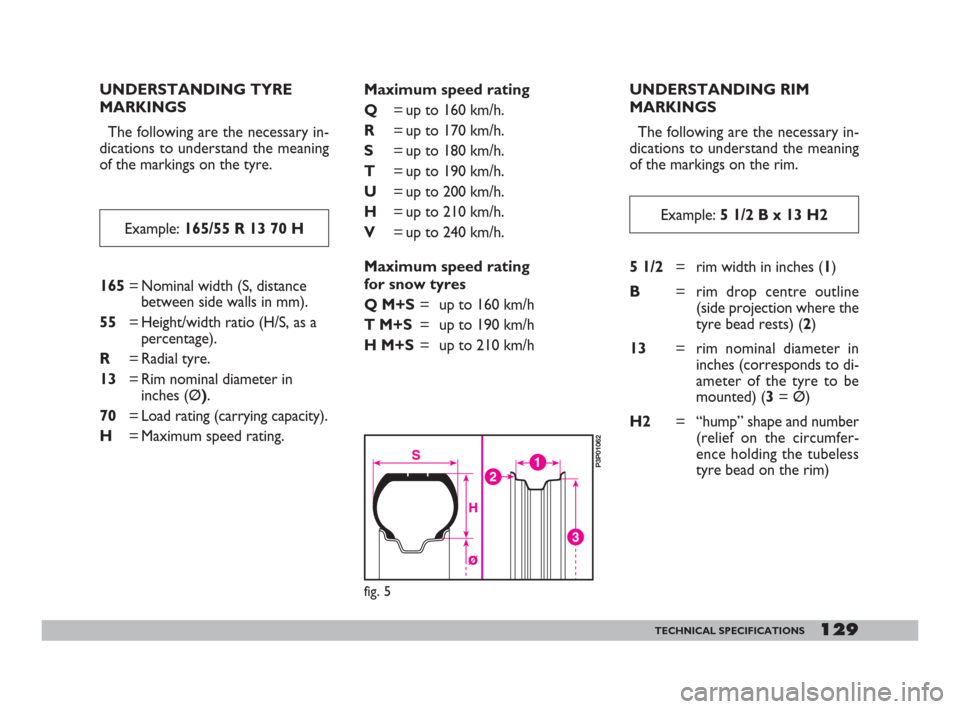
Example: 5 1/2 B x 13 H2
5 1/2= rim width in inches (1)
B= rim drop centre outline
(side projection where the
tyre bead rests) (2)
13= rim nominal diameter in
inches (corresponds to di-
ameter of the tyre to be
mounted) (3 = Ø)
H2= “hump” shape and number
(relief on the circumfer-
ence holding the tubeless
tyre bead on the rim) UNDERSTANDING RIM
MARKINGS
The following are the necessary in-
dications to understand the meaning
of the markings on the rim. Maximum speed rating
Q= up to 160 km/h.
R= up to 170 km/h.
S= up to 180 km/h.
T= up to 190 km/h.
U= up to 200 km/h.
H= up to 210 km/h.
V= up to 240 km/h.
Maximum speed rating
for snow tyres
Q M+S= up to 160 km/h
T M+S= up to 190 km/h
H M+S= up to 210 km/h Example: 165/55 R 13 70 H
165= Nominal width (S, distance
between side walls in mm).
55= Height/width ratio (H/S, as a
percentage).
R= Radial tyre.
13= Rim nominal diameter in
inches (Ø).
70= Load rating (carrying capacity).
H= Maximum speed rating.
fig. 5
P3P01062
UNDERSTANDING TYRE
MARKINGS
The following are the necessary in-
dications to understand the meaning
of the markings on the tyre.
124-136 Seicento GB 22-11-2007 10:51 Pagina 129