Air con FIAT BRAVO 2009 2.G Owner's Manual
[x] Cancel search | Manufacturer: FIAT, Model Year: 2009, Model line: BRAVO, Model: FIAT BRAVO 2009 2.GPages: 246, PDF Size: 4.1 MB
Page 99 of 246
98
SAFETY
DEVICES
CORRECT USE
OF THE CAR
WARNING
LIGHTS AND
MESSAGES
IN AN
EMERGENCY
CAR
MAINTENANCE
TECHNICAL
SPECIFICATIONS
INDEX
DASHBOARD
AND CONTROLS
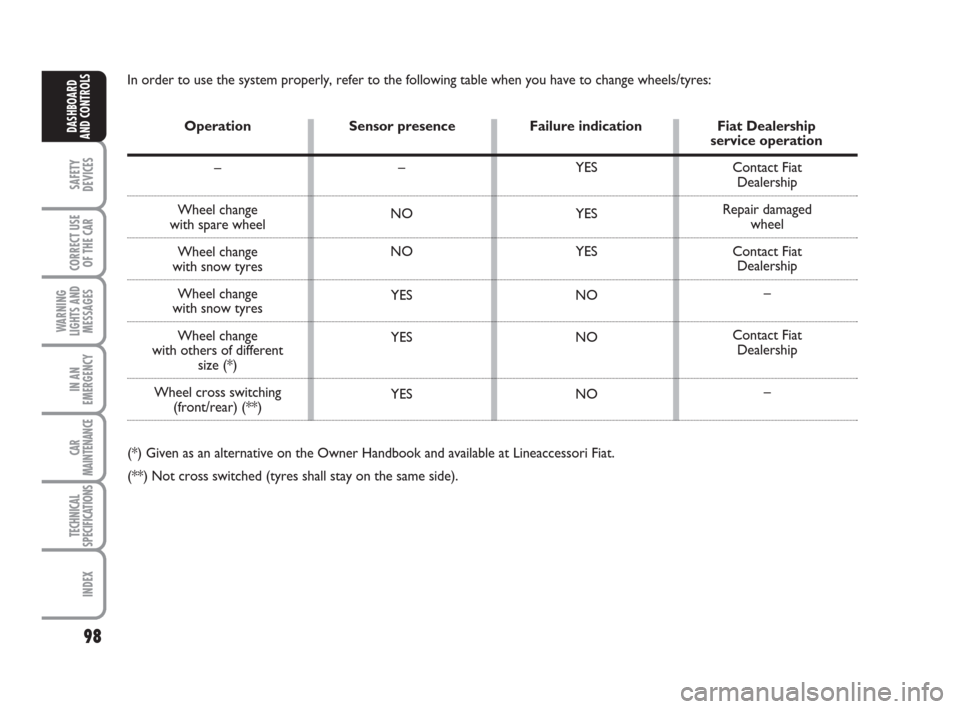
In order to use the system properly, refer to the following table when you have to change wheels/tyres:
Operation Sensor presence Failure indication Fiat Dealership
service operation
–
Wheel change with spare wheel
Wheel change
with snow tyres
Wheel change
with snow tyres
Wheel change
with others of different
size (*)
Wheel cross switching
(front/rear) (**)
(*) Given as an alternative on the Owner Handbook and available at Lineaccessori Fiat.
(**) Not cross switched (tyres shall stay on the same side).–
NO
NO
YES
YES
YESYES
YES
YES
NO
NO
NOContact Fiat
Dealership
Repair damaged
wheel
Contact Fiat
Dealership
–
Contact Fiat
Dealership
–
083-104 BRAVO GB:083-104 BRAVO GB 11-11-2009 10:53 Pagina 98
Page 101 of 246
100
SAFETY
DEVICES
CORRECT USE
OF THE CAR
WARNING
LIGHTS AND
MESSAGES
IN AN
EMERGENCY
CAR
MAINTENANCE
TECHNICAL
SPECIFICATIONS
INDEX
DASHBOARD
AND CONTROLS
BUZZER WARNINGS
The driver is warned of the presence and
distance from the obstacle by the buzzers
installed in the passenger compartment:
❒in versions with 4 rear sensors, a
buzzer located in the front dashboard
area warns of the presence of rear ob-
stacles;
❒In versions with 8 rear sensors (4 front
and 4 rear) a front buzzer warns of the
presence of front obstacles and a
buzzer at the rear warns of the pres-
ence of rear obstacles. This feature
gives the driver a sense of directional-
ity (front/rear) about the presence of
obstacles.
When the reverse gear is engaged an in-
termittent acoustic signal is automatically
activated.
The acoustic signal:
❒becomes louder as the reduction of
distance between the car and the ob-
stacle decreases;
❒becomes continuous when the distance
between the car and the obstacle is less
that 30 cm and stops immediately if the
distance raises;
❒is constant if the distance is unvaried. If
this situation takes place for side sen-
sors, the signal is stopped after about
3 seconds to prevent sound indications
when performing manoeuvres near
walls.
For proper operation, the
parking sensors set on the
bumpers shall be clean from
mud, dirt, snow or ice. When
cleaning the sensors, take the utmost
care to prevent their damaging; do not
use therefore dry or rough clothes. Sen-
sors shall be washed with clean water
and car detergent, if required. In wash-
ing stations, clean sensors quickly keep-
ing the vapour jet/high pressure wash-
ing nozzles at 10 cm at least from the
sensors.
Any repainting of bumpers or
touch/up in sensor areas shall
be carried out at Fiat Dealer-
ship only. Improper painting
could impair the regular operation of
parking sensors.
Parking manoeuvres howev-
er are always under the dri-
ver’s responsibility that shall always
check the absence of people (special-
ly children) or animals in the ma-
noeuvre space. This system is just a
help for the driver but she/he shall nev-
er reduce attention during dangerous
manoeuvres even if performed at low
speed.
WARNING
When the obstacle is located at a distance
of less than 30 cm, the device emits a con-
tinuous sound. Depending on the position
of the obstacle (in front or behind) the
sound is emitted by the corresponding
acoustic indicators (front or rear). The ob-
stacle closest to the vehicle is indicated
in all cases.
The beep will stop immediately if the dis-
tance raises. Beep tone is constant if the
distance detected by central sensors is un-
varied. If this situation takes place for side
sensors, the signal is stopped after about
3 seconds to prevent sound indications
when performing manoeuvres near walls.
083-104 BRAVO GB:083-104 BRAVO GB 11-11-2009 10:53 Pagina 100
Page 103 of 246
102
SAFETY
DEVICES
CORRECT USE
OF THE CAR
WARNING
LIGHTS AND
MESSAGES
IN AN
EMERGENCY
CAR
MAINTENANCE
TECHNICAL
SPECIFICATIONS
INDEX
DASHBOARD
AND CONTROLS
The car must only be filled
with diesel fuel for motor ve-
hicles, in compliance with Eu-
ropean Specification EN590.
The use of other products or mixtures
may irreparably damage the engine
with invalidation of the warranty due
to the damage caused. In the event of
accidentally filling with another type
of fuel, do not start the engine and
empty the tank. If the engine has been
run even for only a very short time, in
addition to the tank, it is also necessary
to drain out the whole fuel circuit.DIESEL ENGINES
If the outside temperature is very low, the
diesel thickens due to the formation of
paraffins and could clog the diesel fuel fil-
ter.
In order to avoid these problems, differ-
ent types of diesel are distributed ac-
cording to the season: summer type, win-
ter type arctic type (mountains/cold ar-
eas).
If refuelling with diesel fuel not suitable for
the current temperature, mix diesel fuel
with TUTELA DIESEL ART additive in the
proportions stated on the can, putting first
the antifreeze in the tank and then the
diesel fuel.
Refuel with local diesel fuel if the car is
used/parked in the mountains or in cold
areas for a long period. In this event you
are recommended to keep an amount of
fuel higher than 50% in the tank.AT THE FILLING
STATION
PETROL ENGINES
Use only unleaded petrol.
To prevent errors, the diameter of the fu-
el tank filler is too small to introduce a lead
petrol pump filler.
Use petrol with a rated octane number
(R.O.N.) not lower than 95.
IMPORTANT An inefficient catalyst leads
to harmful exhaust emissions, thus con-
tributing to air pollution.
IMPORTANT Never use leaded petrol,
even in small amount or in an emergency,
as this would damage the catalyst beyond
repair.REFUELLING
To ensure full tank refuelling, carry out
two top-up operations once the delivery
gun has turned off twice. Avoid further
top-up operations which could cause faults
in the fuel system.
083-104 BRAVO GB:083-104 BRAVO GB 11-11-2009 10:53 Pagina 102
Page 106 of 246
DASHBOARD
AND CONTROLS
CORRECT USE
OF THE CAR
WARNING
LIGHTS AND
MESSAGES
IN AN
EMERGENCY
CAR
MAINTENANCE
TECHNICAL
SPECIFICATIONS
INDEX
SAFETY
DEVICES
105
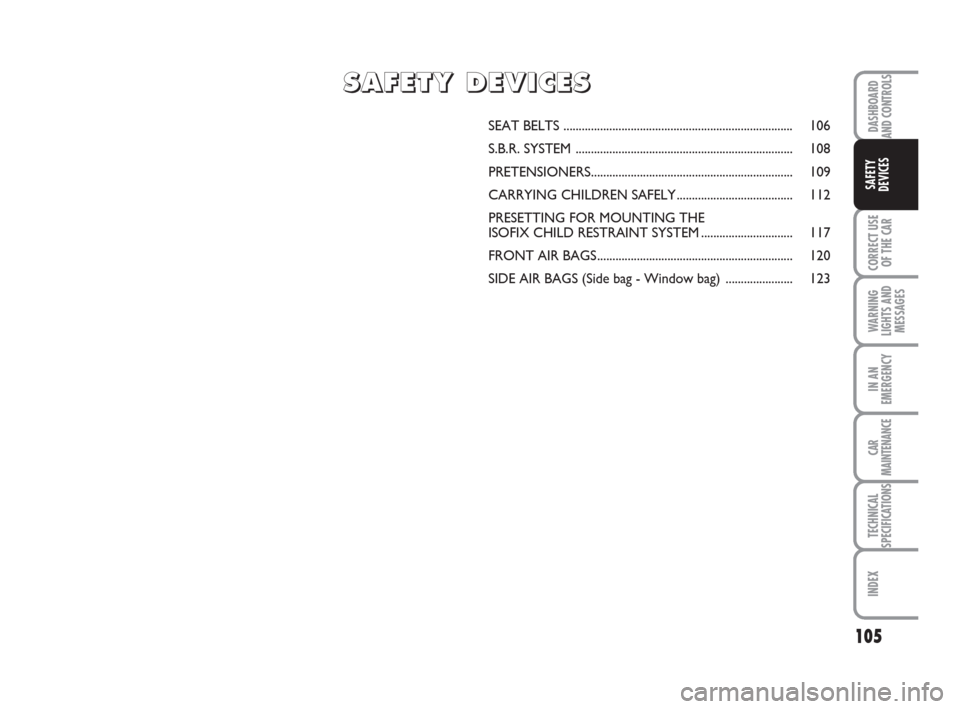
SEAT BELTS ........................................................................... 106
S.B.R. SYSTEM ....................................................................... 108
PRETENSIONERS.................................................................. 109
CARRYING CHILDREN SAFELY...................................... 112
PRESETTING FOR MOUNTING THE
ISOFIX CHILD RESTRAINT SYSTEM.............................. 117
FRONT AIR BAGS................................................................ 120
SIDE AIR BAGS (Side bag - Window bag)...................... 123
S S
A A
F F
E E
T T
Y Y
D D
E E
V V
I I
C C
E E
S S
105-128 BRAVO GB.qxd:105-128 BRAVO GB 11-11-2009 10:54 Pagina 105
Page 113 of 246
DASHBOARD
AND CONTROLS
CORRECT USE
OF THE CAR
WARNING
LIGHTS AND
MESSAGES
IN AN
EMERGENCY
CAR
MAINTENANCE
TECHNICAL
SPECIFICATIONS
INDEX
SAFETY
DEVICES
112
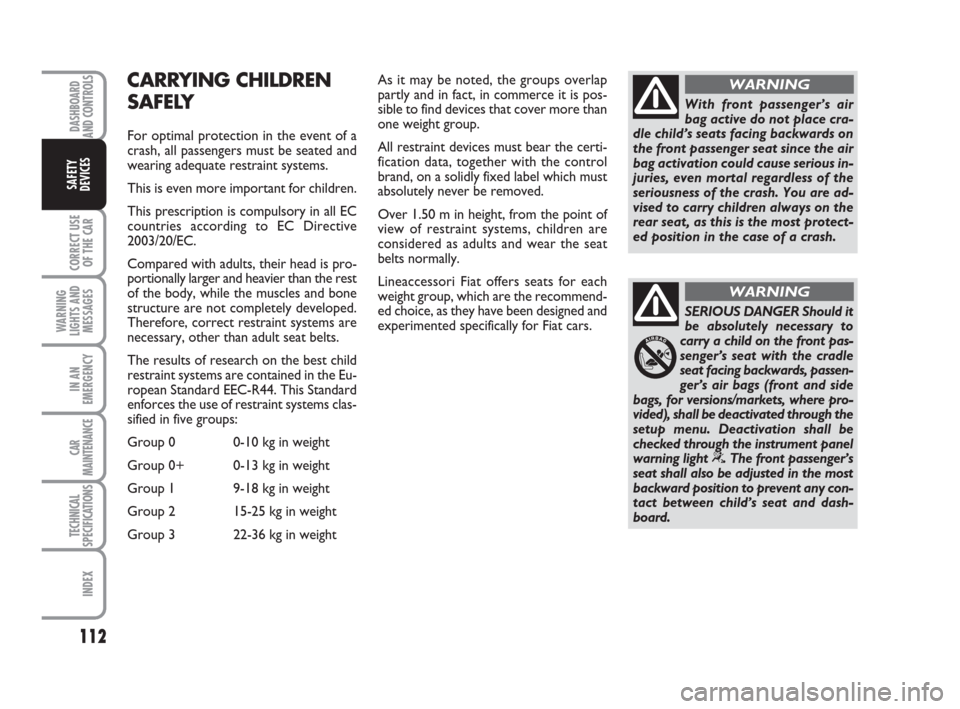
SERIOUS DANGER Should it
be absolutely necessary to
carry a child on the front pas-
senger’s seat with the cradle
seat facing backwards, passen-
ger’s air bags (front and side
bags, for versions/markets, where pro-
vided), shall be deactivated through the
setup menu. Deactivation shall be
checked through the instrument panel
warning light
“. The front passenger’s
seat shall also be adjusted in the most
backward position to prevent any con-
tact between child’s seat and dash-
board.
WARNING
CARRYING CHILDREN
SAFELY
For optimal protection in the event of a
crash, all passengers must be seated and
wearing adequate restraint systems.
This is even more important for children.
This prescription is compulsory in all EC
countries according to EC Directive
2003/20/EC.
Compared with adults, their head is pro-
portionally larger and heavier than the rest
of the body, while the muscles and bone
structure are not completely developed.
Therefore, correct restraint systems are
necessary, other than adult seat belts.
The results of research on the best child
restraint systems are contained in the Eu-
ropean Standard EEC-R44. This Standard
enforces the use of restraint systems clas-
sified in five groups:
Group 0 0-10 kg in weight
Group 0+ 0-13 kg in weight
Group 1 9-18 kg in weight
Group 2 15-25 kg in weight
Group 3 22-36 kg in weightAs it may be noted, the groups overlap
partly and in fact, in commerce it is pos-
sible to find devices that cover more than
one weight group.
All restraint devices must bear the certi-
fication data, together with the control
brand, on a solidly fixed label which must
absolutely never be removed.
Over 1.50 m in height, from the point of
view of restraint systems, children are
considered as adults and wear the seat
belts normally.
Lineaccessori Fiat offers seats for each
weight group, which are the recommend-
ed choice, as they have been designed and
experimented specifically for Fiat cars.With front passenger’s air
bag active do not place cra-
dle child’s seats facing backwards on
the front passenger seat since the air
bag activation could cause serious in-
juries, even mortal regardless of the
seriousness of the crash. You are ad-
vised to carry children always on the
rear seat, as this is the most protect-
ed position in the case of a crash.
WARNING
105-128 BRAVO GB.qxd:105-128 BRAVO GB 11-11-2009 10:54 Pagina 112
Page 117 of 246
DASHBOARD
AND CONTROLS
CORRECT USE
OF THE CAR
WARNING
LIGHTS AND
MESSAGES
IN AN
EMERGENCY
CAR
MAINTENANCE
TECHNICAL
SPECIFICATIONS
INDEX
SAFETY
DEVICES
116
Below is a summary of the rules of
safety to be followed for carrying
children:
1) The recommended position for in-
stalling child’s seat is on the rear seat, as
it is the most protected in the case of a
crash.
2) If the passenger airbag is deactivated,
always check that it is properly deactivat-
ed by ensuring the warning light “is on
with a fixed light on the instrument pan-
el.
3) Attain to the instructions for fastening
the specific child restraint system which
you are using. These instructions must be
provided by the manufacturer. Keep the
child restraint system installation instruc-
tions with the car documents and this
Handbook. Never use a child restraint sys-
tem without installation instructions.4) Always check the seat belt is well fas-
tened by pulling the webbing.
5) Only one child is to be strapped to
each retaining system.
6) Always check the seat belts do not fit
around the child’s throat.
7) While travelling, do not let the child
sit incorrectly or release the belts.
8) Passengers should never carry children
on their laps. No-one, however strong
they are, can hold a child in the event of
a crash.
9) In case of an accident, replace the
child’s seat with a new one.
With passenger’s air bag ac-
tive, never place child’s seats
with the cradle facing backwards
since the air bag activation could
cause to the child serious injuries,
even mortal, regardless of the seri-
ousness of the crash that triggered it.
You are advised to carry children al-
ways with proper restraint systems on
the rear seats, as this is the most pro-
tected position in the case of a crash.
WARNING
105-128 BRAVO GB.qxd:105-128 BRAVO GB 11-11-2009 10:54 Pagina 116
Page 121 of 246
DASHBOARD
AND CONTROLS
CORRECT USE
OF THE CAR
WARNING
LIGHTS AND
MESSAGES
IN AN
EMERGENCY
CAR
MAINTENANCE
TECHNICAL
SPECIFICATIONS
INDEX
SAFETY
DEVICES
120
FRONT AIR BAGS
The car is fitted with front air bags for the
driver, for the passenger and with driver’s
knees air bag (for versions/markets, where
provided).
The front air bags (driver and passenger)
and driver’s knees air bag (for ver-
sions/markets, where provided) have been
designed to protect the occupants in the
event of head-on crashes of medium-high
severity, by placing the cushion between
the occupant and the steering wheel or
dashboard.
Front air bags are designed to protect
car’s occupants in front crashes and there-
fore non-activation in other types of col-
lisions (side collisions, rear shunts, roll-
overs, etc.) is not a system malfunction.In case of front crash, an electronic con-
trol unit, when required, triggers the in-
flation of the cushion according to the
severity of the collision. The cushion im-
mediately inflates, placing itself as a pro-
tection between the body of the front oc-
cupants and the structure that could cause
injuries. Immediately after, the cushion de-
flates.
The front driver/passenger air bags and
the driver’s knees air bag (for versions/
markets, where provided) are not a re-
placement of but complementary to the
use of belts, which should always be worn,
as specified by law in Europe and most non
European countries.
In case of crash, a person not wearing the
seat belt moves forward and may come in-
to contact with the cushion while it is still
inflating. Under this circumstance the pro-
tection offered by the air bag is reduced.
Do not apply stickers or oth-
er objects to the steering
wheel or to the air bag cover on the
passenger’s side or on the side roof
lining. Do not put objects on the
dashboard on passenger side since
they could interfere with proper pas-
senger air bag inflation and cause in-
juries to the car’s passengers.
WARNING
Front air bag may not be activated in the
following situations:
❒front collisions against highly de-
formable objects not affecting the car
front surface (e.g. bumper collision
against guard rail, etc.);
❒in case of wedging under other vehicles
or protective barriers (for example un-
der a truck or guard rail);
as it offers no additional protection com-
pared with the seat belts, consequently,
it would be pointless. Therefore, failure to
come into action in the above circum-
stances does not mean that the system is
not working properly.
105-128 BRAVO GB.qxd:105-128 BRAVO GB 11-11-2009 10:54 Pagina 120
Page 122 of 246
DASHBOARD
AND CONTROLS
CORRECT USE
OF THE CAR
WARNING
LIGHTS AND
MESSAGES
IN AN
EMERGENCY
CAR
MAINTENANCE
TECHNICAL
SPECIFICATIONS
INDEX
SAFETY
DEVICES
121
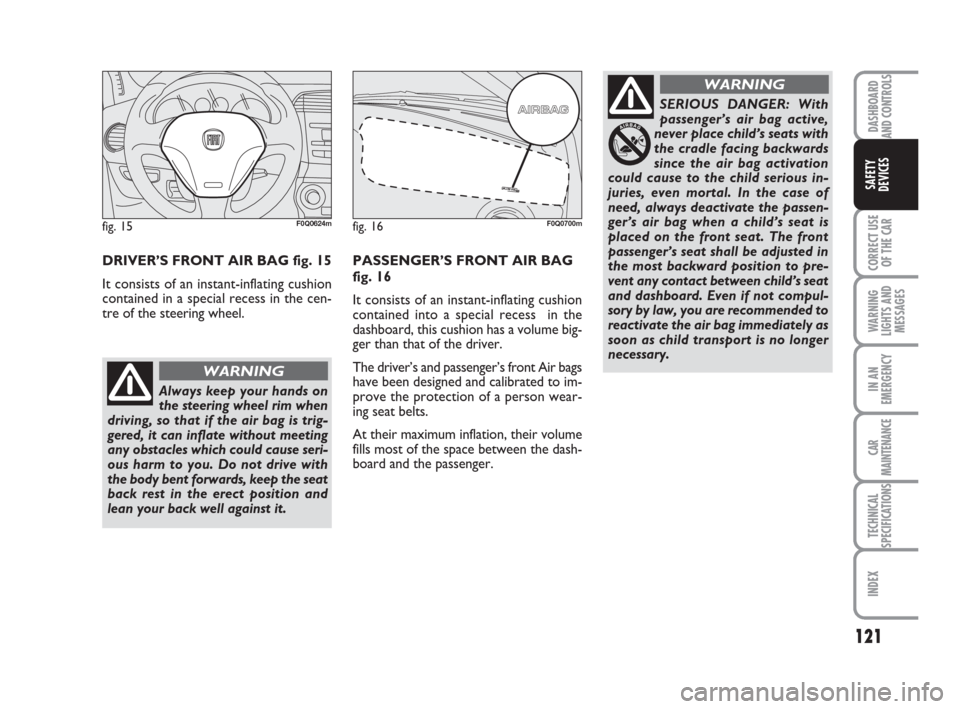
DRIVER’S FRONT AIR BAG fig. 15
It consists of an instant-inflating cushion
contained in a special recess in the cen-
tre of the steering wheel.PASSENGER’S FRONT AIR BAG
fig. 16
It consists of an instant-inflating cushion
contained into a special recess in the
dashboard, this cushion has a volume big-
ger than that of the driver.
The driver’s and passenger’s front Air bags
have been designed and calibrated to im-
prove the protection of a person wear-
ing seat belts.
At their maximum inflation, their volume
fills most of the space between the dash-
board and the passenger.
fig. 15F0Q0624mfig. 16F0Q0700m
SERIOUS DANGER: With
passenger’s air bag active,
never place child’s seats with
the cradle facing backwards
since the air bag activation
could cause to the child serious in-
juries, even mortal. In the case of
need, always deactivate the passen-
ger’s air bag when a child’s seat is
placed on the front seat. The front
passenger’s seat shall be adjusted in
the most backward position to pre-
vent any contact between child’s seat
and dashboard. Even if not compul-
sory by law, you are recommended to
reactivate the air bag immediately as
soon as child transport is no longer
necessary.
WARNING
Always keep your hands on
the steering wheel rim when
driving, so that if the air bag is trig-
gered, it can inflate without meeting
any obstacles which could cause seri-
ous harm to you. Do not drive with
the body bent forwards, keep the seat
back rest in the erect position and
lean your back well against it.
WARNING
105-128 BRAVO GB.qxd:105-128 BRAVO GB 11-11-2009 10:54 Pagina 121
Page 123 of 246
DASHBOARD
AND CONTROLS
CORRECT USE
OF THE CAR
WARNING
LIGHTS AND
MESSAGES
IN AN
EMERGENCY
CAR
MAINTENANCE
TECHNICAL
SPECIFICATIONS
INDEX
SAFETY
DEVICES
122
MANUAL DEACTIVATION
OF PASSENGER’S FRONT
AIR BAG AND SIDE BAG
(for versions/markets, where provided)
Should it be absolutely necessary to car-
ry a child on the front seat, the passenger’s
front air bag and the side bag (where pro-
vided) can be deactivated.
The instrument panel warning light
“will
stay on glowing steadily until reactivating
passenger’s air bag.
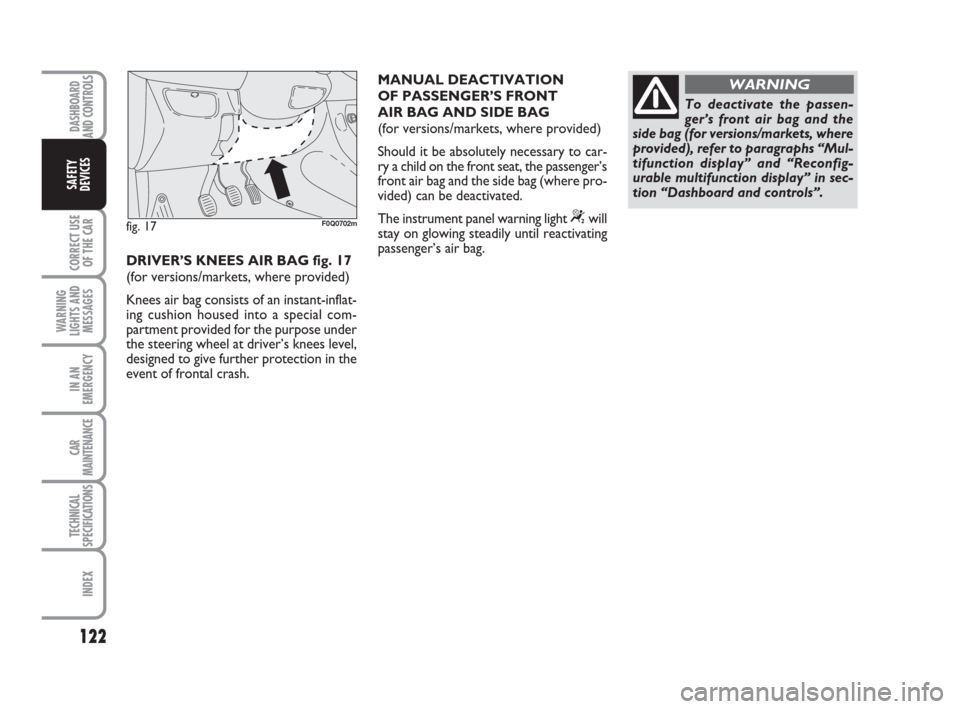
DRIVER’S KNEES AIR BAG fig. 17
(for versions/markets, where provided)
Knees air bag consists of an instant-inflat-
ing cushion housed into a special com-
partment provided for the purpose under
the steering wheel at driver’s knees level,
designed to give further protection in the
event of frontal crash.fig. 17
AUT
O
F0Q0702m
To deactivate the passen-
ger’s front air bag and the
side bag (for versions/markets, where
provided), refer to paragraphs “Mul-
tifunction display” and “Reconfig-
urable multifunction display” in sec-
tion “Dashboard and controls”.
WARNING
105-128 BRAVO GB.qxd:105-128 BRAVO GB 11-11-2009 10:54 Pagina 122
Page 124 of 246
DASHBOARD
AND CONTROLS
CORRECT USE
OF THE CAR
WARNING
LIGHTS AND
MESSAGES
IN AN
EMERGENCY
CAR
MAINTENANCE
TECHNICAL
SPECIFICATIONS
INDEX
SAFETY
DEVICES
123
SIDE AIR BAGS
(Side bag -
Window bag)
The car is fitted with front side bags for
driver and passenger (where provided) for
protecting the chest and window bags
(where provided) for protecting front and
rear passengers’ head.
Side bags protect car occupants from side
crashes of medium-high severity, by plac-
ing the cushion between the occupant and
the internal parts of the side structure of
the car.
Non-activation of side bags in other types
of collisions (front collisions, rear shunts,
roll-overs, etc...) is not a system malfunc-
tion.In case of side crash, an electronic control
unit, when required triggers the inflation
of the cushion. The cushion immediately
inflates, placing itself as a protection, be-
tween the occupant’s body and the struc-
ture that could cause injuries. Immediate-
ly after, the cushion deflates.
Side bags are not a replacement of but
complementary to the belts, which you
are recommended to always wear, as
specified by law in Europe and most non-
European countries.
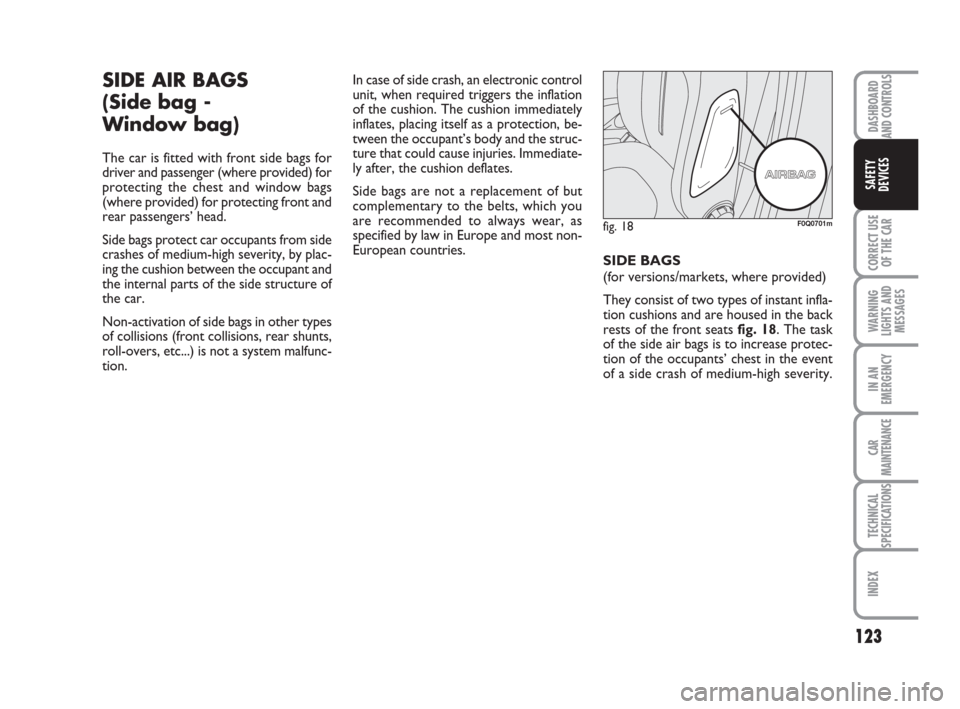
SIDE BAGS
(for versions/markets, where provided)
They consist of two types of instant infla-
tion cushions and are housed in the back
rests of the front seats fig. 18. The task
of the side air bags is to increase protec-
tion of the occupants’ chest in the event
of a side crash of medium-high severity.
fig. 18F0Q0701m
105-128 BRAVO GB.qxd:105-128 BRAVO GB 11-11-2009 10:54 Pagina 123