battery FIAT BRAVO 2012 2.G User Guide
[x] Cancel search | Manufacturer: FIAT, Model Year: 2012, Model line: BRAVO, Model: FIAT BRAVO 2012 2.GPages: 299, PDF Size: 5.81 MB
Page 84 of 299
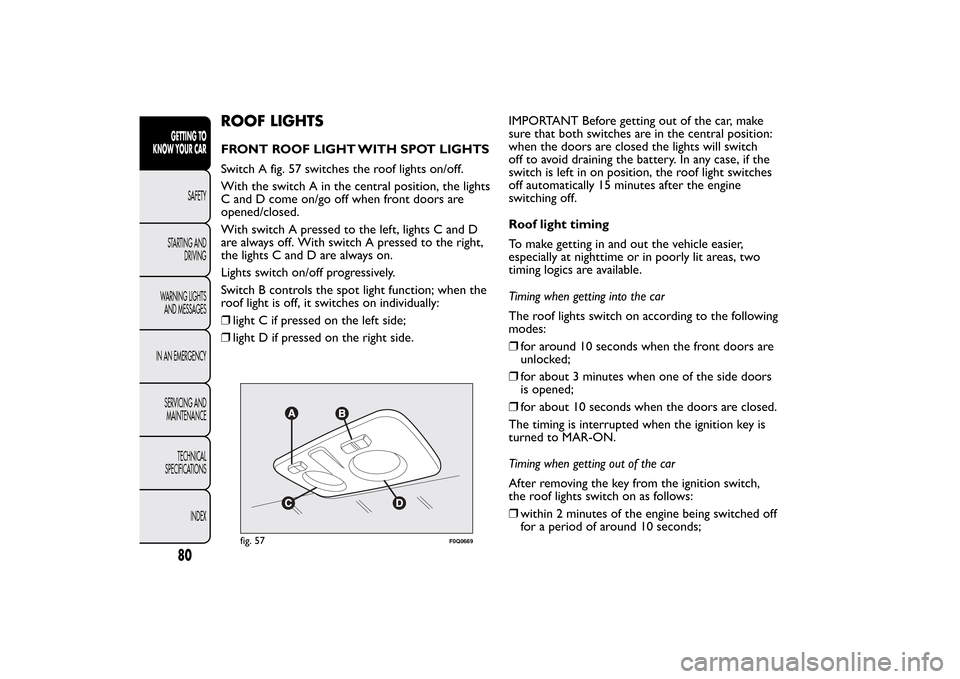
ROOF LIGHTSFRONT ROOF LIGHT WITH SPOT LIGHTS
Switch A fig. 57 switches the roof lights on/off.
With the switch A in the central position, the lights
C and D come on/go off when front doors are
opened/closed.
With switch A pressed to the left, lights C and D
are always off. With switch A pressed to the right,
the lights C and D are always on.
Lights switch on/off progressively.
Switch B controls the spot light function; when the
roof light is off, it switches on individually:
❒light C if pressed on the left side;
❒light D if pressed on the right side.IMPORTANT Before getting out of the car, make
sure that both switches are in the central position:
when the doors are closed the lights will switch
off to avoid draining the battery. In any case, if the
switch is left in on position, the roof light switches
off automatically 15 minutes after the engine
switching off.
Roof light timing
To make getting in and out the vehicle easier,
especially at nighttime or in poorly lit areas, two
timing logics are available.
Timing when getting into the car
The roof lights switch on according to the following
modes:
❒for around 10 seconds when the front doors are
unlocked;
❒for about 3 minutes when one of the side doors
is opened;
❒for about 10 seconds when the doors are closed.
The timing is interrupted when the ignition key is
turned to MAR-ON.
Timing when getting out of the car
After removing the key from the ignition switch,
the roof lights switch on as follows:
❒within 2 minutes of the engine being switched off
for a period of around 10 seconds;
fig. 57
F0Q0669
80GETTING TO
KNOW YOUR CAR
SAFETY
STARTING AND
DRIVING
WARNING LIGHTS
AND MESSAGES
IN AN EMERGENCY
SERVICING AND
MAINTENANCE
TECHNICAL
SPECIFICATIONS
INDEX
Page 87 of 299
FUEL CUT-OFF SWITCH
(as an alternative to the fuel cut-off system, for
versions/markets, where provided)
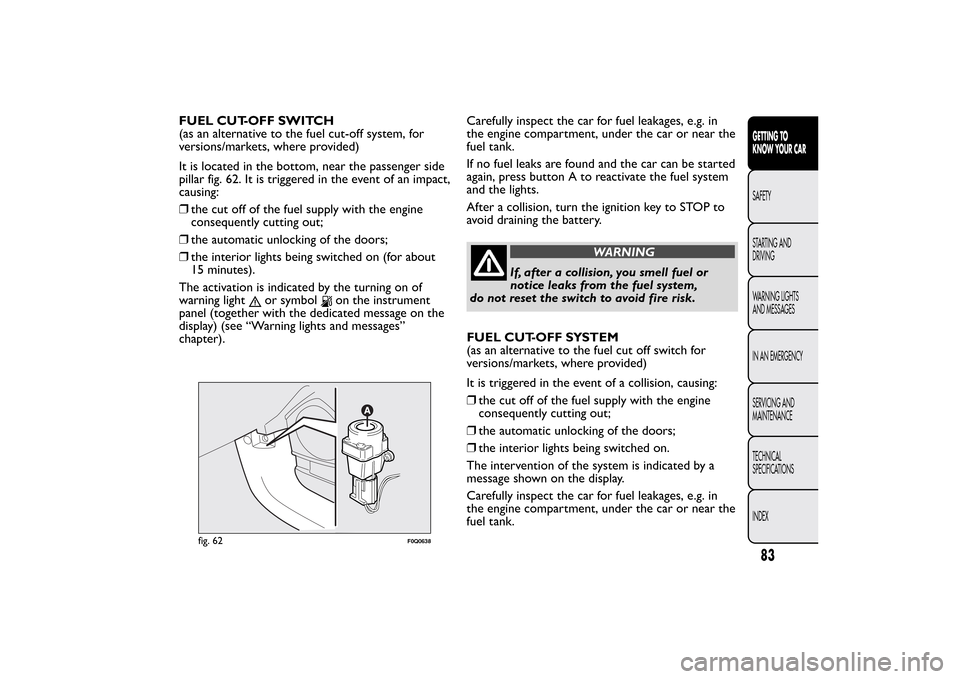
It is located in the bottom, near the passenger side
pillar fig. 62. It is triggered in the event of an impact,
causing:
❒the cut off of the fuel supply with the engine
consequently cutting out;
❒the automatic unlocking of the doors;
❒the interior lights being switched on (for about
15 minutes).
The activation is indicated by the turning on of
warning light
or symbol
on the instrument
panel (together with the dedicated message on the
display) (see “Warning lights and messages”
chapter).Carefully inspect the car for fuel leakages, e.g. in
the engine compartment, under the car or near the
fuel tank.
If no fuel leaks are found and the car can be started
again, press button A to reactivate the fuel system
and the lights.
After a collision, turn the ignition key to STOP to
avoid draining the battery.
WARNING
If, after a collision, you smell fuel or
notice leaks from the fuel system,
do not reset the switch to avoid fire risk.
FUEL CUT-OFF SYSTEM
(as an alternative to the fuel cut off switch for
versions/markets, where provided)
It is triggered in the event of a collision, causing:
❒the cut off of the fuel supply with the engine
consequently cutting out;
❒the automatic unlocking of the doors;
❒the interior lights being switched on.
The intervention of the system is indicated by a
message shown on the display.
Carefully inspect the car for fuel leakages, e.g. in
the engine compartment, under the car or near the
fuel tank.
fig. 62
F0Q0638
83GETTING TO
KNOW YOUR CARSAFETY
STARTING AND
DRIVING
WARNING LIGHTS
AND MESSAGES
IN AN EMERGENCY
SERVICING AND
MAINTENANCE
TECHNICAL
SPECIFICATIONS
INDEX
Page 88 of 299
After a collision, turn the ignition key to STOP to
avoid draining the battery.
The following procedure should be carried out to
restore the correct operation of the vehicle:
❒turn the ignition key to the MAR-ON position;
❒turn on the right direction indicator;
❒turn off the right direction indicator;
❒turn on the left direction indicator;
❒turn off the left direction indicator;
❒turn on the right direction indicator;
❒turn off the right direction indicator;
❒turn on the left direction indicator;
❒turn off the left direction indicator;
❒turn the ignition key to STOP.
WARNING
If, after a collision, you smell fuel or
notice leaks from the fuel system,
do not reset the system to avoid fire risk.
INTERIOR FITTINGSFRONT ARMREST WITH STORAGE
COMPARTMENTS
(for versions/markets, where provided)
This is located between the front seats. A storage
compartment and cooled drinks compartment
are located inside the armrest (for versions/
markets, where provided) (see following
paragraphs).
The armrest can be adjusted lengthwise through
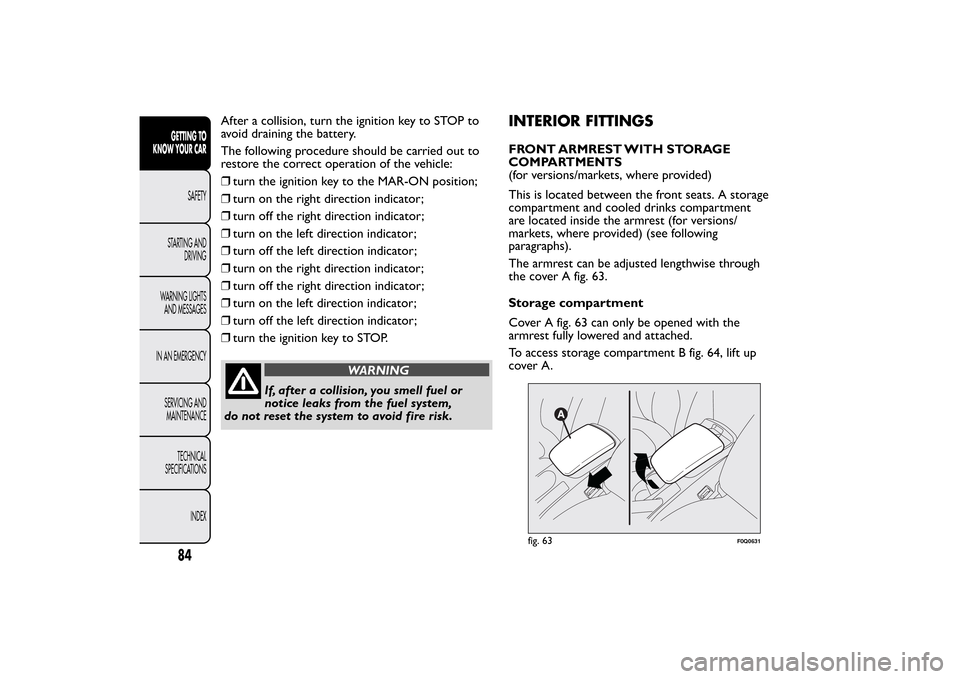
the cover A fig. 63.
Storage compartment
Cover A fig. 63 can only be opened with the
armrest fully lowered and attached.
To access storage compartment B fig. 64, lift up
cover A.
fig. 63
F0Q0631
84GETTING TO
KNOW YOUR CAR
SAFETY
STARTING AND
DRIVING
WARNING LIGHTS
AND MESSAGES
IN AN EMERGENCY
SERVICING AND
MAINTENANCE
TECHNICAL
SPECIFICATIONS
INDEX
Page 96 of 299
INITIALISATION PROCEDURE
After the battery has been disconnected or a fuse
has blown, the operation of the sun roof must
be initialised again.
Proceed as follows:
❒press button A fig. 80 until the roof is completely
closed. Release the button;
❒press button A and keep it pressed for at least 10
seconds and/or until the glass panel clicks
forwards. Release the button at this point;
❒press button A within 5 seconds of this
operation and keep it pressed: the glass panel will
complete a full opening and closing cycle. Only
release the button at the end of this cycle.
EMERGENCY MANOEUVRE
If the switch does not work, the sun roof can be
operated manually as follows:
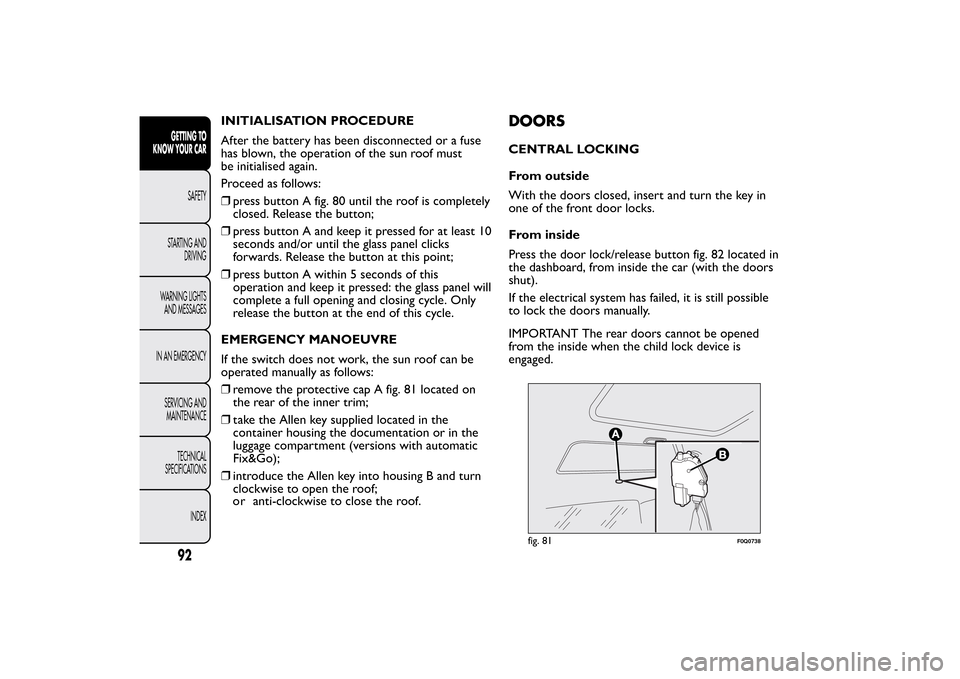
❒remove the protective cap A fig. 81 located on
the rear of the inner trim;
❒take the Allen key supplied located in the
container housing the documentation or in the
luggage compartment (versions with automatic
Fix&Go);
❒introduce the Allen key into housing B and turn
clockwise to open the roof;
anti-clockwise to close the roof.
DOORSCENTRAL LOCKING
From outside
With the doors closed, insert and turn the key in
one of the front door locks.
From inside
Press the door lock/release button fig. 82 located in
the dashboard, from inside the car (with the doors
shut).
If the electrical system has failed, it is still possible
to lock the doors manually.
IMPORTANT The rear doors cannot be opened
from the inside when the child lock device is
engaged.
fig. 81
F0Q0738
92GETTING TO
KNOW YOUR CAR
SAFETY
STARTING AND
DRIVING
WARNING LIGHTS
AND MESSAGES
IN AN EMERGENCY
SERVICING AND
MAINTENANCE
TECHNICAL
SPECIFICATIONS
INDEX
or
Page 98 of 299
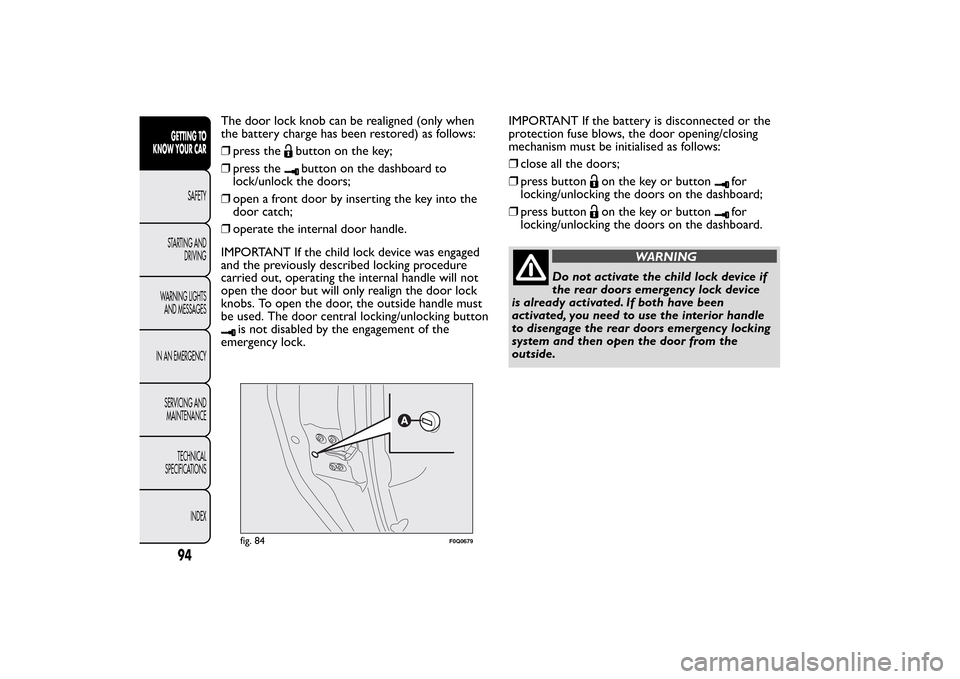
The door lock knob can be realigned (only when
the battery charge has been restored) as follows:
❒press the
button on the key;
❒press thebutton on the dashboard to
lock/unlock the doors;
❒open a front door by inserting the key into the
door catch;
❒operate the internal door handle.
IMPORTANT If the child lock device was engaged
and the previously described locking procedure
carried out, operating the internal handle will not
open the door but will only realign the door lock
knobs. To open the door, the outside handle must
be used. The door central locking/unlocking button
is not disabled by the engagement of the
emergency lock.IMPORTANT If the battery is disconnected or the
protection fuse blows, the door opening/closing
mechanism must be initialised as follows:
❒close all the doors;
❒press button
on the key or button
for
locking/unlocking the doors on the dashboard;
❒press button
on the key or button
for
locking/unlocking the doors on the dashboard.
WARNING
Do not activate the child lock device if
the rear doors emergency lock device
is already activated. If both have been
activated, you need to use the interior handle
to disengage the rear doors emergency locking
system and then open the door from the
outside.
fig. 84
F0Q0679
94GETTING TO
KNOW YOUR CAR
SAFETY
STARTING AND
DRIVING
WARNING LIGHTS
AND MESSAGES
IN AN EMERGENCY
SERVICING AND
MAINTENANCE
TECHNICAL
SPECIFICATIONS
INDEX
Page 101 of 299
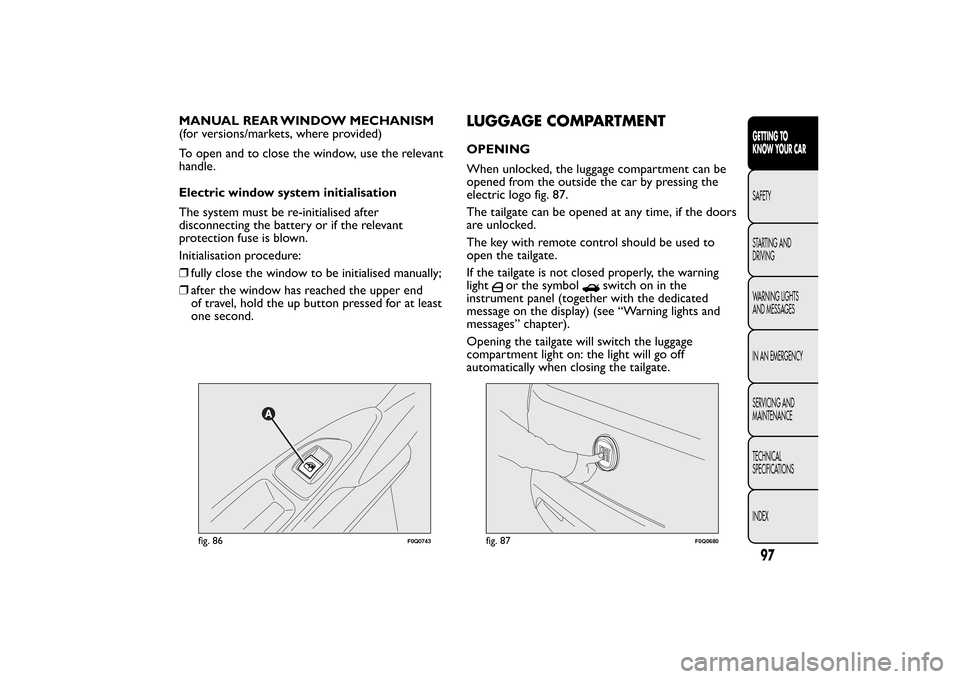
MANUAL REAR WINDOW MECHANISM
(for versions/markets, where provided)
To open and to close the window, use the relevant
handle.
Electric window system initialisation
The system must be re-initialised after
disconnecting the battery or if the relevant
protection fuse is blown.
Initialisation procedure:
❒fully close the window to be initialised manually;
❒after the window has reached the upper end
of travel, hold the up button pressed for at least
one second.
LUGGAGE COMPARTMENTOPENING
When unlocked, the luggage compartment can be
opened from the outside the car by pressing the
electric logo fig. 87.
The tailgate can be opened at any time, if the doors
are unlocked.
The key with remote control should be used to
open the tailgate.
If the tailgate is not closed properly, the warning
light
or the symbol
switch on in the
instrument panel (together with the dedicated
message on the display) (see “Warning lights and
messages” chapter).
Opening the tailgate will switch the luggage
compartment light on: the light will go off
automatically when closing the tailgate.
fig. 86
F0Q0743
fig. 87
F0Q0680
97GETTING TO
KNOW YOUR CARSAFETY
STARTING AND
DRIVING
WARNING LIGHTS
AND MESSAGES
IN AN EMERGENCY
SERVICING AND
MAINTENANCE
TECHNICAL
SPECIFICATIONS
INDEX
Page 117 of 299
Start&Stop system activation
A message and a symbol
will appear on the
display when the Start&Stop system is activated. In
this condition, the LED A fig. 105 on the
button
is off.
Start&Stop system deactivation
Versions with reconfigurable multifunction display:
the
symbol appears on the display when the
Start&Stop system is deactivated. The LED A
fig. 105 is on when the system is deactivated.
ENGINE STOPPING FAILURE
CONDITIONS
When the system is active, due to comfort,
emission control and safety reasons, the engine
does not stop in some conditions, among which:
❒engine still cold;
❒especially cold outside temperature;
❒battery not sufficiently charged;
❒heated rear window activated;
❒driver's door not shut;
❒driver's seat belt not fastened;
❒reverse gear engaged (for example, for parking
manoeuvres);❒for versions equipped with dual zone automatic
climate control system (for versions/markets,
where provided), if an adequate level of thermal
comfort has not been reached or with MAX-DEF
function activation;
❒during the first period of use, to initialise the
system.
In these cases, the display shows a message and -
for versions/markets, where provided - the symbol
flashes on the display.
WARNING
If the climate comfort is to be
favoured, the Star t&Stop system can be
disabled, for a continuous operation of the
climate control system.
ENGINE RESTARTING CONDITIONS
For reasons of comfort, to limit harmful emissions
and for safety purposes, the engine can restart
automatically without any action by the driver if
certain conditions occur, including:
❒battery not sufficiently charged;
❒windscreen wipers working at maximum speed;
❒reduced braking system vacuum (e.g. if the brake
pedal is pressed repeatedly);
❒car moving (e.g. when driving on roads with a
gradient);
113GETTING TO
KNOW YOUR CARSAFETY
STARTING AND
DRIVING
WARNING LIGHTS
AND MESSAGES
IN AN EMERGENCY
SERVICING AND
MAINTENANCE
TECHNICAL
SPECIFICATIONS
INDEX
Page 118 of 299
❒engine stopping by Start&Stop system for over 3
minutes;
❒for versions equipped with automatic climate
control (for versions/markets where provided),
to enable suitable thermal comfort or with
MAX-DEF activation.
If a gear in engaged during stopping with
Start&Stop, the automatic restarting of the engine
is only permitted by fully depressing the clutch
pedal.
The driver is informed by a message on the display
and - for versions/markets, where provided - by
the flashing of the
symbol.
If the clutch is not pressed, about 3 minutes after
the engine stops, the engine can be restarted
only using the ignition key.
In cases of undesired engine stops, due for example
to the clutch pedal being released abruptly with a
gear engaged, if the Start&Stop system is activated,
the engine can be restarted by fully depressing
the clutch pedal.
SAFETY FUNCTIONS
When the engine is stopped by the Start&Stop
system, if the driver releases his/her seat belt and
opens the driver's or passenger's door, the engine
can be restarted only using the ignition key.
The driver is informed by a buzzer and by the
flashing of the symbol
on the display; on some
versions, a message is displayed as well."ENERGY SAVING" FUNCTION
(for versions/markets, where provided)
If, after automatic engine restarting, the driver does
not carry out any action on the car for an
extended period (about 3 minutes), the Start&Stop
system stops the engine definitively, to prevent
fuel consumption. In these cases, the engine can
only be restarted using the ignition key.
NoteIn any case, it is possible to keep the engine
running by deactivating the Start&Stop system.
IRREGULAR OPERATION
In the event of malfunction, the Start&Stop system
is deactivated. The driver is informed of the fault
by the flashing symbol
(versions with
multifunction display) or symbol
(versions with
reconfigurable multifunction display). For
versions/markets, where provided, a warning
message is also displayed. In this case, contact a Fiat
Dealership.
CAR INACTIVITY
In the event of car inactivity, special attention must
be paid to the disconnection of the battery power
supply.
Proceed as follows: detach the connector A (by
pressing button B) from sensor C for monitoring
the status of the battery installed on the negative
114GETTING TO
KNOW YOUR CAR
SAFETY
STARTING AND
DRIVING
WARNING LIGHTS
AND MESSAGES
IN AN EMERGENCY
SERVICING AND
MAINTENANCE
TECHNICAL
SPECIFICATIONS
INDEX
Page 119 of 299
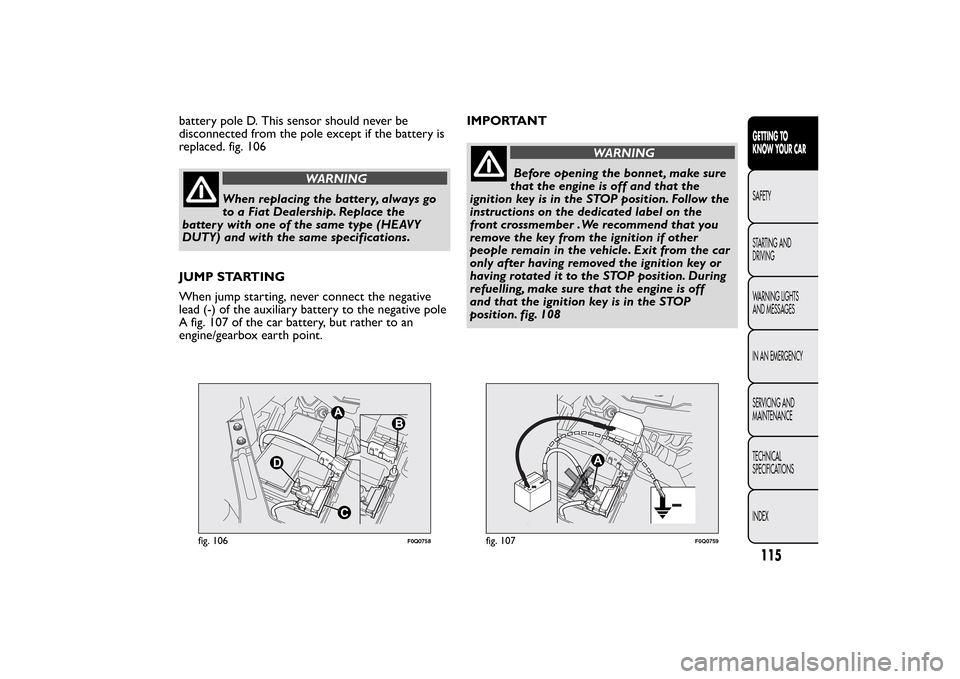
battery pole D. This sensor should never be
disconnected from the pole except if the battery is
replaced. fig. 106
WARNING
When replacing the batter y, always go
to a Fiat Dealership. Replace the
battery with one of the same type (HEAVY
DUTY) and with the same specifications.
JUMP STARTING
When jump starting, never connect the negative
lead (-) of the auxiliary battery to the negative pole
A fig. 107 of the car battery, but rather to an
engine/gearbox earth point.IMPORTANT
WARNING
Before opening the bonnet , make sure
thattheengineisoffandthatthe
ignition key is in the STOP position. Follow the
instructions on the dedicated label on the
front crossmember .We recommend that you
remove the key from the ignition if other
people remain in the vehicle. Exit from the car
only after having removed the ignition key or
having rotated it to the STOP position. During
refuelling, make sure that the engine is off
and that the ignition key is in the STOP
position. fig. 108
fig. 106
F0Q0758
fig. 107
F0Q0759
115GETTING TO
KNOW YOUR CARSAFETY
STARTING AND
DRIVING
WARNING LIGHTS
AND MESSAGES
IN AN EMERGENCY
SERVICING AND
MAINTENANCE
TECHNICAL
SPECIFICATIONS
INDEX
Page 158 of 299
STARTING AND DRIVING
STARTING THE ENGINEThe car is fitted with an electronic engine lock
device: if the engine fails to start, see the paragraph
“The Fiat CODE system” in the section “Knowing
your car”.
The engine may be noisier during the first few
seconds of operation, especially after a long period
of inactivity. This characteristic feature of the
hydraulic tappet system does not compromise
functionality or reliability: the system chosen for
your car was designed to limit maintenance
interventions.
Engine starting is guaranteed to -18°C (Italy and
central Europe) and -20°C (Northern Europe).
We recommend that during the initial
period you do not demand to full
performance from the car (e.g. excessive
acceleration, long journeys at top speed, sharp
braking etc .).When the engine is switched off never
leave the key turned to MAR to prevent
useless current absorption from draining
the battery.
WARNING
It is dangerous to have the engine
running indoors.The engine consumes
oxygen and engine exhaust contains carbon
dioxide, carbon monoxide and other toxic
gasses.
WARNING
Remember that the brake servo and
power steering are not operational
until the engine has been started, therefore
much effort than usual is required on the
brake pedal and steering wheel.
STARTING PROCEDURE FOR PETROL
VERSIONS
Proceed as follows:
❒ensure that the handbrake is up;
❒put the gear lever into neutral;
❒press the clutch pedal down to the floor without
touching the accelerator;
❒turn the ignition key to AVV and release it as
soon as the engine starts.
154GETTING TO KNOW
YOUR CAR
SAFETYSTARTING AND
DRIVINGWARNING LIGHTS
AND MESSAGES
IN AN EMERGENCY
SERVICING AND
MAINTENANCE
TECHNICAL
SPECIFICATIONS
INDEX