brake light FIAT BRAVO 2012 2.G User Guide
[x] Cancel search | Manufacturer: FIAT, Model Year: 2012, Model line: BRAVO, Model: FIAT BRAVO 2012 2.GPages: 299, PDF Size: 5.81 MB
Page 117 of 299
Start&Stop system activation
A message and a symbol
will appear on the
display when the Start&Stop system is activated. In
this condition, the LED A fig. 105 on the
button
is off.
Start&Stop system deactivation
Versions with reconfigurable multifunction display:
the
symbol appears on the display when the
Start&Stop system is deactivated. The LED A
fig. 105 is on when the system is deactivated.
ENGINE STOPPING FAILURE
CONDITIONS
When the system is active, due to comfort,
emission control and safety reasons, the engine
does not stop in some conditions, among which:
❒engine still cold;
❒especially cold outside temperature;
❒battery not sufficiently charged;
❒heated rear window activated;
❒driver's door not shut;
❒driver's seat belt not fastened;
❒reverse gear engaged (for example, for parking
manoeuvres);❒for versions equipped with dual zone automatic
climate control system (for versions/markets,
where provided), if an adequate level of thermal
comfort has not been reached or with MAX-DEF
function activation;
❒during the first period of use, to initialise the
system.
In these cases, the display shows a message and -
for versions/markets, where provided - the symbol
flashes on the display.
WARNING
If the climate comfort is to be
favoured, the Star t&Stop system can be
disabled, for a continuous operation of the
climate control system.
ENGINE RESTARTING CONDITIONS
For reasons of comfort, to limit harmful emissions
and for safety purposes, the engine can restart
automatically without any action by the driver if
certain conditions occur, including:
❒battery not sufficiently charged;
❒windscreen wipers working at maximum speed;
❒reduced braking system vacuum (e.g. if the brake
pedal is pressed repeatedly);
❒car moving (e.g. when driving on roads with a
gradient);
113GETTING TO
KNOW YOUR CARSAFETY
STARTING AND
DRIVING
WARNING LIGHTS
AND MESSAGES
IN AN EMERGENCY
SERVICING AND
MAINTENANCE
TECHNICAL
SPECIFICATIONS
INDEX
Page 131 of 299
If an obstacle is located in a middle area, it is
detected when the distance is less than about 0.9 m
(front) and 1.40 m (rear).
If the obstacle is located at the side, it is detected
at distances of less than 0.6 m.
OPERATION WITH TRAILER
The operation of the sensors is automatically
deactivated when the trailer's electric cable plug is
inserted in the car's tow hook socket.
The sensors are automatically enabled again when
the trailer's cable plug is removed.
IMPORTANT If you wish to leave the tow hook
fitted when there is no trailer, it is advisable to
contact a Fiat Dealership to have the system
updated because the tow hook could be detected
as an obstacle by the central sensors.
FAILURE INDICATIONS
Any failures in the parking sensor system are
signalled, when reverse gear is engaged, by the
warning light
in the instrument panel lighting up
or by the symbol
together with a message in
the display (see "Warning lights and messages"
chapter).GENERAL WARNINGS
During parking manoeuvres, pay the utmost
attention to any obstacles that could be located
above or below the sensors.
Under certain circumstances close objects located
in front of or behind the car may not be detected
and could therefore cause damage to the car or be
damaged themselves.
The following conditions may influence the
performance of the parking sensor system:
❒Reduced sensor sensitivity and a reduction in the
parking assistance system performance could be
due to the presence on the surface of the sensor
of: ice, snow, mud, thick paint.
❒The sensors may detect a non-existent obstacle
(echo interference) due to mechanical
interference, for example when washing the car,
in rain (strong wind), hail.
❒The signals sent by the sensors can also be
altered by the presence of ultrasonic systems
(e.g. pneumatic brake systems or pneumatic
drills) near the vehicle.
127GETTING TO
KNOW YOUR CARSAFETY
STARTING AND
DRIVING
WARNING LIGHTS
AND MESSAGES
IN AN EMERGENCY
SERVICING AND
MAINTENANCE
TECHNICAL
SPECIFICATIONS
INDEX
Page 158 of 299
STARTING AND DRIVING
STARTING THE ENGINEThe car is fitted with an electronic engine lock
device: if the engine fails to start, see the paragraph
“The Fiat CODE system” in the section “Knowing
your car”.
The engine may be noisier during the first few
seconds of operation, especially after a long period
of inactivity. This characteristic feature of the
hydraulic tappet system does not compromise
functionality or reliability: the system chosen for
your car was designed to limit maintenance
interventions.
Engine starting is guaranteed to -18°C (Italy and
central Europe) and -20°C (Northern Europe).
We recommend that during the initial
period you do not demand to full
performance from the car (e.g. excessive
acceleration, long journeys at top speed, sharp
braking etc .).When the engine is switched off never
leave the key turned to MAR to prevent
useless current absorption from draining
the battery.
WARNING
It is dangerous to have the engine
running indoors.The engine consumes
oxygen and engine exhaust contains carbon
dioxide, carbon monoxide and other toxic
gasses.
WARNING
Remember that the brake servo and
power steering are not operational
until the engine has been started, therefore
much effort than usual is required on the
brake pedal and steering wheel.
STARTING PROCEDURE FOR PETROL
VERSIONS
Proceed as follows:
❒ensure that the handbrake is up;
❒put the gear lever into neutral;
❒press the clutch pedal down to the floor without
touching the accelerator;
❒turn the ignition key to AVV and release it as
soon as the engine starts.
154GETTING TO KNOW
YOUR CAR
SAFETYSTARTING AND
DRIVINGWARNING LIGHTS
AND MESSAGES
IN AN EMERGENCY
SERVICING AND
MAINTENANCE
TECHNICAL
SPECIFICATIONS
INDEX
Page 159 of 299
If the engine does not start at the first attempt,
return the ignition key to STOP before attempting
to start again.
If, when the ignition key is on MAR, the instrument
panel warning light
remains on together with
warning light
, turn the key to STOP and then
back to MAR; if the warning light remains on,
try the other keys provided with the vehicle.
If you are still unable to start the engine, perform
the emergency start-up procedure (see "Emergency
start-up" in "In an emergency" chapter) and
contact a Fiat Dealership.
IMPORTANT Never leave the ignition key at
MAR-ON when the engine is stopped.
STARTING PROCEDURE FOR DIESEL
VERSIONS
Proceed as follows:
❒ensure that the handbrake is up;
❒put the gear lever into neutral;
❒turn the ignition key to MAR: the warning lights
and
on the instrument panel will turn
on;
❒wait for the warning lights
and
to switch
off. The hotter the engine is, the quicker this will
happen;❒press the clutch pedal down to the floor without
touching the accelerator;
❒turn the ignition key to AVV as soon as warning
light
switches off. Waiting too long will
waste the work done by the glow plugs.
Release the key as soon as the engine starts.
IMPORTANT With cold engine, the accelerator
must be entirely released when turning the ignition
key to position AVV.
If the engine does not start at the first attempt,
return the ignition key to STOP before attempting
to start again.
If, when the ignition key is at MAR the
warning
light remains lit, turn the key to STOP and then
back to MAR; if the warning light remains lit, try
with the other keys provided with the car.
If you still cannot start the engine, contact a Fiat
Dealership.
IMPORTANT Never leave the ignition key at
MAR-ON when the engine is stopped.
Warning light
will flash for 60
seconds after starting or during
prolonged cranking to indicate a fault
with the glow plug heating system.You can use
the car as usual if the engine starts but you
should contact a Fiat Dealership as soon as
possible.
155GETTING TO KNOW
YOUR CAR
SAFETYSTARTING AND
DRIVINGWARNING LIGHTS
AND MESSAGES
IN AN EMERGENCY
SERVICING AND
MAINTENANCE
TECHNICAL
SPECIFICATIONS
INDEX
Page 161 of 299
PARKINGProceed as follows:
❒stop the engine and engage the handbrake;
❒engage a gear (on a slope, engage first gear if the
car is facing uphill or reverse if it is facing
downhill) and leave the wheels steered.
If the car is parked on a steep slope, it is also
advisable to block the wheels with a wedge or
stone. Do not leave the ignition key on MAR-ON
to avoid draining the battery. Always remove the
key when you leave the car.
HANDBRAKE
The handbrake is located between the front seats.
Pull the lever upwards to operate the handbrake,
until the car is braked.
Four or five clicks are generally enough when the
car is on level ground while nine or ten may be
required if the car is on a steep slope and laden.
IMPORTANT If this is not the case, contact a Fiat
Dealership to have the handbrake adjusted.
For cars equipped with a front armrest, lift this up
to ensure that it does not interfere with the action
of the handbrake.
WARNING
Never leave children in the unattended
car. Always remove the ignition key
when leaving the car and take it out with you.
When the handbrake is on and the ignition key is at
MAR-ON position, the warning light
will come
on in the instrument panel.
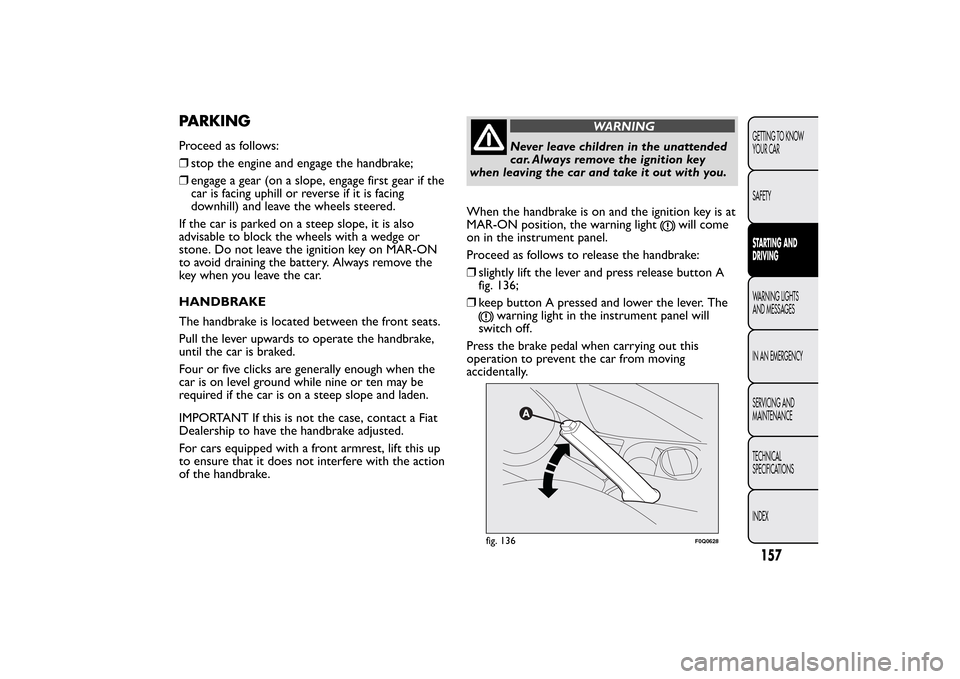
Proceed as follows to release the handbrake:
❒slightly lift the lever and press release button A
fig. 136;
❒keep button A pressed and lower the lever. The
warning light in the instrument panel will
switch off.
Press the brake pedal when carrying out this
operation to prevent the car from moving
accidentally.fig. 136
F0Q0628
157GETTING TO KNOW
YOUR CAR
SAFETYSTARTING AND
DRIVINGWARNING LIGHTS
AND MESSAGES
IN AN EMERGENCY
SERVICING AND
MAINTENANCE
TECHNICAL
SPECIFICATIONS
INDEX
Page 165 of 299
CONDITIONS OF USE
The main usage conditions that negatively affect
fuel consumption are listed below.
Cold starting
Short journeys and frequent cold starts do not
allow the engine to reach optimum operating
temperature. This results in a significant increase in
consumption levels (from +15 to +30% on the
urban cycle) and emissions.
Traffic and road conditions
Rather high consumption levels are linked to
situations with heavy traffic, for instance when
travelling in queues with frequent use of the lower
gears or in cities with many traffic lights. Winding
mountain roads and rough road surfaces also
adversely affect consumption.
Traffic hold-ups
During prolonged hold-ups (e.g. level crossings) the
engine should be switched off.
TOWING TRAILERSIMPORTANT NOTES
For towing caravans or trailers the car must be
fitted with a certified tow hook and an adequate
electric system. Installation should be carried
out by specialised personnel who will issue the
required papers for travelling on roads.
Install any specific and/or additional rear view
mirrors as specified by the Highway Code.
Remember that when towing a trailer, steep hills
are harder to climb, braking distances increase and
overtaking takes longer depending on the overall
weight.
Engage a low gear when driving downhill, rather
than constantly using the brake.
The weight the trailer exerts on the car tow hook
reduces the car's loading capacity by the same
amount. To make sure that the maximum towable
weight is not exceeded (given in the car registration
document) account should be taken of the fully
laden trailer, including accessories and luggage.
Respect the speed limits specific to each country
for vehicles towing trailers.
In any case, the maximum speed must not exceed
80 km/h.
161GETTING TO KNOW
YOUR CAR
SAFETYSTARTING AND
DRIVINGWARNING LIGHTS
AND MESSAGES
IN AN EMERGENCY
SERVICING AND
MAINTENANCE
TECHNICAL
SPECIFICATIONS
INDEX
Page 166 of 299
WARNING
The ABS with which the car may be
equipped will not control the braking
system of the trailer. Particular caution is
required on slippery roads.
WARNING
Never modify the braking system of the
car to control the trailer brake.The
trailer braking system must be fully
independent of the car ’s hydraulic system.
INSTALLING THE TOW HOOK
The towing device should be fastened to the
bodywork by specialised personnel according to any
additional and/or integrative information supplied
by the Manufacturer of the device. The towing
device must meet current regulations with
reference to Directive 94/20/EEC and subsequent
amendments. For any version the towing device
used must be right for the towable weight of the
car on which it is to be installed.
IMPORTANT The use of auxiliary loads other than
external lights (electric brake, winch, etc.) must
be used with engine running.For the electric connection a unified connector
should be used, which is generally placed on a
special bracket fastened to the towing device, and a
special ECU should be installed on the car to
control the trailer's exterior lights.
7 or 13-pole 12 V DC connections should be used
(CUNA/UNI and ISO/DIN Standards). Follow
any instructions provided by the car manufacturer
and/or the towing device manufacturer.
An electric brake or winch should be powered
directly by the battery through a cable with a
cross-section of no less than 2.5 mm
2.
IMPORTANT Electric brakes or other devices must
be used with engine running.
In addition to the electrical branches, the vehicle's
electrical system can be connected only to the
supply cable for an electric brake and to the cable
for an internal trailer light, though not more than
15 W. For connections use the preset control unit
with battery cable no less than 2.5 mm2.
162GETTING TO KNOW
YOUR CAR
SAFETYSTARTING AND
DRIVINGWARNING LIGHTS
AND MESSAGES
IN AN EMERGENCY
SERVICING AND
MAINTENANCE
TECHNICAL
SPECIFICATIONS
INDEX
Page 169 of 299
CAR INACTIVITYIf the car is to be left inactive for longer than a
month, the following precautions should be
observed:
❒park the car in covered, dry and if possible
well-ventilated premises and slightly open the
windows;
❒engage a gear and disengage the handbrake;
❒disconnect the negative battery terminal and
check charge (see paragraph “Battery - Charge
and electrolyte level check” in chapter
“Maintenance and care”);
❒clean and protect the painted parts using
protective wax;
❒clean and protect the shiny metal parts using
special compounds available commercially;❒sprinkle talcum powder on the rubber
windscreen and rear window wiper blades and lift
them off the glass;
❒cover the car with a cloth or perforated plastic
sheet. Do not use sheets of non-perforated
plastic as they do not allow moisture on the car
body to evaporate;
❒inflate tyres to +0.5 bar above the standard
specified pressure and check it at intervals;
❒do not drain the engine cooling system.
IMPORTANT Where relevant, switch off the car
alarm with the remote control.
165GETTING TO KNOW
YOUR CAR
SAFETYSTARTING AND
DRIVINGWARNING LIGHTS
AND MESSAGES
IN AN EMERGENCY
SERVICING AND
MAINTENANCE
TECHNICAL
SPECIFICATIONS
INDEX
Page 170 of 299
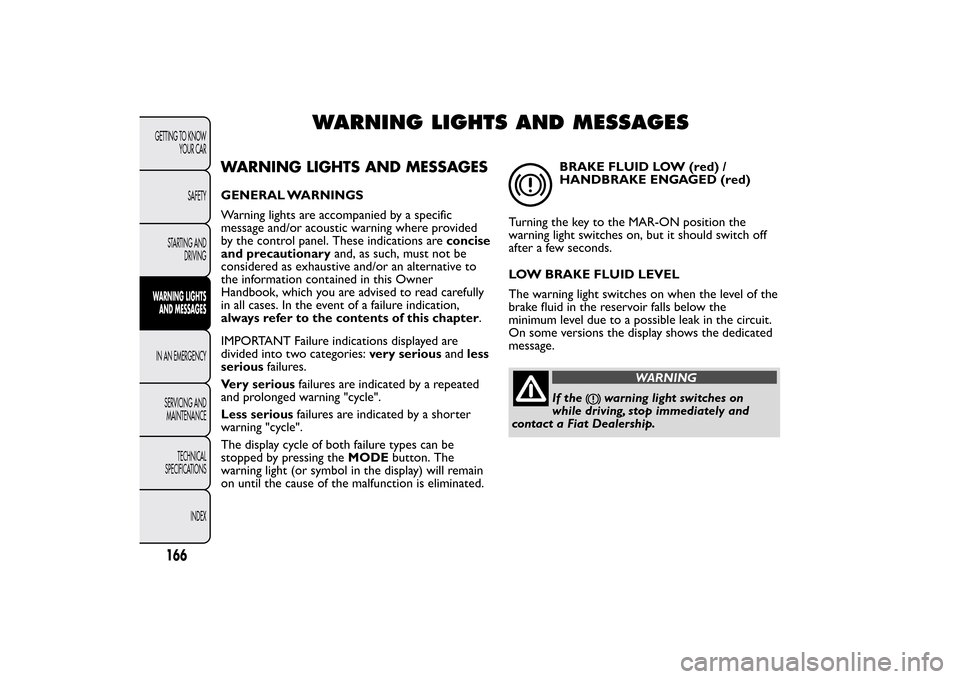
WARNING LIGHTS AND MESSAGES
WARNING LIGHTS AND MESSAGESGENERAL WARNINGS
Warning lights are accompanied by a specific
message and/or acoustic warning where provided
by the control panel. These indications areconcise
and precautionaryand, as such, must not be
considered as exhaustive and/or an alternative to
the information contained in this Owner
Handbook, which you are advised to read carefully
in all cases. In the event of a failure indication,
always refer to the contents of this chapter.
IMPORTANT Failure indications displayed are
divided into two categories:very seriousandless
seriousfailures.
Very seriousfailures are indicated by a repeated
and prolonged warning "cycle".
Less seriousfailures are indicated by a shorter
warning "cycle".
The display cycle of both failure types can be
stopped by pressing theMODEbutton. The
warning light (or symbol in the display) will remain
on until the cause of the malfunction is eliminated.
BRAKE FLUID LOW (red) /
HANDBRAKE ENGAGED (red)
Turning the key to the MAR-ON position the
warning light switches on, but it should switch off
after a few seconds.
LOW BRAKE FLUID LEVEL
The warning light switches on when the level of the
brake fluid in the reservoir falls below the
minimum level due to a possible leak in the circuit.
On some versions the display shows the dedicated
message.
WARNING
If the
warning light switches on
while driving, stop immediately and
contact a Fiat Dealership.
166GETTING TO KNOW
YOUR CAR
SAFETY
STARTING AND
DRIVINGWARNING LIGHTS
AND MESSAGESIN AN EMERGENCY
SERVICING AND
MAINTENANCE
TECHNICAL
SPECIFICATIONS
INDEX
Page 171 of 299
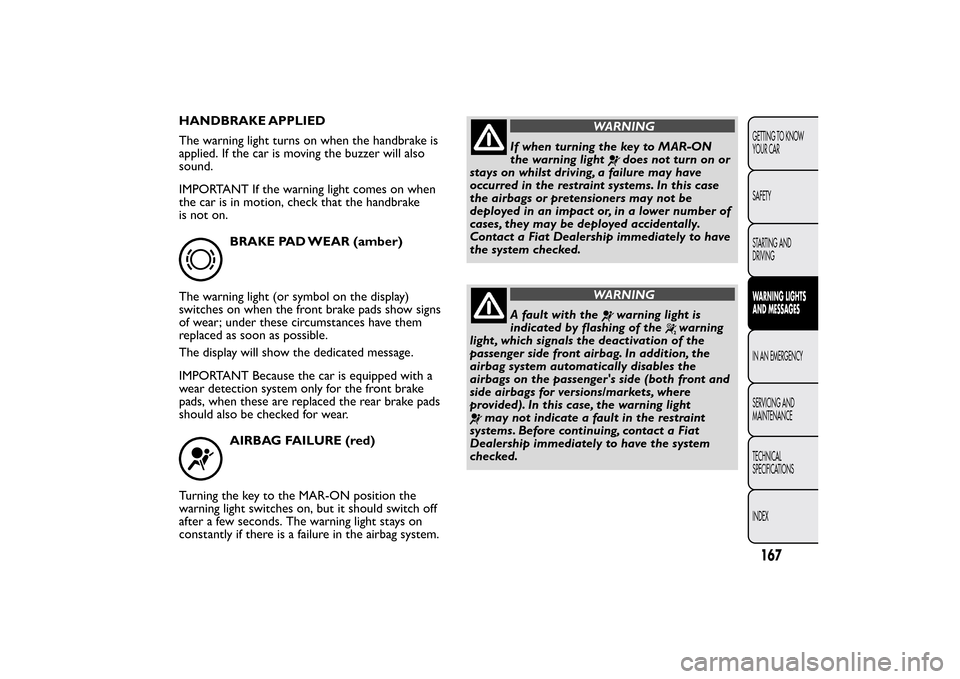
HANDBRAKE APPLIED
The warning light turns on when the handbrake is
applied. If the car is moving the buzzer will also
sound.
IMPORTANT If the warning light comes on when
the car is in motion, check that the handbrake
is not on.
BRAKE PAD WEAR (amber)
The warning light (or symbol on the display)
switches on when the front brake pads show signs
of wear; under these circumstances have them
replaced as soon as possible.
The display will show the dedicated message.
IMPORTANT Because the car is equipped with a
wear detection system only for the front brake
pads, when these are replaced the rear brake pads
should also be checked for wear.AIRBAG FAILURE (red)
Turning the key to the MAR-ON position the
warning light switches on, but it should switch off
after a few seconds. The warning light stays on
constantly if there is a failure in the airbag system.
WARNING
If when turning the key to MAR-ON
the warning light
does not turn on or
stays on whilst driving, a failure may have
occurred in the restraint systems. In this case
the airbags or pretensioners may not be
deployed in an impact or, in a lower number of
cases, they may be deployed accidentally.
Contact a Fiat Dealership immediately to have
the system checked.
WARNING
Afaultwiththe
warning light is
indicated by flashing of the
warning
light , which signals the deactivation of the
passenger side front airbag. In addition, the
airbag system automatically disables the
airbags on the passenger's side (both front and
side airbags for versions/markets, where
provided). In this case, the warning light
may not indicate a fault in the restraint
systems. Before continuing, contact a Fiat
Dealership immediately to have the system
checked.
167GETTING TO KNOW
YOUR CAR
SAFETY
STARTING AND
DRIVINGWARNING LIGHTS
AND MESSAGESIN AN EMERGENCY
SERVICING AND
MAINTENANCE
TECHNICAL
SPECIFICATIONS
INDEX