climate control FIAT BRAVO 2012 2.G User Guide
[x] Cancel search | Manufacturer: FIAT, Model Year: 2012, Model line: BRAVO, Model: FIAT BRAVO 2012 2.GPages: 299, PDF Size: 5.81 MB
Page 68 of 299
CLIMATE CONTROL SYSTEM (cooling)
Proceed as follows:
❒turn knob A to the blue section;
❒turn knob C to the required speed;
❒turn knob F to
;
❒press
and
buttons (button LEDs on).
Cooling adjustment
Proceed as follows:
❒deactivate thebutton (LED on button off );
❒turn knob A rightwards to increase the
temperature;
❒turn knob C leftwards to reduce the fan speed.ADDITIONAL HEATER
(for versions/markets, where provided)
This device warms up the passenger compartment
more quickly when it is very cold and the engine
coolant temperature is low.
The additional heater comes on automatically when
the engine is started, if knob A is turned to the
last red sector and the fan (knob C) is at least at
the first speed level.
The heater switches off automatically when the
required comfort conditions are achieved.
IMPORTANT The heater will not turn on if the
battery voltage is too low.
SYSTEM MAINTENANCE
In winter, the climate control system must be
turned on at least once a month for about
10 minutes. Before summer, have the system
checked at a Fiat Dealership.
64GETTING TO
KNOW YOUR CAR
SAFETY
STARTING AND
DRIVING
WARNING LIGHTS
AND MESSAGES
IN AN EMERGENCY
SERVICING AND
MAINTENANCE
TECHNICAL
SPECIFICATIONS
INDEX
Page 69 of 299
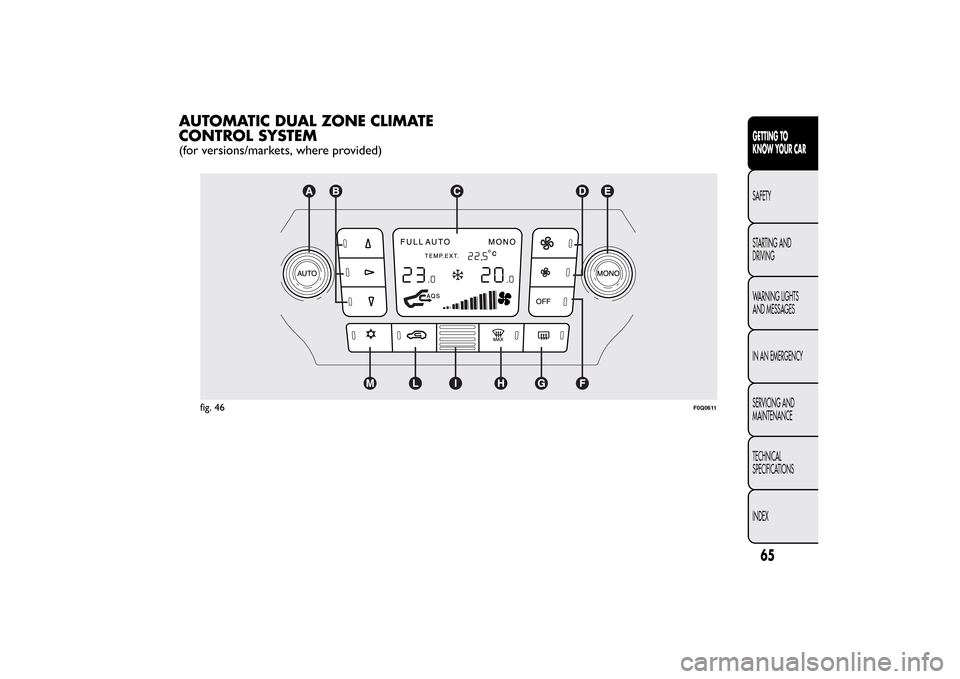
AUTOMATIC DUAL ZONE CLIMATE
CONTROL SYSTEM(for versions/markets, where provided)
fig. 46
F0Q0611
65GETTING TO
KNOW YOUR CARSAFETY
STARTING AND
DRIVING
WARNING LIGHTS
AND MESSAGES
IN AN EMERGENCY
SERVICING AND
MAINTENANCE
TECHNICAL
SPECIFICATIONS
INDEX
Page 70 of 299
DESCRIPTION
The car is equipped with a dual zone climate
control system which allows you to adjust the air
temperature on the driver's and the passenger's
side separately.
The system has an AQS function (Air Quality
System), which automatically activates internal air
recirculation when the outside air is polluted
(e.g. in traffic queues and tunnels).
CONTROLSA
AUTO function activation button (automatic
operation) and driver side temperature
adjustment knob
Bair distribution selection buttonC
climate control system information display
D
fan speed increase/decrease
EMONO function activation button (set
temperature alignment) and passenger side
temperature adjustment knobFclimate control system on/off buttonG
heated rear window on/off button
H
MAX-DEF function activation button (rapid
defrosting/demisting of front windows)
Iinternal air temperature sensorLinternal air recirculation and AQS function on/off
buttonM
climate control system compressor on/off buttonSWITCHING ON THE CLIMATE CONTROL
SYSTEM
The system can be activated by pressing any of the
buttons; it is, however, advisable to set the desired
temperatures on the
display, then press the AUTO button.
The climate control system allows you to customise
the temperatures requested (driver side and
passenger side) with a maximum difference of 7°C.
The climate control system compressor works
only with the engine running and an outside
temperature of above 4°C.
AUTOMATIC OPERATION OF THE
CLIMATE CONTROL SYSTEM (AUTO
function)
Press the AUTO button; the system will
automatically adjust:
❒the amount of air introduced into the passenger
compartment;
❒the distribution of the air in the passenger
compartment;
cancelling all previous manual adjustments.
66GETTING TO
KNOW YOUR CAR
SAFETY
STARTING AND
DRIVING
WARNING LIGHTS
AND MESSAGES
IN AN EMERGENCY
SERVICING AND
MAINTENANCE
TECHNICAL
SPECIFICATIONS
INDEX
Page 71 of 299
During climate control system automatic operation,
the words FULL AUTO appear on the display.
During automatic operation it is still possible to
adjust the temperatures set and carry out the
following operations manually:
❒fan speed adjustment;
❒air distribution selection;
❒internal air recirculation and AQS function
activation/deactivation;
❒climate control system compressor activation.
WARNING
It is advisable not to use the internal
air recirculation function when the
outside temperature is low, because the
windows could mist rapidly.
FAN SPEED ADJUSTMENT
Press button
to increase/decrease the fan speed.
The 12 possible speeds are indicated by bars
lighting up on the display:
❒maximum fan speed = all bars lit
❒minimum fan speed = one bar lit.
The fan can be disabled (no bars lit) only if the
climate control system compressor has been
switched off by pressing button
.To restore automatic fan speed control after a
manual adjustment, press the AUTO button.
RAPID FRONT WINDOW
DEMISTING/DEFROSTING (MAX-DEF
function)
Press button to automatically activate the timed
operation of all the functions required to rapidly
demist/defrost the windscreen and front side
windows.
The functions are:
❒climate control system compressor activation
(with an outside temperature of above 4°C);
❒switching off, if previously on, of the internal air
recirculation (LED on button
off );
❒activation of heated rear window (LED on button
on) and door mirror heater coils;
❒setting maximum air temperature;
❒activation of air flow.
HEATED REAR WINDOW AND DOOR
MIRRORS DEMISTING/DEFROSTING
Press button
to activate: when this function is
activated, the button LED switches on.
This function is timed and will deactivate
automatically after 20 minutes. Press the button
again to switch the function off in advance.
67GETTING TO
KNOW YOUR CARSAFETY
STARTING AND
DRIVING
WARNING LIGHTS
AND MESSAGES
IN AN EMERGENCY
SERVICING AND
MAINTENANCE
TECHNICAL
SPECIFICATIONS
INDEX
Page 72 of 299
IMPORTANT Do not apply stickers on the inside of
the rear window over the heating filaments to
avoid damage.
IMPORTANT Press
to introduce air from the
outside (in this case the LED on the button should
be off ).
ACTIVATION OF INTERNAL AIR
RECIRCULATION AND ENABLEMENT OF
AQS FUNCTION (Air Quality System)
Press button
. Internal air recirculation is
carried out according to three possible operating
modes:
❒automatic control, signalled by the AQS sign on
the display and the LED on button
being
off;
❒forced deactivation (internal air recirculation
always off with introduction of outside air),
indicated by the LED on button
being off;
❒forced activation (internal air recirculation always
on), signalled by the LED on button
being lit.
When OFF button is pressed, the climate control
system automatically activates internal air
recirculation (the LED on button T should be on).
It is still possible to activate outside air recirculation
(LED on the button off ) and vice versa, by pressing
button T.
With the OFF button pressed (LED on the button
is lit up), it is not possible to enable the AQS
(Air Quality System) function.IMPORTANT Internal air recirculation makes it
possible to reach the required heating or cooling
conditions more quickly depending on the mode
selected. It is not advisable to switch the internal
air recirculation on when it is rainy/cold to prevent
the windows from misting, especially if the climate
control system has not been activated. It is
advisable to switch the internal air recirculation on
whilst queuing or in tunnels to prevent the
introduction of polluted air. Do not use the
function for a long time, particularly if there are
several passengers on board, to prevent the
windows from misting.
AQS (Air Quality System) function
activation
The AQS function (AQS sign on the display)
automatically activates internal air recirculation
when the outside air is polluted (e.g. in traffic
queues and tunnels).
IMPORTANT With the AQS function active, after
approx. 15 consecutive minutes of the internal
air recirculation system functioning, the climate
control system enables the intake of outside air for
approximately 1 minute to freshen the air in the
passenger compartment. This takes place regardless
of the pollution level of the outside air.
68GETTING TO
KNOW YOUR CAR
SAFETY
STARTING AND
DRIVING
WARNING LIGHTS
AND MESSAGES
IN AN EMERGENCY
SERVICING AND
MAINTENANCE
TECHNICAL
SPECIFICATIONS
INDEX
Page 73 of 299
SET TEMPERATURE ALIGNMENT (MONO
function)
Press the MONO button to align the temperature
between the driver side and passenger side.
Then turn the AUTO or MONO knob to
increase/decrease the temperature between the
two areas by the same amount.
Press MONO again to deactivate the function.
CLIMATE CONTROL SYSTEM
COMPRESSOR ACTIVATION/
DEACTIVATION
Press the
button to switch on the climate
control system compressor.
Compressor engagement
❒button LED
on;
❒
symbol appears on display.
Compressor deactivation
❒button LED
off;
❒
symbol on display disappears;
❒internal air recirculation excluded;
❒AQS function disabled.
With the climate control system compressor
switched off, air cannot be introduced into the
passenger compartment that has a lower
temperature than the outside air; in this case the
symbol in the display will flash.The deactivation of the climate control system
compressor is memorised even after the engine has
stopped. To reactivate the climate control system
compressor, press the
or AUTO button again:
if you press AUTO, the other manual settings
will be cancelled.
IMPORTANT In order to preserve the battery
charge, the electronic climate control management
permits a higher ventilation speed than minimum
only if the engine is running at a speed greater than
750 rpm. When the speed drops below this
threshold – possible when setting off, for example –
the ventilation speed is automatically reduced to
minimum.
AIR DISTRIBUTION SELECTION
Press one or more of these buttons
/
/
to
manually select one of the seven possible air
distribution settings for the passenger
compartment:
Air flow to the windscreen and front side
window diffusers to demist/defrost them.Air flow to the front and rear footwell
diffusers. This air distribution allows the
passenger compartment to be warmed up
quickly.
69GETTING TO
KNOW YOUR CARSAFETY
STARTING AND
DRIVING
WARNING LIGHTS
AND MESSAGES
IN AN EMERGENCY
SERVICING AND
MAINTENANCE
TECHNICAL
SPECIFICATIONS
INDEX
Page 74 of 299
Air flow distribution between front and
rear diffusers, centre/side dashboard
diffusers, rear diffuser and windscreen
and front side window demisting/
defrosting diffusers.
Air flow distribution to centre/side dashboard
diffusers (passenger's body).
Air flow distribution between footwell
diffusers and windscreen and front side
window defrosting/demisting diffusers. This
distribution setting allows the passenger
compartment to be warmed effectively and
prevents the windows from misting.Air flow distribution between footwell
diffusers (hotter air) and centre/side
dashboard diffusers and rear diffuser (cooler
air).Air flow distribution between centre/side
dashboard diffusers, rear diffuser and
windscreen and front side window
demisting/defrosting diffusers. This
distribution setting ventilates the passenger
compartment well and prevents the
windows from misting up.
IMPORTANT For the climate control system to
function, at least one of the buttons
/
/
must
be operated. The system does not allow the
deactivation of all the buttons
/
/
.IMPORTANT Push the OFF button to turn the
climate control system back on: in this way, all
operating conditions memorised before switching
off are restored.
To restore automatic control of the air distribution
after a manual selection, press the AUTO button.
ADDITIONAL HEATER
(for versions/markets, where provided)
This device warms up the passenger compartment
more quickly when it is very cold and the engine
coolant temperature is low.
In these conditions, the device comes on
automatically when the engine is started and the
fan is on.
The heater switches off automatically when the
required comfort conditions are achieved.
IMPORTANT The heater will not turn on if the
battery voltage is too low.
SWITCHING OFF THE CLIMATE
CONTROL SYSTEM
Press the OFF button.
The following information is shown on the display:
❒OFF;
❒outside temperature indication;
❒internal air recirculation on indication (LED on
button
lit).
70GETTING TO
KNOW YOUR CAR
SAFETY
STARTING AND
DRIVING
WARNING LIGHTS
AND MESSAGES
IN AN EMERGENCY
SERVICING AND
MAINTENANCE
TECHNICAL
SPECIFICATIONS
INDEX
Page 117 of 299
Start&Stop system activation
A message and a symbol
will appear on the
display when the Start&Stop system is activated. In
this condition, the LED A fig. 105 on the
button
is off.
Start&Stop system deactivation
Versions with reconfigurable multifunction display:
the
symbol appears on the display when the
Start&Stop system is deactivated. The LED A
fig. 105 is on when the system is deactivated.
ENGINE STOPPING FAILURE
CONDITIONS
When the system is active, due to comfort,
emission control and safety reasons, the engine
does not stop in some conditions, among which:
❒engine still cold;
❒especially cold outside temperature;
❒battery not sufficiently charged;
❒heated rear window activated;
❒driver's door not shut;
❒driver's seat belt not fastened;
❒reverse gear engaged (for example, for parking
manoeuvres);❒for versions equipped with dual zone automatic
climate control system (for versions/markets,
where provided), if an adequate level of thermal
comfort has not been reached or with MAX-DEF
function activation;
❒during the first period of use, to initialise the
system.
In these cases, the display shows a message and -
for versions/markets, where provided - the symbol
flashes on the display.
WARNING
If the climate comfort is to be
favoured, the Star t&Stop system can be
disabled, for a continuous operation of the
climate control system.
ENGINE RESTARTING CONDITIONS
For reasons of comfort, to limit harmful emissions
and for safety purposes, the engine can restart
automatically without any action by the driver if
certain conditions occur, including:
❒battery not sufficiently charged;
❒windscreen wipers working at maximum speed;
❒reduced braking system vacuum (e.g. if the brake
pedal is pressed repeatedly);
❒car moving (e.g. when driving on roads with a
gradient);
113GETTING TO
KNOW YOUR CARSAFETY
STARTING AND
DRIVING
WARNING LIGHTS
AND MESSAGES
IN AN EMERGENCY
SERVICING AND
MAINTENANCE
TECHNICAL
SPECIFICATIONS
INDEX
Page 118 of 299
❒engine stopping by Start&Stop system for over 3
minutes;
❒for versions equipped with automatic climate
control (for versions/markets where provided),
to enable suitable thermal comfort or with
MAX-DEF activation.
If a gear in engaged during stopping with
Start&Stop, the automatic restarting of the engine
is only permitted by fully depressing the clutch
pedal.
The driver is informed by a message on the display
and - for versions/markets, where provided - by
the flashing of the
symbol.
If the clutch is not pressed, about 3 minutes after
the engine stops, the engine can be restarted
only using the ignition key.
In cases of undesired engine stops, due for example
to the clutch pedal being released abruptly with a
gear engaged, if the Start&Stop system is activated,
the engine can be restarted by fully depressing
the clutch pedal.
SAFETY FUNCTIONS
When the engine is stopped by the Start&Stop
system, if the driver releases his/her seat belt and
opens the driver's or passenger's door, the engine
can be restarted only using the ignition key.
The driver is informed by a buzzer and by the
flashing of the symbol
on the display; on some
versions, a message is displayed as well."ENERGY SAVING" FUNCTION
(for versions/markets, where provided)
If, after automatic engine restarting, the driver does
not carry out any action on the car for an
extended period (about 3 minutes), the Start&Stop
system stops the engine definitively, to prevent
fuel consumption. In these cases, the engine can
only be restarted using the ignition key.
NoteIn any case, it is possible to keep the engine
running by deactivating the Start&Stop system.
IRREGULAR OPERATION
In the event of malfunction, the Start&Stop system
is deactivated. The driver is informed of the fault
by the flashing symbol
(versions with
multifunction display) or symbol
(versions with
reconfigurable multifunction display). For
versions/markets, where provided, a warning
message is also displayed. In this case, contact a Fiat
Dealership.
CAR INACTIVITY
In the event of car inactivity, special attention must
be paid to the disconnection of the battery power
supply.
Proceed as follows: detach the connector A (by
pressing button B) from sensor C for monitoring
the status of the battery installed on the negative
114GETTING TO
KNOW YOUR CAR
SAFETY
STARTING AND
DRIVING
WARNING LIGHTS
AND MESSAGES
IN AN EMERGENCY
SERVICING AND
MAINTENANCE
TECHNICAL
SPECIFICATIONS
INDEX
Page 164 of 299
levels. When transporting particularly large objects,
use a trailer if possible.
Electric devices
Use electric devices only for the amount of time
needed. The heated rear window, additional
headlights, windscreen wipers and heater fan need a
considerable amount of energy, therefore
increasing fuel consumption (by up to 25% in the
urban cycle).
Climate control system
Air conditioning leads to higher fuel consumption
(on average up to +20%). If the temperature
outside permits, try and use the air vents.
Devices for aerodynamic control
The use of non-certified spoilers may adversely
affect air drag and fuel consumption.
DRIVING STYLE
The main driving styles that affect fuel consumption
are listed below.
Starting
Do not warm the engine with the car at a standstill
or at idle or high speed: under these conditions
the engine warms up much more slowly, increasing
electrical consumption and emissions. It istherefore advisable to move off immediately, slowly,
avoiding high speeds: in this way the engine will
warm faster.
Unnecessary actions
Avoid accelerating when starting at traffic lights or
before switching off the engine. This and also
double declutching is absolutely pointless on
modern cars and also increases consumption and
pollution.
Gear selection
As soon as the conditions of the traffic and road
allow, use a higher gear. Using a low gear for faster
acceleration will increase consumption.
In the same way improper use of a high gear
increases consumption, emissions an engine wear.
Max. speed
Fuel consumption considerably increases as speed
increases. Avoiding unnecessary braking and
acceleration, which cost in terms of both fuel and
emissions.
Acceleration
Accelerating violently severely affects consumption
and emissions: acceleration should be gradual and
should not exceed the maximum torque.
160GETTING TO KNOW
YOUR CAR
SAFETYSTARTING AND
DRIVINGWARNING LIGHTS
AND MESSAGES
IN AN EMERGENCY
SERVICING AND
MAINTENANCE
TECHNICAL
SPECIFICATIONS
INDEX