instrument panel FIAT BRAVO 2012 2.G User Guide
[x] Cancel search | Manufacturer: FIAT, Model Year: 2012, Model line: BRAVO, Model: FIAT BRAVO 2012 2.GPages: 299, PDF Size: 5.81 MB
Page 76 of 299
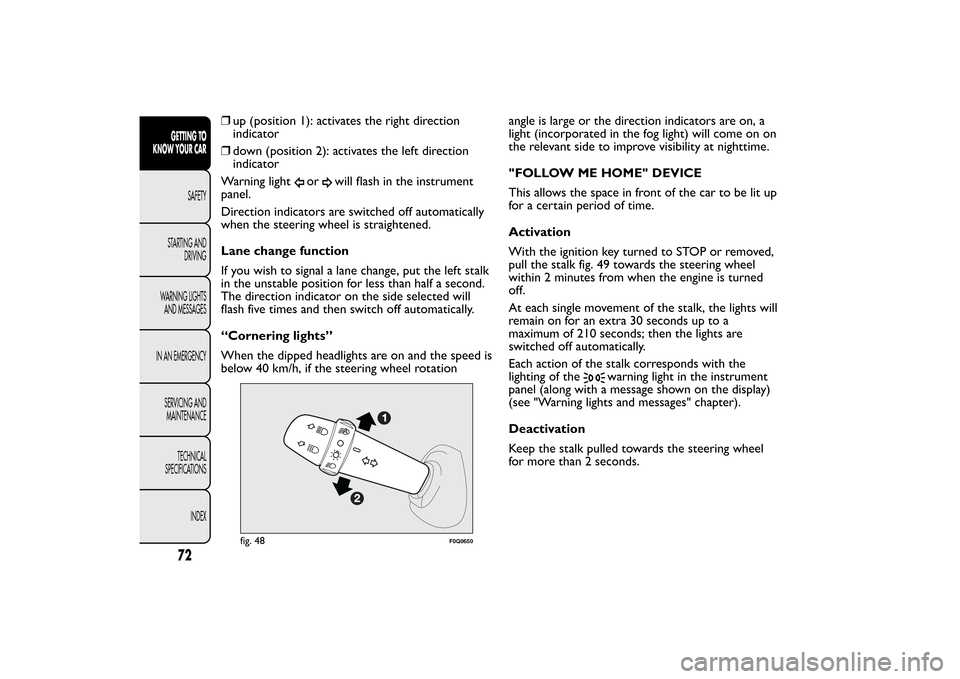
❒up (position 1): activates the right direction
indicator
❒down (position 2): activates the left direction
indicator
Warning light
or
will flash in the instrument
panel.
Direction indicators are switched off automatically
when the steering wheel is straightened.
Lane change function
If you wish to signal a lane change, put the left stalk
in the unstable position for less than half a second.
The direction indicator on the side selected will
flash five times and then switch off automatically.
“Cornering lights”
When the dipped headlights are on and the speed is
below 40 km/h, if the steering wheel rotationangle is large or the direction indicators are on, a
light (incorporated in the fog light) will come on on
the relevant side to improve visibility at nighttime.
"FOLLOW ME HOME" DEVICE
This allows the space in front of the car to be lit up
for a certain period of time.
Activation
With the ignition key turned to STOP or removed,
pull the stalk fig. 49 towards the steering wheel
within 2 minutes from when the engine is turned
off.
At each single movement of the stalk, the lights will
remain on for an extra 30 seconds up to a
maximum of 210 seconds; then the lights are
switched off automatically.
Each action of the stalk corresponds with the
lighting of the
warning light in the instrument
panel (along with a message shown on the display)
(see "Warning lights and messages" chapter).
Deactivation
Keep the stalk pulled towards the steering wheel
for more than 2 seconds.
fig. 48
F0Q0650
72GETTING TO
KNOW YOUR CAR
SAFETY
STARTING AND
DRIVING
WARNING LIGHTS
AND MESSAGES
IN AN EMERGENCY
SERVICING AND
MAINTENANCE
TECHNICAL
SPECIFICATIONS
INDEX
Page 77 of 299
AUTOMATIC HEADLIGHT SENSOR (dusk
sensor)
(for versions/markets, where provided)
It detects variations in brightness outside the
vehicle depending on the light sensitivity setting:
the greater the sensitivity, the less outside light
needed to activate the exterior lights being turned
on.
The sensitivity of the dusk sensor may be adjusted
by means of the "Setup menu" on the instrument
panel.Activation
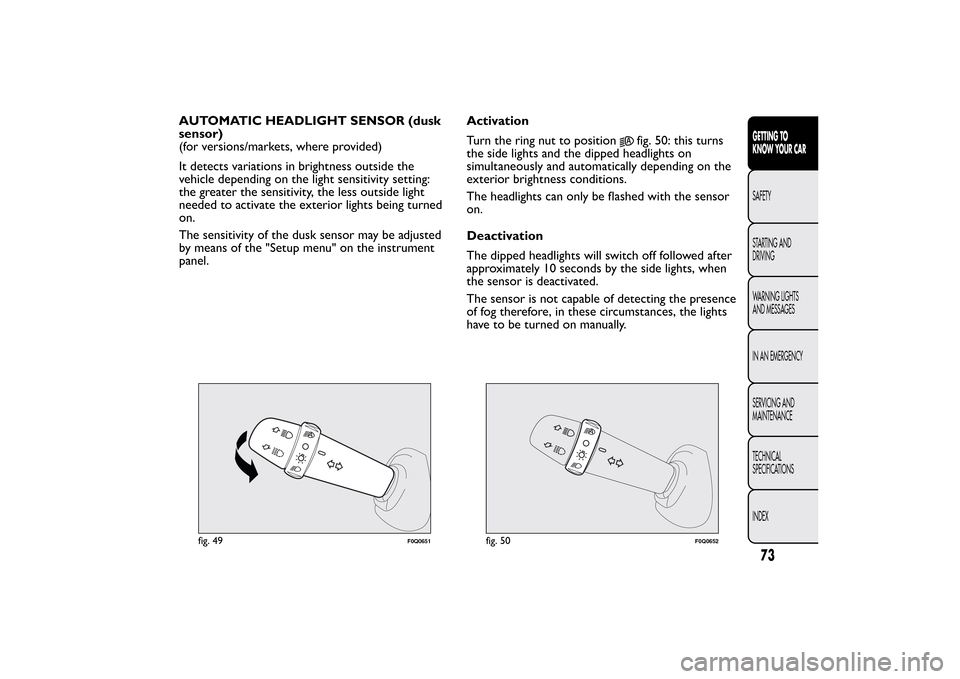
Turn the ring nut to position
fig. 50: this turns
the side lights and the dipped headlights on
simultaneously and automatically depending on the
exterior brightness conditions.
The headlights can only be flashed with the sensor
on.
Deactivation
The dipped headlights will switch off followed after
approximately 10 seconds by the side lights, when
the sensor is deactivated.
The sensor is not capable of detecting the presence
of fog therefore, in these circumstances, the lights
have to be turned on manually.
fig. 49
F0Q0651
fig. 50
F0Q0652
73GETTING TO
KNOW YOUR CARSAFETY
STARTING AND
DRIVING
WARNING LIGHTS
AND MESSAGES
IN AN EMERGENCY
SERVICING AND
MAINTENANCE
TECHNICAL
SPECIFICATIONS
INDEX
Page 82 of 299
CRUISE CONTROL(constant speed regulator)
(for versions/markets, where provided)
This is an electronically controlled driving assistance
device which allows the car to be driven at a
chosen speed above 30 km/h on long stretches of
dry, straight roads with few variations (e.g.
motorways), without having to depress the
accelerator pedal.
The use of this device on extra-urban roads with
traffic is not therefore recommended. Do not
use the device in town.
TURNING THE DEVICE ON
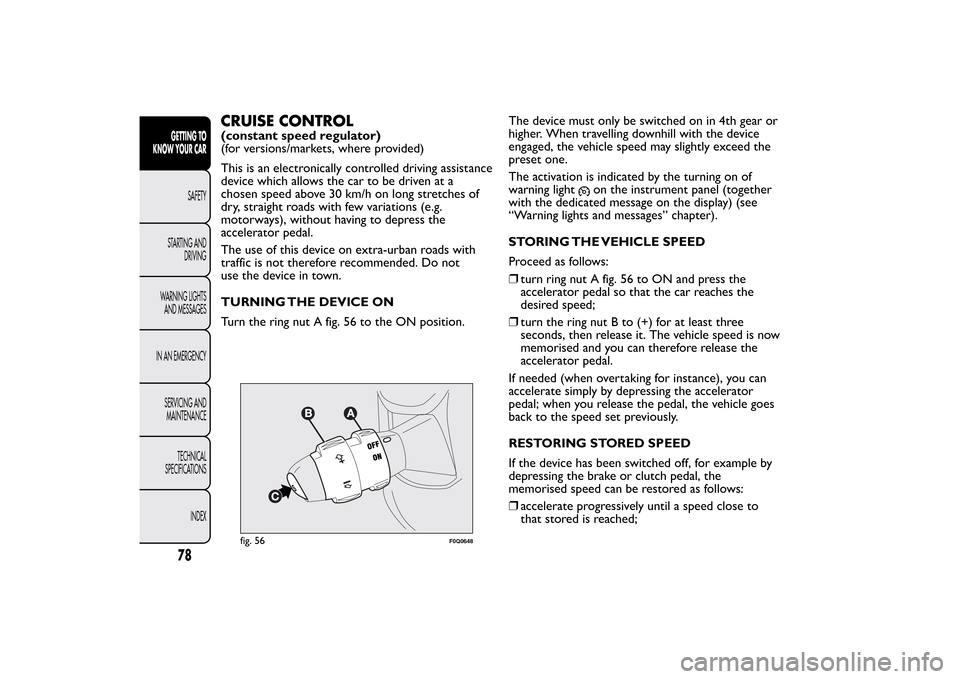
Turn the ring nut A fig. 56 to the ON position.The device must only be switched on in 4th gear or
higher. When travelling downhill with the device
engaged, the vehicle speed may slightly exceed the
preset one.
The activation is indicated by the turning on of
warning light
on the instrument panel (together
with the dedicated message on the display) (see
“Warning lights and messages” chapter).
STORING THE VEHICLE SPEED
Proceed as follows:
❒turn ring nut A fig. 56 to ON and press the
accelerator pedal so that the car reaches the
desired speed;
❒turn the ring nut B to (+) for at least three
seconds, then release it. The vehicle speed is now
memorised and you can therefore release the
accelerator pedal.
If needed (when overtaking for instance), you can
accelerate simply by depressing the accelerator
pedal; when you release the pedal, the vehicle goes
back to the speed set previously.
RESTORING STORED SPEED
If the device has been switched off, for example by
depressing the brake or clutch pedal, the
memorised speed can be restored as follows:
❒accelerate progressively until a speed close to
that stored is reached;
fig. 56
F0Q0648
78GETTING TO
KNOW YOUR CAR
SAFETY
STARTING AND
DRIVING
WARNING LIGHTS
AND MESSAGES
IN AN EMERGENCY
SERVICING AND
MAINTENANCE
TECHNICAL
SPECIFICATIONS
INDEX
Page 86 of 299
CONTROLSHAZARD WARNING LIGHTS
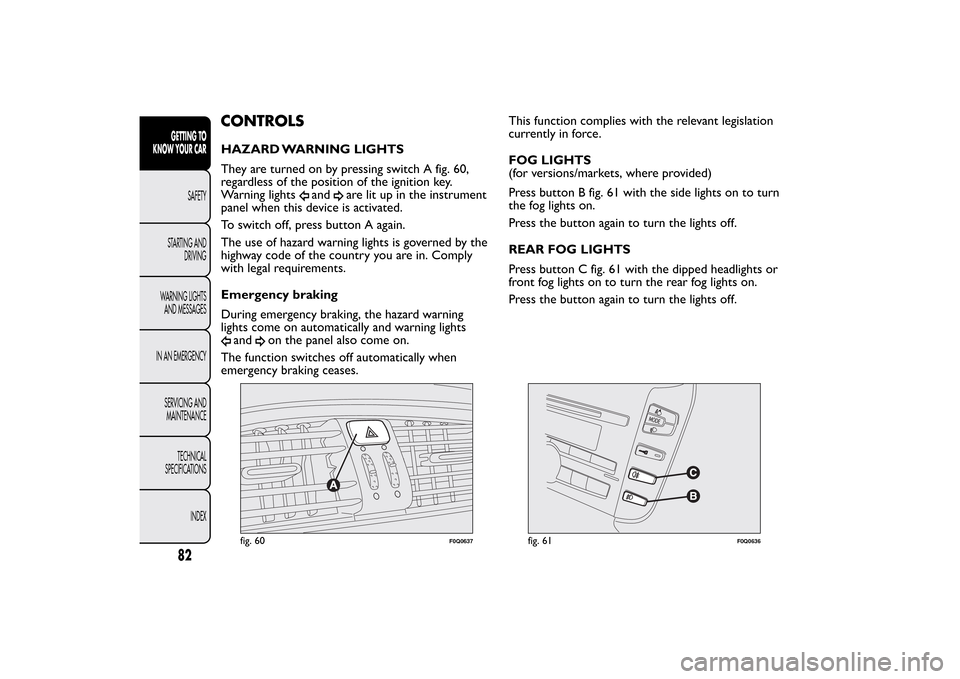
They are turned on by pressing switch A fig. 60,
regardless of the position of the ignition key.
Warning lights
and
are lit up in the instrument
panel when this device is activated.
To switch off, press button A again.
The use of hazard warning lights is governed by the
highway code of the country you are in. Comply
with legal requirements.
Emergency braking
During emergency braking, the hazard warning
lights come on automatically and warning lights
and
on the panel also come on.
The function switches off automatically when
emergency braking ceases.This function complies with the relevant legislation
currently in force.
FOG LIGHTS
(for versions/markets, where provided)
Press button B fig. 61 with the side lights on to turn
the fog lights on.
Press the button again to turn the lights off.
REAR FOG LIGHTS
Press button C fig. 61 with the dipped headlights or
front fog lights on to turn the rear fog lights on.
Press the button again to turn the lights off.
fig. 60
F0Q0637
fig. 61
F0Q0636
82GETTING TO
KNOW YOUR CAR
SAFETY
STARTING AND
DRIVING
WARNING LIGHTS
AND MESSAGES
IN AN EMERGENCY
SERVICING AND
MAINTENANCE
TECHNICAL
SPECIFICATIONS
INDEX
Page 87 of 299
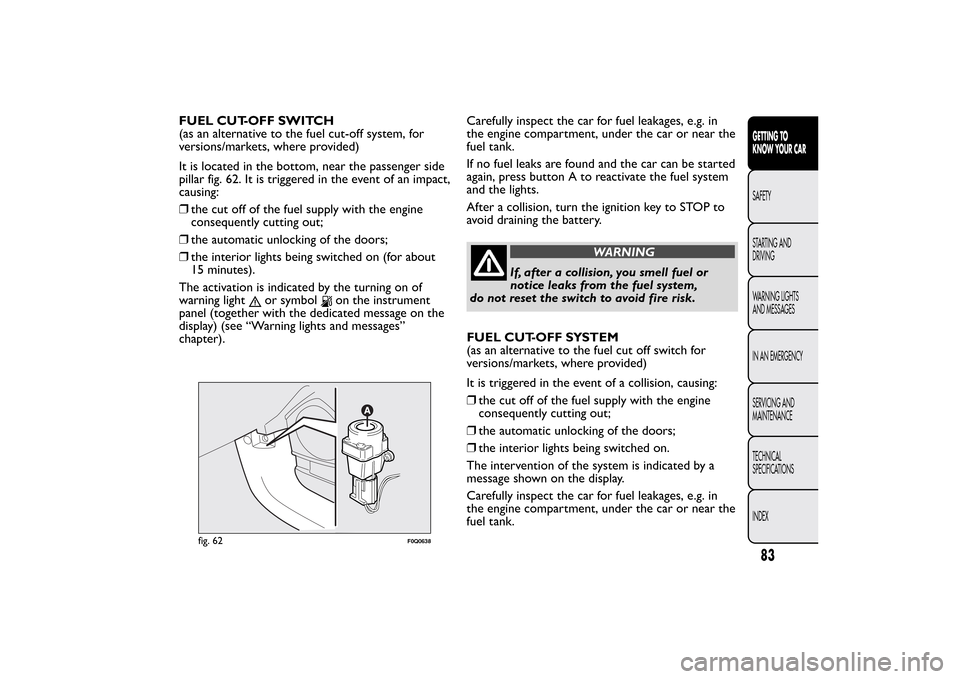
FUEL CUT-OFF SWITCH
(as an alternative to the fuel cut-off system, for
versions/markets, where provided)
It is located in the bottom, near the passenger side
pillar fig. 62. It is triggered in the event of an impact,
causing:
❒the cut off of the fuel supply with the engine
consequently cutting out;
❒the automatic unlocking of the doors;
❒the interior lights being switched on (for about
15 minutes).
The activation is indicated by the turning on of
warning light
or symbol
on the instrument
panel (together with the dedicated message on the
display) (see “Warning lights and messages”
chapter).Carefully inspect the car for fuel leakages, e.g. in
the engine compartment, under the car or near the
fuel tank.
If no fuel leaks are found and the car can be started
again, press button A to reactivate the fuel system
and the lights.
After a collision, turn the ignition key to STOP to
avoid draining the battery.
WARNING
If, after a collision, you smell fuel or
notice leaks from the fuel system,
do not reset the switch to avoid fire risk.
FUEL CUT-OFF SYSTEM
(as an alternative to the fuel cut off switch for
versions/markets, where provided)
It is triggered in the event of a collision, causing:
❒the cut off of the fuel supply with the engine
consequently cutting out;
❒the automatic unlocking of the doors;
❒the interior lights being switched on.
The intervention of the system is indicated by a
message shown on the display.
Carefully inspect the car for fuel leakages, e.g. in
the engine compartment, under the car or near the
fuel tank.
fig. 62
F0Q0638
83GETTING TO
KNOW YOUR CARSAFETY
STARTING AND
DRIVING
WARNING LIGHTS
AND MESSAGES
IN AN EMERGENCY
SERVICING AND
MAINTENANCE
TECHNICAL
SPECIFICATIONS
INDEX
Page 101 of 299
MANUAL REAR WINDOW MECHANISM
(for versions/markets, where provided)
To open and to close the window, use the relevant
handle.
Electric window system initialisation
The system must be re-initialised after
disconnecting the battery or if the relevant
protection fuse is blown.
Initialisation procedure:
❒fully close the window to be initialised manually;
❒after the window has reached the upper end
of travel, hold the up button pressed for at least
one second.
LUGGAGE COMPARTMENTOPENING
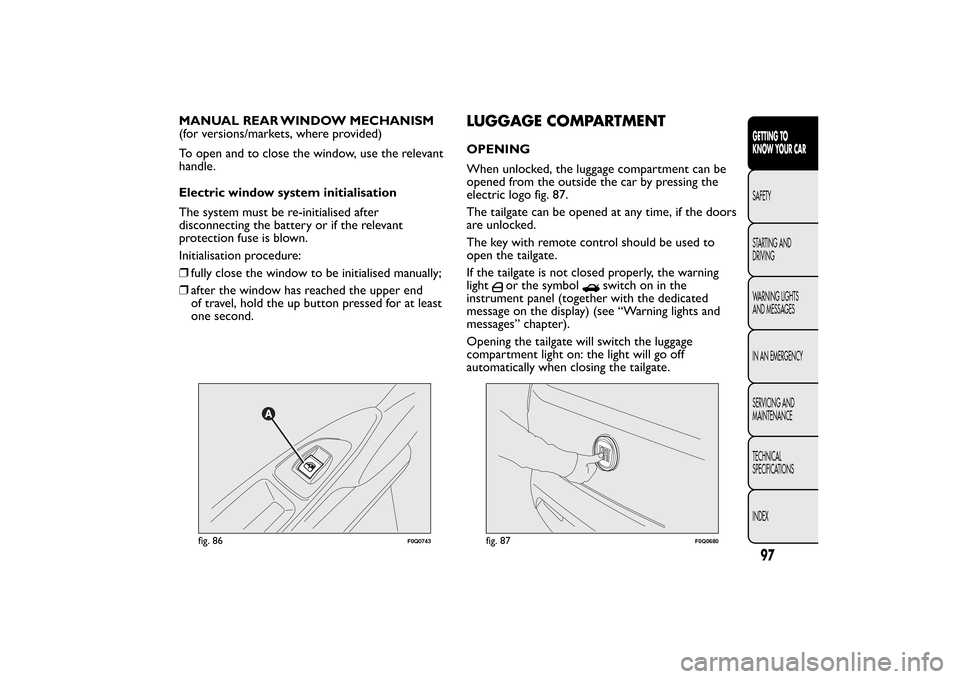
When unlocked, the luggage compartment can be
opened from the outside the car by pressing the
electric logo fig. 87.
The tailgate can be opened at any time, if the doors
are unlocked.
The key with remote control should be used to
open the tailgate.
If the tailgate is not closed properly, the warning
light
or the symbol
switch on in the
instrument panel (together with the dedicated
message on the display) (see “Warning lights and
messages” chapter).
Opening the tailgate will switch the luggage
compartment light on: the light will go off
automatically when closing the tailgate.
fig. 86
F0Q0743
fig. 87
F0Q0680
97GETTING TO
KNOW YOUR CARSAFETY
STARTING AND
DRIVING
WARNING LIGHTS
AND MESSAGES
IN AN EMERGENCY
SERVICING AND
MAINTENANCE
TECHNICAL
SPECIFICATIONS
INDEX
Page 107 of 299
Use both hands to lift the bonnet . Before
lifting, check that the windscreen wiper
arms are not raised from the windscreen,
that the car is stationary and that the
handbrake is engaged.CLOSING
Proceed as follows:
❒hold the bonnet up with one hand and with the
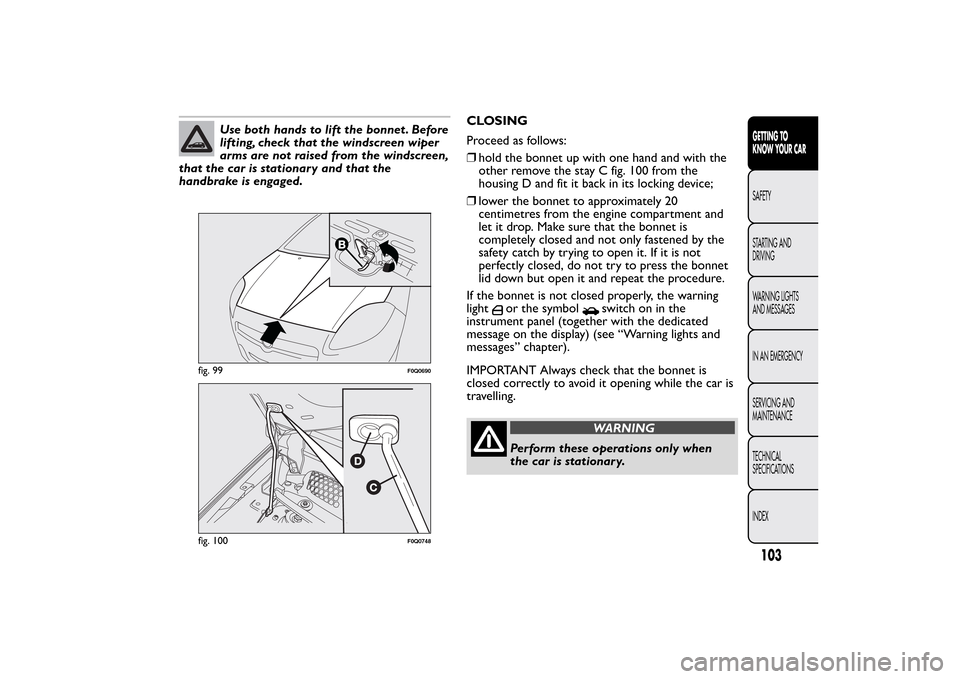
other remove the stay C fig. 100 from the
housing D and fit it back in its locking device;
❒lower the bonnet to approximately 20
centimetres from the engine compartment and
let it drop. Make sure that the bonnet is
completely closed and not only fastened by the
safety catch by trying to open it. If it is not
perfectly closed, do not try to press the bonnet
lid down but open it and repeat the procedure.
If the bonnet is not closed properly, the warning
light
or the symbol
switch on in the
instrument panel (together with the dedicated
message on the display) (see “Warning lights and
messages” chapter).
IMPORTANT Always check that the bonnet is
closed correctly to avoid it opening while the car is
travelling.WARNING
Perform these operations only when
the car is stationary.
fig. 99
F0Q0690
fig. 100
F0Q0748
103GETTING TO
KNOW YOUR CARSAFETY
STARTING AND
DRIVING
WARNING LIGHTS
AND MESSAGES
IN AN EMERGENCY
SERVICING AND
MAINTENANCE
TECHNICAL
SPECIFICATIONS
INDEX
Page 109 of 299
HEADLIGHTSLIGHT BEAM DIRECTION
The correct direction of the headlights is essential
for the comfort and safety of the driver and other
road users. The headlights must be correctly
directed to ensure the best visibility. Contact a Fiat
Dealership to have the headlights checked and
adjusted.
IMPORTANT When the gas discharge (Xenon)
bulbs (for versions/markets, where provided) are
switched on, normally parabolas and light beam
move vertically for about 2 seconds until headlight
alignment has stabilised.
HEADLIGHT ALIGNMENT CORRECTOR
This device works with the ignition key in the
MAR-ON position and the dipped headlights on.
The car will tilt backwards when it is loaded, raising
the light beam. The beams must therefore be
realigned in this case.
Adjusting headlights alignment
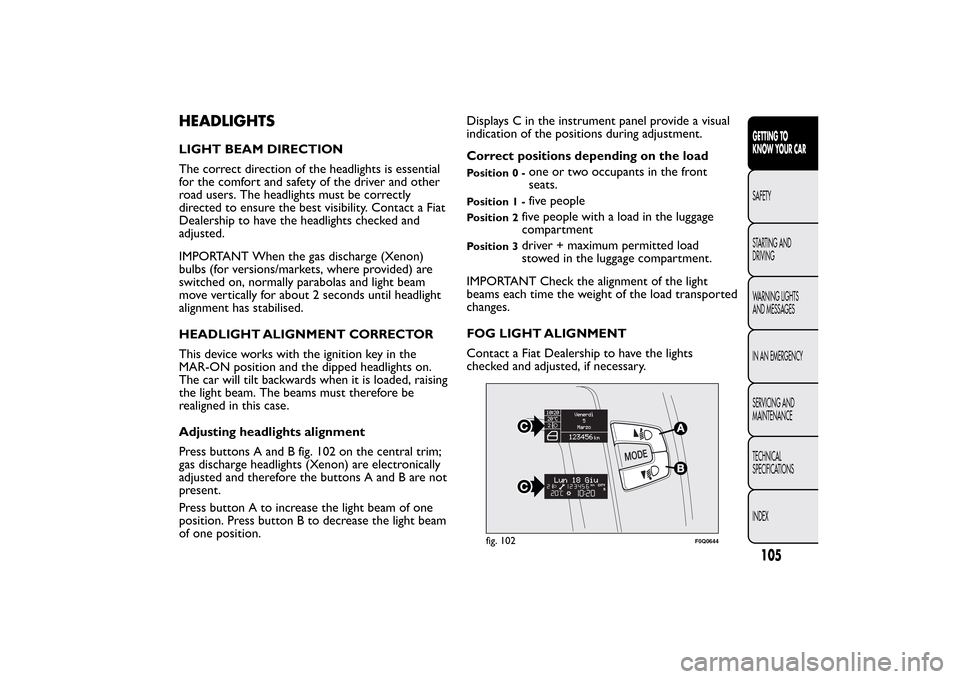
Press buttons A and B fig. 102 on the central trim;
gas discharge headlights (Xenon) are electronically
adjusted and therefore the buttons A and B are not
present.
Press button A to increase the light beam of one
position. Press button B to decrease the light beam
of one position.Displays C in the instrument panel provide a visual
indication of the positions during adjustment.
Correct positions depending on the load
Position 0 -
one or two occupants in the front
seats.
Position 1 -
five people
Position 2
five people with a load in the luggage
compartment
Position 3
driver + maximum permitted load
stowed in the luggage compartment.
IMPORTANT Check the alignment of the light
beams each time the weight of the load transported
changes.
FOG LIGHT ALIGNMENT
Contact a Fiat Dealership to have the lights
checked and adjusted, if necessary.
fig. 102
F0Q0644
105GETTING TO
KNOW YOUR CARSAFETY
STARTING AND
DRIVING
WARNING LIGHTS
AND MESSAGES
IN AN EMERGENCY
SERVICING AND
MAINTENANCE
TECHNICAL
SPECIFICATIONS
INDEX
Page 111 of 299
SYSTEM INTERVENTION
The driver can feel that the ABS system has come
into action because the brake pedal pulsates slightly
and the system gets noisier: it means that the car
speed should be altered to suit the type of road
surface.
WARNING
When the ABS cuts in and you feel the
brake pedal pulsating, do not raise
your foot , but keep it pressed; in doing so you
will stop in the shortest amount of space
possible depending on the current road
conditions.
WARNING
If the ABS intervenes, it is a sign that
the grip between tyre and the road
surface has reached the limit : you must slow
down to adapt the speed to the road grip
available.
ABS FAILURE INDICATION
This is indicated by the
warning light on the
instrument panel together with the dedicated
message on the multifunction display (for
versions/markets where available) coming on (see
“Warning lights and messages” section).In the case, the braking system will work as normal
without the extra capacity offered by the ABS
system. Drive carefully to the nearest Fiat
Dealership to have the system checked.
EBD FAILURE INDICATION
This is indicated by the warning lights
and
on
the instrument panel together with the dedicated
message on the multifunction display (for
versions/markets where available) coming on (see
“Warning lights and messages” section).
In this case, the rear wheels may suddenly lock and
the vehicle may swerve when braking sharply.
Drive carefully to the nearest Fiat Dealership to
have the system checked.
WARNING
If only the warning light
on the
instrument panel switches on - together
with a message in the multifunction display
(for versions/markets, where provided) - stop
the car immediately and contact the nearest
Fiat Dealership. Fluid leaking from the
hydraulic system will compromise the
operation of the braking system, whether it is
of the conventional type or with ABS.
107GETTING TO
KNOW YOUR CARSAFETY
STARTING AND
DRIVING
WARNING LIGHTS
AND MESSAGES
IN AN EMERGENCY
SERVICING AND
MAINTENANCE
TECHNICAL
SPECIFICATIONS
INDEX
Page 112 of 299
BRAKE ASSIST (emergency braking
assistance)
(for versions/markets, where provided)
The system, which cannot be turned off, recognises
emergency braking (on the basis of the brake
pedal operating speed) and speeds up the response
of the braking system.
Brake Assist is deactivated on the versions
equipped with ESP, in the event of ESP system
failure, indicated by warning light
coming on
together with the message on the display.
ESP SYSTEM (Electronic Stability
Program)(for versions/markets, where provided)
This is an electronic system that controls vehicle
stability in the event of tyre grip loss, helping
maintain directional control.
The ESP system is therefore particularly useful
when the grip conditions of road surfaces change.
With the ESP, the car is provided with ASR
(traction control with interventions on brakes and
engine), HILL HOLDER (device for starting on
gradients without using the brakes), MSR (control
of engine braking torque when shifting gear down)
and HBA (automatic increase of braking pressure in
the case of emergency braking).
SYSTEM INTERVENTION
It is signalled by the blinking of the warning light
on the instrument panel, to inform the driver
that the car is in critical stability and grip
conditions.
SYSTEM ACTIVATION
The ESP system comes on automatically when the
vehicle is started and cannot be turned off.
108GETTING TO
KNOW YOUR CAR
SAFETY
STARTING AND
DRIVING
WARNING LIGHTS
AND MESSAGES
IN AN EMERGENCY
SERVICING AND
MAINTENANCE
TECHNICAL
SPECIFICATIONS
INDEX