roof FIAT BRAVO 2012 2.G User Guide
[x] Cancel search | Manufacturer: FIAT, Model Year: 2012, Model line: BRAVO, Model: FIAT BRAVO 2012 2.GPages: 299, PDF Size: 5.81 MB
Page 108 of 299
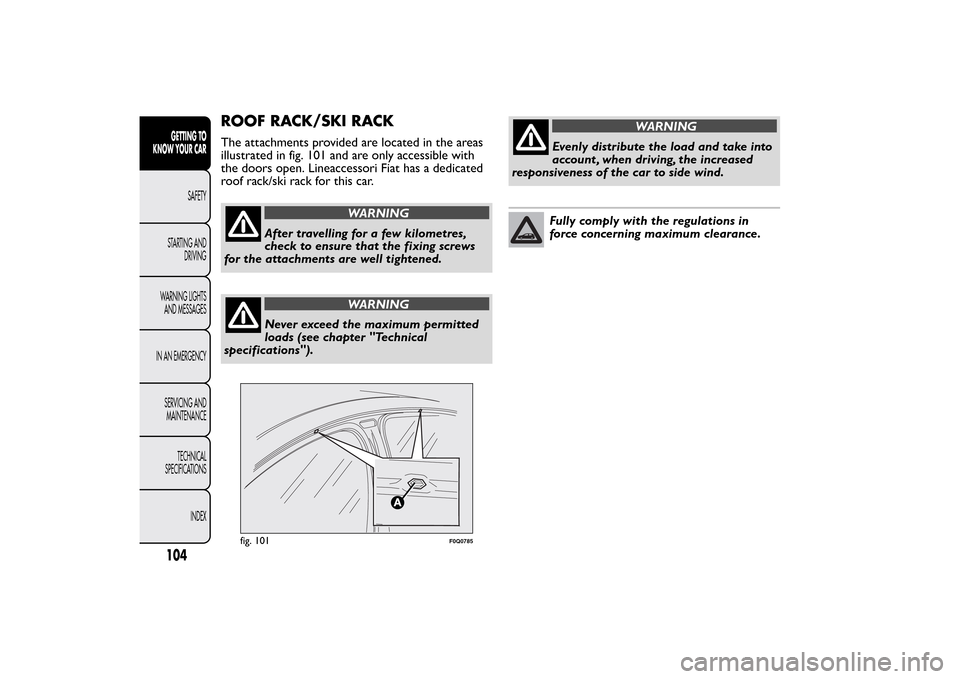
ROOF RACK/SKI RACKThe attachments provided are located in the areas
illustrated in fig. 101 and are only accessible with
the doors open. Lineaccessori Fiat has a dedicated
roof rack/ski rack for this car.
WARNING
After travelling for a few kilometres,
check to ensure that the fixing screws
for the attachments are well tightened.
WARNING
Never exceed the maximum permitted
loads (see chapter "Technical
specifications").
WARNING
Evenly distribute the load and take into
account , when driving, the increased
responsiveness of the car to side wind.Fully comply with the regulations in
force concerning maximum clearance.
fig. 101
F0Q0785
104GETTING TO
KNOW YOUR CAR
SAFETY
STARTING AND
DRIVING
WARNING LIGHTS
AND MESSAGES
IN AN EMERGENCY
SERVICING AND
MAINTENANCE
TECHNICAL
SPECIFICATIONS
INDEX
Page 154 of 299
SIDE AIRBAGS (Side bag - Window
bag)The car is fitted with front side bags for driver and
passenger, protecting the chest/pelvis, and window
bags for protecting front and rear passengers’
heads.
Side airbags protect occupants from side impacts of
medium/high severity by placing the bag between
the occupant and the internal parts of the side
structure of the car.
Non-activation of side bags in other types of
collisions (frontal impacts, rear shunts, roll-overs,
etc...) is not an indication of system malfunction.
In the event of a side impact, an electronic control
unit triggers the inflation of the bag if required.
The cushion immediately inflates, placing itself
between the occupant's body and structures that
could cause injuries. Immediately after, the cushion
deflates.
Side bags are not a replacement of, but rather a
complement to, seat belts, which you are
recommended to wear at all times, as specified by
law in Europe and most non-European countries.
SIDE BAGS
(for versions/markets, where provided)
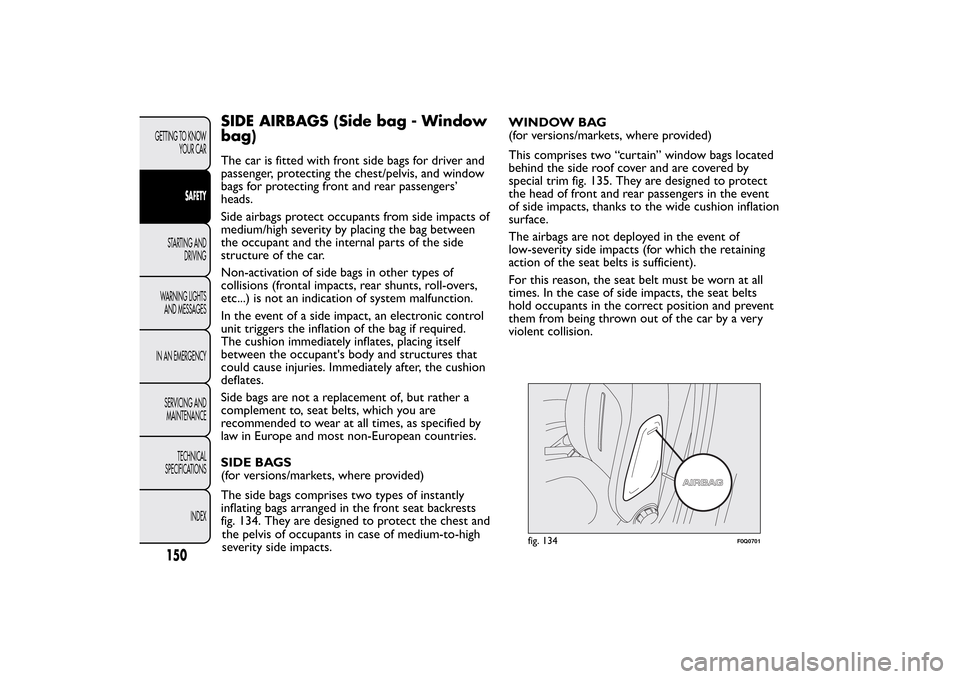
The side bags comprises two types of instantly
inflating bags arranged in the front seat backrests
fig. 134. They are designed to protect the chest and
the pelvis of occupants in case of medium-to-high
severity side impacts.WINDOW BAG
(for versions/markets, where provided)
This comprises two “curtain” window bags located
behind the side roof cover and are covered by
special trim fig. 135. They are designed to protect
the head of front and rear passengers in the event
of side impacts, thanks to the wide cushion inflation
surface.
The airbags are not deployed in the event of
low-severity side impacts (for which the retaining
action of the seat belts is sufficient).
For this reason, the seat belt must be worn at all
times. In the case of side impacts, the seat belts
hold occupants in the correct position and prevent
them from being thrown out of the car by a very
violent collision.
fig. 134
F0Q0701
150GETTING TO KNOW
YOUR CAR
SAFETY
STARTING AND
DRIVING
WARNING LIGHTS
AND MESSAGES
IN AN EMERGENCY
SERVICING AND
MAINTENANCE
TECHNICAL
SPECIFICATIONS
INDEX
Page 163 of 299
WARNING
Press the clutch pedal fully to change
gears correctly. It is therefore essential
that there is nothing under the pedals: make
sure the mats are lying flat and do not get
in the way of the pedals.Do not drive with your hand resting on
the gear lever as the force exerted,
even if slight , could lead over time to
premature wear on the gearbox internal
components
FUEL SAVINGSHere are some useful tips to save fuel and minimise
harmful emissions of CO
2and other pollutants
(nitric oxides, unburnt hydrocarbons, fine dusts
etc…).
GENERAL CONSIDERATIONS
The general factors that affect fuel consumption are
listed below.
Car maintenance
Have checks and adjustments carried out in
accordance with the “Scheduled Servicing Plan”.
Ty r e s
Check the pressure of the tyres routinely at an
interval of no more than 4 weeks: if the pressure is
too low, consumption levels increase as resistance
to rolling is higher.
Unnecessary loads
Do not travel with an overloaded boot. The weight
of the car (especially when driving in town) and
its ride greatly affects consumption and stability.
Roof rack/ski rack
Remove the roof rack or the ski rack from the roof
after use. These accessories lower aerodynamic
penetration and adversely affect consumption
159GETTING TO KNOW
YOUR CAR
SAFETYSTARTING AND
DRIVINGWARNING LIGHTS
AND MESSAGES
IN AN EMERGENCY
SERVICING AND
MAINTENANCE
TECHNICAL
SPECIFICATIONS
INDEX
Page 200 of 299
BulbsUse Type Power Re. Figure
Main beam headlights H1 55 W E
Longlife dipped headlights H1 55 W D
Dipped headlights with gas discharge bulbs (for
versions/markets, where provided)D2R 35 W F
Longlife front side lights W5W 5 W A
Front fog lights (for versions/markets, where provided) H11 55 W E
Front direction indicators PY24W 24W B
Side direction indicators WY5W 5 W A
Rear direction indicators R10W 10 W B
Rear side lights/rear fog lights P5/21W 5 W/21 W B
Rear side lights/break lights P5/21W 5 W/21 W B
Third brake light (additional brake light) W2.3W 2.3 W A
Reverse lights P21W 21 W B
Number plate lights W5W 5 W A
Front roof light C10W 2x10 W C
Rear roof light (for versions/markets, where provided) C10W 10 W C
Glove compartment light C5W 5W C
Luggage compartment roof light W5W 5W A
Courtesy mirror lights (for versions/markets, where
provided)C5W 5 W C
196GETTING TO KNOW
YOUR CAR
SAFETY
STARTING AND
DRIVING
WARNING LIGHTS
AND MESSAGES
IN AN
EMERGENCY
SERVICING AND
MAINTENANCE
TECHNICAL
SPECIFICATIONS
INDEX
Page 208 of 299
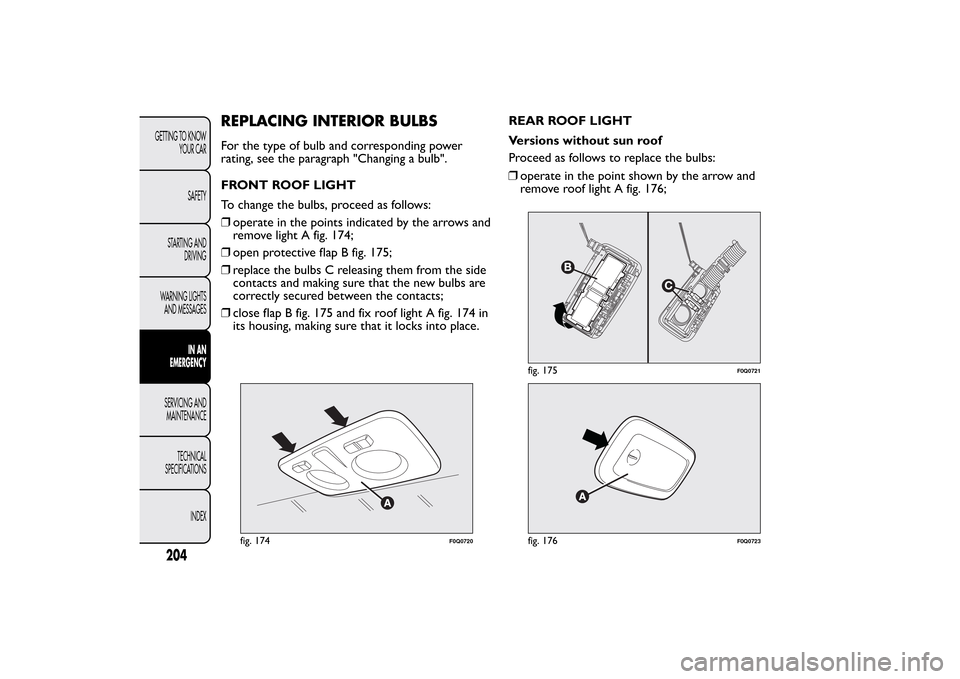
REPLACING INTERIOR BULBSFor the type of bulb and corresponding power
rating, see the paragraph "Changing a bulb".
FRONT ROOF LIGHT
To change the bulbs, proceed as follows:
❒operate in the points indicated by the arrows and
remove light A fig. 174;
❒open protective flap B fig. 175;
❒replace the bulbs C releasing them from the side
contacts and making sure that the new bulbs are
correctly secured between the contacts;
❒close flap B fig. 175 and fix roof light A fig. 174 in
its housing, making sure that it locks into place.REAR ROOF LIGHT
Versions without sun roof
Proceed as follows to replace the bulbs:
fig. 174
F0Q0720
fig. 175
F0Q0721
fig. 176
F0Q0723
204GETTING TO KNOW
YOUR CAR
SAFETY
STARTING AND
DRIVING
WARNING LIGHTS
AND MESSAGES
IN AN
EMERGENCY
SERVICING AND
MAINTENANCE
TECHNICAL
SPECIFICATIONS
INDEX
❒operate in the point shown by the arrow and
remove roof light A fig. 176;
Page 209 of 299
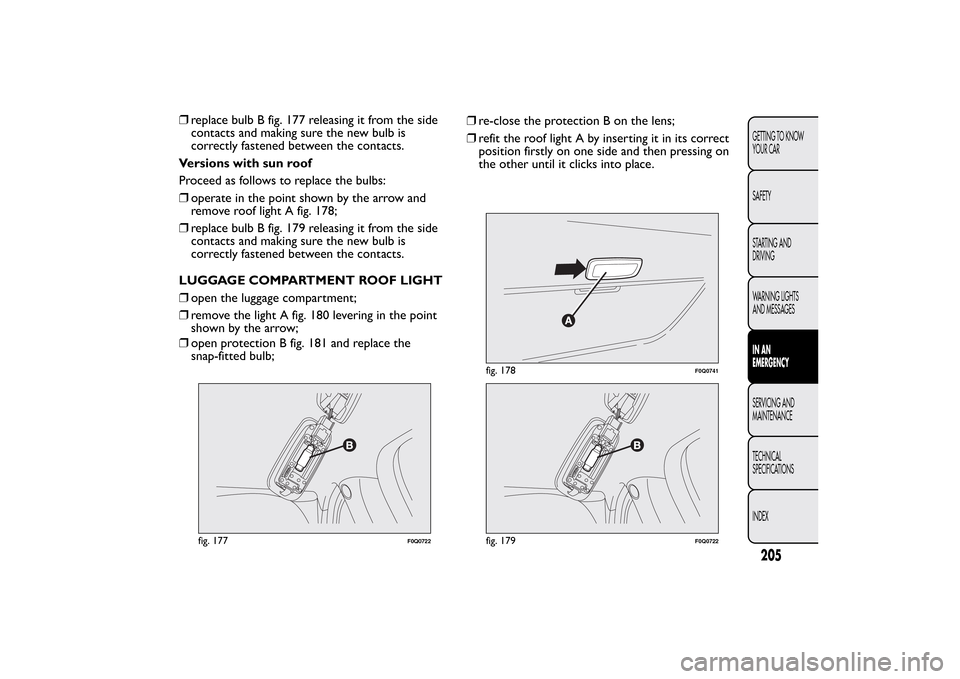
❒replace bulb B fig. 177 releasing it from the side
contacts and making sure the new bulb is
correctly fastened between the contacts.
Versions with sun roof
Proceed as follows to replace the bulbs:
❒operate in the point shown by the arrow and
remove roof light A fig. 178;
❒replace bulb B fig. 179 releasing it from the side
contacts and making sure the new bulb is
correctly fastened between the contacts.
LUGGAGE COMPARTMENT ROOF LIGHT
❒open the luggage compartment;
❒remove the light A fig. 180 levering in the point
shown by the arrow;
❒open protection B fig. 181 and replace the
snap-fitted bulb;❒re-close the protection B on the lens;
❒refit the roof light A by inserting it in its correct
position firstly on one side and then pressing on
the other until it clicks into place.
fig. 177
F0Q0722
fig. 178
F0Q0741
fig. 179
F0Q0722
205GETTING TO KNOW
YOUR CAR
SAFETY
STARTING AND
DRIVING
WARNING LIGHTS
AND MESSAGESIN AN
EMERGENCYSERVICING AND
MAINTENANCE
TECHNICAL
SPECIFICATIONS
INDEX
Page 210 of 299
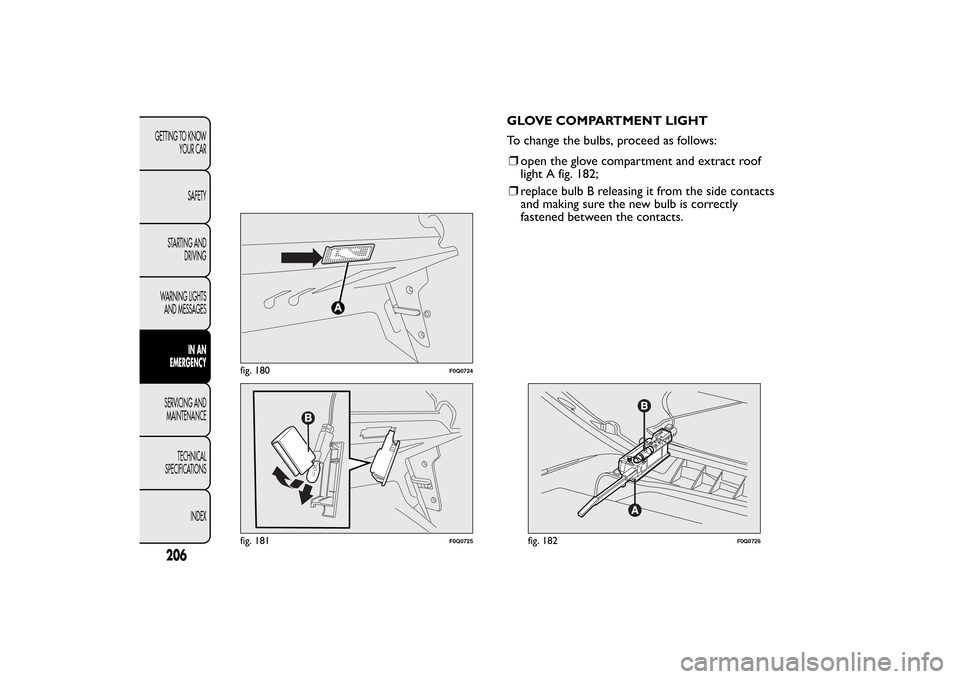
GLOVE COMPARTMENT LIGHT
To change the bulbs, proceed as follows:
❒open the glove compartment and extract roof
light A fig. 182;
❒replace bulb B releasing it from the side contacts
and making sure the new bulb is correctly
fastened between the contacts.
fig. 180
F0Q0724
fig. 181
F0Q0725
fig. 182
F0Q0726
206GETTING TO KNOW
YOUR CAR
SAFETY
STARTING AND
DRIVING
WARNING LIGHTS
AND MESSAGES
IN AN
EMERGENCY
SERVICING AND
MAINTENANCE
TECHNICAL
SPECIFICATIONS
INDEX
Page 219 of 299
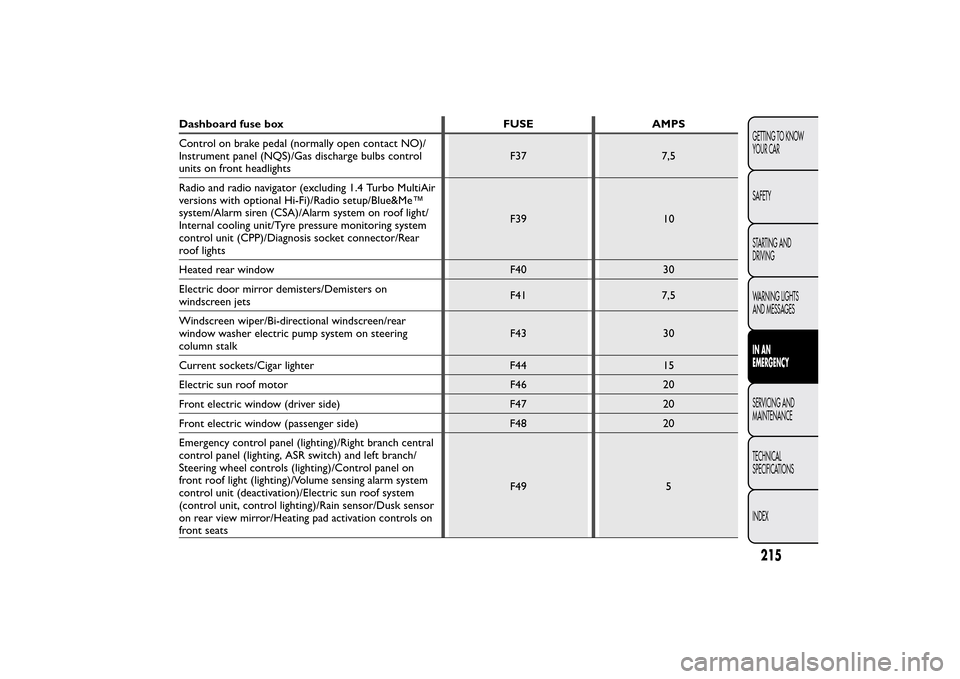
Dashboard fuse box FUSE AMPS
Control on brake pedal (normally open contact NO)/
Instrument panel (NQS)/Gas discharge bulbs control
units on front headlightsF37 7,5
Radio and radio navigator (excluding 1.4 Turbo MultiAir
versions with optional Hi-Fi)/Radio setup/Blue&Me™
system/Alarm siren (CSA)/Alarm system on roof light/
Internal cooling unit/Tyre pressure monitoring system
control unit (CPP)/Diagnosis socket connector/Rear
roof lightsF39 10
Heated rear window F40 30
Electric door mirror demisters/Demisters on
windscreen jetsF41 7,5
Windscreen wiper/Bi-directional windscreen/rear
window washer electric pump system on steering
column stalkF43 30
Current sockets/Cigar lighter F44 15
Electric sun roof motor F46 20
Front electric window (driver side) F47 20
Front electric window (passenger side) F48 20
Emergency control panel (lighting)/Right branch central
control panel (lighting, ASR switch) and left branch/
Steering wheel controls (lighting)/Control panel on
front roof light (lighting)/Volume sensing alarm system
control unit (deactivation)/Electric sun roof system
(control unit, control lighting)/Rain sensor/Dusk sensor
on rear view mirror/Heating pad activation controls on
front seatsF49 5
215GETTING TO KNOW
YOUR CAR
SAFETY
STARTING AND
DRIVING
WARNING LIGHTS
AND MESSAGESIN AN
EMERGENCYSERVICING AND
MAINTENANCE
TECHNICAL
SPECIFICATIONS
INDEX
Page 246 of 299
USEFUL ADVICE FOR EXTENDING THE
LIFE OF YOUR BATTERY
To avoid draining your battery and make it last
longer, observe the following instructions:
❒when you park the car, ensure that the doors,
tailgate, bonnet and flaps are closed properly,
to prevent any roof lights from remaining on
inside the passenger compartment;
❒switch off all roof lights inside the car: the car is
however equipped with a system which switches
the internal lights off automatically;
❒do not keep accessories (e.g. radio, hazard
warning lights, etc.) switched on for a long time
when the engine is not running;
❒before performing any operation on the electrical
system, disconnect the negative battery pole;
❒completely tighten the battery terminals.IMPORTANT If the charge level remains under 50%
for a long time, the battery is damaged by
sulphation, reducing its capacity and efficiency at
start-up.
The battery will also be more at risk of freezing
(this can happen as early as -10°C). Refer to the
paragraph "Car inactivity" in "Starting and driving" if
the car is left parked for a long time.
If after buying the car, you want to install electric
accessories which require permanent electrical
supply (alarm, etc.) or accessories influencing the
electrical supply requirements, contact a Fiat
Dealership whose qualified personnel, in addition to
suggesting the most suitable devices from
Lineaccessori Fiat, will evaluate the overall electrical
consumption, checking whether the car’s electric
system is capable of withstanding the load required,
or whether it should be integrated with a more
powerful battery.
Since these devices continue to consume energy
even when the engine is off, they gradually run
down the battery.
242GETTING TO KNOW
YOUR CAR
SAFETY
STARTING AND
DRIVING
WARNING LIGHTS
AND MESSAGES
IN AN EMERGENCYSERVICING AND
MAINTENANCE
TECHNICAL
SPECIFICATIONS
INDEX
Page 252 of 299
To correctly wash the vehicle, proceed as follows:
❒remove the aerial from the roof to prevent
damage to it if the car is washed in an automatic
system;
❒if high pressure jets or cleaners are used to wash
the vehicle, keep a distance of at least 40 cm
from the bodywork to avoid damage or
alteration. It should be remembered that the
build up of water can damage the car over a
period of time;
❒wash the body using a low pressure jet of water;
❒wipe a sponge with a slightly soapy solution
over the bodywork, frequently rinsing with
the sponge;
❒rinse well with water and dry with a jet of air or
a chamois leather.
Dry the less visible parts particularly carefully, such
as the door frames, bonnet and the headlight
frames, where water may stagnate more easily. The
car should not be taken to a closed area
immediately, but left outside so that residual water
can evaporate.
Do not wash the car after it has been left in the
sun or with the bonnet hot: this may alter the shine
of the paintwork.
Exterior plastic parts must be cleaned in the same
way as the rest of the car.Where possible, do not park under trees; the
resinous substance that many species release give
the paint a dull appearance and increase the
possibility of triggering rusting processes.
IMPORTANT Bird droppings must be washed off
immediately and thoroughly as the acid they contain
is particularly aggressive.
Detergents pollute the environment .
Therefore the engine compartment
should be washed in areas equipped for
collecting and purifying the liquid used in the
washing process.
248GETTING TO KNOW
YOUR CAR
SAFETY
STARTING AND
DRIVING
WARNING LIGHTS
AND MESSAGES
IN AN EMERGENCYSERVICING AND
MAINTENANCE
TECHNICAL
SPECIFICATIONS
INDEX