steering wheel FIAT BRAVO 2012 2.G User Guide
[x] Cancel search | Manufacturer: FIAT, Model Year: 2012, Model line: BRAVO, Model: FIAT BRAVO 2012 2.GPages: 299, PDF Size: 5.81 MB
Page 126 of 299
send the relative indications to the instrument
panel only after the vehicle has been in motion for a
short time.
Tyre pressure must be checked with tyres rested
and cold. Should it become necessary for whatever
reason to check pressure with warm tyres, do
not reduce pressure even though it is higher than
the prescribed value, but repeat the check when
tyres are cold (see "Wheels" in the "Technical data"
chapter).
The TPMS cannot indicate sudden tyre pressure
drops (for example when a tyre bursts). In this
case, stop the car, braking with caution and avoiding
abrupt steering.
Strong radio-frequency interference could inhibit
the correct operation of the TPMS. This condition
is indicated to the driver by the
warning light
or the symbol lighting up on the instrument panel
together with a message on the display. The
message will disappear automatically as soon as the
interference ceases to affect the system.
The TPMS requires the use of specific equipment.
Contact a Fiat Dealership to find out which
accessories are compatible with the system
(wheels, hub caps, etc.). Using other accessories
may hinder the normal operation of the system.
Given the valve unique specifications, only use
Fiat-approved sealers to repair the tyres. The use of
other sealers may affect the normal operation of
the system.If the vehicle is fitted with TPMS, when a tyre is
removed, it is advisable to replace the rubber
gasket for the valve as well as the ring nut fixing the
sensor. Have this operation performed at a Fiat
Dealership.
If the "punctured tyre" indication persists on the
instrument panel after the initial conditions have
been restored using the Fix&Go Automatic tyre
repair kit, contact a Fiat Dealership.
Changes in outside temperature may cause tyre
pressures to vary. The TPMS may temporarily
indicate insufficient pressure. In this case, check the
tyre pressure when cold and, if necessary, restore
the inflation values.
If the vehicle is fitted with TPMS, tyre and/or rims
fitting/removal operations require specific
precautions. To avoid damaging the sensors or
fitting them incorrectly, tyre and/or rims
fitting/removal operations should be carried out
only by specialists. Contact a Fiat Dealership.
122GETTING TO
KNOW YOUR CAR
SAFETY
STARTING AND
DRIVING
WARNING LIGHTS
AND MESSAGES
IN AN EMERGENCY
SERVICING AND
MAINTENANCE
TECHNICAL
SPECIFICATIONS
INDEX
Page 151 of 299
FRONT AIRBAGSThe car is fitted with front airbags for the driver
and the passenger, and with a knee bag on the
driver's side (for versions/markets, where
provided).
The front driver/passenger airbags and the driver's
knee bag (for versions/markets, where provided)
have been designed to protect the front seat
occupants in the event of frontal impacts of
medium/high severity, by placing the bag between
the occupant and the steering wheel or dashboard.
Therefore non-deployment in other types of
impacts (side impacts, rear shunts, roll-overs, etc.)
does not indicate a system malfunction.
In the event of a frontal impact, an electronic
control unit triggers the inflation of the bags if
required. The cushions immediately inflate, placing
themselves between the front occupants' bodies
and structures that could cause injuries.
Immediately after, the cushions deflate.
The front driver/passenger airbags and the driver's
knee bag (for versions/markets, where provided)
are not a replacement for, but rather complement
the use of, seat belts, which should always be worn,
as specified by law in Europe and most non-
European countries.
In the event of an impact, those not wearing a seat
belt will move forward and come into contact
with the bag which is still inflating. The protection
offered by the bag is compromised in these
circumstances.Front airbags may not be activated in the following
situations:
❒frontal impacts against highly deformable objects
not involving the front surface of the car (e.g.
wing collision against guard rail, etc.);
❒car wedging under other vehicles or protective
barriers (e.g. trucks or guard rails);
they may not provide any additional protection
compared with seat belts, so their deployment
would be inappropriate. In these cases, non-
deployment does not indicate a system malfunction.
WARNING
Do not apply stickers or other objects
to the steering wheel, passenger side
airbag cover or upper side upholstery. Do not
place objects on the passenger side dashboard
because these could interfere with the correct
opening of the passenger airbag and cause
injury to occupants.
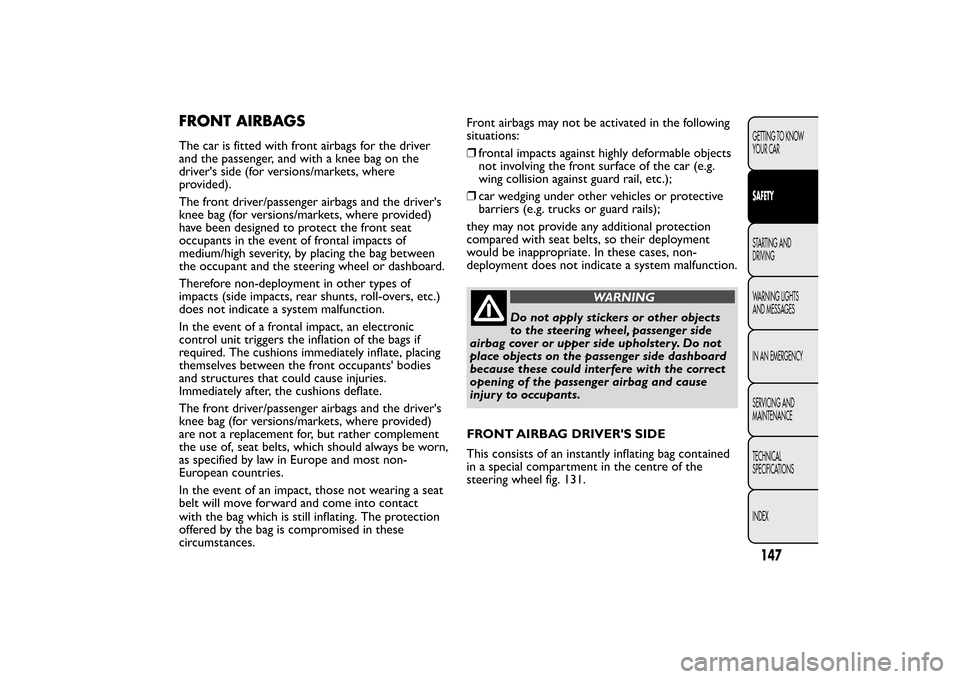
FRONT AIRBAG DRIVER'S SIDE
This consists of an instantly inflating bag contained
in a special compartment in the centre of the
steering wheel fig. 131.
147GETTING TO KNOW
YOUR CARSAFETYSTARTING AND
DRIVING
WARNING LIGHTS
AND MESSAGES
IN AN EMERGENCY
SERVICING AND
MAINTENANCE
TECHNICAL
SPECIFICATIONS
INDEX
Page 152 of 299
WARNING
Always drive with both hands on the
steering wheel so that , if the airbags
must be deployed, they may do so freely. Do
not drive with your body bent forward. Keep
your back straight against the backrest .
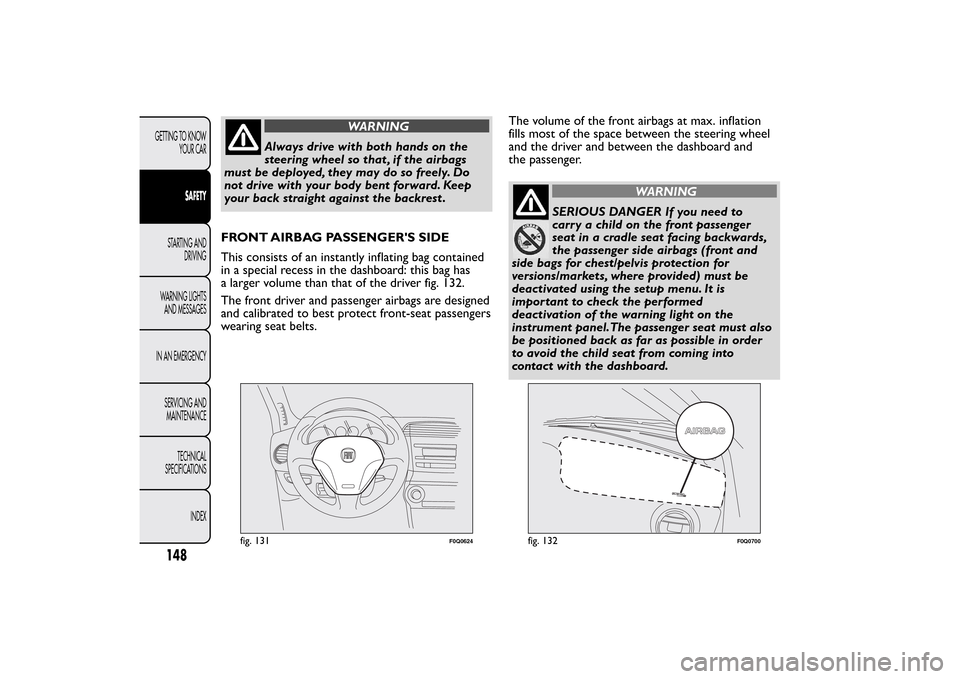
FRONT AIRBAG PASSENGER'S SIDE
This consists of an instantly inflating bag contained
in a special recess in the dashboard: this bag has
a larger volume than that of the driver fig. 132.
The front driver and passenger airbags are designed
and calibrated to best protect front-seat passengers
wearing seat belts.The volume of the front airbags at max. inflation
fills most of the space between the steering wheel
and the driver and between the dashboard and
the passenger.
WARNING
SERIOUS DANGER If you need to
carr y a child on the front passenger
seat in a cradle seat facing backwards,
the passenger side airbags (front and
side bags for chest/pelvis protection for
versions/markets, where provided) must be
deactivated using the setup menu. It is
important to check the performed
deactivation of the warning light on the
instrument panel.The passenger seat must also
be positioned back as far as possible in order
to avoid the child seat from coming into
contact with the dashboard.
fig. 131
F0Q0624
fig. 132
F0Q0700
148GETTING TO KNOW
YOUR CAR
SAFETY
STARTING AND
DRIVING
WARNING LIGHTS
AND MESSAGES
IN AN EMERGENCY
SERVICING AND
MAINTENANCE
TECHNICAL
SPECIFICATIONS
INDEX
Page 153 of 299
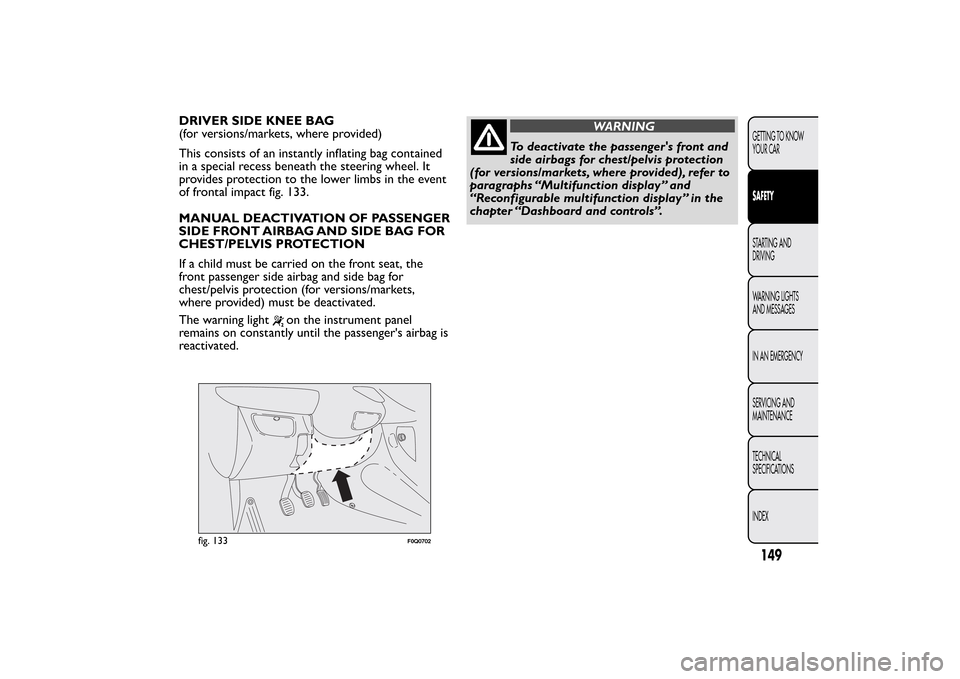
DRIVER SIDE KNEE BAG
(for versions/markets, where provided)
This consists of an instantly inflating bag contained
in a special recess beneath the steering wheel. It
provides protection to the lower limbs in the event
of frontal impact fig. 133.
MANUAL DEACTIVATION OF PASSENGER
SIDE FRONT AIRBAG AND SIDE BAG FOR
CHEST/PELVIS PROTECTION
If a child must be carried on the front seat, the
front passenger side airbag and side bag for
chest/pelvis protection (for versions/markets,
where provided) must be deactivated.
The warning light
on the instrument panel
remains on constantly until the passenger's airbag is
reactivated.
WARNING
To deactivate the passenger's front and
side airbags for chest/pelvis protection
(for versions/markets, where provided), refer to
paragraphs “Multifunction display” and
“Reconfigurable multifunction display” in the
chapter “Dashboard and controls”.
AU
TO
fig. 133
F0Q0702
149GETTING TO KNOW
YOUR CARSAFETYSTARTING AND
DRIVING
WARNING LIGHTS
AND MESSAGES
IN AN EMERGENCY
SERVICING AND
MAINTENANCE
TECHNICAL
SPECIFICATIONS
INDEX
Page 158 of 299
STARTING AND DRIVING
STARTING THE ENGINEThe car is fitted with an electronic engine lock
device: if the engine fails to start, see the paragraph
“The Fiat CODE system” in the section “Knowing
your car”.
The engine may be noisier during the first few
seconds of operation, especially after a long period
of inactivity. This characteristic feature of the
hydraulic tappet system does not compromise
functionality or reliability: the system chosen for
your car was designed to limit maintenance
interventions.
Engine starting is guaranteed to -18°C (Italy and
central Europe) and -20°C (Northern Europe).
We recommend that during the initial
period you do not demand to full
performance from the car (e.g. excessive
acceleration, long journeys at top speed, sharp
braking etc .).When the engine is switched off never
leave the key turned to MAR to prevent
useless current absorption from draining
the battery.
WARNING
It is dangerous to have the engine
running indoors.The engine consumes
oxygen and engine exhaust contains carbon
dioxide, carbon monoxide and other toxic
gasses.
WARNING
Remember that the brake servo and
power steering are not operational
until the engine has been started, therefore
much effort than usual is required on the
brake pedal and steering wheel.
STARTING PROCEDURE FOR PETROL
VERSIONS
Proceed as follows:
❒ensure that the handbrake is up;
❒put the gear lever into neutral;
❒press the clutch pedal down to the floor without
touching the accelerator;
❒turn the ignition key to AVV and release it as
soon as the engine starts.
154GETTING TO KNOW
YOUR CAR
SAFETYSTARTING AND
DRIVINGWARNING LIGHTS
AND MESSAGES
IN AN EMERGENCY
SERVICING AND
MAINTENANCE
TECHNICAL
SPECIFICATIONS
INDEX
Page 174 of 299
“DUALDRIVE” ELECTRIC POWER
STEERING FAILURE (red)
This warning light switches on when the ignition
key is turned to MAR-ON, but it should switch off
after a few seconds. If the warning light (or symbol
on the display) remains on, you will not have
steering assistance and the effort required to
operate the steering wheel will be increased;
steering is, however, possible. In this case, contact a
Fiat Dealership. The display shows the dedicated
message.“DUALDRIVE” ELECTRIC POWER
STEERING ACTIVATION (green
warning light or symbol on display)
The warning light switches on (or the word "CITY"
appears on the display) when the "Dualdrive"
electric power steering system is activated
by pressing the relevant control button. If the
button is pressed again the word CITY goes out.
START&STOP SYSTEM
ACTIVATION/DEACTIVATION
(for versions/markets, where provided)
Start&Stop system activation
Start&Stop system activation is signalled by a
message and a symbol
on the display. In this
condition, the LED on the button
is off.
Start&Stop system deactivation
Versions with reconfigurable multifunction display: a
symbol,
, appears on the display when the
Start&Stop system is deactivated. The LED on the
buttonswitches on when the system is
deactivated.Start&Stop SYSTEM FAILURE
(versions with reconfigurable multifunction display)
The
symbol and a message appear on the display
when a failure in the Start&Stop system is detected.
In this case, contact a Fiat Dealership.
170GETTING TO KNOW
YOUR CAR
SAFETY
STARTING AND
DRIVINGWARNING LIGHTS
AND MESSAGESIN AN EMERGENCY
SERVICING AND
MAINTENANCE
TECHNICAL
SPECIFICATIONS
INDEX
Page 181 of 299
TPMS FAILURE
(for versions/markets, where provided)
On some versions, the display shows a message and
an amber symbol when a tyre pressure monitoring
system (TPMS) fault is detected: in this case,
contact a Fiat Dealership as soon as possible.
Should one or more wheels be fitted without
sensors, the display will show a warning message
until initial conditions are restored.INSUFFICIENT TYRE PRESSURE
(amber-red) / CHECK TYRE
PRESSURE (amber) / TYRE
PRESSURE UNSUITABLE FOR
SPEED (amber)
(for versions/markets, where provided)
This warning light switches on when the ignition
key is turned to MAR-ON, but it should switch off
after a few seconds.
Insufficient tyre pressure
The warning light (amber), or symbol in the display
(red), switch on when the inflation pressure of
one or more tyres falls below a preset level. In this
way the TPMS warns the driver that one or more
tyres may be dangerously flat and liable to
puncture.IMPORTANT Do not continue driving with one or
more flat tyres as handling may be compromised.
Stop the car, avoiding harsh braking and steering
manoeuvres. Replace the wheel immediately with
the space-saver wheel (for versions/markets, where
provided) or carry out a repair using the dedicated
kit (see “Changing a wheel” in the "In an
emergency" chapter) and contact a Fiat Dealership
as soon as possible.
Check tyre pressure
This warning light (or symbol in the display)
switches on in the instrument panel to indicate that
the tyre pressure is below the value recommended
to guarantee long tyre life and low fuel
consumption. It may also indicate a slow loss of
pressure.
Should two or more tyres be flat, the display will
show the indications corresponding to each tyre in
sequence.
Restore correct tyre pressures as soon as possible
(see “Cold tyre pressures” in the “Technical data”
chapter).
Tyre pressure unsuitable for speed
Should you need to travel at a speed higher than
160 km/h, inflate the tyres to the pressures
specified in “Tyre pressures” paragraph.
If the TPMS system (for versions/markets where
provided) detects that the pressure of one or more
tyres is unsuitable for the current speed, the
177GETTING TO KNOW
YOUR CAR
SAFETY
STARTING AND
DRIVINGWARNING LIGHTS
AND MESSAGESIN AN EMERGENCY
SERVICING AND
MAINTENANCE
TECHNICAL
SPECIFICATIONS
INDEX
Page 186 of 299
WARNING
This procedure must be performed by
exper t personnel because incorrect
actions could cause electrical discharge of
considerable intensity. Furthermore, battery
fluid is poisonous and corrosive: avoid contact
with skin and eyes. Keep naked flames and
lighted cigarettes away from the battery and
do not cause sparks.
BUMP STARTING
Never bump start the engine by pushing, towing or
coasting downhill.
IMPORTANT Remember that the brake servo and
electrical power steering system are not active until
the engine is started. A much greater effort will
therefore be required to use the brake pedal or
turn the steering wheel.
CHANGING A WHEELGENERAL INSTRUCTIONS
The car is equipped with the “Fix&Go Automatic
Kit”: see paragraph “Fix&Go Automatic Kit” for
instructions on how to use this device. As an
alternative to the “Fix&Go Automatic Kit” the car
may be equipped with a space-saver wheel: see
the instructions on the following pages for changing
the wheel.
WARNING
The space-saver wheel (for versions/
markets, where provided) is specific to
your car, do not use it on other models, or use
the space-saver wheel of other models on
your car.The space-saver wheel must only be
used in case of emergency. It must only be
used for the distance necessary to reach a
service point and the car speed must not
exceed 80 km/h.The space-saver wheel has an
orange sticker that summarises the main
cautions for use and limitations. Never remove
or cover the sticker.The following information
is provided in four languages on the sticker:
"Impor tant! For temporar y use only! 80 km/h
max.! Replace with a standard wheel as soon
as possible. Never cover this indication". Never
apply a hub cap on a space-saver wheel.
182GETTING TO KNOW
YOUR CAR
SAFETY
STARTING AND
DRIVING
WARNING LIGHTS
AND MESSAGES
IN AN
EMERGENCY
SERVICING AND
MAINTENANCE
TECHNICAL
SPECIFICATIONS
INDEX
Page 219 of 299
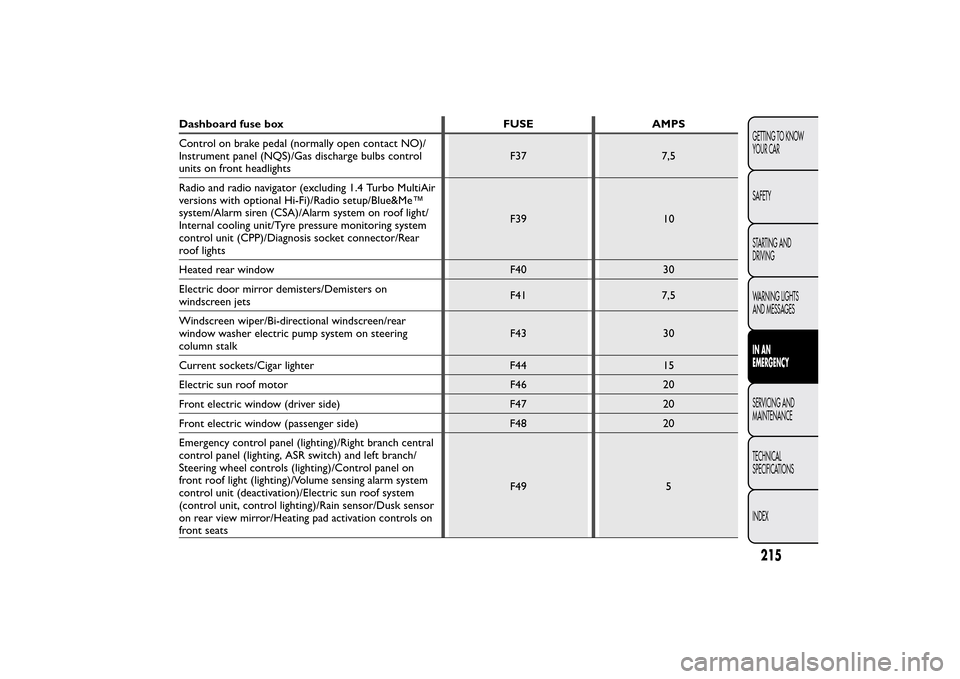
Dashboard fuse box FUSE AMPS
Control on brake pedal (normally open contact NO)/
Instrument panel (NQS)/Gas discharge bulbs control
units on front headlightsF37 7,5
Radio and radio navigator (excluding 1.4 Turbo MultiAir
versions with optional Hi-Fi)/Radio setup/Blue&Me™
system/Alarm siren (CSA)/Alarm system on roof light/
Internal cooling unit/Tyre pressure monitoring system
control unit (CPP)/Diagnosis socket connector/Rear
roof lightsF39 10
Heated rear window F40 30
Electric door mirror demisters/Demisters on
windscreen jetsF41 7,5
Windscreen wiper/Bi-directional windscreen/rear
window washer electric pump system on steering
column stalkF43 30
Current sockets/Cigar lighter F44 15
Electric sun roof motor F46 20
Front electric window (driver side) F47 20
Front electric window (passenger side) F48 20
Emergency control panel (lighting)/Right branch central
control panel (lighting, ASR switch) and left branch/
Steering wheel controls (lighting)/Control panel on
front roof light (lighting)/Volume sensing alarm system
control unit (deactivation)/Electric sun roof system
(control unit, control lighting)/Rain sensor/Dusk sensor
on rear view mirror/Heating pad activation controls on
front seatsF49 5
215GETTING TO KNOW
YOUR CAR
SAFETY
STARTING AND
DRIVING
WARNING LIGHTS
AND MESSAGESIN AN
EMERGENCYSERVICING AND
MAINTENANCE
TECHNICAL
SPECIFICATIONS
INDEX
Page 226 of 299
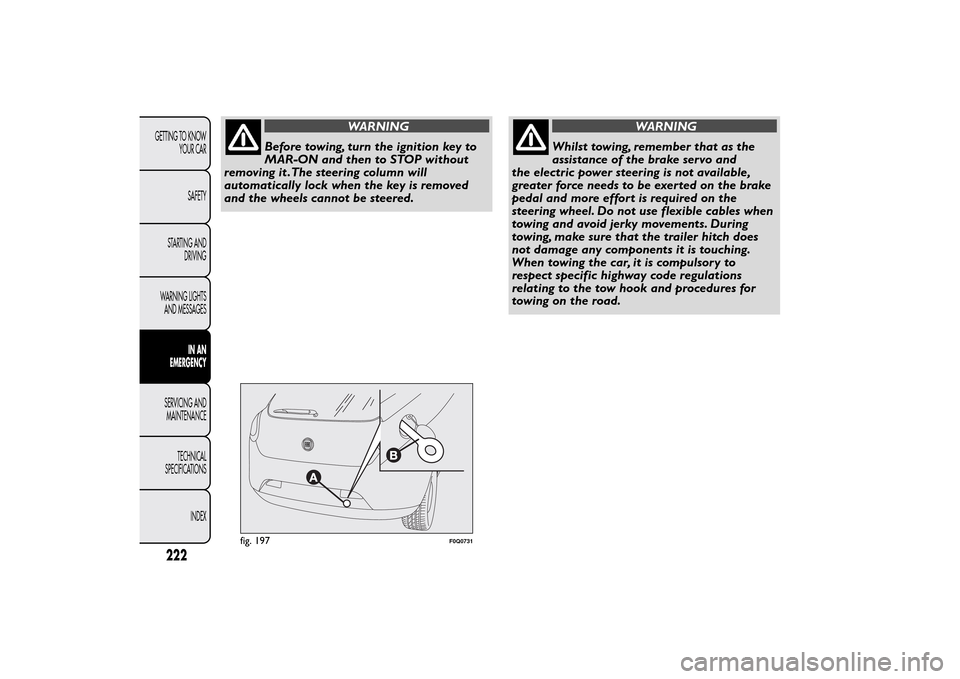
WARNING
Before towing, turn the ignition key to
MAR-ON and then to STOP without
removing it .The steering column will
automatically lock when the key is removed
and the wheels cannot be steered.
WARNING
Whilst towing, remember that as the
assistance of the brake servo and
the electric power steering is not available,
greater force needs to be exerted on the brake
pedal and more effort is required on the
steering wheel. Do not use flexible cables when
towing and avoid jerky movements. During
towing, make sure that the trailer hitch does
not damage any components it is touching.
When towing the car, it is compulsor y to
respect specific highway code regulations
relating to the tow hook and procedures for
towing on the road.
fig. 197
F0Q0731
222GETTING TO KNOW
YOUR CAR
SAFETY
STARTING AND
DRIVING
WARNING LIGHTS
AND MESSAGES
IN AN
EMERGENCY
SERVICING AND
MAINTENANCE
TECHNICAL
SPECIFICATIONS
INDEX