tyre pressure FIAT BRAVO 2012 2.G User Guide
[x] Cancel search | Manufacturer: FIAT, Model Year: 2012, Model line: BRAVO, Model: FIAT BRAVO 2012 2.GPages: 299, PDF Size: 5.81 MB
Page 187 of 299
WARNING
Alert other drivers that the car is
stationary in compliance with local
regulations: hazard warning lights, warning
triangle, etc . Any passengers on board should
leave the car, especially if it is heavily laden.
Passengers should stay away from on-coming
traffic while the wheel is being changed. On
hills or uneven roads, use chocks or
appropriate objects to block the wheels of the
car.
WARNING
The car's driving characteristics will be
modified with the space-saver wheel
fitted. Avoid sudden starting or stopping, sharp
or fast turns.The total life of a space-saver
wheel is approximately 3000 km, after which it
must be replaced by another wheel of the
same type. Never install a traditional tyre on a
rim designed to be used as a space-saver
wheel. Have the tyre repaired and refitted as
soon as possible. Using two or more space-
saver wheels at the same time is forbidden. Do
not grease the threads of bolts before fitting
them: they might slip out .
WARNING
The jack provided is only intended to
be used for replacing wheels on the car
with which it is supplied, or on same-model
vehicles. Never use the jack for other
purposes, such as lifting other car models.
Never use it for repair operations under the
car. Incorrectly positioning the jack may cause
the car to fall. Do not use the jack for loads
higher than the one shown on its label. Never
install snow chains on the space-saver wheel; if
a front tyre (driving wheel) is punctured and
you need to use snow chains, use a standard
wheel from the rear axle and install the
space-saver wheel on the rear axle. In this
way, with two normal drive wheels, it is
possible to use snow chains.
WARNING
Fit the hub cap correctly to prevent it
from coming free in motion. Never
tamper with the inflating valve. Never
introduce tools of any kind between rim and
tyre. Check tyre and space-saver wheel
pressures regularly, referring to the values
shown in the "Technical data" chapter.
183GETTING TO KNOW
YOUR CAR
SAFETY
STARTING AND
DRIVING
WARNING LIGHTS
AND MESSAGESIN AN
EMERGENCYSERVICING AND
MAINTENANCE
TECHNICAL
SPECIFICATIONS
INDEX
Page 193 of 299
The quick tyre repair kit contains fig. 150:
❒a cylinder A containing sealing fluid and fitted
with: filling tube B and adhesive label C with
the wording “max. 80 km/h” to be placed in a
clearly visible position (e.g. on the dashboard)
after repairing the tyre;
❒instruction booklet fig. 151, to be used for
prompt and correct use of the quick repair kit
and then to be handed to the personnel charged
with handling the tyre treated with the tyre
repair kit;
❒a compressor D including a pressure gauge and
connections, found in the compartment;
❒a pair of protective gloves located in the side
compartment of the compressor;
❒adapters for inflating different elements.
WARNING
Give the instruction booklet to the
personnel charged with handling the
treated tyre.In the event of a puncture caused by
foreign bodies, the kit may be used
to repair tyres showing damages on the
track or shoulder up to max 4 mm diameter.
WARNING
Holes and damage on the tyre side
walls cannot be repaired. Do not use
the quick repair kit if the tyre is damaged as a
result of driving with it deflated.
WARNING
If the wheel rim has been damaged
(bent so as to cause air to leak), the
tyre may not be repaired. Do not remove
foreign bodies (screws or nails) from the tyre.
IMPORTANT INFORMATION:
The sealing fluid of the quick tyre repair kit is
effective at external temperatures of between -20
°C and +50 °C.
WARNING
Never operate the compressor for
longer than 20 consecutive minutes.
Risk of overheating.Tyres repaired with the
quick tyre repair kit must only be used
temporarily.
189GETTING TO KNOW
YOUR CAR
SAFETY
STARTING AND
DRIVING
WARNING LIGHTS
AND MESSAGESIN AN
EMERGENCYSERVICING AND
MAINTENANCE
TECHNICAL
SPECIFICATIONS
INDEX
Page 194 of 299
Dispose of the cylinder and the sealing
fluid properly. Have the sealing fluid and
the cylinder disposed of in compliance
with national and local regulations.
WARNING
The cylinder contains ethylene glycol
and latex: it may cause an allergic
reaction. It is harmful if swallowed. It is irritant
for the eyes in case of contact . May cause
irritation if inhaled or on contact . Avoid
contact with the eyes, skin and clothes. In the
event of contact , rinse immediately with plenty
of water. If ingested, do not induce vomiting.
Rinse out your mouth, drink large quantities of
water and seek immediate medical attention.
Keep away from children.The product must
not be used by asthmatics. Do not inhale the
vapours during insertion and suction. Call a
doctor immediately if allergic reactions are
noted. Store the cylinder in the specific
compartment , away from sources of heat .The
sealing fluid has an expiry date. Replace the
cylinder containing out-of-date sealing fluid.INFLATING PROCEDURE
WARNING
Wear the protective gloves provided
with the kit.
Proceed as follows:
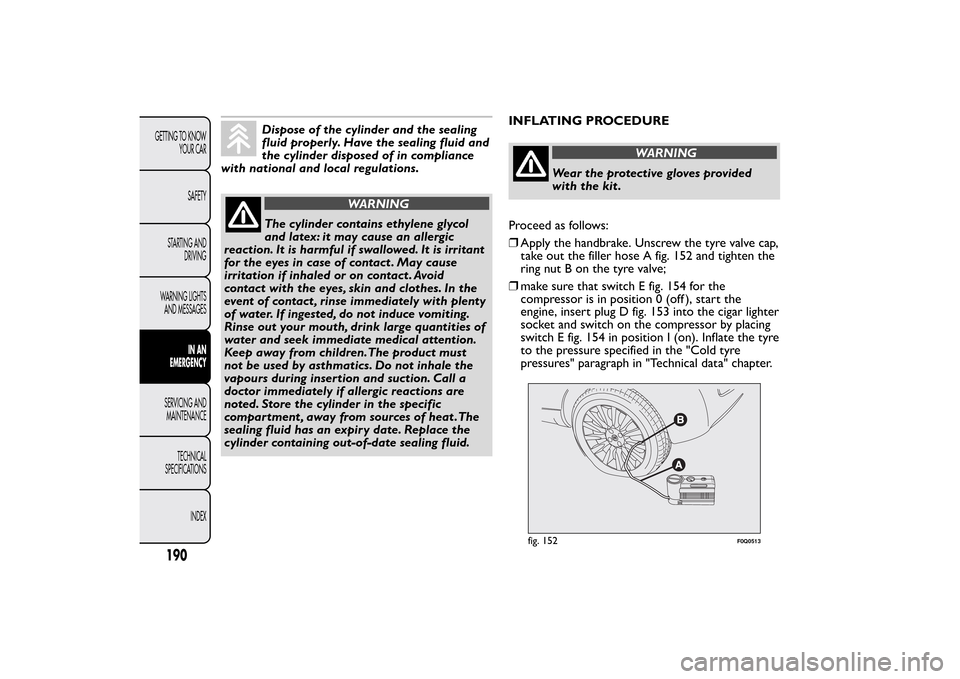
❒Apply the handbrake. Unscrew the tyre valve cap,
take out the filler hose A fig. 152 and tighten the
ring nut B on the tyre valve;
❒make sure that switch E fig. 154 for the
compressor is in position 0 (off ), start the
engine, insert plug D fig. 153 into the cigar lighter
socket and switch on the compressor by placing
switch E fig. 154 in position I (on). Inflate the tyre
to the pressure specified in the "Cold tyre
pressures" paragraph in "Technical data" chapter.
fig. 152
F0Q0513
190GETTING TO KNOW
YOUR CAR
SAFETY
STARTING AND
DRIVING
WARNING LIGHTS
AND MESSAGES
IN AN
EMERGENCY
SERVICING AND
MAINTENANCE
TECHNICAL
SPECIFICATIONS
INDEX
Page 195 of 299
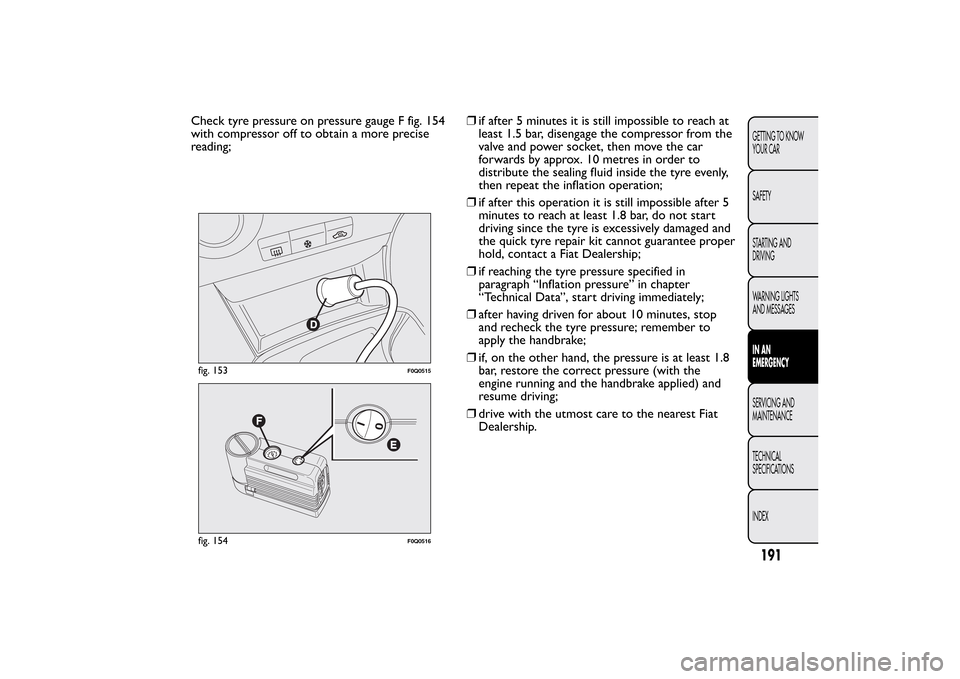
Check tyre pressure on pressure gauge F fig. 154
with compressor off to obtain a more precise
reading;❒if after 5 minutes it is still impossible to reach at
least 1.5 bar, disengage the compressor from the
valve and power socket, then move the car
forwards by approx. 10 metres in order to
distribute the sealing fluid inside the tyre evenly,
then repeat the inflation operation;
❒if after this operation it is still impossible after 5
minutes to reach at least 1.8 bar, do not start
driving since the tyre is excessively damaged and
the quick tyre repair kit cannot guarantee proper
hold, contact a Fiat Dealership;
❒if reaching the tyre pressure specified in
paragraph “Inflation pressure” in chapter
“Technical Data”, start driving immediately;
❒after having driven for about 10 minutes, stop
and recheck the tyre pressure; remember to
apply the handbrake;
❒if, on the other hand, the pressure is at least 1.8
bar, restore the correct pressure (with the
engine running and the handbrake applied) and
resume driving;
❒drive with the utmost care to the nearest Fiat
Dealership.fig. 153
F0Q0515
fig. 154
F0Q0516
191GETTING TO KNOW
YOUR CAR
SAFETY
STARTING AND
DRIVING
WARNING LIGHTS
AND MESSAGESIN AN
EMERGENCYSERVICING AND
MAINTENANCE
TECHNICAL
SPECIFICATIONS
INDEX
Page 196 of 299
WARNING
Apply the adhesive label where it can
be easily seen by the driver as a
reminder that the tyre has been treated with
the quick repair kit . Drive carefully,
particularly on bends. Do not exceed 80 km/h.
Do not accelerate or brake suddenly.
WARNING
If the pressure has fallen below 1.8
bars, do not drive any further: the
Fix&Go Automatic quick tyre repair kit cannot
guarantee proper hold because the tyre is
too damaged. Contact a Fiat Dealership.
WARNING
You must inform the dealership that
the tyre has been repaired using the
quick tyre repair kit . Give the instruction
booklet to the personnel charged with
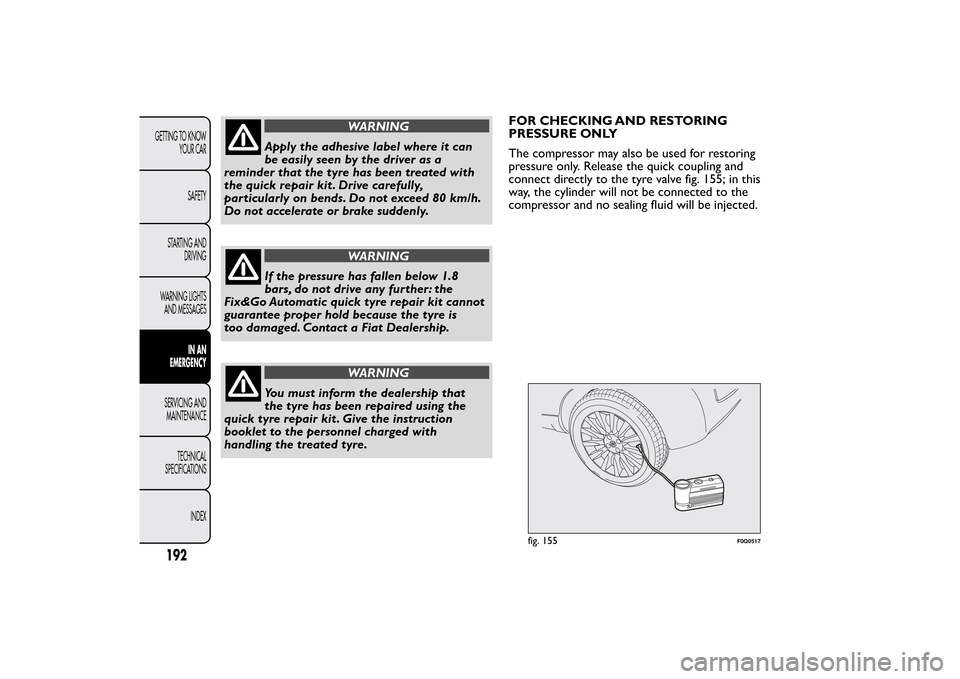
handling the treated tyre.FOR CHECKING AND RESTORING
PRESSURE ONLY
The compressor may also be used for restoring
pressure only. Release the quick coupling and
connect directly to the tyre valve fig. 155; in this
way, the cylinder will not be connected to the
compressor and no sealing fluid will be injected.
fig. 155
F0Q0517
192GETTING TO KNOW
YOUR CAR
SAFETY
STARTING AND
DRIVING
WARNING LIGHTS
AND MESSAGES
IN AN
EMERGENCY
SERVICING AND
MAINTENANCE
TECHNICAL
SPECIFICATIONS
INDEX
Page 219 of 299
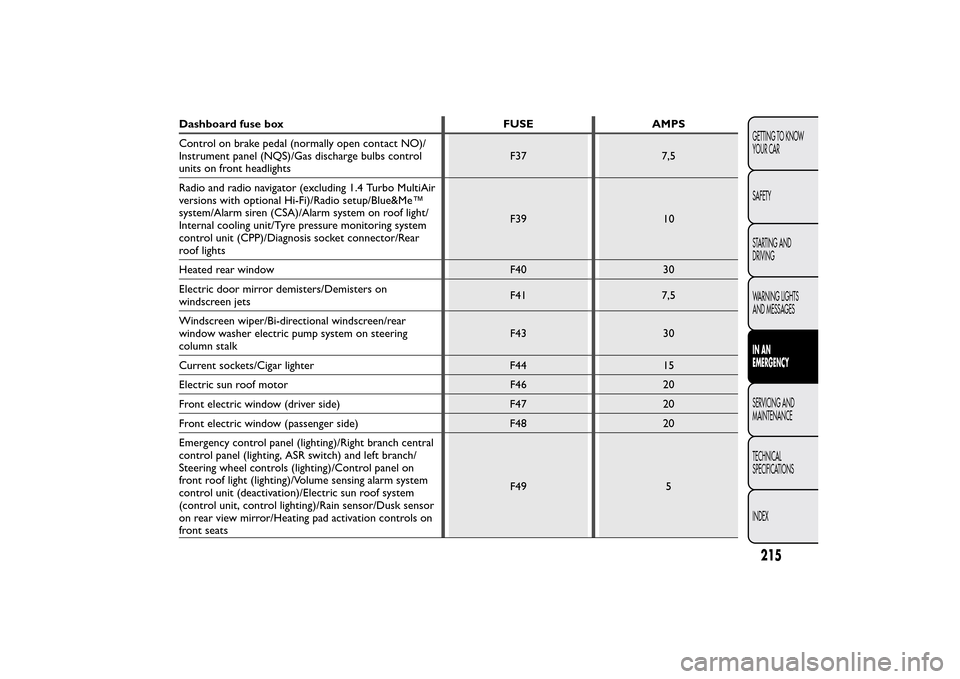
Dashboard fuse box FUSE AMPS
Control on brake pedal (normally open contact NO)/
Instrument panel (NQS)/Gas discharge bulbs control
units on front headlightsF37 7,5
Radio and radio navigator (excluding 1.4 Turbo MultiAir
versions with optional Hi-Fi)/Radio setup/Blue&Me™
system/Alarm siren (CSA)/Alarm system on roof light/
Internal cooling unit/Tyre pressure monitoring system
control unit (CPP)/Diagnosis socket connector/Rear
roof lightsF39 10
Heated rear window F40 30
Electric door mirror demisters/Demisters on
windscreen jetsF41 7,5
Windscreen wiper/Bi-directional windscreen/rear
window washer electric pump system on steering
column stalkF43 30
Current sockets/Cigar lighter F44 15
Electric sun roof motor F46 20
Front electric window (driver side) F47 20
Front electric window (passenger side) F48 20
Emergency control panel (lighting)/Right branch central
control panel (lighting, ASR switch) and left branch/
Steering wheel controls (lighting)/Control panel on
front roof light (lighting)/Volume sensing alarm system
control unit (deactivation)/Electric sun roof system
(control unit, control lighting)/Rain sensor/Dusk sensor
on rear view mirror/Heating pad activation controls on
front seatsF49 5
215GETTING TO KNOW
YOUR CAR
SAFETY
STARTING AND
DRIVING
WARNING LIGHTS
AND MESSAGESIN AN
EMERGENCYSERVICING AND
MAINTENANCE
TECHNICAL
SPECIFICATIONS
INDEX
Page 220 of 299
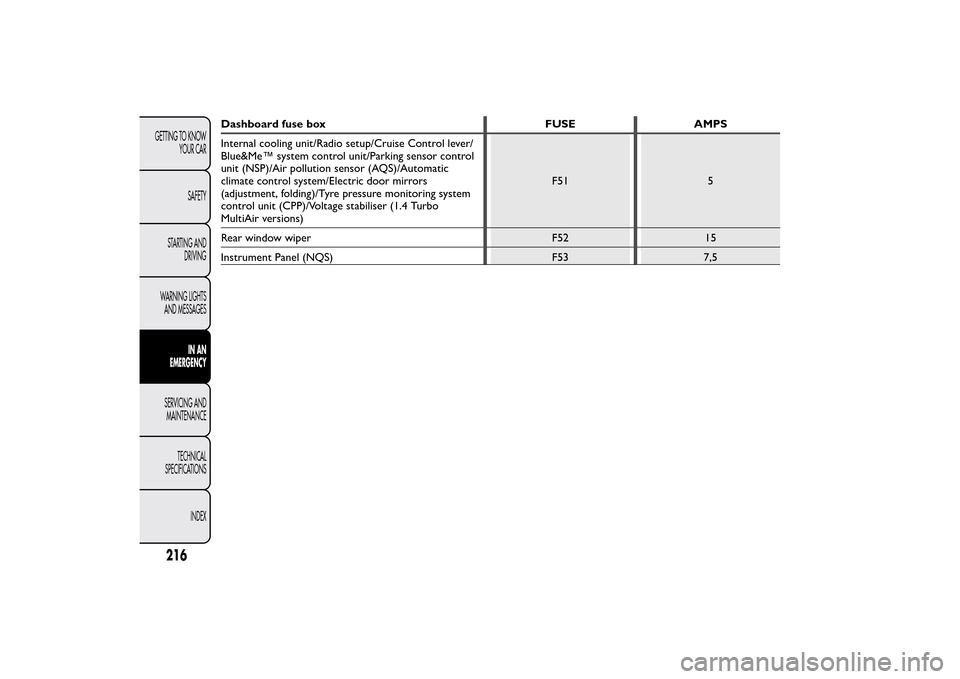
Dashboard fuse box FUSE AMPS
Internal cooling unit/Radio setup/Cruise Control lever/
Blue&Me™ system control unit/Parking sensor control
unit (NSP)/Air pollution sensor (AQS)/Automatic
climate control system/Electric door mirrors
(adjustment, folding)/Tyre pressure monitoring system
control unit (CPP)/Voltage stabiliser (1.4 Turbo
MultiAir versions)F51 5
Rear window wiper F52 15
Instrument Panel (NQS) F53 7,5
216GETTING TO KNOW
YOUR CAR
SAFETY
STARTING AND
DRIVING
WARNING LIGHTS
AND MESSAGES
IN AN
EMERGENCY
SERVICING AND
MAINTENANCE
TECHNICAL
SPECIFICATIONS
INDEX
Page 228 of 299
SERVICING AND MAINTENANCE
SCHEDULED SERVICINGCorrect servicing is essential in guaranteeing a long
life for the car under the best conditions.
Fiat has therefore arranged a series of checks and
service operations to be carried out every 30,000
kilometres (for petrol versions) or every 35,000
kilometres (for 1.6 MultiJet and 2.0 MultiJet
versions).
It is, however, important to remember that
scheduled servicing does not completely cover all
the car's requirements: even in the initial period
before 30,000/35,000 km (the latter for 1.6 MultiJet
and 2.0 MultiJet versions), and then subsequently
between one service and another, ordinary care
is still required such as routine checks involving
topping up fluid levels, checking tyre pressures, etc.IMPORTANT The Scheduled Servicing Plan
coupons are set out by the Manufacturer. Failure to
have them carried out may invalidate the warranty.
Scheduled Servicing is performed by all Fiat
Dealerships, at pre-established times.
If, during any service, the need arises for additional
replacements or repairs, these may be carried
out only with the explicit agreement of the
Customer.
IMPORTANT It is advisable to inform a Fiat
Dealership of any small operating irregularities
without waiting for the next service.
If the car is used frequently for towing a trailer, the
interval between services should be reduced.
224GETTING TO KNOW
YOUR CAR
SAFETY
STARTING AND
DRIVING
WARNING LIGHTS
AND MESSAGES
IN AN EMERGENCYSERVICING AND
MAINTENANCE
TECHNICAL
SPECIFICATIONS
INDEX
Page 229 of 299
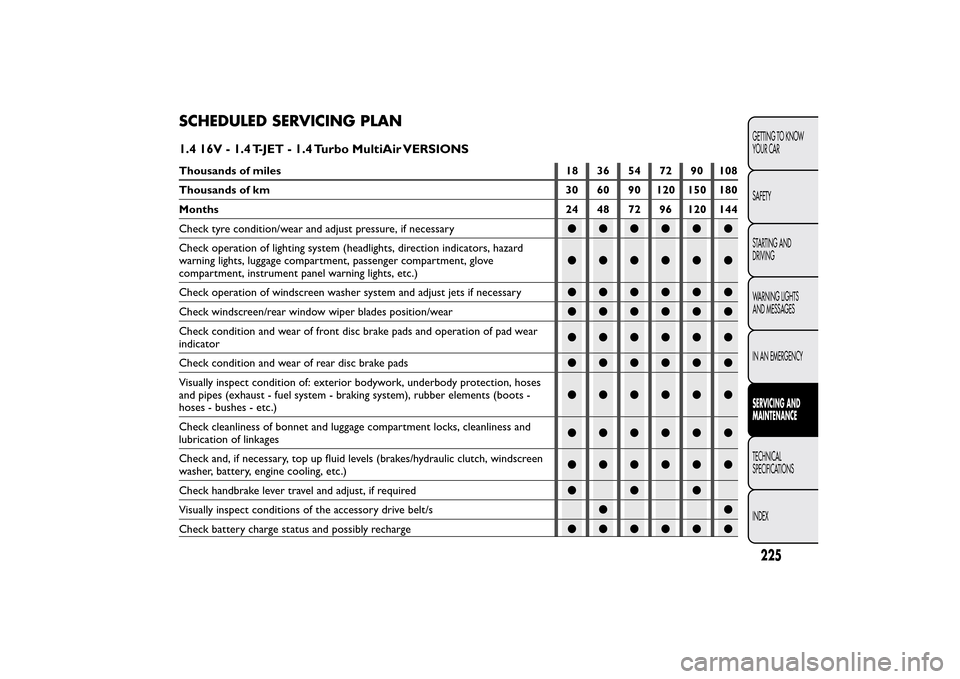
SCHEDULED SERVICING PLAN1.4 16V - 1.4 T-JET - 1.4 Turbo MultiAir VERSIONSThousands of miles 18 36 54 72 90 108
Thousands of km 30 60 90 120 150 180
Months 24 48 72 96 120 144
Check tyre condition/wear and adjust pressure, if necessary●●●●●●
Check operation of lighting system (headlights, direction indicators, hazard
warning lights, luggage compartment, passenger compartment, glove
compartment, instrument panel warning lights, etc.)●●●●●●
Check operation of windscreen washer system and adjust jets if necessary●●●●●●
Check windscreen/rear window wiper blades position/wear●●●●●●
Check condition and wear of front disc brake pads and operation of pad wear
indicator●●●●●●
Check condition and wear of rear disc brake pads●●●●●●
Visually inspect condition of: exterior bodywork, underbody protection, hoses
and pipes (exhaust - fuel system - braking system), rubber elements (boots -
hoses - bushes - etc.)●●●●●●
Check cleanliness of bonnet and luggage compartment locks, cleanliness and
lubrication of linkages●●●●●●
Check and, if necessary, top up fluid levels (brakes/hydraulic clutch, windscreen
washer, battery, engine cooling, etc.)●●●●●●
Check handbrake lever travel and adjust, if required●●●
Visually inspect conditions of the accessory drive belt/s●●
Check battery charge status and possibly recharge●●●●●●
225GETTING TO KNOW
YOUR CAR
SAFETY
STARTING AND
DRIVING
WARNING LIGHTS
AND MESSAGES
IN AN EMERGENCYSERVICING AND
MAINTENANCETECHNICAL
SPECIFICATIONS
INDEX
Page 233 of 299
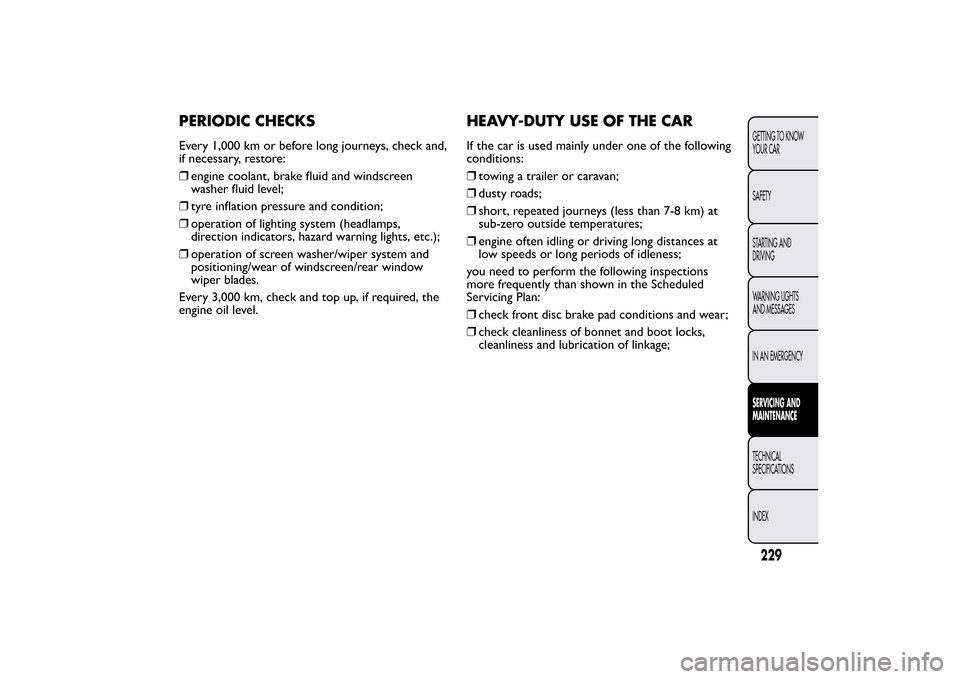
PERIODIC CHECKSEvery 1,000 km or before long journeys, check and,
if necessary, restore:
❒engine coolant, brake fluid and windscreen
washer fluid level;
❒tyre inflation pressure and condition;
❒operation of lighting system (headlamps,
direction indicators, hazard warning lights, etc.);
❒operation of screen washer/wiper system and
positioning/wear of windscreen/rear window
wiper blades.
Every 3,000 km, check and top up, if required, the
engine oil level.
HEAVY-DUTY USE OF THE CARIf the car is used mainly under one of the following
conditions:
❒towing a trailer or caravan;
❒dusty roads;
❒short, repeated journeys (less than 7-8 km) at
sub-zero outside temperatures;
❒engine often idling or driving long distances at
low speeds or long periods of idleness;
you need to perform the following inspections
more frequently than shown in the Scheduled
Servicing Plan:
❒check front disc brake pad conditions and wear;
❒check cleanliness of bonnet and boot locks,
cleanliness and lubrication of linkage;
229GETTING TO KNOW
YOUR CAR
SAFETY
STARTING AND
DRIVING
WARNING LIGHTS
AND MESSAGES
IN AN EMERGENCYSERVICING AND
MAINTENANCETECHNICAL
SPECIFICATIONS
INDEX