belt FIAT BRAVO 2012 2.G Owner's Manual
[x] Cancel search | Manufacturer: FIAT, Model Year: 2012, Model line: BRAVO, Model: FIAT BRAVO 2012 2.GPages: 299, PDF Size: 5.81 MB
Page 151 of 299
FRONT AIRBAGSThe car is fitted with front airbags for the driver
and the passenger, and with a knee bag on the
driver's side (for versions/markets, where
provided).
The front driver/passenger airbags and the driver's
knee bag (for versions/markets, where provided)
have been designed to protect the front seat
occupants in the event of frontal impacts of
medium/high severity, by placing the bag between
the occupant and the steering wheel or dashboard.
Therefore non-deployment in other types of
impacts (side impacts, rear shunts, roll-overs, etc.)
does not indicate a system malfunction.
In the event of a frontal impact, an electronic
control unit triggers the inflation of the bags if
required. The cushions immediately inflate, placing
themselves between the front occupants' bodies
and structures that could cause injuries.
Immediately after, the cushions deflate.
The front driver/passenger airbags and the driver's
knee bag (for versions/markets, where provided)
are not a replacement for, but rather complement
the use of, seat belts, which should always be worn,
as specified by law in Europe and most non-
European countries.
In the event of an impact, those not wearing a seat
belt will move forward and come into contact
with the bag which is still inflating. The protection
offered by the bag is compromised in these
circumstances.Front airbags may not be activated in the following
situations:
❒frontal impacts against highly deformable objects
not involving the front surface of the car (e.g.
wing collision against guard rail, etc.);
❒car wedging under other vehicles or protective
barriers (e.g. trucks or guard rails);
they may not provide any additional protection
compared with seat belts, so their deployment
would be inappropriate. In these cases, non-
deployment does not indicate a system malfunction.
WARNING
Do not apply stickers or other objects
to the steering wheel, passenger side
airbag cover or upper side upholstery. Do not
place objects on the passenger side dashboard
because these could interfere with the correct
opening of the passenger airbag and cause
injury to occupants.
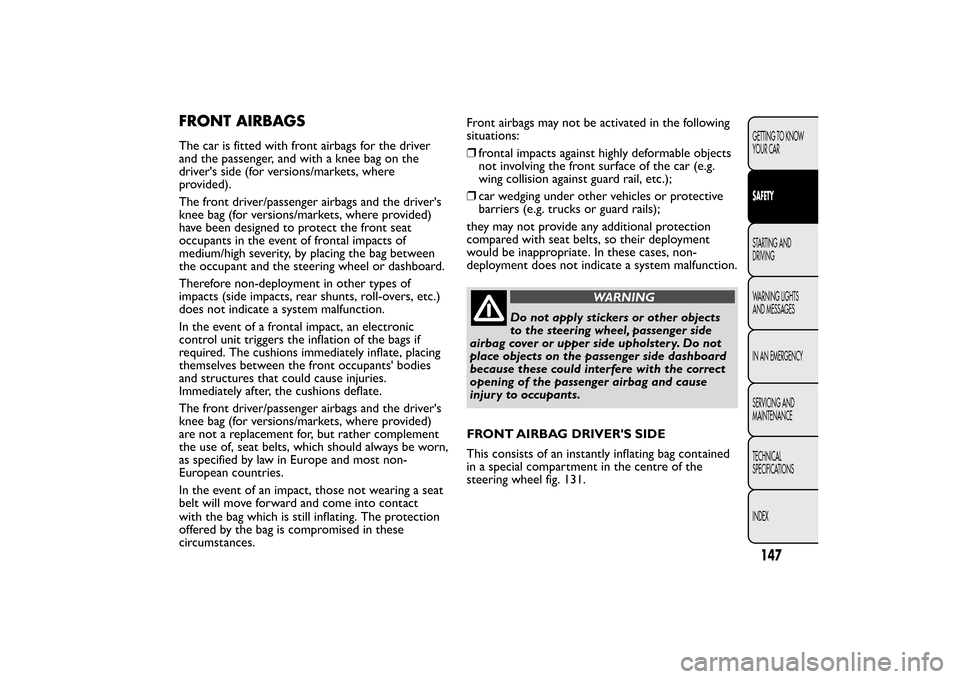
FRONT AIRBAG DRIVER'S SIDE
This consists of an instantly inflating bag contained
in a special compartment in the centre of the
steering wheel fig. 131.
147GETTING TO KNOW
YOUR CARSAFETYSTARTING AND
DRIVING
WARNING LIGHTS
AND MESSAGES
IN AN EMERGENCY
SERVICING AND
MAINTENANCE
TECHNICAL
SPECIFICATIONS
INDEX
Page 152 of 299
WARNING
Always drive with both hands on the
steering wheel so that , if the airbags
must be deployed, they may do so freely. Do
not drive with your body bent forward. Keep
your back straight against the backrest .
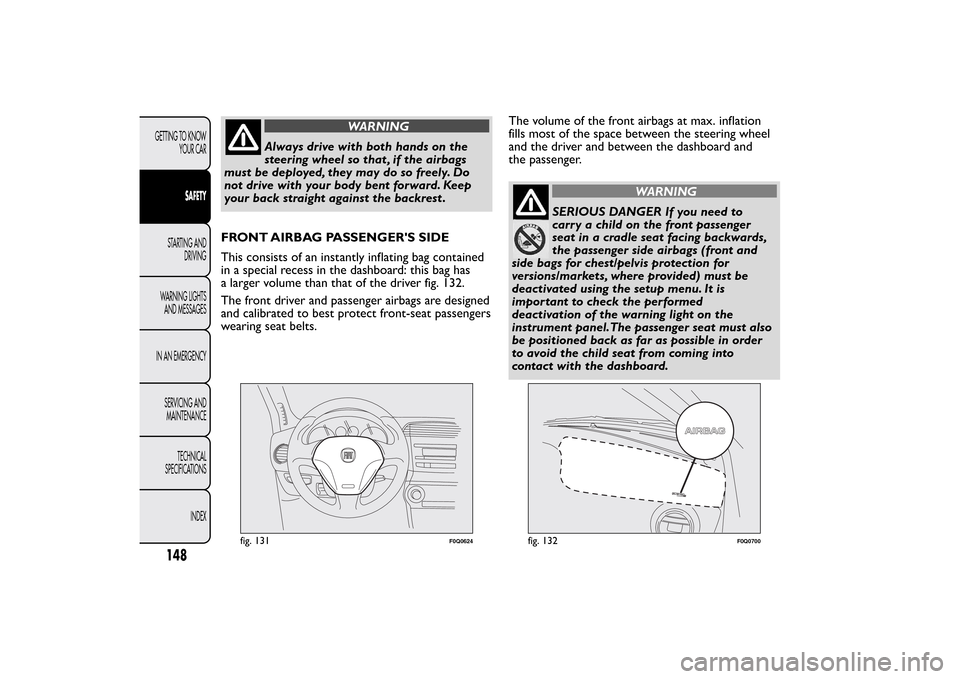
FRONT AIRBAG PASSENGER'S SIDE
This consists of an instantly inflating bag contained
in a special recess in the dashboard: this bag has
a larger volume than that of the driver fig. 132.
The front driver and passenger airbags are designed
and calibrated to best protect front-seat passengers
wearing seat belts.The volume of the front airbags at max. inflation
fills most of the space between the steering wheel
and the driver and between the dashboard and
the passenger.
WARNING
SERIOUS DANGER If you need to
carr y a child on the front passenger
seat in a cradle seat facing backwards,
the passenger side airbags (front and
side bags for chest/pelvis protection for
versions/markets, where provided) must be
deactivated using the setup menu. It is
important to check the performed
deactivation of the warning light on the
instrument panel.The passenger seat must also
be positioned back as far as possible in order
to avoid the child seat from coming into
contact with the dashboard.
fig. 131
F0Q0624
fig. 132
F0Q0700
148GETTING TO KNOW
YOUR CAR
SAFETY
STARTING AND
DRIVING
WARNING LIGHTS
AND MESSAGES
IN AN EMERGENCY
SERVICING AND
MAINTENANCE
TECHNICAL
SPECIFICATIONS
INDEX
Page 154 of 299
SIDE AIRBAGS (Side bag - Window
bag)The car is fitted with front side bags for driver and
passenger, protecting the chest/pelvis, and window
bags for protecting front and rear passengers’
heads.
Side airbags protect occupants from side impacts of
medium/high severity by placing the bag between
the occupant and the internal parts of the side
structure of the car.
Non-activation of side bags in other types of
collisions (frontal impacts, rear shunts, roll-overs,
etc...) is not an indication of system malfunction.
In the event of a side impact, an electronic control
unit triggers the inflation of the bag if required.
The cushion immediately inflates, placing itself
between the occupant's body and structures that
could cause injuries. Immediately after, the cushion
deflates.
Side bags are not a replacement of, but rather a
complement to, seat belts, which you are
recommended to wear at all times, as specified by
law in Europe and most non-European countries.
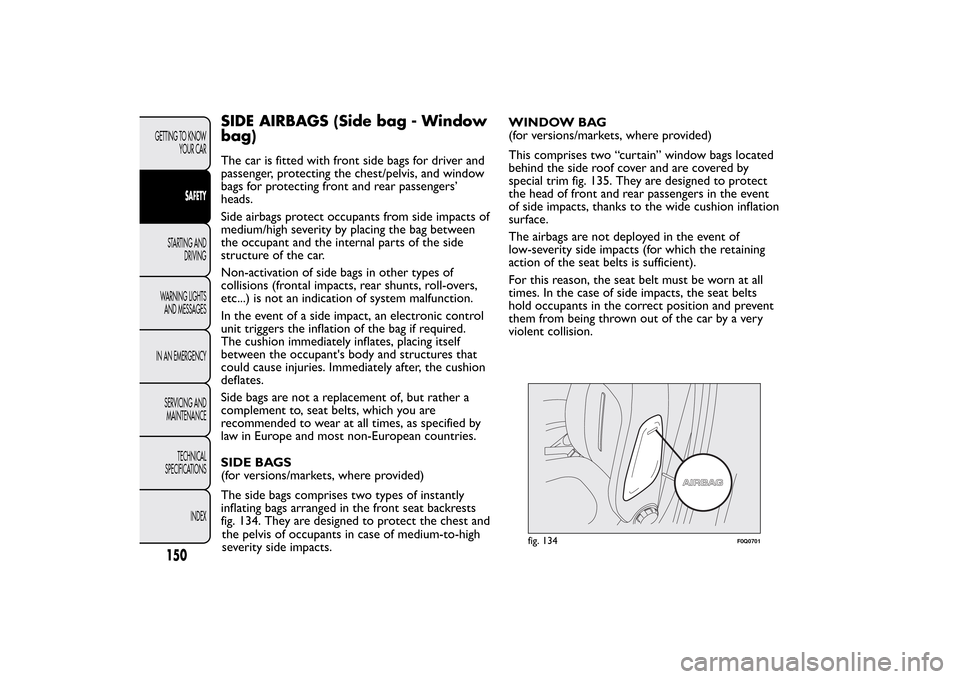
SIDE BAGS
(for versions/markets, where provided)
The side bags comprises two types of instantly
inflating bags arranged in the front seat backrests
fig. 134. They are designed to protect the chest and
the pelvis of occupants in case of medium-to-high
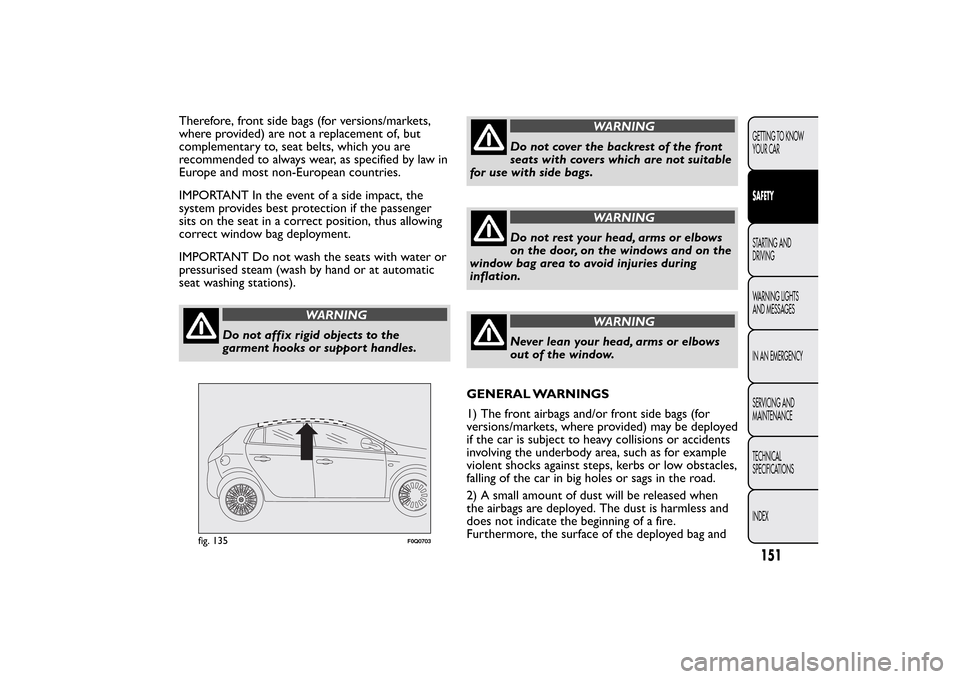
severity side impacts.WINDOW BAG
(for versions/markets, where provided)
This comprises two “curtain” window bags located
behind the side roof cover and are covered by
special trim fig. 135. They are designed to protect
the head of front and rear passengers in the event
of side impacts, thanks to the wide cushion inflation
surface.
The airbags are not deployed in the event of
low-severity side impacts (for which the retaining
action of the seat belts is sufficient).
For this reason, the seat belt must be worn at all
times. In the case of side impacts, the seat belts
hold occupants in the correct position and prevent
them from being thrown out of the car by a very
violent collision.
fig. 134
F0Q0701
150GETTING TO KNOW
YOUR CAR
SAFETY
STARTING AND
DRIVING
WARNING LIGHTS
AND MESSAGES
IN AN EMERGENCY
SERVICING AND
MAINTENANCE
TECHNICAL
SPECIFICATIONS
INDEX
Page 155 of 299
Therefore, front side bags (for versions/markets,
where provided) are not a replacement of, but
complementary to, seat belts, which you are
recommended to always wear, as specified by law in
Europe and most non-European countries.
IMPORTANT In the event of a side impact, the
system provides best protection if the passenger
sits on the seat in a correct position, thus allowing
correct window bag deployment.
IMPORTANT Do not wash the seats with water or
pressurised steam (wash by hand or at automatic
seat washing stations).
WARNING
Do not affix rigid objects to the
garment hooks or support handles.
WARNING
Do not cover the backrest of the front
seats with covers which are not suitable
for use with side bags.
WARNING
Do not rest your head, arms or elbows
on the door, on the windows and on the
window bag area to avoid injuries during
inflation.
WARNING
Never lean your head, arms or elbows
out of the window.
GENERAL WARNINGS
1) The front airbags and/or front side bags (for
versions/markets, where provided) may be deployed
if the car is subject to heavy collisions or accidents
involving the underbody area, such as for example
violent shocks against steps, kerbs or low obstacles,
falling of the car in big holes or sags in the road.
2) A small amount of dust will be released when
the airbags are deployed. The dust is harmless and
does not indicate the beginning of a fire.
Furthermore, the surface of the deployed bag and
fig. 135
F0Q0703
151GETTING TO KNOW
YOUR CARSAFETYSTARTING AND
DRIVING
WARNING LIGHTS
AND MESSAGES
IN AN EMERGENCY
SERVICING AND
MAINTENANCE
TECHNICAL
SPECIFICATIONS
INDEX
Page 157 of 299
WARNING
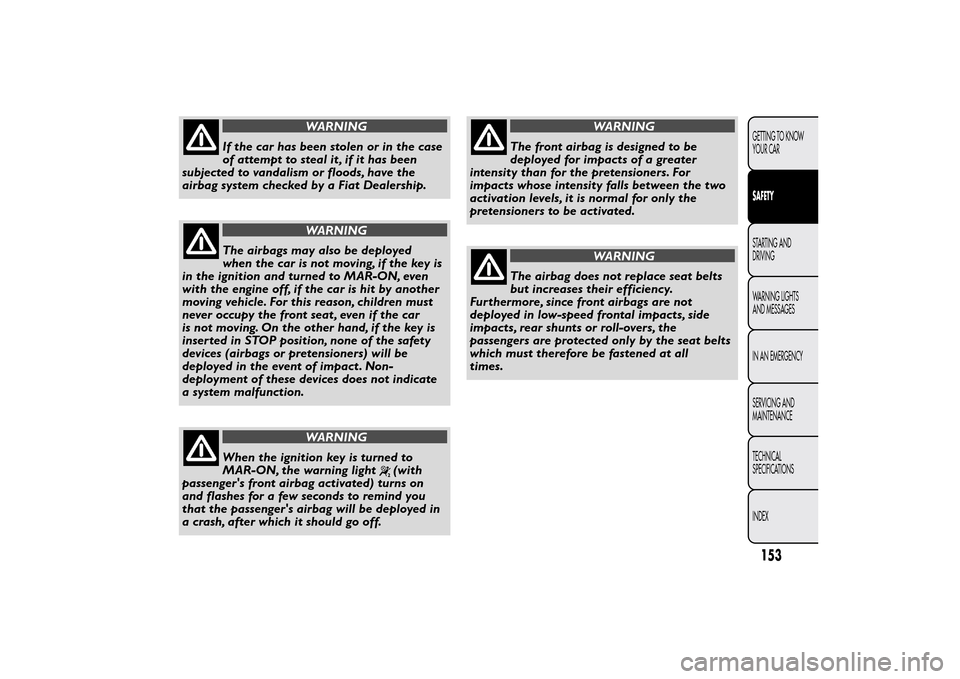
If the car has been stolen or in the case
of attempt to steal it , if it has been
subjected to vandalism or floods, have the
airbag system checked by a Fiat Dealership.
WARNING
The airbags may also be deployed
when the car is not moving, if the key is
in the ignition and turned to MAR-ON, even
with the engine off, if the car is hit by another
moving vehicle. For this reason, children must
never occupy the front seat , even if the car
is not moving. On the other hand, if the key is
inserted in STOP position, none of the safety
devices (airbags or pretensioners) will be
deployed in the event of impact . Non-
deployment of these devices does not indicate
a system malfunction.
WARNING
When the ignition key is turned to
MAR-ON, the warning light
(with
passenger's front airbag activated) turns on
and flashes for a few seconds to remind you
that the passenger's airbag will be deployed in
a crash, after which it should go off.
WARNING
The front airbag is designed to be
deployed for impacts of a greater
intensity than for the pretensioners. For
impacts whose intensity falls between the two
activation levels, it is normal for only the
pretensioners to be activated.
WARNING
The airbag does not replace seat belts
but increases their efficiency.
Furthermore, since front airbags are not
deployed in low-speed frontal impacts, side
impacts, rear shunts or roll-overs, the
passengers are protected only by the seat belts
which must therefore be fastened at all
times.
153GETTING TO KNOW
YOUR CARSAFETYSTARTING AND
DRIVING
WARNING LIGHTS
AND MESSAGES
IN AN EMERGENCY
SERVICING AND
MAINTENANCE
TECHNICAL
SPECIFICATIONS
INDEX
Page 172 of 299
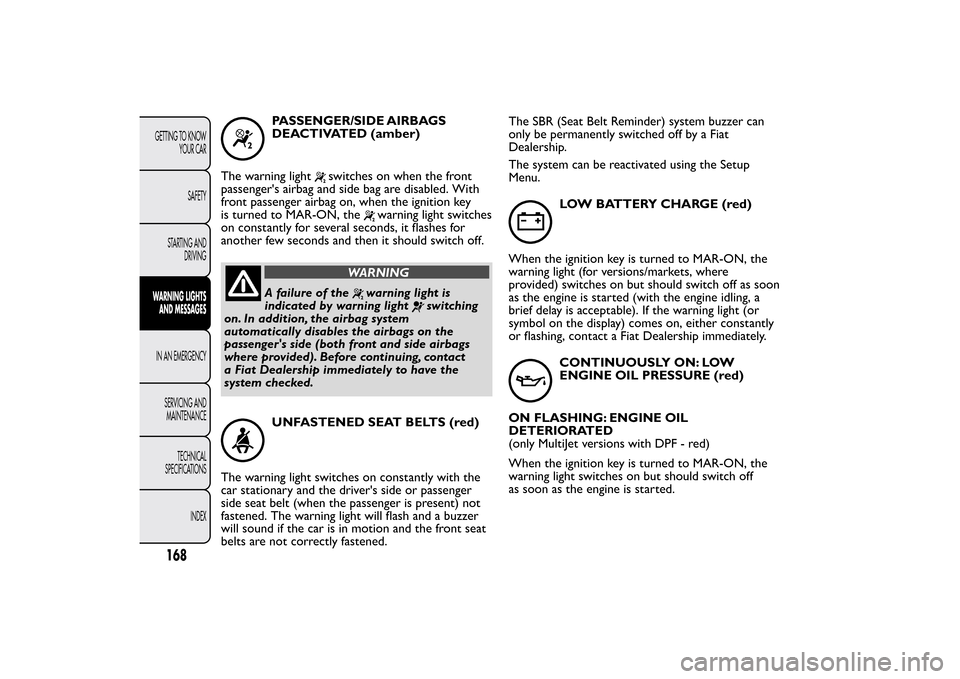
PASSENGER/SIDE AIRBAGS
DEACTIVATED (amber)
The warning light
switches on when the front
passenger's airbag and side bag are disabled. With
front passenger airbag on, when the ignition key
is turned to MAR-ON, the
warning light switches
on constantly for several seconds, it flashes for
another few seconds and then it should switch off.
WARNING
A failure of the
warning light is
indicated by warning light
switching
on. In addition, the airbag system
automatically disables the airbags on the
passenger's side (both front and side airbags
where provided). Before continuing, contact
a Fiat Dealership immediately to have the
system checked.
UNFASTENED SEAT BELTS (red)
The warning light switches on constantly with the
car stationary and the driver's side or passenger
side seat belt (when the passenger is present) not
fastened. The warning light will flash and a buzzer
will sound if the car is in motion and the front seat
belts are not correctly fastened.The SBR (Seat Belt Reminder) system buzzer can
only be permanently switched off by a Fiat
Dealership.
The system can be reactivated using the Setup
Menu.
LOW BATTERY CHARGE (red)
When the ignition key is turned to MAR-ON, the
warning light (for versions/markets, where
provided) switches on but should switch off as soon
as the engine is started (with the engine idling, a
brief delay is acceptable). If the warning light (or
symbol on the display) comes on, either constantly
or flashing, contact a Fiat Dealership immediately.CONTINUOUSLY ON: LOW
ENGINE OIL PRESSURE (red)
ON FLASHING: ENGINE OIL
DETERIORATED
(only MultiJet versions with DPF - red)
When the ignition key is turned to MAR-ON, the
warning light switches on but should switch off
as soon as the engine is started.
168GETTING TO KNOW
YOUR CAR
SAFETY
STARTING AND
DRIVINGWARNING LIGHTS
AND MESSAGESIN AN EMERGENCY
SERVICING AND
MAINTENANCE
TECHNICAL
SPECIFICATIONS
INDEX
Page 229 of 299
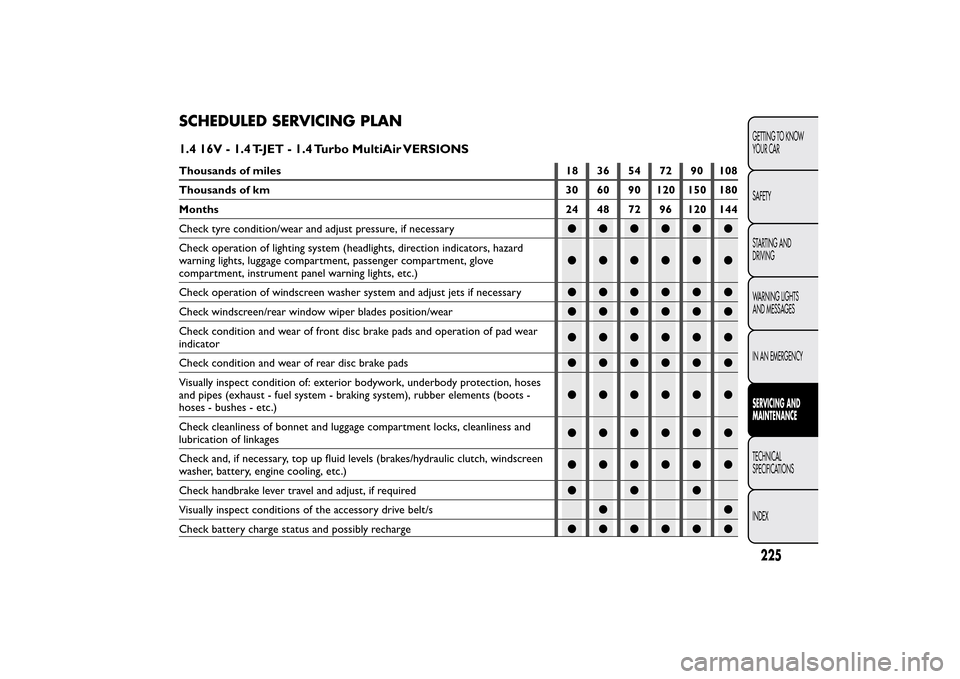
SCHEDULED SERVICING PLAN1.4 16V - 1.4 T-JET - 1.4 Turbo MultiAir VERSIONSThousands of miles 18 36 54 72 90 108
Thousands of km 30 60 90 120 150 180
Months 24 48 72 96 120 144
Check tyre condition/wear and adjust pressure, if necessary●●●●●●
Check operation of lighting system (headlights, direction indicators, hazard
warning lights, luggage compartment, passenger compartment, glove
compartment, instrument panel warning lights, etc.)●●●●●●
Check operation of windscreen washer system and adjust jets if necessary●●●●●●
Check windscreen/rear window wiper blades position/wear●●●●●●
Check condition and wear of front disc brake pads and operation of pad wear
indicator●●●●●●
Check condition and wear of rear disc brake pads●●●●●●
Visually inspect condition of: exterior bodywork, underbody protection, hoses
and pipes (exhaust - fuel system - braking system), rubber elements (boots -
hoses - bushes - etc.)●●●●●●
Check cleanliness of bonnet and luggage compartment locks, cleanliness and
lubrication of linkages●●●●●●
Check and, if necessary, top up fluid levels (brakes/hydraulic clutch, windscreen
washer, battery, engine cooling, etc.)●●●●●●
Check handbrake lever travel and adjust, if required●●●
Visually inspect conditions of the accessory drive belt/s●●
Check battery charge status and possibly recharge●●●●●●
225GETTING TO KNOW
YOUR CAR
SAFETY
STARTING AND
DRIVING
WARNING LIGHTS
AND MESSAGES
IN AN EMERGENCYSERVICING AND
MAINTENANCETECHNICAL
SPECIFICATIONS
INDEX
Page 230 of 299
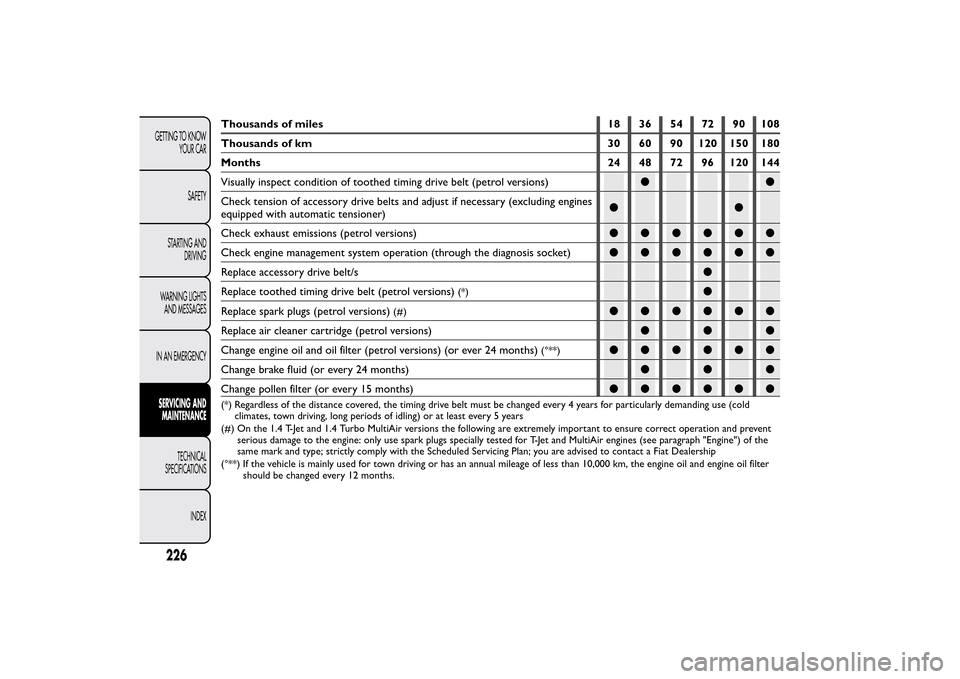
Thousands of miles 18 36 54 72 90 108
Thousands of km 30 60 90 120 150 180
Months 24 48 72 96 120 144
Visually inspect condition of toothed timing drive belt (petrol versions)●●
Check tension of accessory drive belts and adjust if necessary (excluding engines
equipped with automatic tensioner)●●
Check exhaust emissions (petrol versions)●●●●●●
Check engine management system operation (through the diagnosis socket)●●●●●●
Replace accessory drive belt/s●
Replace toothed timing drive belt (petrol versions)
(*)
●
Replace spark plugs (petrol versions)
(#)
●●●●●●
Replace air cleaner cartridge (petrol versions)●●●
Change engine oil and oil filter (petrol versions) (or ever 24 months)
(°**)
●●●●●●
Change brake fluid (or every 24 months)●●●
Change pollen filter (or every 15 months)●●●●●●
(*) Regardless of the distance covered, the timing drive belt must be changed every 4 years for particularly demanding use (cold
climates, town driving, long periods of idling) or at least every 5 years
(#) On the 1.4 T-Jet and 1.4 Turbo MultiAir versions the following are extremely important to ensure correct operation and prevent
serious damage to the engine: only use spark plugs specially tested for T-Jet and MultiAir engines (see paragraph "Engine") of the
same mark and type; strictly comply with the Scheduled Servicing Plan; you are advised to contact a Fiat Dealership
(°**) If the vehicle is mainly used for town driving or has an annual mileage of less than 10,000 km, the engine oil and engine oil filter
should be changed every 12 months.
226GETTING TO KNOW
YOUR CAR
SAFETY
STARTING AND
DRIVING
WARNING LIGHTS
AND MESSAGES
IN AN EMERGENCYSERVICING AND
MAINTENANCE
TECHNICAL
SPECIFICATIONS
INDEX
Page 234 of 299
❒visually inspect conditions of: engine, gearbox,
transmission, pipes and hoses (exhaust - fuel
system - brakes) and rubber elements (boots -
sleeves - bushes - etc.);
❒check battery charge and battery fluid level
(electrolyte);
❒visually inspect condition of the accessory drive
belts;
❒check and, if necessary, change engine oil and
replace oil filter;
❒check and, if necessary, replace pollen filter.
CHECKING FLUID LEVELS
When topping up, take care not to mix
up the various types of fluids: they are
not compatible with each other and
could seriously damage the car.
WARNING
Never smoke while working in the
engine compartment : inflammable
gases and vapours may be present ,
constituting a fire risk.
230GETTING TO KNOW
YOUR CAR
SAFETY
STARTING AND
DRIVING
WARNING LIGHTS
AND MESSAGES
IN AN EMERGENCYSERVICING AND
MAINTENANCE
TECHNICAL
SPECIFICATIONS
INDEX
Page 296 of 299
Parking.......................................... 157
Parking lights ................................. 71
Parking sensors............................ 124
Passenger compartment
heating ..................................... 57-61
Performance (top speed) .......... 270
Pollen filter ................................... 240
Power socket ................................ 87
Pretensioners ............................... 135
Protecting the environment ..... 130Radio ............................................. 117
Rain sensor.................................... 75
Raising the car ............................. 221
Rapid front window
demisting/defrosting
(MAX-DEF function) ................ 67
Rear armrest ................................. 85
Rear diffuser.................................. 55
Rear door emergency
locking device ............................. 93
Rear fog lights ........................ 82-201
Rear roof light .............................. 81
– bulb replacement ................... 204
Rear view mirrors ........................ 51
Rear window washer nozzles... 246
Rear window washer/wiper ...... 76
Rear window wiper– blade replacement ................. 246
– blades ....................................... 245
Reconfigurable multifunction
display ........................................... 31
Refuelling
– capacities table ....................... 273
Refuelling the car ........................ 128
Replacing fuses............................. 208
Replacing the battery in the
key with remote control .......... 13
Rev counter................................... 24
Reverse lights ............................... 201
Rims
– wheels and tyres.................... 243
Roof lights...................................... 80
Roof rack/ski rack ....................... 104
Safe Lock device.......................... 15
Safety
– carrying children safely......... 138
– "Isofix" child seat (fitting) .... 144
SBR system ................................... 134
Scheduled Servicing Plan ........... 225
Seat belts ...................................... 132
– load limiters ............................ 135
– maintenance ........................... 137
– pretensioners ......................... 135Seats................................................ 46
– Backrest angle adjustment ... 46
– Height adjustment.................. 46
– Longitudinal adjustment ....... 46
– Lumbar adjustment ................ 46
Servicing and care
– heavy-duty use of the car .... 229
– periodic checks ...................... 229
Set temperature alignment
(MONO function) ..................... 69
Setup menu (multifunction
display) ......................................... 29
Setup menu (reconfigurable
multifunction display)................ 34
Side airbags (side bag -
window bag)............................... 150
Side bags........................................ 150
Side lights....................................... 71
– bulb replacement ................... 198
Snow chains.................................. 164
Snow tyres .................................... 163
Spark plugs (type) ....................... 255
Speedometer ................................ 23
Starting the engine ............. 154-181
Starting up and driving............... 154
Start&Stop system ...................... 112
Start&Stop (system) ................... 112
292GETTING TO KNOW
YOUR CAR
SAFETY
STARTING AND
DRIVING
WARNING LIGHTS
AND MESSAGES
IN AN EMERGENCY
SERVICING AND
MAINTENANCE
TECHNICAL
SPECIFICATIONS
INDEX