stop start FIAT BRAVO 2012 2.G Workshop Manual
[x] Cancel search | Manufacturer: FIAT, Model Year: 2012, Model line: BRAVO, Model: FIAT BRAVO 2012 2.GPages: 299, PDF Size: 5.81 MB
Page 195 of 299
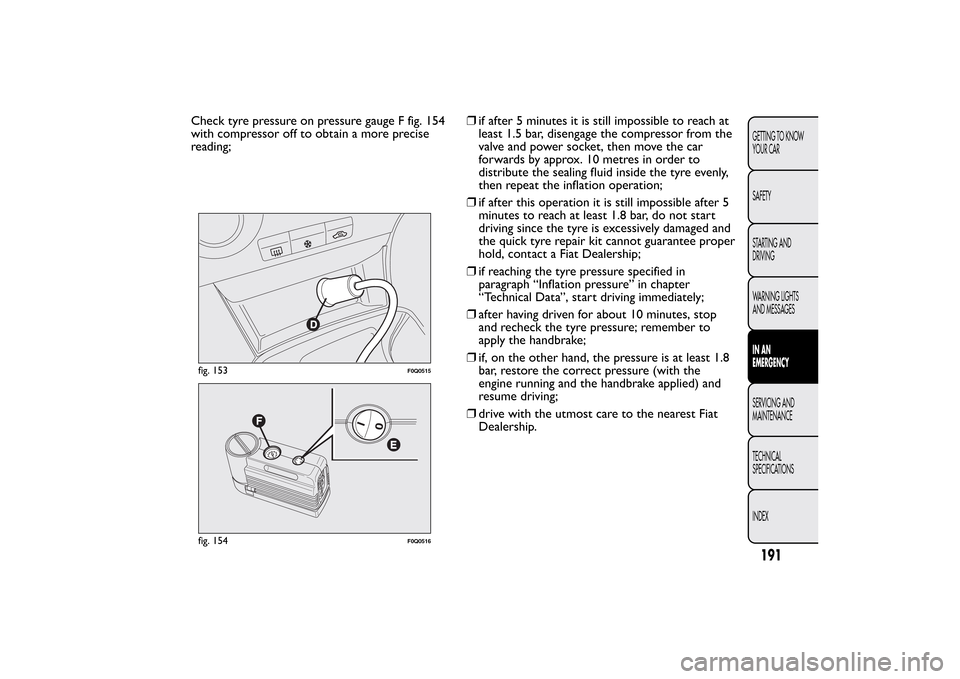
Check tyre pressure on pressure gauge F fig. 154
with compressor off to obtain a more precise
reading;❒if after 5 minutes it is still impossible to reach at
least 1.5 bar, disengage the compressor from the
valve and power socket, then move the car
forwards by approx. 10 metres in order to
distribute the sealing fluid inside the tyre evenly,
then repeat the inflation operation;
❒if after this operation it is still impossible after 5
minutes to reach at least 1.8 bar, do not start
driving since the tyre is excessively damaged and
the quick tyre repair kit cannot guarantee proper
hold, contact a Fiat Dealership;
❒if reaching the tyre pressure specified in
paragraph “Inflation pressure” in chapter
“Technical Data”, start driving immediately;
❒after having driven for about 10 minutes, stop
and recheck the tyre pressure; remember to
apply the handbrake;
❒if, on the other hand, the pressure is at least 1.8
bar, restore the correct pressure (with the
engine running and the handbrake applied) and
resume driving;
❒drive with the utmost care to the nearest Fiat
Dealership.fig. 153
F0Q0515
fig. 154
F0Q0516
191GETTING TO KNOW
YOUR CAR
SAFETY
STARTING AND
DRIVING
WARNING LIGHTS
AND MESSAGESIN AN
EMERGENCYSERVICING AND
MAINTENANCE
TECHNICAL
SPECIFICATIONS
INDEX
Page 204 of 299
FOG LIGHTS
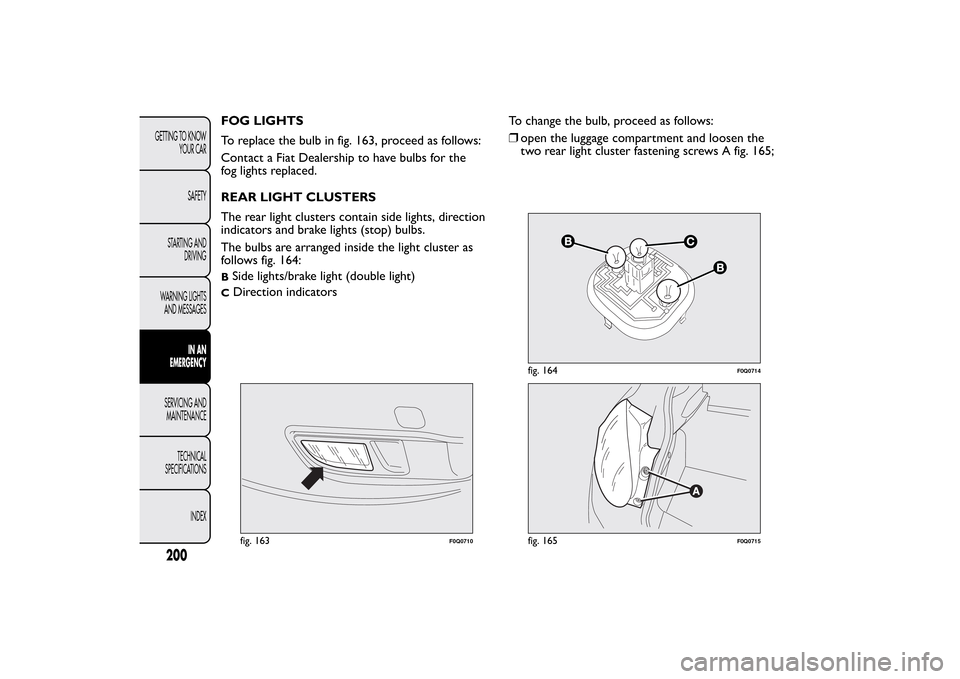
To replace the bulb in fig. 163, proceed as follows:
Contact a Fiat Dealership to have bulbs for the
fog lights replaced.
REAR LIGHT CLUSTERS
The rear light clusters contain side lights, direction
indicators and brake lights (stop) bulbs.
The bulbs are arranged inside the light cluster as
follows fig. 164:BSide lights/brake light (double light)C
Direction indicatorsTo change the bulb, proceed as follows:
❒open the luggage compartment and loosen the
two rear light cluster fastening screws A fig. 165;fig. 163
F0Q0710
fig. 164
F0Q0714
fig. 165
F0Q0715
200GETTING TO KNOW
YOUR CAR
SAFETY
STARTING AND
DRIVING
WARNING LIGHTS
AND MESSAGES
IN AN
EMERGENCY
SERVICING AND
MAINTENANCE
TECHNICAL
SPECIFICATIONS
INDEX
Page 218 of 299
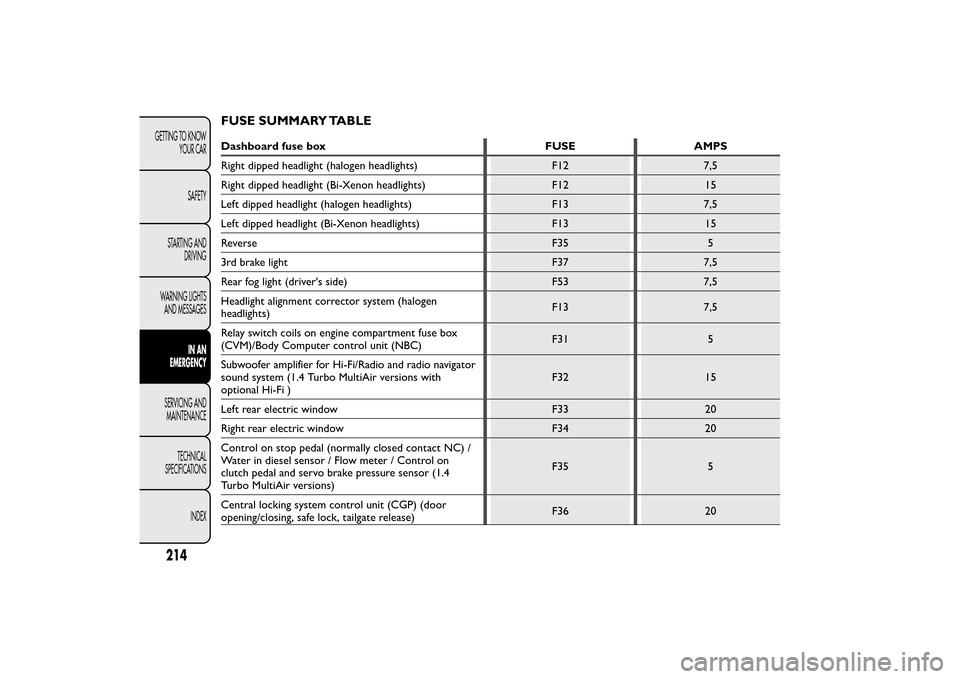
FUSE SUMMARY TABLEDashboard fuse box FUSE AMPS
Right dipped headlight (halogen headlights) F12 7,5
Right dipped headlight (Bi-Xenon headlights) F12 15
Left dipped headlight (halogen headlights) F13 7,5
Left dipped headlight (Bi-Xenon headlights) F13 15
Reverse F35 5
3rd brake light F37 7,5
Rear fog light (driver's side) F53 7,5
Headlight alignment corrector system (halogen
headlights)F13 7,5
Relay switch coils on engine compartment fuse box
(CVM)/Body Computer control unit (NBC)F31 5
Subwoofer amplifier for Hi-Fi/Radio and radio navigator
sound system (1.4 Turbo MultiAir versions with
optional Hi-Fi )F32 15
Left rear electric window F33 20
Right rear electric window F34 20
Control on stop pedal (normally closed contact NC) /
Water in diesel sensor / Flow meter / Control on
clutch pedal and servo brake pressure sensor (1.4
Turbo MultiAir versions)F35 5
Central locking system control unit (CGP) (door
opening/closing, safe lock, tailgate release)F36 20
214GETTING TO KNOW
YOUR CAR
SAFETY
STARTING AND
DRIVING
WARNING LIGHTS
AND MESSAGES
IN AN
EMERGENCY
SERVICING AND
MAINTENANCE
TECHNICAL
SPECIFICATIONS
INDEX
Page 223 of 299
BATTERY RECHARGINGIMPORTANT The battery recharging procedure is
given as information only. You are advised to
contact a Fiat Dealership to have this operation
performed.
Low amperage slow recharging for approximately
24 hours is advised. Charging for a longer time may
damage the battery.
VERSIONS WITHOUT Start&Stop SYSTEM
(for versions/markets, where provided)
Charge the battery as follows:
❒disconnect the negative battery terminal;
❒connect the charger cables to the battery
terminals, observing the polarity;
❒turn on the charger;
❒when it is recharged, turn the charger off before
disconnecting it from the battery;
❒reconnect the negative battery terminal.
VERSIONS WITH Start&Stop SYSTEM
(for versions/markets, where provided)
Charge the battery as follows:
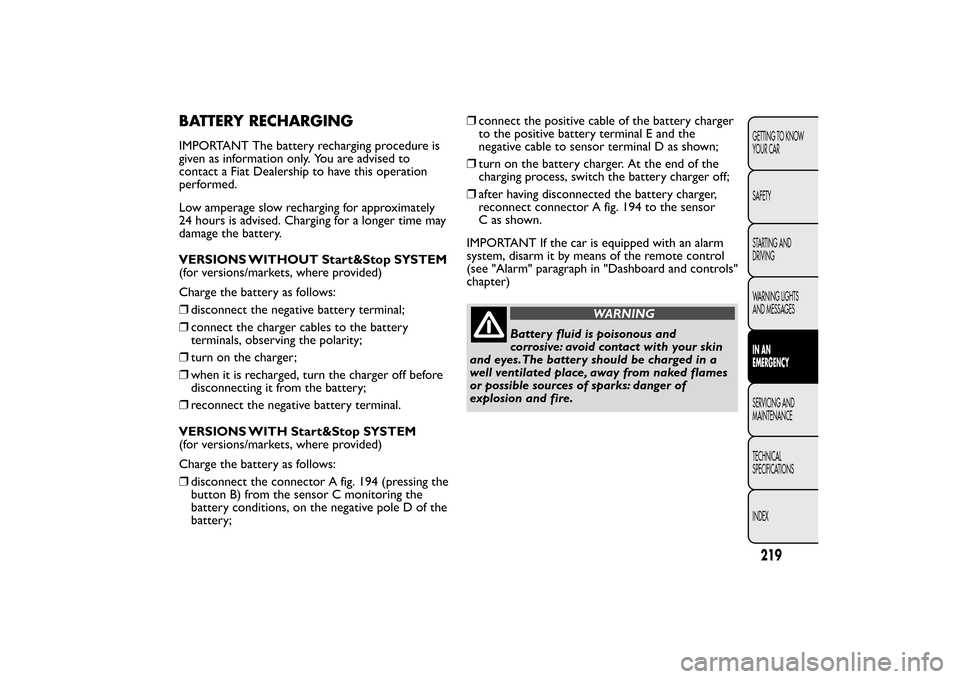
❒disconnect the connector A fig. 194 (pressing the
button B) from the sensor C monitoring the
battery conditions, on the negative pole D of the
battery;❒connect the positive cable of the battery charger
to the positive battery terminal E and the
negative cable to sensor terminal D as shown;
❒turn on the battery charger. At the end of the
charging process, switch the battery charger off;
❒after having disconnected the battery charger,
reconnect connector A fig. 194 to the sensor
C as shown.
IMPORTANT If the car is equipped with an alarm
system, disarm it by means of the remote control
(see "Alarm" paragraph in "Dashboard and controls"
chapter)
WARNING
Battery fluid is poisonous and
corrosive: avoid contact with your skin
and eyes.The battery should be charged in a
well ventilated place, away from naked flames
or possible sources of sparks: danger of
explosion and fire.
219GETTING TO KNOW
YOUR CAR
SAFETY
STARTING AND
DRIVING
WARNING LIGHTS
AND MESSAGESIN AN
EMERGENCYSERVICING AND
MAINTENANCE
TECHNICAL
SPECIFICATIONS
INDEX
Page 226 of 299
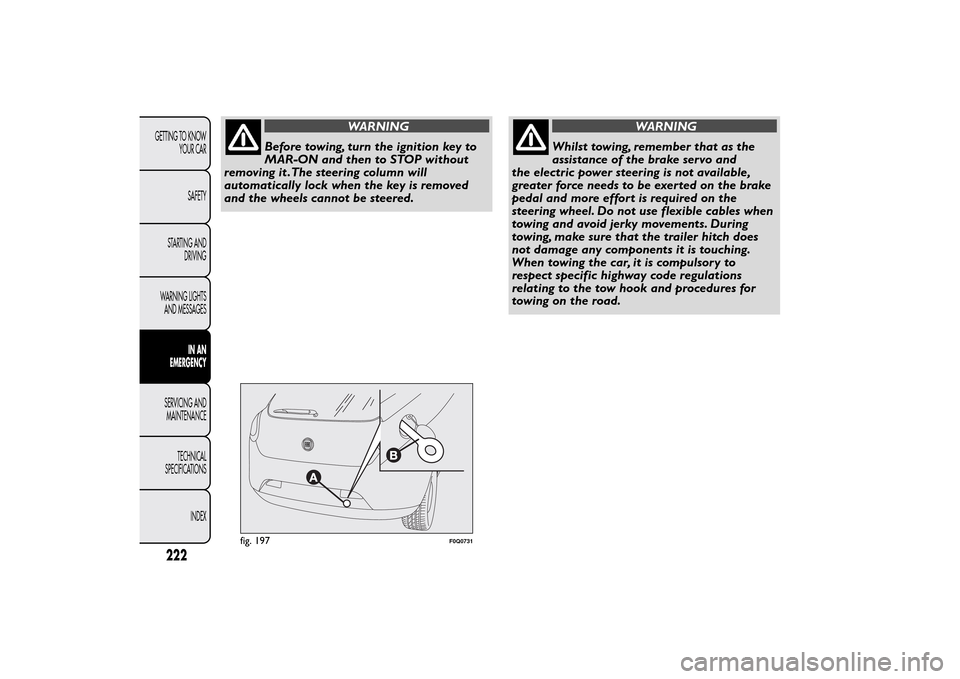
WARNING
Before towing, turn the ignition key to
MAR-ON and then to STOP without
removing it .The steering column will
automatically lock when the key is removed
and the wheels cannot be steered.
WARNING
Whilst towing, remember that as the
assistance of the brake servo and
the electric power steering is not available,
greater force needs to be exerted on the brake
pedal and more effort is required on the
steering wheel. Do not use flexible cables when
towing and avoid jerky movements. During
towing, make sure that the trailer hitch does
not damage any components it is touching.
When towing the car, it is compulsor y to
respect specific highway code regulations
relating to the tow hook and procedures for
towing on the road.
fig. 197
F0Q0731
222GETTING TO KNOW
YOUR CAR
SAFETY
STARTING AND
DRIVING
WARNING LIGHTS
AND MESSAGES
IN AN
EMERGENCY
SERVICING AND
MAINTENANCE
TECHNICAL
SPECIFICATIONS
INDEX
Page 240 of 299
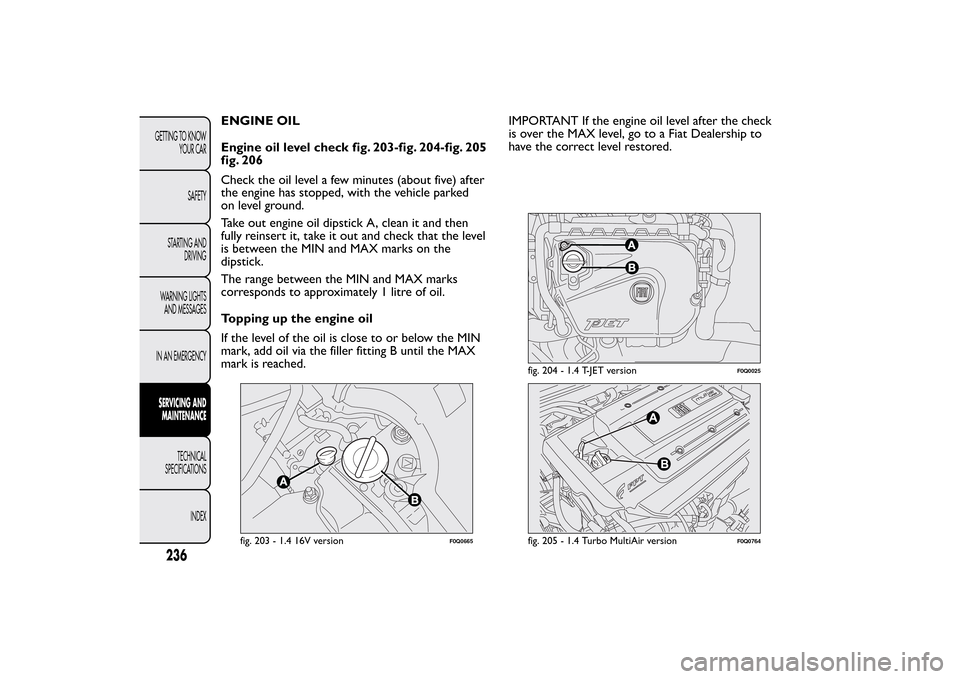
ENGINE OIL
Engine oil level check fig. 203-fig. 204-fig. 205
fig. 206
Check the oil level a few minutes (about five) after
the engine has stopped, with the vehicle parked
on level ground.
Take out engine oil dipstick A, clean it and then
fully reinsert it, take it out and check that the level
is between the MIN and MAX marks on the
dipstick.
The range between the MIN and MAX marks
corresponds to approximately 1 litre of oil.
Topping up the engine oil
If the level of the oil is close to or below the MIN
mark, add oil via the filler fitting B until the MAX
mark is reached.IMPORTANT If the engine oil level after the check
is over the MAX level, go to a Fiat Dealership to
have the correct level restored.
fig. 203 - 1.4 16V version
F0Q0665
fig. 204 - 1.4 T-JET version
F0Q0025
fig. 205 - 1.4 Turbo MultiAir version
F0Q0764
236GETTING TO KNOW
YOUR CAR
SAFETY
STARTING AND
DRIVING
WARNING LIGHTS
AND MESSAGES
IN AN EMERGENCYSERVICING AND
MAINTENANCE
TECHNICAL
SPECIFICATIONS
INDEX
Page 247 of 299
WHEELS AND TYRESBefore long trips, and every two weeks, check the
tyre and space-saver wheel inflation pressure (for
versions/markets, where provided). Check the tyres
when cold.
While driving the car, the pressure increases under
standard conditions: for the correct tyre inflation
pressure, see "Wheels" paragraph in the "Technical
specifications" chapter.
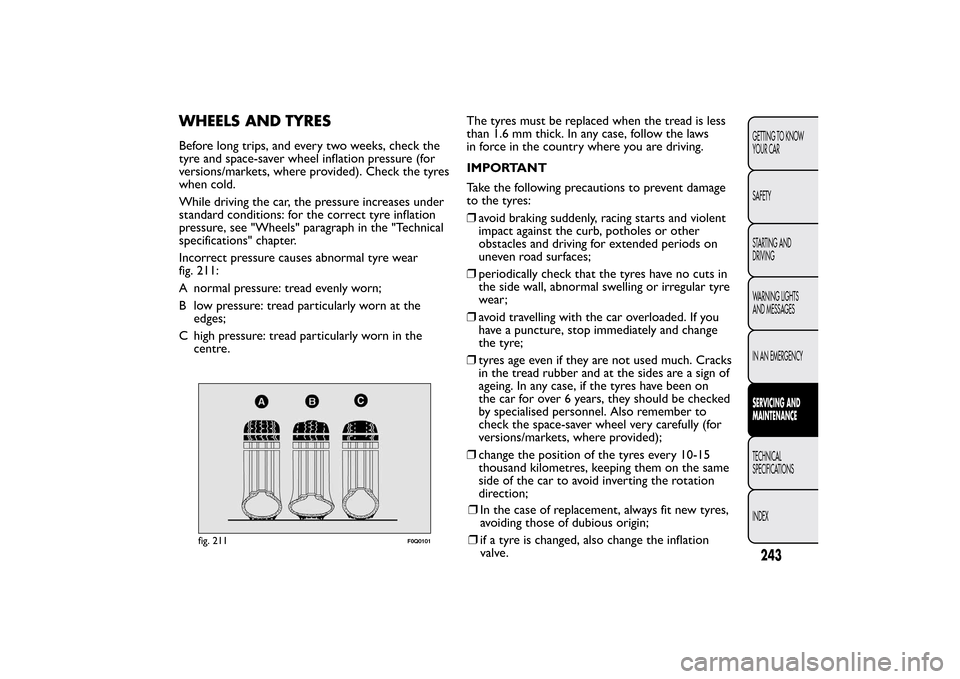
Incorrect pressure causes abnormal tyre wear
fig. 211:
A normal pressure: tread evenly worn;
B low pressure: tread particularly worn at the
edges;
C high pressure: tread particularly worn in the
centre.The tyres must be replaced when the tread is less
than 1.6 mm thick. In any case, follow the laws
in force in the country where you are driving.
IMPORTANT
Take the following precautions to prevent damage
to the tyres:
❒avoid braking suddenly, racing starts and violent
impact against the curb, potholes or other
obstacles and driving for extended periods on
uneven road surfaces;
❒periodically check that the tyres have no cuts in
the side wall, abnormal swelling or irregular tyre
wear;
❒avoid travelling with the car overloaded. If you
have a puncture, stop immediately and change
the tyre;
❒tyres age even if they are not used much. Cracks
in the tread rubber and at the sides are a sign of
ageing. In any case, if the tyres have been on
the car for over 6 years, they should be checked
by specialised personnel. Also remember to
check the space-saver wheel very carefully (for
versions/markets, where provided);
❒change the position of the tyres every 10-15
thousand kilometres, keeping them on the same
side of the car to avoid inverting the rotation
direction;
fig. 211
F0Q0101
243GETTING TO KNOW
YOUR CAR
SAFETY
STARTING AND
DRIVING
WARNING LIGHTS
AND MESSAGES
IN AN EMERGENCYSERVICING AND
MAINTENANCETECHNICAL
SPECIFICATIONS
INDEX
❒In the case of replacement, always fit new tyres,
avoiding those of dubious origin;
❒if a tyre is changed, also change the inflation
valve.
Page 253 of 299
Glasses
To clean glasses, use specific window cleaner
products.
Also use clean cloths to avoid scratching the glass
or damaging the transparency.
IMPORTANT Wipe the rear window inside gently
with a cloth in the direction of the filaments to
avoid damaging the heating device.
Engine compartment
At the end of each winter, thoroughly wash the
engine compartment, taking care to avoid spraying
the water jet directly onto the electronic control
units and the relay/fuse control unit on the left side
of the engine compartment (as you look from
behind the wheel). Have this operation performed
at a specialised workshop.
IMPORTANT The washing should take place with
the engine cold and the ignition key in the STOP
position. After the washing operation, make sure
that the various protections (e.g. rubber caps
and guards) have not been removed or damaged.Front headlights
IMPORTANT Never use aromatic substances (e.g.
petrol) or ketenes (e.g. acetone) for cleaning the
plastic lenses of the front headlights.
249GETTING TO KNOW
YOUR CAR
SAFETY
STARTING AND
DRIVING
WARNING LIGHTS
AND MESSAGES
IN AN EMERGENCYSERVICING AND
MAINTENANCETECHNICAL
SPECIFICATIONS
INDEX
Page 296 of 299
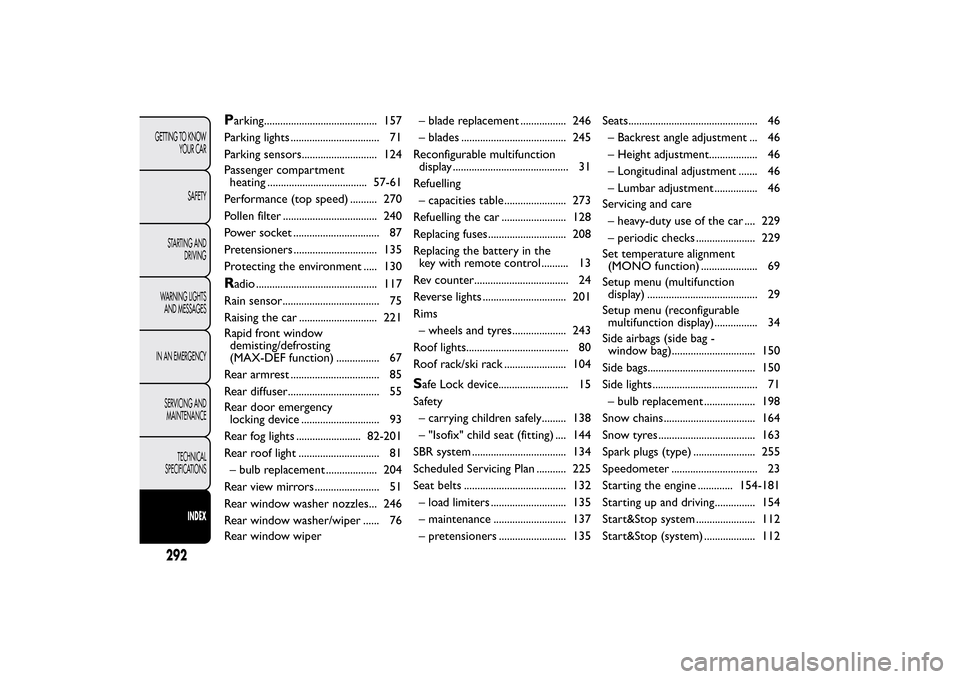
Parking.......................................... 157
Parking lights ................................. 71
Parking sensors............................ 124
Passenger compartment
heating ..................................... 57-61
Performance (top speed) .......... 270
Pollen filter ................................... 240
Power socket ................................ 87
Pretensioners ............................... 135
Protecting the environment ..... 130Radio ............................................. 117
Rain sensor.................................... 75
Raising the car ............................. 221
Rapid front window
demisting/defrosting
(MAX-DEF function) ................ 67
Rear armrest ................................. 85
Rear diffuser.................................. 55
Rear door emergency
locking device ............................. 93
Rear fog lights ........................ 82-201
Rear roof light .............................. 81
– bulb replacement ................... 204
Rear view mirrors ........................ 51
Rear window washer nozzles... 246
Rear window washer/wiper ...... 76
Rear window wiper– blade replacement ................. 246
– blades ....................................... 245
Reconfigurable multifunction
display ........................................... 31
Refuelling
– capacities table ....................... 273
Refuelling the car ........................ 128
Replacing fuses............................. 208
Replacing the battery in the
key with remote control .......... 13
Rev counter................................... 24
Reverse lights ............................... 201
Rims
– wheels and tyres.................... 243
Roof lights...................................... 80
Roof rack/ski rack ....................... 104
Safe Lock device.......................... 15
Safety
– carrying children safely......... 138
– "Isofix" child seat (fitting) .... 144
SBR system ................................... 134
Scheduled Servicing Plan ........... 225
Seat belts ...................................... 132
– load limiters ............................ 135
– maintenance ........................... 137
– pretensioners ......................... 135Seats................................................ 46
– Backrest angle adjustment ... 46
– Height adjustment.................. 46
– Longitudinal adjustment ....... 46
– Lumbar adjustment ................ 46
Servicing and care
– heavy-duty use of the car .... 229
– periodic checks ...................... 229
Set temperature alignment
(MONO function) ..................... 69
Setup menu (multifunction
display) ......................................... 29
Setup menu (reconfigurable
multifunction display)................ 34
Side airbags (side bag -
window bag)............................... 150
Side bags........................................ 150
Side lights....................................... 71
– bulb replacement ................... 198
Snow chains.................................. 164
Snow tyres .................................... 163
Spark plugs (type) ....................... 255
Speedometer ................................ 23
Starting the engine ............. 154-181
Starting up and driving............... 154
Start&Stop system ...................... 112
Start&Stop (system) ................... 112
292GETTING TO KNOW
YOUR CAR
SAFETY
STARTING AND
DRIVING
WARNING LIGHTS
AND MESSAGES
IN AN EMERGENCY
SERVICING AND
MAINTENANCE
TECHNICAL
SPECIFICATIONS
INDEX