seats FIAT BRAVO 2013 2.G User Guide
[x] Cancel search | Manufacturer: FIAT, Model Year: 2013, Model line: BRAVO, Model: FIAT BRAVO 2013 2.GPages: 299, PDF Size: 5.86 MB
Page 144 of 299
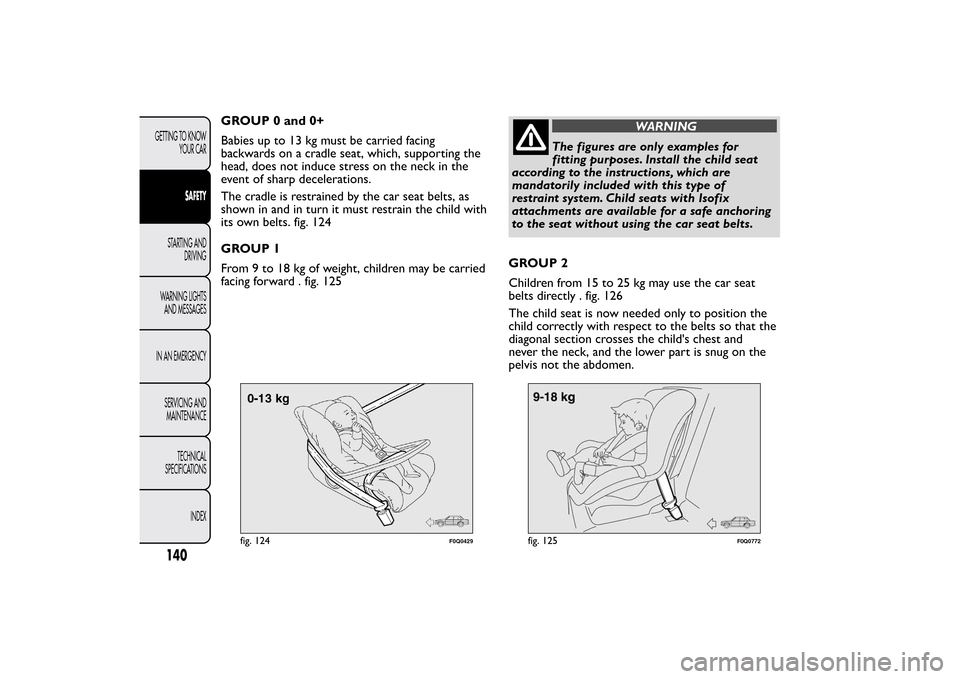
GROUP 0 and 0+
Babies up to 13 kg must be carried facing
backwards on a cradle seat, which, supporting the
head, does not induce stress on the neck in the
event of sharp decelerations.
The cradle is restrained by the car seat belts, as
shown in and in turn it must restrain the child with
its own belts. fig. 124
GROUP 1
From 9 to 18 kg of weight, children may be carried
facing forward . fig. 125
WARNING
The figures are only examples for
fitting purposes. Install the child seat
according to the instructions, which are
mandatorily included with this type of
restraint system. Child seats with Isofix
attachments are available for a safe anchoring
to the seat without using the car seat belts.
GROUP 2
Children from 15 to 25 kg may use the car seat
belts directly . fig. 126
The child seat is now needed only to position the
child correctly with respect to the belts so that the
diagonal section crosses the child's chest and
never the neck, and the lower part is snug on the
pelvis not the abdomen.
fig. 124
F0Q0429
fig. 125
F0Q0772
140GETTING TO KNOW
YOUR CAR
SAFETY
STARTING AND
DRIVING
WARNING LIGHTS
AND MESSAGES
IN AN EMERGENCY
SERVICING AND
MAINTENANCE
TECHNICAL
SPECIFICATIONS
INDEX
Page 146 of 299
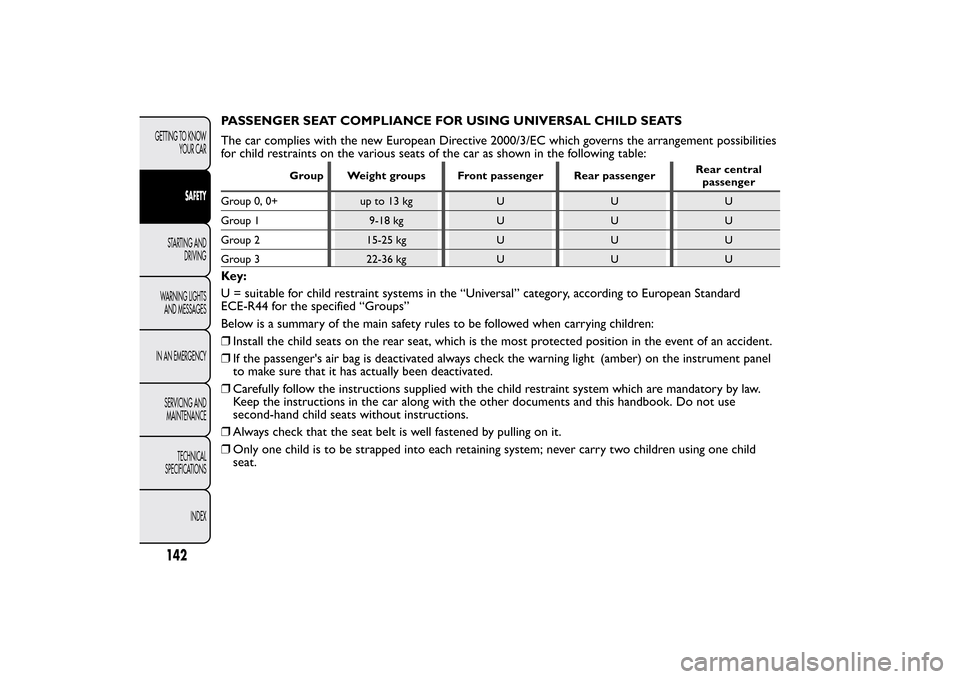
PASSENGER SEAT COMPLIANCE FOR USING UNIVERSAL CHILD SEATS
The car complies with the new European Directive 2000/3/EC which governs the arrangement possibilities
for child restraints on the various seats of the car as shown in the following table:
Group Weight groups Front passenger Rear passengerRear central
passenger
Group 0, 0+ up to 13 kg U U U
Group 1 9-18 kg U U U
Group 2 15-25 kg U U U
Group 3 22-36 kg U U U
Key:
U = suitable for child restraint systems in the “Universal” category, according to European Standard
ECE-R44 for the specified “Groups”
Below is a summary of the main safety rules to be followed when carrying children:
❒Install the child seats on the rear seat, which is the most protected position in the event of an accident.
❒If the passenger's air bag is deactivated always check the warning light (amber) on the instrument panel
to make sure that it has actually been deactivated.
❒Carefully follow the instructions supplied with the child restraint system which are mandatory by law.
Keep the instructions in the car along with the other documents and this handbook. Do not use
second-hand child seats without instructions.
❒Always check that the seat belt is well fastened by pulling on it.
❒Only one child is to be strapped into each retaining system; never carry two children using one child
seat.
142GETTING TO KNOW
YOUR CAR
SAFETY
STARTING AND
DRIVING
WARNING LIGHTS
AND MESSAGES
IN AN EMERGENCY
SERVICING AND
MAINTENANCE
TECHNICAL
SPECIFICATIONS
INDEX
Page 148 of 299
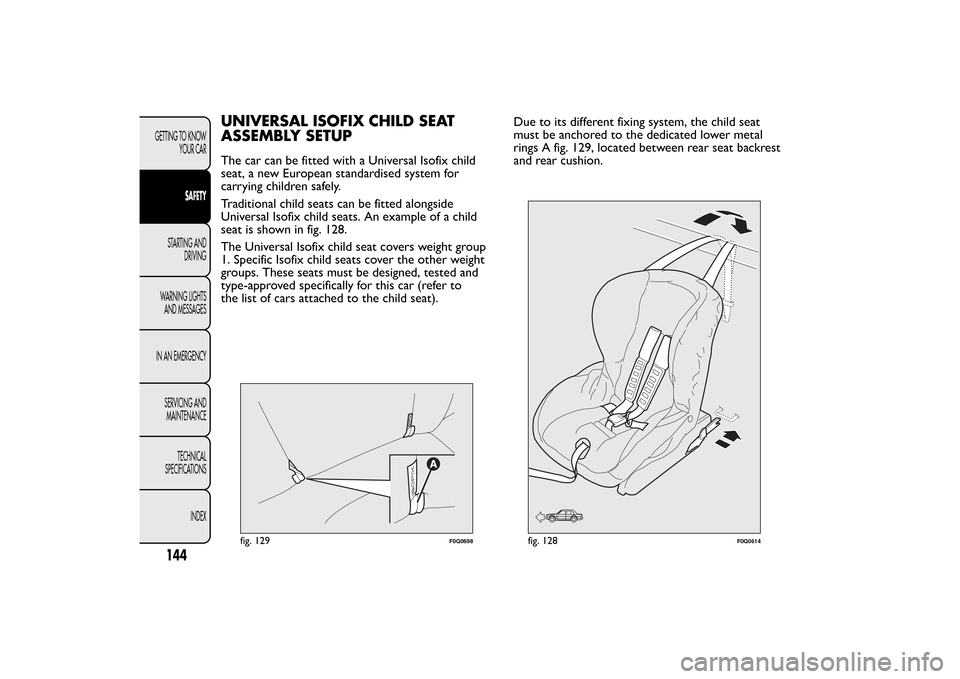
UNIVERSAL ISOFIX CHILD SEAT
ASSEMBLY SETUPThe car can be fitted with a Universal Isofix child
seat, a new European standardised system for
carrying children safely.
Traditional child seats can be fitted alongside
Universal Isofix child seats. An example of a child
seat is shown in fig. 128.
The Universal Isofix child seat covers weight group
1. Specific Isofix child seats cover the other weight
groups. These seats must be designed, tested and
type-approved specifically for this car (refer to
the list of cars attached to the child seat).Due to its different fixing system, the child seat
must be anchored to the dedicated lower metal
rings A fig. 129, located between rear seat backrest
and rear cushion.
fig. 129
F0Q0698
fig. 128
F0Q0614
144GETTING TO KNOW
YOUR CAR
SAFETY
STARTING AND
DRIVING
WARNING LIGHTS
AND MESSAGES
IN AN EMERGENCY
SERVICING AND
MAINTENANCE
TECHNICAL
SPECIFICATIONS
INDEX
Page 149 of 299
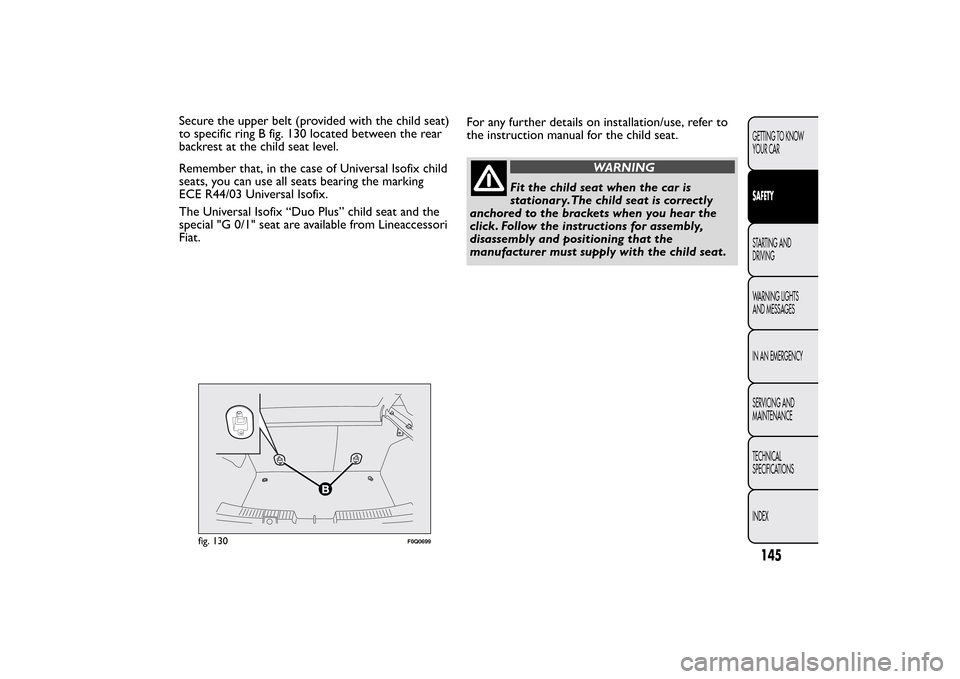
Secure the upper belt (provided with the child seat)
to specific ring B fig. 130 located between the rear
backrest at the child seat level.
Remember that, in the case of Universal Isofix child
seats, you can use all seats bearing the marking
ECE R44/03 Universal Isofix.
The Universal Isofix “Duo Plus” child seat and the
special "G 0/1" seat are available from Lineaccessori
Fiat.For any further details on installation/use, refer to
the instruction manual for the child seat.
WARNING
Fit the child seat when the car is
stationary.The child seat is correctly
anchored to the brackets when you hear the
click. Follow the instructions for assembly,
disassembly and positioning that the
manufacturer must supply with the child seat .
fig. 130
F0Q0699
145GETTING TO KNOW
YOUR CARSAFETYSTARTING AND
DRIVING
WARNING LIGHTS
AND MESSAGES
IN AN EMERGENCY
SERVICING AND
MAINTENANCE
TECHNICAL
SPECIFICATIONS
INDEX
Page 150 of 299
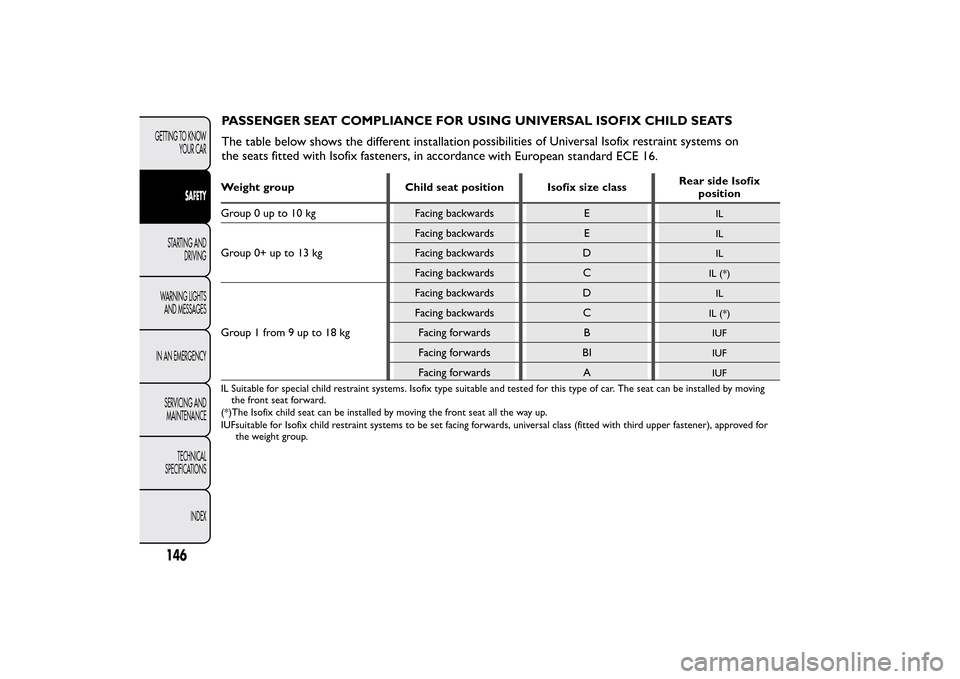
Weight group Child seat position Isofix size classRear side Isofix
position
Group 0 up to 10 kg Facing backwards E
IL
Group 0+ up to 13 kgFacing backwards E
IL
Facing backwards D
IL
Facing backwards C
IL (*)
Group1from9upto18kgFacing backwards D
IL
Facing backwards C
IL (*)
Facing forwards B
IUF
Facing forwards BI
IUF
Facing forwards A
IUF
IL Suitable for special child restraint systems. Isofix type suitable and tested for this type of car. The seat can be installed by moving
the front seat forward.
(*)The Isofix child seat can be installed by moving the front seat all the way up.
IUFsuitable for Isofix child restraint systems to be set facing forwards, universal class (fitted with third upper fastener), approved for
the weight group.
146GETTING TO KNOW
YOUR CAR
SAFETY
STARTING AND
DRIVING
WARNING LIGHTS
AND MESSAGES
IN AN EMERGENCY
SERVICING AND
MAINTENANCE
TECHNICAL
SPECIFICATIONS
INDEX
PASSENGER SEAT COMPLIANCE FORUSING UNIVERSAL ISOFIX CHILD SEATS
The table below shows the different installationpossibilities of Universal Isofix restraint systems on
the seats fitted with Isofix fasteners, in accordance
with European standard ECE 16.
Page 155 of 299
Therefore, front side bags (for versions/markets,
where provided) are not a replacement of, but
complementary to, seat belts, which you are
recommended to always wear, as specified by law in
Europe and most non-European countries.
IMPORTANT In the event of a side impact, the
system provides best protection if the passenger
sits on the seat in a correct position, thus allowing
correct window bag deployment.
IMPORTANT Do not wash the seats with water or
pressurised steam (wash by hand or at automatic
seat washing stations).
WARNING
Do not affix rigid objects to the
garment hooks or support handles.
WARNING
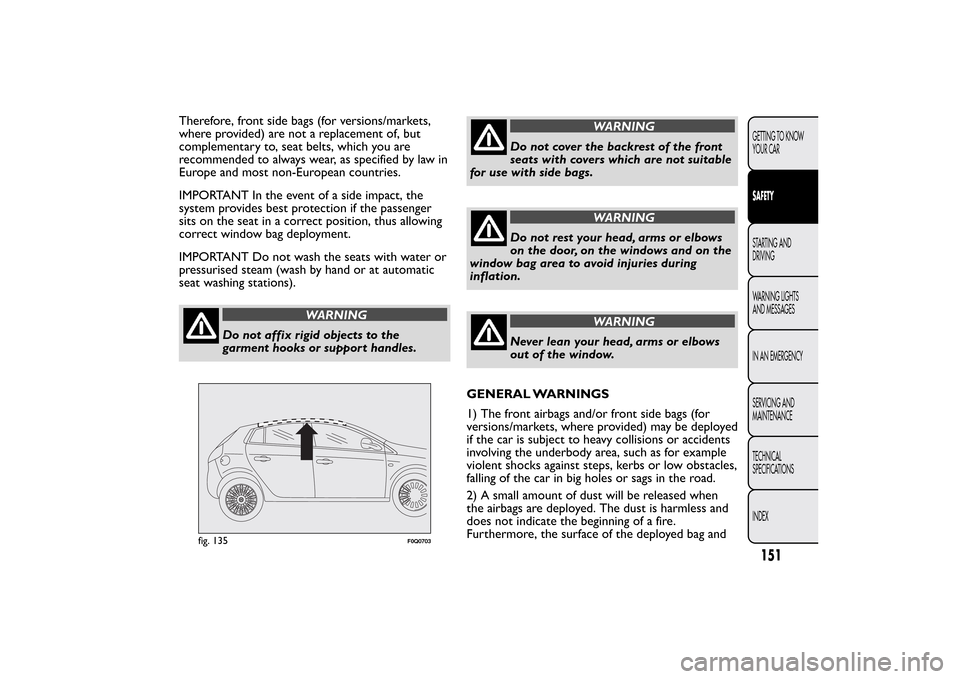
Do not cover the backrest of the front
seats with covers which are not suitable
for use with side bags.
WARNING
Do not rest your head, arms or elbows
on the door, on the windows and on the
window bag area to avoid injuries during
inflation.
WARNING
Never lean your head, arms or elbows
out of the window.
GENERAL WARNINGS
1) The front airbags and/or front side bags (for
versions/markets, where provided) may be deployed
if the car is subject to heavy collisions or accidents
involving the underbody area, such as for example
violent shocks against steps, kerbs or low obstacles,
falling of the car in big holes or sags in the road.
2) A small amount of dust will be released when
the airbags are deployed. The dust is harmless and
does not indicate the beginning of a fire.
Furthermore, the surface of the deployed bag and
fig. 135
F0Q0703
151GETTING TO KNOW
YOUR CARSAFETYSTARTING AND
DRIVING
WARNING LIGHTS
AND MESSAGES
IN AN EMERGENCY
SERVICING AND
MAINTENANCE
TECHNICAL
SPECIFICATIONS
INDEX
Page 161 of 299
PARKINGProceed as follows:
❒stop the engine and engage the handbrake;
❒engage a gear (on a slope, engage first gear if the
car is facing uphill or reverse if it is facing
downhill) and leave the wheels steered.
If the car is parked on a steep slope, it is also
advisable to block the wheels with a wedge or
stone. Do not leave the ignition key on MAR-ON
to avoid draining the battery. Always remove the
key when you leave the car.
HANDBRAKE
The handbrake is located between the front seats.
Pull the lever upwards to operate the handbrake,
until the car is braked.
Four or five clicks are generally enough when the
car is on level ground while nine or ten may be
required if the car is on a steep slope and laden.
IMPORTANT If this is not the case, contact a Fiat
Dealership to have the handbrake adjusted.
For cars equipped with a front armrest, lift this up
to ensure that it does not interfere with the action
of the handbrake.
WARNING
Never leave children in the unattended
car. Always remove the ignition key
when leaving the car and take it out with you.
When the handbrake is on and the ignition key is at
MAR-ON position, the warning light
will come
on in the instrument panel.
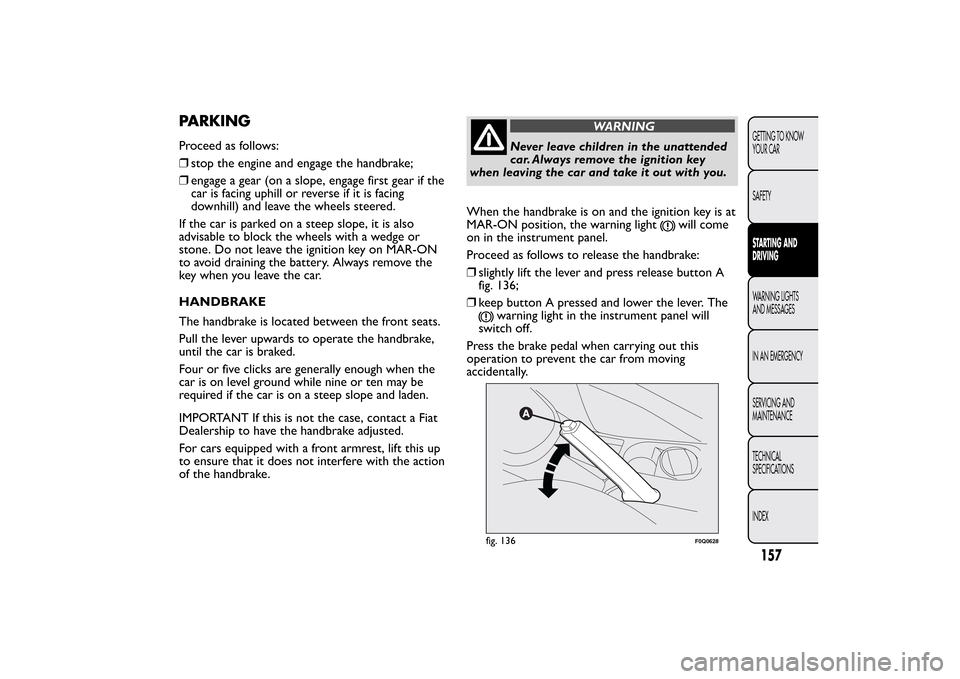
Proceed as follows to release the handbrake:
❒slightly lift the lever and press release button A
fig. 136;
❒keep button A pressed and lower the lever. The
warning light in the instrument panel will
switch off.
Press the brake pedal when carrying out this
operation to prevent the car from moving
accidentally.fig. 136
F0Q0628
157GETTING TO KNOW
YOUR CAR
SAFETYSTARTING AND
DRIVINGWARNING LIGHTS
AND MESSAGES
IN AN EMERGENCY
SERVICING AND
MAINTENANCE
TECHNICAL
SPECIFICATIONS
INDEX
Page 219 of 299
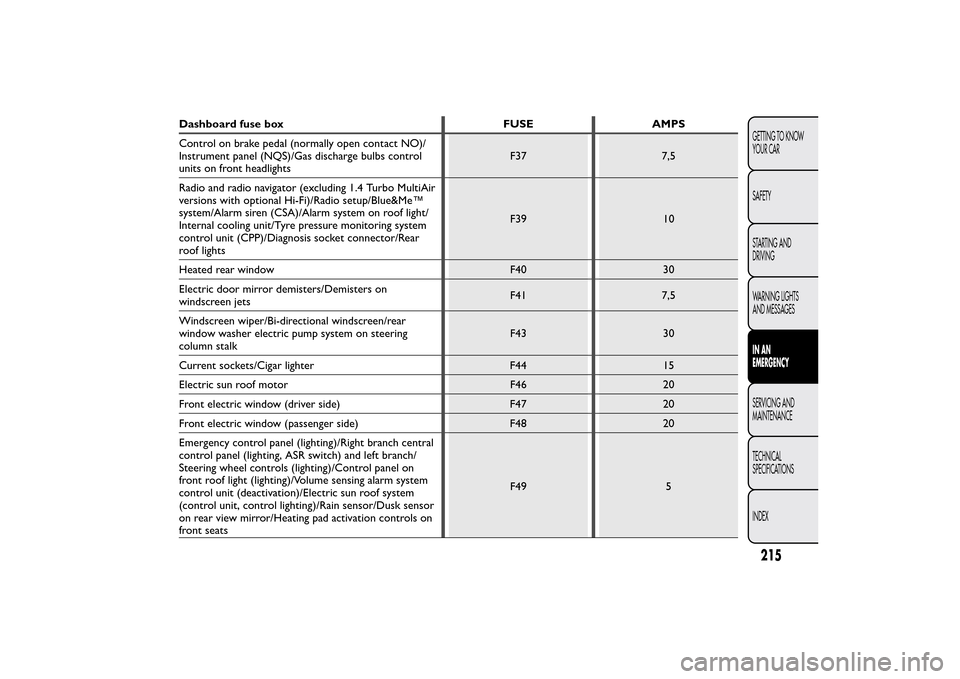
Dashboard fuse box FUSE AMPS
Control on brake pedal (normally open contact NO)/
Instrument panel (NQS)/Gas discharge bulbs control
units on front headlightsF37 7,5
Radio and radio navigator (excluding 1.4 Turbo MultiAir
versions with optional Hi-Fi)/Radio setup/Blue&Me™
system/Alarm siren (CSA)/Alarm system on roof light/
Internal cooling unit/Tyre pressure monitoring system
control unit (CPP)/Diagnosis socket connector/Rear
roof lightsF39 10
Heated rear window F40 30
Electric door mirror demisters/Demisters on
windscreen jetsF41 7,5
Windscreen wiper/Bi-directional windscreen/rear
window washer electric pump system on steering
column stalkF43 30
Current sockets/Cigar lighter F44 15
Electric sun roof motor F46 20
Front electric window (driver side) F47 20
Front electric window (passenger side) F48 20
Emergency control panel (lighting)/Right branch central
control panel (lighting, ASR switch) and left branch/
Steering wheel controls (lighting)/Control panel on
front roof light (lighting)/Volume sensing alarm system
control unit (deactivation)/Electric sun roof system
(control unit, control lighting)/Rain sensor/Dusk sensor
on rear view mirror/Heating pad activation controls on
front seatsF49 5
215GETTING TO KNOW
YOUR CAR
SAFETY
STARTING AND
DRIVING
WARNING LIGHTS
AND MESSAGESIN AN
EMERGENCYSERVICING AND
MAINTENANCE
TECHNICAL
SPECIFICATIONS
INDEX
Page 254 of 299
INTERIORSPeriodically check for water puddles under the mats
that could cause the panels to rust.
Replace the worn carpet mats, if present, with
genuine products and make sure they remain
securely fastened to the passenger compartment
carpet. It is not advisable to use non genuine mats
that could move whilst driving.
WARNING
Never use flammable products, such as
petrol ether or rectified petrol to
clean the inside of the car.The electrostatic
charges which are generated by rubbing during
the cleaning operation may cause a fire.
WARNING
Do not keep aerosol cans in the car:
they might explode. Aerosol cans must
not be exposed to a temperature exceeding
50°C .When the car is exposed to sunlight ,
internal temperature can greatly exceed this
value.SEATS AND FABRIC PARTS
Remove dust with a soft brush or a vacuum cleaner.
Rub the seats with a sponge and a solution of
water and mild soap.
LEATHER SEATS
Remove the dry dirt with a buckskin or slightly
damp cloth, without exercising too much pressure.
Remove any liquid or grease stains using an
absorbent dry cloth, without rubbing. Then clean
with a soft cloth or buckskin cloth dampened with
water and neutral soap.
If the stain persists, use specific products and
observe the instructions carefully.
IMPORTANT Never use alcohol. Make sure that
the cleaning products used contain no alcohol
or alcohol derivatives, even in small quantities.
The fabric upholstery of your car has
been designed to withstand wear
deriving from common use of the car.You
are however recommended to avoid strong
and/or continuous scratching with clothing
accessories such as metal buckles, studs,Velcro
fastenings and the like, as these items cause
stress of the cover fabric that could lead to yarn
breaking and damage the upholstery.
250GETTING TO KNOW
YOUR CAR
SAFETY
STARTING AND
DRIVING
WARNING LIGHTS
AND MESSAGES
IN AN EMERGENCYSERVICING AND
MAINTENANCE
TECHNICAL
SPECIFICATIONS
INDEX
Page 286 of 299
PRESCRIPTIONS FOR HANDLING THE VEHICLE AT THE END OF ITS LIFEFiat has been committed for many years to safeguarding the environment through the constant improvement
of its production processes and manufacturing products that are increasingly compatible with the ecosystem.
European Directive 2000/53/EC governing vehicles at the end of their life, Fiat is offering their customers the
opportunity of handing over their vehicle (*) at the end of its life without incurring any additional costs.
The European Directive sets out that when the vehicle is handed over the last keeper or owner should not
incur any expenses as a result of it having a zero or negative market value. In particular, in almost all European
Union countries, until 1st January 2007, vehicles registered after 1st July 2002 will be collected free of
charge, whilst from 2007 collection will be free of charge irrespective of the year of registration as long as the
vehicle contains its basic components (in particular, the engine and bodywork) and has no additional waste.
To hand your vehicle over at the end of its life without extra cost, go to one of our Dealerships or
Fiat-authorised collection and scrapping centres. These centres have been carefully chosen to offer high
quality service for the collection, treatment and recycling of vehicles at their end of life, respecting the
surrounding environment.
You can find further information on these collection and scrapping centres either from a Fiat and Fiat
Commercial Vehicle Dealership or by calling the toll-free number 00800 3428 0000 or on the Fiat website.
(*) Vehicle for transporting passengers with a maximum of nine seats and a total permitted weight of 3.5 t
282GETTING TO KNOW
YOUR CAR
SAFETY
STARTING AND
DRIVING
WARNING LIGHTS
AND MESSAGES
IN AN EMERGENCY
SERVICING AND
MAINTENANCE
TECHNICAL
SPECIFICATIONS
INDEX