stop start FIAT BRAVO 2013 2.G Owner's Guide
[x] Cancel search | Manufacturer: FIAT, Model Year: 2013, Model line: BRAVO, Model: FIAT BRAVO 2013 2.GPages: 299, PDF Size: 5.86 MB
Page 125 of 299
WARNING
Before starting any servicing operation,
stop the engine and remove the key
from the ignition switch to operate the
steering lock, particularly when the wheels do
not touch the ground. If this is not possible
(for example if the key needs to be turned to
MAR-ON or the engine must be running),
remove the main fuse that protects the
electric power steering.
TYRE PRESSURE MONITORING
SYSTEM TPMS(Tyre Pressure Monitoring System)
(for versions/markets, where provided)
The car may be fitted with a tyre pressure
monitoring system (TPMS), which informs the
driver of the tyre inflation status via the "Check
tyre pressure" and "Low tyre pressure" messages
on the display. For a detailed description of the two
messages, see "Warning lights and messages"
chapter. This system comprises a radio frequency
transmitter fitted to each wheel (on the wheel rim
inside the tyre), which is able to send information
on the tyre inflation pressure of each wheel to
the control unit.
WARNING
The presence of TPMS does not
exonerate the driver from regularly
checking the pressure of the tyres and the
spare wheel (see "Wheels" in the
"Maintenance and care" chapter).
WARNING
Sensor malfunctioning fault indications are not
stored and will therefore not be displayed after the
engine has been switched off and then on again. If
the fault conditions persist, the control unit will
121GETTING TO
KNOW YOUR CARSAFETY
STARTING AND
DRIVING
WARNING LIGHTS
AND MESSAGES
IN AN EMERGENCY
SERVICING AND
MAINTENANCE
TECHNICAL
SPECIFICATIONS
INDEX
Page 126 of 299
send the relative indications to the instrument
panel only after the vehicle has been in motion for a
short time.
Tyre pressure must be checked with tyres rested
and cold. Should it become necessary for whatever
reason to check pressure with warm tyres, do
not reduce pressure even though it is higher than
the prescribed value, but repeat the check when
tyres are cold (see "Wheels" in the "Technical data"
chapter).
The TPMS cannot indicate sudden tyre pressure
drops (for example when a tyre bursts). In this
case, stop the car, braking with caution and avoiding
abrupt steering.
Strong radio-frequency interference could inhibit
the correct operation of the TPMS. This condition
is indicated to the driver by the
warning light
or the symbol lighting up on the instrument panel
together with a message on the display. The
message will disappear automatically as soon as the
interference ceases to affect the system.
The TPMS requires the use of specific equipment.
Contact a Fiat Dealership to find out which
accessories are compatible with the system
(wheels, hub caps, etc.). Using other accessories
may hinder the normal operation of the system.
Given the valve unique specifications, only use
Fiat-approved sealers to repair the tyres. The use of
other sealers may affect the normal operation of
the system.If the vehicle is fitted with TPMS, when a tyre is
removed, it is advisable to replace the rubber
gasket for the valve as well as the ring nut fixing the
sensor. Have this operation performed at a Fiat
Dealership.
If the "punctured tyre" indication persists on the
instrument panel after the initial conditions have
been restored using the Fix&Go Automatic tyre
repair kit, contact a Fiat Dealership.
Changes in outside temperature may cause tyre
pressures to vary. The TPMS may temporarily
indicate insufficient pressure. In this case, check the
tyre pressure when cold and, if necessary, restore
the inflation values.
If the vehicle is fitted with TPMS, tyre and/or rims
fitting/removal operations require specific
precautions. To avoid damaging the sensors or
fitting them incorrectly, tyre and/or rims
fitting/removal operations should be carried out
only by specialists. Contact a Fiat Dealership.
122GETTING TO
KNOW YOUR CAR
SAFETY
STARTING AND
DRIVING
WARNING LIGHTS
AND MESSAGES
IN AN EMERGENCY
SERVICING AND
MAINTENANCE
TECHNICAL
SPECIFICATIONS
INDEX
Page 129 of 299
When reverse gear is released, the front and rear
sensors remain activated until a speed of around 15
km/h is exceeded to allow the parking manoeuvre
to be completed.
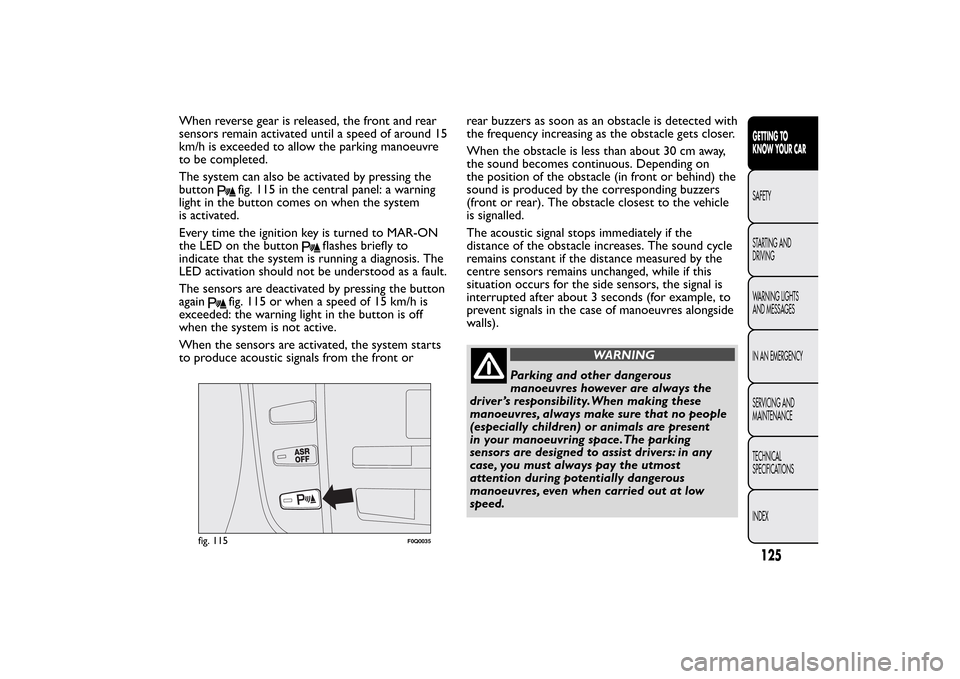
The system can also be activated by pressing the
button
fig. 115 in the central panel: a warning
light in the button comes on when the system
is activated.
Every time the ignition key is turned to MAR-ON
the LED on the button
flashes briefly to
indicate that the system is running a diagnosis. The
LED activation should not be understood as a fault.
The sensors are deactivated by pressing the button
again
fig. 115 or when a speed of 15 km/h is
exceeded: the warning light in the button is off
when the system is not active.
When the sensors are activated, the system starts
to produce acoustic signals from the front orrear buzzers as soon as an obstacle is detected with
the frequency increasing as the obstacle gets closer.
When the obstacle is less than about 30 cm away,
the sound becomes continuous. Depending on
the position of the obstacle (in front or behind) the
sound is produced by the corresponding buzzers
(front or rear). The obstacle closest to the vehicle
is signalled.
The acoustic signal stops immediately if the
distance of the obstacle increases. The sound cycle
remains constant if the distance measured by the
centre sensors remains unchanged, while if this
situation occurs for the side sensors, the signal is
interrupted after about 3 seconds (for example, to
prevent signals in the case of manoeuvres alongside
walls).
WARNING
Parking and other dangerous
manoeuvres however are always the
driver ’s responsibility.When making these
manoeuvres, always make sure that no people
(especially children) or animals are present
in your manoeuvring space.The parking
sensors are designed to assist drivers: in any
case, you must always pay the utmost
attention during potentially dangerous
manoeuvres, even when carried out at low
speed.
fig. 115
F0Q0035
125GETTING TO
KNOW YOUR CARSAFETY
STARTING AND
DRIVING
WARNING LIGHTS
AND MESSAGES
IN AN EMERGENCY
SERVICING AND
MAINTENANCE
TECHNICAL
SPECIFICATIONS
INDEX
Page 130 of 299
ACOUSTIC SIGNAL
The information concerning the presence and
distance of an obstacle from the vehicle is
transmitted by means of acoustic signals from
buzzers installed in the passenger compartment:
❒in the versions with 4 rear sensors, a buzzer
in the front dashboard area warns of the
presence of rear obstacles;
❒in the versions with 8 sensors (4 front and 4 rear
sensors), a front buzzer warns of the presence of
obstacles at the front and a buzzer located at
the rear warns of the presence of obstacles
at the rear. This notifies the driver of the
direction (front/rear) of the obstacles.
When reverse gear is engaged an intermittent
acoustic signal is automatically activated.
The acoustic signal:
❒increases as the distance between the car and the
obstacle decreases;
❒becomes continuous when the distance between
the car and the obstacle is less than 30 cm and
stops immediately if the distance increases;
❒remains constant if the distance remains
unchanged; if this situation concerns the side
sensors, the buzzer will stop after about 3
seconds to avoid, for example, warning
indications in the event of manoeuvres along
walls.
WARNING
For correct operation, sensors must
always be clean from mud, dir t , snow
or ice. Be careful not to scratch or damage the
sensors while cleaning them. Avoid using dr y,
rough or hard cloths.The sensors should be
washed using clean water with the addition of
car shampoo if necessary. In washing stations,
clean sensors quickly keeping the vapour
jet/high pressure washing nozzles at 10 cm at
least from the sensors.
WARNING
Only have the bumpers repainted or
any retouches to the paintwork in the
area of the sensors carried out by a Fiat
Dealership. Incorrect paint application could
affect the operation of the parking sensors.
SENSOR OPERATING RANGE
The sensors allow the system to check the front
part (version with 8 sensors) and rear part of the
vehicle.
Their position covers the middle and side areas of
the front and rear of the vehicle.
126GETTING TO
KNOW YOUR CAR
SAFETY
STARTING AND
DRIVING
WARNING LIGHTS
AND MESSAGES
IN AN EMERGENCY
SERVICING AND
MAINTENANCE
TECHNICAL
SPECIFICATIONS
INDEX
Page 157 of 299
WARNING
If the car has been stolen or in the case
of attempt to steal it , if it has been
subjected to vandalism or floods, have the
airbag system checked by a Fiat Dealership.
WARNING
The airbags may also be deployed
when the car is not moving, if the key is
in the ignition and turned to MAR-ON, even
with the engine off, if the car is hit by another
moving vehicle. For this reason, children must
never occupy the front seat , even if the car
is not moving. On the other hand, if the key is
inserted in STOP position, none of the safety
devices (airbags or pretensioners) will be
deployed in the event of impact . Non-
deployment of these devices does not indicate
a system malfunction.
WARNING
When the ignition key is turned to
MAR-ON, the warning light
(with
passenger's front airbag activated) turns on
and flashes for a few seconds to remind you
that the passenger's airbag will be deployed in
a crash, after which it should go off.
WARNING
The front airbag is designed to be
deployed for impacts of a greater
intensity than for the pretensioners. For
impacts whose intensity falls between the two
activation levels, it is normal for only the
pretensioners to be activated.
WARNING
The airbag does not replace seat belts
but increases their efficiency.
Furthermore, since front airbags are not
deployed in low-speed frontal impacts, side
impacts, rear shunts or roll-overs, the
passengers are protected only by the seat belts
which must therefore be fastened at all
times.
153GETTING TO KNOW
YOUR CARSAFETYSTARTING AND
DRIVING
WARNING LIGHTS
AND MESSAGES
IN AN EMERGENCY
SERVICING AND
MAINTENANCE
TECHNICAL
SPECIFICATIONS
INDEX
Page 159 of 299
If the engine does not start at the first attempt,
return the ignition key to STOP before attempting
to start again.
If, when the ignition key is on MAR, the instrument
panel warning light
remains on together with
warning light
, turn the key to STOP and then
back to MAR; if the warning light remains on,
try the other keys provided with the vehicle.
If you are still unable to start the engine, perform
the emergency start-up procedure (see "Emergency
start-up" in "In an emergency" chapter) and
contact a Fiat Dealership.
IMPORTANT Never leave the ignition key at
MAR-ON when the engine is stopped.
STARTING PROCEDURE FOR DIESEL
VERSIONS
Proceed as follows:
❒ensure that the handbrake is up;
❒put the gear lever into neutral;
❒turn the ignition key to MAR: the warning lights
and
on the instrument panel will turn
on;
❒wait for the warning lights
and
to switch
off. The hotter the engine is, the quicker this will
happen;❒press the clutch pedal down to the floor without
touching the accelerator;
❒turn the ignition key to AVV as soon as warning
light
switches off. Waiting too long will
waste the work done by the glow plugs.
Release the key as soon as the engine starts.
IMPORTANT With cold engine, the accelerator
must be entirely released when turning the ignition
key to position AVV.
If the engine does not start at the first attempt,
return the ignition key to STOP before attempting
to start again.
If, when the ignition key is at MAR the
warning
light remains lit, turn the key to STOP and then
back to MAR; if the warning light remains lit, try
with the other keys provided with the car.
If you still cannot start the engine, contact a Fiat
Dealership.
IMPORTANT Never leave the ignition key at
MAR-ON when the engine is stopped.
Warning light
will flash for 60
seconds after starting or during
prolonged cranking to indicate a fault
with the glow plug heating system.You can use
the car as usual if the engine starts but you
should contact a Fiat Dealership as soon as
possible.
155GETTING TO KNOW
YOUR CAR
SAFETYSTARTING AND
DRIVINGWARNING LIGHTS
AND MESSAGES
IN AN EMERGENCY
SERVICING AND
MAINTENANCE
TECHNICAL
SPECIFICATIONS
INDEX
Page 160 of 299
HOW TO WARM UP THE ENGINE AFTER
IT HAS JUST STARTED
Proceed as follows:
❒Drive off slowly, letting the engine turn at
medium revs. Do not accelerate abruptly;
❒Do not demand full performance at first. Wait
until the engine coolant temperature gauge
starts moving.
Never jump start the engine by pushing,
towing or coasting downhill.This could
cause fuel to flow into the catalytic
conver ter and damage it beyond repair.
EMERGENCY START-UP
Contact a Fiat Dealership if instrument panel
warning light
(or the symbol on the display)
stays on constantly.STOPPING THE ENGINE
Turn the ignition key to STOP while the engine is
idling.
IMPORTANT After a taxing drive, you should allow
the engine to “catch its breath” before turning it
off by letting it idle to allow the temperature in the
engine compartment to fall.
A quick burst on the accelerator before
turning off the engine serves absolutely
no practical purpose, it wastes fuel and is
damaging especially to turbocharged engines.
156GETTING TO KNOW
YOUR CAR
SAFETYSTARTING AND
DRIVINGWARNING LIGHTS
AND MESSAGES
IN AN EMERGENCY
SERVICING AND
MAINTENANCE
TECHNICAL
SPECIFICATIONS
INDEX
Page 161 of 299
PARKINGProceed as follows:
❒stop the engine and engage the handbrake;
❒engage a gear (on a slope, engage first gear if the
car is facing uphill or reverse if it is facing
downhill) and leave the wheels steered.
If the car is parked on a steep slope, it is also
advisable to block the wheels with a wedge or
stone. Do not leave the ignition key on MAR-ON
to avoid draining the battery. Always remove the
key when you leave the car.
HANDBRAKE
The handbrake is located between the front seats.
Pull the lever upwards to operate the handbrake,
until the car is braked.
Four or five clicks are generally enough when the
car is on level ground while nine or ten may be
required if the car is on a steep slope and laden.
IMPORTANT If this is not the case, contact a Fiat
Dealership to have the handbrake adjusted.
For cars equipped with a front armrest, lift this up
to ensure that it does not interfere with the action
of the handbrake.
WARNING
Never leave children in the unattended
car. Always remove the ignition key
when leaving the car and take it out with you.
When the handbrake is on and the ignition key is at
MAR-ON position, the warning light
will come
on in the instrument panel.
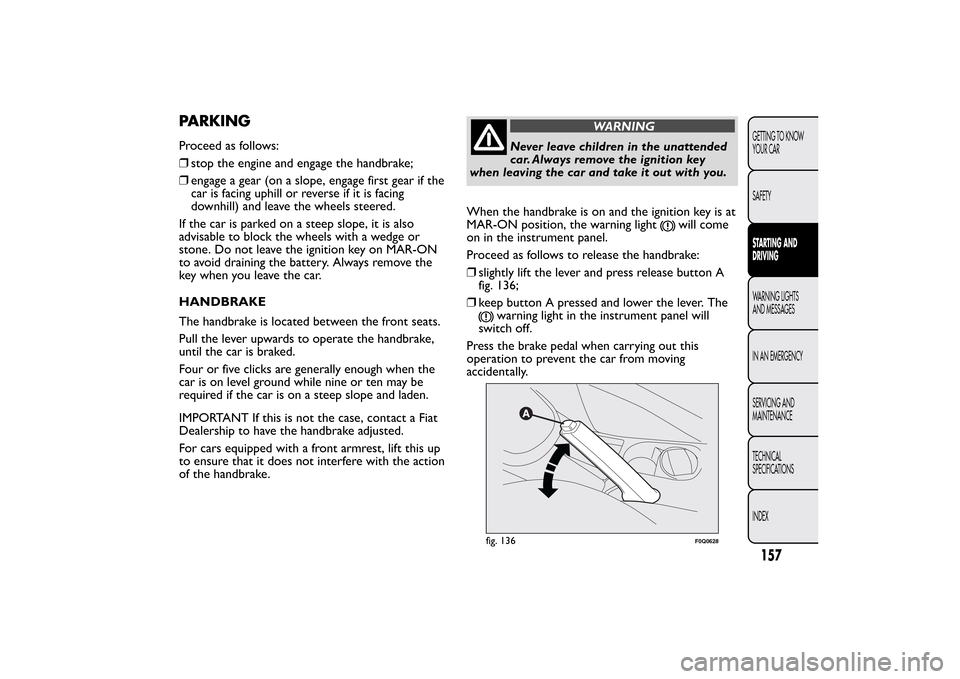
Proceed as follows to release the handbrake:
❒slightly lift the lever and press release button A
fig. 136;
❒keep button A pressed and lower the lever. The
warning light in the instrument panel will
switch off.
Press the brake pedal when carrying out this
operation to prevent the car from moving
accidentally.fig. 136
F0Q0628
157GETTING TO KNOW
YOUR CAR
SAFETYSTARTING AND
DRIVINGWARNING LIGHTS
AND MESSAGES
IN AN EMERGENCY
SERVICING AND
MAINTENANCE
TECHNICAL
SPECIFICATIONS
INDEX
Page 170 of 299
WARNING LIGHTS AND MESSAGES
WARNING LIGHTS AND MESSAGESGENERAL WARNINGS
Warning lights are accompanied by a specific
message and/or acoustic warning where provided
by the control panel. These indications areconcise
and precautionaryand, as such, must not be
considered as exhaustive and/or an alternative to
the information contained in this Owner
Handbook, which you are advised to read carefully
in all cases. In the event of a failure indication,
always refer to the contents of this chapter.
IMPORTANT Failure indications displayed are
divided into two categories:very seriousandless
seriousfailures.
Very seriousfailures are indicated by a repeated
and prolonged warning "cycle".
Less seriousfailures are indicated by a shorter
warning "cycle".
The display cycle of both failure types can be
stopped by pressing theMODEbutton. The
warning light (or symbol in the display) will remain
on until the cause of the malfunction is eliminated.
BRAKE FLUID LOW (red) /
HANDBRAKE ENGAGED (red)
Turning the key to the MAR-ON position the
warning light switches on, but it should switch off
after a few seconds.
LOW BRAKE FLUID LEVEL
The warning light switches on when the level of the
brake fluid in the reservoir falls below the
minimum level due to a possible leak in the circuit.
On some versions the display shows the dedicated
message.
WARNING
If the
warning light switches on
while driving, stop immediately and
contact a Fiat Dealership.
166GETTING TO KNOW
YOUR CAR
SAFETY
STARTING AND
DRIVINGWARNING LIGHTS
AND MESSAGESIN AN EMERGENCY
SERVICING AND
MAINTENANCE
TECHNICAL
SPECIFICATIONS
INDEX
Page 173 of 299
1. Low engine oil pressure
The warning light switches on constantly together
(for versions/markets, where provided) with a
message on the display when the system detects
that the engine oil pressure is too low.
WARNING
If the warning light
turns on
when the car is travelling (on certain
versions together with the message on the
display) stop the engine immediately and
contact a Fiat Dealership.
2. Engine oil deteriorated
(only MultiJet versions with DPF)
The warning light will flash and a specific message
will appear on the display (for versions/markets,
where provided). The warning light may flash in the
following ways, depending on the version:
❒for 1 minute every two hours;
❒cycles of 3 minutes with intervals with the
warning light off for 5 seconds until the oil is
changed.
After the first indication, at each engine start-up
the warning light will continue flashing as described
above until the oil is changed. The display (for
versions/markets, where provided), shows a
dedicated message together with the warning light.The flashing of this warning light should not be
considered as a fault; it informs the customer that
the oil needs to be changed following normal car
use.
Note that engine oil degrades faster under the
following circumstances:
❒mainly town use of the car which makes the DPF
regeneration process more frequent;
❒use of the car for short drives, in which the
engine does not have time to reach its regular
operating temperature;
❒repeated interruption of the regeneration
process, signalled by the DPF warning light
coming on.
WARNING
If the warning light switches on, the
deteriorated engine oil must be
changed as soon as possible, and never more
than 500 km from the first time that the
warning light switches on. Failure to observe
the above indication may result in severe
damage to the engine and invalidate the
warranty. Remember that the operation of this
warning light is not related to the amount of
oil in the engine.Therefore, never top up
with oil when the warning light starts flashing.
169GETTING TO KNOW
YOUR CAR
SAFETY
STARTING AND
DRIVINGWARNING LIGHTS
AND MESSAGESIN AN EMERGENCY
SERVICING AND
MAINTENANCE
TECHNICAL
SPECIFICATIONS
INDEX