Side light FIAT BRAVO 2014 2.G Owners Manual
[x] Cancel search | Manufacturer: FIAT, Model Year: 2014, Model line: BRAVO, Model: FIAT BRAVO 2014 2.GPages: 275, PDF Size: 3.95 MB
Page 166 of 275
WARNING
This procedure must be performed by
expert personnel because incorrect
actions could cause electrical discharge of
considerable intensity. Furthermore, battery
fluid is poisonous and corrosive: avoid contact
with skin and eyes. Keep naked flames and
lighted cigarettes away from the battery and do
not cause sparks.
BUMP STARTING
Never bump start the engine by pushing, towing or
coasting downhill.
IMPORTANT Remember that the brake servo and
electrical power steering system are not active until
the engine is started. A much greater effort will
therefore be required to use the brake pedal or turn
the steering wheel.
CHANGING A WHEELGENERAL INSTRUCTIONS
The car is equipped with the “Fix&Go Automatic
Kit”: see paragraph “Fix&Go Automatic Kit” for
instructions on how to use this device. As an
alternative to the “Fix&Go Automatic Kit” the car
may be equipped with a space-saver wheel: see
the instructions on the following pages for changing
the wheel.
WARNING
The space-saver wheel (for versions/
markets, where provided) is specific to
your car, do not use it on other models, or use
the space-saver wheel of other models on your
car.The space-saver wheel must only be used
in case of emergency. It must only be used
for the distance necessary to reach a service
point and the car speed must not exceed 80
km/h.The space-saver wheel has an orange
sticker that summarises the main cautions for
use and limitations. Never remove or cover
the sticker.The following information is
provided in four languages on the sticker:
"Important! For temporary use only! 80 km/h
max.! Replace with a standard wheel as soon as
possible. Never cover this indication". Never
apply a hub cap on a space-saver wheel.
162GETTING TO KNOW
YOUR CAR
SAFETY
STARTING AND
DRIVING
WARNING LIGHTS
AND MESSAGES
IN AN
EMERGENCY
SERVICING AND
MAINTENANCE
TECHNICAL
SPECIFICATIONS
INDEX
Page 173 of 275
FIX&GO Automatic KITThe Fix&Go Automatic kit is located in a special
container in the boot.
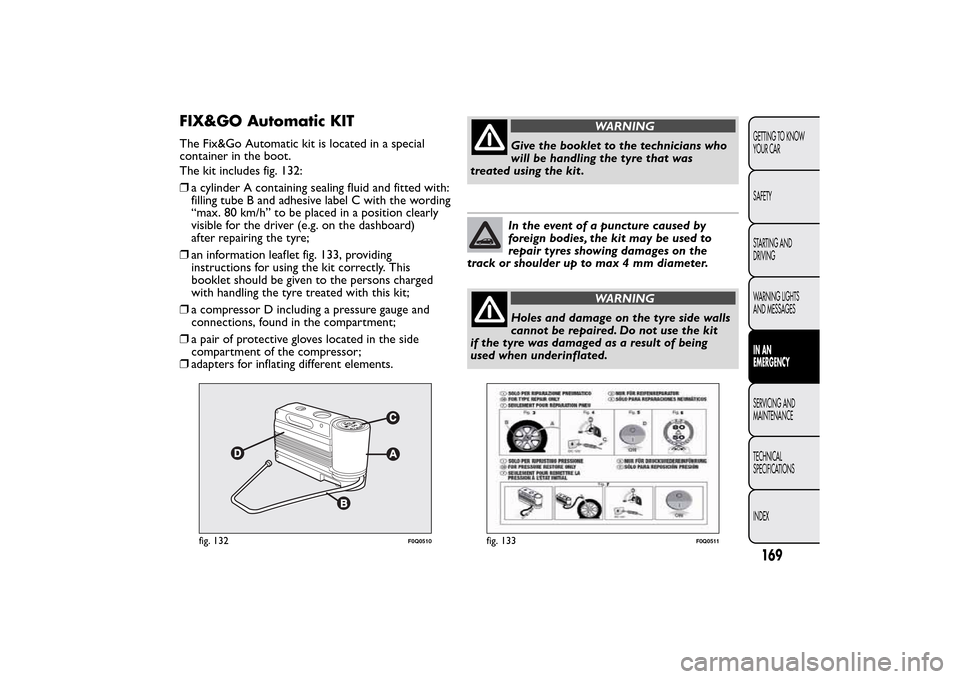
The kit includes fig. 132:
❒a cylinder A containing sealing fluid and fitted with:
filling tube B and adhesive label C with the wording
“max. 80 km/h” to be placed in a position clearly
visible for the driver (e.g. on the dashboard)
after repairing the tyre;
❒an information leaflet fig. 133, providing
instructions for using the kit correctly. This
booklet should be given to the persons charged
with handling the tyre treated with this kit;
❒a compressor D including a pressure gauge and
connections, found in the compartment;
❒a pair of protective gloves located in the side
compartment of the compressor;
❒adapters for inflating different elements.
WARNING
Give the booklet to the technicians who
will be handling the tyre that was
treated using the kit .In the event of a puncture caused by
foreign bodies, the kit may be used to
repair tyres showing damages on the
track or shoulder up to max 4 mm diameter.
WARNING
Holes and damage on the tyre side walls
cannot be repaired. Do not use the kit
if the tyre was damaged as a result of being
used when underinflated.
fig. 132
F0Q0510
fig. 133
F0Q0511
169GETTING TO KNOW
YOUR CAR
SAFETY
STARTING AND
DRIVING
WARNING LIGHTS
AND MESSAGESIN AN
EMERGENCYSERVICING AND
MAINTENANCE
TECHNICAL
SPECIFICATIONS
INDEX
Page 175 of 275
INFLATING PROCEDURE
WARNING
Wear the protective gloves provided
with the kit.
Proceed as follows:
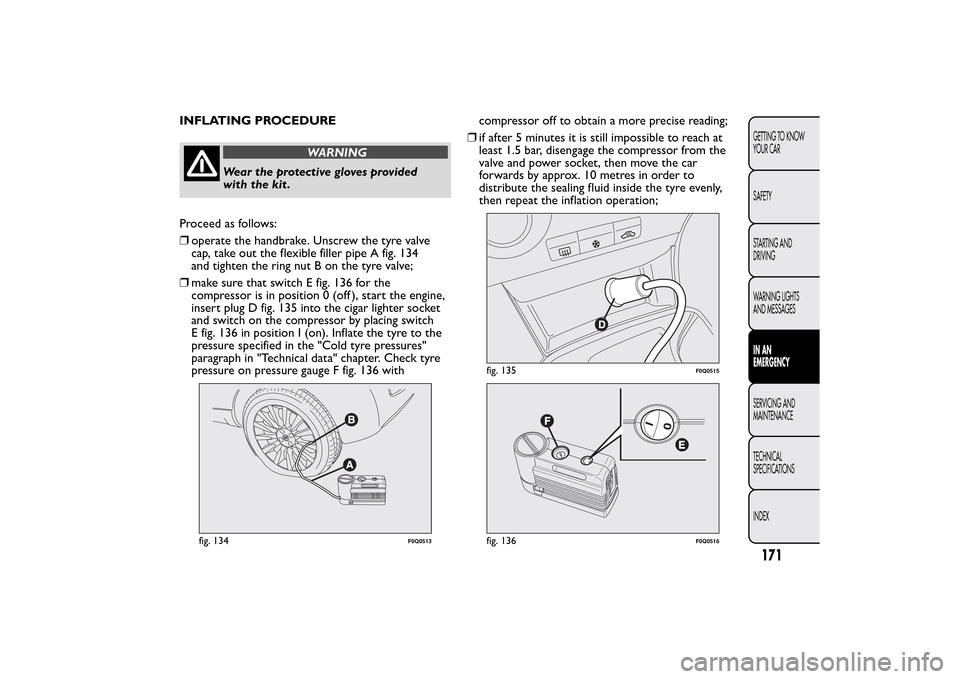
❒operate the handbrake. Unscrew the tyre valve
cap, take out the flexible filler pipe A fig. 134
and tighten the ring nut B on the tyre valve;
❒make sure that switch E fig. 136 for the
compressor is in position 0 (off ), start the engine,
insert plug D fig. 135 into the cigar lighter socket
and switch on the compressor by placing switch
E fig. 136 in position I (on). Inflate the tyre to the
pressure specified in the "Cold tyre pressures"
paragraph in "Technical data" chapter. Check tyre
pressure on pressure gauge F fig. 136 withcompressor off to obtain a more precise reading;
❒if after 5 minutes it is still impossible to reach at
least 1.5 bar, disengage the compressor from the
valve and power socket, then move the car
forwards by approx. 10 metres in order to
distribute the sealing fluid inside the tyre evenly,
then repeat the inflation operation;
fig. 134
F0Q0513
fig. 135
F0Q0515
fig. 136
F0Q0516
171GETTING TO KNOW
YOUR CAR
SAFETY
STARTING AND
DRIVING
WARNING LIGHTS
AND MESSAGESIN AN
EMERGENCYSERVICING AND
MAINTENANCE
TECHNICAL
SPECIFICATIONS
INDEX
Page 178 of 275
CHANGING A BULBGENERAL INSTRUCTIONS
❒Before changing a bulb check the contacts for
oxidation;
❒Burnt bulbs must be replaced by others of the
same type and power;
❒after replacing a headlight bulb, always check its
alignment;
❒when a light is not working, check that the
corresponding fuse is intact before changing a bulb.
For the location of fuses, refer to the paragraph
“If a fuse blows” in this section;
WARNING
Modifications or repairs to the electric
system that are not carried out properly
or do not take the system technical
specifications into account can cause
malfunctions leading to the risk of fire.
WARNING
Halogen bulbs contain pressurised gas,
in the case of breakage they may burst .
Halogen bulbs must be handled holding
the metallic part only.Touching the
transparent part of the bulb with your
fingers may reduce the intensity of the emitted
light and even reduce the lifespan of the bulb. In
case of accidental contact , wipe the bulb with
a cloth moistened with alcohol and let the bulb
dry.If possible, we recommend have bulbs
replaced by a Fiat Dealership.The correct
operation and aiming of the outer lights
are absolutely essential for the safety of the car
and of compliance with law.Due to the high supply voltage, gas
discharge bulbs (Bi-Xenon) (for versions/
markets, where provided) must only be
replaced by a specialist technician: danger of
death! Contact a Fiat Dealership.
IMPORTANT When the weather is cold or damp or
after heavy rain or washing, the surface of headlights
or rear lights, may steam up and/or form drops of
condensation on the inside. This is a natural
phenomenon due to the difference in temperature
and humidity between the inside and the outside
of the glass which does not indicate a fault and does
not compromise the normal operation of lighting
devices. The mist disappears quickly when the lights
are turned on, starting from the centre of the
diffuser, extending progressively towards the edges.
174GETTING TO KNOW
YOUR CAR
SAFETY
STARTING AND
DRIVING
WARNING LIGHTS
AND MESSAGES
IN AN
EMERGENCY
SERVICING AND
MAINTENANCE
TECHNICAL
SPECIFICATIONS
INDEX
Page 180 of 275
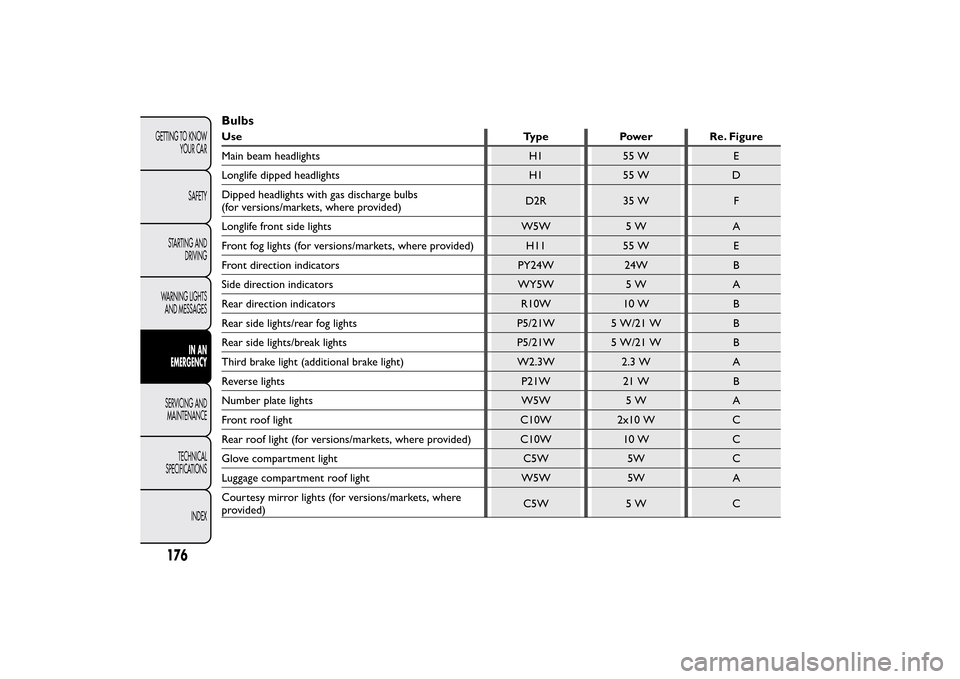
BulbsUse Type Power Re. Figure
Main beam headlights H1 55 W E
Longlife dipped headlights H1 55 W D
Dipped headlights with gas discharge bulbs
(for versions/markets, where provided)D2R 35 W F
Longlife front side lights W5W 5 W A
Front fog lights (for versions/markets, where provided) H11 55 W E
Front direction indicators PY24W 24W B
Side direction indicators WY5W 5 W A
Rear direction indicators R10W 10 W B
Rear side lights/rear fog lights P5/21W 5 W/21 W B
Rear side lights/break lights P5/21W 5 W/21 W B
Third brake light (additional brake light) W2.3W 2.3 W A
Reverse lights P21W 21 W B
Number plate lights W5W 5 W A
Front roof light C10W 2x10 W C
Rear roof light (for versions/markets, where provided) C10W 10 W C
Glove compartment light C5W 5W C
Luggage compartment roof light W5W 5W A
Courtesy mirror lights (for versions/markets, where
provided)C5W 5 W C
176GETTING TO KNOW
YOUR CAR
SAFETY
STARTING AND
DRIVING
WARNING LIGHTS
AND MESSAGES
IN AN
EMERGENCY
SERVICING AND
MAINTENANCE
TECHNICAL
SPECIFICATIONS
INDEX
Page 181 of 275
REPLACING EXTERIOR BULBSFor the type of bulb and power rating, see “Changing
a bulb" paragraph.
FRONT LIGHT CLUSTERS
The front light clusters contain side lights, dipped
headlights, main beam headlights and direction
indicator bulbs.
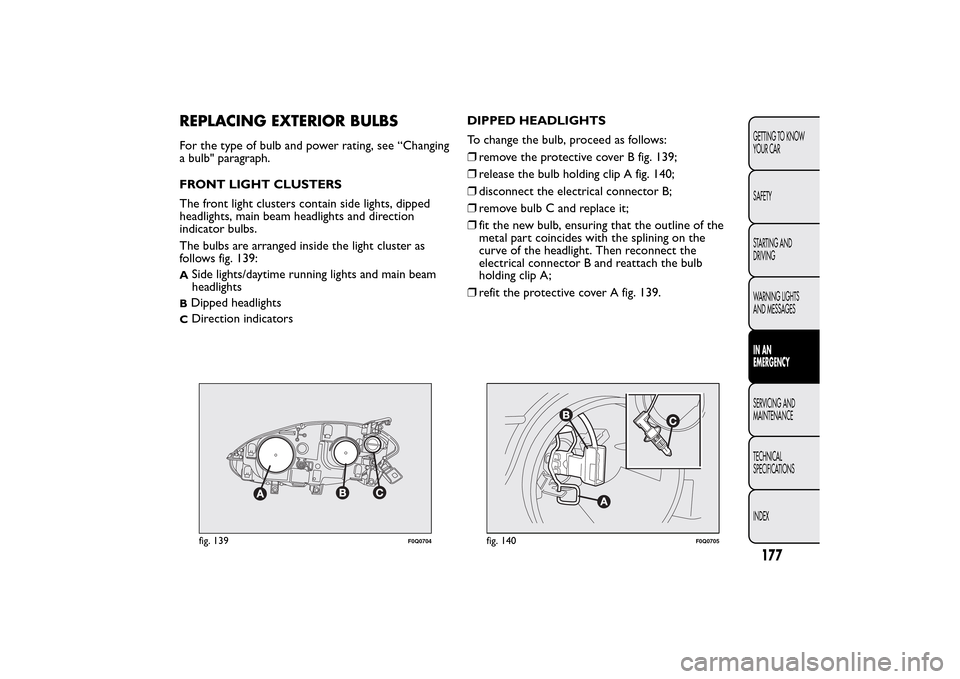
The bulbs are arranged inside the light cluster as
follows fig. 139:A
Side lights/daytime running lights and main beam
headlights
BDipped headlightsC
Direction indicatorsDIPPED HEADLIGHTS
To change the bulb, proceed as follows:
❒remove the protective cover B fig. 139;
❒release the bulb holding clip A fig. 140;
❒disconnect the electrical connector B;
❒remove bulb C and replace it;
❒fit the new bulb, ensuring that the outline of the
metal part coincides with the splining on the
curve of the headlight. Then reconnect the
electrical connector B and reattach the bulb
holding clip A;
❒refit the protective cover A fig. 139.fig. 139
F0Q0704
fig. 140
F0Q0705
177GETTING TO KNOW
YOUR CAR
SAFETY
STARTING AND
DRIVING
WARNING LIGHTS
AND MESSAGESIN AN
EMERGENCYSERVICING AND
MAINTENANCE
TECHNICAL
SPECIFICATIONS
INDEX
Page 182 of 275
With gas discharge bulbs (Bi-Xenon)
(for versions/markets, where provided)
WARNING
Due to the high power supply voltage,
gas discharge bulbs (Bi-Xenon) should
only be replaced by specialised personnel:
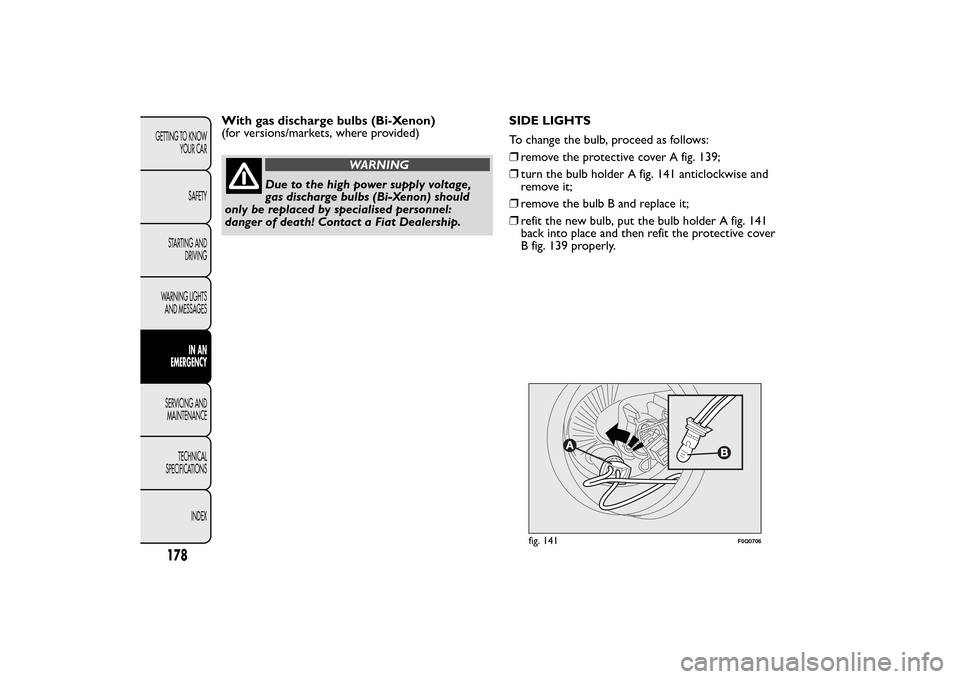
danger of death! Contact a Fiat Dealership.SIDE LIGHTS
To change the bulb, proceed as follows:
❒remove the protective cover A fig. 139;
❒turn the bulb holder A fig. 141 anticlockwise and
remove it;
❒remove the bulb B and replace it;
❒refit the new bulb, put the bulb holder A fig. 141
back into place and then refit the protective cover
B fig. 139 properly.
fig. 141
F0Q0706
178GETTING TO KNOW
YOUR CAR
SAFETY
STARTING AND
DRIVING
WARNING LIGHTS
AND MESSAGES
IN AN
EMERGENCY
SERVICING AND
MAINTENANCE
TECHNICAL
SPECIFICATIONS
INDEX
Page 184 of 275
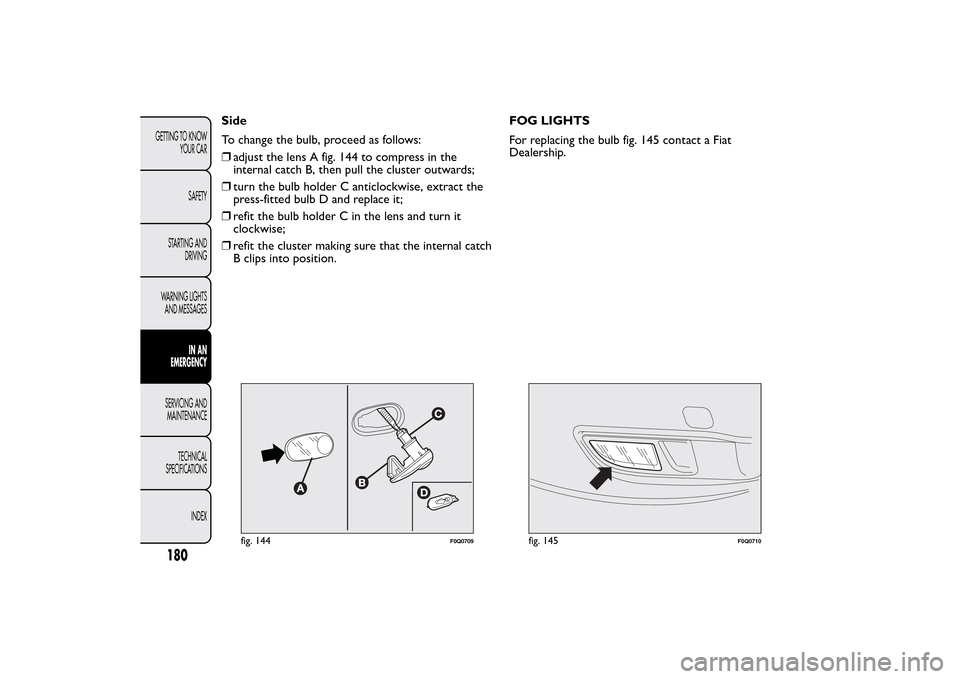
Side
To change the bulb, proceed as follows:
❒adjust the lens A fig. 144 to compress in the
internal catch B, then pull the cluster outwards;
❒turn the bulb holder C anticlockwise, extract the
press-fitted bulb D and replace it;
❒refit the bulb holder C in the lens and turn it
clockwise;
❒refit the cluster making sure that the internal catch
B clips into position.FOG LIGHTS
For replacing the bulb fig. 145 contact a Fiat
Dealership.
fig. 144
F0Q0709
fig. 145
F0Q0710
180GETTING TO KNOW
YOUR CAR
SAFETY
STARTING AND
DRIVING
WARNING LIGHTS
AND MESSAGES
IN AN
EMERGENCY
SERVICING AND
MAINTENANCE
TECHNICAL
SPECIFICATIONS
INDEX
Page 185 of 275
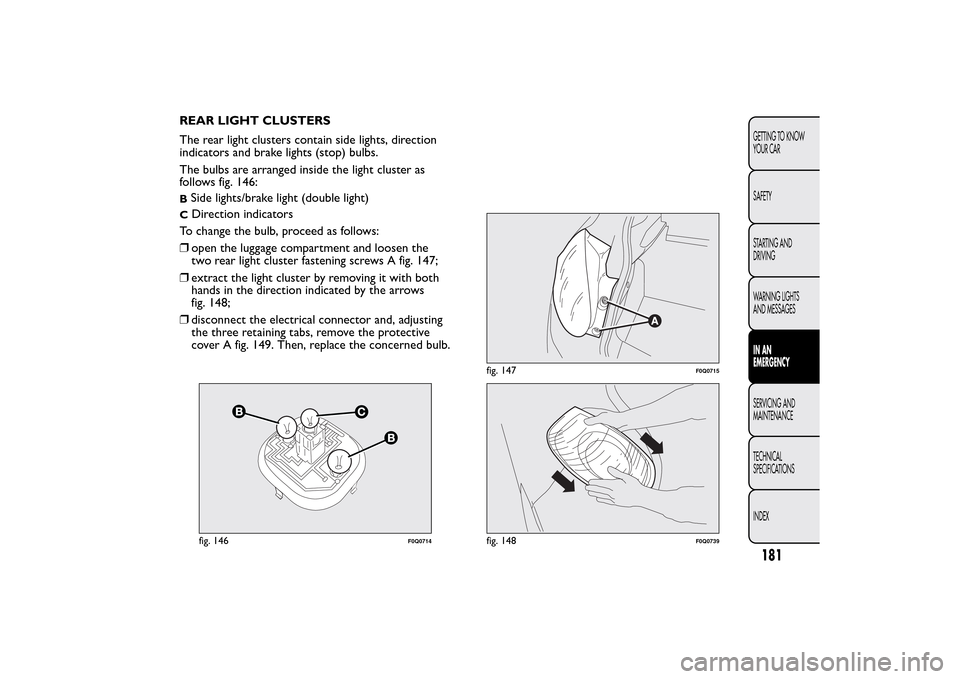
REAR LIGHT CLUSTERS
The rear light clusters contain side lights, direction
indicators and brake lights (stop) bulbs.
The bulbs are arranged inside the light cluster as
follows fig. 146:BSide lights/brake light (double light)C
Direction indicators
To change the bulb, proceed as follows:
❒open the luggage compartment and loosen the
two rear light cluster fastening screws A fig. 147;
❒extract the light cluster by removing it with both
hands in the direction indicated by the arrows
fig. 148;
❒disconnect the electrical connector and, adjusting
the three retaining tabs, remove the protective
cover A fig. 149. Then, replace the concerned bulb.fig. 146
F0Q0714
fig. 147
F0Q0715
fig. 148
F0Q0739
181GETTING TO KNOW
YOUR CAR
SAFETY
STARTING AND
DRIVING
WARNING LIGHTS
AND MESSAGESIN AN
EMERGENCYSERVICING AND
MAINTENANCE
TECHNICAL
SPECIFICATIONS
INDEX
Page 188 of 275
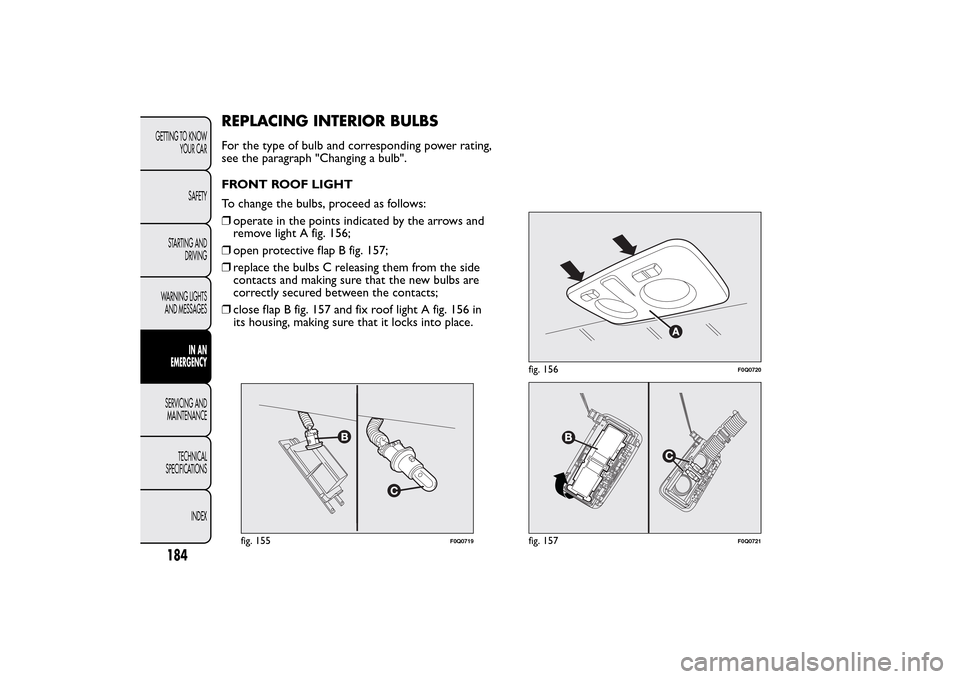
REPLACING INTERIOR BULBSFor the type of bulb and corresponding power rating,
see the paragraph "Changing a bulb".
FRONT ROOF LIGHT
To change the bulbs, proceed as follows:
❒operate in the points indicated by the arrows and
remove light A fig. 156;
❒open protective flap B fig. 157;
❒replace the bulbs C releasing them from the side
contacts and making sure that the new bulbs are
correctly secured between the contacts;
❒close flap B fig. 157 and fix roof light A fig. 156 in
its housing, making sure that it locks into place.
fig. 155
F0Q0719
fig. 156
F0Q0720
fig. 157
F0Q0721
184GETTING TO KNOW
YOUR CAR
SAFETY
STARTING AND
DRIVING
WARNING LIGHTS
AND MESSAGES
IN AN
EMERGENCY
SERVICING AND
MAINTENANCE
TECHNICAL
SPECIFICATIONS
INDEX