roof FIAT BRAVO 2014 2.G User Guide
[x] Cancel search | Manufacturer: FIAT, Model Year: 2014, Model line: BRAVO, Model: FIAT BRAVO 2014 2.GPages: 275, PDF Size: 3.95 MB
Page 91 of 275
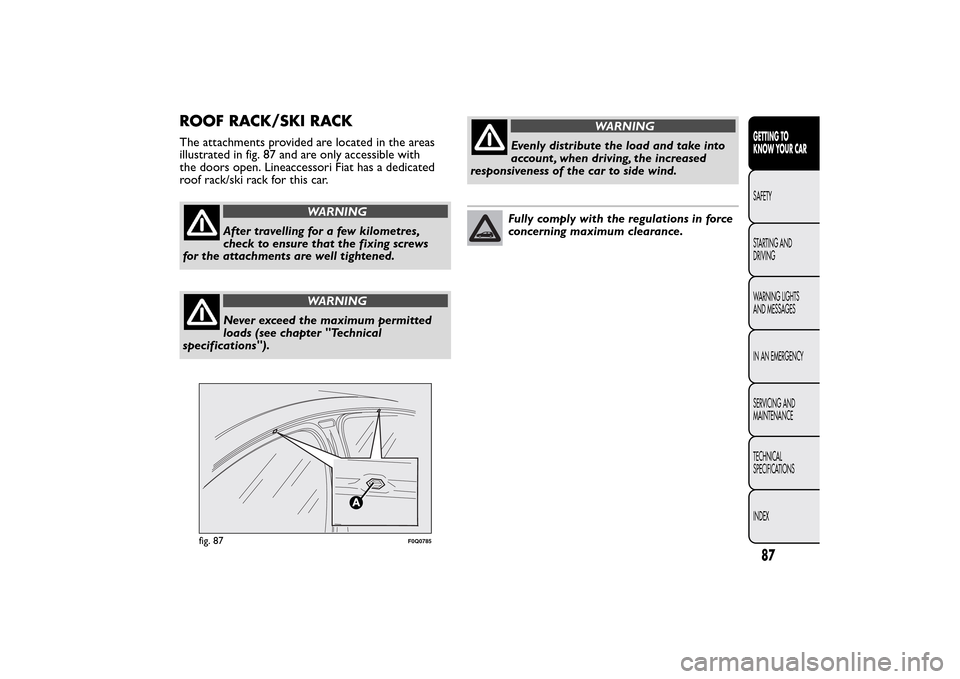
ROOF RACK/SKI RACKThe attachments provided are located in the areas
illustrated in fig. 87 and are only accessible with
the doors open. Lineaccessori Fiat has a dedicated
roof rack/ski rack for this car.
WARNING
After travelling for a few kilometres,
check to ensure that the fixing screws
for the attachments are well tightened.
WARNING
Never exceed the maximum permitted
loads (see chapter "Technical
specifications").
WARNING
Evenly distribute the load and take into
account , when driving, the increased
responsiveness of the car to side wind.Fully comply with the regulations in force
concerning maximum clearance.
fig. 87
F0Q0785
87GETTING TO
KNOW YOUR CARSAFETY
STARTING AND
DRIVING
WARNING LIGHTS
AND MESSAGES
IN AN EMERGENCY
SERVICING AND
MAINTENANCE
TECHNICAL
SPECIFICATIONS
INDEX
Page 130 of 275
FRONT AIRBAGSThe car is fitted with front airbags for the driver and
the passenger, and with a knee bag on the driver's
side (for versions/markets, where provided).
The front driver/passenger airbags and the driver's
knee bag (for versions/markets, where provided)
have been designed to protect the front seat
occupants in the event of frontal impacts of
medium/high severity, by placing the bag between the
occupant and the steering wheel or dashboard.
Therefore non-deployment in other types of impacts
(side impacts, rear shunts, roll-overs, etc.) does not
indicate a system malfunction.
In the event of a frontal impact, an electronic control
unit triggers the inflation of the bags if required.
The cushions immediately inflate, placing themselves
between the front occupants' bodies and structures
that could cause injuries. Immediately after, the
cushions deflate.
The front driver/passenger airbags and the driver's
knee bag (for versions/markets, where provided) are
not a replacement for, but rather complement the
use of, seat belts, which should always be worn,
as specified by law in Europe and most non-European
countries.
In the event of an impact, those not wearing a seat
belt will move forward and come into contact with
the bag which is still inflating. The protection offered
by the bag is compromised in these circumstances.Front airbags may not be activated in the following
situations:
❒frontal impacts against highly deformable objects
not involving the front surface of the car (e.g.
wing collision against guard rail, etc.);
❒car wedging under other vehicles or protective
barriers (e.g. trucks or guard rails);
Failure to activate in the conditions described above
is due to the fact that they may not provide any
additional protection compared with seat belts, so
their activation would be inappropriate.
In these cases, non-deployment does not indicate a
system malfunction.
WARNING
Do not apply stickers or other objects
on the steering wheel, on the dashboard
in the passenger side airbag area, on side
upholstery on the roof or on the seats. Never
put objects (e.g. mobile phones) on the
passenger's side dashboard since they could
interfere with correct inflation of the airbag
and also cause serious injur y to the passengers.
126GETTING TO KNOW
YOUR CAR
SAFETY
STARTING AND
DRIVING
WARNING LIGHTS
AND MESSAGES
IN AN EMERGENCY
SERVICING AND
MAINTENANCE
TECHNICAL
SPECIFICATIONS
INDEX
Page 136 of 275
WINDOW BAG
(for versions/markets, where provided)
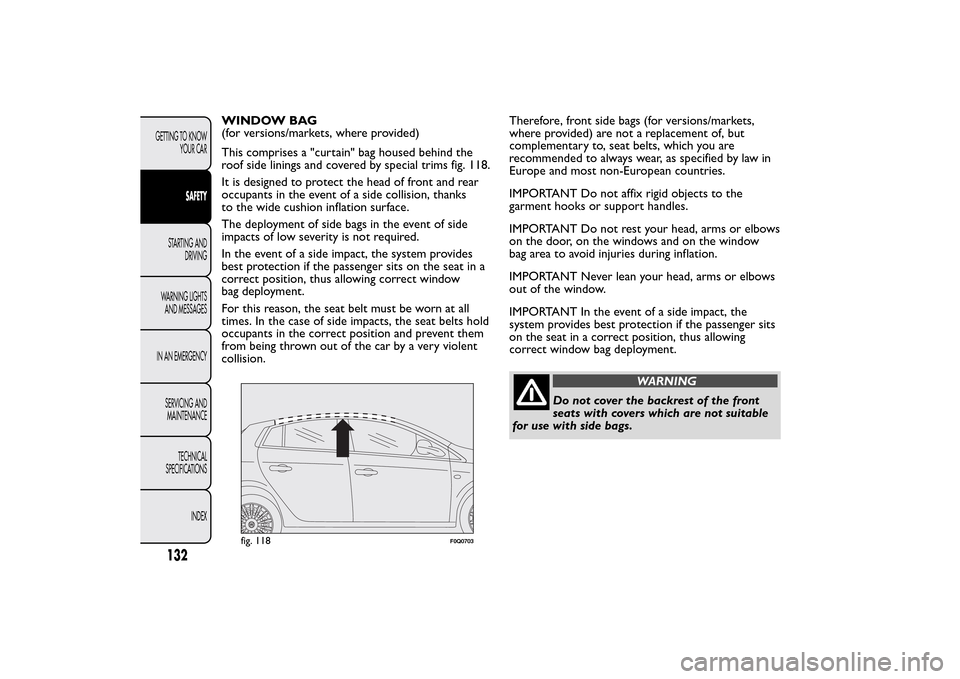
This comprises a "curtain" bag housed behind the
roof side linings and covered by special trims fig. 118.
It is designed to protect the head of front and rear
occupants in the event of a side collision, thanks
to the wide cushion inflation surface.
The deployment of side bags in the event of side
impacts of low severity is not required.
In the event of a side impact, the system provides
best protection if the passenger sits on the seat in a
correct position, thus allowing correct window
bag deployment.
For this reason, the seat belt must be worn at all
times. In the case of side impacts, the seat belts hold
occupants in the correct position and prevent them
from being thrown out of the car by a very violent
collision.Therefore, front side bags (for versions/markets,
where provided) are not a replacement of, but
complementary to, seat belts, which you are
recommended to always wear, as specified by law in
Europe and most non-European countries.
IMPORTANT Do not affix rigid objects to the
garment hooks or support handles.
IMPORTANT Do not rest your head, arms or elbows
on the door, on the windows and on the window
bag area to avoid injuries during inflation.
IMPORTANT Never lean your head, arms or elbows
out of the window.
IMPORTANT In the event of a side impact, the
system provides best protection if the passenger sits
on the seat in a correct position, thus allowing
correct window bag deployment.
WARNING
Do not cover the backrest of the front
seats with covers which are not suitable
for use with side bags.
fig. 118
F0Q0703
132GETTING TO KNOW
YOUR CAR
SAFETY
STARTING AND
DRIVING
WARNING LIGHTS
AND MESSAGES
IN AN EMERGENCY
SERVICING AND
MAINTENANCE
TECHNICAL
SPECIFICATIONS
INDEX
Page 143 of 275
WARNING
Depress the clutch pedal fully to change
gear correctly. It is therefore essential
that there is nothing under the pedals: make
sure the mats are lying flat and do not get
in the way of the pedals.Do not drive with your hand resting on
the gear lever as the force exerted, even if
slight , could lead over time to premature
wear of the gearbox internal components.
SAVING FUELSome useful tips are given below for fuel saving and
reducing harmful emissions of CO
2and other
pollutants [nitrogen oxides, unburnt hydrocarbons,
Particulate Matter (PM) etc.].
GENERAL CONSIDERATIONS
The general factors that affect fuel consumption are
listed below.
Car maintenance
Have checks and adjustments carried out in
accordance with the “Scheduled Servicing Plan”.
Ty r e s
Check the tyre pressures at least once every four
weeks: if the pressure is too low, consumption levels
increase as resistance to rolling is higher.
Unnecessary loads
Do not travel with an overloaded boot. The weight
of the car (especially when driving in town) and
its ride greatly affects consumption and stability.
Roof rack/ski rack
Remove the roof rack or the ski rack from the roof
after use. These accessories lower aerodynamic
penetration and adversely affect consumption levels.
When transporting particularly large objects, use a
trailer if possible.
139GETTING TO KNOW
YOUR CAR
SAFETYSTARTING AND
DRIVINGWARNING LIGHTS
AND MESSAGES
IN AN EMERGENCY
SERVICING AND
MAINTENANCE
TECHNICAL
SPECIFICATIONS
INDEX
Page 180 of 275
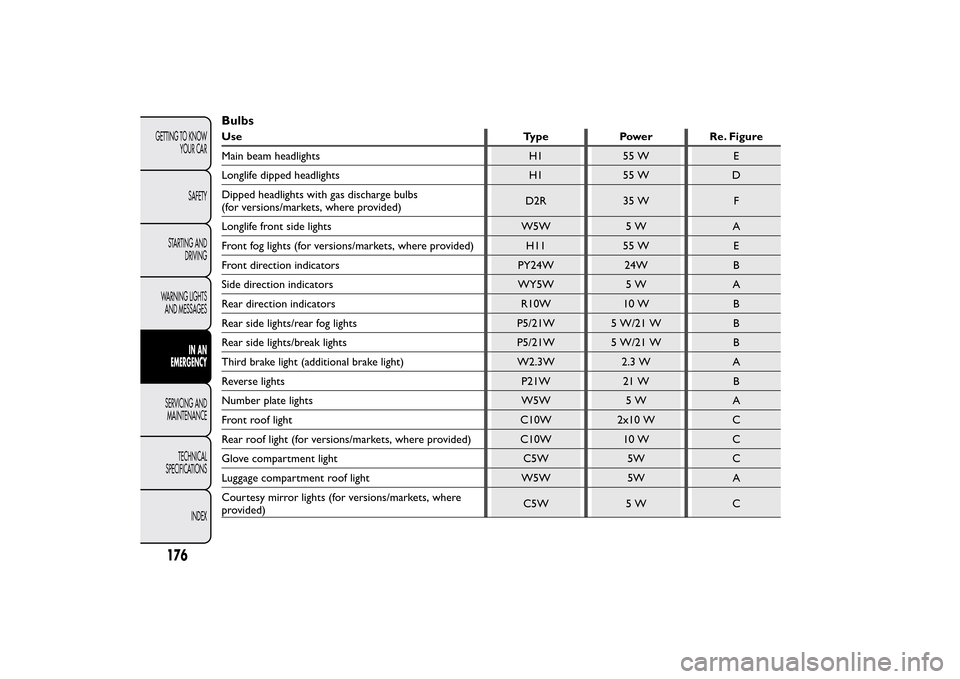
BulbsUse Type Power Re. Figure
Main beam headlights H1 55 W E
Longlife dipped headlights H1 55 W D
Dipped headlights with gas discharge bulbs
(for versions/markets, where provided)D2R 35 W F
Longlife front side lights W5W 5 W A
Front fog lights (for versions/markets, where provided) H11 55 W E
Front direction indicators PY24W 24W B
Side direction indicators WY5W 5 W A
Rear direction indicators R10W 10 W B
Rear side lights/rear fog lights P5/21W 5 W/21 W B
Rear side lights/break lights P5/21W 5 W/21 W B
Third brake light (additional brake light) W2.3W 2.3 W A
Reverse lights P21W 21 W B
Number plate lights W5W 5 W A
Front roof light C10W 2x10 W C
Rear roof light (for versions/markets, where provided) C10W 10 W C
Glove compartment light C5W 5W C
Luggage compartment roof light W5W 5W A
Courtesy mirror lights (for versions/markets, where
provided)C5W 5 W C
176GETTING TO KNOW
YOUR CAR
SAFETY
STARTING AND
DRIVING
WARNING LIGHTS
AND MESSAGES
IN AN
EMERGENCY
SERVICING AND
MAINTENANCE
TECHNICAL
SPECIFICATIONS
INDEX
Page 188 of 275
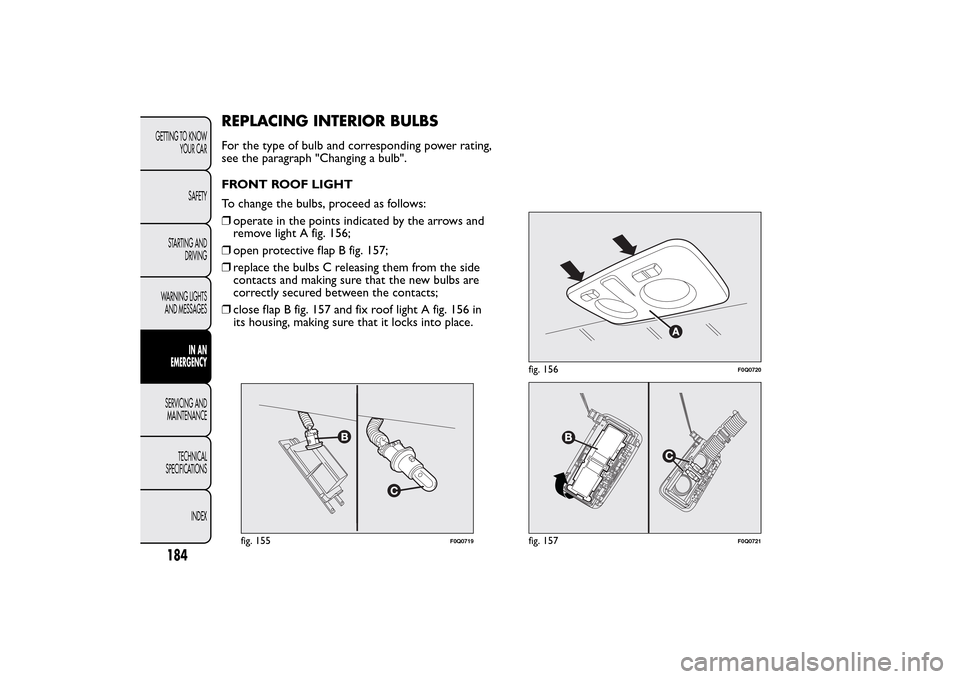
REPLACING INTERIOR BULBSFor the type of bulb and corresponding power rating,
see the paragraph "Changing a bulb".
FRONT ROOF LIGHT
To change the bulbs, proceed as follows:
❒operate in the points indicated by the arrows and
remove light A fig. 156;
❒open protective flap B fig. 157;
❒replace the bulbs C releasing them from the side
contacts and making sure that the new bulbs are
correctly secured between the contacts;
❒close flap B fig. 157 and fix roof light A fig. 156 in
its housing, making sure that it locks into place.
fig. 155
F0Q0719
fig. 156
F0Q0720
fig. 157
F0Q0721
184GETTING TO KNOW
YOUR CAR
SAFETY
STARTING AND
DRIVING
WARNING LIGHTS
AND MESSAGES
IN AN
EMERGENCY
SERVICING AND
MAINTENANCE
TECHNICAL
SPECIFICATIONS
INDEX
Page 189 of 275
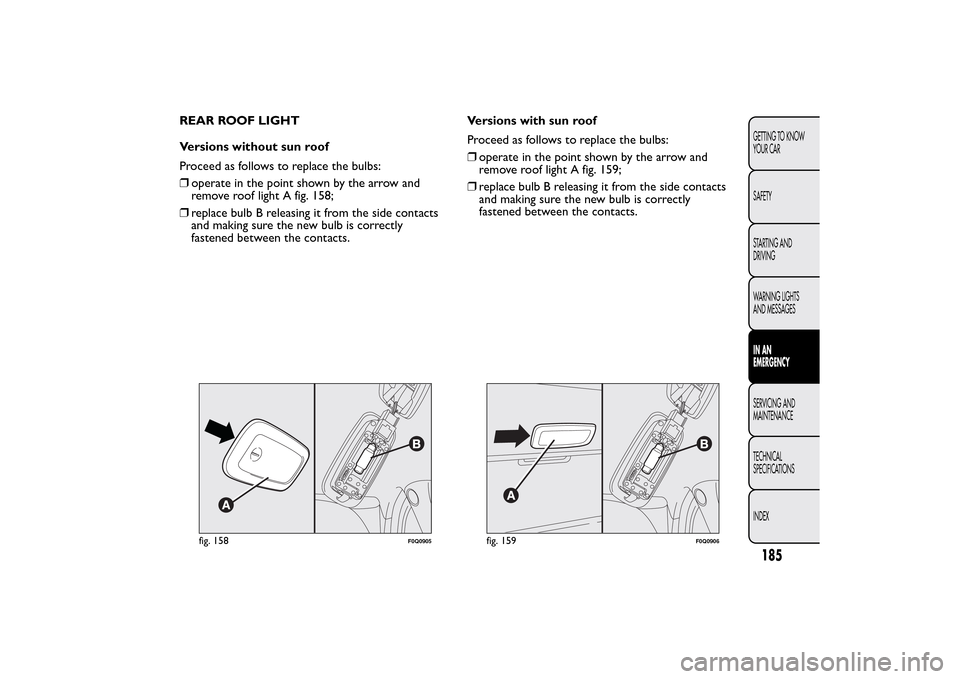
REAR ROOF LIGHT
Versions without sun roof
Proceed as follows to replace the bulbs:
❒operate in the point shown by the arrow and
remove roof light A fig. 158;
❒replace bulb B releasing it from the side contacts
and making sure the new bulb is correctly
fastened between the contacts.Versions with sun roof
Proceed as follows to replace the bulbs:
❒operate in the point shown by the arrow and
remove roof light A fig. 159;
❒replace bulb B releasing it from the side contacts
and making sure the new bulb is correctly
fastened between the contacts.
fig. 158
F0Q0905
fig. 159
F0Q0906
185GETTING TO KNOW
YOUR CAR
SAFETY
STARTING AND
DRIVING
WARNING LIGHTS
AND MESSAGESIN AN
EMERGENCYSERVICING AND
MAINTENANCE
TECHNICAL
SPECIFICATIONS
INDEX
Page 190 of 275
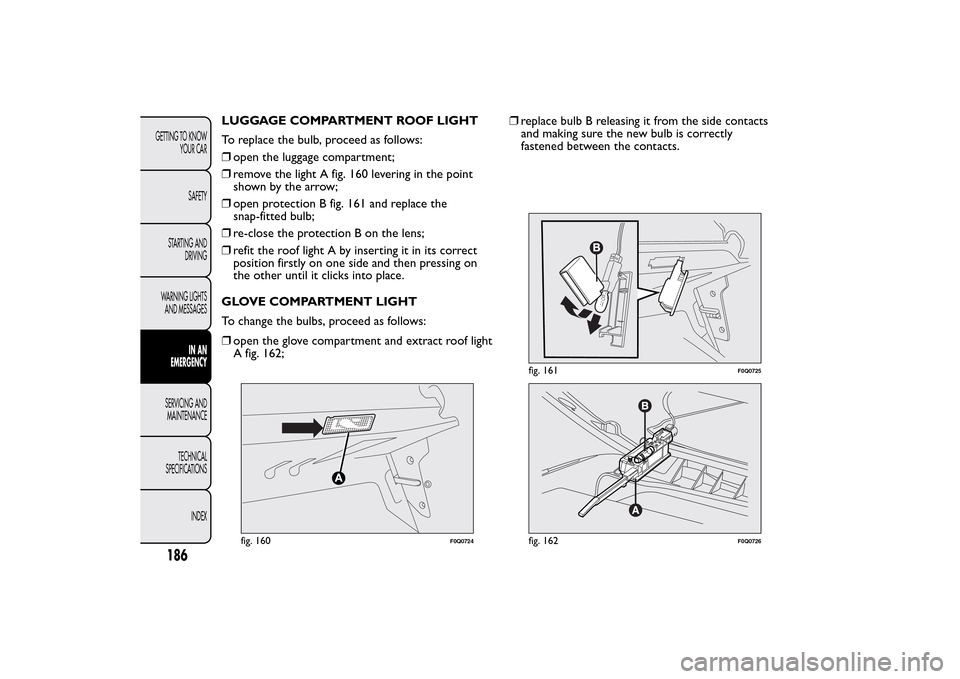
LUGGAGE COMPARTMENT ROOF LIGHT
To replace the bulb, proceed as follows:
❒open the luggage compartment;
❒remove the light A fig. 160 levering in the point
shown by the arrow;
❒open protection B fig. 161 and replace the
snap-fitted bulb;
❒re-close the protection B on the lens;
❒refit the roof light A by inserting it in its correct
position firstly on one side and then pressing on
the other until it clicks into place.
GLOVE COMPARTMENT LIGHT
To change the bulbs, proceed as follows:
❒open the glove compartment and extract roof light
A fig. 162;❒replace bulb B releasing it from the side contacts
and making sure the new bulb is correctly
fastened between the contacts.
fig. 160
F0Q0724
fig. 161
F0Q0725
fig. 162
F0Q0726
186GETTING TO KNOW
YOUR CAR
SAFETY
STARTING AND
DRIVING
WARNING LIGHTS
AND MESSAGES
IN AN
EMERGENCY
SERVICING AND
MAINTENANCE
TECHNICAL
SPECIFICATIONS
INDEX
Page 198 of 275
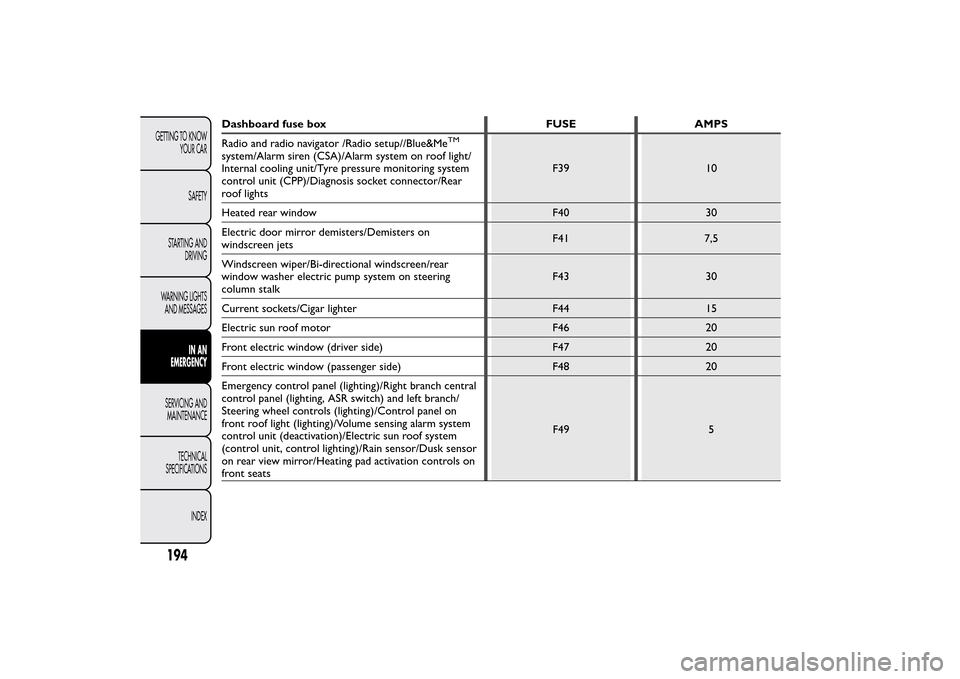
Dashboard fuse box FUSE AMPS
Radio and radio navigator /Radio setup//Blue&Me
TM
system/Alarm siren (CSA)/Alarm system on roof light/
Internal cooling unit/Tyre pressure monitoring system
control unit (CPP)/Diagnosis socket connector/Rear
roof lightsF39 10
Heated rear window F40 30
Electric door mirror demisters/Demisters on
windscreen jetsF41 7,5
Windscreen wiper/Bi-directional windscreen/rear
window washer electric pump system on steering
column stalkF43 30
Current sockets/Cigar lighter F44 15
Electric sun roof motor F46 20
Front electric window (driver side) F47 20
Front electric window (passenger side) F48 20
Emergency control panel (lighting)/Right branch central
control panel (lighting, ASR switch) and left branch/
Steering wheel controls (lighting)/Control panel on
front roof light (lighting)/Volume sensing alarm system
control unit (deactivation)/Electric sun roof system
(control unit, control lighting)/Rain sensor/Dusk sensor
on rear view mirror/Heating pad activation controls on
front seatsF49 5
194GETTING TO KNOW
YOUR CAR
SAFETY
STARTING AND
DRIVING
WARNING LIGHTS
AND MESSAGES
IN AN
EMERGENCY
SERVICING AND
MAINTENANCE
TECHNICAL
SPECIFICATIONS
INDEX
Page 216 of 275
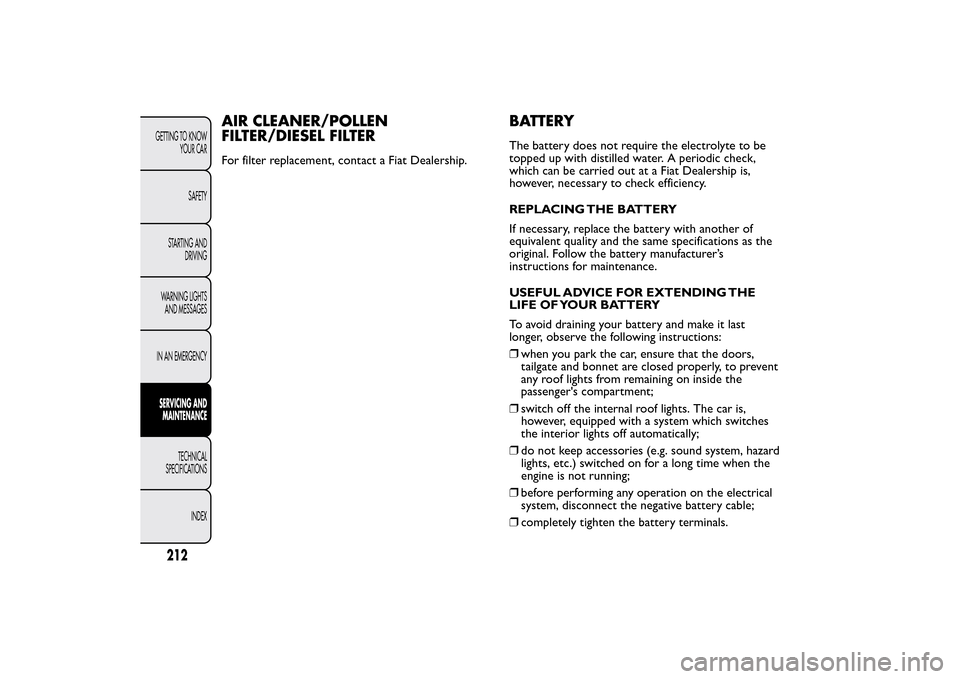
AIR CLEANER/POLLEN
FILTER/DIESEL FILTERFor filter replacement, contact a Fiat Dealership.
BATTERYThe battery does not require the electrolyte to be
topped up with distilled water. A periodic check,
which can be carried out at a Fiat Dealership is,
however, necessary to check efficiency.
REPLACING THE BATTERY
If necessary, replace the battery with another of
equivalent quality and the same specifications as the
original. Follow the battery manufacturer’s
instructions for maintenance.
USEFUL ADVICE FOR EXTENDING THE
LIFE OF YOUR BATTERY
To avoid draining your battery and make it last
longer, observe the following instructions:
❒when you park the car, ensure that the doors,
tailgate and bonnet are closed properly, to prevent
any roof lights from remaining on inside the
passenger's compartment;
❒switch off the internal roof lights. The car is,
however, equipped with a system which switches
the interior lights off automatically;
❒do not keep accessories (e.g. sound system, hazard
lights, etc.) switched on for a long time when the
engine is not running;
❒before performing any operation on the electrical
system, disconnect the negative battery cable;
❒completely tighten the battery terminals.
212GETTING TO KNOW
YOUR CAR
SAFETY
STARTING AND
DRIVING
WARNING LIGHTS
AND MESSAGES
IN AN EMERGENCYSERVICING AND
MAINTENANCE
TECHNICAL
SPECIFICATIONS
INDEX