battery FIAT BRAVO 2014 2.G Owner's Manual
[x] Cancel search | Manufacturer: FIAT, Model Year: 2014, Model line: BRAVO, Model: FIAT BRAVO 2014 2.GPages: 275, PDF Size: 3.95 MB
Page 146 of 275
WARNING
The ABS with which the car may be
equipped will not control the braking
system of the trailer. Particular caution is
required on slippery roads.
WARNING
Never modify the braking system of the
car to control the trailer brake.The
trailer braking system must be fully
independent of the car ’s hydraulic system.
INSTALLING THE TOW HOOK
The towing device should be fastened to the
bodywork by specialised personnel according to any
additional and/or integrative information supplied
by the Manufacturer of the device. The towing device
must meet current regulations with reference to
Directive 94/20/EEC and subsequent amendments.
For any version the towing device used must be right
for the towable weight of the car on which it is to
be installed.IMPORTANT The use of auxiliary loads other than
external lights (electric brake, winch, etc.) must
be used with engine running.
For the electric connection a unified connector
should be used, which is generally placed on a special
bracket fastened to the towing device, and a special
ECU should be installed on the car to control the
trailer's exterior lights.
7 or 13-pole 12 V DC connections should be used
(CUNA/UNI and ISO/DIN Standards). Follow any
instructions provided by the car manufacturer and/or
the towing device manufacturer.
An electric brake or winch should be powered
directly by the battery through a cable with a
cross-section of no less than 2.5 mm
2.
IMPORTANT Electric brakes or other devices must
be used with engine running.
In addition to the electrical branches, the vehicle's
electrical system can be connected only to the supply
cable for an electric brake and to the cable for an
internal trailer light, though not more than 15 W. For
connections use the preset control unit with battery
cable no less than 2.5 mm
2.
142GETTING TO KNOW
YOUR CAR
SAFETYSTARTING AND
DRIVINGWARNING LIGHTS
AND MESSAGES
IN AN EMERGENCY
SERVICING AND
MAINTENANCE
TECHNICAL
SPECIFICATIONS
INDEX
Page 149 of 275
CAR INACTIVITYIf the car is to be left inactive for longer than a
month, the following precautions should be
observed:
❒park the car in covered, dry and if possible
well-ventilated premises and slightly open
the windows;
❒engage a gear and disengage the handbrake;
❒disconnect the negative battery terminal and check
charge (see paragraph “Battery - Charge and
electrolyte level check” in chapter “Maintenance
and care”);
❒clean and protect the painted parts using
protective wax;
❒clean and protect the shiny metal parts using
special compounds available commercially;
❒sprinkle talcum powder on the rubber windscreen
and rear window wiper blades and lift them off the
glass;❒cover the car with a cloth or perforated plastic
sheet. Do not use sheets of non-perforated plastic
as they do not allow moisture on the car body
to evaporate;
❒inflate tyres to +0.5 bar above the standard
specified pressure and check it at intervals;
❒do not drain the engine cooling system.
IMPORTANT Where relevant, switch off the car
alarm with the remote control.
145GETTING TO KNOW
YOUR CAR
SAFETYSTARTING AND
DRIVINGWARNING LIGHTS
AND MESSAGES
IN AN EMERGENCY
SERVICING AND
MAINTENANCE
TECHNICAL
SPECIFICATIONS
INDEX
Page 152 of 275
PASSENGER/SIDE AIRBAGS
DEACTIVATED (amber)
The warning light
switches on when the front
passenger's airbag and side bag are disabled. With
front passenger airbag on, when the ignition key
is turned to MAR-ON, the
warning light switches
on constantly for several seconds, it flashes for
another few seconds and then it should switch off.
WARNING
A failure of the
warning light is
indicated by warning light
switching
on. In addition, the airbag system automatically
disables the airbags on the passenger's side
(both front and side airbags where provided).
Before continuing, contact a Fiat Dealership
immediately to have the system checked.
UNFASTENED SEAT BELTS (red)
The warning light switches on constantly with the
car stationary and the driver's side or passenger side
seat belt (when the passenger is present) not
fastened.The warning light will flash and a buzzer will sound if
the car is in motion and the front seat belts are
not correctly fastened.
The SBR (Seat Belt Reminder) system buzzer can
only be permanently switched off by a Fiat
Dealership.
The system can be reactivated using the Setup Menu.
LOW BATTERY CHARGE (red)
The warning light comes on when the ignition key is
turned to MAR-ON, but it should go out as soon
as the engine has started (with the engine running at
idle speed a brief delay before going out is
acceptable).
If the warning light stays on constantly or continues
to flash, contact a Fiat Dealership immediately.CONTINUOUSLY ON: LOW
ENGINE OIL PRESSURE (red)
ON FLASHING: ENGINE OIL
DETERIORATED
(only MultiJet versions with DPF - red)
When the ignition key is turned to MAR-ON, the
warning light switches on but should switch off
as soon as the engine is started.
148GETTING TO KNOW
YOUR CAR
SAFETY
STARTING AND
DRIVINGWARNING LIGHTS
AND MESSAGESIN AN EMERGENCY
SERVICING AND
MAINTENANCE
TECHNICAL
SPECIFICATIONS
INDEX
Page 165 of 275
IN AN EMERGENCY
STARTING THE ENGINEContact a Fiat Dealership immediately if instrument
panel warning light
stays on constantly.
JUMP STARTING
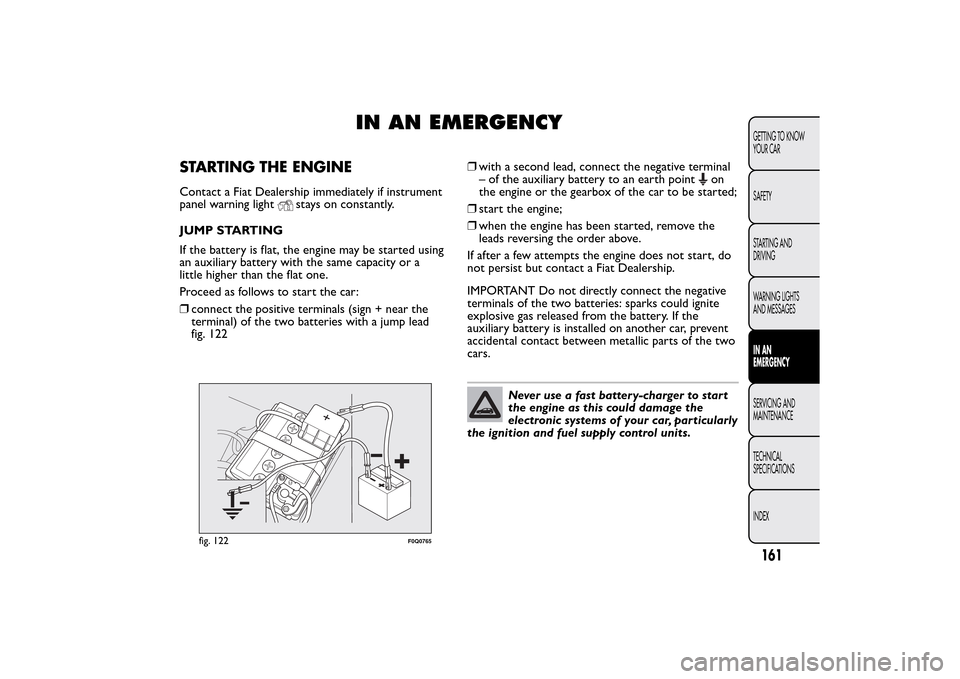
If the battery is flat, the engine may be started using
an auxiliary battery with the same capacity or a
little higher than the flat one.
Proceed as follows to start the car:
❒connect the positive terminals (sign + near the
terminal) of the two batteries with a jump lead
fig. 122❒with a second lead, connect the negative terminal
– of the auxiliary battery to an earth point
on
the engine or the gearbox of the car to be started;
❒start the engine;
❒when the engine has been started, remove the
leads reversing the order above.
If after a few attempts the engine does not start, do
not persist but contact a Fiat Dealership.
IMPORTANT Do not directly connect the negative
terminals of the two batteries: sparks could ignite
explosive gas released from the battery. If the
auxiliary battery is installed on another car, prevent
accidental contact between metallic parts of the two
cars.
Never use a fast batter y-charger to star t
the engine as this could damage the
electronic systems of your car, particularly
the ignition and fuel supply control units.
fig. 122
F0Q0765
161GETTING TO KNOW
YOUR CAR
SAFETY
STARTING AND
DRIVING
WARNING LIGHTS
AND MESSAGESIN AN
EMERGENCYSERVICING AND
MAINTENANCE
TECHNICAL
SPECIFICATIONS
INDEX
Page 166 of 275
WARNING
This procedure must be performed by
expert personnel because incorrect
actions could cause electrical discharge of
considerable intensity. Furthermore, battery
fluid is poisonous and corrosive: avoid contact
with skin and eyes. Keep naked flames and
lighted cigarettes away from the battery and do
not cause sparks.
BUMP STARTING
Never bump start the engine by pushing, towing or
coasting downhill.
IMPORTANT Remember that the brake servo and
electrical power steering system are not active until
the engine is started. A much greater effort will
therefore be required to use the brake pedal or turn
the steering wheel.
CHANGING A WHEELGENERAL INSTRUCTIONS
The car is equipped with the “Fix&Go Automatic
Kit”: see paragraph “Fix&Go Automatic Kit” for
instructions on how to use this device. As an
alternative to the “Fix&Go Automatic Kit” the car
may be equipped with a space-saver wheel: see
the instructions on the following pages for changing
the wheel.
WARNING
The space-saver wheel (for versions/
markets, where provided) is specific to
your car, do not use it on other models, or use
the space-saver wheel of other models on your
car.The space-saver wheel must only be used
in case of emergency. It must only be used
for the distance necessary to reach a service
point and the car speed must not exceed 80
km/h.The space-saver wheel has an orange
sticker that summarises the main cautions for
use and limitations. Never remove or cover
the sticker.The following information is
provided in four languages on the sticker:
"Important! For temporary use only! 80 km/h
max.! Replace with a standard wheel as soon as
possible. Never cover this indication". Never
apply a hub cap on a space-saver wheel.
162GETTING TO KNOW
YOUR CAR
SAFETY
STARTING AND
DRIVING
WARNING LIGHTS
AND MESSAGES
IN AN
EMERGENCY
SERVICING AND
MAINTENANCE
TECHNICAL
SPECIFICATIONS
INDEX
Page 194 of 275
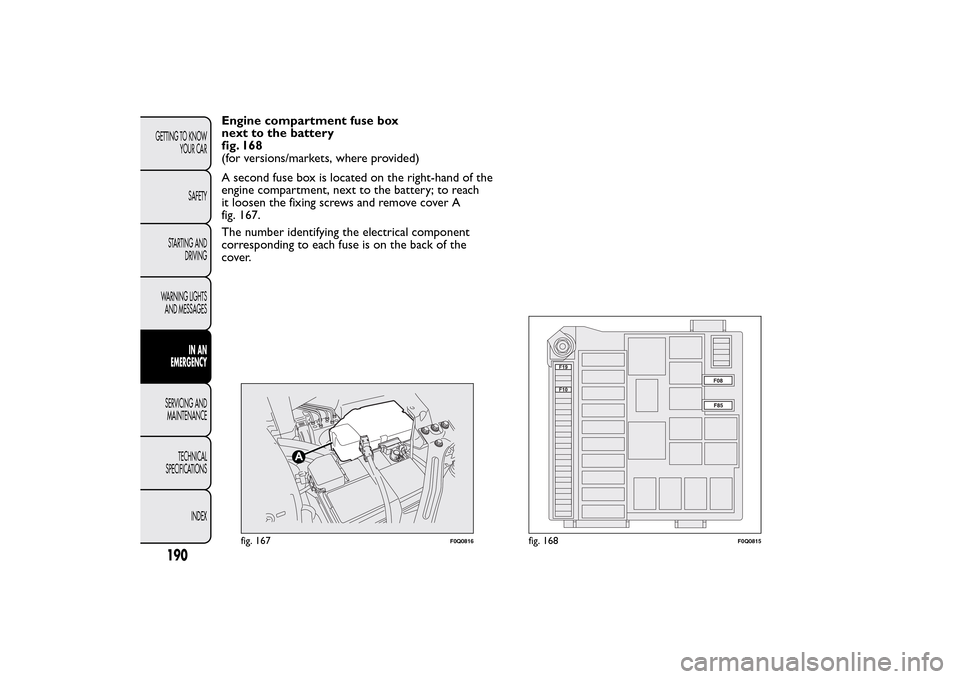
Engine compartment fuse box
next to the battery
fig. 168
(for versions/markets, where provided)
A second fuse box is located on the right-hand of the
engine compartment, next to the battery; to reach
it loosen the fixing screws and remove cover A
fig. 167.
The number identifying the electrical component
corresponding to each fuse is on the back of the
cover.
fig. 167
F0Q0816
fig. 168
F0Q0815
190GETTING TO KNOW
YOUR CAR
SAFETY
STARTING AND
DRIVING
WARNING LIGHTS
AND MESSAGES
IN AN
EMERGENCY
SERVICING AND
MAINTENANCE
TECHNICAL
SPECIFICATIONS
INDEX
Page 195 of 275
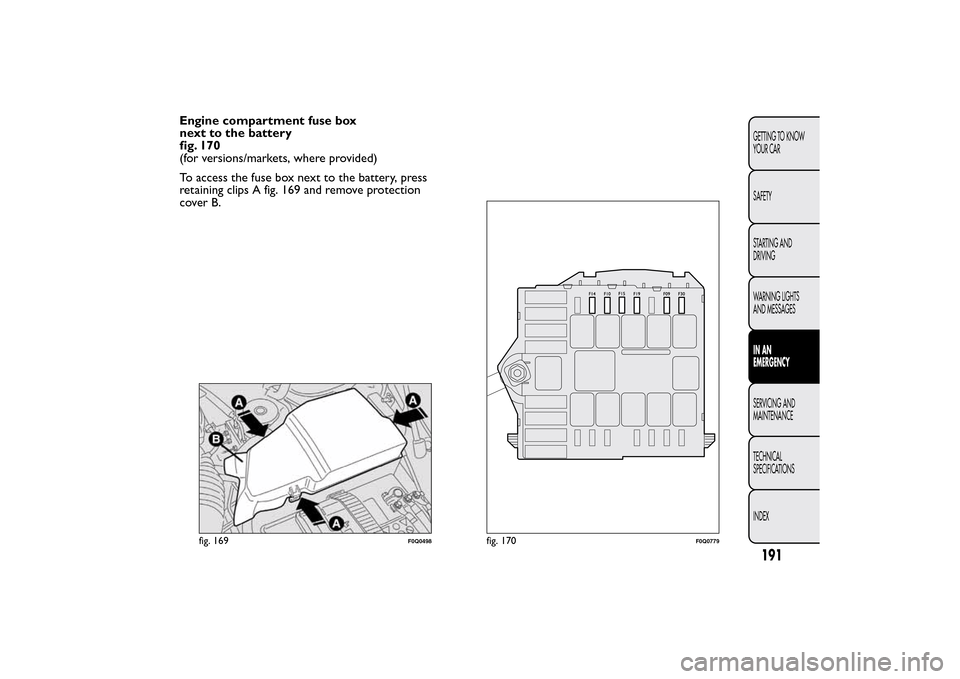
Engine compartment fuse box
next to the battery
fig. 170
(for versions/markets, where provided)
To access the fuse box next to the battery, press
retaining clips A fig. 169 and remove protection
cover B.
fig. 169
F0Q0498
fig. 170
F0Q0779
191GETTING TO KNOW
YOUR CAR
SAFETY
STARTING AND
DRIVING
WARNING LIGHTS
AND MESSAGESIN AN
EMERGENCYSERVICING AND
MAINTENANCE
TECHNICAL
SPECIFICATIONS
INDEX
Page 202 of 275
BATTERY RECHARGINGIMPORTANT The battery recharging procedure is
given as information only. You are advised to contact
a Fiat Dealership to have this operation performed.
Low amperage slow recharging for approximately
24 hours is advised. Charging for a longer time may
damage the battery.
Charge the battery as follows:
❒disconnect the negative battery terminal;
❒connect the charger cables to the battery
terminals, observing the polarity;
❒turn on the charger;
❒when it is recharged, turn the charger off before
disconnecting it from the battery;
❒reconnect the negative battery terminal.
IMPORTANT If the car is equipped with an alarm
system, this has to be disabled using the remote
control (see the "Alarm" paragraph in "Knowing your
car" chapter).
WARNING
Battery fluid is poisonous and corrosive:
avoid contact with your skin and eyes.
The battery should be charged in a well
ventilated place, away from naked flames or
possible sources of sparks: danger of explosion
and fire.
WARNING
Do not attempt to charge a frozen
battery: it must be thawed first ,
otherwise it may explode. If freezing has
occurred, the battery should be checked by
skilled personnel to make sure that the internal
elements are not damaged and that the body
is not cracked, with the risk of leaking
poisonous and corrosive acid.
198GETTING TO KNOW
YOUR CAR
SAFETY
STARTING AND
DRIVING
WARNING LIGHTS
AND MESSAGES
IN AN
EMERGENCY
SERVICING AND
MAINTENANCE
TECHNICAL
SPECIFICATIONS
INDEX
Page 207 of 275
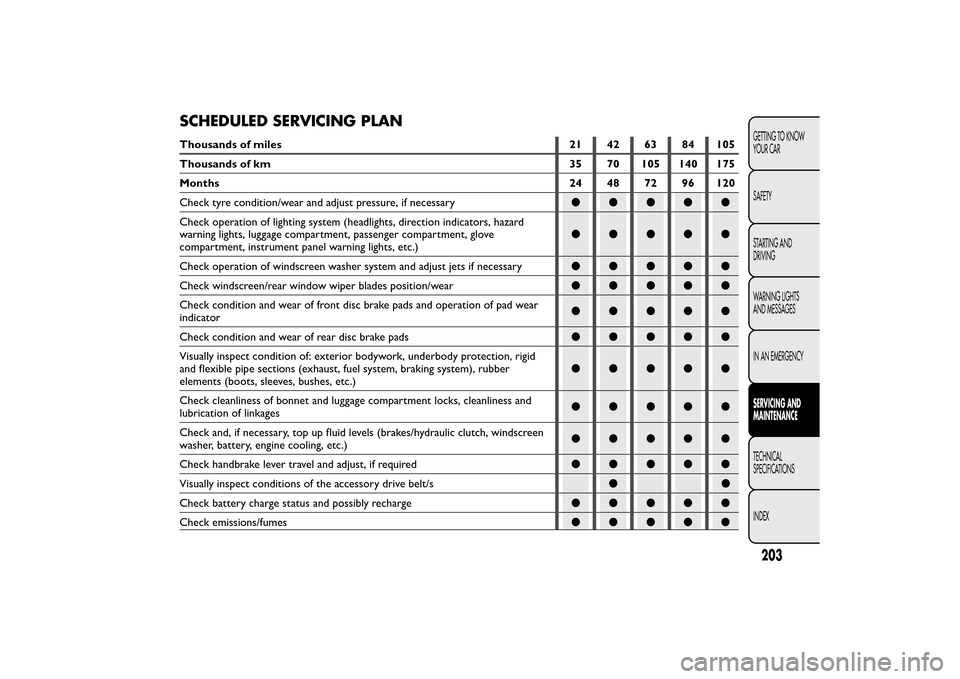
SCHEDULED SERVICING PLANThousands of miles 21 42 63 84 105
Thousands of km 35 70 105 140 175
Months 24 48 72 96 120
Check tyre condition/wear and adjust pressure, if necessary●●●●●
Check operation of lighting system (headlights, direction indicators, hazard
warning lights, luggage compartment, passenger compartment, glove
compartment, instrument panel warning lights, etc.)●●●●●
Check operation of windscreen washer system and adjust jets if necessary●●●●●
Check windscreen/rear window wiper blades position/wear●●●●●
Check condition and wear of front disc brake pads and operation of pad wear
indicator●●●●●
Check condition and wear of rear disc brake pads●●●●●
Visually inspect condition of: exterior bodywork, underbody protection, rigid
and flexible pipe sections (exhaust, fuel system, braking system), rubber
elements (boots, sleeves, bushes, etc.)●●●●●
Check cleanliness of bonnet and luggage compartment locks, cleanliness and
lubrication of linkages●●●●●
Check and, if necessary, top up fluid levels (brakes/hydraulic clutch, windscreen
washer, battery, engine cooling, etc.)●●●●●
Check handbrake lever travel and adjust, if required●●●●●
Visually inspect conditions of the accessory drive belt/s●●
Check battery charge status and possibly recharge●●●●●
Check emissions/fumes●●●●●
203GETTING TO KNOW
YOUR CAR
SAFETY
STARTING AND
DRIVING
WARNING LIGHTS
AND MESSAGES
IN AN EMERGENCYSERVICING AND
MAINTENANCETECHNICAL
SPECIFICATIONS
INDEX
Page 209 of 275
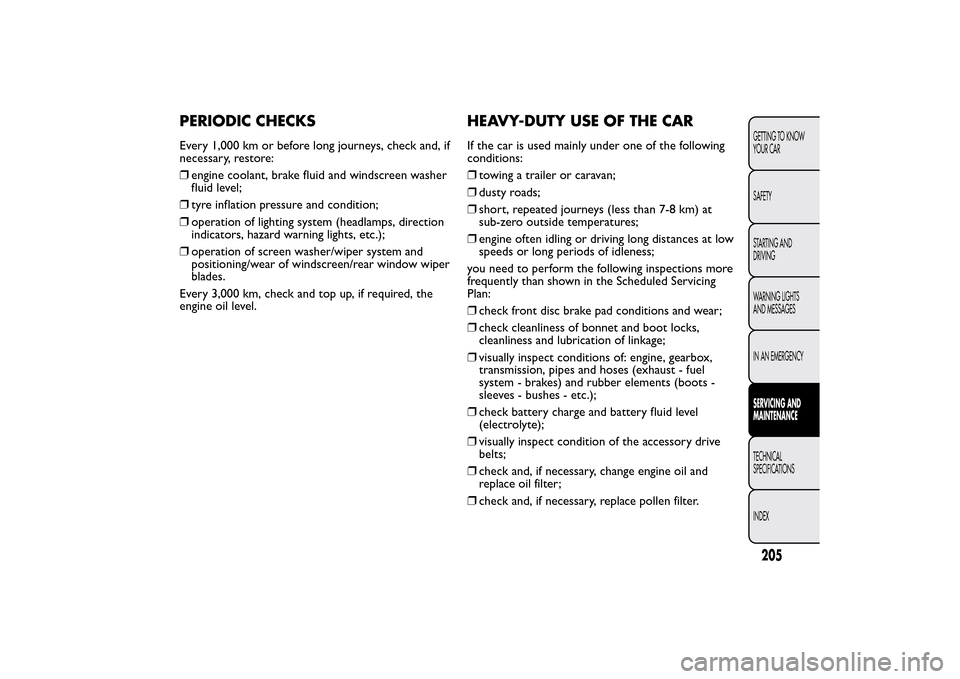
PERIODIC CHECKSEvery 1,000 km or before long journeys, check and, if
necessary, restore:
❒engine coolant, brake fluid and windscreen washer
fluid level;
❒tyre inflation pressure and condition;
❒operation of lighting system (headlamps, direction
indicators, hazard warning lights, etc.);
❒operation of screen washer/wiper system and
positioning/wear of windscreen/rear window wiper
blades.
Every 3,000 km, check and top up, if required, the
engine oil level.
HEAVY-DUTY USE OF THE CARIf the car is used mainly under one of the following
conditions:
❒towing a trailer or caravan;
❒dusty roads;
❒short, repeated journeys (less than 7-8 km) at
sub-zero outside temperatures;
❒engine often idling or driving long distances at low
speeds or long periods of idleness;
you need to perform the following inspections more
frequently than shown in the Scheduled Servicing
Plan:
❒check front disc brake pad conditions and wear;
❒check cleanliness of bonnet and boot locks,
cleanliness and lubrication of linkage;
❒visually inspect conditions of: engine, gearbox,
transmission, pipes and hoses (exhaust - fuel
system - brakes) and rubber elements (boots -
sleeves - bushes - etc.);
❒check battery charge and battery fluid level
(electrolyte);
❒visually inspect condition of the accessory drive
belts;
❒check and, if necessary, change engine oil and
replace oil filter;
❒check and, if necessary, replace pollen filter.
205GETTING TO KNOW
YOUR CAR
SAFETY
STARTING AND
DRIVING
WARNING LIGHTS
AND MESSAGES
IN AN EMERGENCYSERVICING AND
MAINTENANCETECHNICAL
SPECIFICATIONS
INDEX