display FIAT BRAVO 2014 2.G Owner's Manual
[x] Cancel search | Manufacturer: FIAT, Model Year: 2014, Model line: BRAVO, Model: FIAT BRAVO 2014 2.GPages: 275, PDF Size: 3.95 MB
Page 53 of 275
IMPORTANT Press
to introduce air from the
outside (in this case the LED on the button should
be off ).
ACTIVATION OF INTERNAL AIR
RECIRCULATION AND ENABLEMENT OF
AQS FUNCTION (Air Quality System)
Press button
. Internal air recirculation is carried
out according to three possible operating modes:
❒automatic control, signalled by the AQS sign
on the display and the LED on button
being
off;
❒forced deactivation (internal air recirculation
always off with introduction of outside air),
indicated by the LED on button
being off;
❒forced activation (internal air recirculation always
on), signalled by the LED on button
being lit.
When OFF button is pressed, the climate control
system automatically activates internal air
recirculation (the LED on button T should be on). It
is still possible to activate outside air recirculation
(LED on the button off ) and vice versa, by pressing
button T.
With the OFF button pressed (LED on the button is
lit up), it is not possible to enable the AQS (Air
Quality System) function.IMPORTANT Internal air recirculation makes it
possible to reach the required heating or cooling
conditions more quickly depending on the mode
selected. It is not advisable to switch the internal air
recirculation on when it is rainy/cold to prevent
the windows from misting, especially if the climate
control system has not been activated. It is advisable
to switch the internal air recirculation on whilst
queuing or in tunnels to prevent the introduction of
polluted air. Do not use the function for a long
time, particularly if there are several passengers on
board, to prevent the windows from misting.
AQS (Air Quality System) function activation
The AQS function (AQS sign on the display)
automatically activates internal air recirculation when
the outside air is polluted (e.g. in traffic queues and
tunnels).
IMPORTANT With the AQS function active, after
approx. 15 consecutive minutes of the internal
air recirculation system functioning, the climate
control system enables the intake of outside air for
approximately 1 minute to freshen the air in the
passenger compartment. This takes place regardless
of the pollution level of the outside air.
49GETTING TO
KNOW YOUR CARSAFETY
STARTING AND
DRIVING
WARNING LIGHTS
AND MESSAGES
IN AN EMERGENCY
SERVICING AND
MAINTENANCE
TECHNICAL
SPECIFICATIONS
INDEX
Page 54 of 275
SET TEMPERATURE ALIGNMENT
(MONO function)
Press the MONO button to align the temperature
between the driver side and passenger side.
Then turn the AUTO or MONO knob to
increase/decrease the temperature between the two
areas by the same amount.
Press MONO again to deactivate the function.
CLIMATE CONTROL SYSTEM
COMPRESSOR ACTIVATION/
DEACTIVATION
Press the
button to switch on the climate control
system compressor.
Compressor engagement
❒button LED
on;
❒
symbol appears on display.
Compressor deactivation
❒button LED
off;
❒
symbol on display disappears;
❒internal air recirculation excluded;
❒AQS function disabled.
With the climate control system compressor
switched off, air cannot be introduced into the
passenger compartment that has a lower
temperature than the outside air; in this case the
symbol in the display will flash.The deactivation of the climate control system
compressor is memorised even after the engine has
stopped. To reactivate the climate control system
compressor, press the
or AUTO button again:
if you press AUTO, the other manual settings will be
cancelled.
IMPORTANT In order to preserve the battery
charge, the electronic climate control management
permits a higher ventilation speed than minimum
only if the engine is running at a speed greater than
750 rpm. When the speed drops below this
threshold – possible when setting off, for example –
the ventilation speed is automatically reduced to
minimum.
AIR DISTRIBUTION SELECTION
Press one or more of these buttons
/
/
to
manually select one of the seven possible air
distribution settings for the passenger compartment:
Air flow to the windscreen and front side
window diffusers to demist/defrost them.Air flow to the front and rear footwell diffusers.
This air distribution allows the passenger
compartment to be warmed up quickly.
Air flow distribution between front and
rear diffusers, centre/side dashboard
diffusers, rear diffuser and windscreen and
front side window demisting/defrosting
diffusers.
Air flow distribution to centre/side dashboard
diffusers (passenger's body).
50GETTING TO
KNOW YOUR CAR
SAFETY
STARTING AND
DRIVING
WARNING LIGHTS
AND MESSAGES
IN AN EMERGENCY
SERVICING AND
MAINTENANCE
TECHNICAL
SPECIFICATIONS
INDEX
Page 55 of 275
Air flow distribution between footwell
diffusers and windscreen and front side
window defrosting/demisting diffusers. This
distribution setting allows the passenger
compartment to be warmed effectively and
prevents the windows from misting.Air flow distribution between footwell
diffusers (hotter air) and centre/side
dashboard diffusers and rear diffuser (cooler
air).Air flow distribution between centre/side
dashboard diffusers, rear diffuser and
windscreen and front side window
demisting/defrosting diffusers. This
distribution setting ventilates the passenger
compartment well and prevents the windows
from misting up.
IMPORTANT For the climate control system to
function, at least one of the buttons
/
/
must
be operated. The system does not allow the
deactivation of all the buttons
/
/
.
IMPORTANT Push the OFF button to turn the
climate control system back on: in this way, all
operating conditions memorised before switching off
are restored.
To restore automatic control of the air distribution
after a manual selection, press the AUTO button.ADDITIONAL HEATER
(for versions/markets, where provided)
This device warms up the passenger compartment
more quickly when it is very cold and the engine
coolant temperature is low.
In these conditions, the device comes on
automatically when the engine is started and the fan
is on.
The heater switches off automatically when the
required comfort conditions are achieved.
IMPORTANT The heater will not turn on if the
battery voltage is too low.
SWITCHING OFF THE CLIMATE CONTROL
SYSTEM
Press the OFF button.
The following information is shown on the display:
❒OFF;
❒outside temperature indication;
❒internal air recirculation on indication (LED on
button
lit).
51GETTING TO
KNOW YOUR CARSAFETY
STARTING AND
DRIVING
WARNING LIGHTS
AND MESSAGES
IN AN EMERGENCY
SERVICING AND
MAINTENANCE
TECHNICAL
SPECIFICATIONS
INDEX
Page 57 of 275
DIRECTION INDICATORS
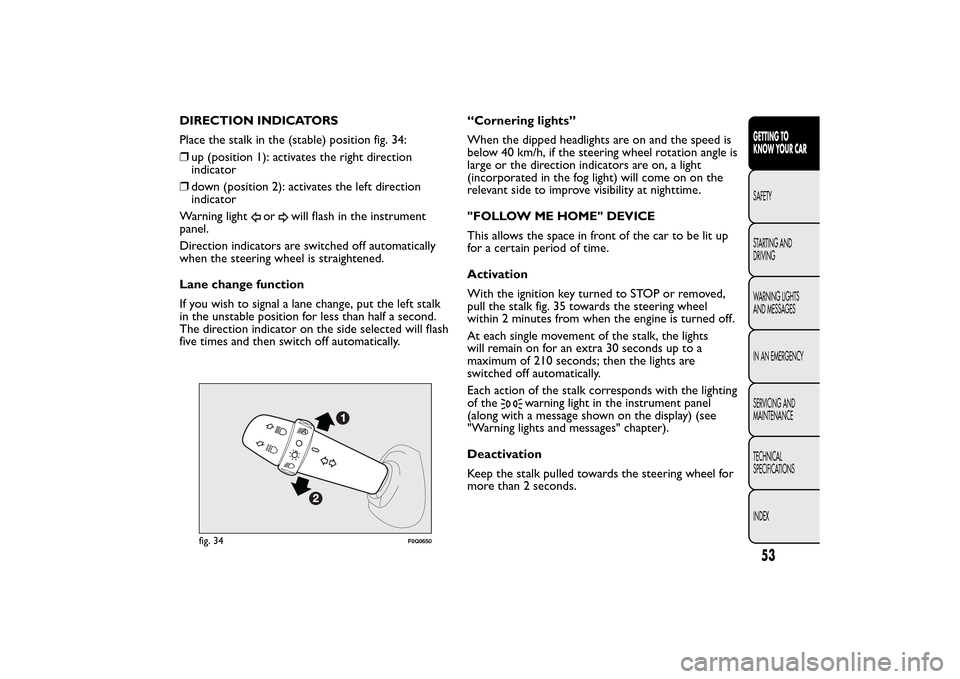
Place the stalk in the (stable) position fig. 34:
❒up (position 1): activates the right direction
indicator
❒down (position 2): activates the left direction
indicator
Warning light
or
will flash in the instrument
panel.
Direction indicators are switched off automatically
when the steering wheel is straightened.
Lane change function
If you wish to signal a lane change, put the left stalk
in the unstable position for less than half a second.
The direction indicator on the side selected will flash
five times and then switch off automatically.“Cornering lights”
When the dipped headlights are on and the speed is
below 40 km/h, if the steering wheel rotation angle is
large or the direction indicators are on, a light
(incorporated in the fog light) will come on on the
relevant side to improve visibility at nighttime.
"FOLLOW ME HOME" DEVICE
This allows the space in front of the car to be lit up
for a certain period of time.
Activation
With the ignition key turned to STOP or removed,
pull the stalk fig. 35 towards the steering wheel
within 2 minutes from when the engine is turned off.
At each single movement of the stalk, the lights
will remain on for an extra 30 seconds up to a
maximum of 210 seconds; then the lights are
switched off automatically.
Each action of the stalk corresponds with the lighting
of the
warning light in the instrument panel
(along with a message shown on the display) (see
"Warning lights and messages" chapter).
Deactivation
Keep the stalk pulled towards the steering wheel for
more than 2 seconds.
fig. 34
F0Q0650
53GETTING TO
KNOW YOUR CARSAFETY
STARTING AND
DRIVING
WARNING LIGHTS
AND MESSAGES
IN AN EMERGENCY
SERVICING AND
MAINTENANCE
TECHNICAL
SPECIFICATIONS
INDEX
Page 63 of 275
CRUISE CONTROL(constant speed regulator)
(for versions/markets, where provided)
This is an electronically controlled driving assistance
device which allows the car to be driven at a chosen
speed above 30 km/h on long stretches of dry,
straight roads with few variations (e.g. motorways),
without having to depress the accelerator pedal.
The use of this device on extra-urban roads with
traffic is not therefore recommended. Do not use
the device in town.
TURNING THE DEVICE ON
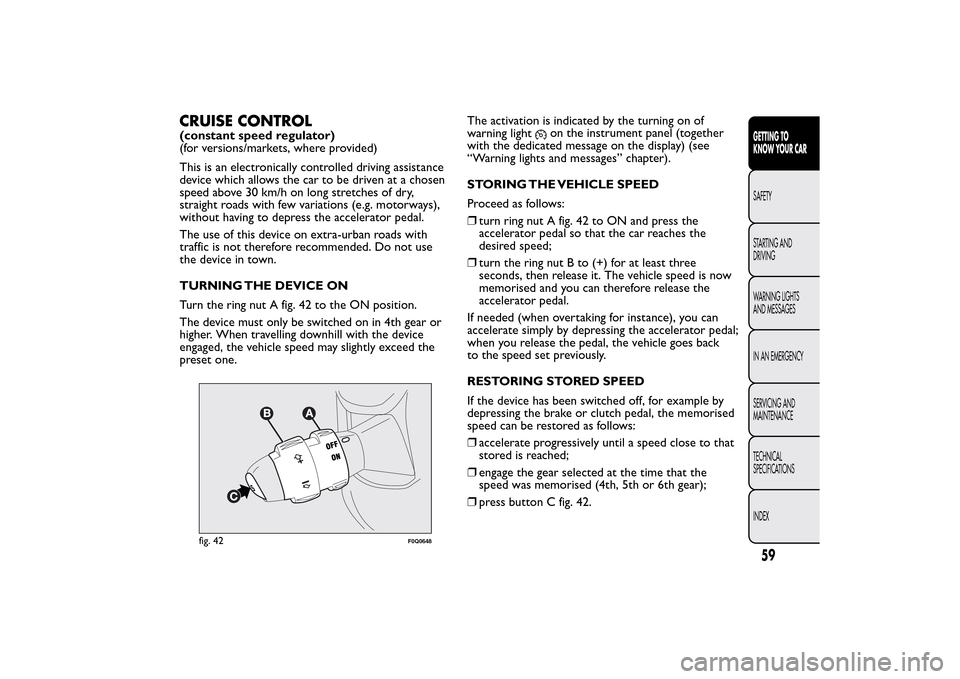
Turn the ring nut A fig. 42 to the ON position.
The device must only be switched on in 4th gear or
higher. When travelling downhill with the device
engaged, the vehicle speed may slightly exceed the
preset one.The activation is indicated by the turning on of
warning light
on the instrument panel (together
with the dedicated message on the display) (see
“Warning lights and messages” chapter).
STORING THE VEHICLE SPEED
Proceed as follows:
❒turn ring nut A fig. 42 to ON and press the
accelerator pedal so that the car reaches the
desired speed;
❒turn the ring nut B to (+) for at least three
seconds, then release it. The vehicle speed is now
memorised and you can therefore release the
accelerator pedal.
If needed (when overtaking for instance), you can
accelerate simply by depressing the accelerator pedal;
when you release the pedal, the vehicle goes back
to the speed set previously.
RESTORING STORED SPEED
If the device has been switched off, for example by
depressing the brake or clutch pedal, the memorised
speed can be restored as follows:
❒accelerate progressively until a speed close to that
stored is reached;
❒engage the gear selected at the time that the
speed was memorised (4th, 5th or 6th gear);
❒press button C fig. 42.
fig. 42
F0Q0648
59GETTING TO
KNOW YOUR CARSAFETY
STARTING AND
DRIVING
WARNING LIGHTS
AND MESSAGES
IN AN EMERGENCY
SERVICING AND
MAINTENANCE
TECHNICAL
SPECIFICATIONS
INDEX
Page 68 of 275
FUEL CUT-OFF SWITCH
(as an alternative to the fuel cut-off system, for
versions/markets where provided)
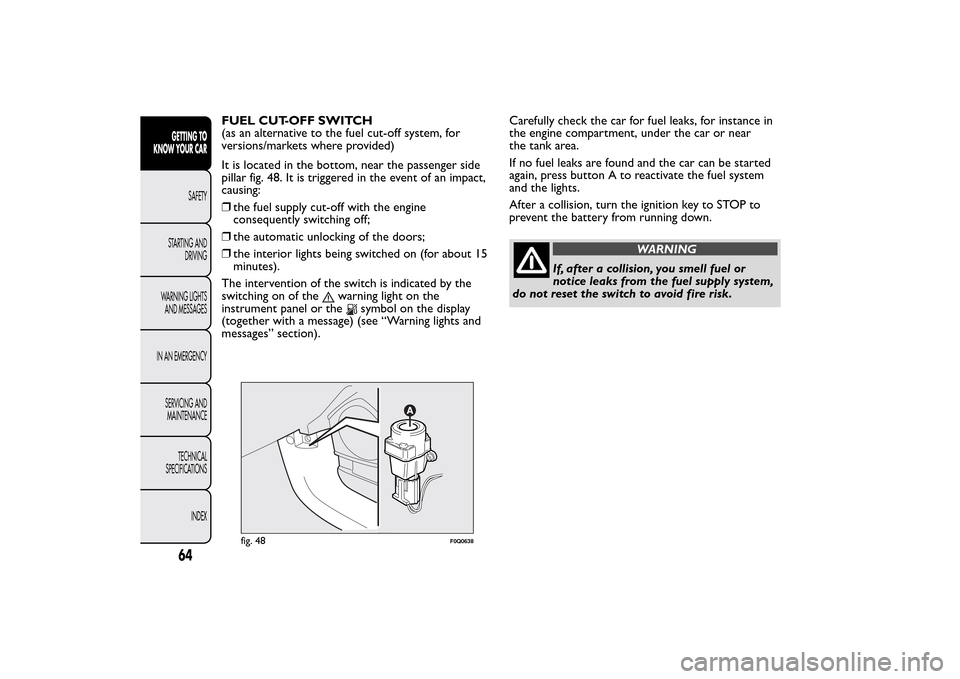
It is located in the bottom, near the passenger side
pillar fig. 48. It is triggered in the event of an impact,
causing:
❒the fuel supply cut-off with the engine
consequently switching off;
❒the automatic unlocking of the doors;
❒the interior lights being switched on (for about 15
minutes).
The intervention of the switch is indicated by the
switching on of the
warning light on the
instrument panel or the
symbol on the display
(together with a message) (see “Warning lights and
messages” section).Carefully check the car for fuel leaks, for instance in
the engine compartment, under the car or near
the tank area.
If no fuel leaks are found and the car can be started
again, press button A to reactivate the fuel system
and the lights.
After a collision, turn the ignition key to STOP to
prevent the battery from running down.
WARNING
If, after a collision, you smell fuel or
notice leaks from the fuel supply system,
do not reset the switch to avoid fire risk.
fig. 48
F0Q0638
64GETTING TO
KNOW YOUR CAR
SAFETY
STARTING AND
DRIVING
WARNING LIGHTS
AND MESSAGES
IN AN EMERGENCY
SERVICING AND
MAINTENANCE
TECHNICAL
SPECIFICATIONS
INDEX
Page 69 of 275
FUEL CUT-OFF SYSTEM
(as an alternative to the fuel cut-off switch, for
versions/markets where provided)
It is triggered in the event of a collision, causing:
❒the fuel supply cut-off with the engine
consequently switching off;
❒the automatic unlocking of the doors;
❒the interior lights being switched on.
The intervention of the system is indicated by a
message shown on the display.
Carefully check the car for fuel leaks, for instance in
the engine compartment, under the car or near
the tank area.
After a collision, turn the ignition key to STOP to
prevent the battery from running down.The following procedure should be carried out to
restore the correct operation of the vehicle:
❒turn the ignition key to the MAR-ON position;
❒turn on the right direction indicator;
❒turn off the right direction indicator;
❒turn on the left direction indicator;
❒turn off the left direction indicator;
❒turn on the right direction indicator;
❒turn off the right direction indicator;
❒turn on the left direction indicator;
❒turn off the left direction indicator;
❒turn the ignition key to the OFF position;
❒turn the ignition key to the MAR-ON position.
WARNING
If, after an impact , you smell fuel or
notice leaks from the fuel supply system,
do not reactivate the system to avoid the risk of
fire.
65GETTING TO
KNOW YOUR CARSAFETY
STARTING AND
DRIVING
WARNING LIGHTS
AND MESSAGES
IN AN EMERGENCY
SERVICING AND
MAINTENANCE
TECHNICAL
SPECIFICATIONS
INDEX
Page 84 of 275
LUGGAGE COMPARTMENTOPENING
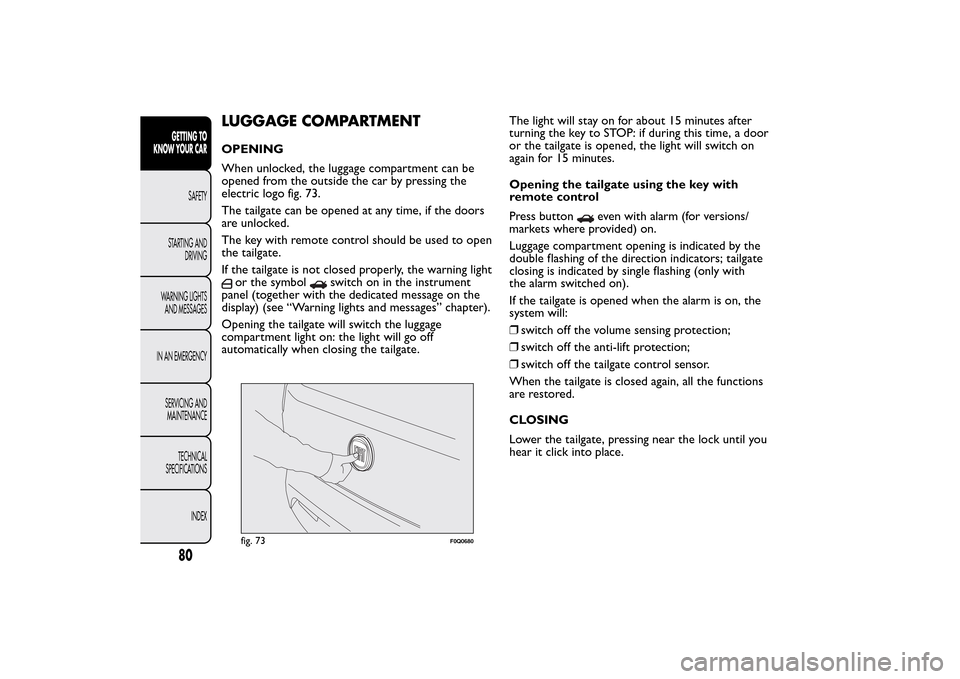
When unlocked, the luggage compartment can be
opened from the outside the car by pressing the
electric logo fig. 73.
The tailgate can be opened at any time, if the doors
are unlocked.
The key with remote control should be used to open
the tailgate.
If the tailgate is not closed properly, the warning light
or the symbol
switch on in the instrument
panel (together with the dedicated message on the
display) (see “Warning lights and messages” chapter).
Opening the tailgate will switch the luggage
compartment light on: the light will go off
automatically when closing the tailgate.The light will stay on for about 15 minutes after
turning the key to STOP: if during this time, a door
or the tailgate is opened, the light will switch on
again for 15 minutes.
Opening the tailgate using the key with
remote control
Press button
even with alarm (for versions/
markets where provided) on.
Luggage compartment opening is indicated by the
double flashing of the direction indicators; tailgate
closing is indicated by single flashing (only with
the alarm switched on).
If the tailgate is opened when the alarm is on, the
system will:
❒switch off the volume sensing protection;
❒switch off the anti-lift protection;
❒switch off the tailgate control sensor.
When the tailgate is closed again, all the functions
are restored.
CLOSING
Lower the tailgate, pressing near the lock until you
hear it click into place.
fig. 73
F0Q0680
80GETTING TO
KNOW YOUR CAR
SAFETY
STARTING AND
DRIVING
WARNING LIGHTS
AND MESSAGES
IN AN EMERGENCY
SERVICING AND
MAINTENANCE
TECHNICAL
SPECIFICATIONS
INDEX
Page 90 of 275
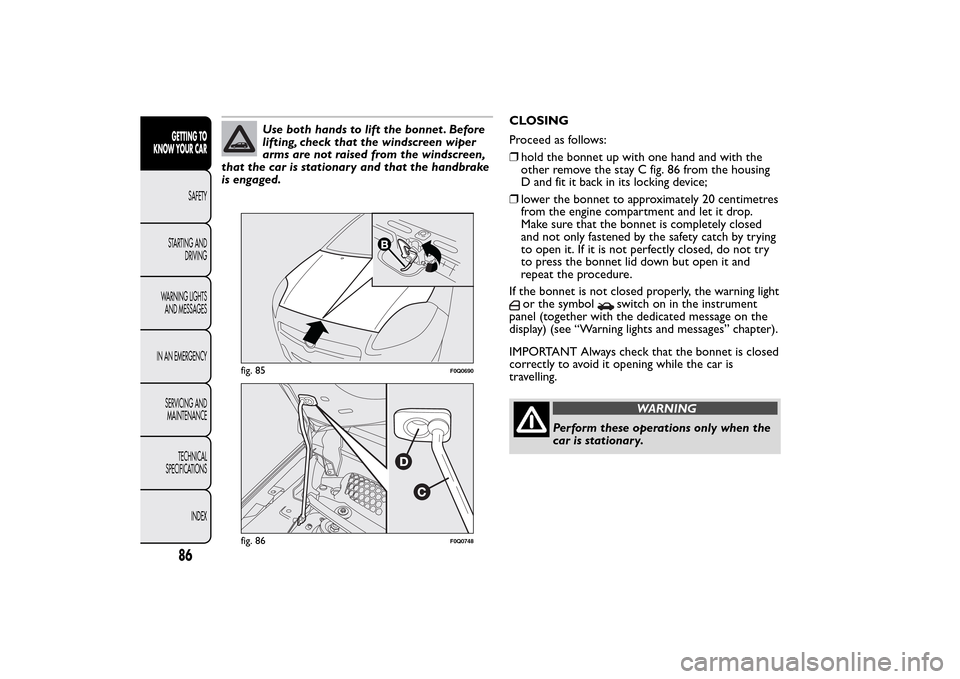
Use both hands to lift the bonnet . Before
lifting, check that the windscreen wiper
arms are not raised from the windscreen,
that the car is stationary and that the handbrake
is engaged.CLOSING
Proceed as follows:
❒hold the bonnet up with one hand and with the
other remove the stay C fig. 86 from the housing
D and fit it back in its locking device;
❒lower the bonnet to approximately 20 centimetres
from the engine compartment and let it drop.
Make sure that the bonnet is completely closed
and not only fastened by the safety catch by trying
to open it. If it is not perfectly closed, do not try
to press the bonnet lid down but open it and
repeat the procedure.
If the bonnet is not closed properly, the warning light
or the symbol
switch on in the instrument
panel (together with the dedicated message on the
display) (see “Warning lights and messages” chapter).
IMPORTANT Always check that the bonnet is closed
correctly to avoid it opening while the car is
travelling.
WARNING
Perform these operations only when the
car is stationary.
fig. 85
F0Q0690
fig. 86
F0Q0748
86GETTING TO
KNOW YOUR CAR
SAFETY
STARTING AND
DRIVING
WARNING LIGHTS
AND MESSAGES
IN AN EMERGENCY
SERVICING AND
MAINTENANCE
TECHNICAL
SPECIFICATIONS
INDEX
Page 92 of 275
HEADLIGHTSLIGHT BEAM DIRECTION
The correct aiming of the headlights is important for
the comfort and safety of not only the driver but
all other road users. This is also covered by a specific
rule of the highway code.
The headlights must be correctly aligned to
guarantee the best visibility conditions for all drivers
while travelling with headlights on.
Contact a Fiat Dealership to have the lights checked
and adjusted, if necessary.
IMPORTANT When the gas discharge (Xenon)
headlamps (for versions/markets, where provided)
are switched on, normally parabolas and light beam
move vertically for about 2 seconds until headlamp
alignment has stabilised.
HEADLIGHT ALIGNMENT CORRECTOR
This device works with the ignition key in the
MAR-ON position and the dipped beam headlights
on.
The car will tilt backwards when it is loaded, raising
the light beam. The beams must therefore be
realigned in this case.
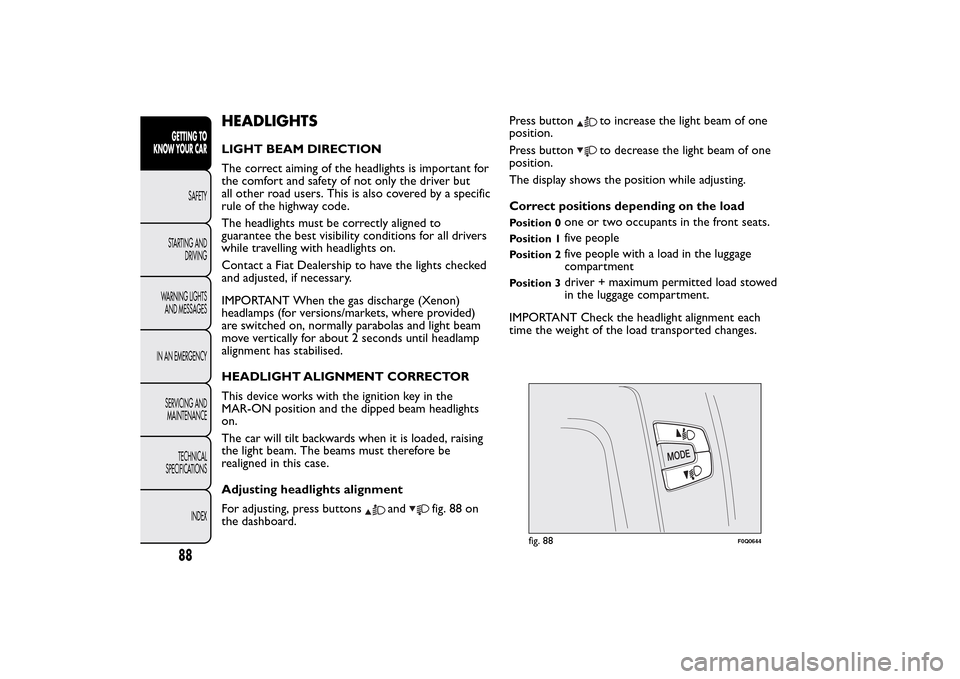
Adjusting headlights alignment
For adjusting, press buttons
and
fig. 88 on
the dashboard.Press button
to increase the light beam of one
position.
Press buttonto decrease the light beam of one
position.
The display shows the position while adjusting.
Correct positions depending on the load
Position 0
one or two occupants in the front seats.
Position 1
five people
Position 2
five people with a load in the luggage
compartment
Position 3
driver + maximum permitted load stowed
in the luggage compartment.
IMPORTANT Check the headlight alignment each
time the weight of the load transported changes.
fig. 88
F0Q0644
88GETTING TO
KNOW YOUR CAR
SAFETY
STARTING AND
DRIVING
WARNING LIGHTS
AND MESSAGES
IN AN EMERGENCY
SERVICING AND
MAINTENANCE
TECHNICAL
SPECIFICATIONS
INDEX