engine FIAT BRAVO 2014 2.G Workshop Manual
[x] Cancel search | Manufacturer: FIAT, Model Year: 2014, Model line: BRAVO, Model: FIAT BRAVO 2014 2.GPages: 275, PDF Size: 3.95 MB
Page 165 of 275
IN AN EMERGENCY
STARTING THE ENGINEContact a Fiat Dealership immediately if instrument
panel warning light
stays on constantly.
JUMP STARTING
If the battery is flat, the engine may be started using
an auxiliary battery with the same capacity or a
little higher than the flat one.
Proceed as follows to start the car:
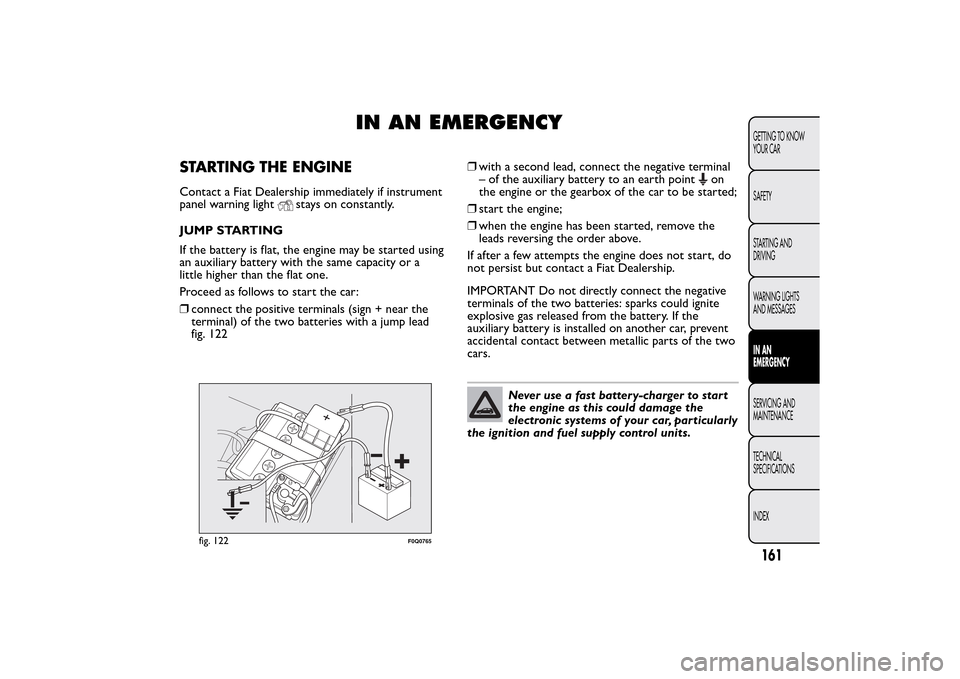
❒connect the positive terminals (sign + near the
terminal) of the two batteries with a jump lead
fig. 122❒with a second lead, connect the negative terminal
– of the auxiliary battery to an earth point
on
the engine or the gearbox of the car to be started;
❒start the engine;
❒when the engine has been started, remove the
leads reversing the order above.
If after a few attempts the engine does not start, do
not persist but contact a Fiat Dealership.
IMPORTANT Do not directly connect the negative
terminals of the two batteries: sparks could ignite
explosive gas released from the battery. If the
auxiliary battery is installed on another car, prevent
accidental contact between metallic parts of the two
cars.
Never use a fast batter y-charger to star t
the engine as this could damage the
electronic systems of your car, particularly
the ignition and fuel supply control units.
fig. 122
F0Q0765
161GETTING TO KNOW
YOUR CAR
SAFETY
STARTING AND
DRIVING
WARNING LIGHTS
AND MESSAGESIN AN
EMERGENCYSERVICING AND
MAINTENANCE
TECHNICAL
SPECIFICATIONS
INDEX
Page 166 of 275
WARNING
This procedure must be performed by
expert personnel because incorrect
actions could cause electrical discharge of
considerable intensity. Furthermore, battery
fluid is poisonous and corrosive: avoid contact
with skin and eyes. Keep naked flames and
lighted cigarettes away from the battery and do
not cause sparks.
BUMP STARTING
Never bump start the engine by pushing, towing or
coasting downhill.
IMPORTANT Remember that the brake servo and
electrical power steering system are not active until
the engine is started. A much greater effort will
therefore be required to use the brake pedal or turn
the steering wheel.
CHANGING A WHEELGENERAL INSTRUCTIONS
The car is equipped with the “Fix&Go Automatic
Kit”: see paragraph “Fix&Go Automatic Kit” for
instructions on how to use this device. As an
alternative to the “Fix&Go Automatic Kit” the car
may be equipped with a space-saver wheel: see
the instructions on the following pages for changing
the wheel.
WARNING
The space-saver wheel (for versions/
markets, where provided) is specific to
your car, do not use it on other models, or use
the space-saver wheel of other models on your
car.The space-saver wheel must only be used
in case of emergency. It must only be used
for the distance necessary to reach a service
point and the car speed must not exceed 80
km/h.The space-saver wheel has an orange
sticker that summarises the main cautions for
use and limitations. Never remove or cover
the sticker.The following information is
provided in four languages on the sticker:
"Important! For temporary use only! 80 km/h
max.! Replace with a standard wheel as soon as
possible. Never cover this indication". Never
apply a hub cap on a space-saver wheel.
162GETTING TO KNOW
YOUR CAR
SAFETY
STARTING AND
DRIVING
WARNING LIGHTS
AND MESSAGES
IN AN
EMERGENCY
SERVICING AND
MAINTENANCE
TECHNICAL
SPECIFICATIONS
INDEX
Page 168 of 275
JACK
Please note that:
❒the jack weight is 1.76 kg;
❒the jack requires no adjustment;
❒the jack cannot be repaired and in the event of a
fault it must be replaced by another original one;
❒no tool other than its cranking device may be
fitted on the jack.
To change a wheel proceed as follows:
❒stop the car in a position that is not dangerous for
on-coming traffic where you can change the wheel
safely. the ground must be flat and sufficiently
compact;
❒turn the engine off and pull up the handbrake;
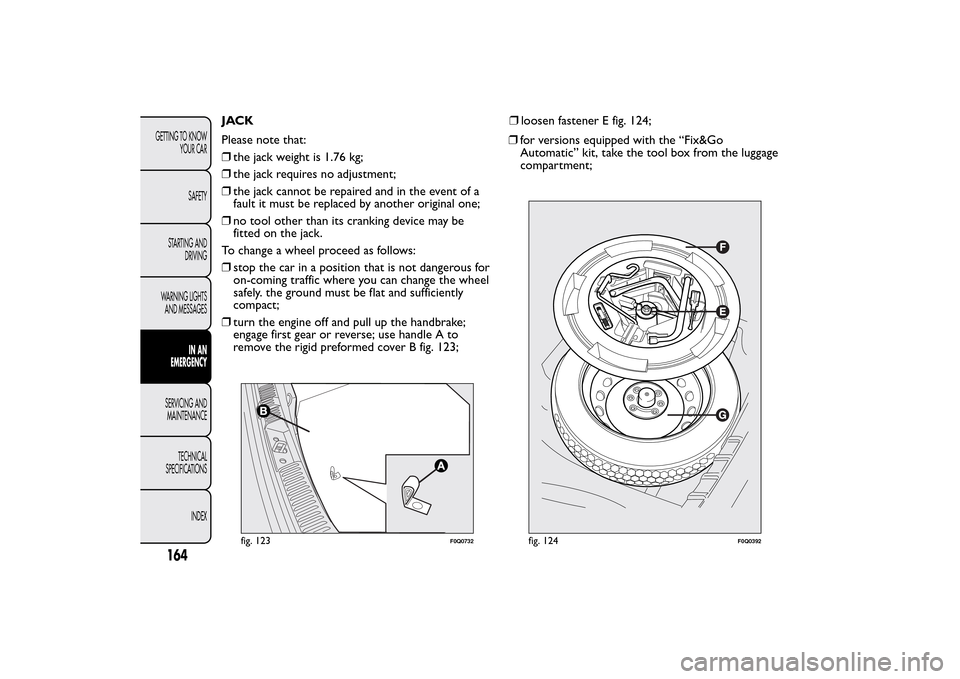
engage first gear or reverse; use handle A to
remove the rigid preformed cover B fig. 123;❒loosen fastener E fig. 124;
fig. 123
F0Q0732
fig. 124
F0Q0392
164GETTING TO KNOW
YOUR CAR
SAFETY
STARTING AND
DRIVING
WARNING LIGHTS
AND MESSAGES
IN AN
EMERGENCY
SERVICING AND
MAINTENANCE
TECHNICAL
SPECIFICATIONS
INDEX
❒for versions equipped with the “Fix&Go
Automatic” kit, take the tool box from the luggage
compartment;
Page 175 of 275
INFLATING PROCEDURE
WARNING
Wear the protective gloves provided
with the kit.
Proceed as follows:
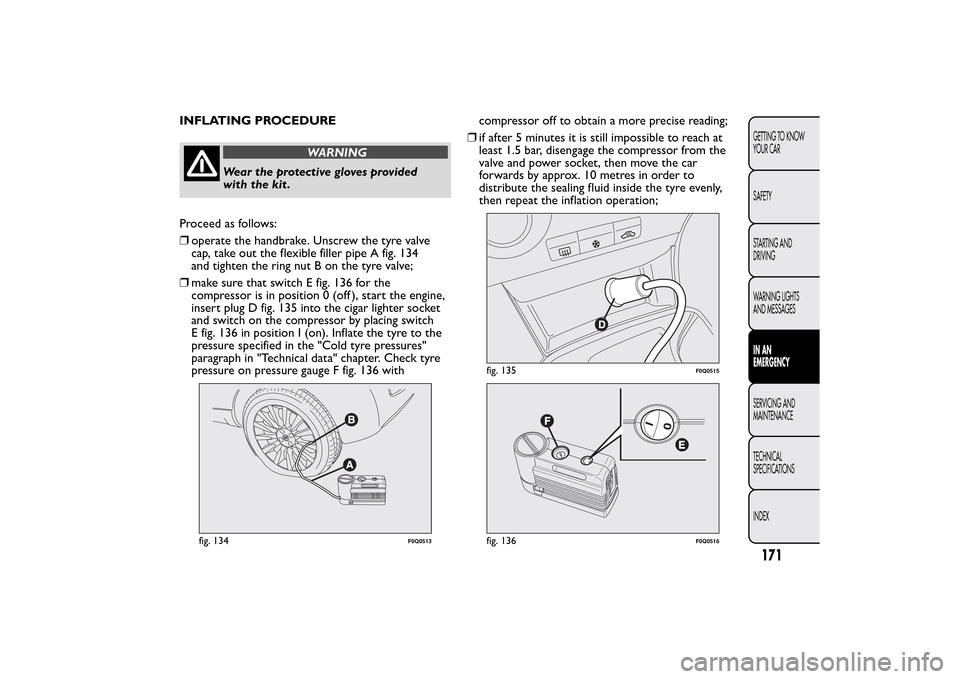
❒operate the handbrake. Unscrew the tyre valve
cap, take out the flexible filler pipe A fig. 134
and tighten the ring nut B on the tyre valve;
❒make sure that switch E fig. 136 for the
compressor is in position 0 (off ), start the engine,
insert plug D fig. 135 into the cigar lighter socket
and switch on the compressor by placing switch
E fig. 136 in position I (on). Inflate the tyre to the
pressure specified in the "Cold tyre pressures"
paragraph in "Technical data" chapter. Check tyre
pressure on pressure gauge F fig. 136 withcompressor off to obtain a more precise reading;
❒if after 5 minutes it is still impossible to reach at
least 1.5 bar, disengage the compressor from the
valve and power socket, then move the car
forwards by approx. 10 metres in order to
distribute the sealing fluid inside the tyre evenly,
then repeat the inflation operation;
fig. 134
F0Q0513
fig. 135
F0Q0515
fig. 136
F0Q0516
171GETTING TO KNOW
YOUR CAR
SAFETY
STARTING AND
DRIVING
WARNING LIGHTS
AND MESSAGESIN AN
EMERGENCYSERVICING AND
MAINTENANCE
TECHNICAL
SPECIFICATIONS
INDEX
Page 176 of 275
❒if after this operation it is still impossible after 5
minutes to reach at least 1.8 bar, do not start
driving since the tyre is excessively damaged and
the kit cannot guarantee proper hold, contact
a Fiat Dealership.
❒if reaching the tyre pressure specified in paragraph
“Inflation pressure” in chapter “Technical Data”,
start driving immediately;
❒after having driven for about 10 minutes, stop and
recheck the tyre pressure; remember to apply the
handbrake;
❒if, on the other hand, the pressure is at least 1.8
bar, restore the correct pressure (with the engine
running and the handbrake applied) and resume
driving;
❒drive with the utmost care to the nearest Fiat
Dealership.
WARNING
Apply the adhesive label where it can be
easily seen by the driver as a reminder
that the tyre has been treated with the Fix&Go
Automatic kit . Drive carefully, particularly on
bends. Do not exceed 80 km/h. Do not
accelerate or brake suddenly.
WARNING
If the pressure has fallen below 1.8 bar,
do not drive any further: the Fix&Go
Automatic kit cannot guarantee proper hold
because the tyre is too damaged. Contact a Fiat
Dealership.
WARNING
You must always indicate that the tyre
was repaired using the Fix&Go
Automatic kit . Give the booklet to the
technicians who will be handling the tyre that
was treated using the kit .
172GETTING TO KNOW
YOUR CAR
SAFETY
STARTING AND
DRIVING
WARNING LIGHTS
AND MESSAGES
IN AN
EMERGENCY
SERVICING AND
MAINTENANCE
TECHNICAL
SPECIFICATIONS
INDEX
Page 192 of 275
WARNING
If the replaced fuse blows again, contact
a Fiat Dealership.
WARNING
Never replace a fuse with metal wires or
other material.
WARNING
Never replace a fuse with another with
a higher amp rating; DANGER OF FIRE.
WARNING
If a general protective fuse (MEGA-
FUSE, MIDI-FUSE, MAXI-FUSE) blows,
contact a Fiat Dealership.
WARNING
Before replacing a fuse, make sure that
the ignition key has been removed
and that all the other services are switched off
and/or disengaged.
WARNING
Contact a Fiat Dealership if a safety
system (airbags, brakes), engine system
(engine, gearbox) or steering system general
protection fuse blows.
FUSE LOCATION
The fuses are grouped in three fuse boxes:
❒dashboard fuse box;
❒engine compartment fuse box;
❒luggage compartment fuse box.
188GETTING TO KNOW
YOUR CAR
SAFETY
STARTING AND
DRIVING
WARNING LIGHTS
AND MESSAGES
IN AN
EMERGENCY
SERVICING AND
MAINTENANCE
TECHNICAL
SPECIFICATIONS
INDEX
Page 194 of 275
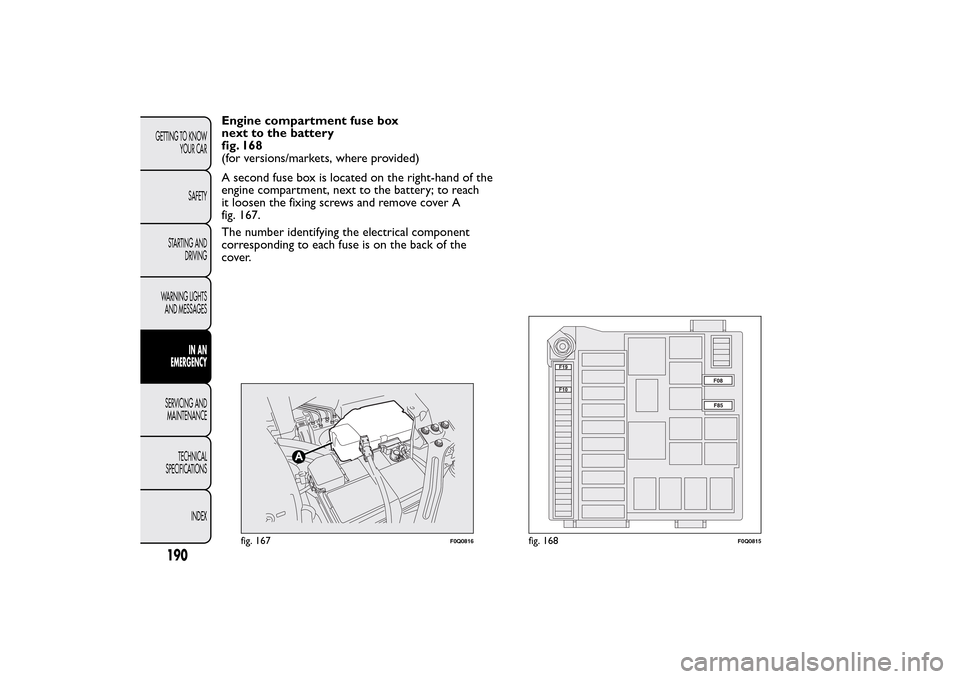
Engine compartment fuse box
next to the battery
fig. 168
(for versions/markets, where provided)
A second fuse box is located on the right-hand of the
engine compartment, next to the battery; to reach
it loosen the fixing screws and remove cover A
fig. 167.
The number identifying the electrical component
corresponding to each fuse is on the back of the
cover.
fig. 167
F0Q0816
fig. 168
F0Q0815
190GETTING TO KNOW
YOUR CAR
SAFETY
STARTING AND
DRIVING
WARNING LIGHTS
AND MESSAGES
IN AN
EMERGENCY
SERVICING AND
MAINTENANCE
TECHNICAL
SPECIFICATIONS
INDEX
Page 195 of 275
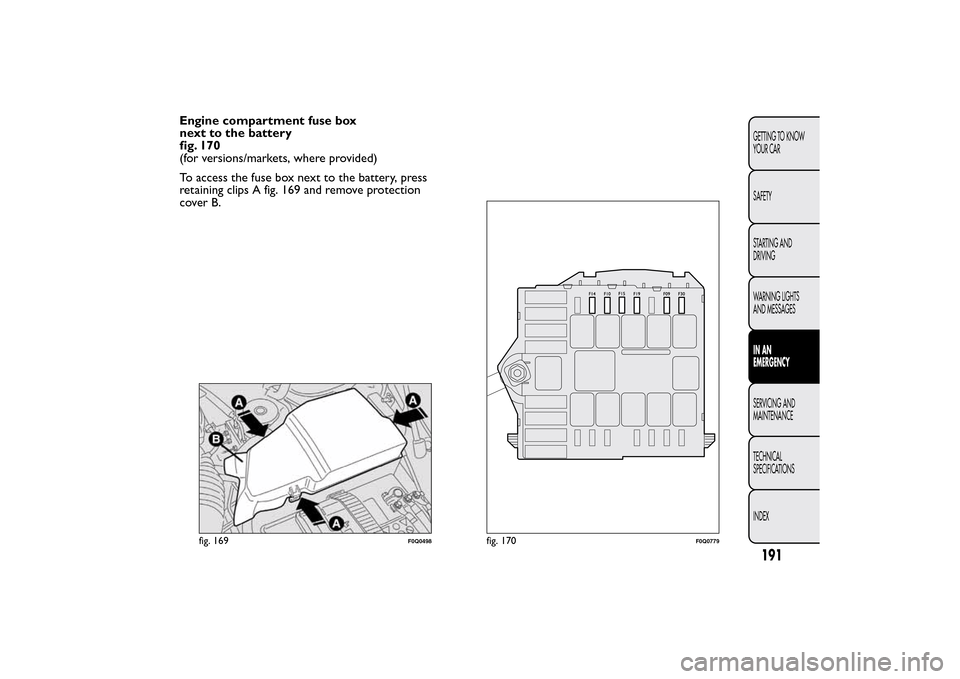
Engine compartment fuse box
next to the battery
fig. 170
(for versions/markets, where provided)
To access the fuse box next to the battery, press
retaining clips A fig. 169 and remove protection
cover B.
fig. 169
F0Q0498
fig. 170
F0Q0779
191GETTING TO KNOW
YOUR CAR
SAFETY
STARTING AND
DRIVING
WARNING LIGHTS
AND MESSAGESIN AN
EMERGENCYSERVICING AND
MAINTENANCE
TECHNICAL
SPECIFICATIONS
INDEX
Page 197 of 275
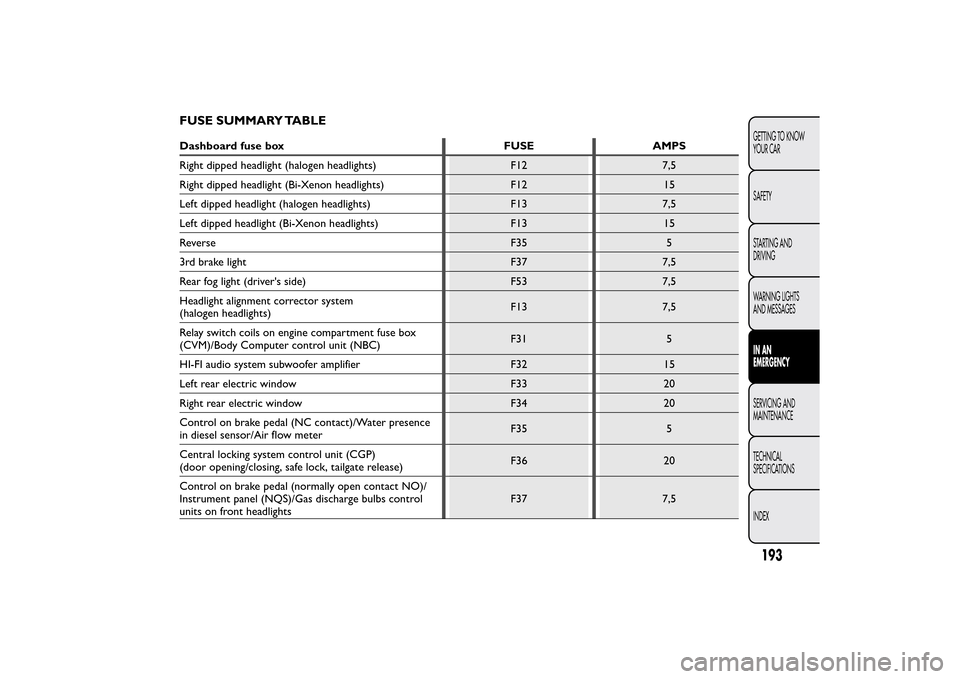
FUSE SUMMARY TABLEDashboard fuse box FUSE AMPS
Right dipped headlight (halogen headlights) F12 7,5
Right dipped headlight (Bi-Xenon headlights) F12 15
Left dipped headlight (halogen headlights) F13 7,5
Left dipped headlight (Bi-Xenon headlights) F13 15
Reverse F35 5
3rd brake light F37 7,5
Rear fog light (driver's side) F53 7,5
Headlight alignment corrector system
(halogen headlights)F13 7,5
Relay switch coils on engine compartment fuse box
(CVM)/Body Computer control unit (NBC)F31 5
HI-FI audio system subwoofer amplifier F32 15
Left rear electric window F33 20
Right rear electric window F34 20
Control on brake pedal (NC contact)/Water presence
in diesel sensor/Air flow meterF35 5
Central locking system control unit (CGP)
(door opening/closing, safe lock, tailgate release)F36 20
Control on brake pedal (normally open contact NO)/
Instrument panel (NQS)/Gas discharge bulbs control
units on front headlightsF37 7,5
193GETTING TO KNOW
YOUR CAR
SAFETY
STARTING AND
DRIVING
WARNING LIGHTS
AND MESSAGESIN AN
EMERGENCYSERVICING AND
MAINTENANCE
TECHNICAL
SPECIFICATIONS
INDEX
Page 200 of 275
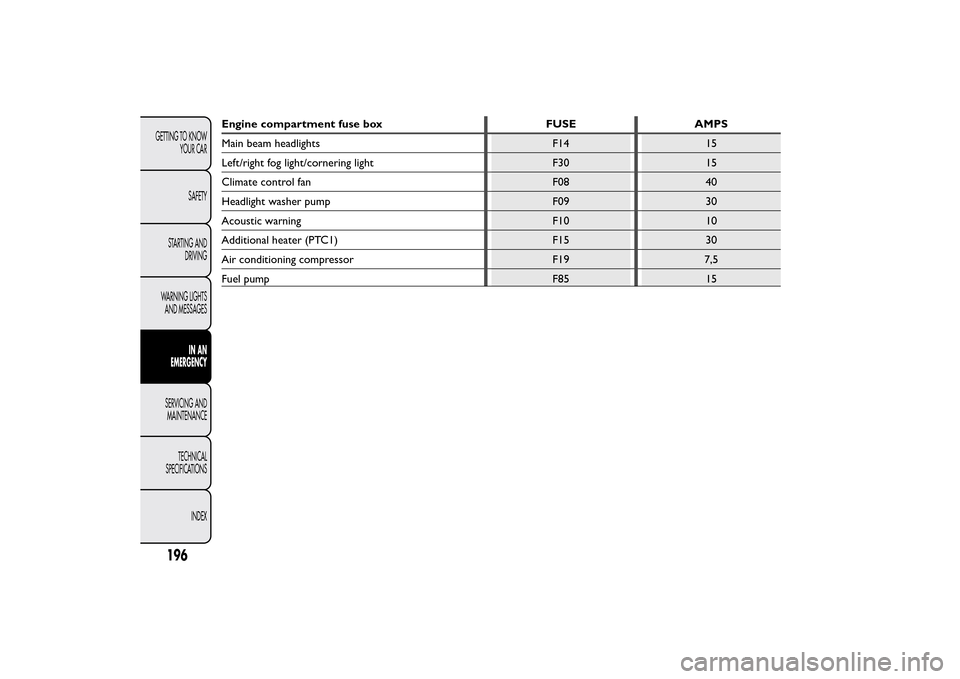
Engine compartment fuse box FUSE AMPS
Main beam headlights F14 15
Left/right fog light/cornering light F30 15
Climate control fan F08 40
Headlight washer pump F09 30
Acoustic warning F10 10
Additional heater (PTC1) F15 30
Air conditioning compressor F19 7,5
Fuel pump F85 15
196GETTING TO KNOW
YOUR CAR
SAFETY
STARTING AND
DRIVING
WARNING LIGHTS
AND MESSAGES
IN AN
EMERGENCY
SERVICING AND
MAINTENANCE
TECHNICAL
SPECIFICATIONS
INDEX