boot FIAT BRAVO 2014 2.G Owners Manual
[x] Cancel search | Manufacturer: FIAT, Model Year: 2014, Model line: BRAVO, Model: FIAT BRAVO 2014 2.GPages: 275, PDF Size: 3.95 MB
Page 143 of 275
WARNING
Depress the clutch pedal fully to change
gear correctly. It is therefore essential
that there is nothing under the pedals: make
sure the mats are lying flat and do not get
in the way of the pedals.Do not drive with your hand resting on
the gear lever as the force exerted, even if
slight , could lead over time to premature
wear of the gearbox internal components.
SAVING FUELSome useful tips are given below for fuel saving and
reducing harmful emissions of CO
2and other
pollutants [nitrogen oxides, unburnt hydrocarbons,
Particulate Matter (PM) etc.].
GENERAL CONSIDERATIONS
The general factors that affect fuel consumption are
listed below.
Car maintenance
Have checks and adjustments carried out in
accordance with the “Scheduled Servicing Plan”.
Ty r e s
Check the tyre pressures at least once every four
weeks: if the pressure is too low, consumption levels
increase as resistance to rolling is higher.
Unnecessary loads
Do not travel with an overloaded boot. The weight
of the car (especially when driving in town) and
its ride greatly affects consumption and stability.
Roof rack/ski rack
Remove the roof rack or the ski rack from the roof
after use. These accessories lower aerodynamic
penetration and adversely affect consumption levels.
When transporting particularly large objects, use a
trailer if possible.
139GETTING TO KNOW
YOUR CAR
SAFETYSTARTING AND
DRIVINGWARNING LIGHTS
AND MESSAGES
IN AN EMERGENCY
SERVICING AND
MAINTENANCE
TECHNICAL
SPECIFICATIONS
INDEX
Page 173 of 275
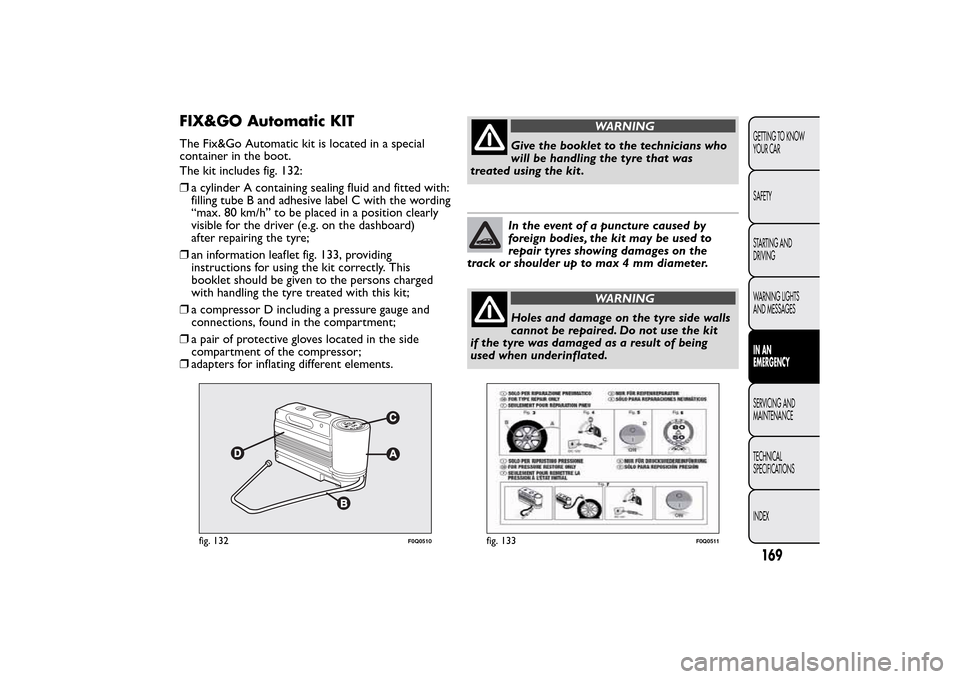
FIX&GO Automatic KITThe Fix&Go Automatic kit is located in a special
container in the boot.
The kit includes fig. 132:
❒a cylinder A containing sealing fluid and fitted with:
filling tube B and adhesive label C with the wording
“max. 80 km/h” to be placed in a position clearly
visible for the driver (e.g. on the dashboard)
after repairing the tyre;
❒an information leaflet fig. 133, providing
instructions for using the kit correctly. This
booklet should be given to the persons charged
with handling the tyre treated with this kit;
❒a compressor D including a pressure gauge and
connections, found in the compartment;
❒a pair of protective gloves located in the side
compartment of the compressor;
❒adapters for inflating different elements.
WARNING
Give the booklet to the technicians who
will be handling the tyre that was
treated using the kit .In the event of a puncture caused by
foreign bodies, the kit may be used to
repair tyres showing damages on the
track or shoulder up to max 4 mm diameter.
WARNING
Holes and damage on the tyre side walls
cannot be repaired. Do not use the kit
if the tyre was damaged as a result of being
used when underinflated.
fig. 132
F0Q0510
fig. 133
F0Q0511
169GETTING TO KNOW
YOUR CAR
SAFETY
STARTING AND
DRIVING
WARNING LIGHTS
AND MESSAGESIN AN
EMERGENCYSERVICING AND
MAINTENANCE
TECHNICAL
SPECIFICATIONS
INDEX
Page 207 of 275
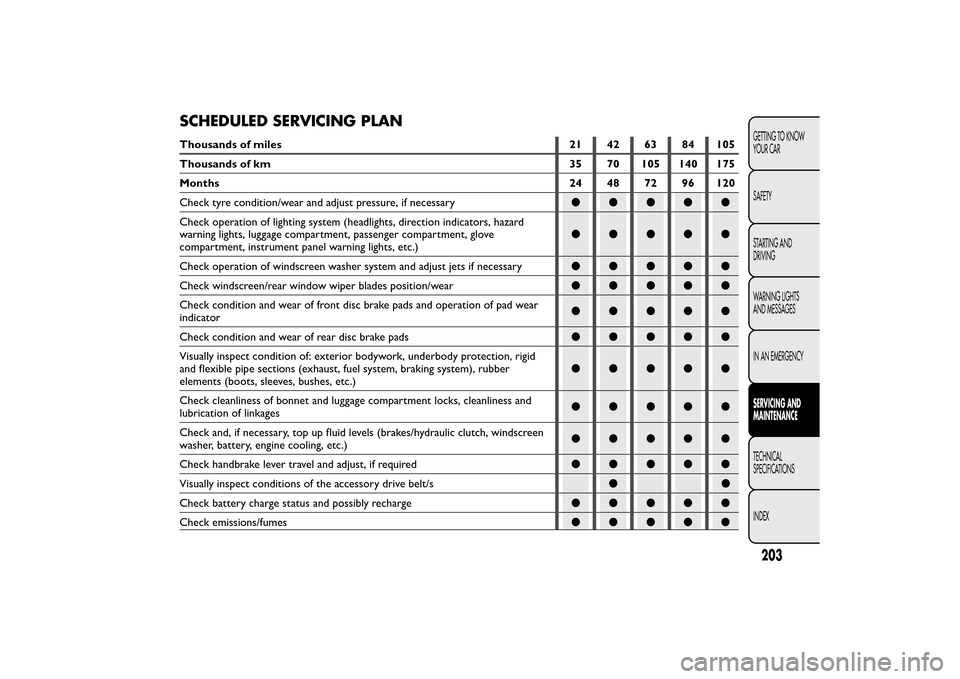
SCHEDULED SERVICING PLANThousands of miles 21 42 63 84 105
Thousands of km 35 70 105 140 175
Months 24 48 72 96 120
Check tyre condition/wear and adjust pressure, if necessary●●●●●
Check operation of lighting system (headlights, direction indicators, hazard
warning lights, luggage compartment, passenger compartment, glove
compartment, instrument panel warning lights, etc.)●●●●●
Check operation of windscreen washer system and adjust jets if necessary●●●●●
Check windscreen/rear window wiper blades position/wear●●●●●
Check condition and wear of front disc brake pads and operation of pad wear
indicator●●●●●
Check condition and wear of rear disc brake pads●●●●●
Visually inspect condition of: exterior bodywork, underbody protection, rigid
and flexible pipe sections (exhaust, fuel system, braking system), rubber
elements (boots, sleeves, bushes, etc.)●●●●●
Check cleanliness of bonnet and luggage compartment locks, cleanliness and
lubrication of linkages●●●●●
Check and, if necessary, top up fluid levels (brakes/hydraulic clutch, windscreen
washer, battery, engine cooling, etc.)●●●●●
Check handbrake lever travel and adjust, if required●●●●●
Visually inspect conditions of the accessory drive belt/s●●
Check battery charge status and possibly recharge●●●●●
Check emissions/fumes●●●●●
203GETTING TO KNOW
YOUR CAR
SAFETY
STARTING AND
DRIVING
WARNING LIGHTS
AND MESSAGES
IN AN EMERGENCYSERVICING AND
MAINTENANCETECHNICAL
SPECIFICATIONS
INDEX
Page 209 of 275
PERIODIC CHECKSEvery 1,000 km or before long journeys, check and, if
necessary, restore:
❒engine coolant, brake fluid and windscreen washer
fluid level;
❒tyre inflation pressure and condition;
❒operation of lighting system (headlamps, direction
indicators, hazard warning lights, etc.);
❒operation of screen washer/wiper system and
positioning/wear of windscreen/rear window wiper
blades.
Every 3,000 km, check and top up, if required, the
engine oil level.
HEAVY-DUTY USE OF THE CARIf the car is used mainly under one of the following
conditions:
❒towing a trailer or caravan;
❒dusty roads;
❒short, repeated journeys (less than 7-8 km) at
sub-zero outside temperatures;
❒engine often idling or driving long distances at low
speeds or long periods of idleness;
you need to perform the following inspections more
frequently than shown in the Scheduled Servicing
Plan:
❒check front disc brake pad conditions and wear;
❒check cleanliness of bonnet and boot locks,
cleanliness and lubrication of linkage;
❒visually inspect conditions of: engine, gearbox,
transmission, pipes and hoses (exhaust - fuel
system - brakes) and rubber elements (boots -
sleeves - bushes - etc.);
❒check battery charge and battery fluid level
(electrolyte);
❒visually inspect condition of the accessory drive
belts;
❒check and, if necessary, change engine oil and
replace oil filter;
❒check and, if necessary, replace pollen filter.
205GETTING TO KNOW
YOUR CAR
SAFETY
STARTING AND
DRIVING
WARNING LIGHTS
AND MESSAGES
IN AN EMERGENCYSERVICING AND
MAINTENANCETECHNICAL
SPECIFICATIONS
INDEX