belt FIAT BRAVO 2015 2.G Owner's Manual
[x] Cancel search | Manufacturer: FIAT, Model Year: 2015, Model line: BRAVO, Model: FIAT BRAVO 2015 2.GPages: 275, PDF Size: 7.55 MB
Page 138 of 275
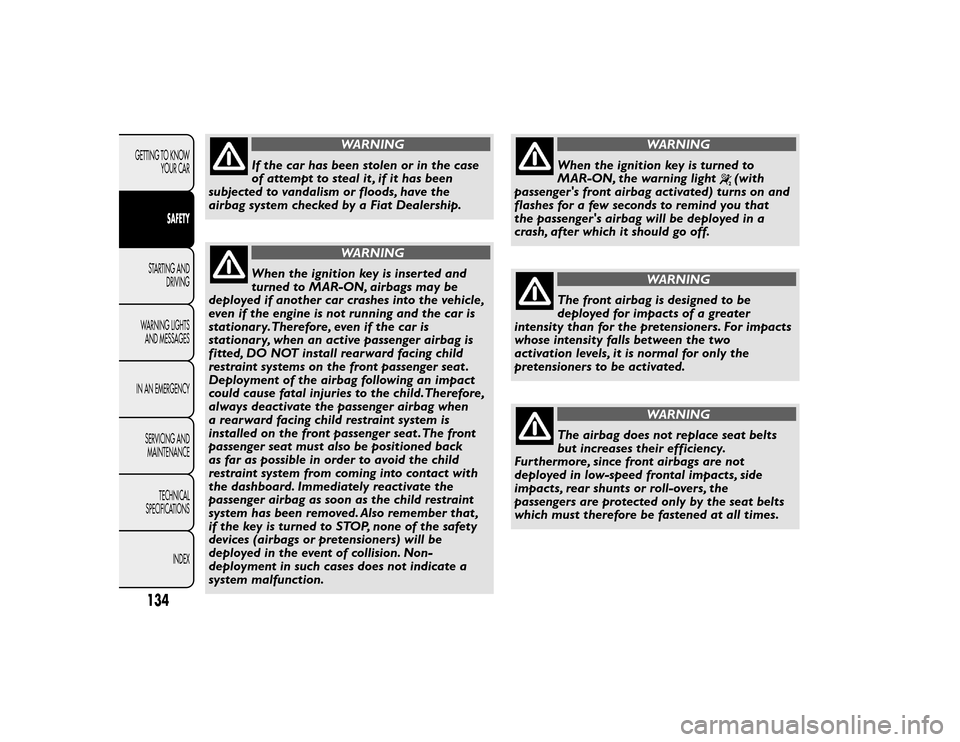
WARNING
If the car has been stolen or in the case
of attempt to steal it , if it has been
subjected to vandalism or floods, have the
airbag system checked by a Fiat Dealership.WARNING
When the ignition key is inserted and
turned to MAR-ON, airbags may be
deployed if another car crashes into the vehicle,
even if the engine is not running and the car is
stationary.Therefore, even if the car is
stationary, when an active passenger airbag is
fitted, DO NOT install rearward facing child
restraint systems on the front passenger seat .
Deployment of the airbag following an impact
could cause fatal injuries to the child.Therefore,
always deactivate the passenger airbag when
a rearward facing child restraint system is
installed on the front passenger seat .The front
passenger seat must also be positioned back
as far as possible in order to avoid the child
restraint system from coming into contact with
the dashboard. Immediately reactivate the
passenger airbag as soon as the child restraint
system has been removed. Also remember that ,
if the key is turned to STOP, none of the safety
devices (airbags or pretensioners) will be
deployed in the event of collision. Non-
deployment in such cases does not indicate a
system malfunction.
WARNING
When the ignition key is turned to
MAR-ON, the warning light
(with
passenger's front airbag activated) turns on and
flashes for a few seconds to remind you that
the passenger's airbag will be deployed in a
crash, after which it should go off.
WARNING
The front airbag is designed to be
deployed for impacts of a greater
intensity than for the pretensioners. For impacts
whose intensity falls between the two
activation levels, it is normal for only the
pretensioners to be activated.WARNING
The airbag does not replace seat belts
but increases their efficiency.
Furthermore, since front airbags are not
deployed in low-speed frontal impacts, side
impacts, rear shunts or roll-overs, the
passengers are protected only by the seat belts
which must therefore be fastened at all times.
134GETTING TO KNOW YOUR CAR
SAFETY
STARTING AND DRIVING
WARNING LIGHTS AND MESSAGES
IN AN EMERGENCY SERVICING ANDMAINTENANCE
TECHNICAL
SPECIFICATIONS
INDEX
Page 152 of 275
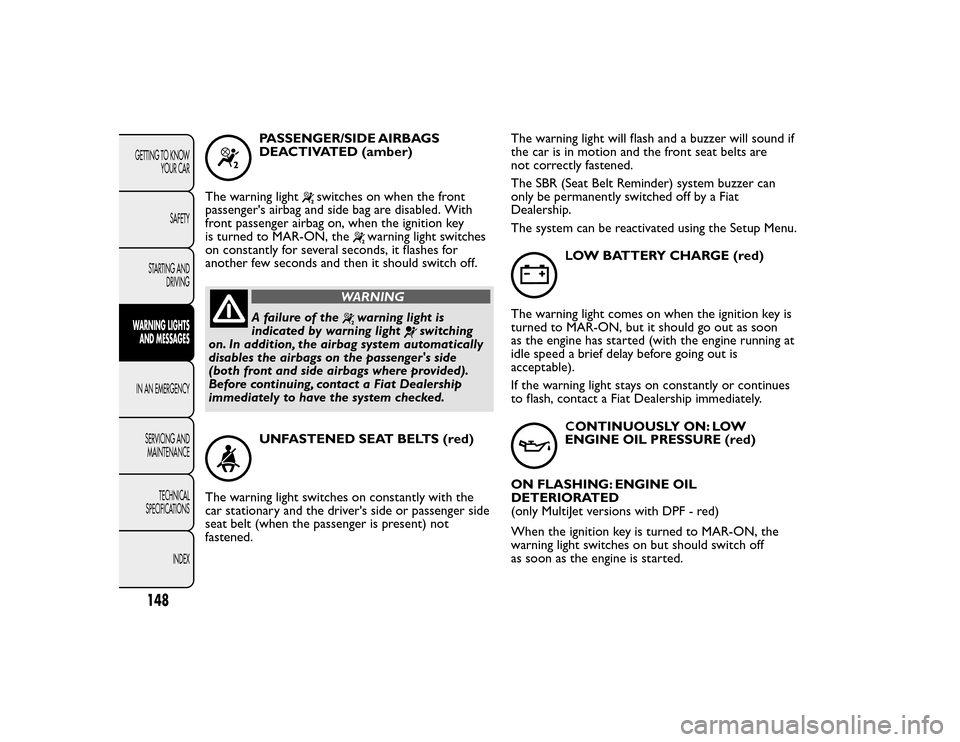
PASSENGER/SIDE AIRBAGS
DEACTIVATED (amber)
The warning light
switches on when the front
passenger's airbag and side bag are disabled. With
front passenger airbag on, when the ignition key
is turned to MAR-ON, the
warning light switches
on constantly for several seconds, it flashes for
another few seconds and then it should switch off.
WARNING
A failure of the
warning light is
indicated by warning light
switching
on. In addition, the airbag system automatically
disables the airbags on the passenger's side
(both front and side airbags where provided).
Before continuing, contact a Fiat Dealership
immediately to have the system checked.
UNFASTENED SEAT BELTS (red)
The warning light switches on constantly with the
car stationary and the driver's side or passenger side
seat belt (when the passenger is present) not
fastened. The warning light will flash and a buzzer will sound if
the car is in motion and the front seat belts are
not correctly fastened.
The SBR (Seat Belt Reminder) system buzzer can
only be permanently switched off by a Fiat
Dealership.
The system can be reactivated using the Setup Menu.
LOW BATTERY CHARGE (red)
The warning light comes on when the ignition key is
turned to MAR-ON, but it should go out as soon
as the engine has started (with the engine running at
idle speed a brief delay before going out is
acceptable).
If the warning light stays on constantly or continues
to flash, contact a Fiat Dealership immediately.CONTINUOUSLY ON: LOW
ENGINE OIL PRESSURE (red)
ON FLASHING: ENGINE OIL
DETERIORATED
(only MultiJet versions with DPF - red)
When the ignition key is turned to MAR-ON, the
warning light switches on but should switch off
as soon as the engine is started.
148GETTING TO KNOW YOUR CAR
SAFETY
STARTING AND DRIVING
WARNING LIGHTS AND MESSAGES
IN AN EMERGENCY SERVICING ANDMAINTENANCE
TECHNICAL
SPECIFICATIONS
INDEX
Page 208 of 275
204GETTING TO KNOW
YOUR CARSAFETY
STARTING AND
DRIVING
WARNING LIGHTSAND MESSAGESIN AN EMERGENCYSERVICING ANDMAINTENANCE
TECHNICAL
SPECIFICATIONS
INDEX
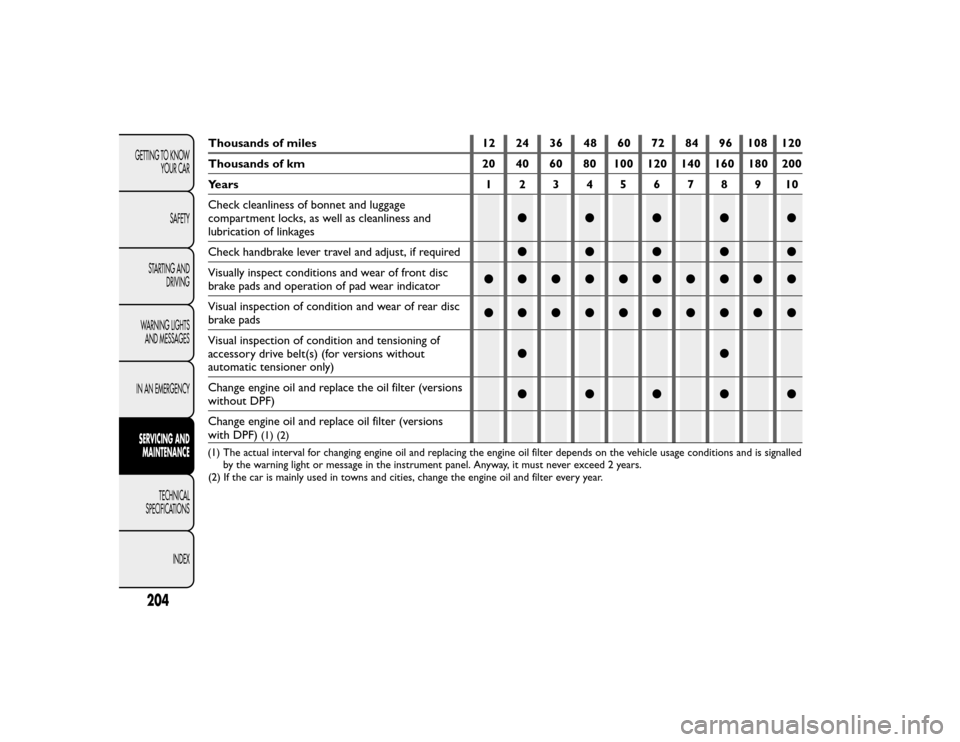
Thousandsofmiles
12
2
3
6
7
8
9
1
12
Thousands of km 20 40 60 80 100 120 140 160 180 200Years
12345678910
Check cleanliness of bonnet and luggage compartment locks, as well as cleanliness andlubrication of linkages
●●●●●
Check handbrake lever travel and adjust, if required
●●●●●
Visually inspect conditions and wear of front disc brake pads and operation of pad wear indicator
●●●●●●●●●●
Visual inspection of condition and wear of rear disc brake pads
●●●●●●●●●●
Visual inspection of condition and tensioning of accessory drive belt(s) (for versions withoutautomatic tensioner only)
●●
Change engine oil and replace the oil filter (versions without DPF)
●●●●●
Change engine oil and replace oil filter (versions with DPF)
(1) (2)
(2) If the car is mainly used in towns and cities, change the engine oil and filter every year.
4
6
48
0
2
4
6
08
0
(1) The actual interval for changing engine oil and replacing the engine oil filter depends on the vehicle usage conditions and is signalled
by the warning light or message in the instrument panel. Anyway, it must never exceed 2 years.
Page 209 of 275
205GETTING TO KNOWYOUR CAR SAFETYSTARTING AND DRIVING WARNING LIGHTS AND MESSAGES IN AN EMERGENCYSERVICING AND MAINTENANCE TECHNICAL SPECIFICATIONS INDEX
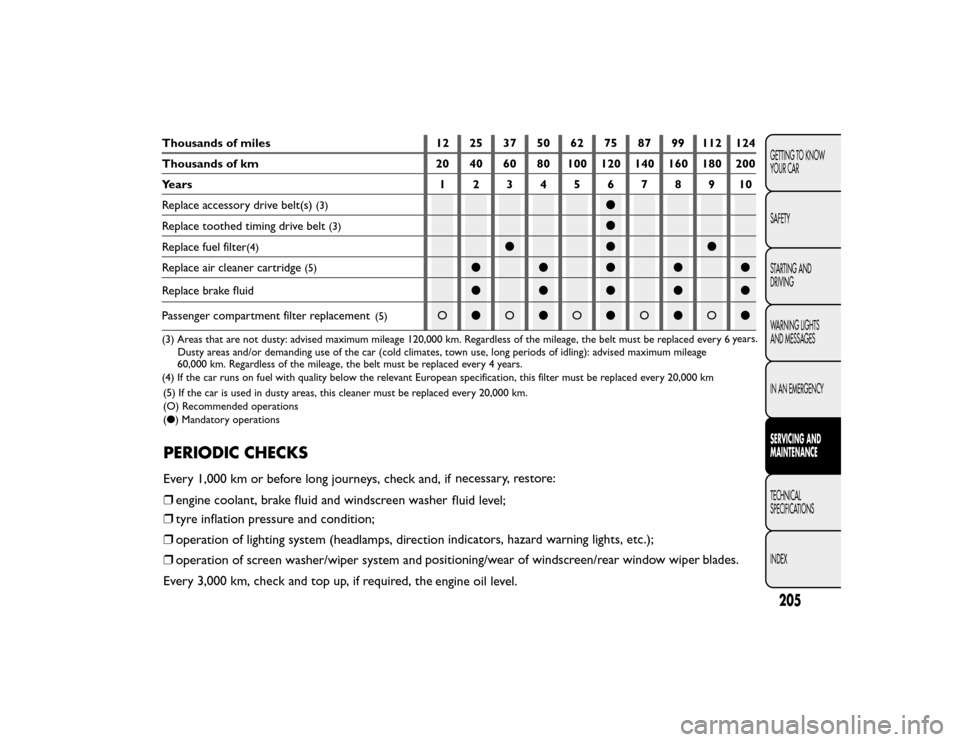
PERIODIC CHECKSEvery 1,000 km or before long journeys, check and, if necessary, restore: ❒
engine coolant, brake fluid and windscreen washer fluid level;
❒
tyre inflation pressure and condition;
❒
operation of lighting system (headlamps, directionindicators, hazard warning lights, etc.);
❒
operation of screen washer/wiper system andpositioning/wear of windscreen/rear window wiperblades.
Every 3,000 km, check and top up, if required, theengine oil level.
Thousands of miles 12 25 37 50 62 75 87 99 112 124 Thousands of km 20 40 60 80 100 120 140 160 180 200Years
12345678910
Replace accessory drive belt(s)
(3)
●
Replace toothed timing drive belt
(3)
●
Replace fuel filter
(4)
●●●
Replace air cleaner cartridge
(5)
●●●●●
Replace brake fluid
●●●●●
Passenger compartment filter replacement
(5)
O
●
O
●
O
●
O
●
O
●
(3) Areas that are not dusty: advised maximum mileage 120,000 km. Regardless of the mileage, the belt must be replaced every 6
years. Dusty areas and/or demanding use of the car (cold climates, town use, long periods of idling): advised maximum mileage 60,000 km. Regardless of the mileage, the belt must be replaced every 4 years.
(4) If the car runs on fuel with quality below the relevant European specification, this filter must be replaced every 20,000 km(5) If the car is used in dusty areas, this cleaner must be replaced every 20,000 km.(O) Recommended operations( ●) Mandatory operations
Page 210 of 275
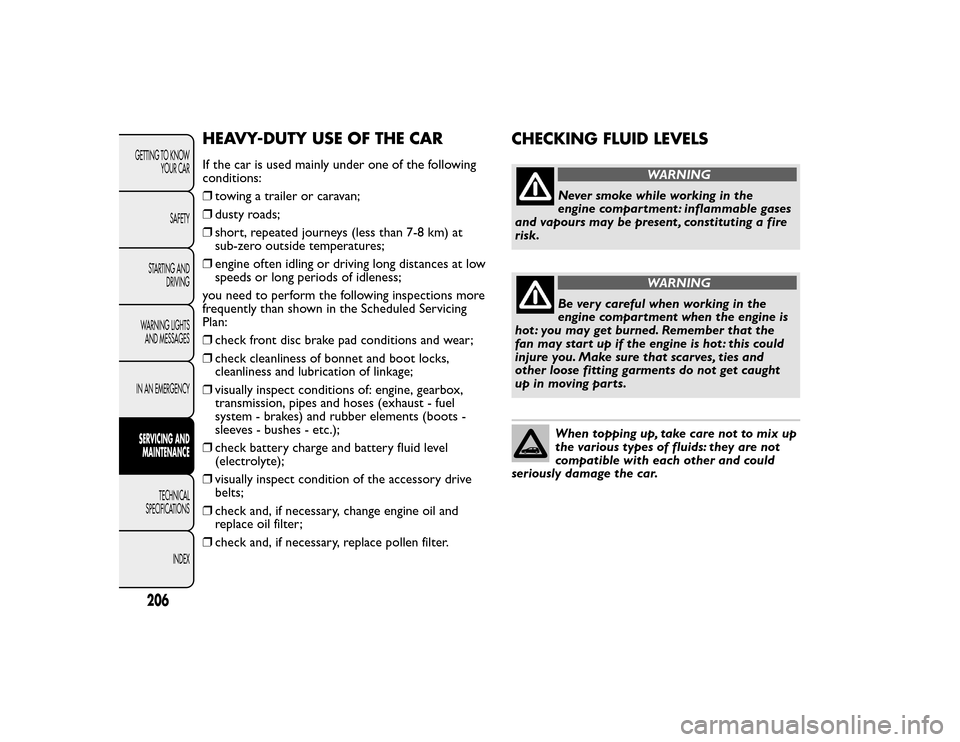
CHECKING FLUID LEVELS
WARNING
Never smoke while working in the engine compartment : inflammable gases
and vapours may be present , constituting a firerisk.
WARNING
Be very careful when working in theengine compartment when the engine is
hot : you may get burned. Remember that thefan may start up if the engine is hot : this couldinjure you. Make sure that scarves, ties andother loose fitting garments do not get caughtup in moving parts.
When topping up, take care not to mix upthe various types of fluids: they are notcompatible with each other and could
seriously damage the car.
206GETTING TO KNOW
YOUR CARSAFETY
STARTING AND
DRIVING
WARNING LIGHTSAND MESSAGESIN AN EMERGENCYSERVICING ANDMAINTENANCE
TECHNICAL
SPECIFICATIONS
INDEX
HEAVY-DUTY USE OF THE CARIf the car is used mainly under one of the followingconditions: ❒
towing a trailer or caravan;
❒
dusty roads;
❒
short, repeated journeys (less than 7-8 km) at sub-zero outside temperatures;
❒
engine often idling or driving long distances at lowspeeds or long periods of idleness;
you need to perform the following inspections morefrequently than shown in the Scheduled ServicingPlan: ❒
check front disc brake pad conditions and wear;
❒
check cleanliness of bonnet and boot locks, cleanliness and lubrication of linkage;
❒
visually inspect conditions of: engine, gearbox,transmission, pipes and hoses (exhaust - fuelsystem - brakes) and rubber elements (boots -sleeves - bushes - etc.);
❒
check battery charge and battery fluid level(electrolyte);
❒
visually inspect condition of the accessory drivebelts;
❒
check and, if necessary, change engine oil andreplace oil filter;
❒
check and, if necessary, replace pollen filter.
Page 272 of 275
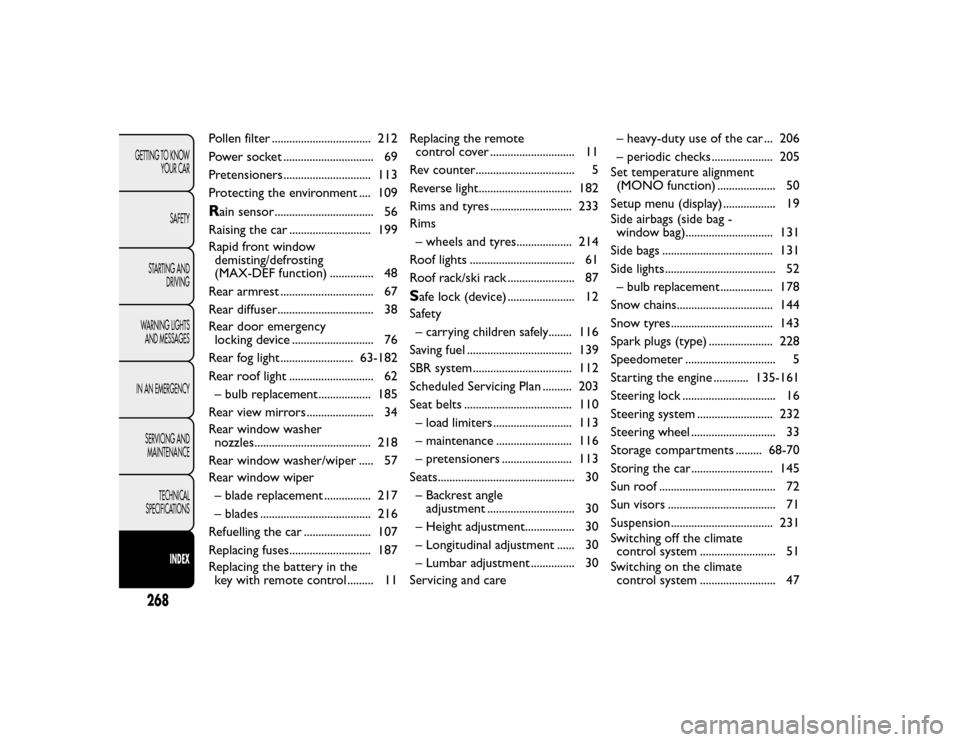
Pollen filter .................................. 212 Power socket ............................... 69Pretensioners .............................. 113Protecting the environment .... 109Rain sensor.................................. 56Raising the car ............................ 199 Rapid front windowdemisting/defrosting (MAX-DEF function) ............... 48Rear armrest ................................ 67 Rear diffuser................................. 38 Rear door emergencylocking device ............................ 76Rear fog light ......................... 63-182 Rear roof light ............................. 62– bulb replacement.................. 185Rear view mirrors ....................... 34 Rear window washernozzles........................................ 218Rear window washer/wiper ..... 57Rear window wiper– blade replacement ................ 217 – blades ...................................... 216Refuelling the car ....................... 107Replacing fuses............................ 187 Replacing the battery in thekey with remote control ......... 11
Replacing the remotecontrol cover ............................. 11Rev counter.................................. 5 Reverse light................................ 182Rims and tyres ............................ 233 Rims– wheels and tyres................... 214Roof lights .................................... 61 Roof rack/ski rack ....................... 87Safe lock (device) ....................... 12Safety– carrying children safely........ 116Saving fuel .................................... 139SBR system .................................. 112Scheduled Servicing Plan .......... 203Seat belts ..................................... 110– load limiters ........................... 113– maintenance .......................... 116– pretensioners ........................ 113Seats............................................... 30– Backrest angleadjustment .............................. 30– Height adjustment................. 30– Longitudinal adjustment ...... 30– Lumbar adjustment ............... 30Servicing and care
– heavy-duty use of the car ... 206– periodic checks ..................... 205Set temperature alignment(MONO function) .................... 50Setup menu (display) .................. 19 Side airbags (side bag -window bag).............................. 131Side bags ...................................... 131 Side lights...................................... 52– bulb replacement.................. 178Snow chains................................. 144Snow tyres................................... 143Spark plugs (type) ...................... 228Speedometer ............................... 5Starting the engine ............ 135-161Steering lock ................................ 16Steering system .......................... 232Steering wheel ............................. 33Storage compartments ......... 68-70Storing the car ............................ 145Sun roof ........................................ 72Sun visors ..................................... 71Suspension ................................... 231 Switching off the climatecontrol system .......................... 51Switching on the climatecontrol system .......................... 47
268GETTING TO KNOW
YOUR CARSAFETY
STARTING AND
DRIVING
WARNING LIGHTSAND MESSAGESIN AN EMERGENCYSERVICING ANDMAINTENANCETECHNICAL
SPECIFICATIONS
INDEX