instrument panel FIAT CROMA 2008 2.G User Guide
[x] Cancel search | Manufacturer: FIAT, Model Year: 2008, Model line: CROMA, Model: FIAT CROMA 2008 2.GPages: 258, PDF Size: 5.86 MB
Page 69 of 258
68
SAFETY
DEVICES
CORRECT USE
OF THE CAR
WARNING
LIGHTS AND
MESSAGES
IN AN
EMERGENCY
CAR
MAINTENANCE
TECHNICAL
SPECIFICATIONS
INDEX
DASHBOARD
AND CONTROLS
CRUISE CONTROL
(where provided)
It is a device able to support the driver,
with electronic control, which allows dri-
ving at speed over 30 km/h on long and
straight dry roads (e.g.: motorways), at a
desired speed, without pressing the ac-
celerator pedal. Therefore it is not sug-
gested to use this device on extra-urban
roads with traffic. Do not use it in town.
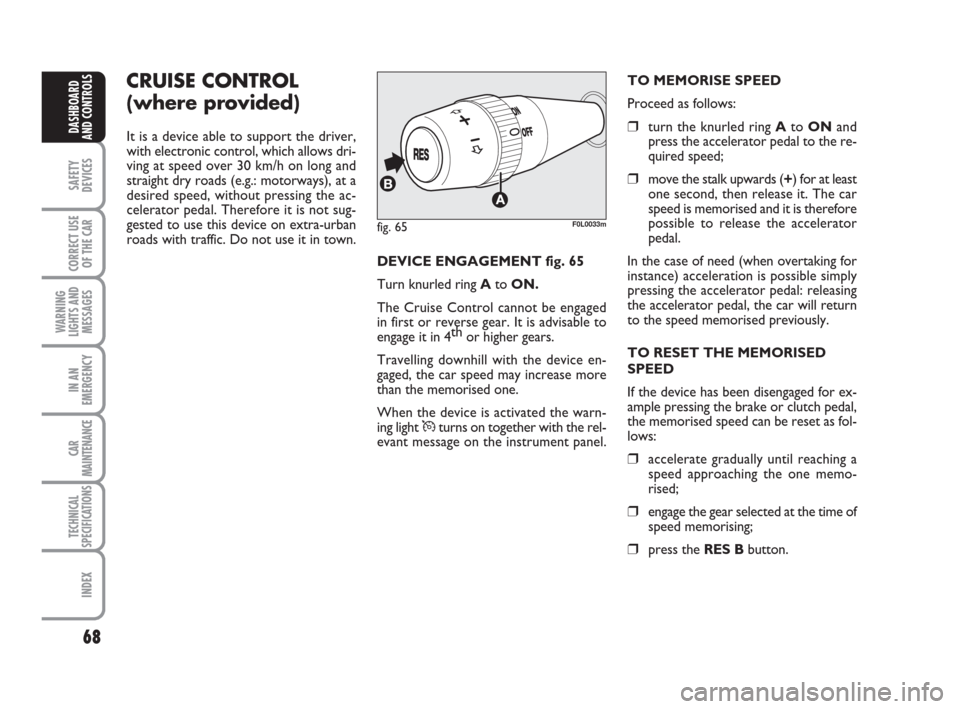
DEVICE ENGAGEMENT fig. 65
Turn knurled ring Ato ON.
The Cruise Control cannot be engaged
in first or reverse gear. It is advisable to
engage it in 4th
or higher gears.
Travelling downhill with the device en-
gaged, the car speed may increase more
than the memorised one.
When the device is activated the warn-
ing light
Üturns on together with the rel-
evant message on the instrument panel.TO MEMORISE SPEED
Proceed as follows:
❒turn the knurled ring AtoONand
press the accelerator pedal to the re-
quired speed;
❒move the stalk upwards (+) for at least
one second, then release it. The car
speed is memorised and it is therefore
possible to release the accelerator
pedal.
In the case of need (when overtaking for
instance) acceleration is possible simply
pressing the accelerator pedal: releasing
the accelerator pedal, the car will return
to the speed memorised previously.
TO RESET THE MEMORISED
SPEED
If the device has been disengaged for ex-
ample pressing the brake or clutch pedal,
the memorised speed can be reset as fol-
lows:
❒accelerate gradually until reaching a
speed approaching the one memo-
rised;
❒engage the gear selected at the time of
speed memorising;
❒press the RES Bbutton.
fig. 65F0L0033m
039-069 Croma TRW GB 10-11-2008 13:15 Pagina 68
Page 72 of 258
71
SAFETY
DEVICES
CORRECT USE
OF THE CAR
WARNING
LIGHTS AND
MESSAGES
IN AN
EMERGENCY
MANUTENZIONE
E CURA
TECHNICAL
SPECIFICATIONS
INDEX
DASHBOARD
AND CONTROLS
CONTROLS
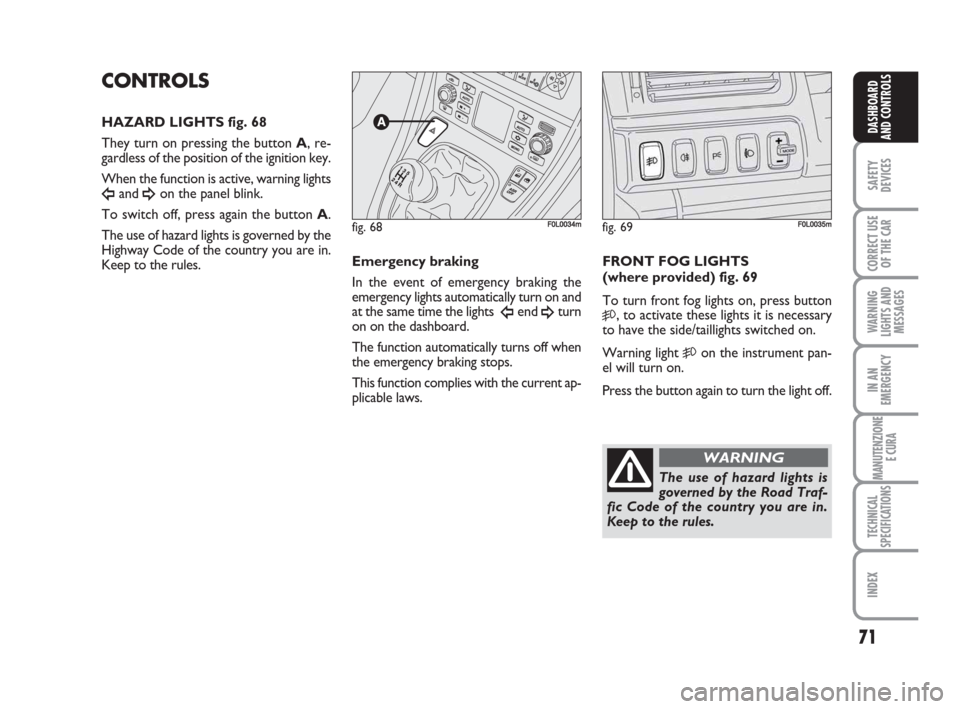
HAZARD LIGHTS fig. 68
They turn on pressing the button A, re-
gardless of the position of the ignition key.
When the function is active, warning lights
Îand ¥on the panel blink.
To switch off, press again the button A.
The use of hazard lights is governed by the
Highway Code of the country you are in.
Keep to the rules.
fig. 68F0L0034mfig. 69F0L0035m
The use of hazard lights is
governed by the Road Traf-
fic Code of the country you are in.
Keep to the rules.
WARNING
FRONT FOG LIGHTS
(where provided) fig. 69
To turn front fog lights on, press button
5, to activate these lights it is necessary
to have the side/taillights switched on.
Warning light
5on the instrument pan-
el will turn on.
Press the button again to turn the light off. Emergency braking
In the event of emergency braking the
emergency lights automatically turn on and
at the same time the lights
Îend ¥turn
on on the dashboard.
The function automatically turns off when
the emergency braking stops.
This function complies with the current ap-
plicable laws.
070-106 Croma TRW GB 29-05-2008 8:57 Pagina 71
Page 73 of 258
72
SAFETY
DEVICES
CORRECT USE
OF THE CAR
WARNING
LIGHTS AND
MESSAGES
IN AN
EMERGENCY
CAR
MAINTENANCE
TECHNICAL
SPECIFICATIONS
INDEX
DASHBOARD
AND CONTROLS
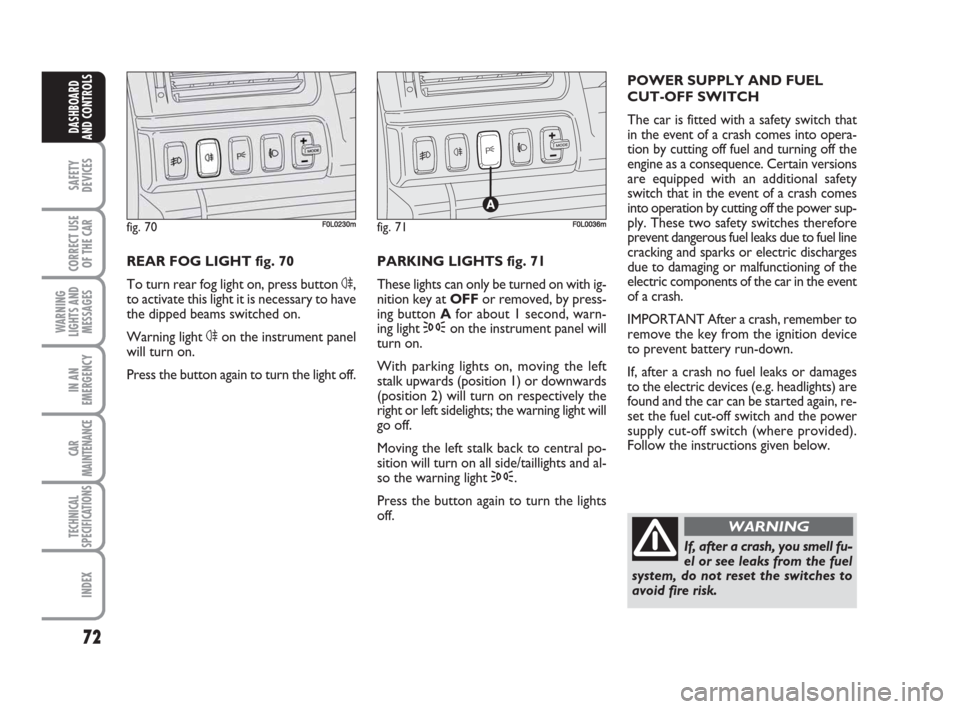
REAR FOG LIGHT fig. 70
To turn rear fog light on, press button 4,
to activate this light it is necessary to have
the dipped beams switched on.
Warning light 4on the instrument panel
will turn on.
Press the button again to turn the light off.PARKING LIGHTS fig. 71
These lights can only be turned on with ig-
nition key at OFFor removed, by press-
ing button Afor about 1 second, warn-
ing light 3on the instrument panel will
turn on.
With parking lights on, moving the left
stalk upwards (position 1) or downwards
(position 2) will turn on respectively the
right or left sidelights; the warning light will
go off.
Moving the left stalk back to central po-
sition will turn on all side/taillights and al-
so the warning light 3.
Press the button again to turn the lights
off. POWER SUPPLY AND FUEL
CUT-OFF SWITCH
The car is fitted with a safety switch that
in the event of a crash comes into opera-
tion by cutting off fuel and turning off the
engine as a consequence. Certain versions
are equipped with an additional safety
switch that in the event of a crash comes
into operation by cutting off the power sup-
ply. These two safety switches therefore
prevent dangerous fuel leaks due to fuel line
cracking and sparks or electric discharges
due to damaging or malfunctioning of the
electric components of the car in the event
of a crash.
IMPORTANT After a crash, remember to
remove the key from the ignition device
to prevent battery run-down.
If, after a crash no fuel leaks or damages
to the electric devices (e.g. headlights) are
found and the car can be started again, re-
set the fuel cut-off switch and the power
supply cut-off switch (where provided).
Follow the instructions given below.
fig. 70F0L0230mfig. 71F0L0036m
If, after a crash, you smell fu-
el or see leaks from the fuel
system, do not reset the switches to
avoid fire risk.
WARNING
070-106 Croma TRW GB 29-05-2008 8:57 Pagina 72
Page 85 of 258
84
SAFETY
DEVICES
CORRECT USE
OF THE CAR
WARNING
LIGHTS AND
MESSAGES
IN AN
EMERGENCY
CAR
MAINTENANCE
TECHNICAL
SPECIFICATIONS
INDEX
DASHBOARD
AND CONTROLS
BOOT
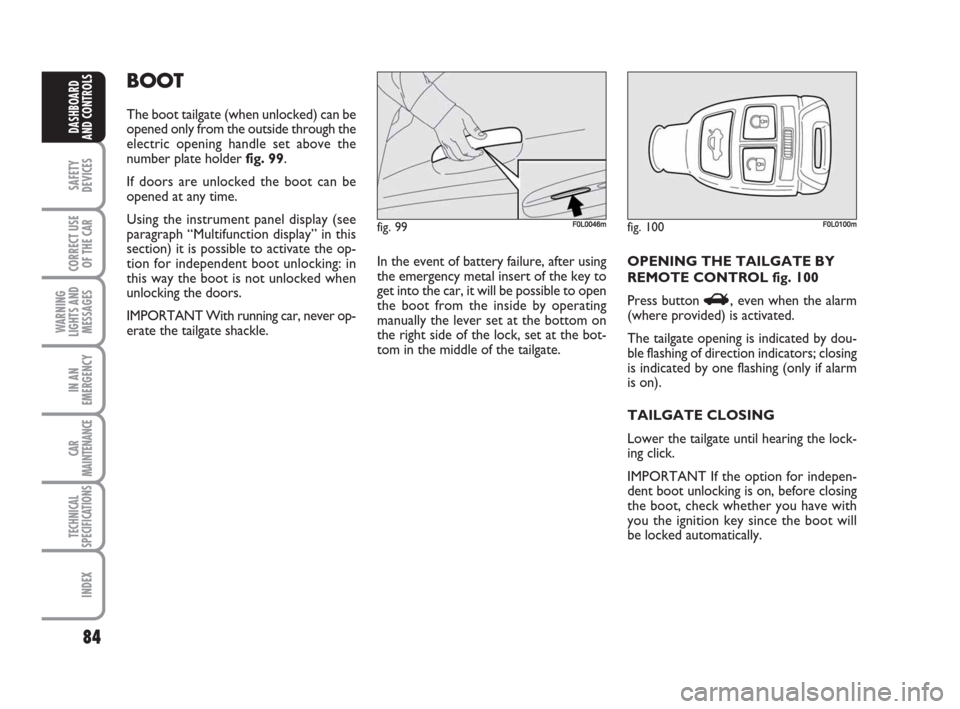
The boot tailgate (when unlocked) can be
opened only from the outside through the
electric opening handle set above the
number plate holder fig. 99.
If doors are unlocked the boot can be
opened at any time.
Using the instrument panel display (see
paragraph “Multifunction display” in this
section) it is possible to activate the op-
tion for independent boot unlocking: in
this way the boot is not unlocked when
unlocking the doors.
IMPORTANT With running car, never op-
erate the tailgate shackle.In the event of battery failure, after using
the emergency metal insert of the key to
get into the car, it will be possible to open
the boot from the inside by operating
manually the lever set at the bottom on
the right side of the lock, set at the bot-
tom in the middle of the tailgate. OPENING THE TAILGATE BY
REMOTE CONTROL fig. 100
Press button
R, even when the alarm
(where provided) is activated.
The tailgate opening is indicated by dou-
ble flashing of direction indicators; closing
is indicated by one flashing (only if alarm
is on).
TAILGATE CLOSING
Lower the tailgate until hearing the lock-
ing click.
IMPORTANT If the option for indepen-
dent boot unlocking is on, before closing
the boot, check whether you have with
you the ignition key since the boot will
be locked automatically.
fig. 99F0L0046mfig. 100F0L0100m
070-106 Croma TRW GB 29-05-2008 8:57 Pagina 84
Page 94 of 258
93
SAFETY
DEVICES
CORRECT USE
OF THE CAR
WARNING
LIGHTS AND
MESSAGES
IN AN
EMERGENCY
CAR
MAINTENANCE
TECHNICAL
SPECIFICATIONS
INDEX
DASHBOARD
AND CONTROLS
HEADLIGHTS
ADJUSTING THE HEADLIGHT
BEAM
Proper adjustment of the headlight beams
is of vital importance for your safety and
comfort and also for the other road users.
To ensure you and other drivers have the
best visibility conditions when travelling
with the headlights on, the headlights must
be set properly. Contact Fiat Dealership
to have the headlights properly adjusted.
IMPORTANT When turning on (Xenon)
gas discharge headlight lamps (where pro-
vided), it is normal that there should be a
vertical movement of reflectors, and con-
sequently the same will also happen to the
light beam, for the time required to
achieve the correct headlight trim stabili-
sation, equal to approx. 2 seconds.
Headlight aiming device
It works with ignition key at ONand
dipped beams on. When the car is loaded,
it slopes backwards. This means that the
headlight beam rises. In this case, it is nec-
essary to return it to the correct position.To adjust the headlight slant
fig. 122
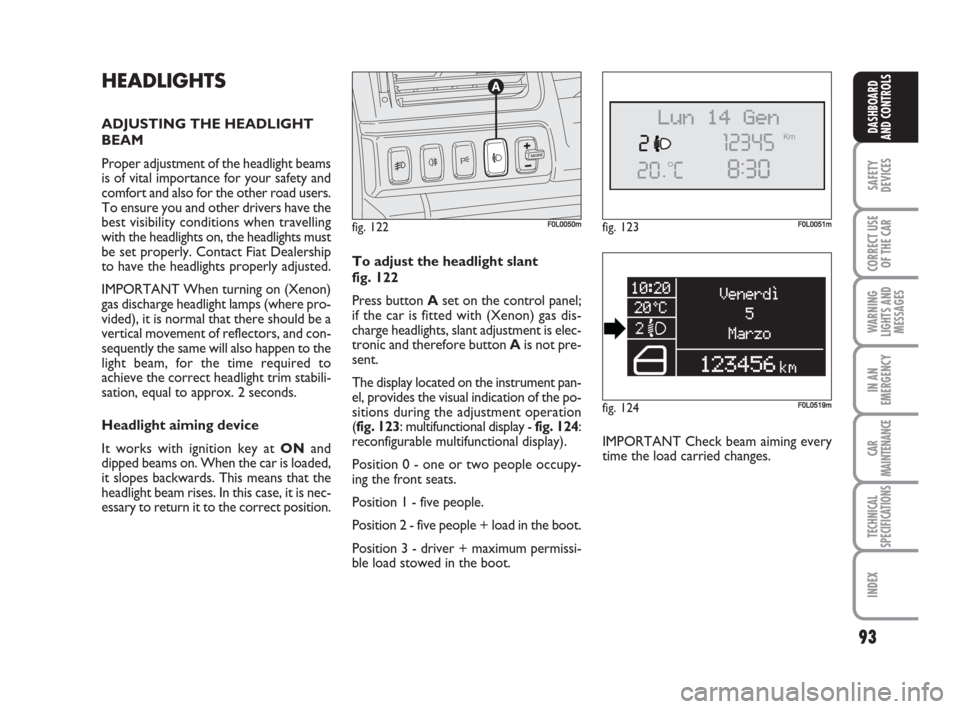
Press button Aset on the control panel;
if the car is fitted with (Xenon) gas dis-
charge headlights, slant adjustment is elec-
tronic and therefore button Ais not pre-
sent.
The display located on the instrument pan-
el, provides the visual indication of the po-
sitions during the adjustment operation
(fig. 123: multifunctional display - fig. 124:
reconfigurable multifunctional display).
Position 0 - one or two people occupy-
ing the front seats.
Position 1 - five people.
Position 2 - five people + load in the boot.
Position 3 - driver + maximum permissi-
ble load stowed in the boot.IMPORTANT Check beam aiming every
time the load carried changes.
fig. 122F0L0050mfig. 123F0L0051m
fig. 124F0L0519m
070-106 Croma TRW GB 29-05-2008 8:57 Pagina 93
Page 96 of 258
95
SAFETY
DEVICES
CORRECT USE
OF THE CAR
WARNING
LIGHTS AND
MESSAGES
IN AN
EMERGENCY
CAR
MAINTENANCE
TECHNICAL
SPECIFICATIONS
INDEX
DASHBOARD
AND CONTROLS
FAILURE WARNINGS
ABS failure
ABS failure is indicated by the turning on
of warning light
>on the instrument pan-
el together with the dedicated message on
the display (see section “Warning lights
and messages”).
In this case the braking system is still effi-
cient, though without the aid of the ABS
system. Drive carefully to the closest Fiat
Dealership to have the system checked.EBD failure
EBD failure is indicated by the turning on
of warning lights
>and xon the in-
strument panel together with the dedi-
cated message on the display (see section
“Warning lights and messages”).
In this case with sharp braking the rear
wheels might lock too early, with the pos-
sibility of skidding. Drive extremely care-
fully to the nearest Fiat Dealership to have
the system checked.
BRAKE ASSIST
(emergency braking assistance)
(where provided)
The system, which cannot be cut out, rec-
ognizes emergency braking (on the ground
of the brake pedal operation speed) and
considerably increases the pressure in the
brake circuit.
During emergency braking, the emergency
lights turn on automatically; when accel-
erating the lights turn off automatically.
Brake Assist is deactivated on the versions
equipped with ESP, in the event of ESP sys-
tem failure (indicated by warning light
áswitching on together with the message
on the display).
If the ABS system cuts in, it
is a sign that the grip be-
tween tyre and the road surface has
reached the limit: you must slow
down to match the speed to the road
grip available.
WARNING
The ABS exploits the tyre-
road grip at the best, but it
cannot improve it; you should there-
fore take every care when driving on
slippery surfaces without taking un-
necessary risks.
WARNING
When the ABS cuts in, and
you feel the brake pedal pul-
sating, do not remove your foot, but
keep it pressed; in doing so you will
stop in the shortest amount of space
possible under the current road con-
ditions.
WARNING
If the brake fluid low warn-
ing light xcomes on (to-
gether with the message on the dis-
play), stop the car immediately and
contact the nearest Fiat Dealership.
Fluid leaks from the hydraulic system,
in fact, can compromise the braking
system, both traditional systems and
systems with ABS.
WARNING
070-106 Croma TRW GB 29-05-2008 8:57 Pagina 95
Page 97 of 258
96
SAFETY
DEVICES
CORRECT USE
OF THE CAR
WARNING
LIGHTS AND
MESSAGES
IN AN
EMERGENCY
CAR
MAINTENANCE
TECHNICAL
SPECIFICATIONS
INDEX
DASHBOARD
AND CONTROLS
ESP SYSTEM
(Electronic Stability
Program)
(where provided)
The ESP system is an electronic system
controlling the car stability in the event of
tyre grip loss.
The ESP system is therefore particularly
useful when grip conditions of the road sur-
faces changes.
ESP SYSTEM INTERVENTION
It is signalled by the blinking of the warn-
ing light
áon the instrument panel, to in-
form the driver that the car is in critical
stability and grip conditions.
ESP SYSTEM OPERATION
The ESP system is automatically activat-
ed when the car is started and cannot be
de-activated.
FAILURE WARNINGS
In the event of failure, the ESP system is
automatically disconnected and the warn-
ing light
á, comes on with fixed light on
the instrument panel, together with the
message on the display (see section
“Warning lights and messages”). In this
case contact a Fiat Dealership as soon as
possible.At pickup the ESP system control unit will
keep brake force on wheels until reaching
the torque suitable for starting, or in any
case for max. 1.5 seconds in order to pass
easily from the brake pedal to the accel-
erator pedal.
After 1,5 seconds without starting, the
system will deactivate automatically by re-
leasing gradually the brake force.
At releasing, the typical brake disengage-
ment noise indicating that the car is go-
ing to move will be heard.
Failure indications
System failure is indicated by the turning
on of warning light
áon the instrument
panel (together with the message on the
multifunction display) (see section “Warn-
ing lights and messages”).
IMPORTANT The Hill Holder system is
not a parking brake. Never get out of the
car without engaging the handbrake,
switching the engine off and engaging the
first gear (position P con with automatic
transmission).
Performance of the ESP sys-
tem, in terms of active safe-
ty should not induce the driver to take
pointless and unnecessary risks. The
style of driving must in any case al-
ways be adapted to the conditions of
the road surface, visibility an traffic.
Road safety is always the driver’s re-
sponsibility.
WARNING
HILL HOLDER SYSTEM
(where provided)
This system is an integral part of the ESP
system and it is provided to facilitate start-
ing on slopes.
It will activate automatically with the fol-
lowing conditions:
Uphill: car at a standstill on a road with a
gradient higher than 5%, engine running,
clutch and brake pedal pressed, gearbox
to neutral or engaged gear other than re-
verse.
Downhill: car at a standstill on a road with
a gradient higher than 5%, engine running,
clutch and brake pedal pressed and re-
verse gear engaged.
070-106 Croma TRW GB 29-05-2008 8:57 Pagina 96
Page 99 of 258
98
SAFETY
DEVICES
CORRECT USE
OF THE CAR
WARNING
LIGHTS AND
MESSAGES
IN AN
EMERGENCY
CAR
MAINTENANCE
TECHNICAL
SPECIFICATIONS
INDEX
DASHBOARD
AND CONTROLS
When travelling on snowy roads with
snow chains, it may be helpful to turn the
ASR off: in fact, in these conditions, slip-
ping of the driving wheels when moving off
makes it possible to obtain better drive.FAILURE INDICATIONS
In the event of malfunctioning, the ASR
system is automatically disconnected and
the warning light
áwill come on with
fixed light on the instrument together with
the message on the display (see section
“Warning lights and messages”). In this
case contact Fiat Dealership as soon as
possible.
EOBD SYSTEM
The European On Board Diagnostic sys-
tem (EOBD), fitted to engine electronic
control units, allows monitoring and warn-
ing of any malfunction to the electronic
systems that could increase exhaust emis-
sions.
The objective is:
❒To keep system efficiency under con-
trol;
❒Warn when a fault causes emission lev-
els to increase;
❒Warn of the need to replace deterio-
rated components.
This diagnostic system indicates the pres-
ence of deteriorated components or sys-
tem malfunctioning (see section “Warn-
ing lights and messages”) by the turning on
of the instrument panel warning light U
(together with the message on the dis-
play).
The performance of the sys-
tem, in terms of active safe-
ty should not induce the driver to take
pointless and unnecessary risks. The
style of driving must in any case al-
ways be adapted to the conditions of
the road surface, visibility an traffic.
Road safety is always the driver’s re-
sponsibility.
WARNING
For correct operation of the
ASR system, the tyres must
absolutely be of the same brand and
type on all wheels, in perfect condi-
tions and, above all, of type, brand
and size specified.
WARNING
For correct operation of the
ASR system, the tyres must
absolutely be of the same brand and
type on all wheels, in perfect condi-
tions and, above all, of type, brand
and size specified.
WARNING
070-106 Croma TRW GB 29-05-2008 8:57 Pagina 98
Page 101 of 258
100
SAFETY
DEVICES
CORRECT USE
OF THE CAR
WARNING
LIGHTS AND
MESSAGES
IN AN
EMERGENCY
CAR
MAINTENANCE
TECHNICAL
SPECIFICATIONS
INDEX
DASHBOARD
AND CONTROLS
IMPORTANT NOTES ABOUT
THE T.P.M.S. SYSTEM
Failure indications will not be stored and
therefore will not be displayed when turn-
ing the engine off and on again. If failure
persists, the control unit will send warn-
ing indications to the instrument panel on-
ly after a few seconds when the car is
moving.
IMPORTANT T.P.M.S. system cannot in-
dicate sudden tyre pressure drops (e.g.:
tyre burst). In this event, brake the car
cautiously and avoid sudden steering.
IMPORTANT Replacing standard tyres
with winter tyres and vice versa involves
T.P.M.S. system set-up that shall be per-
formed at Fiat Dealerships only.
IMPORTANT The T.P.M.S. system re-
quires special equipment. Consult Fiat
Dealership to know what type of acces-
sories are compatible with the system
(wheels, wheel caps, etc.). Using other ac-
cessories could cause system malfunc-
tioning.IMPORTANT Tyre pressure could change
according to outside temperature. For this
reason the T.P.M.S. system could tem-
porarily indicate low tyre pressure. In this
event check pressure with cold tyres and
restore proper inflation values if required.
IMPORTANT If the car is fitted with
T.P.M.S. system, tyre and/or rim removal
and refitting operations involve special
precautions; to prevent damages or wrong
sensor refitting, contact Fiat Dealership to
have tyre and/or rim changed.
IMPORTANT If the car is fitted with
T.P.M.S. system, when changing a tyre,
change also the rubber seal of the valve.
Contact a Fiat Dealership.
IMPORTANT Strong radiofrequency
noise may inhibit regular TPMS system op-
eration; in this event, a dedicated message
will be displayed to warn the driver. This
message will disappear automatically as
soon as noise disappears.SOUND SYSTEM
(where provided)
For the operation of the radio with
CD/MP3 CD (where provided), read the
instructions for use given in the Supple-
ment attached to the Owner Handbook.
SOUND SYSTEM
(where provided)
The system includes:
❒2 tweeters (power 40W max. each),
located on front doors;
❒2 mid-woofers, (diameter 165 mm,
power 40W max. each), located on
front doors;
❒2 full-range speakers, (diameter 165
mm, power 40W max. each), located
on rear doors.
070-106 Croma TRW GB 29-05-2008 8:57 Pagina 100
Page 104 of 258
103
SAFETY
DEVICES
CORRECT USE
OF THE CAR
WARNING
LIGHTS AND
MESSAGES
IN AN
EMERGENCY
CAR
MAINTENANCE
TECHNICAL
SPECIFICATIONS
INDEX
DASHBOARD
AND CONTROLS
GENERAL WARNINGS
❒When parking, take the utmost care
to obstacles that may be set above or
under the sensors.
❒Objects set close to the car, under
certain circumstances are not detect-
ed and could therefore cause damages
to the car or be damaged.
❒Indications sent by the sensors can be
altered by dirt, snow or ice deposit-
ed on the sensors or by ultrasound
systems (e.g.: truck pneumatic brakes
or pneumatic hammers) set nearby the
car. For proper operation, the
parking sensors shall always
be clean from mud, dirt, snow
or ice. When cleaning the sen-
sors, take the utmost care to prevent
their damaging; do not use therefore
dry or rough clothes. Sensors shall be
washed with clean water and car de-
tergent, if required.
Parking manoeuvres howev-
er are always under the dri-
ver’s responsibility that shall always
check the absence of people (spe-
cially children) or animals in the ma-
noeuvre space. This system is just a
help for the driver but she/he shall
never reduce attention during dan-
gerous manoeuvres even if performed
at low speed.
WARNING
FAILURE INDICATIONS
In the event of sensor failures, the driver
is warned by the turning on of warning
light
èon the instrument panel and by
the relevant message on the display (see
section “Warning lights and messages”).
OPERATION WITH TRAILER
Parking sensor operation is deactivated
automatically when the trailer electric ca-
ble plug is fitted into the car tow hook
socket.
Sensors are reactivated when removing
the trailer cable plug.
In washing stations, clean sensors quickly
keeping the vapour jet/high pressure
washing nozzles at 10 cm at least from the
sensors.
070-106 Croma TRW GB 29-05-2008 8:57 Pagina 103