roof FIAT CROMA 2008 2.G User Guide
[x] Cancel search | Manufacturer: FIAT, Model Year: 2008, Model line: CROMA, Model: FIAT CROMA 2008 2.GPages: 258, PDF Size: 5.86 MB
Page 103 of 258
102
SAFETY
DEVICES
CORRECT USE
OF THE CAR
WARNING
LIGHTS AND
MESSAGES
IN AN
EMERGENCY
CAR
MAINTENANCE
TECHNICAL
SPECIFICATIONS
INDEX
DASHBOARD
AND CONTROLS
PARKING SENSORS
(where provided)
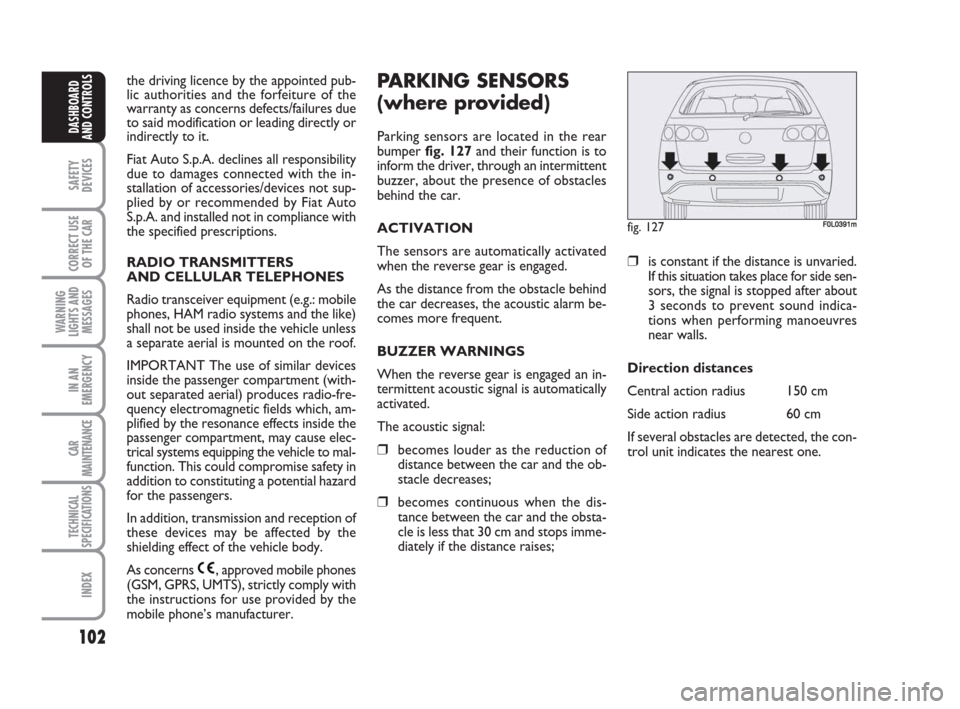
Parking sensors are located in the rear
bumper fig. 127and their function is to
inform the driver, through an intermittent
buzzer, about the presence of obstacles
behind the car.
ACTIVATION
The sensors are automatically activated
when the reverse gear is engaged.
As the distance from the obstacle behind
the car decreases, the acoustic alarm be-
comes more frequent.
BUZZER WARNINGS
When the reverse gear is engaged an in-
termittent acoustic signal is automatically
activated.
The acoustic signal:
❒becomes louder as the reduction of
distance between the car and the ob-
stacle decreases;
❒becomes continuous when the dis-
tance between the car and the obsta-
cle is less that 30 cm and stops imme-
diately if the distance raises;
❒is constant if the distance is unvaried.
If this situation takes place for side sen-
sors, the signal is stopped after about
3 seconds to prevent sound indica-
tions when performing manoeuvres
near walls.
Direction distances
Central action radius 150 cm
Side action radius 60 cm
If several obstacles are detected, the con-
trol unit indicates the nearest one.
fig. 127F0L0391m
the driving licence by the appointed pub-
lic authorities and the forfeiture of the
warranty as concerns defects/failures due
to said modification or leading directly or
indirectly to it.
Fiat Auto S.p.A. declines all responsibility
due to damages connected with the in-
stallation of accessories/devices not sup-
plied by or recommended by Fiat Auto
S.p.A. and installed not in compliance with
the specified prescriptions.
RADIO TRANSMITTERS
AND CELLULAR TELEPHONES
Radio transceiver equipment (e.g.: mobile
phones, HAM radio systems and the like)
shall not be used inside the vehicle unless
a separate aerial is mounted on the roof.
IMPORTANT The use of similar devices
inside the passenger compartment (with-
out separated aerial) produces radio-fre-
quency electromagnetic fields which, am-
plified by the resonance effects inside the
passenger compartment, may cause elec-
trical systems equipping the vehicle to mal-
function. This could compromise safety in
addition to constituting a potential hazard
for the passengers.
In addition, transmission and reception of
these devices may be affected by the
shielding effect of the vehicle body.
As concerns , approved mobile phones
(GSM, GPRS, UMTS), strictly comply with
the instructions for use provided by the
mobile phone’s manufacturer.
070-106 Croma TRW GB 29-05-2008 8:57 Pagina 102
Page 120 of 258
119
CORRECT USE
OF THE CAR
WARNING
LIGHTS AND
MESSAGES
IN AN
EMERGENCY
CAR
MAINTENANCE
TECHNICAL
SPECIFICATIONS
IINDEX
DASHBOARD
AND CONTROLS
SAFETY
DEVICES
At their maximum inflation, their volume
fills most of the space between the dash-
board and the passenger.
In case of crash, a person not wearing the
seat belt moves forward and may come in-
to contact with the cushion while it is still
inflating. Under this circumstance the pro-
tection offered by the air bag is reduced.
Front air bag may not be activated in the
following situations:
❒in collisions against highly deformable
objects not affecting the car front sur-
face (e.g. bumper collision against
guard rail, etc.);
❒in case of wedging under other vehi-
cles or protective barriers (for exam-
ple under a truck or guard rail), the air
bag is not triggered as it offers no ad-
ditional protection compared with the
seat belts, consequently it would be
pointless. Therefore, failure to come
into action in the above circumstance
does not mean that the system is not
working properly.
In minor crashes (for which the restrain-
ing action of the seat belts is sufficient), the
air bags are not deployed. Also in this case
it is of vital importance to wear the seat
belts since in case of side crash they guar-
antee proper positioning of the occupant
and prevent the occupants to be pitched
out of the car in case of violent crashes.
Do not apply stickers or oth-
er objects to the steering
wheel or to the air bag cover on the
passenger’s side or on the side roof
lining. Never put objects on the dash-
board on passenger side since they
could interfere with proper air bag in-
flation .
WARNING
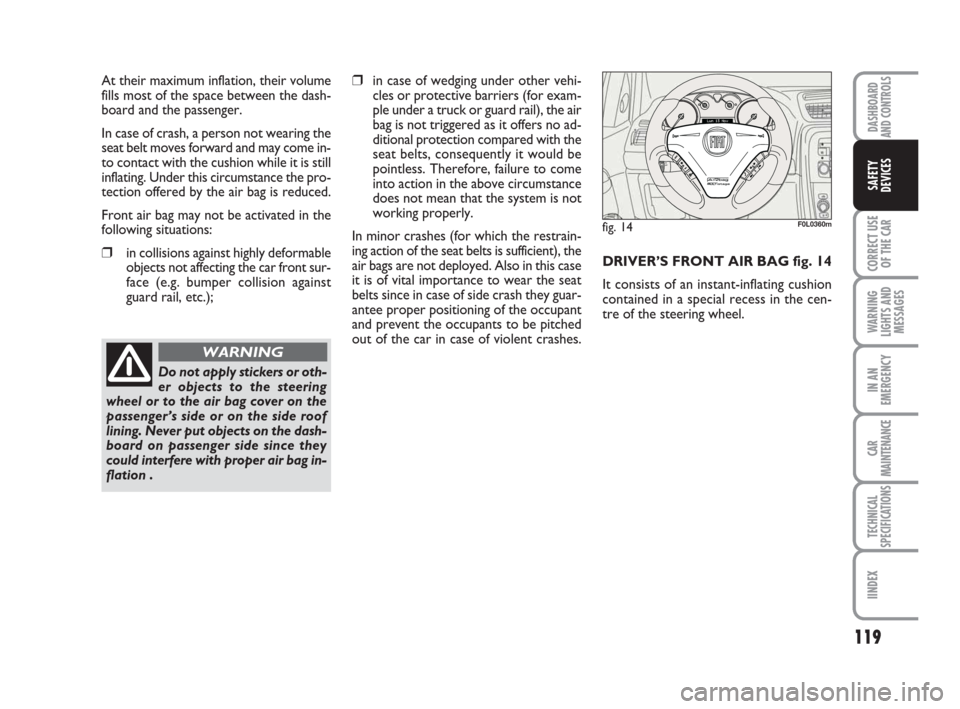
DRIVER’S FRONT AIR BAG fig. 14
It consists of an instant-inflating cushion
contained in a special recess in the cen-
tre of the steering wheel.
fig. 14
10
0
0
70
F0L0360m
107-126 Croma TRW GB 28-05-2008 16:32 Pagina 119
Page 123 of 258
122
CORRECT USE
OF THE CAR
WARNING
LIGHTS AND
MESSAGES
IN AN
EMERGENCY
CAR
MAINTENANCE
TECHNICAL
SPECIFICATIONS
INDEX
DASHBOARD
AND CONTROLS
SAFETY
DEVICES
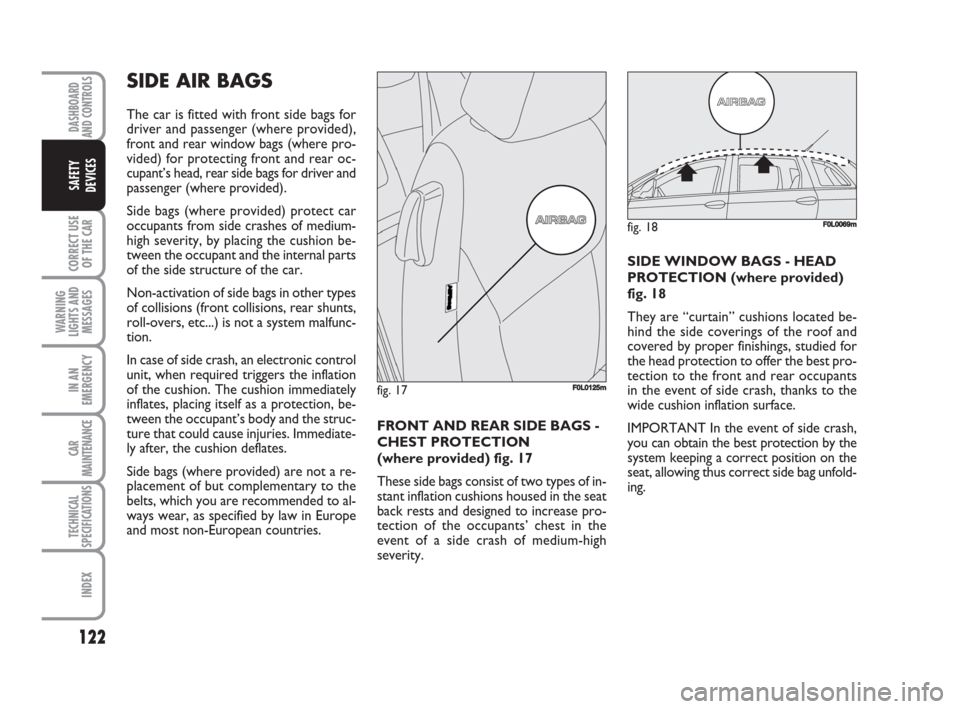
FRONT AND REAR SIDE BAGS -
CHEST PROTECTION
(where provided) fig. 17
These side bags consist of two types of in-
stant inflation cushions housed in the seat
back rests and designed to increase pro-
tection of the occupants’ chest in the
event of a side crash of medium-high
severity.SIDE WINDOW BAGS - HEAD
PROTECTION (where provided)
fig. 18
They are “curtain” cushions located be-
hind the side coverings of the roof and
covered by proper finishings, studied for
the head protection to offer the best pro-
tection to the front and rear occupants
in the event of side crash, thanks to the
wide cushion inflation surface.
IMPORTANT In the event of side crash,
you can obtain the best protection by the
system keeping a correct position on the
seat, allowing thus correct side bag unfold-
ing.
fig. 17F0L0125m
fig. 18F0L0069m
SIDE AIR BAGS
The car is fitted with front side bags for
driver and passenger (where provided),
front and rear window bags (where pro-
vided) for protecting front and rear oc-
cupant’s head, rear side bags for driver and
passenger (where provided).
Side bags (where provided) protect car
occupants from side crashes of medium-
high severity, by placing the cushion be-
tween the occupant and the internal parts
of the side structure of the car.
Non-activation of side bags in other types
of collisions (front collisions, rear shunts,
roll-overs, etc...) is not a system malfunc-
tion.
In case of side crash, an electronic control
unit, when required triggers the inflation
of the cushion. The cushion immediately
inflates, placing itself as a protection, be-
tween the occupant’s body and the struc-
ture that could cause injuries. Immediate-
ly after, the cushion deflates.
Side bags (where provided) are not a re-
placement of but complementary to the
belts, which you are recommended to al-
ways wear, as specified by law in Europe
and most non-European countries.
107-126 Croma TRW GB 28-05-2008 16:32 Pagina 122
Page 139 of 258
Roof rack/ski rack
Remove the roof rack or the ski rack from
the roof as soon as they are no longer
used. These accessories lower air pene-
tration and adversely affect consumption
levels. When needing to carry particular-
ly voluminous objects, preferably use a
trailer.
Electric devices
Use electric devices only for the amount
of time needed. Rear heated window, ad-
ditional headlights, windscreen wipers and
heater fan need a considerable amount of
energy, therefore increasing the require-
ment of current increases fuel consump-
tion (up to +25% in the urban cycle).
Climate control
The air conditioner is an additional load
which greatly affects the engine leading to
higher consumption (on average up to
+20%). When the temperature outside
the car permits it, use the air vents where
possible.
Spoilers
The use of non-certified aerodynamic
items may adversely affect air drag and
consumption levels.DRIVING STYLE
Starting
Do not warm the engine with the car at
a standstill or at idle or high speed: under
these conditions the engine warms up
much more slowly, increasing electrical
consumption and emissions. It is therefore
advisable to move off immediately, slow-
ly, avoiding high speeds. This way the en-
gine will warm faster.
Unnecessary actions
Avoid accelerating when waiting at traffic
lights or before switching off the engine.
This and also double declutching is ab-
solutely pointless on modern cars and al-
so increase consumption and pollution.
Gear selection
As soon as the conditions of the traffic and
road allow, use a higher gear. Using a low
gear to obtain brilliant performance in-
creases consumption.
In the same way improper use of a high
gear increases consumption, emissions an
engine wear.CONTAINING
RUNNING COSTS
Here are some suggestions which may
help you to keep the running costs of your
car down and lower the amount of toxic
emissions released into the atmosphere.
GENERAL CONSIDERATIONS
Car maintenance
Have checks and adjustments carried out
in accordance with the “Service schedule”.
Tyres
Check the pressure of the tyres routine-
ly at an interval of no more than 4 weeks:
if the pressure is too low, consumption
levels increase as resistance to rolling is
higher.
Unnecessary loads
Do not travel with too much luggage
stowed in the boot. The weight of the car
(especially when driving in town) and its
trim greatly affects consumption and sta-
bility.
138
WARNING
LIGHTS AND
MESSAGES
IN AN
EMERGENCY
CAR
MAINTENANCE
TECHNICAL
SPECIFICATIONS
INDEX
DASHBOARD
AND CONTROLS
SAFETY
DEVICES
CORRECT USE
OF THE CAR
127-144 Croma TRW GB 28-05-2008 16:33 Pagina 138
Page 162 of 258
161
WARNING
LIGHTS AND
MESSAGES
CAR
MAINTENANCE
TECHNICAL
SPECIFICATIONS
INDEX
DASHBOARD
AND CONTROLS
SAFETY
DEVICES
CORRECT USE
OF THE CAR
IN AN
EMERGENCY
To change a wheel proceed as follows:
❒Stop the car in a position that is not
dangerous for oncoming traffic where
you can change the wheel safely. The
ground should be flat and adequately
firm;
❒Turn the engine off and pull up the
handbrake;
❒Engage first gear or reverse (position
P with automatic transmission);
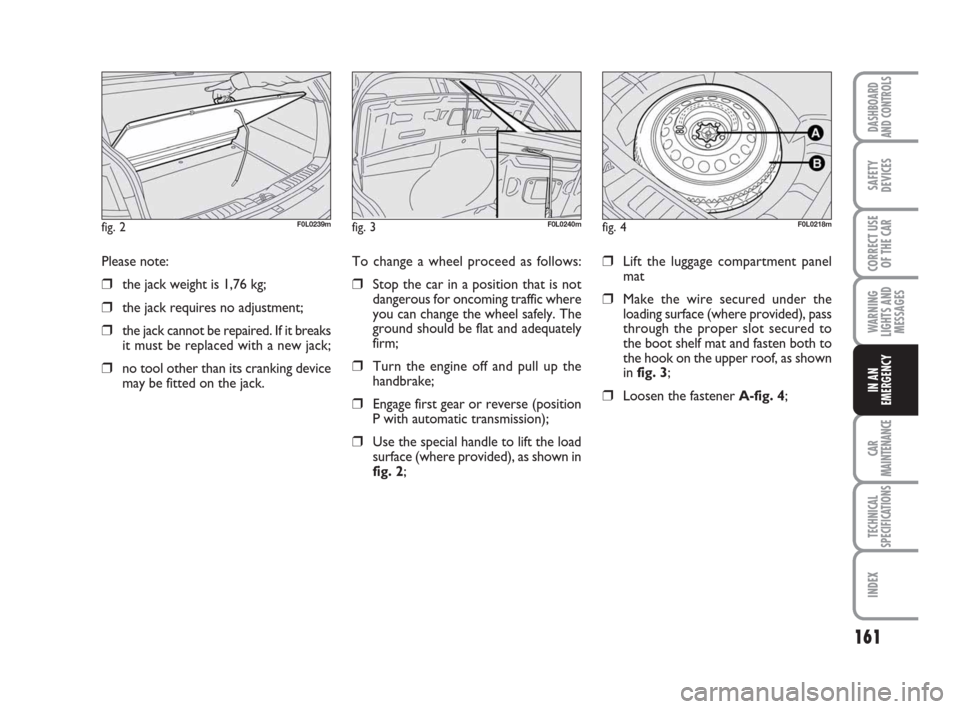
❒Use the special handle to lift the load
surface (where provided), as shown in
fig. 2;
❒Lift the luggage compartment panel
mat
❒Make the wire secured under the
loading surface (where provided), pass
through the proper slot secured to
the boot shelf mat and fasten both to
the hook on the upper roof, as shown
in fig. 3;
❒Loosen the fastener A-fig. 4; Please note:
❒the jack weight is 1,76 kg;
❒the jack requires no adjustment;
❒the jack cannot be repaired. If it breaks
it must be replaced with a new jack;
❒no tool other than its cranking device
may be fitted on the jack.
fig. 2F0L0239mfig. 3F0L0240mfig. 4F0L0218m
157-192 Croma TRW GB 10-11-2008 13:15 Pagina 161
Page 173 of 258
172
WARNING
LIGHTS AND
MESSAGES
CAR
MAINTENANCE
TECHNICAL
SPECIFICATIONS
INDEX
DASHBOARD
AND CONTROLS
SAFETY
DEVICES
CORRECT USE
OF THE CAR
IN AN
EMERGENCY
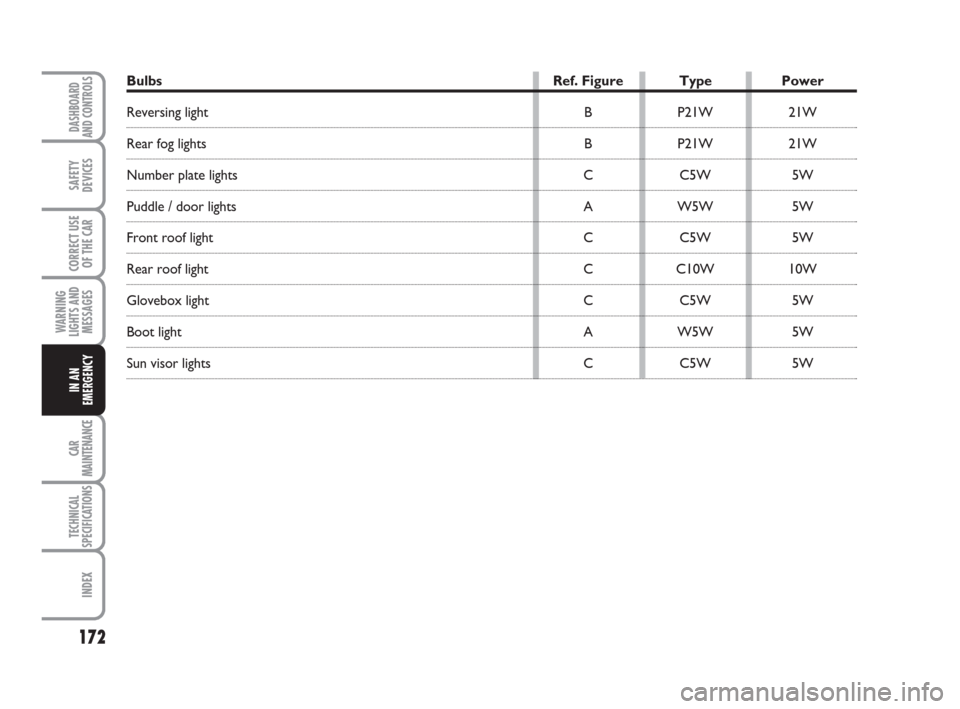
Bulbs Ref. Figure Type Power
Reversing light B P21W 21W
Rear fog lights B P21W 21W
Number plate lights C C5W 5W
Puddle / door lights A W5W 5W
Front roof light C C5W 5W
Rear roof light C C10W 10W
Glovebox light C C5W 5W
Boot light A W5W 5W
Sun visor lights C C5W 5W
157-192 Croma TRW GB 10-11-2008 13:15 Pagina 172
Page 188 of 258
187
WARNING
LIGHTS AND
MESSAGES
CAR
MAINTENANCE
TECHNICAL
SPECIFICATIONS
INDEX
DASHBOARD
AND CONTROLS
SAFETY
DEVICES
CORRECT USE
OF THE CAR
IN AN
EMERGENCY
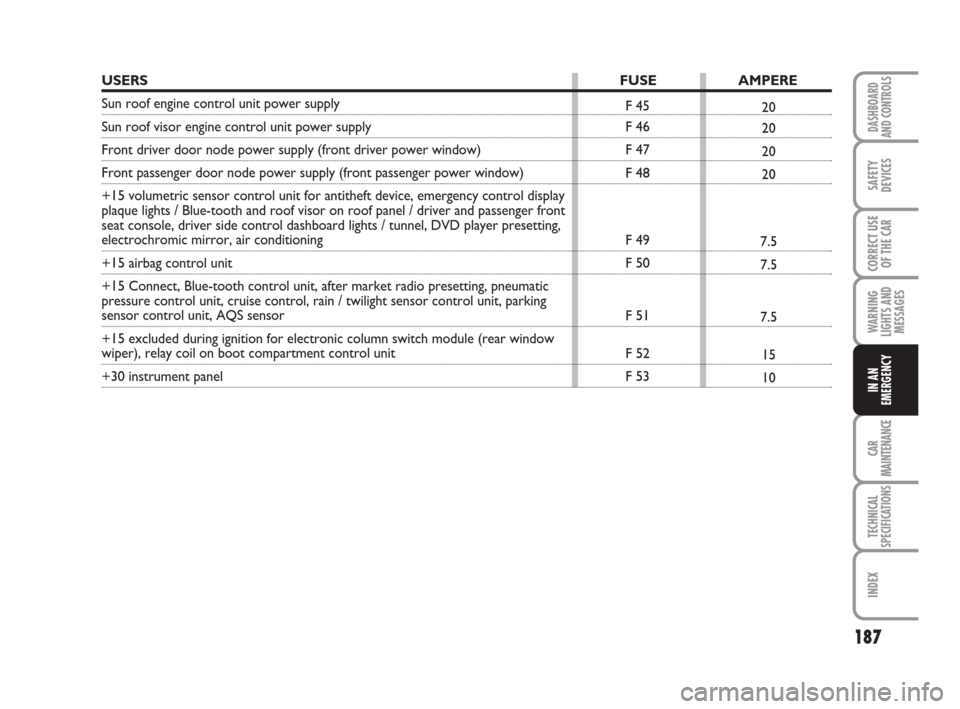
F 45
F 46
F 47
F 48
F 49
F 50
F 51
F 52
F 5320
20
20
20
7.5
7.5
7.5
15
10
USERSFUSE AMPERE
Sun roof engine control unit power supply
Sun roof visor engine control unit power supply
Front driver door node power supply (front driver power window)
Front passenger door node power supply (front passenger power window)
+15 volumetric sensor control unit for antitheft device, emergency control display
plaque lights / Blue-tooth and roof visor on roof panel / driver and passenger front
seat console, driver side control dashboard lights / tunnel, DVD player presetting,
electrochromic mirror, air conditioning
+15 airbag control unit
+15 Connect, Blue-tooth control unit, after market radio presetting, pneumatic
pressure control unit, cruise control, rain / twilight sensor control unit, parking
sensor control unit, AQS sensor
+15 excluded during ignition for electronic column switch module (rear window
wiper), relay coil on boot compartment control unit
+30 instrument panel
157-192 Croma TRW GB 10-11-2008 13:15 Pagina 187
Page 215 of 258
214
WARNING
LIGHTS AND
MESSAGES
TECHNICAL
SPECIFICATIONS
INDEX
DASHBOARD
AND CONTROLS
SAFETY
DEVICES
CORRECT USE
OF THE CAR
IN AN
EMERGENCY
CAR
MAINTENANCE
ADVICE FOR PRESERVING
THE BODYWORK
Paint
Paintwork does not only serve an aesteth-
ic purpose, but also protects the under-
lying sheet metal.
In the case of deep scrapes or scores, you
are advised to have the necessary touch-
ing up carried out immediately to avoid
the formation of rust. Use only original
paint products for touching up (see “Body-
work paint identification plate” in section
“Technical specification”). Normal paint
maintenance consists in washing at inter-
vals depending on the conditions and en-
vironment of use. For example, in highly
polluted areas, or if the roads are sprayed
with salt, it is wise to wash the car more
frequently.
For a correct wash of the vehicle proceed
as follows:
❒soak the body with a low pressure wa-
ter jet;
❒pass on the body a sponge with a li-
ght cleansing solution, frequently rin-
sing the sponge;
❒rinse accurately with water and dry
with air jet or suede.If the vehicle is washed in an automatic car
wash, follow these recommendations:
– remove the antenna from the roof to
avoid damages;
– water with a cleansing solution must be
used for washing;
– rinse accurately to avoid cleansing so-
lution residues which may remain on the
body or hidden parts.
❒Spraying the underbody, engine com-
partment, wheelhouse internal parts
and other parts with highly protective
wax products;
❒Spraying of plastic parts, with a pro-
tective function, in the more exposed
points: underdoor, inner fender parts,
edges, etc.;
❒Use of “open” boxed sections to pre-
vent condensation and pockets of
moisture from triggering rust inside.
BODY AND UNDERBODY
WARRANTY
Your car is covered by warranty against
perforation due to rust of any original el-
ement of the structure or body. For the
general terms of this warranty, refer to
the Fiat Warranty booklet.
When drying, take particular care with the
less visible parts like door surrounds, bon-
net and around the headlights where wa-
ter may stagnate. The car should not be
taken to a closed area immediately, but left
in the open so that residual water can eva-
porate. Do not wash the car after it has
been left in the sun or with the bonnet
hot: this may alter the shine of the
paintwork.Some automatic systems pro-
vided with old generation
and/or not correctly maintai-
ned brushes may damage the
varnish, easing the creation of micro-
scratches, especially on dark colours.
To remove those scratches, slightly po-
lish with a specific product.
193-216 Croma TRW GB 28-05-2008 15:19 Pagina 214
Page 231 of 258
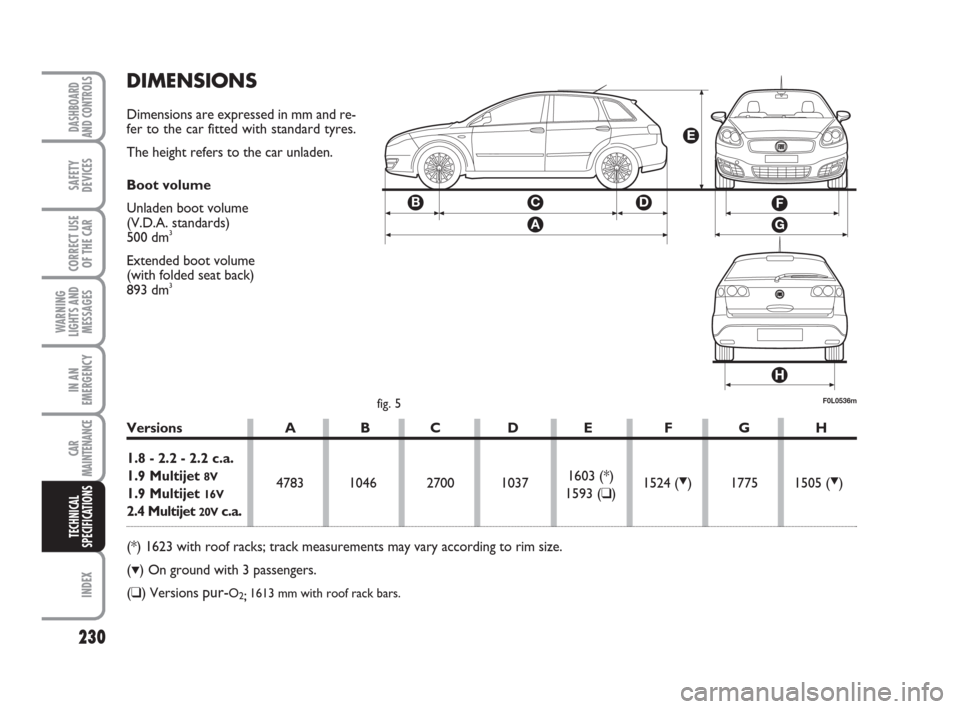
DIMENSIONS
Dimensions are expressed in mm and re-
fer to the car fitted with standard tyres.
The height refers to the car unladen.
Boot volume
Unladen boot volume
(V.D.A. standards)
500 dm
3
Extended boot volume
(with folded seat back)
893 dm
3
230
WARNING
LIGHTS AND
MESSAGES
INDEX
DASHBOARD
AND CONTROLS
SAFETY
DEVICES
CORRECT USE
OF THE CAR
IN AN
EMERGENCY
CAR
MAINTENANCE
TECHNICAL
SPECIFICATIONS
Versions A B C D E F G H
1.8 - 2.2 - 2.2 c.a.
1.9 Multijet
8V4783 1046 2700 10371603 (*)
1524 (▼) 1775 1505 (▼)
1.9 Multijet 16V1593 (❑)
2.4 Multijet 20Vc.a.
(*) 1623 with roof racks; track measurements may vary according to rim size.
(
▼) On ground with 3 passengers.
(❑) Versions
pur-O2;1613 mm with roof rack bars.
A
CBD
E
F
G
H
fig. 5F0L0536m
217-242 Croma TRW GB 10-11-2008 13:16 Pagina 230
Page 233 of 258
232
WARNING
LIGHTS AND
MESSAGES
INDEX
DASHBOARD
AND CONTROLS
SAFETY
DEVICES
CORRECT USE
OF THE CAR
IN AN
EMERGENCY
CAR
MAINTENANCE
TECHNICAL
SPECIFICATIONS
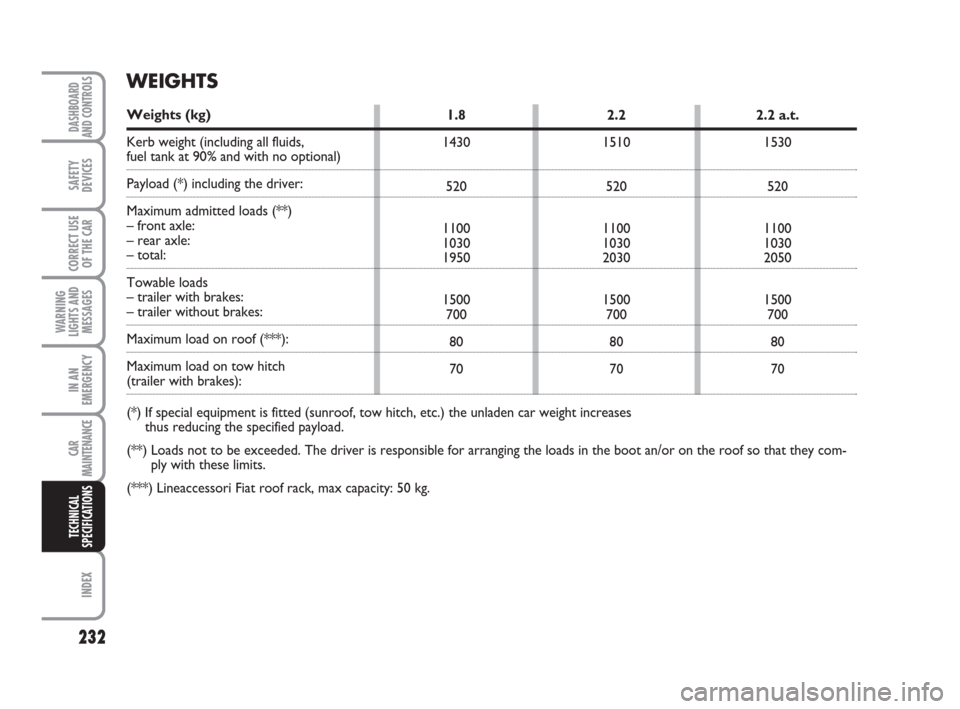
1.8
1430
520
1100
1030
1950
1500
700
80
702.2
1510
520
1100
1030
2030
1500
700
80
702.2 a.t.
1530
520
1100
1030
2050
1500
700
80
70
WEIGHTS
Weights (kg)
Kerb weight (including all fluids,
fuel tank at 90% and with no optional)
Payload (*) including the driver:
Maximum admitted loads (**)
– front axle:
– rear axle:
– total:
Towable loads
– trailer with brakes:
– trailer without brakes:
Maximum load on roof (***):
Maximum load on tow hitch
(trailer with brakes):
(*) If special equipment is fitted (sunroof, tow hitch, etc.) the unladen car weight increases
thus reducing the specified payload.
(**) Loads not to be exceeded. The driver is responsible for arranging the loads in the boot an/or on the roof so that they com-
ply with these limits.
(***) Lineaccessori Fiat roof rack, max capacity: 50 kg.
217-242 Croma TRW GB 10-11-2008 13:16 Pagina 232