clima FIAT DOBLO 2008 1.G User Guide
[x] Cancel search | Manufacturer: FIAT, Model Year: 2008, Model line: DOBLO, Model: FIAT DOBLO 2008 1.GPages: 222, PDF Size: 3.39 MB
Page 154 of 222
153VEHICLE MAINTENANCE
IMPORTANT - Engine oil
Should prevailing use of the vehicle
be under one of the following special-
ly heavy conditions:
– towing a trailer
– on dirty roads
– for short, repeated trips (less than
7-8 km) with outside temperature be-
low zero
– frequently idling engines or long
distance low speed driving (e.g. taxis
or door-to-door deliveries) or in case
of a long term inactivity; replace en-
gine oil more frequently than required
on Service schedule
IMPORTANT - Air cleaner
If the vehicle is used on dusty roads
change the air cleaner more frequently
than the indications in the Service
schedule. If in doubt as to how often
the engine oil and air cleaner should
be changed according to how you use
the vehicle, contact a Fiat Dealer-
ship.IMPORTANT - Pollen filter
If the vehicle is used frequently in
dusty or heavily polluted environ-
ments it is advisable to replace the fil-
tering element more frequently; in
particular it should be replaced if a re-
duction of the amount of air admitted
to the passenger compartment is not-
ed.
IMPORTANT - Battery
The charge in your battery should be
checked, where possible at the start
of the winter, to limit the risk of the
battery electrolyte freezing. This check
should be carried out more frequent-
ly if the vehicle is mainly used for short
trips or if it is fitted with accessories
that permanently take in electricity
even when the ignition key is re-
moved, especially in the case of after
market accessories.You should check the battery fluid
(electrolyte) level more frequently
than shown in the service schedule in
this chapter if the vehicle is used in hot
climates or particularly demanding
conditions.
Maintenance of your ve-
hicle should be entrusted
to a Fiat Dealership. For
ordinary routine maintenance
operations which you are able to
carry out yourself, ensure that
you have the necessary tools and
original Fiat spare parts and flu-
ids available. Do not carry out
servicing operations if you have
no experience.
149-173 Doblo GB 9-05-2008 12:10 Pagina 153
Page 160 of 222
159VEHICLE MAINTENANCE
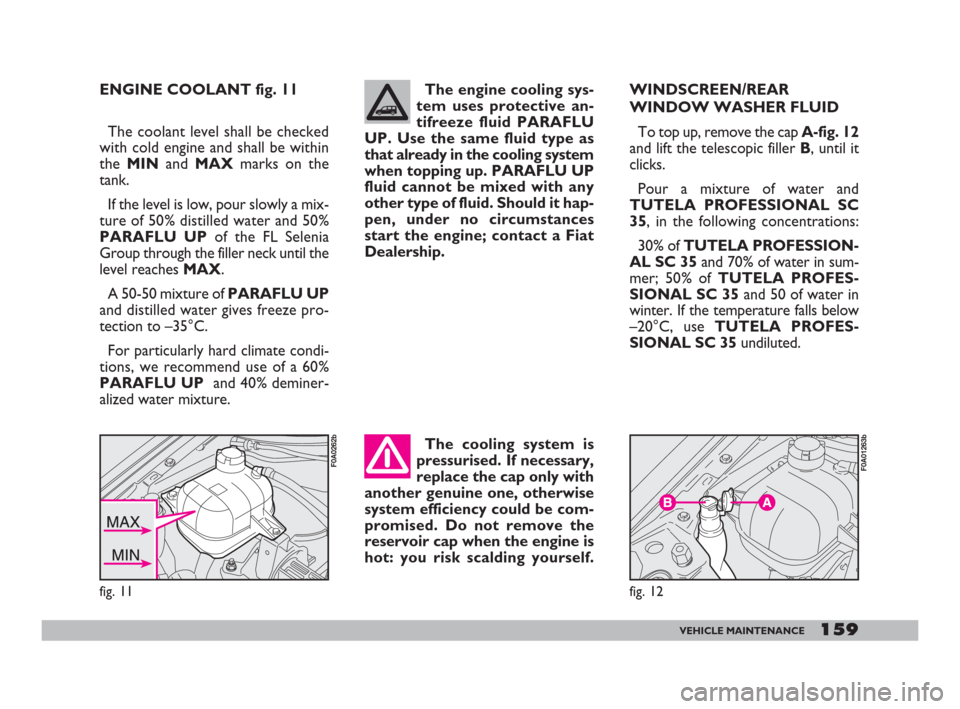
ENGINE COOLANT fig. 11
The cooling system is
pressurised. If necessary,
replace the cap only with
another genuine one, otherwise
system efficiency could be com-
promised. Do not remove the
reservoir cap when the engine is
hot: you risk scalding yourself.
The coolant level shall be checked
with cold engine and shall be within
the MINand MAXmarks on the
tank.
If the level is low, pour slowly a mix-
ture of 50% distilled water and 50%
PARAFLU UPof the FL Selenia
Group through the filler neck until the
level reaches MAX.
A 50-50 mixture of PARAFLU UP
and distilled water gives freeze pro-
tection to –35°C.
For particularly hard climate condi-
tions, we recommend use of a 60%
PARAFLU UP and 40% deminer-
alized water mixture.
fig. 11
F0A0262b
WINDSCREEN/REAR
WINDOW WASHER FLUID
To top up, remove the capA-fig. 12
and lift the telescopic filler B, until it
clicks.
Pour a mixture of water and
TUTELA PROFESSIONAL SC
35, in the following concentrations:
30% of TUTELA PROFESSION-
AL SC 35and 70% of water in sum-
mer; 50% of TUTELA PROFES-
SIONAL SC 35and 50 of water in
winter. If the temperature falls below
–20°C, use TUTELA PROFES-
SIONAL SC 35undiluted.
fig. 12
F0A01263b
The engine cooling sys-
tem uses protective an-
tifreeze fluid PARAFLU
UP. Use the same fluid type as
that already in the cooling system
when topping up. PARAFLU UP
fluid cannot be mixed with any
other type of fluid. Should it hap-
pen, under no circumstances
start the engine; contact a Fiat
Dealership.
149-173 Doblo GB 9-05-2008 12:10 Pagina 159
Page 201 of 222
200TECHNICAL SPECIFICATIONS
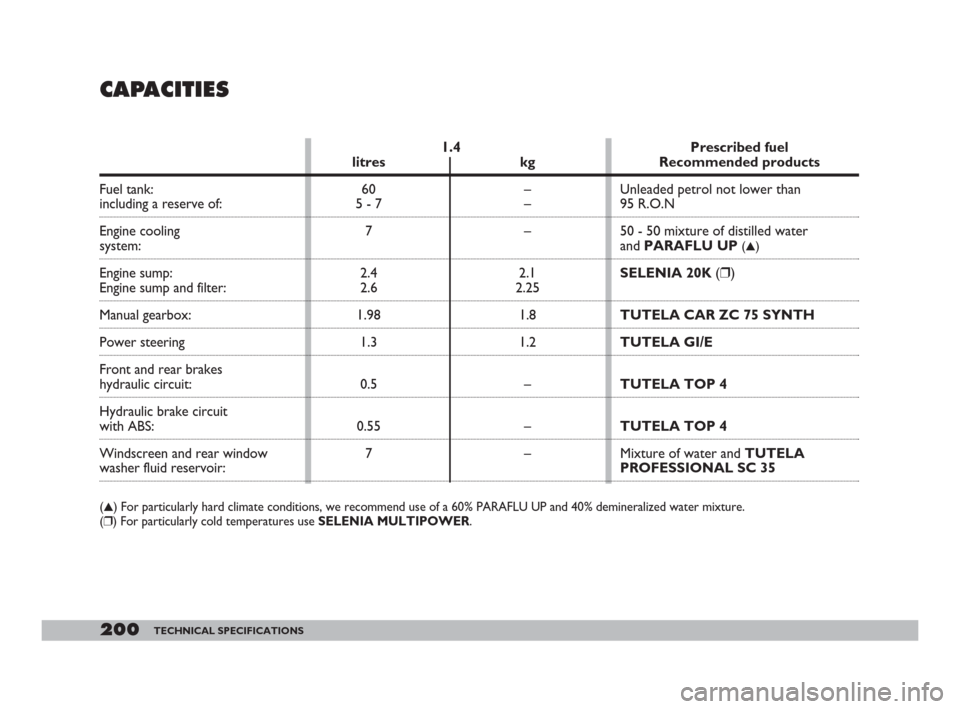
CAPACITIES
1.4
litres kg
60 –
5 - 7 –
7–
2.4 2.1
2.6 2.25
1.98 1.8
1.3 1.2
0.5 –
0.55 –
7–
Fuel tank:including a reserve of:
Engine cooling
system:
Engine sump:
Engine sump and filter:
Manual gearbox:
Power steering
Front and rear brakes
hydraulic circuit:
Hydraulic brake circuit
with ABS:
Windscreen and rear window
washer fluid reservoir:
(▲) For particularly hard climate conditions, we recommend use of a 60% PARAFLU UP and 40% demineralized water mixture.
(❒) For particularly cold temperatures use SELENIA MULTIPOWER.
Prescribed fuel
Recommended products
Unleaded petrol not lower than
95 R.O.N
50 - 50 mixture of distilled water
and PARAFLU UP
(▲)
SELENIA 20K(❒)
TUTELA CAR ZC 75 SYNTH
TUTELA GI/E
TUTELA TOP 4
TUTELA TOP 4
Mixture of water and TUTELA
PROFESSIONAL SC 35
174-211 Doblo GB 16-12-2008 14:26 Pagina 200
Page 202 of 222
201TECHNICAL SPECIFICATIONS201
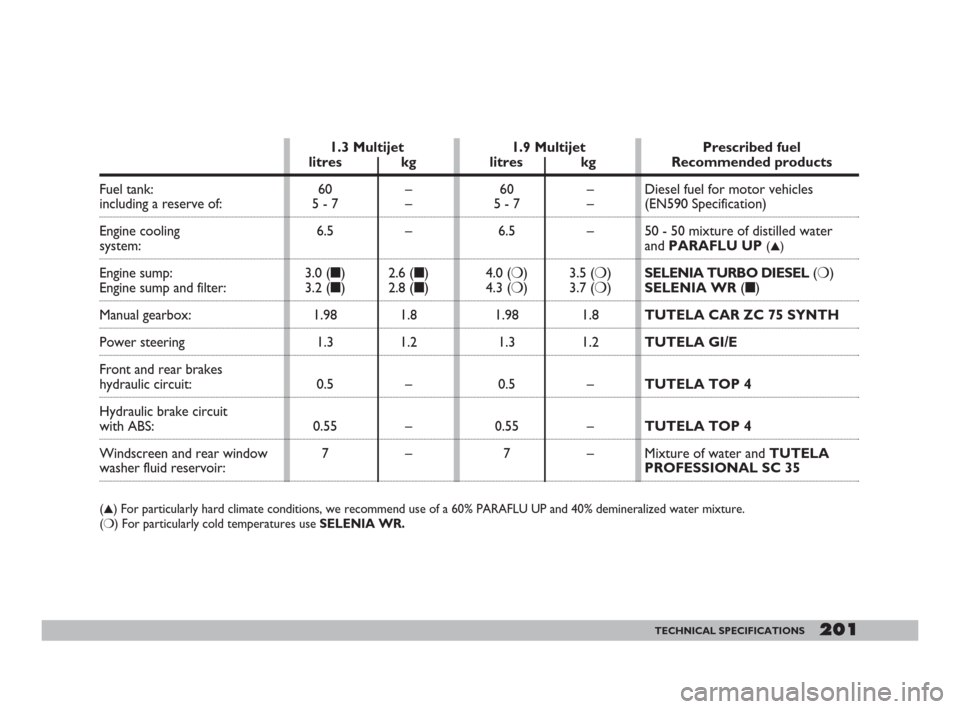
1.9 Multijet
litres kg
60 –
5 - 7 –
6.5 –
4.0 (❍) 3.5 (❍)
4.3 (❍) 3.7 (❍)
1.98 1.8
1.3 1.2
0.5 –
0.55 –
7– 1.3 Multijet
litres kg
60 –
5 - 7 –
6.5 –
3.0 (■) 2.6 (■)
3.2 (■) 2.8 (■)
1.98 1.8
1.3 1.2
0.5 –
0.55 –
7–
(▲) For particularly hard climate conditions, we recommend use of a 60% PARAFLU UP and 40% demineralized water mixture.
(❍) For particularly cold temperatures use SELENIA WR.
Fuel tank:including a reserve of:
Engine cooling
system:
Engine sump:
Engine sump and filter:
Manual gearbox:
Power steering
Front and rear brakes
hydraulic circuit:
Hydraulic brake circuit
with ABS:
Windscreen and rear window
washer fluid reservoir: Prescribed fuel
Recommended products
Diesel fuel for motor vehicles
(EN590 Specification)
50 - 50 mixture of distilled water
and PARAFLU UP
(▲)
SELENIA TURBO DIESEL(❍)
SELENIA WR(■)
TUTELA CAR ZC 75 SYNTH
TUTELA GI/E
TUTELA TOP 4
TUTELA TOP 4
Mixture of water and TUTELA
PROFESSIONAL SC 35
174-211 Doblo GB 16-12-2008 14:26 Pagina 201
Page 204 of 222
203TECHNICAL SPECIFICATIONS203
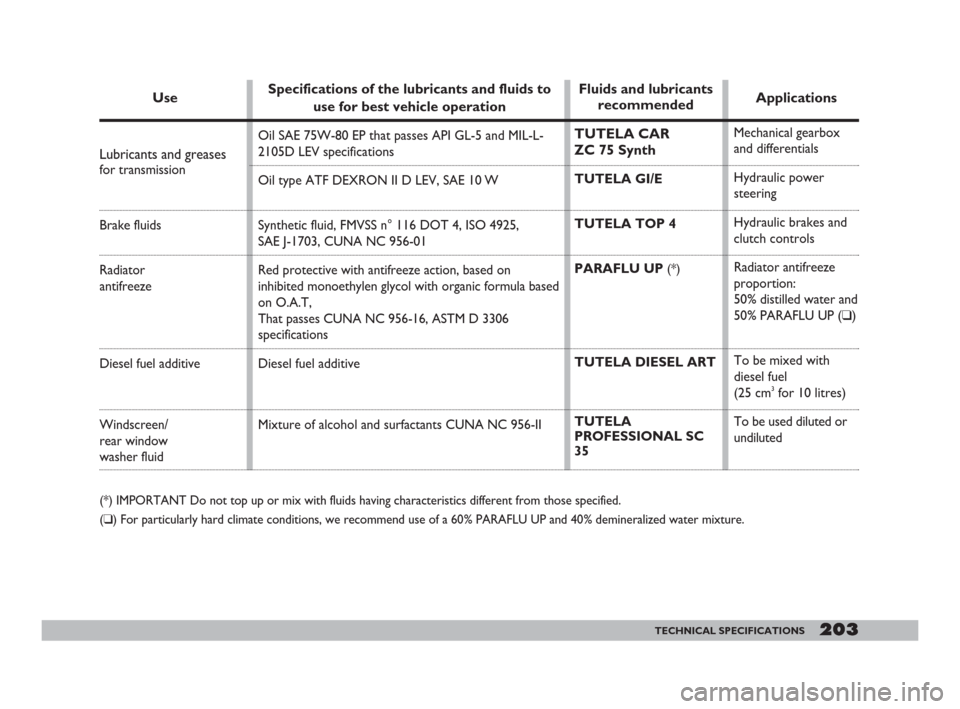
Use
Lubricants and greases
for transmission
Brake fluids
Radiator
antifreeze
Diesel fuel additive
Windscreen/
rear window
washer fluid
(*) IMPORTANT Do not top up or mix with fluids having characteristics different from those specified.
(❑) For particularly hard climate conditions, we recommend use of a 60% PARAFLU UP and 40% demineralized water mixture.
Specifications of the lubricants and fluids to
use for best vehicle operation
Oil SAE 75W-80 EP that passes API GL-5 and MIL-L-
2105D LEV specifications
Oil type ATF DEXRON II D LEV, SAE 10 W
Synthetic fluid, FMVSS n° 116 DOT 4, ISO 4925,
SAE J-1703, CUNA NC 956-01
Red protective with antifreeze action, based on
inhibited monoethylen glycol with organic formula based
on O.A.T,
That passes CUNA NC 956-16, ASTM D 3306
specifications
Diesel fuel additive
Mixture of alcohol and surfactants CUNA NC 956-II
Fluids and lubricants
recommended
TUTELA CAR
ZC 75 Synth
TUTELA GI/E
TUTELA TOP 4
PARAFLU UP
(*)
TUTELA DIESEL ART
TUTELA
PROFESSIONAL SC
35
Applications
Mechanical gearbox
and differentials
Hydraulic power
steering
Hydraulic brakes and
clutch controls
Radiator antifreeze
proportion:
50% distilled water and
50% PARAFLU UP (❑)
To be mixed with
diesel fuel
(25 cm
3for 10 litres)
To be used diluted or
undiluted
174-211 Doblo GB 19-02-2009 12:39 Pagina 203
Page 205 of 222
204TECHNICAL SPECIFICATIONS
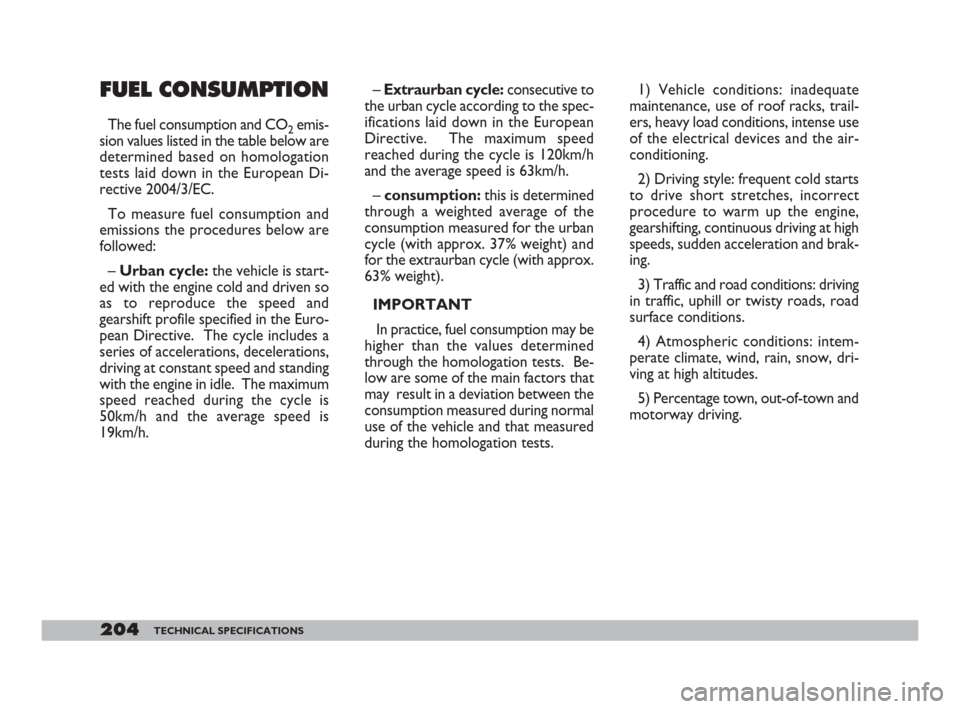
FUEL CONSUMPTION
The fuel consumption and CO2emis-
sion values listed in the table below are
determined based on homologation
tests laid down in the European Di-
rective 2004/3/EC.
To measure fuel consumption and
emissions the procedures below are
followed:
– Urban cycle:the vehicle is start-
ed with the engine cold and driven so
as to reproduce the speed and
gearshift profile specified in the Euro-
pean Directive. The cycle includes a
series of accelerations, decelerations,
driving at constant speed and standing
with the engine in idle. The maximum
speed reached during the cycle is
50km/h and the average speed is
19km/h.– Extraurban cycle:consecutive to
the urban cycle according to the spec-
ifications laid down in the European
Directive. The maximum speed
reached during the cycle is 120km/h
and the average speed is 63km/h.
– consumption:this is determined
through a weighted average of the
consumption measured for the urban
cycle (with approx. 37% weight) and
for the extraurban cycle (with approx.
63% weight).
IMPORTANT
In practice, fuel consumption may be
higher than the values determined
through the homologation tests. Be-
low are some of the main factors that
may result in a deviation between the
consumption measured during normal
use of the vehicle and that measured
during the homologation tests.1) Vehicle conditions: inadequate
maintenance, use of roof racks, trail-
ers, heavy load conditions, intense use
of the electrical devices and the air-
conditioning.
2) Driving style: frequent cold starts
to drive short stretches, incorrect
procedure to warm up the engine,
gearshifting, continuous driving at high
speeds, sudden acceleration and brak-
ing.
3) Traffic and road conditions: driving
in traffic, uphill or twisty roads, road
surface conditions.
4) Atmospheric conditions: intem-
perate climate, wind, rain, snow, dri-
ving at high altitudes.
5) Percentage town, out-of-town and
motorway driving.
174-211 Doblo GB 16-12-2008 14:26 Pagina 204
Page 206 of 222
205TECHNICAL SPECIFICATIONS205
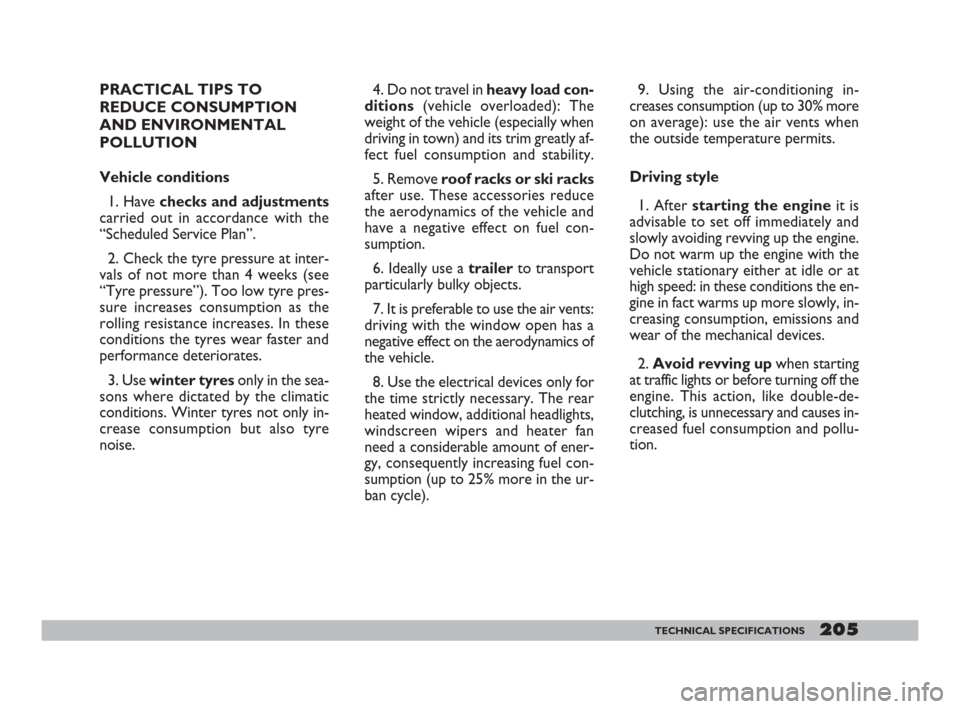
PRACTICAL TIPS TO
REDUCE CONSUMPTION
AND ENVIRONMENTAL
POLLUTION
Vehicle conditions
1. Have checks and adjustments
carried out in accordance with the
“Scheduled Service Plan”.
2. Check the tyre pressure at inter-
vals of not more than 4 weeks (see
“Tyre pressure”). Too low tyre pres-
sure increases consumption as the
rolling resistance increases. In these
conditions the tyres wear faster and
performance deteriorates.
3. Use winter tyresonly in the sea-
sons where dictated by the climatic
conditions. Winter tyres not only in-
crease consumption but also tyre
noise.4. Do not travel in heavy load con-
ditions(vehicle overloaded): The
weight of the vehicle (especially when
driving in town) and its trim greatly af-
fect fuel consumption and stability.
5. Remove roof racks or ski racks
after use. These accessories reduce
the aerodynamics of the vehicle and
have a negative effect on fuel con-
sumption.
6. Ideally use a trailerto transport
particularly bulky objects.
7. It is preferable to use the air vents:
driving with the window open has a
negative effect on the aerodynamics of
the vehicle.
8. Use the electrical devices only for
the time strictly necessary. The rear
heated window, additional headlights,
windscreen wipers and heater fan
need a considerable amount of ener-
gy, consequently increasing fuel con-
sumption (up to 25% more in the ur-
ban cycle).9. Using the air-conditioning in-
creases consumption (up to 30% more
on average): use the air vents when
the outside temperature permits.
Driving style
1. After starting the engineit is
advisable to set off immediately and
slowly avoiding revving up the engine.
Do not warm up the engine with the
vehicle stationary either at idle or at
high speed: in these conditions the en-
gine in fact warms up more slowly, in-
creasing consumption, emissions and
wear of the mechanical devices.
2. Avoid revving upwhen starting
at traffic lights or before turning off the
engine. This action, like double-de-
clutching, is unnecessary and causes in-
creased fuel consumption and pollu-
tion.
174-211 Doblo GB 16-12-2008 14:26 Pagina 205
Page 215 of 222
214INDEX
- front ........................................... 54
- rear ............................................. 54
Heated rear window ................... 68
Heating............................................ 57
Hydraulic power steering
- fluid level ................................... 160
Identification data ....................... 174
If an accident occurs .................... 147
- first aid kit ................................. 148
- if anyone is injured.................. 148
Ignition switch ............................... 20
In an emergency ........................... 119
Individual settings ......................... 48
Instrument panel .......................... 22
Instruments.................................... 23
Interior equipment....................... 69
Interiors.......................................... 173
- cleaning seats
and plastic parts....................... 173
Jack................................................ 122
Jacking the vehicle ........................ 145
Keys.............................................. 6
- duplicate copies ....................... 8
Lambda sensors .......................... 104
Levels
- checking..................................... 154
Loading ramps .............................. 87
Lubricants....................................... 202
Main beam headlights
- bulb replacement ...................... 131
- control ......................................... 64
- flashing ........................................... 64
Manual climate control system
- air distribution ............................ 59
- climatic comfort ......................... 62
- controls ....................................... 61
- cooling .......................................... 61
- maintenance ............................... 63
Model plate ....................................... 174
Number plate light .................... 136
Paint ............................................ 171
Parking ............................................ 107
Parking sensors ............................. 101
Partitions ....................................... 51
- double ladder ........................... 51
- driver’s protection ladder ..... 51
- fixed panelled partition .......... 50- fixed partition with window . 51
Performance ............................... 186
Pollen filter .................................... 161
Power steering fluid level ........... 160
Pretensioners ............................... 11
Prolonged vehicle inactivity ....... 117
Protecting the environment ...... 104
Radio transmitters .................... 100
Radio-frequency
remote control ............................. 8
- battery replacement ............... 9
- homologation numbers.......... 206
Rear double doors ....................... 77
Rear foglight
- bulb replacement ................... 134
- control button ......................... 68
Rear side windows ....................... 72
Rear window shelf ....................... 71
Rear window washer
- control ...................................... 65
- fluid level ................................... 159
Rear window wiper
- blade ........................................... 169
- control ...................................... 65
- nozzle......................................... 170
- smart wash ............................... 66
212-220 Doblo GB 16-12-2008 14:26 Pagina 214