fuel FIAT DOBLO 2008 1.G Owner's Manual
[x] Cancel search | Manufacturer: FIAT, Model Year: 2008, Model line: DOBLO, Model: FIAT DOBLO 2008 1.GPages: 222, PDF Size: 3.39 MB
Page 109 of 222
108DRIVING YOUR VEHICLE
IMPORTANTAfter a taxing drive
you should allow the engine to “catch
its breath” before turning it off by let-
ting it idle to allow the temperature in
the engine compartment to fall.
PARKING
Switch off the engine, pull up the
handbrake and engage a gear (1st gear
or reverse, according to whether the
vehicle is facing up or downhill) and
leave the wheels turned. If the vehi-
cle is left on a steep slope, wedges or
a rock should be used to lock the
wheels.
Do not leave the ignition key at
MARto prevent draining the battery.
Always remove the key when you
leave the vehicle.HANDBRAKE
The handbrake lever is located be-
tween the two front seats.
Pull the handbrake lever upwards un-
til the vehicle cannot be moved. Four
or five clicks are generally enough
when the vehicle is on level ground
while nine or ten may be required if
the vehicle is on a steep slope or laden.
IMPORTANTIf this is not the
case, take the vehicle to a Fiat Deal-
ership to have the handbrake adjust-
ed.
Instrument panel warning light x
will come on when the handbrake
lever is pulled up and the ignition key
is at MAR.
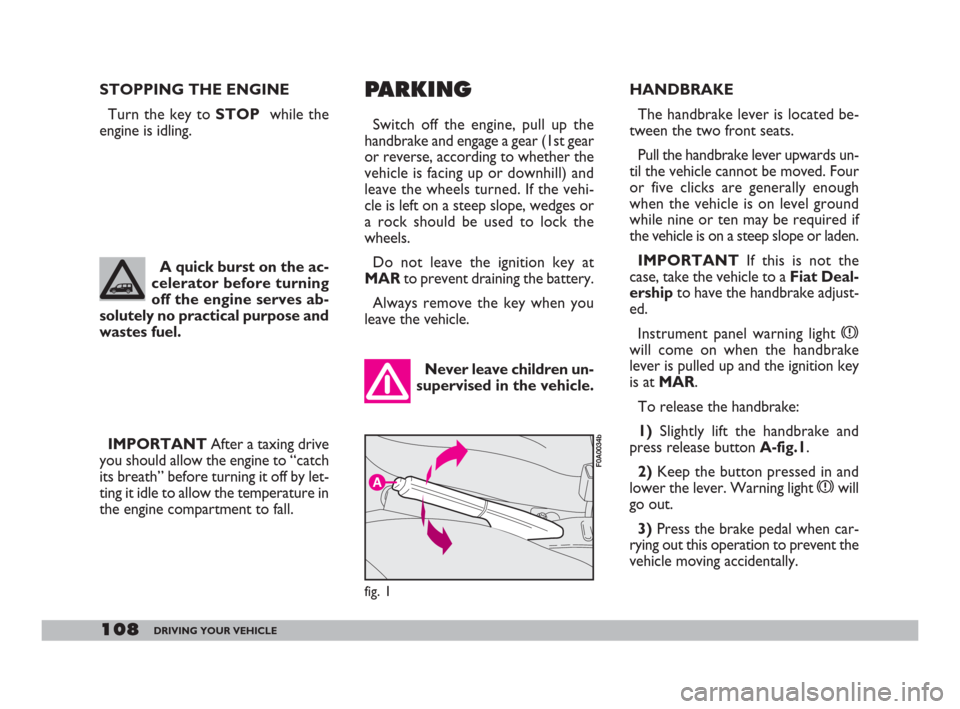
To release the handbrake:
1)Slightly lift the handbrake and
press release button A-fig.1.
2)Keep the button pressed in and
lower the lever. Warning light xwill
go out.
3)Press the brake pedal when car-
rying out this operation to prevent the
vehicle moving accidentally. STOPPING THE ENGINE
Turn the key to STOPwhile the
engine is idling.
A quick burst on the ac-
celerator before turning
off the engine serves ab-
solutely no practical purpose and
wastes fuel.
Never leave children un-
supervised in the vehicle.
A
fig. 1
F0A0034b
106-118 Doblo GB 9-05-2008 12:09 Pagina 108
Page 111 of 222
110DRIVING YOUR VEHICLE
Some suggestions which may help
you to keep the running costs of the
vehicle down and lower the amount
of toxic emissions released into the at-
mosphere are given below.
GENERAL
CONSIDERATIONS
Vehicle maintenance
The overall state of the vehicle is an
important factor which has a marked
influence over fuel consumption and
driving comfort and on the life span of
your vehicle. For this reason care
should be taken to maintain your ve-
hicle by carrying out the necessary
checks and regulations in accordance
with the specifications given in the
SERVICE SCHEDULE (see sections:
spark plugs, idling, air cleaners, diesel
fuel filter, timing).Tyres
Tyre pressure should be checked at
least once every four weeks: if the
pressure is too low fuel consumption
increases as the resistance to the
rolling movement of the tyre is
greater. In this state, tyre wear is in-
creased and handling suffers which will
effect safety.
Unnecessary loads
Do not travel with too much load in
the boot. The weight of the vehicle
and its trim greatly effects consump-
tion and stability.
Roof rack/ski rack
Remove the roof rack or the ski rack
from the roof as soon as they are no
longer used.
These accessories reduce the aero-
dynamic penetration of the vehicle and
will increase consumption. Whentransporting particularly large objects,
use a trailer, where possible.
Electric devices
Use electric devices for the neces-
sary time only. The heated rear win-
dow, fog lights, windscreen wipers,
heater fan require large amounts of
electricity and increasing the request
for power will also increase fuel con-
sumption (up to +25% when driving in
towns).
Climate control system
The climate control system is an ad-
ditional load which greatly effects the
engine leading to higher consumption
(up to +20% in average). When the
temperature outside allows, use the
air vents where possible.
Aerodynamic accessories
The use of non-certified aerodynamic
items may adversely affect air drag and
consumption levels.
CONTAINING RUNNING COSTS AND POLLUTION
106-118 Doblo GB 9-05-2008 12:09 Pagina 110
Page 112 of 222
DRIVING STYLE
Starting
Do not warm the engine when the
vehicle is stationary or at high or low
revs: in this way the engine will warm
up gradually increasing consumption
and emissions. You should drive off
slowly straight away avoiding high revs
so that the engine will warm up more
quickly.
Unnecessary actions
Avoid revving the engine when
stopped at traffic lights or before
switching off the engine and avoid dou-
bling the clutch as these actions have
no purpose of modern vehicles and
serve only to increase consumption
and pollution.
Gear selection
As soon as the traffic and road con-
ditions allow it, shift to a higher gear.
Using a lower gear to liven up accel-
eration greatly increases consumption.
In the same way, improper use of the
higher gears will increase consump-tion, emissions and wear and tear on
the engine.
Top speed
Fuel consumption increases consid-
erably as speed increases. For exam-
ple, when accelerating from 90 to 120
km/h, fuel consumption increases up
to approximately +30%. Your speed
should be kept as even as possible and
superfluous braking and acceleration
avoided as this increases both con-
sumption and emissions. A “smooth”
driving style should be adopted by at-
tempting to anticipate manoeuvres to
avoid imminent danger and to keep a
safe distance from the vehicle in front
to avoid braking sharply.
Acceleration
Accelerating violently increasing the
revs will greatly effect consumption
and emission: acceleration should be
gradual and not exceed the maximum
torque.CONDITIONS OF USE
Cold starting
Frequent cold starting will not enable
the engine to reach optimal running
temperature. It follows, therefore, that
consumption will be higher (from +15
to +30% in towns) as will the pro-
duction of toxic emissions.
Traffic situations and road
conditions
Heavy traffic and higher consumption
are synonymous: for example, when
driving slowly with frequent use of
lower gears or in towns where there
are numerous traffic lights.
Also twisting roads, mountain roads
and rough road surfaces pay a heavy toll
on consumption.
Traffic hold-ups
During prolonged stops (traffic lights,
level crossings, etc.) the engine should
be switched off.
111DRIVING YOUR VEHICLE
106-118 Doblo GB 9-05-2008 12:09 Pagina 111
Page 113 of 222
112DRIVING YOUR VEHICLE
CHEAP RUNNING
THAT RESPECTS THE ENVIRONMENT
LOOKING
AFTER EMISSION
CONTROL DEVICES
The correct use of pollution control
devices not only ensures respect for
the environment but also has an effect
on the vehicle’s performance. Keeping
these devices in good condition is
therefore a fundamental rule for dri-
ving that is easy on your pocket and
on the environment too.
The first step to take is to follow the
SERVICE SCHEDULE to the letter.
If your vehicle has a petrol engine use
only unleaded petrol.
If you have trouble starting, do not
keep turning the ignition key for long
periods. Be especially careful to avoid
bump starting the vehicle by pushing,
towing or rolling downhill: these are
all manoeuvres that can damage the
catalytic exhaust. Use an auxiliary bat-
tery for start-ups only.If the engine begins to “loose its
smoothness”, when travelling, contin-
ue your journey but reduce the de-
mands you are making on the engine
and have the vehicle seen to at a Fi-
at Dealershipas soon as possible.
When the instrument panel fuel re-
serve warning light comes on, fill up as
soon as possible. A low level of fuel
can cause an uneven supply of fuel to
the engine with the inevitable increase
in the temperature of the exhaust gas
and serious damage to the catalytic
converter.
Never run the engine with one or
more spark plugs disconnected, even
for testing purposes.
Do not warm up the engine by let-
ting it idle for a while before moving
off unless the outside temperature is
very low and, even in this case, only
do so for less than 30 seconds.
Do not install other heat shields and
do not remove those already fitted to
the catalytic converter and exhaust
pipe. Environmental protection has been
one of the guiding principles in the
production of the Fiat Doblò. It is no
accident that its pollution control
equipment is much more effective than
that required by current legislation.
Nonetheless, the environment can-
not get by without a concerted effort
from everyone.
By following a few simple rules you
can avoid harming the environment
and often cut down fuel consumption
at the same time.
On this subject, a few useful tips have
been given below to supplement those
marked by symbol #, at various points
of the handbook.
You are asked to read both the for-
mer and the latter carefully.
106-118 Doblo GB 9-05-2008 12:09 Pagina 112
Page 122 of 222
121IN AN EMERGENCY
BUMP STARTING IF A TYRE IS
PUNCTURED
GENERAL INSTRUCTIONS
Wheel changing and correct use of
the jack and spare wheel call for some
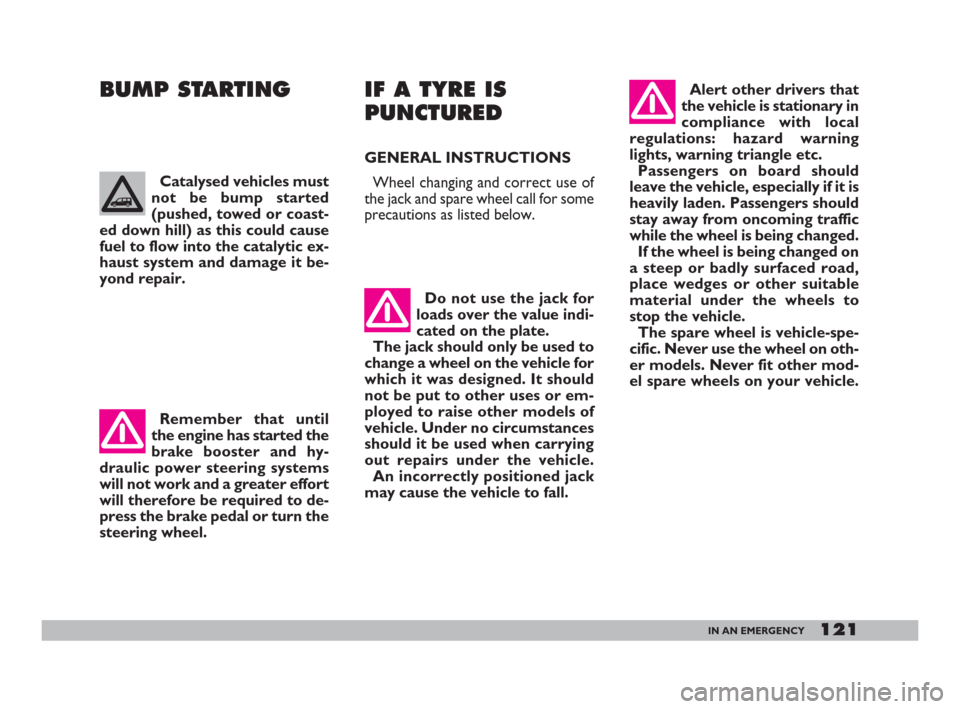
precautions as listed below. Catalysed vehicles must
not be bump started
(pushed, towed or coast-
ed down hill) as this could cause
fuel to flow into the catalytic ex-
haust system and damage it be-
yond repair.
Remember that until
the engine has started the
brake booster and hy-
draulic power steering systems
will not work and a greater effort
will therefore be required to de-
press the brake pedal or turn the
steering wheel.
Alert other drivers that
the vehicle is stationary in
compliance with local
regulations: hazard warning
lights, warning triangle etc.
Passengers on board should
leave the vehicle, especially if it is
heavily laden. Passengers should
stay away from oncoming traffic
while the wheel is being changed.
If the wheel is being changed on
a steep or badly surfaced road,
place wedges or other suitable
material under the wheels to
stop the vehicle.
The spare wheel is vehicle-spe-
cific. Never use the wheel on oth-
er models. Never fit other mod-
el spare wheels on your vehicle.
Do not use the jack for
loads over the value indi-
cated on the plate.
The jack should only be used to
change a wheel on the vehicle for
which it was designed. It should
not be put to other uses or em-
ployed to raise other models of
vehicle. Under no circumstances
should it be used when carrying
out repairs under the vehicle.
An incorrectly positioned jack
may cause the vehicle to fall.
119-148 Doblo GB 9-05-2008 12:09 Pagina 121
Page 143 of 222
142IN AN EMERGENCY
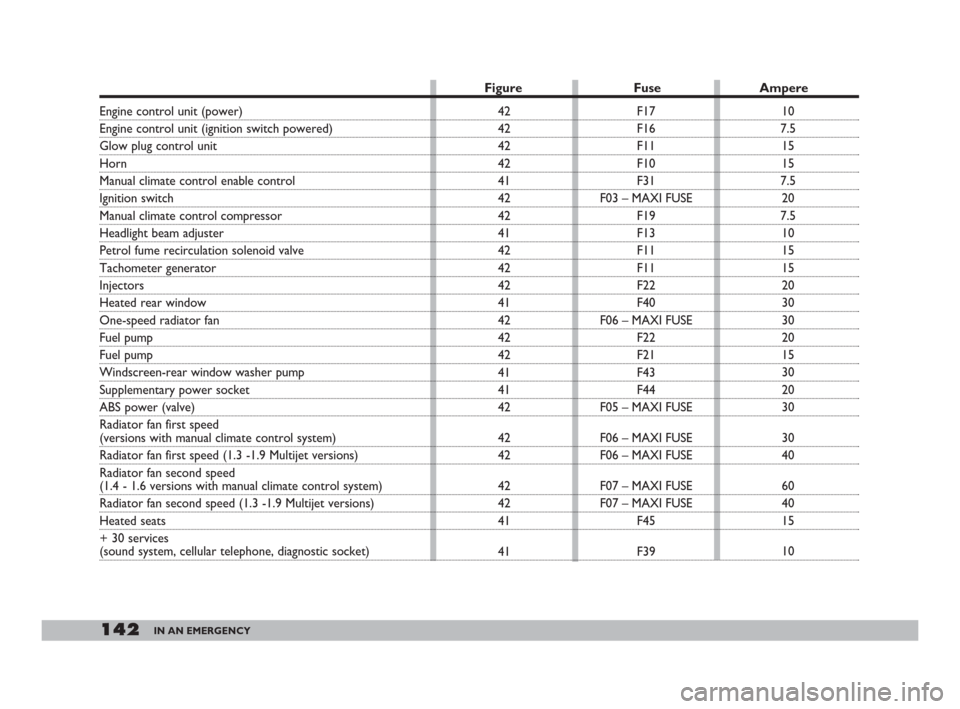
Engine control unit (power)
Engine control unit (ignition switch powered)
Glow plug control unit
Horn
Manual climate control enable control
Ignition switch
Manual climate control compressor
Headlight beam adjuster
Petrol fume recirculation solenoid valve
Tachometer generator
Injectors
Heated rear window
One-speed radiator fan
Fuel pump
Fuel pump
Windscreen-rear window washer pump
Supplementary power socket
ABS power (valve)
Radiator fan first speed
(versions with manual climate control system)
Radiator fan first speed (1.3 -1.9 Multijet versions)
Radiator fan second speed
(1.4 - 1.6 versions with manual climate control system)
Radiator fan second speed (1.3 -1.9 Multijet versions)
Heated seats
+ 30 services
(sound system, cellular telephone, diagnostic socket)
Figure Fuse Ampere
10
7.5
15
15
7.5
20
7.5
10
15
15
20
30
30
20
15
30
20
30
30
40
60
40
15
10 F17
F16
F11
F10
F31
F03 – MAXI FUSE
F19
F13
F11
F11
F22
F40
F06 – MAXI FUSE
F22
F21
F43
F44
F05 – MAXI FUSE
F06 – MAXI FUSE
F06 – MAXI FUSE
F07 – MAXI FUSE
F07 – MAXI FUSE
F45
F39 42
42
42
42
41
42
42
41
42
42
42
41
42
42
42
41
41
42
42
42
42
42
41
41
119-148 Doblo GB 9-05-2008 12:09 Pagina 142
Page 151 of 222
150VEHICLE MAINTENANCE
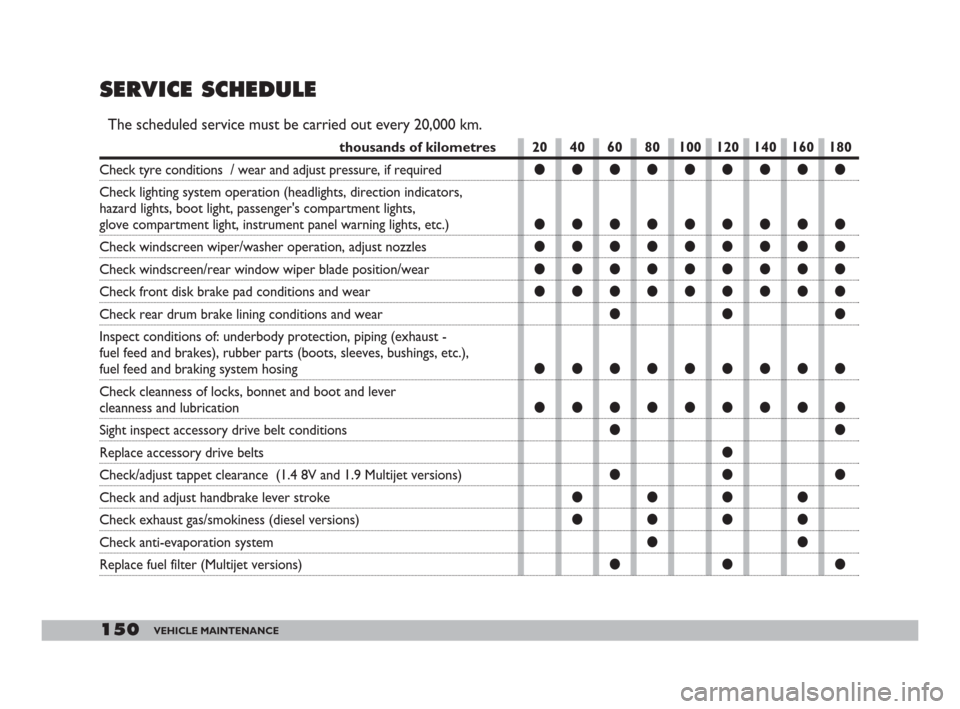
thousands of kilometres
Check tyre conditions / wear and adjust pressure, if required
Check lighting system operation (headlights, direction indicators,
hazard lights, boot light, passenger's compartment lights,
glove compartment light, instrument panel warning lights, etc.)
Check windscreen wiper/washer operation, adjust nozzles
Check windscreen/rear window wiper blade position/wear
Check front disk brake pad conditions and wear
Check rear drum brake lining conditions and wear
Inspect conditions of: underbody protection, piping (exhaust -
fuel feed and brakes), rubber parts (boots, sleeves, bushings, etc.),
fuel feed and braking system hosing
Check cleanness of locks, bonnet and boot and lever
cleanness and lubrication
Sight inspect accessory drive belt conditions
Replace accessory drive belts
Check/adjust tappet clearance (1.4 8V and 1.9 Multijet versions)
Check and adjust handbrake lever stroke
Check exhaust gas/smokiness (diesel versions)
Check anti-evaporation system
Replace fuel filter (Multijet versions)
SERVICE SCHEDULE
The scheduled service must be carried out every 20,000 km.
20 40 60 80 100 120 140 160 180
●●●●●●●●●
●●●●●●●●●
●●●●●●●●●
●●●●●●●●●
●●●●●●●●●
●●●
●●●●●●●●●
●●●●●●●●●
●●
●
●●●
●●●●
●●●●
●●
●●●
149-173 Doblo GB 9-05-2008 12:10 Pagina 150
Page 153 of 222
152VEHICLE MAINTENANCE
ANNUAL
INSPECTION
SCHEDULE
For vehicles with an annual
mileage of below 20.000 km (for
example about 10.000 km) the
following yearly inspection pro-
gramme is advised:
– check tyre conditions/wear and ad-
just pressure if required (including the
spare wheel).
– check light system operation (head-
lights, direction indicators, hazard
lights, boot lights, passenger compart-
ment lights, glovebox light, warning
lights, etc.).
– check windscreen wiper/washer
operation, adjust nozzles.
– check windscreen/rear window
blade position/wear
– check front disk brake pad condi-
tions and wear.– check cleanness of bonnet and
boot locks and lever cleanness and lu-
brication
– sight inspect the conditions of: en-
gine, gearbox, transmission, pipes and
hoses (exhaust - fuel - brakes), rubber
parts (boots, sleeves, bushes, etc)
brake and fuel hoses.
– check battery charge.
– visual check on various drive belt
conditions.
– check and top up, if required, fluid
levels (engine coolant, brake fluid,
windscreen washer fluid, battery fluid,
etc.).
– change engine oil.
– change engine oil filter.
– replace pollen filter (where pro-
vided).
ADDITIONAL
CHECKS
Every 1,000 kmor before long
trips, check and top up as necessary:
engine coolant level, brake fluid level,
windscreen washer liquid level, tyre
pressure and conditions.
Every 3,000 km check and top up
as necessary: engine oil level.
You are recommended to use FL
Selenia,products designed and pro-
duced specifically for Fiat vehicles (see
“Capacities” in section “Technical
specifications”).
149-173 Doblo GB 9-05-2008 12:10 Pagina 152
Page 169 of 222
168VEHICLE MAINTENANCE
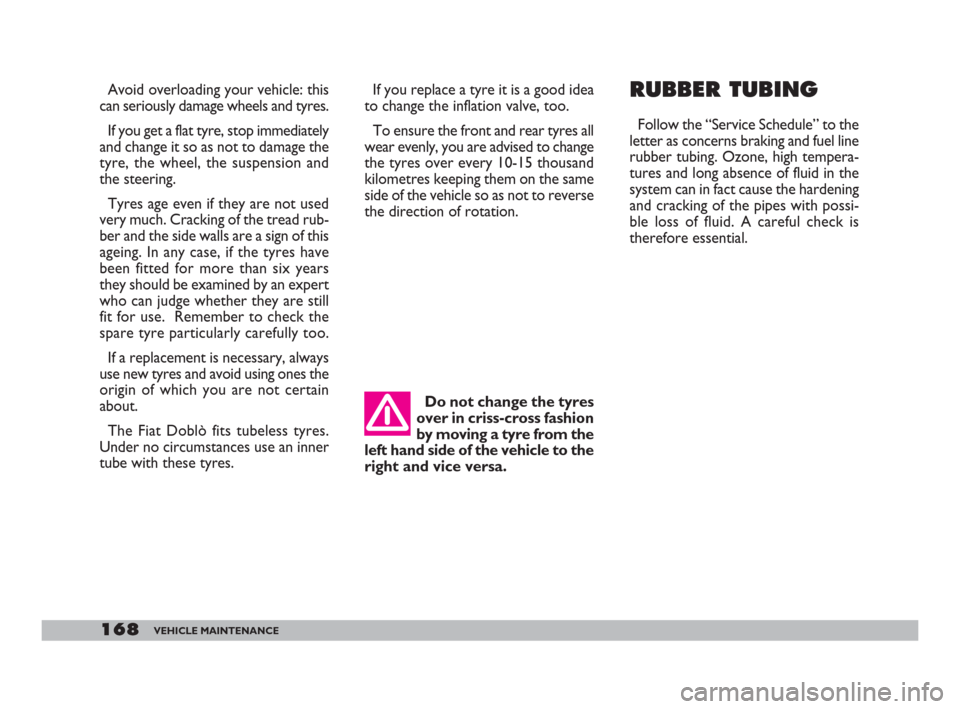
Avoid overloading your vehicle: this
can seriously damage wheels and tyres.
If you get a flat tyre, stop immediately
and change it so as not to damage the
tyre, the wheel, the suspension and
the steering.
Tyres age even if they are not used
very much. Cracking of the tread rub-
ber and the side walls are a sign of this
ageing. In any case, if the tyres have
been fitted for more than six years
they should be examined by an expert
who can judge whether they are still
fit for use. Remember to check the
spare tyre particularly carefully too.
If a replacement is necessary, always
use new tyres and avoid using ones the
origin of which you are not certain
about.
The Fiat Doblò fits tubeless tyres.
Under no circumstances use an inner
tube with these tyres.If you replace a tyre it is a good idea
to change the inflation valve, too.
To ensure the front and rear tyres all
wear evenly, you are advised to change
the tyres over every 10-15 thousand
kilometres keeping them on the same
side of the vehicle so as not to reverse
the direction of rotation.
Do not change the tyres
over in criss-cross fashion
by moving a tyre from the
left hand side of the vehicle to the
right and vice versa.RUBBER TUBING
Follow the “Service Schedule” to the
letter as concerns braking and fuel line
rubber tubing. Ozone, high tempera-
tures and long absence of fluid in the
system can in fact cause the hardening
and cracking of the pipes with possi-
ble loss of fluid. A careful check is
therefore essential.
149-173 Doblo GB 9-05-2008 12:10 Pagina 168
Page 180 of 222
179TECHNICAL SPECIFICATIONS
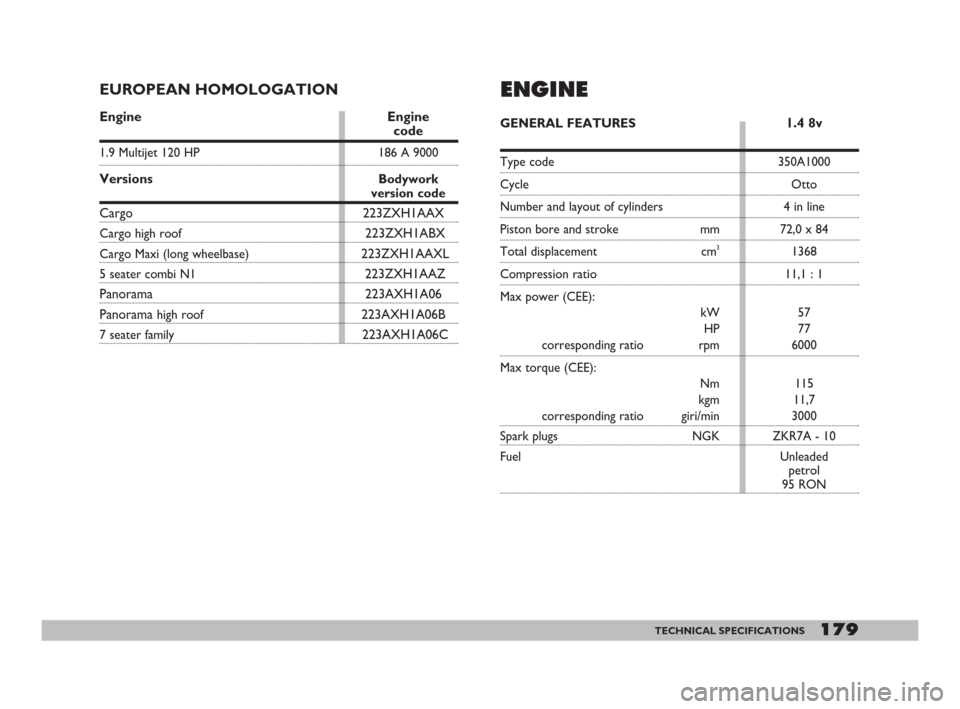
EUROPEAN HOMOLOGATION
Engine Engine code
1.9 Multijet 120 HP 186 A 9000
VersionsBodywork version code
Cargo 223ZXH1AAX
Cargo high roof223ZXH1ABX
Cargo Maxi (long wheelbase)223ZXH1AAXL
5 seater combi N1223ZXH1AAZ
Panorama 223AXH1A06
Panorama high roof223AXH1A06B
7 seater family223AXH1A06C
ENGINE
GENERAL FEATURES1.4 8v
Type code 350A1000
Cycle Otto
Number and layout of cylinders 4 in line
Piston bore and stroke mm 72,0 x 84
Total displacement cm31368
Compression ratio 11,1 : 1
Max power (CEE):
kW 57
HP 77
corresponding ratio rpm 6000
Max torque (CEE):
Nm 115
kgm 11,7
corresponding ratio giri/min 3000
Spark plugs NGK ZKR7A - 10
Fuel Unleaded
petrol
95 RON
174-211 Doblo GB 16-12-2008 14:26 Pagina 179