Vehicle specifications FIAT DOBLO 2008 1.G Owner's Guide
[x] Cancel search | Manufacturer: FIAT, Model Year: 2008, Model line: DOBLO, Model: FIAT DOBLO 2008 1.GPages: 222, PDF Size: 3.39 MB
Page 204 of 222
203TECHNICAL SPECIFICATIONS203
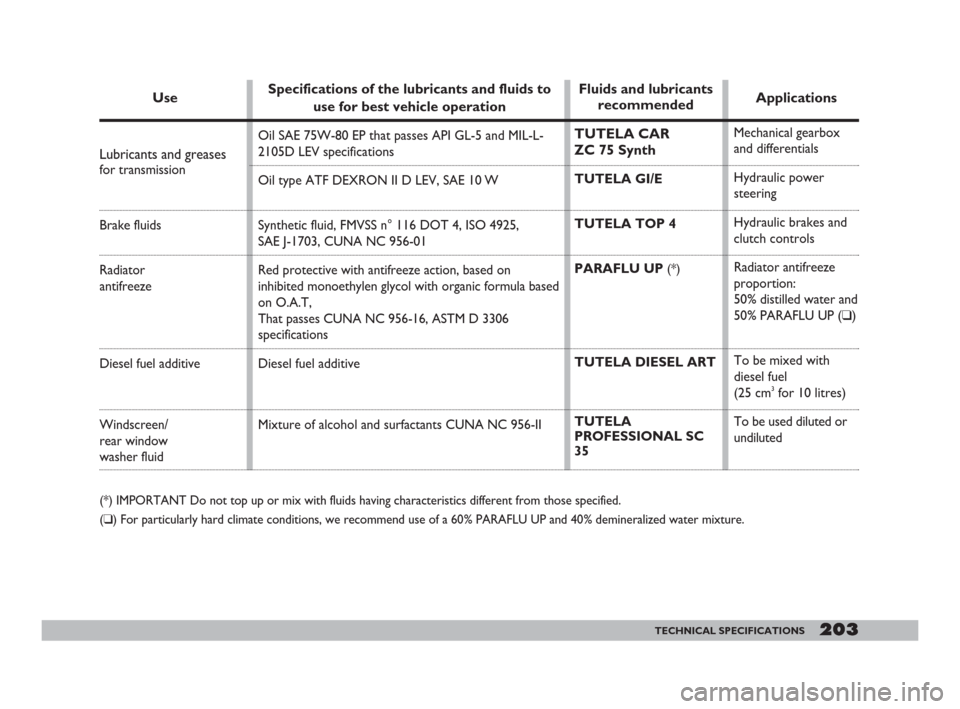
Use
Lubricants and greases
for transmission
Brake fluids
Radiator
antifreeze
Diesel fuel additive
Windscreen/
rear window
washer fluid
(*) IMPORTANT Do not top up or mix with fluids having characteristics different from those specified.
(❑) For particularly hard climate conditions, we recommend use of a 60% PARAFLU UP and 40% demineralized water mixture.
Specifications of the lubricants and fluids to
use for best vehicle operation
Oil SAE 75W-80 EP that passes API GL-5 and MIL-L-
2105D LEV specifications
Oil type ATF DEXRON II D LEV, SAE 10 W
Synthetic fluid, FMVSS n° 116 DOT 4, ISO 4925,
SAE J-1703, CUNA NC 956-01
Red protective with antifreeze action, based on
inhibited monoethylen glycol with organic formula based
on O.A.T,
That passes CUNA NC 956-16, ASTM D 3306
specifications
Diesel fuel additive
Mixture of alcohol and surfactants CUNA NC 956-II
Fluids and lubricants
recommended
TUTELA CAR
ZC 75 Synth
TUTELA GI/E
TUTELA TOP 4
PARAFLU UP
(*)
TUTELA DIESEL ART
TUTELA
PROFESSIONAL SC
35
Applications
Mechanical gearbox
and differentials
Hydraulic power
steering
Hydraulic brakes and
clutch controls
Radiator antifreeze
proportion:
50% distilled water and
50% PARAFLU UP (❑)
To be mixed with
diesel fuel
(25 cm
3for 10 litres)
To be used diluted or
undiluted
174-211 Doblo GB 19-02-2009 12:39 Pagina 203
Page 205 of 222
204TECHNICAL SPECIFICATIONS
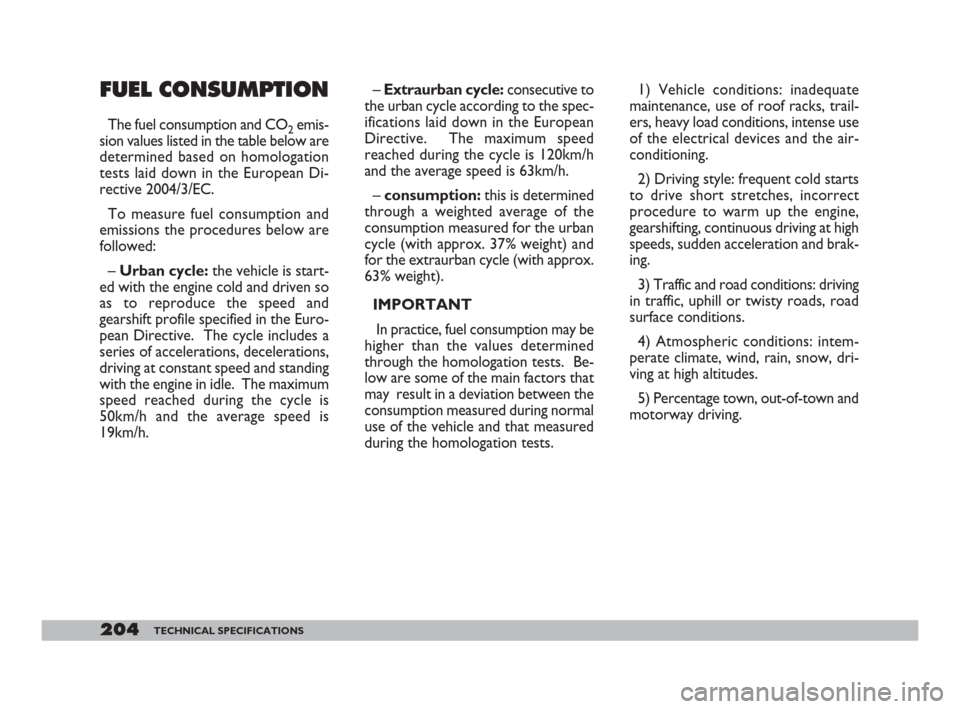
FUEL CONSUMPTION
The fuel consumption and CO2emis-
sion values listed in the table below are
determined based on homologation
tests laid down in the European Di-
rective 2004/3/EC.
To measure fuel consumption and
emissions the procedures below are
followed:
– Urban cycle:the vehicle is start-
ed with the engine cold and driven so
as to reproduce the speed and
gearshift profile specified in the Euro-
pean Directive. The cycle includes a
series of accelerations, decelerations,
driving at constant speed and standing
with the engine in idle. The maximum
speed reached during the cycle is
50km/h and the average speed is
19km/h.– Extraurban cycle:consecutive to
the urban cycle according to the spec-
ifications laid down in the European
Directive. The maximum speed
reached during the cycle is 120km/h
and the average speed is 63km/h.
– consumption:this is determined
through a weighted average of the
consumption measured for the urban
cycle (with approx. 37% weight) and
for the extraurban cycle (with approx.
63% weight).
IMPORTANT
In practice, fuel consumption may be
higher than the values determined
through the homologation tests. Be-
low are some of the main factors that
may result in a deviation between the
consumption measured during normal
use of the vehicle and that measured
during the homologation tests.1) Vehicle conditions: inadequate
maintenance, use of roof racks, trail-
ers, heavy load conditions, intense use
of the electrical devices and the air-
conditioning.
2) Driving style: frequent cold starts
to drive short stretches, incorrect
procedure to warm up the engine,
gearshifting, continuous driving at high
speeds, sudden acceleration and brak-
ing.
3) Traffic and road conditions: driving
in traffic, uphill or twisty roads, road
surface conditions.
4) Atmospheric conditions: intem-
perate climate, wind, rain, snow, dri-
ving at high altitudes.
5) Percentage town, out-of-town and
motorway driving.
174-211 Doblo GB 16-12-2008 14:26 Pagina 204
Page 206 of 222
205TECHNICAL SPECIFICATIONS205
PRACTICAL TIPS TO
REDUCE CONSUMPTION
AND ENVIRONMENTAL
POLLUTION
Vehicle conditions
1. Have checks and adjustments
carried out in accordance with the
“Scheduled Service Plan”.
2. Check the tyre pressure at inter-
vals of not more than 4 weeks (see
“Tyre pressure”). Too low tyre pres-
sure increases consumption as the
rolling resistance increases. In these
conditions the tyres wear faster and
performance deteriorates.
3. Use winter tyresonly in the sea-
sons where dictated by the climatic
conditions. Winter tyres not only in-
crease consumption but also tyre
noise.4. Do not travel in heavy load con-
ditions(vehicle overloaded): The
weight of the vehicle (especially when
driving in town) and its trim greatly af-
fect fuel consumption and stability.
5. Remove roof racks or ski racks
after use. These accessories reduce
the aerodynamics of the vehicle and
have a negative effect on fuel con-
sumption.
6. Ideally use a trailerto transport
particularly bulky objects.
7. It is preferable to use the air vents:
driving with the window open has a
negative effect on the aerodynamics of
the vehicle.
8. Use the electrical devices only for
the time strictly necessary. The rear
heated window, additional headlights,
windscreen wipers and heater fan
need a considerable amount of ener-
gy, consequently increasing fuel con-
sumption (up to 25% more in the ur-
ban cycle).9. Using the air-conditioning in-
creases consumption (up to 30% more
on average): use the air vents when
the outside temperature permits.
Driving style
1. After starting the engineit is
advisable to set off immediately and
slowly avoiding revving up the engine.
Do not warm up the engine with the
vehicle stationary either at idle or at
high speed: in these conditions the en-
gine in fact warms up more slowly, in-
creasing consumption, emissions and
wear of the mechanical devices.
2. Avoid revving upwhen starting
at traffic lights or before turning off the
engine. This action, like double-de-
clutching, is unnecessary and causes in-
creased fuel consumption and pollu-
tion.
174-211 Doblo GB 16-12-2008 14:26 Pagina 205
Page 207 of 222
206TECHNICAL SPECIFICATIONS
3. Gear selection: change to the
highest gear as soon as possible (con-
sistent with smoothness of engine op-
eration and the traffic conditions) and
do not push the engine to high speeds
in the intermediate gears. Engaging low
gears at high speeds to achieve super
acceleration increases consumption,
polluting emissions and engine wear.
4. Vehicle speed: fuel consumption
increases exponentially as the speed
increases. Keep your speed as mod-
erate and constant as possible, avoid-
ing unnecessary braking and acceler-
ation, which cause excessive fuel con-
sumption and increased emissions.
Keeping an adequate safety distance
from the vehicle in front of you will
help smoother driving.5. Acceleration: violently acceler-
ating considerably affects consumption
and emissions; therefore, accelerate
gradually without exceeding the max-
imum torque speed of the engine.CO2EMISSIONS
The values were obtained from
analysis of the exhaust gas emitted
during the test and are related to the
consumption values through the car-
bon balance of the emissions pro-
duced.
The CO
2emission values listed in the
following table refer to combined con-
sumption.
174-211 Doblo GB 16-12-2008 14:26 Pagina 206
Page 212 of 222
211TECHNICAL SPECIFICATIONS
PROVISIONS FOR THE PROCESSING OF A VEHICLE
AT THE END OF ITS LIFE-CYCLE
For years now Fiat has been developing its global commitment towards the safeguarding and protection of the
Environment through the continuous improvement of its production processes and the making of increasingly more “eco
friendly” products. With a view to guaranteeing the best possible service to clients in full observance of environmental
standards and in response to the obligations imposed by European Directive 2000/53/EC on end-of-life vehicles, Fiat offers
its clients the possibility to hand in their vehicle* at the end of its life span without additional costs.
The European Directive, in fact, provides for the take-back of the vehicle without the last holder or owner of the same
incurring expenses due to the fact that the market value of the vehicle is zero or negative. In particular, in almost all of
the countries of the European Union, up until 1st January 2007, take-back of the vehicle free of charge only applies to vehi-
cles registered from 1 July 2002 on, while, from 2007 on, take-back will be carried out free of charge, independently of
the year of registration, provided that the vehicle still contains all its essential component parts (especially engine and
body) and is free from additional waste materials.
Our contracted network of authorised treatment facilities has been carefully selected in order to provide a quality ser-
vice to our customers by de-polluting and recycling “End of Life Vehicles” to approved environmental standards. To find
out the location of your nearest authorised treatment facility, offering free of charge take-back, simply contact one of our
dealers or refer to the Fiat web site or call the toll free number 00800 3428 0000.
*Passenger transportation vehicles to seat a max. of nine persons, having a total admissible weight of 3.5 t
174-211 Doblo GB 16-12-2008 14:26 Pagina 211
Page 214 of 222
213INDEX
- rear window ............................. 61
- windscreen ............................... 60
Digital clock .......................... 26-27
Dimensions ................................... 187
Direction indicators
- control ...................................... 64
- front bulb replacement .......... 133
- rear bulb replacement ........... 134
- side bulb replacement ............ 134
Door lock/unlock
remote control ............................. 8
Double ladder (partitions) ......... 51
Driver’s protection ladder
(partitions)................................... 51
Driving your vehicle .................... 106
EBD electronic brake force
distributor ................................... 90
Electric windows .......................... 74
Electronic brake force
distributor EBD .......................... 90
Electronic control units .............. 166
Engine
- fuel feed ..................................... 181
- identification code .................. 176
- ignition ...................................... 181
- specifications ............................ 179Engine compartment
- washing ...................................... 172
Engine coolant gauge ................... 25
Engine coolant level ..................... 159
Engine oil
- checking the level.................... 157
- consumption............................. 158
- specifications ............................ 202
Engine oil level .............................. 157
EOBD system................................ 97
Evaporation system...................... 104
Exhaust gas recirculation ............ 104
Extending the boot ...................... 80
Fiat CODE system ..................... 6
First aid kit ..................................... 148
Follow me home ......................... 66
Front doors ................................... 74
Front foglights
- bulb replacement ................... 133
- control button ......................... 68
Fuel
- at the filling station ................. 102
- capacities .................................. 200
- fuel cut-off switch ................... 69
- gauge .......................................... 25
Fuel cap........................................... 103Fuel consumption ......................... 204
Fuel cut-off switch........................ 69
Fuses
- dashboard fusebox.................. 139
- engine compartment
fusebox ...................................... 140
- replacement.............................. 138
- table............................................ 141
Gearbox
- gearbox use .............................. 109
- technical characteristics ........ 182
Getting to know your vehicle ... 6
Glove compartment .................... 69
Handbrake .......................... 107-182
Hazard lights.................................. 68
Headlight beam corrector.......... 88
Headlight slant
(electrical corrector) ................ 88
Headlights
- adjusting the headlights
abroad........................................ 89
- beam corrector ....................... 88
- beam direction......................... 89
- slant compensation ................. 88
Head restraints
212-220 Doblo GB 16-12-2008 14:26 Pagina 213