ignition FIAT DOBLO 2008 1.G Service Manual
[x] Cancel search | Manufacturer: FIAT, Model Year: 2008, Model line: DOBLO, Model: FIAT DOBLO 2008 1.GPages: 222, PDF Size: 3.39 MB
Page 121 of 222
120IN AN EMERGENCY
If the battery is flat, you can use an-
other battery to start the engine. Its
capacity must be the same or slightly
greater than the flat battery.
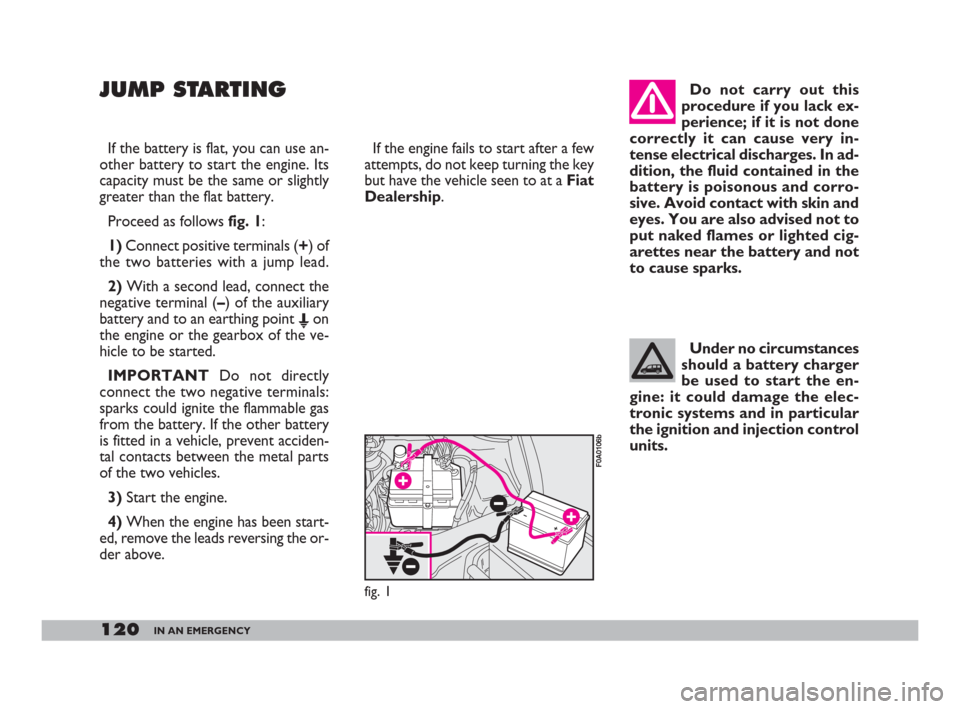
Proceed as follows fig. 1:
1) Connect positive terminals (+) of
the two batteries with a jump lead.
2)With a second lead, connect the
negative terminal (–) of the auxiliary
battery and to an earthing point E
on
the engine or the gearbox of the ve-
hicle to be started.
IMPORTANTDo not directly
connect the two negative terminals:
sparks could ignite the flammable gas
from the battery. If the other battery
is fitted in a vehicle, prevent acciden-
tal contacts between the metal parts
of the two vehicles.
3) Start the engine.
4)When the engine has been start-
ed, remove the leads reversing the or-
der above.If the engine fails to start after a few
attempts, do not keep turning the key
but have the vehicle seen to at a Fiat
Dealership.
JUMP STARTING
fig. 1
F0A0106b
Do not carry out this
procedure if you lack ex-
perience; if it is not done
correctly it can cause very in-
tense electrical discharges. In ad-
dition, the fluid contained in the
battery is poisonous and corro-
sive. Avoid contact with skin and
eyes. You are also advised not to
put naked flames or lighted cig-
arettes near the battery and not
to cause sparks.
Under no circumstances
should a battery charger
be used to start the en-
gine: it could damage the elec-
tronic systems and in particular
the ignition and injection control
units.
119-148 Doblo GB 9-05-2008 12:09 Pagina 120
Page 139 of 222
138IN AN EMERGENCY
IF A FUSE BLOWS
GENERAL
A fuse is an element for protecting
the electrical system. A fuse will trip
(i.e. it will blow) in the event of a fail-
ure or improper interventions in the
electrical system.
If an electrical device is not working,
check whether the respective fuse is
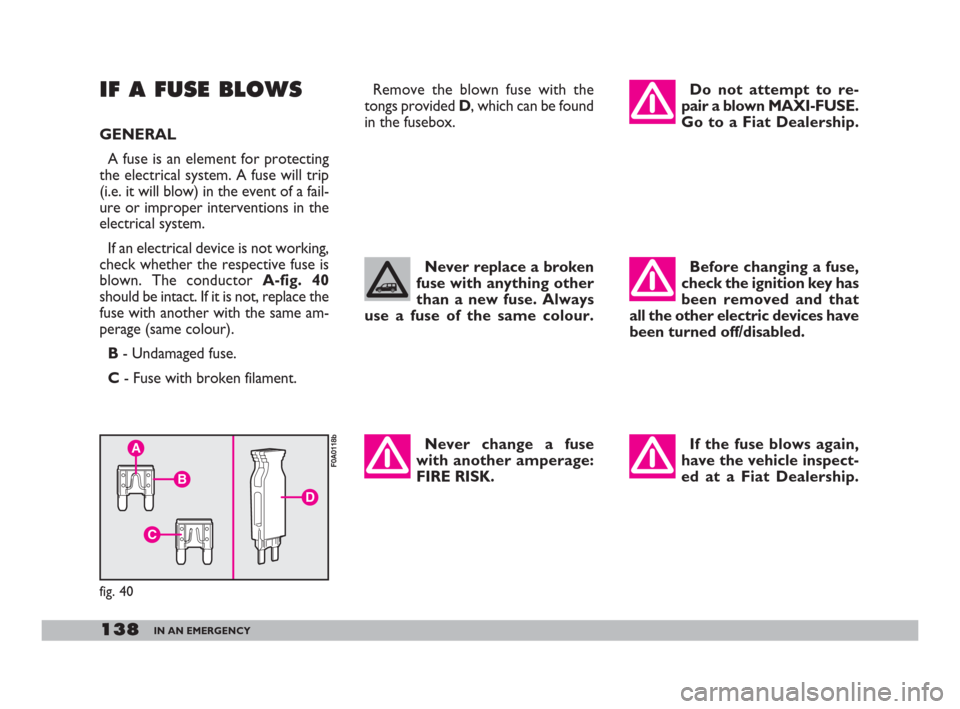
blown. The conductor A-fig. 40
should be intact. If it is not, replace the
fuse with another with the same am-
perage (same colour).
B- Undamaged fuse.
C- Fuse with broken filament.Remove the blown fuse with the
tongs provided D, which can be found
in the fusebox.
D
B
C
A
fig. 40
F0A0118b
Never replace a broken
fuse with anything other
than a new fuse. Always
use a fuse of the same colour.
Never change a fuse
with another amperage:
FIRE RISK.
Do not attempt to re-
pair a blown MAXI-FUSE.
Go to a Fiat Dealership.
Before changing a fuse,
check the ignition key has
been removed and that
all the other electric devices have
been turned off/disabled.
If the fuse blows again,
have the vehicle inspect-
ed at a Fiat Dealership.
119-148 Doblo GB 9-05-2008 12:09 Pagina 138
Page 142 of 222
141IN AN EMERGENCY
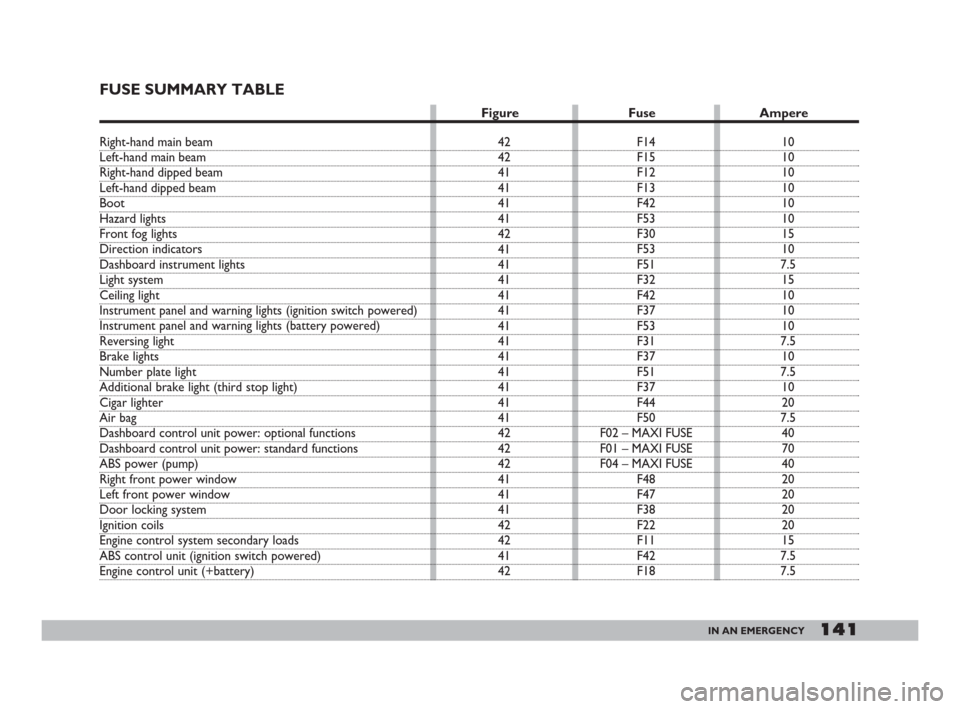
FUSE SUMMARY TABLE
10
10
10
10
10
10
15
10
7.5
15
10
10
10
7.5
10
7.5
10
20
7.5
40
70
40
20
20
20
20
15
7.5
7.5 F14
F15
F12
F13
F42
F53
F30
F53
F51
F32
F42
F37
F53
F31
F37
F51
F37
F44
F50
F02 – MAXI FUSE
F01 – MAXI FUSE
F04 – MAXI FUSE
F48
F47
F38
F22
F11
F42
F18 42
42
41
41
41
41
42
41
41
41
41
41
41
41
41
41
41
41
41
42
42
42
41
41
41
42
42
41
42
Figure Fuse Ampere
Right-hand main beam
Left-hand main beam
Right-hand dipped beam
Left-hand dipped beam
Boot
Hazard lights
Front fog lights
Direction indicators
Dashboard instrument lights
Light system
Ceiling light
Instrument panel and warning lights (ignition switch powered)
Instrument panel and warning lights (battery powered)
Reversing light
Brake lights
Number plate light
Additional brake light (third stop light)
Cigar lighter
Air bag
Dashboard control unit power: optional functions
Dashboard control unit power: standard functions
ABS power (pump)
Right front power window
Left front power window
Door locking system
Ignition coils
Engine control system secondary loads
ABS control unit (ignition switch powered)
Engine control unit (+battery)
119-148 Doblo GB 9-05-2008 12:09 Pagina 141
Page 143 of 222
142IN AN EMERGENCY
Engine control unit (power)
Engine control unit (ignition switch powered)
Glow plug control unit
Horn
Manual climate control enable control
Ignition switch
Manual climate control compressor
Headlight beam adjuster
Petrol fume recirculation solenoid valve
Tachometer generator
Injectors
Heated rear window
One-speed radiator fan
Fuel pump
Fuel pump
Windscreen-rear window washer pump
Supplementary power socket
ABS power (valve)
Radiator fan first speed
(versions with manual climate control system)
Radiator fan first speed (1.3 -1.9 Multijet versions)
Radiator fan second speed
(1.4 - 1.6 versions with manual climate control system)
Radiator fan second speed (1.3 -1.9 Multijet versions)
Heated seats
+ 30 services
(sound system, cellular telephone, diagnostic socket)
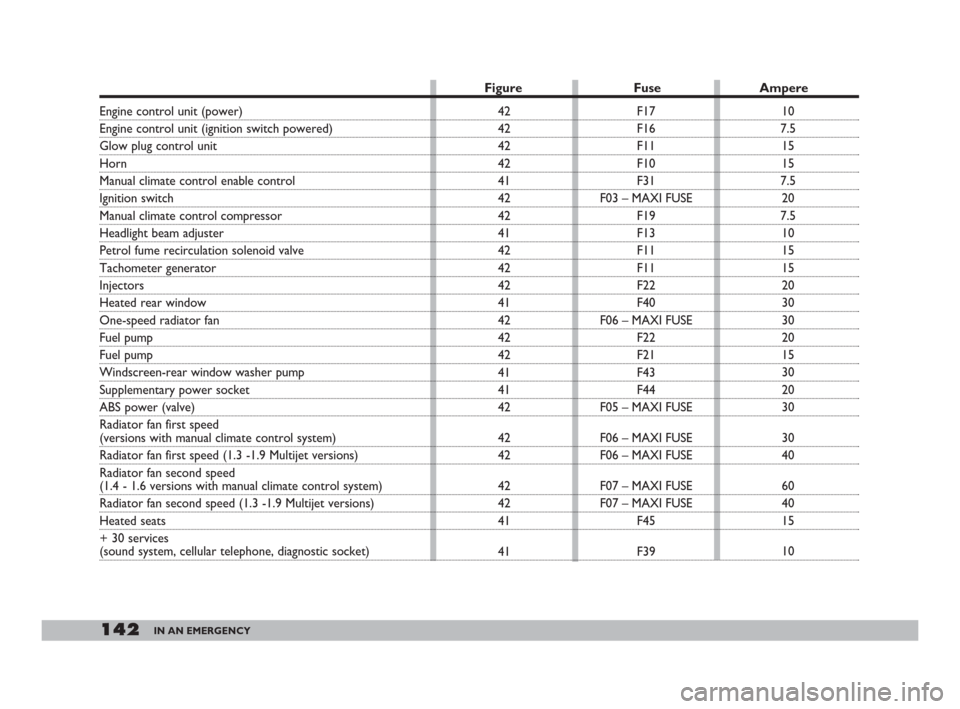
Figure Fuse Ampere
10
7.5
15
15
7.5
20
7.5
10
15
15
20
30
30
20
15
30
20
30
30
40
60
40
15
10 F17
F16
F11
F10
F31
F03 – MAXI FUSE
F19
F13
F11
F11
F22
F40
F06 – MAXI FUSE
F22
F21
F43
F44
F05 – MAXI FUSE
F06 – MAXI FUSE
F06 – MAXI FUSE
F07 – MAXI FUSE
F07 – MAXI FUSE
F45
F39 42
42
42
42
41
42
42
41
42
42
42
41
42
42
42
41
41
42
42
42
42
42
41
41
119-148 Doblo GB 9-05-2008 12:09 Pagina 142
Page 145 of 222
144IN AN EMERGENCY
IF THE BATTERY
IS FLAT
First of all, read the “Vehicle main-
tenance” section for the steps to be
taken to avoid the battery running
down and to ensure it has a long life.
IF THE BATTERY IS FLAT
Charging should be slow at a low
amp rating for 24 hours. Charging for
a longer time may damage the battery.
Proceed as follows:
1) Disconnect the electrical system
from the battery terminals.
IMPORTANTWhere relevant,
switch the electronic alarm off with
the remote control.2)Connect the charger cables to the
battery terminals.
3)Turn on the charger.
4)When you have finished, turn the
charger off before disconnecting the
battery.
5)Reconnect the cables to the bat-
tery terminals. Make sure the polari-
ty is correct.JUMP STARTING
See “Jump starting”, in this chapter.
The liquid in the battery
is poisonous and corro-
sive. Do not let it touch
the skin or eyes. Recharging the
battery should be done in a well-
ventilated area away from naked
flames or possible sources of
sparks: explosion and fire risk.
Do not attempt to
recharge a frozen bat-
tery. Thaw it first other-
wise it could explode. If the bat-
tery froze, make sure that the in-
ternal elements are not broken
(short-circuit risk) and that the
casing is not cracked (risk of
spilling the poisonous and corro-
sive fluid).
Under no circumstances
should a battery charger
be used to start the en-
gine: it could damage the elec-
tronic systems and in particular
the ignition and injection control
units.
119-148 Doblo GB 9-05-2008 12:09 Pagina 144
Page 148 of 222
147IN AN EMERGENCY
IF AN ACCIDENT
OCCURS
– It is important to keep calm.
– If you are not directly involved in
the accident, stop at least ten metres
away from the accident.
– If you are on a motorway, do not
obstruct the emergency lane with
your vehicle.
– Turn off the engine and turn on the
hazard lights.
– At night, illuminate the scene of the
accident with your headlights.
– Act carefully, you must not risk be-
ing run over.
– Mark the accident by putting the
red triangle at the regulatory distance
from the vehicle where it can be clear-
ly seen.
– Call for rescue making the infor-
mation you give as accurate as you
can. On the motorway use the special
column-mounted emergency phones. When towing the vehi-
cle, you must comply with
the specific traffic regula-
tions regarding the tow hitch and
how to tow on the road.
Before starting to tow,
turn the ignition key to
MAR and then to STOP.
Do not remove the key. If the key
is removed, the steering lock en-
gages automatically which pre-
vents the wheels being turned.
While the vehicle is be-
ing towed with the engine
off, remember that the
brake pedal and steering will re-
quire more effort as you no
longer have the benefit of the
power brakes and power steer-
ing. Do not use flexible cables to
tow. Avoid jerking. Whilst tow-
ing, ensure that the coupling to
the vehicle does not damage the
surrounding components.
fig. 47
F0A0417b
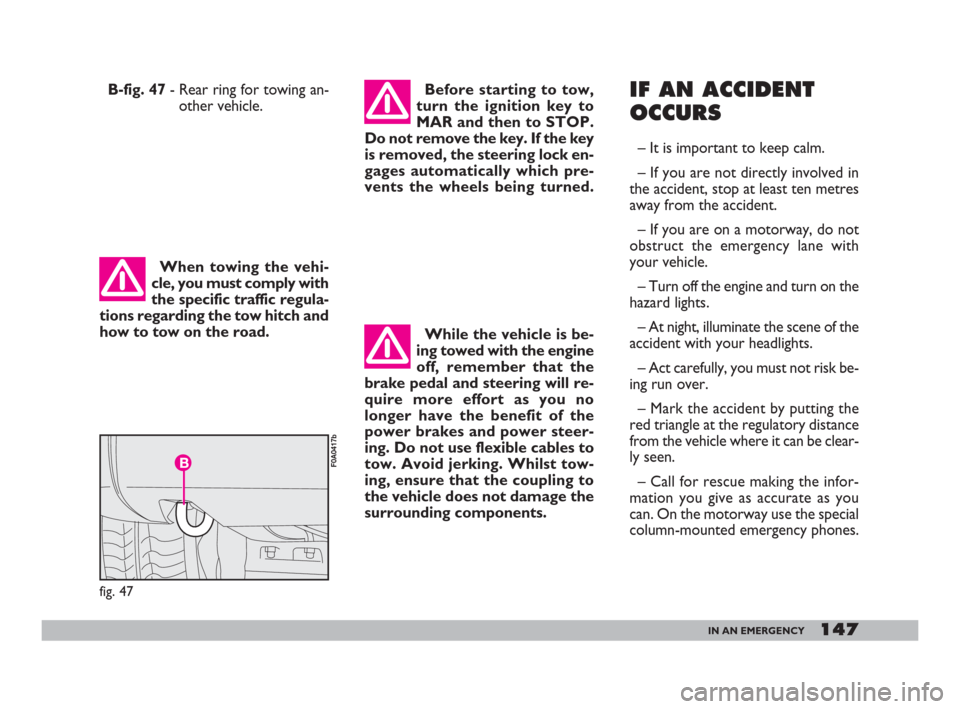
B-fig. 47- Rear ring for towing an-
other vehicle.
119-148 Doblo GB 9-05-2008 12:09 Pagina 147
Page 149 of 222
148IN AN EMERGENCY
FIRST-AID KIT
It is a good idea to keep a fire extin-
guisher and blanket in the vehicle in
addition to the first-aid kit.
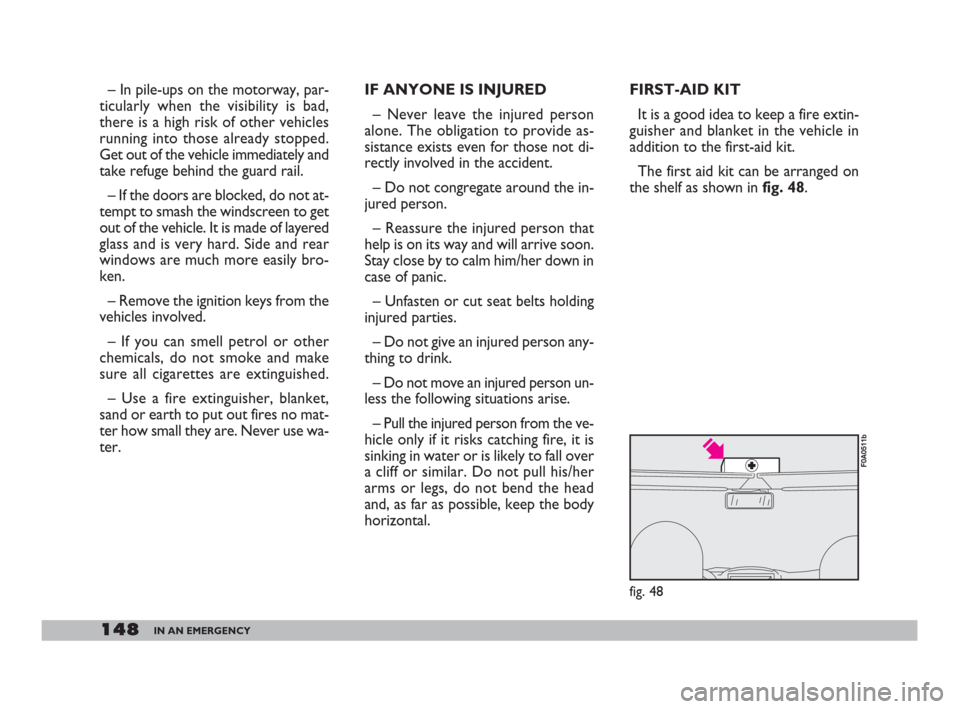
The first aid kit can be arranged on
the shelf as shown in fig. 48.
fig. 48
F0A0511b
– In pile-ups on the motorway, par-
ticularly when the visibility is bad,
there is a high risk of other vehicles
running into those already stopped.
Get out of the vehicle immediately and
take refuge behind the guard rail.
– If the doors are blocked, do not at-
tempt to smash the windscreen to get
out of the vehicle. It is made of layered
glass and is very hard. Side and rear
windows are much more easily bro-
ken.
– Remove the ignition keys from the
vehicles involved.
– If you can smell petrol or other
chemicals, do not smoke and make
sure all cigarettes are extinguished.
– Use a fire extinguisher, blanket,
sand or earth to put out fires no mat-
ter how small they are. Never use wa-
ter.IF ANYONE IS INJURED
– Never leave the injured person
alone. The obligation to provide as-
sistance exists even for those not di-
rectly involved in the accident.
– Do not congregate around the in-
jured person.
– Reassure the injured person that
help is on its way and will arrive soon.
Stay close by to calm him/her down in
case of panic.
– Unfasten or cut seat belts holding
injured parties.
– Do not give an injured person any-
thing to drink.
– Do not move an injured person un-
less the following situations arise.
– Pull the injured person from the ve-
hicle only if it risks catching fire, it is
sinking in water or is likely to fall over
a cliff or similar. Do not pull his/her
arms or legs, do not bend the head
and, as far as possible, keep the body
horizontal.
119-148 Doblo GB 9-05-2008 12:09 Pagina 148
Page 154 of 222
153VEHICLE MAINTENANCE
IMPORTANT - Engine oil
Should prevailing use of the vehicle
be under one of the following special-
ly heavy conditions:
– towing a trailer
– on dirty roads
– for short, repeated trips (less than
7-8 km) with outside temperature be-
low zero
– frequently idling engines or long
distance low speed driving (e.g. taxis
or door-to-door deliveries) or in case
of a long term inactivity; replace en-
gine oil more frequently than required
on Service schedule
IMPORTANT - Air cleaner
If the vehicle is used on dusty roads
change the air cleaner more frequently
than the indications in the Service
schedule. If in doubt as to how often
the engine oil and air cleaner should
be changed according to how you use
the vehicle, contact a Fiat Dealer-
ship.IMPORTANT - Pollen filter
If the vehicle is used frequently in
dusty or heavily polluted environ-
ments it is advisable to replace the fil-
tering element more frequently; in
particular it should be replaced if a re-
duction of the amount of air admitted
to the passenger compartment is not-
ed.
IMPORTANT - Battery
The charge in your battery should be
checked, where possible at the start
of the winter, to limit the risk of the
battery electrolyte freezing. This check
should be carried out more frequent-
ly if the vehicle is mainly used for short
trips or if it is fitted with accessories
that permanently take in electricity
even when the ignition key is re-
moved, especially in the case of after
market accessories.You should check the battery fluid
(electrolyte) level more frequently
than shown in the service schedule in
this chapter if the vehicle is used in hot
climates or particularly demanding
conditions.
Maintenance of your ve-
hicle should be entrusted
to a Fiat Dealership. For
ordinary routine maintenance
operations which you are able to
carry out yourself, ensure that
you have the necessary tools and
original Fiat spare parts and flu-
ids available. Do not carry out
servicing operations if you have
no experience.
149-173 Doblo GB 9-05-2008 12:10 Pagina 153
Page 167 of 222
166VEHICLE MAINTENANCE
ELECTRONIC
CONTROL UNITS
When the vehicle is being used nor-
mally, special measures are not neces-
sary.
The following instructions must be
followed very carefully, however, if
you work on the electrical system or
in cases where emergency starting is
necessary:
– Never disconnect the battery from
the electrical system while the engine
is running.
– Disconnect the battery from the
electrical system if you are recharg-
ing it. The modern battery chargers
can discharge voltage up to 20V.
– Never perform emergency start-
ups with a battery charger. Always use
an auxiliary battery.
– Be particularly careful when con-
necting the battery to the electrical
system. Ensure the battery posts are
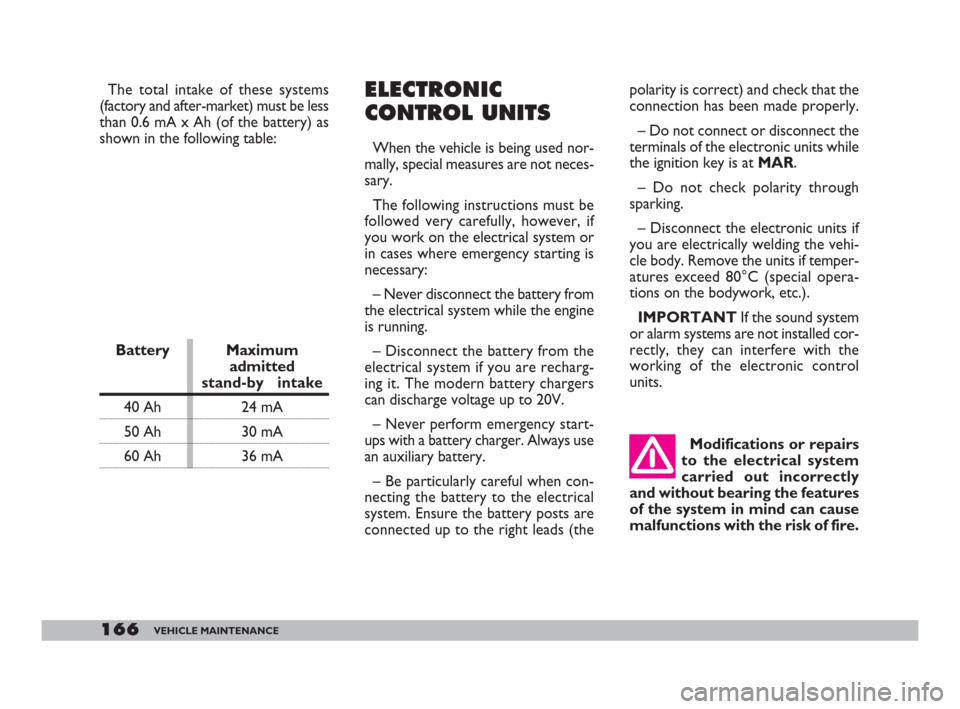
connected up to the right leads (the Battery Maximum
admitted
stand-by intake
40 Ah 24 mA
50 Ah 30 mA
60 Ah 36 mApolarity is correct) and check that the
connection has been made properly.
– Do not connect or disconnect the
terminals of the electronic units while
the ignition key is at MAR.
– Do not check polarity through
sparking.
– Disconnect the electronic units if
you are electrically welding the vehi-
cle body. Remove the units if temper-
atures exceed 80°C (special opera-
tions on the bodywork, etc.).
IMPORTANTIf the sound system
or alarm systems are not installed cor-
rectly, they can interfere with the
working of the electronic control
units.
Modifications or repairs
to the electrical system
carried out incorrectly
and without bearing the features
of the system in mind can cause
malfunctions with the risk of fire.
The total intake of these systems
(factory and after-market) must be less
than 0.6 mA x Ah (of the battery) as
shown in the following table:
149-173 Doblo GB 9-05-2008 12:10 Pagina 166
Page 173 of 222
172VEHICLE MAINTENANCE
Detergents pollute wa-
ter. The vehicle must
therefore be washed in an
area equipped for the collection
and purification of the liquids
used while washing.
IMPORTANT The engine com-
partment should be washed while the
engine is cold and with the ignition key
at STOP. After washing, make sure
that the various protections (e.g. rub-
ber boots and various guards) have
not be removed or damaged. To wash the vehicle properly:
1) Remove the aerial from the roof
to prevent damaging it when washing
the vehicle in an automatic carwash.
2) Wash the body using a low pres-
sure jet of water.
3)Wipe a sponge with a slightly
soapy solution over the bodywork,
frequently rinsing the sponge.
4)Rinse well with water and dry
with a jet of air or a chamois leather.
When drying the vehicle, be careful
to get at those parts which are not so
easily seen e.g. the door frames, bon-
net and around the headlights where
water can most readily collect. You
should leave the vehicle out in the
open so that any water remaining can
evaporate more easily.Detergents pollute wa-
ter. For this reason, the
vehicle must be washed in
an area equipped for the collec-
tion and purification of the liquids
used while washing.
Engine compartment
At the end of each winter season,
carefully clean the engine compart-
ment. Be careful not to direct the jet
of water on the electronic control
units. Have this done at a garage. Do not wash the vehicle after it has
been parked in the sun or while the
bonnet is hot: it could take the shine
off the paint.
Outside plastic parts must be cleaned
following the usual vehicle washing
procedure.
Where possible avoid parking the ve-
hicle under trees; the resinous sub-
stances that certain species of tree
shed dull the paintwork and increase
the possibility of rust forming.
IMPORTANTBird droppings must
be washed off immediately and with
great care as their acid is particularly
aggressive.
Windows
Use specific window cleaner prod-
ucts to clean cloths to avoid scratch-
ing the glass or damaging the trans-
parency.
IMPORTANTTo prevent damage
to the electric heater element, wipe the
inside of the heated rear window gen-
tly in the same direction as the ele-
ments.
149-173 Doblo GB 9-05-2008 12:10 Pagina 172