fuel pressure FIAT DOBLO COMBI 2015 2.G User Guide
[x] Cancel search | Manufacturer: FIAT, Model Year: 2015, Model line: DOBLO COMBI, Model: FIAT DOBLO COMBI 2015 2.GPages: 323, PDF Size: 46.77 MB
Page 198 of 323
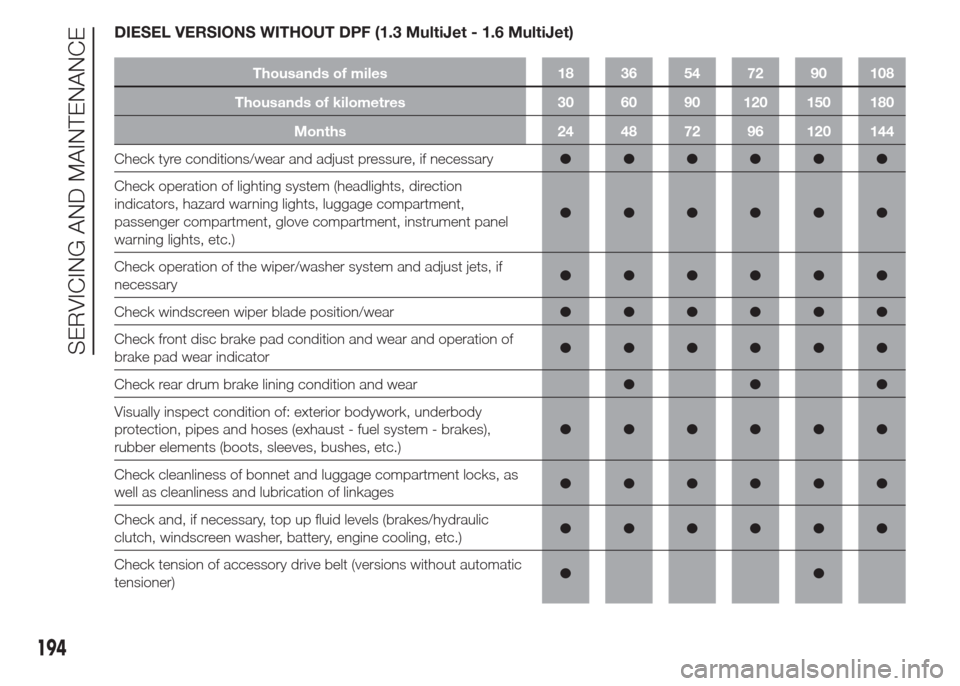
DIESEL VERSIONS WITHOUT DPF (1.3 MultiJet - 1.6 MultiJet)
Thousands of miles 18 36 54 72 90 108
Thousands of kilometres 30 60 90 120 150 180
Months 24 48 72 96 120 144
Check tyre conditions/wear and adjust pressure, if necessary●●●●●●
Check operation of lighting system (headlights, direction
indicators, hazard warning lights, luggage compartment,
passenger compartment, glove compartment, instrument panel
warning lights, etc.)●●●●●●
Check operation of the wiper/washer system and adjust jets, if
necessary●●●●●●
Check windscreen wiper blade position/wear●●●●●●
Check front disc brake pad condition and wear and operation of
brake pad wear indicator●●●●●●
Check rear drum brake lining condition and wear●●●
Visually inspect condition of: exterior bodywork, underbody
protection, pipes and hoses (exhaust - fuel system - brakes),
rubber elements (boots, sleeves, bushes, etc.)●●●●●●
Check cleanliness of bonnet and luggage compartment locks, as
well as cleanliness and lubrication of linkages●●●●●●
Check and, if necessary, top up fluid levels (brakes/hydraulic
clutch, windscreen washer, battery, engine cooling, etc.)●●●●●●
Check tension of accessory drive belt (versions without automatic
tensioner)●●
194
SERVICING AND MAINTENANCE
Page 200 of 323
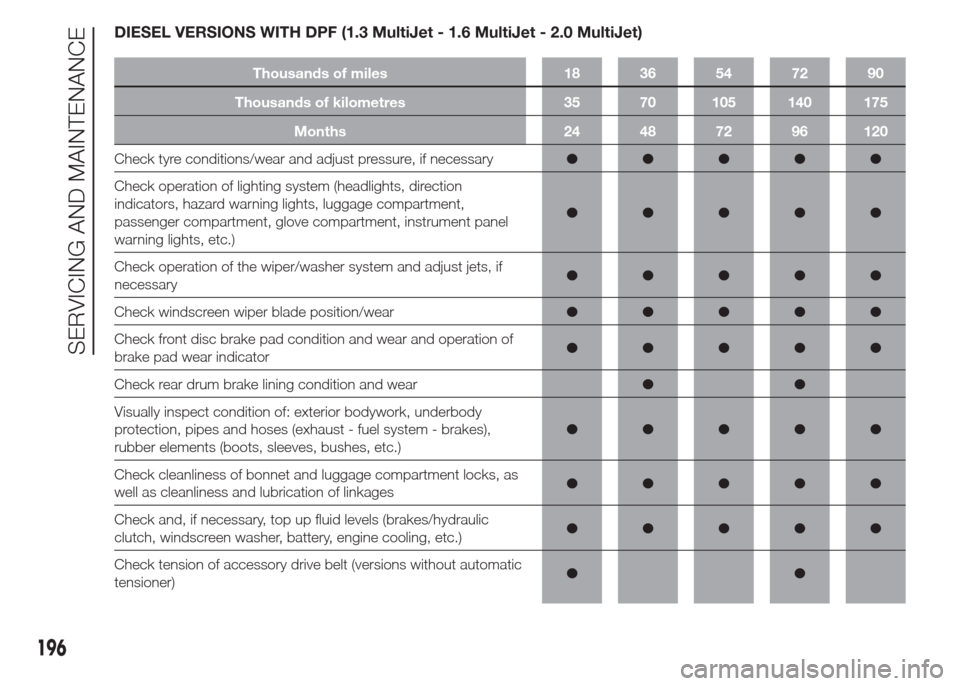
DIESEL VERSIONS WITH DPF (1.3 MultiJet - 1.6 MultiJet - 2.0 MultiJet)
Thousands of miles 18 36 54 72 90
Thousands of kilometres 35 70 105 140 175
Months 24 48 72 96 120
Check tyre conditions/wear and adjust pressure, if necessary●●●●●
Check operation of lighting system (headlights, direction
indicators, hazard warning lights, luggage compartment,
passenger compartment, glove compartment, instrument panel
warning lights, etc.)●●●●●
Check operation of the wiper/washer system and adjust jets, if
necessary●●●●●
Check windscreen wiper blade position/wear●●●●●
Check front disc brake pad condition and wear and operation of
brake pad wear indicator●●●●●
Check rear drum brake lining condition and wear●●
Visually inspect condition of: exterior bodywork, underbody
protection, pipes and hoses (exhaust - fuel system - brakes),
rubber elements (boots, sleeves, bushes, etc.)●●●●●
Check cleanliness of bonnet and luggage compartment locks, as
well as cleanliness and lubrication of linkages●●●●●
Check and, if necessary, top up fluid levels (brakes/hydraulic
clutch, windscreen washer, battery, engine cooling, etc.)●●●●●
Check tension of accessory drive belt (versions without automatic
tensioner)●●
196
SERVICING AND MAINTENANCE
Page 202 of 323
PERIODIC CHECKS
Every 1,000 km or before long
journeys, check and, if necessary,
top up the following:
❒engine coolant level;
❒brake fluid level;
❒windscreen washer fluid level;
❒tyre inflation pressure and condition;
❒operation of lighting system
(headlights, direction indicators,
hazard warning lights, etc.);
❒operation of screen washer/wiper
system and positioning/wear of
windscreen/rear screen wiper blades
(for versions/markets where
provided);
Every 3,000 km check and top up if
required: engine oil level.
DEMANDING
VEHICLE USE
If the vehicle is mostly used in one of
the following conditions:
❒towing a trailer or motorhome;
❒dusty roads;
❒short, repeated journeys (less than
7-8 km) at sub-zero outside
temperatures;
❒engine often idling or driving long
distances at low speeds or long
periods of inactivity;
the following checks must be
carried out more often than
indicated in the Scheduled Servicing
Plan:
❒check front disc brake pad condition
and wear;
❒check cleanliness of bonnet and
luggage compartment locks,
cleanliness and lubrication of linkage;
❒visually inspect condition of: engine,
gearbox, transmission, pipes and
hoses (exhaust - fuel system -
brakes) and rubber elements (boots -
sleeves - bushes - etc.);
❒check battery charge and battery
fluid level (electrolyte);❒visually inspect conditions of the
auxiliary drive belts;
❒check and, if necessary, change
engine oil and replace oil filter;
❒check and, if necessary, replace
pollen filter;
❒replacement of air cleaner cartridge
every 15,000 km.
198
SERVICING AND MAINTENANCE
Page 219 of 323
RUBBER HOSES
As far as the maintenance of the
brake system and fuel supply
system rubber hoses is concerned,
follow the "Scheduled Servicing
Plan" in this chapter carefully.
Ozone, high temperatures and
prolonged lack of fluid in the system
may cause hardening and cracking
of the hoses, with possible leaks.
Careful checking is therefore
necessary.
PROLONGED
VEHICLE INACTIVITY
If the vehicle needs to be off the
road for longer than one month, the
following precautions must be
taken:
❒park the vehicle indoors in a dry and,
if possible, well-ventilated place;
❒engage a gear and check that the
handbrake is not engaged;
❒disconnect the negative terminal from
the battery pole (see paragraph
“Vehicle inactivity” in the "Dashboard
and controls" chapter) and check
the charge conditions (see paragraph
“Battery” in the “Care and
maintenance” chapter);
❒clean and protect the painted parts
using protective wax;
❒clean and protect the shiny metal
parts using special compounds
available commercially;
❒sprinkle talcum powder on the
windscreen and rear window wiper
rubber blades and lift them off the
glass;
❒slightly open the windows;❒cover the vehicle with a piece of
fabric or perforated plastic sheet. Do
not use compact plastic tarpaulins,
which prevent humidity from
evaporating from the surface of the
vehicle;
❒inflate tyres to +0.5 bar above the
standard specified pressure and
check it at intervals;
❒do not drain the engine cooling
system.
215
Page 285 of 323
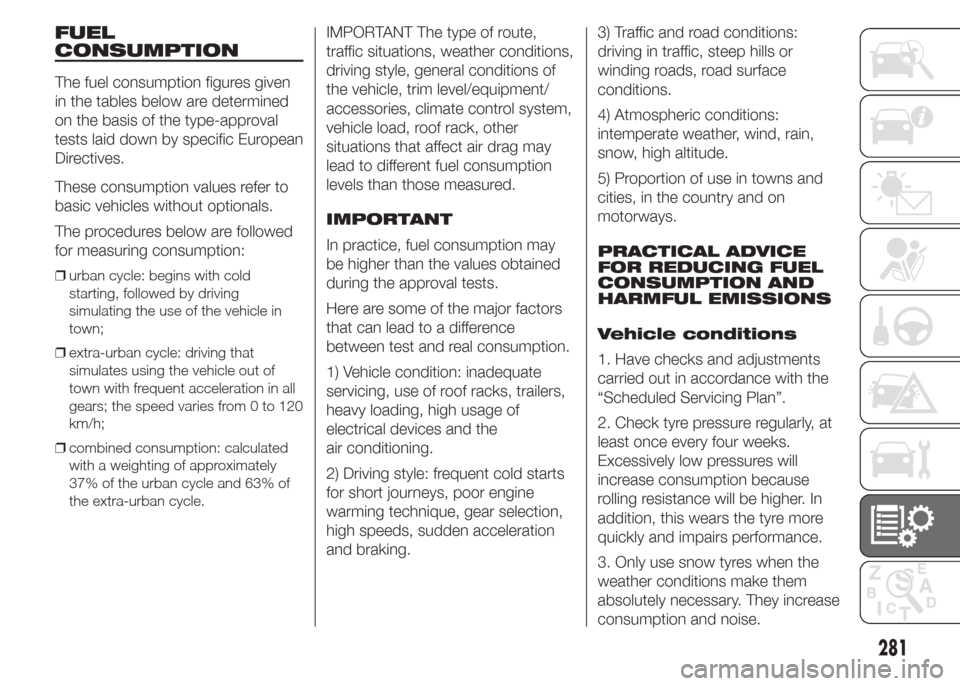
FUEL
CONSUMPTION
The fuel consumption figures given
in the tables below are determined
on the basis of the type-approval
tests laid down by specific European
Directives.
These consumption values refer to
basic vehicles without optionals.
The procedures below are followed
for measuring consumption:
❒urban cycle: begins with cold
starting, followed by driving
simulating the use of the vehicle in
town;
❒extra-urban cycle: driving that
simulates using the vehicle out of
town with frequent acceleration in all
gears; the speed varies from 0 to 120
km/h;
❒combined consumption: calculated
with a weighting of approximately
37% of the urban cycle and 63% of
the extra-urban cycle.
IMPORTANT The type of route,
traffic situations, weather conditions,
driving style, general conditions of
the vehicle, trim level/equipment/
accessories, climate control system,
vehicle load, roof rack, other
situations that affect air drag may
lead to different fuel consumption
levels than those measured.
IMPORTANT
In practice, fuel consumption may
be higher than the values obtained
during the approval tests.
Here are some of the major factors
that can lead to a difference
between test and real consumption.
1) Vehicle condition: inadequate
servicing, use of roof racks, trailers,
heavy loading, high usage of
electrical devices and the
air conditioning.
2) Driving style: frequent cold starts
for short journeys, poor engine
warming technique, gear selection,
high speeds, sudden acceleration
and braking.3) Traffic and road conditions:
driving in traffic, steep hills or
winding roads, road surface
conditions.
4) Atmospheric conditions:
intemperate weather, wind, rain,
snow, high altitude.
5) Proportion of use in towns and
cities, in the country and on
motorways.
PRACTICAL ADVICE
FOR REDUCING FUEL
CONSUMPTION AND
HARMFUL EMISSIONS
Vehicle conditions
1. Have checks and adjustments
carried out in accordance with the
“Scheduled Servicing Plan”.
2. Check tyre pressure regularly, at
least once every four weeks.
Excessively low pressures will
increase consumption because
rolling resistance will be higher. In
addition, this wears the tyre more
quickly and impairs performance.
3. Only use snow tyres when the
weather conditions make them
absolutely necessary. They increase
consumption and noise.
281
Page 320 of 323
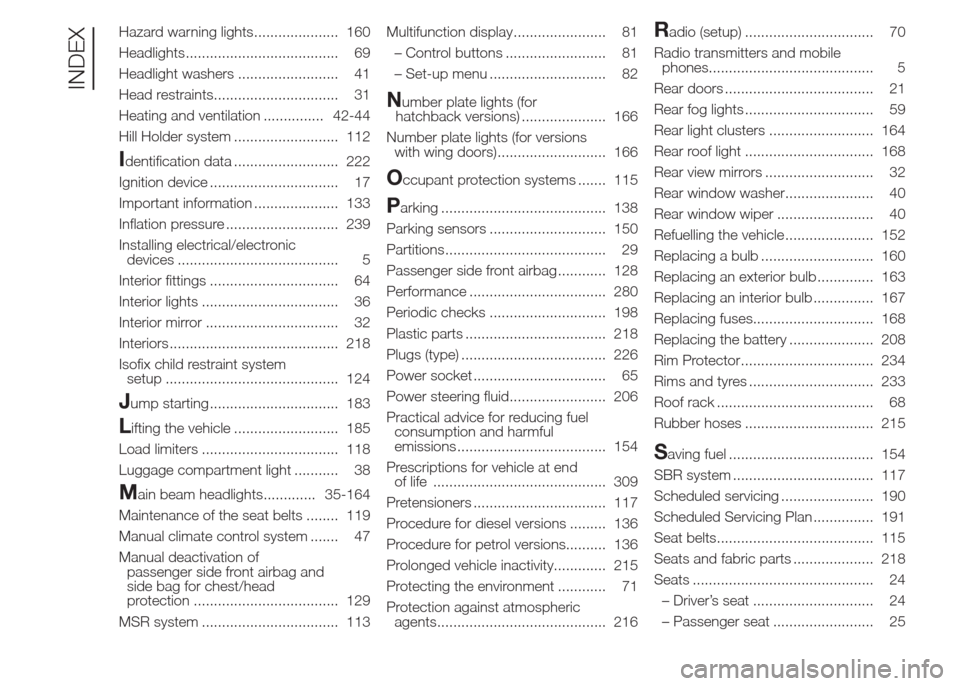
Hazard warning lights..................... 160
Headlights...................................... 69
Headlight washers ......................... 41
Head restraints............................... 31
Heating and ventilation ............... 42-44
Hill Holder system .......................... 112
Identification data .......................... 222
Ignition device ................................ 17
Important information ..................... 133
Inflation pressure ............................ 239
Installing electrical/electronic
devices ........................................ 5
Interior fittings ................................ 64
Interior lights .................................. 36
Interior mirror ................................. 32
Interiors .......................................... 218
Isofix child restraint system
setup ........................................... 124
Jump starting ................................ 183
Lifting the vehicle .......................... 185
Load limiters .................................. 118
Luggage compartment light ........... 38
Main beam headlights............. 35-164
Maintenance of the seat belts ........ 119
Manual climate control system ....... 47
Manual deactivation of
passenger side front airbag and
side bag for chest/head
protection .................................... 129
MSR system .................................. 113Multifunction display....................... 81
– Control buttons ......................... 81
– Set-up menu ............................. 82
Number plate lights (for
hatchback versions) ..................... 166
Number plate lights (for versions
with wing doors)........................... 166
Occupant protection systems ....... 115
Parking ......................................... 138
Parking sensors ............................. 150
Partitions........................................ 29
Passenger side front airbag ............ 128
Performance .................................. 280
Periodic checks ............................. 198
Plastic parts ................................... 218
Plugs (type) .................................... 226
Power socket ................................. 65
Power steering fluid........................ 206
Practical advice for reducing fuel
consumption and harmful
emissions ..................................... 154
Prescriptions for vehicle at end
of life ........................................... 309
Pretensioners ................................. 117
Procedure for diesel versions ......... 136
Procedure for petrol versions.......... 136
Prolonged vehicle inactivity............. 215
Protecting the environment ............ 71
Protection against atmospheric
agents.......................................... 216
Radio (setup) ................................ 70
Radio transmitters and mobile
phones......................................... 5
Rear doors ..................................... 21
Rear fog lights ................................ 59
Rear light clusters .......................... 164
Rear roof light ................................ 168
Rear view mirrors ........................... 32
Rear window washer...................... 40
Rear window wiper ........................ 40
Refuelling the vehicle ...................... 152
Replacing a bulb ............................ 160
Replacing an exterior bulb .............. 163
Replacing an interior bulb ............... 167
Replacing fuses.............................. 168
Replacing the battery ..................... 208
Rim Protector................................. 234
Rims and tyres ............................... 233
Roof rack ....................................... 68
Rubber hoses ................................ 215
Saving fuel .................................... 154
SBR system ................................... 117
Scheduled servicing ....................... 190
Scheduled Servicing Plan ............... 191
Seat belts....................................... 115
Seats and fabric parts .................... 218
Seats ............................................. 24
– Driver’s seat .............................. 24
– Passenger seat ......................... 25
INDEX