seats FIAT DOBLO COMBI 2015 2.G User Guide
[x] Cancel search | Manufacturer: FIAT, Model Year: 2015, Model line: DOBLO COMBI, Model: FIAT DOBLO COMBI 2015 2.GPages: 323, PDF Size: 46.77 MB
Page 66 of 323
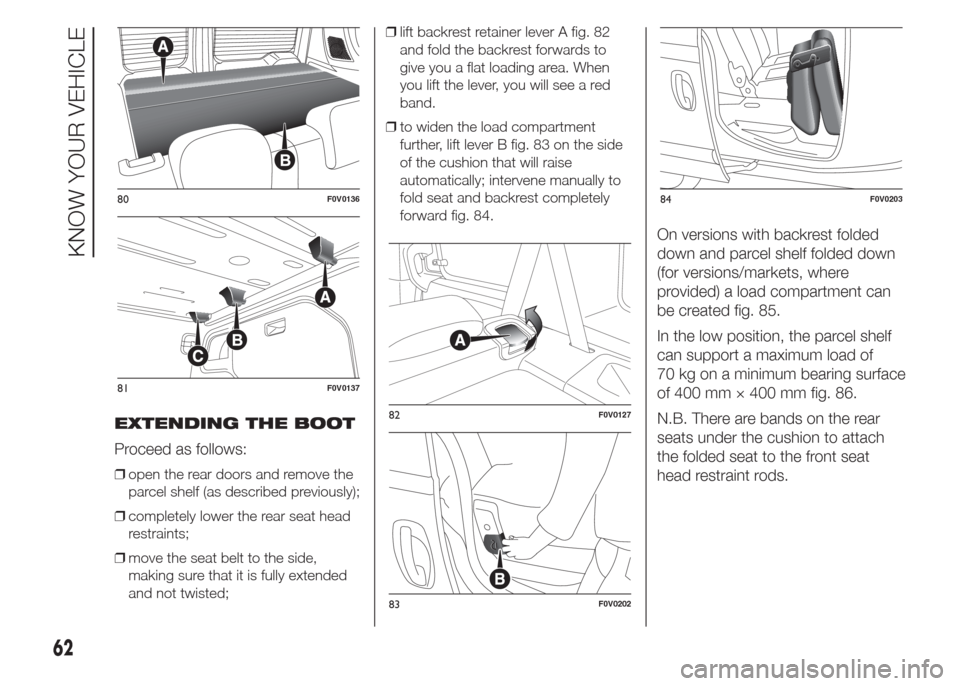
EXTENDING THE BOOT
Proceed as follows:
❒open the rear doors and remove the
parcel shelf (as described previously);
❒completely lower the rear seat head
restraints;
❒move the seat belt to the side,
making sure that it is fully extended
and not twisted;❒lift backrest retainer lever A fig. 82
and fold the backrest forwards to
give you a flat loading area. When
you lift the lever, you will see a red
band.
❒to widen the load compartment
further, lift lever B fig. 83 on the side
of the cushion that will raise
automatically; intervene manually to
fold seat and backrest completely
forward fig. 84.
On versions with backrest folded
down and parcel shelf folded down
(for versions/markets, where
provided) a load compartment can
be created fig. 85.
In the low position, the parcel shelf
can support a maximum load of
70 kg on a minimum bearing surface
of 400 mm × 400 mm fig. 86.
N.B. There are bands on the rear
seats under the cushion to attach
the folded seat to the front seat
head restraint rods.
80F0V0136
81F0V0137
82F0V0127
83F0V0202
84F0V0203
62
KNOW YOUR VEHICLE
Page 68 of 323
38) Never exceed the maximum
allowed load in the boot (see
the "Technical specifications"
chapter). Also make sure that the
objects you place in the boot
have been properly secured, to
avoid them from being thrown
forward consequent to sudden
braking and injuring your
passengers.
39) You must not use the folded
rear seat to carry luggage. The
load could be thrown forward into
the backrest of the front seats,
seriously injuring the occupants.
40) Make sure that the objects are
positioned carefully and fixed to
the hooks on the floor to prevent
them being flung forwards in
the event of sharp braking and
causing injury to the passengers.
IMPORTANT
7) To close the tailgate use handle B
fig. 77. Do not try to close the
tailgate by pressing on the side
shock absorbers C fig. 77. Also be
careful not to knock the side
shock absorbers when you load
the boot, to avoid damaging them.
INTERIOR FITTINGS
DRIVER SIDE ARMREST
(for versions/markets, where
provided)
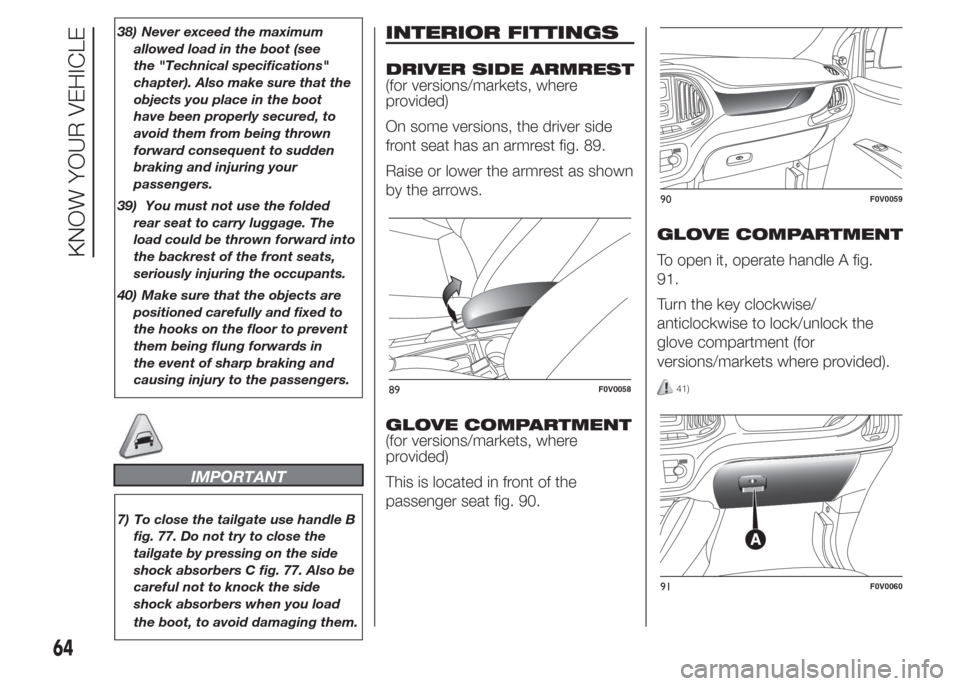
On some versions, the driver side
front seat has an armrest fig. 89.
Raise or lower the armrest as shown
by the arrows.
GLOVE COMPARTMENT
(for versions/markets, where
provided)
This is located in front of the
passenger seat fig. 90.GLOVE COMPARTMENT
To open it, operate handle A fig.
91.
Turn the key clockwise/
anticlockwise to lock/unlock the
glove compartment (for
versions/markets where provided).
41)89F0V0058
90F0V0059
91F0V0060
64
KNOW YOUR VEHICLE
Page 70 of 323
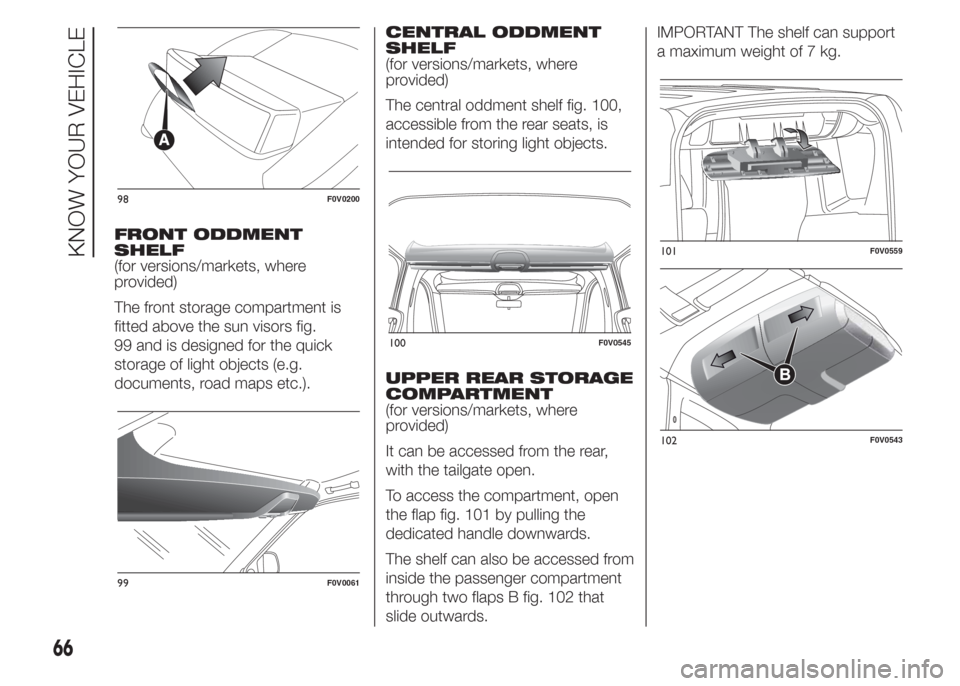
FRONT ODDMENT
SHELF
(for versions/markets, where
provided)
The front storage compartment is
fitted above the sun visors fig.
99 and is designed for the quick
storage of light objects (e.g.
documents, road maps etc.).CENTRAL ODDMENT
SHELF
(for versions/markets, where
provided)
The central oddment shelf fig. 100,
accessible from the rear seats, is
intended for storing light objects.
UPPER REAR STORAGE
COMPARTMENT
(for versions/markets, where
provided)
It can be accessed from the rear,
with the tailgate open.
To access the compartment, open
the flap fig. 101 by pulling the
dedicated handle downwards.
The shelf can also be accessed from
inside the passenger compartment
through two flaps B fig. 102 that
slide outwards.IMPORTANT The shelf can support
a maximum weight of 7 kg.
98F0V0200
99F0V0061
100F0V0545
101F0V0559
102F0V0543
66
KNOW YOUR VEHICLE
Page 73 of 323
WARNING
44) Strictly adhere to the laws in
force concerning maximum
clearance.
45) Check that the attachment fixing
screws are tight after a few
kilometres.
IMPORTANT
8) Evenly distribute the load and
take into account, when driving,
the increased responsiveness
of the vehicle to side wind.
9) Never exceed the maximum
permitted loads (see chapter
“Technical specifications”).
HEADLIGHTS
LIGHT BEAM
ALIGNMENT
The correct alignment of the
headlights is essential for the
comfort and safety of the driver and
other road users. To ensure the
best visibility when travelling with the
headlights on, the headlight
alignment must be correct. Contact
a Fiat Dealership to have the
headlights checked and adjusted.
HEADLIGHT
ALIGNMENT
CORRECTOR
This device works with the ignition
key in the MAR position and the
dipped beam headlights on.
The vehicle tilts backwards when it
is laden, raising the beam. The
beams must therefore be realigned
in this case.Headlight alignment
adjustment
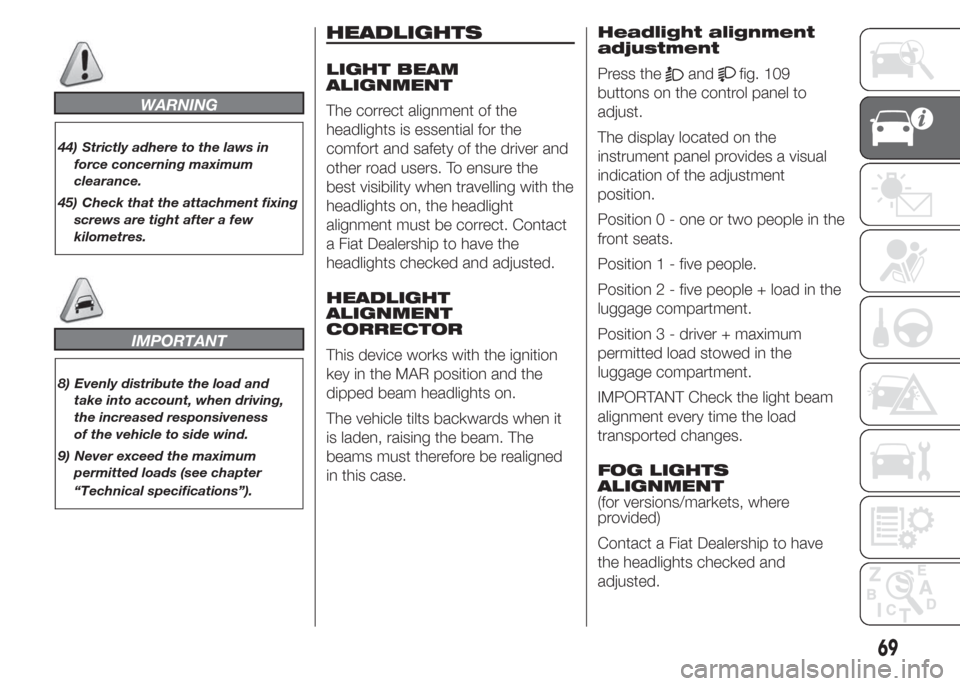
Press theandfig. 109
buttons on the control panel to
adjust.
The display located on the
instrument panel provides a visual
indication of the adjustment
position.
Position 0 - one or two people in the
front seats.
Position 1 - five people.
Position 2 - five people + load in the
luggage compartment.
Position 3 - driver + maximum
permitted load stowed in the
luggage compartment.
IMPORTANT Check the light beam
alignment every time the load
transported changes.
FOG LIGHTS
ALIGNMENT
(for versions/markets, where
provided)
Contact a Fiat Dealership to have
the headlights checked and
adjusted.
69
Page 119 of 323
OCCUPANT
PROTECTION
SYSTEMS
The most important safety
equipment of the vehicle comprises
the following protection systems:
❒seat belts;
❒SBR (Seat Belt Reminder) system;
❒head restraints;
❒child restraint systems;
❒front airbags and side bags.
Read the information given the
following pages with the utmost
care. It is of fundamental importance
that the protection systems are
used in the correct way to
guarantee the maximum possible
safety level for the driver and the
passengers.
SEAT BELTS
USING THE SEAT
BELTS
The seat belt should be worn
keeping the torso straight and
rested against the backrest.
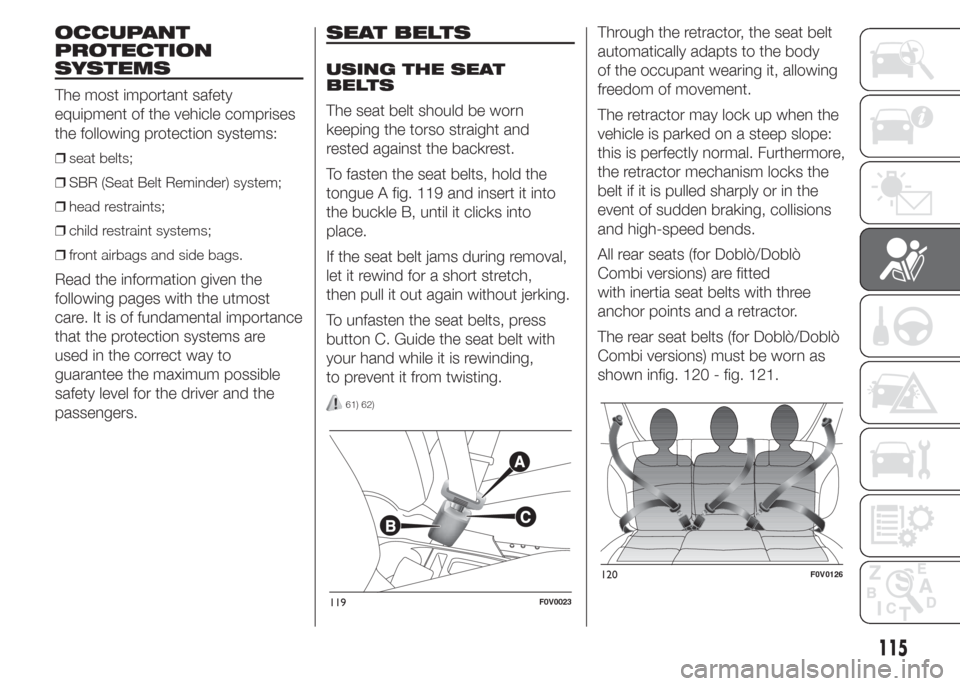
To fasten the seat belts, hold the
tongue A fig. 119 and insert it into
the buckle B, until it clicks into
place.
If the seat belt jams during removal,
let it rewind for a short stretch,
then pull it out again without jerking.
To unfasten the seat belts, press
button C. Guide the seat belt with
your hand while it is rewinding,
to prevent it from twisting.
61) 62)
Through the retractor, the seat belt
automatically adapts to the body
of the occupant wearing it, allowing
freedom of movement.
The retractor may lock up when the
vehicle is parked on a steep slope:
this is perfectly normal. Furthermore,
the retractor mechanism locks the
belt if it is pulled sharply or in the
event of sudden braking, collisions
and high-speed bends.
All rear seats (for Doblò/Doblò
Combi versions) are fitted
with inertia seat belts with three
anchor points and a retractor.
The rear seat belts (for Doblò/Doblò
Combi versions) must be worn as
shown infig. 120 - fig. 121.
119F0V0023
120F0V0126
115
Page 120 of 323
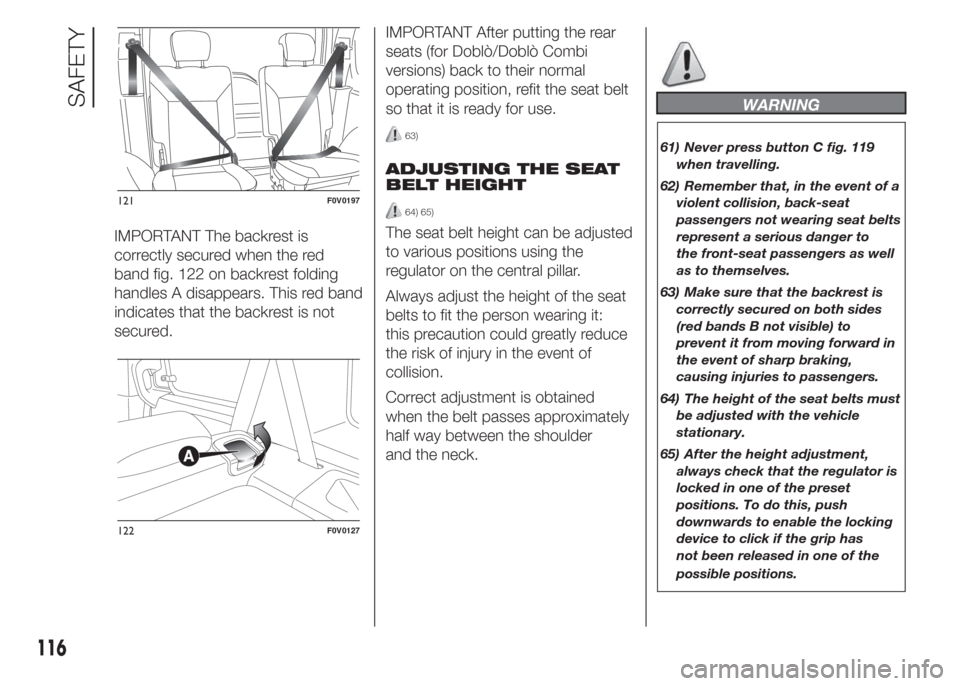
IMPORTANT The backrest is
correctly secured when the red
band fig. 122 on backrest folding
handles A disappears. This red band
indicates that the backrest is not
secured.IMPORTANT After putting the rear
seats (for Doblò/Doblò Combi
versions) back to their normal
operating position, refit the seat belt
so that it is ready for use.
63)
ADJUSTING THE SEAT
BELT HEIGHT
64) 65)
The seat belt height can be adjusted
to various positions using the
regulator on the central pillar.
Always adjust the height of the seat
belts to fit the person wearing it:
this precaution could greatly reduce
the risk of injury in the event of
collision.
Correct adjustment is obtained
when the belt passes approximately
half way between the shoulder
and the neck.
WARNING
61) Never press button C fig. 119
when travelling.
62) Remember that, in the event of a
violent collision, back-seat
passengers not wearing seat belts
represent a serious danger to
the front-seat passengers as well
as to themselves.
63) Make sure that the backrest is
correctly secured on both sides
(red bands B not visible) to
prevent it from moving forward in
the event of sharp braking,
causing injuries to passengers.
64) The height of the seat belts must
be adjusted with the vehicle
stationary.
65) After the height adjustment,
always check that the regulator is
locked in one of the preset
positions. To do this, push
downwards to enable the locking
device to click if the grip has
not been released in one of the
possible positions.
121F0V0197
122F0V0127
116
SAFETY
Page 123 of 323
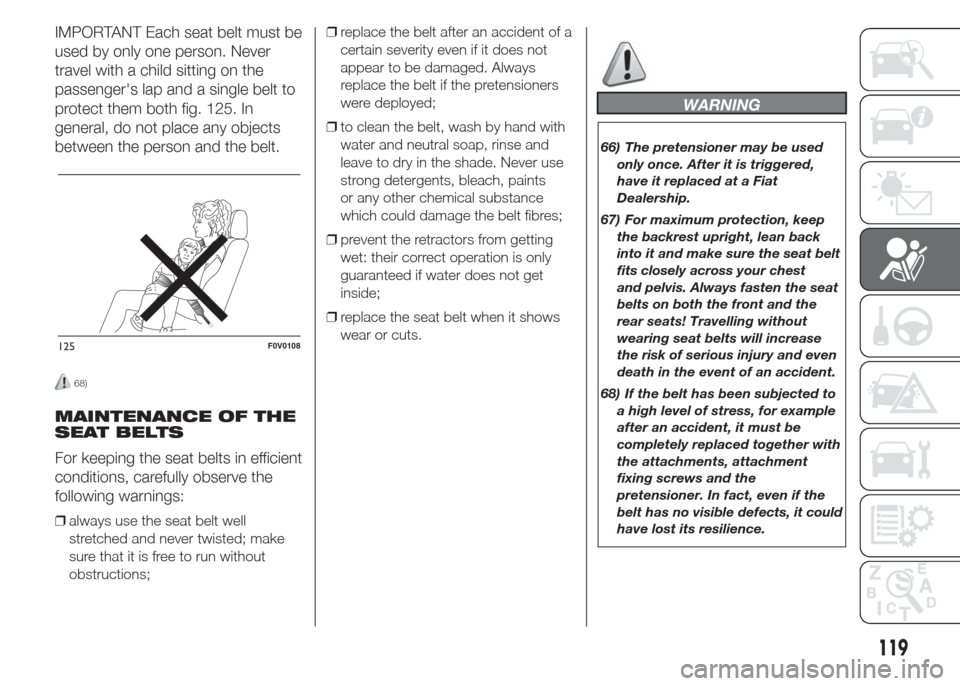
IMPORTANT Each seat belt must be
used by only one person. Never
travel with a child sitting on the
passenger's lap and a single belt to
protect them both fig. 125. In
general, do not place any objects
between the person and the belt.
68)
MAINTENANCE OF THE
SEAT BELTS
For keeping the seat belts in efficient
conditions, carefully observe the
following warnings:
❒always use the seat belt well
stretched and never twisted; make
sure that it is free to run without
obstructions;❒replace the belt after an accident of a
certain severity even if it does not
appear to be damaged. Always
replace the belt if the pretensioners
were deployed;
❒to clean the belt, wash by hand with
water and neutral soap, rinse and
leave to dry in the shade. Never use
strong detergents, bleach, paints
or any other chemical substance
which could damage the belt fibres;
❒prevent the retractors from getting
wet: their correct operation is only
guaranteed if water does not get
inside;
❒replace the seat belt when it shows
wear or cuts.
WARNING
66) The pretensioner may be used
only once. After it is triggered,
have it replaced at a Fiat
Dealership.
67) For maximum protection, keep
the backrest upright, lean back
into it and make sure the seat belt
fits closely across your chest
and pelvis. Always fasten the seat
belts on both the front and the
rear seats! Travelling without
wearing seat belts will increase
the risk of serious injury and even
death in the event of an accident.
68) If the belt has been subjected to
a high level of stress, for example
after an accident, it must be
completely replaced together with
the attachments, attachment
fixing screws and the
pretensioner. In fact, even if the
belt has no visible defects, it could
have lost its resilience.
125F0V0108
119
Page 126 of 323
122
SAFETY
PASSENGER SEAT COMPLIANCE WITH REGULATIONS ON UNIVERSAL
CHILD RESTRAINT SYSTEM USE
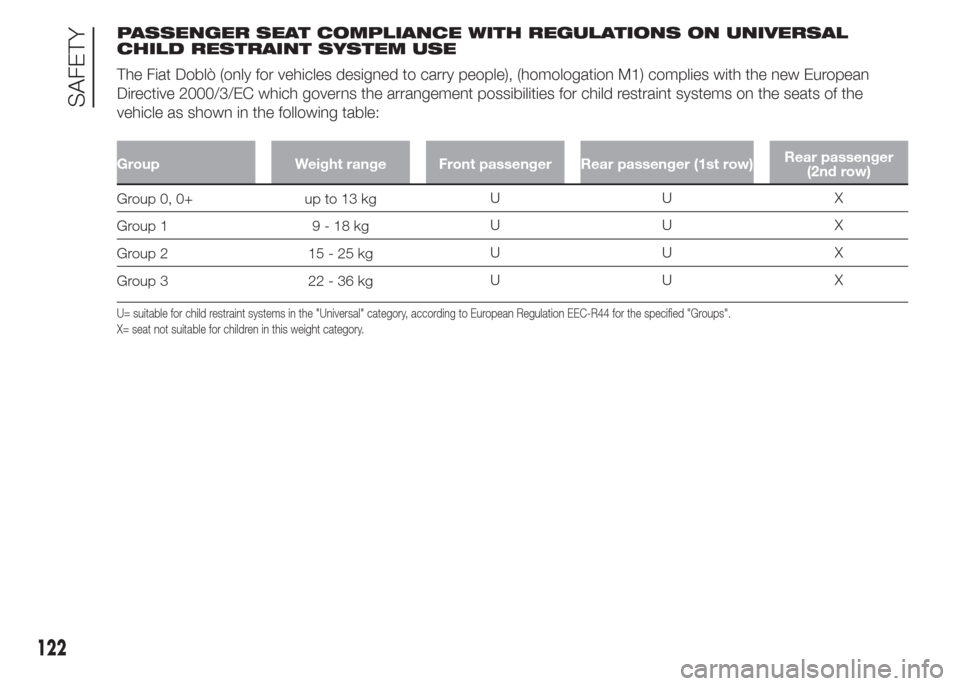
The Fiat Doblò (only for vehicles designed to carry people), (homologation M1) complies with the new European
Directive 2000/3/EC which governs the arrangement possibilities for child restraint systems on the seats of the
vehicle as shown in the following table:
Group Weight range Front passenger Rear passenger (1st row)Rear passenger
(2nd row)
Group 0, 0+ up to 13 kgUU X
Group 1 9 - 18 kgUU X
Group 2 15 - 25 kgUU X
Group 3 22 - 36 kgUU X
U= suitable for child restraint systems in the "Universal" category, according to European Regulation EEC-R44 for the specified "Groups".
X= seat not suitable for children in this weight category.
Page 128 of 323
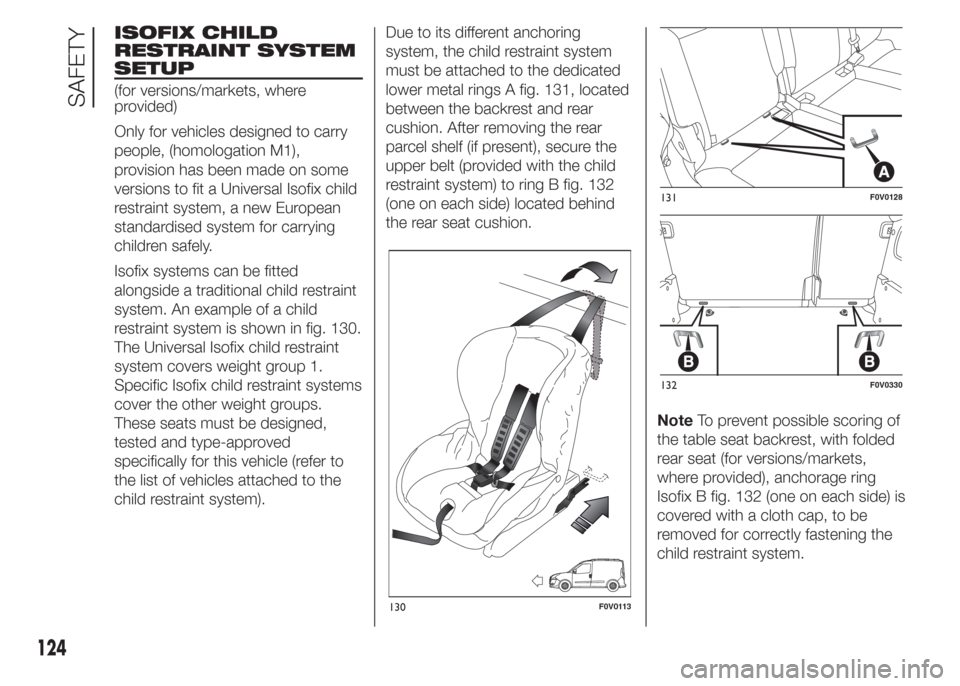
ISOFIX CHILD
RESTRAINT SYSTEM
SETUP
(for versions/markets, where
provided)
Only for vehicles designed to carry
people, (homologation M1),
provision has been made on some
versions to fit a Universal Isofix child
restraint system, a new European
standardised system for carrying
children safely.
Isofix systems can be fitted
alongside a traditional child restraint
system. An example of a child
restraint system is shown in fig. 130.
The Universal Isofix child restraint
system covers weight group 1.
Specific Isofix child restraint systems
cover the other weight groups.
These seats must be designed,
tested and type-approved
specifically for this vehicle (refer to
the list of vehicles attached to the
child restraint system).Due to its different anchoring
system, the child restraint system
must be attached to the dedicated
lower metal rings A fig. 131, located
between the backrest and rear
cushion. After removing the rear
parcel shelf (if present), secure the
upper belt (provided with the child
restraint system) to ring B fig. 132
(one on each side) located behind
the rear seat cushion.
NoteTo prevent possible scoring of
the table seat backrest, with folded
rear seat (for versions/markets,
where provided), anchorage ring
Isofix B fig. 132 (one on each side) is
covered with a cloth cap, to be
removed for correctly fastening the
child restraint system.
130F0V0113
131F0V0128
132F0V0330
124
SAFETY
Page 130 of 323
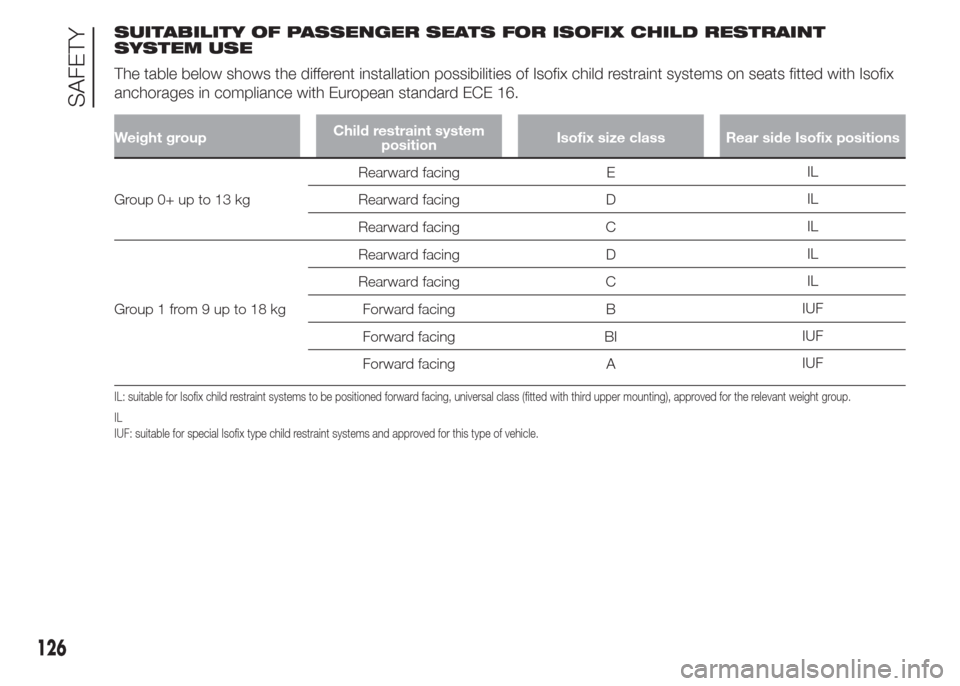
SUITABILITY OF PASSENGER SEATS FOR ISOFIX CHILD RESTRAINT
SYSTEM USE
The table below shows the different installation possibilities of Isofix child restraint systems on seats fitted with Isofix
anchorages in compliance with European standard ECE 16.
Weight groupChild restraint system
positionIsofix size class Rear side Isofix positions
Group 0+ up to 13 kgRearward facing EIL
Rearward facing DIL
Rearward facing CIL
Group1from9upto18kgRearward facing DIL
Rearward facing CIL
Forward facing BIUF
Forward facing BIIUF
Forward facing AIUF
IL: suitable for Isofix child restraint systems to be positioned forward facing, universal class (fitted with third upper mounting), approved for the relevant weight group.
IL
IUF: suitable for special Isofix type child restraint systems and approved for this type of vehicle.
126
SAFETY