brake fluid FIAT DOBLO COMBI 2016 2.G Owner's Manual
[x] Cancel search | Manufacturer: FIAT, Model Year: 2016, Model line: DOBLO COMBI, Model: FIAT DOBLO COMBI 2016 2.GPages: 298, PDF Size: 25.92 MB
Page 191 of 298
ENGINE OIL
Check the oil level a few minutes after
stopping the engine (about 5 minutes)
with the vehicle parked on level ground.
Check the level is within the MIN. and
MAX. marks on the dipstick B fig. 208 -
fig. 209 - fig. 210 - fig. 211 - fig. 213 -
fig. 214 - fig. 215.
The range between the MIN. and MAX.
marks corresponds to about 1 litre of
oil.
If the oil level is near or under the MIN
line, add oil through the filler Afig. 208 -
fig. 209 - fig. 210 - fig. 211 - fig. 213
- fig. 214 - fig. 215, until it reaches the
MAX line.
The oil level must never exceed the
MAX reference.
Engine oil consumption
The maximum engine oil consumption
is usually 400 grams every 1000 km.
The engine needs to run in when the
vehicle is new, and therefore the engine
oil consumption can only be considered
stabilised after the first 5,000 - 6,000
km.
IMPORTANT Oil consumption depends
on driving style and conditions of use
of the vehicle.
IMPORTANT After adding or changing
the oil, let the engine turn over for a few
seconds and wait a few minutes after
turning it off before checking oil level.137)
32)
2)
ENGINE COOLANT
The coolant level must be checked
when the engine is cold and must
range between the MIN and MAX
marks on the reservoir. If the level is
low, slowly pour a mixture of 50%
distilled water and 50% PARAFLU
UPby
PETRONAS LUBRICANTSthrough
the filler neck C fig. 208 - fig. 209 - fig.
210 - fig. 211 - fig. 213 - fig. 214 -
fig. 215, until the level approaches
MAX.
The mixture of 50% PARAFLU
UPand
50% distilled water protects against
freezing down to temperatures of
–35°C. For particularly harsh climate
conditions, we recommended using a
mixture of 60% PARAFLU
UPand 40%
distilled water.
33)
138)
WINDSCREEN/REAR
WINDOW WASHING FLUID
Remove the cap D fig. 208 - fig. 209 -
fig. 210 - fig. 211 - fig. 213 - fig. 214
- fig. 215, using the special tab, to add
fluid.
Use a mixture of water and TUTELA
PROFESSIONAL SC35 fluid, in the
following concentrations:
30% TUTELA PROFESSIONAL SC 35
and 70% water in summer.
50% TUTELA PROFESSIONAL SC 35
and 50% water in winter.
At temperatures below -20°C, use
undiluted TUTELA PROFESSIONAL SC
35 fluid.
Check fluid level through the reservoir.
Close cap D by pressing on the central
section.
139)
BRAKE FLUID
Undo cap E fig. 208 - fig. 209 - fig. 210
- fig. 211 - fig. 213 - fig. 214 - fig. 215
and check that the liquid in the reservoir
is at the maximum level.
The fluid level in the reservoir must not
exceed the MAX mark.
Use the brake fluid shown in the "Fluids
and lubricants" table (see "Technical
Specifications").
NB Carefully clean the reservoir cap E
and surrounding surfaces.
187
Page 192 of 298
Take great care to ensure that
impurities do not enter the reservoir
when the cap is opened.
For topping-up, always use a funnel
with integrated filter with mesh equal to
or lower than 0.12 mm.
IMPORTANT Brake fluid absorbs
moisture. For this reason, if the vehicle
is mainly used in areas with a high
degree of atmospheric humidity, the
fluid should be replaced at more
frequent intervals than specified in the
“Scheduled Servicing Plan”.
34)
140) 141)
POWER STEERING FLUID
Check that the oil level with the vehicle
on flat ground and the engine cold is
between the MIN and MAX marks
on the reservoir body G fig. 208 - fig.
209 - fig. 210 - fig. 211 - fig. 213 - fig.
214 - fig. 215.
The level may exceed the MAX mark
when the oil is hot.
If topping up is required, make sure the
oil you use has the same specifications
as that already in the system.
142)
3)
35)
WARNING
136)Never smoke while working in the
engine compartment: gas and inflammable
vapours may be present, with the risk of
fire.
137)When the engine is hot, take care
when working inside the engine
compartment to avoid burns. Remember
that when the engine is hot, the fan may
operate: danger of injury. Scarves, ties and
other loose clothing might be pulled by
moving parts.
138)The cooling system is pressurised. If
necessary, only replace the plug with
another original or the operation of the
system may be adversely affected. Do not
remove the reservoir plug when the engine
is hot: you risk scalding yourself.
139)Do not travel with the windscreen
washer fluid reservoir empty: the
windscreen washer is essential for
improving visibility. Some commercial
windscreen washer additives are
flammable. The engine compartment
contains hot components which may set it
on fire.
140)Brake fluid is poisonous and highly
corrosive. In the event of accidental
contact, immediately wash the affected
parts with water and mild soap. Then rinse
thoroughly. Call a doctor immediately if
swallowed.141)The symbol
, on the brake fluid
container indicates if a brake fluid is
synthetic or mineralbased. Using
a mineral-type fluid will damage the special
rubber seals of the braking system beyond
repair.
142)Prevent power steering fluid from
coming into contact with hot engine parts:
it is flammable.
WARNING
31)When topping up, take care not to mix
up the various types of fluids: they are
not compatible with each other and could
seriously damage the vehicle.
32)Do not add oil with specifications other
than those of the oil already existing in
the engine.
33)PARAFLU
UPanti-freeze is used in the
engine cooling system. Use the same
fluid as in the cooling system when topping
up. PARAFLU
UPcannot be mixed with
any other type of fluid. If this occurs, do not
start the engine and contact your Fiat
Dealership immediately.
34)Prevent brake fluid, which is highly
corrosive, from coming into contact with
painted parts. Should it happen,
immediately wash with water.
35)Do not press on the power steering
end of travel with engine on for more than
8 consecutive seconds, since noise is
produced and there is a risk of system
damages.
188
SERVICING AND CARE
Page 199 of 298
If a tyre is changed, also change the
inflation valve;
to allow even wear between the
front and rear tyres, it is advisable to
change them over every 10-15
thousand kilometres, keeping them on
the same side of the vehicle so as
not to reverse the direction of rotation.
149) 150) 151) 152)
WARNING
149)Remember that the road holding
qualities of your vehicle also depend on the
correct inflation pressure of the tyres.
150)If tyre pressure is too low, the tire may
overheat and be severely damaged as a
result.
151)Do not switch tyres from the
righthand side of the vehicle to the
lefthand side, and vice versa.
152)Never submit alloy rims to repainting
treatments requiring the use of
temperatures exceeding 150°C. The
mechanical properties of the wheels could
be impaired.
RUBBER HOSES
As far as the maintenance of the brake
system and fuel supply system rubber
hoses is concerned, follow the
"Scheduled Servicing Plan" in this
chapter carefully.
Ozone, high temperatures and
prolonged lack of fluid in the system
may cause hardening and cracking of
the hoses, with possible leaks. Careful
checking is therefore necessary.
PROLONGED
VEHICLE INACTIVITY
If the vehicle needs to be off the road
for longer than one month, the following
precautions must be taken:
park the vehicle indoors in a dry
and, if possible, well-ventilated place;
engage a gear and check that
the handbrake is not engaged;
disconnect the negative terminal
from the battery pole (see paragraph
“Vehicle inactivity” in the "Dashboard
and controls" chapter) and check
the charge conditions (see paragraph
“Battery” in the “Care and
maintenance” chapter);
clean and protect the painted parts
using protective wax;
clean and protect the shiny metal
parts using special compounds
available commercially;
sprinkle talcum powder on the
windscreen and rear window wiper
rubber blades and lift them off the
glass;
slightly open the windows;
cover the vehicle with a piece of
fabric or perforated plastic sheet. Do
not use compact plastic tarpaulins,
which prevent humidity from
evaporating from the surface of the
vehicle;
195
Page 203 of 298

TECHNICAL DATA
Everything you may find useful for
understanding how your vehicle
is made and works is contained in this
chapter and illustrated with data, tables
and graphics. For the enthusiasts and
the technician, but also just for those
who want to know every detail of their
vehicle.IDENTIFICATION DATA....................200
ENGINE CODES - BODYWORK
VERSIONS ......................................202
ENGINE ..........................................204
SUPPLY ..........................................207
TRANSMISSION .............................207
BRAKES .........................................207
SUSPENSION .................................208
STEERING ......................................208
WHEELS .........................................209
DIMENSIONS ..................................214
WEIGHTS........................................219
REFUELLING ..................................248
FLUIDS AND LUBRICANTS ............250
PERFORMANCE .............................253
FUEL CONSUMPTION ....................254
CO2 EMISSIONS ...........................268
OFFICIAL TYPE APPROVALS .........277
PRESCRIPTIONS FOR HANDLING
THE VEHICLE AT THE END OF ITS
LIFE ................................................278
199
Page 223 of 298
WEIGHTS
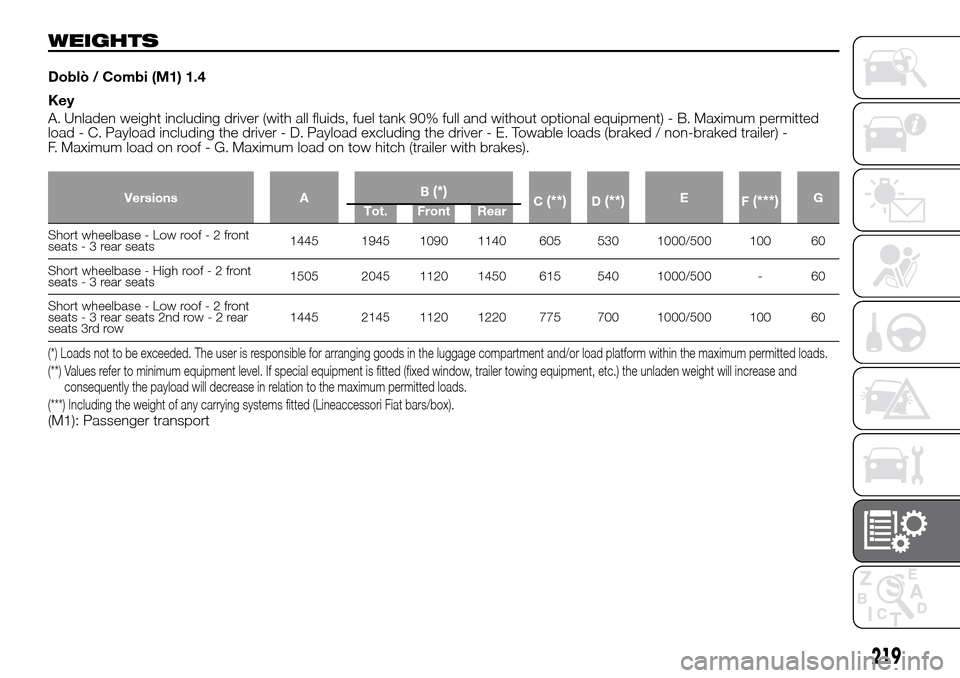
Doblò / Combi (M1) 1.4
Key
A. Unladen weight including driver (with all fluids, fuel tank 90% full and without optional equipment) - B. Maximum permitted
load - C. Payload including the driver - D. Payload excluding the driver - E. Towable loads (braked / non-braked trailer) -
F. Maximum load on roof - G. Maximum load on tow hitch (trailer with brakes).
Versions AB(*)C(**)D(**)E
F(***)G
Tot. Front Rear
Short wheelbase - Low roof-2front
seats-3rearseats1445 1945 1090 1140 605 530 1000/500 100 60
Short wheelbase - High roof-2front
seats-3rearseats1505 2045 1120 1450 615 540 1000/500 - 60
Short wheelbase - Low roof-2front
seats-3rearseats 2nd row-2rear
seats 3rd row1445 2145 1120 1220 775 700 1000/500 100 60
(*) Loads not to be exceeded. The user is responsible for arranging goods in the luggage compartment and/or load platform within the maximum permittedloads.
(**) Values refer to minimum equipment level. If special equipment is fitted (fixed window, trailer towing equipment, etc.) the unladen weight will increase and
consequently the payload will decrease in relation to the maximum permitted loads.
(***) Including the weight of any carrying systems fitted (Lineaccessori Fiat bars/box).
(M1): Passenger transport
219
Page 224 of 298

Doblò / Combi (M1) 1.4 T-JET
Key
A. Unladen weight including driver (with all fluids, fuel tank 90% full and without optional equipment) - B. Maximum permitted
load - C. Payload including the driver - D. Payload excluding the driver - E. Towable loads (braked / non-braked trailer) -
F. Maximum load on roof - G. Maximum load on tow hitch (trailer with brakes).
Versions AB(*)C(**)D(**)E
F(***)G
Tot. Front Rear
Short wheelbase - Low roof-2front
seats-3rearseats1490 2030 1090 1140 615 540 1000/500 100 60
Short wheelbase - Low roof-2front
seats-3rearseats 2nd row-2rear
seats 3rd row1490 2190 1120 1160 775 700 1000/500 100 60
(*) Loads not to be exceeded. The user is responsible for arranging goods in the luggage compartment and/or load platform within the maximum permittedloads.
(**) Values refer to minimum equipment level. If special equipment is fitted (fixed window, trailer towing equipment, etc.) the unladen weight will increase and
consequently the payload will decrease in relation to the maximum permitted loads.
(***) Including the weight of any carrying systems fitted (Lineaccessori Fiat bars/box).
(M1): Passenger transport
220
TECHNICAL DATA
Page 225 of 298

Doblò / Combi (M1) 1.6 Multijet
Key
A. Unladen weight including driver (with all fluids, fuel tank 90% full and without optional equipment) - B. Maximum permitted
load - C. Payload including the driver - D. Payload excluding the driver - E. Towable loads (braked / non-braked trailer) -
F. Maximum load on roof - G. Maximum load on tow hitch (trailer with brakes).
Versions AB(*)C(**)D(**)E
F(***)G
Tot. Front Rear
Short wheelbase - Low roof-2front
seats-3rearseats1505 2035 1090 1075 605 530 1300/500 100 60
Short wheelbase - High roof-2front
seats-3rearseats1575 2115 1120 1450 615 540 1300/500 - 60
Short wheelbase - Low roof-2front
seats-3rearseats 2nd row-2rear
seats 3rd row1505 2205 1120 1220 775 700 1300/500 100 60
Long wheelbase - Low roof-2front
seats-3rearseats1600 2105 1200 1310 580 505 1300/500 100 60
Long Wheelbase - High Roof - 2
front seats-3rearseats -
Reinforced Suspension1615 2105 1200 1310 565 490 1300/500 - 60
(*) Loads not to be exceeded. The user is responsible for arranging goods in the luggage compartment and/or load platform within the maximum permittedloads.
(**) Values refer to minimum equipment level. If special equipment is fitted (fixed window, trailer towing equipment, etc.) the unladen weight will increase and
consequently the payload will decrease in relation to the maximum permitted loads.
(***) Including the weight of any carrying systems fitted (Lineaccessori Fiat bars/box).
(M1): Passenger transport
221
Page 226 of 298

Doblò / Combi (M1) 2.0 Multijet
Key
A. Unladen weight including driver (with all fluids, fuel tank 90% full and without optional equipment) - B. Maximum permitted
load - C. Payload including the driver - D. Payload excluding the driver - E. Towable loads (braked / non-braked trailer) -
F. Maximum load on roof - G. Maximum load on tow hitch (trailer with brakes).
Versions AB(*)C(**)D(**)E
F(***)G
Tot. Front Rear
Short wheelbase - Low roof-2front
seats-3rearseats1555 2085 1130 1140 605 530 1500/500 100 60
Short wheelbase - High roof-2front
seats-3rearseats1615 2155 1120 1450 615 540 1500/500 - 60
Short wheelbase - Low roof-2front
seats-3rearseats 2nd row-2rear
seats 3rd row1555 2255 1120 1220 775 700 1500/500 100 60
Long wheelbase - Low roof-2front
seats-3rearseats1615 2105 1200 1450 565 490 1500/500 100 60
Long wheelbase - High roof-2front
seats-3rearseats1675 2215 1200 1450 615 540 1500/500 - 60
(*) Loads not to be exceeded. The user is responsible for arranging goods in the luggage compartment and/or load platform within the maximum permittedloads.
(**) Values refer to minimum equipment level. If special equipment is fitted (fixed window, trailer towing equipment, etc.) the unladen weight will increase and
consequently the payload will decrease in relation to the maximum permitted loads.
(***) Including the weight of any carrying systems fitted (Lineaccessori Fiat bars/box).
(M1): Passenger transport
222
TECHNICAL DATA
Page 227 of 298

Cargo 1.4
Key
A. Unladen weight including driver (with all fluids, fuel tank 90% full and without optional equipment) - B. Maximum permitted
load - C. Payload including the driver - D. Payload excluding the driver - E. Towable loads (braked / non-braked trailer) -
F. Maximum load on roof - G. Maximum load on tow hitch (trailer with brakes).
Versions AB(*)C(**)D(**)E
F(***)G
Tot. Front Rear
Short wheelbase - Low roof-2front
seats1355 1850 1090 1140 570
495
(°)1000/500 100 60
1355 2030 1090 1140 750 675 1000/500 100 60
1355 2210 1090 1450 930
855
(°°)1000/500 100 60
Short wheelbase - High roof-2front
seats1365 1860 1090 1140 570
495
(°)1000/500 - 60
1365 2040 1090 1160 750 675 1000/500 - 60
1360 2215 1090 1450 930
855
(°°)1000/500 - 60
(*) Loads not to be exceeded. The user is responsible for arranging goods in the luggage compartment and/or load platform within the maximum permittedloads.
(**) Values refer to minimum equipment level. If special equipment is fitted (fixed window, trailer towing equipment, etc.) the unladen weight will increase and
consequently the payload will decrease in relation to the maximum permitted loads.
(***) Including the weight of any carrying systems fitted (Lineaccessori Fiat bars/box).
(°) Reduced payload
(°°) Increased payload
223
Page 229 of 298

Combi 1.4
Key
A. Unladen weight including driver (with all fluids, fuel tank 90% full and without optional equipment) - B. Maximum permitted
load - C. Payload including the driver - D. Payload excluding the driver - E. Towable loads (braked / non-braked trailer) -
F. Maximum load on roof - G. Maximum load on tow hitch (trailer with brakes).
Versions AB(*)C(**)D(**)E
F(***)G
Tot. Front Rear
Short wheelbase - Low roof-2front
seats-3rearseats1425 2084 1090 1450 734 659 1000/500 100 60
1435 2184 1090 1450 824
749
(°°)1000/500 100 60
Long wheelbase - Low roof-2front
seats-3rearseats1466 2215 1090 1450 824 749 1000/500 100 60
(*) Loads not to be exceeded. The user is responsible for arranging goods in the luggage compartment and/or load platform within the maximum permittedloads.
(**) Values refer to minimum equipment level. If special equipment is fitted (fixed window, trailer towing equipment, etc.) the unladen weight will increase and
consequently the payload will decrease in relation to the maximum permitted loads.
(***) Including the weight of any carrying systems fitted (Lineaccessori Fiat bars/box).
(°°) Increased payload
225