air condition FIAT DOBLO COMBI 2017 2.G User Guide
[x] Cancel search | Manufacturer: FIAT, Model Year: 2017, Model line: DOBLO COMBI, Model: FIAT DOBLO COMBI 2017 2.GPages: 300, PDF Size: 24.91 MB
Page 97 of 300
Warning lights on
panelWhat it means What to do
Fuel cut-off system failure
Parking sensor failure.
Start&Stop system failureGo to a Fiat Dealership to have the fault fixed as soon
as possible.
The warning light turns on and flashes to indicate a failure
of the
warning light. In this case, thewarning light
may not indicate a possible problem with the airbag
restraint system.Before continuing, contact a Fiat Dealership to have
the system checked immediately.
Warning lights on
panelWhat it means What to do
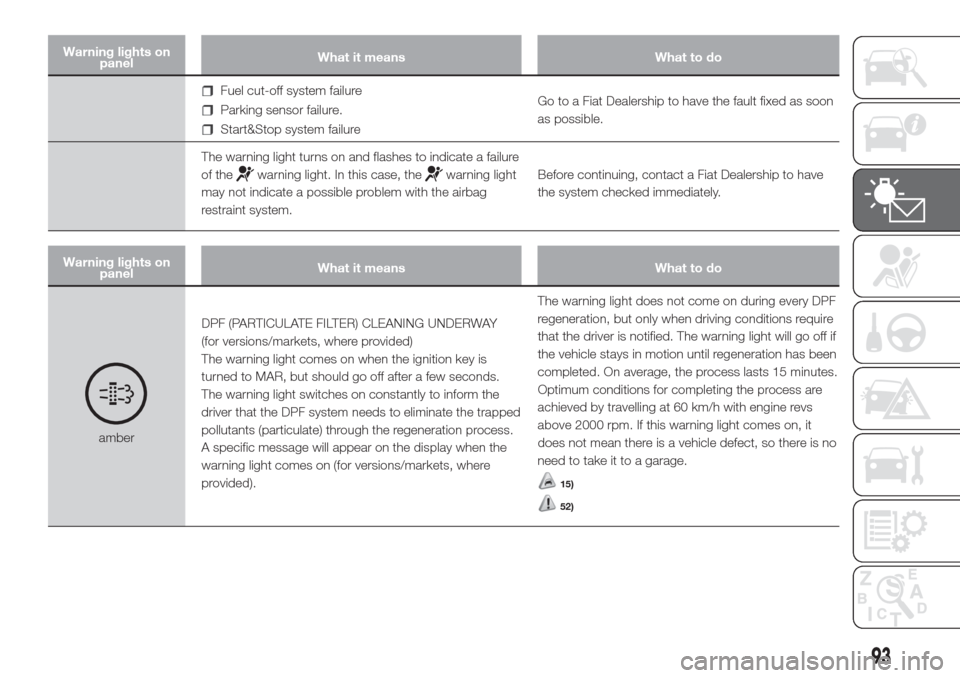
amberDPF (PARTICULATE FILTER) CLEANING UNDERWAY
(for versions/markets, where provided)
The warning light comes on when the ignition key is
turned to MAR, but should go off after a few seconds.
The warning light switches on constantly to inform the
driver that the DPF system needs to eliminate the trapped
pollutants (particulate) through the regeneration process.
A specific message will appear on the display when the
warning light comes on (for versions/markets, where
provided).The warning light does not come on during every DPF
regeneration, but only when driving conditions require
that the driver is notified. The warning light will go off if
the vehicle stays in motion until regeneration has been
completed. On average, the process lasts 15 minutes.
Optimum conditions for completing the process are
achieved by travelling at 60 km/h with engine revs
above 2000 rpm. If this warning light comes on, it
does not mean there is a vehicle defect, so there is no
need to take it to a garage.
15)
52)
93
Page 139 of 300
The TPMS uses wireless devices with
electronic sensors mounted on the
wheel rims to constantly monitor the
value of tyre pressure. The sensors
mounted on each wheel as part of the
valve stem transmit various information
of the tyres to the receiver module, in
order to calculate the pressure.
IMPORTANT Monitoring and
maintaining the correct pressure in all
four tyres are particularly important.
Tyre pressure monitoring system
low pressure warning
The system warns the driver if one or
more tyres are flat by switching on
the warning light
on the instrument
panel (together with a warning message
and an acoustic signal).The TPMS continues to advise the
driver of the low tyre pressure condition
until this is corrected; the warning
continues until the pressure
corresponds or exceeds the pressure
prescribed for the cold tyres. When the
tyre low pressure control warning
light
switches on constantly, the
inflation pressure must be adjusted until
it reaches the pressure prescribed for
cold tyres. After the automatic update
of the system, the tyre pressure control
warning light switches off. You may
need to drive the vehicle for about 20
minutes at a speed higher than 20
km/h to allow the TPMS to receive this
information.
IMPORTANT In the case of deflation of
more than one tyre sequentially, without
switching off and on the engine, from
the second tyre involved the acoustic
signal is not activated, only the
dedicated signal is shown on the
display.
To prevent the signal from being stored
in the event of pressure loss of a
subsequent tyre (with deactivation of
the acoustic signal), the ignition key
must be turned to MAR and then to
STOP, each time pressure is restored.TPMS operation faults
The system fault is indicated by
warning light
which first flashes for
75 seconds and then stays on steadily.
This can occur in any of the following
situations:
interference caused by electronic
devices or radio frequency emissions
similar to those of the TPM sensors.
Application of tinted films which
interfere with the signals of the radio
waves.
Presence of snow or ice on the
wheels or the wheel arches.
Use of snow chains.
Use of wheels/tyres not equipped
with TPM sensors.
The space-saver wheel is not
equipped with the tyre pressure control
sensor. Therefore, the tyre pressure is
not controlled by the system.
NOTE The vehicle may be equipped
with FiX&Go Automatic tyre repair
kit, space-saver wheel or full size spare
wheel (with or without original TPMS
sensor to measure tyre pressure).
After the punctured tyre has been
repaired with the original tyre sealant
contained in the FiX&Go Automatic tyre
repair kit, the previous condition must
be restored, so that the
warning
light is off during normal driving.
135
Page 140 of 300
Space-saver wheel (for versions/
markets, where provided): the
space-saver wheel is not equipped with
a TPMS sensor. Once fitted, while
driving normally, the warning light
comes on (flashing for about 75
seconds, and then constantly). This
condition lasts until a wheel equipped
with an original TPMS sensor is fitted
on the vehicle.
Normal spare wheel (without TPMS
sensor): once fitted, while driving
normally, the
warning light comes on
(flashing for about 75 seconds, and
then constantly). This condition lasts
until a wheel equipped with an original
TPMS sensor is fitted on the vehicle.
The system is then restored and the
warning light switches off.
Normal spare wheel (with TPMS
sensor): once fitted, while driving
normally, the
warning light switches
off.
IMPORTANT In all the above-mentioned
cases, it is advisable to check the
spare wheel tyre pressure before
starting driving.
NOTE If the tyres are replaced, driving
the vehicle for short stretches, some
time might be needed before the
system is restored.IMPORTANT
WARNING
103)The TPMS is optimised for the
original tyres and wheels provided. TPMS
pressures and alerts have been defined
according to the size of the tyres mounted
on the vehicle. Using equipment with
different size, type or kind may cause
irregular system operation or sensor
damage. Non-original spare wheels can
damage the sensor. Do not use tyre
sealant or balancing weights if the vehicle
is equipped with TPMS as these may
damage the sensors.
104)If the system signals a pressure
decrease on a specific tyre, it is
recommended to check the pressure on all
four tyres.
105)TPMS does not relieve the driver from
the obligation to check the tyre pressure
every month; it is not to be considered
a replacing system for maintenance or a
safety system.
106)Tyre pressure must be checked with
tyres cold. Should it become necessary for
whatever reason to check pressure with
warm tyres, do not reduce pressure even if
it is higher than the prescribed value, but
repeat the check when tyres are cold.
107)The TPMS cannot indicate sudden
tyre pressure drops (for example when
a tyre bursts). In this case, stop the vehicle,
braking with caution and avoiding abrupt
steering.108)The system only warns that the tyre
pressure is low: it is not able to inflate
them.
109)Insufficient tyre inflation increases fuel
consumption, reduces the tread duration
and may affect the capacity to drive safely.
110)Always refit the valve stem cap after
inspecting or adjusting tyre pressure.
This prevents dampness or dirt from
entering the valve stem and thus
the pressure control sensor from being
damaged.
111)The tyre repair kit (Fix&Go) provided
with the vehicle (for versions/markets,
where provided) is compatible with the
TPMS sensors; using sealants not
equivalent with that in the original kit may
adversely affect its operation. If sealants
not equivalent with the original one are
used, it is recommended to have the
TPMS sensor operation checked by a
qualified repair centre.
136
STARTING AND DRIVING
Page 147 of 300
WARNING
22)For diesel engines, use only diesel fuel
for motor vehicles in accordance with
EN590 European specifications. The use of
other products or mixtures may damage
the engine beyond repair and
consequently invalidate the warranty, due
to the damage caused. If you accidentally
introduce other types of fuel into the tank,
do not start the engine. Empty the tank.
If the engine has been run for even an
extremely limited amount of time, you must
not only drain the fuel tank, but the rest of
the supply circuit as well.
23)Do not approach naked flames or lit
cigarettes to the fuel tank filler: fire risk.
Keep your face away from the fuel filler to
prevent breathing in harmful vapours.
SAVING FUEL
Some useful tips are given below for
fuel saving and reducing harmful
emissions of CO2 and other pollutants
(nitrogen oxides, unburnt
hydrocarbons, Particulate Matter (PM),
etc.).
PRACTICAL ADVICE FOR
REDUCING FUEL
CONSUMPTION AND
HARMFUL EMISSIONS
Vehicle conditions
Have checks and adjustments for
vehicle maintenancecarried out
in accordance with the “Scheduled
servicing plan”.
Checktyrepressure regularly, at
least once every four weeks.
Excessively low pressures will increase
consumption because rolling resistance
will be higher. In addition, this wears
the tyre more quickly and impairs
performance.
Only usesnow tyreswhen the
weather conditions make them
absolutely necessary. They increase
consumption and noise.
Do not travel witha heavy load: the
weight of the vehicle (especially when
driving in town) and its geometry greatly
affect fuel consumption and stability.
Removeroof racks or ski racks
after use. These accessories reduce the
vehicle's aerodynamic penetration and
have a negative effect on fuel
consumption.
When transporting particularly large
objects, use atrailerif possible.
Use the vehicle's air vents if
possible: travelling with the windows
open impairs aerodynamics.
Use electrical devices only for the
amount of time needed. The vehicle’s
heated rear window, additional
headlights, screen wipers and heater
fan require a considerable amount
of energy; this increases fuel
consumption (by up to +25% in an
urban cycle).
Air conditioning leads to higher fuel
consumption (on average up to +30%).
If the temperature outside is not too
extreme, try and use the air vents.
Driving style
Afterstarting the engineyou
should drive away immediately and
slowly, avoiding high revs. Do not warm
up the engine at low or high revs when
the vehicle is stationary; this causes
the engine to warm up more slowly,
thereby increasing fuel consumption,
emissions and mechanical component
wear.
143
Page 166 of 300
CHANGING A WHEEL
The vehicle is originally equipped with
the Fix&Go automatic quick tyre repair
kit (see instructions in the next section).
As an alternative, the vehicle may
have a normal-sized spare wheel.
Wheel changing and correct use of the
jack and spare wheel call for some
precautions, as listed below.
125) 126) 127) 128)
Note for one-way tyres
One-way tyres have a few arrows on
the side indicating the rotation direction.
If a wheel is changed (when punctured,
for example) the direction of the arrows
on the spare wheel tyre may not
coincide with the rotation direction of
the wheel to be replaced.
In these conditions, too, the tyre still
maintains its safety features.
Anyway, it is recommended to have the
wheel repaired and refitted as soon as
possible, as the best performance is
achieved when the rotation direction of
all tyres coincides with the one
indicated by the arrows.
Please note that:
the jack weight is 4 kg;
the jack requires no adjustment;
the jack cannot be repaired and in
the event of a fault it must be replaced
by another original one;
no tool other than its cranking
device may be fitted on the jack.
To change a wheel, proceed as follows:
stop the vehicle in a position that is
not dangerous for oncoming traffic
where you can change the wheel safely.
The ground should be flat if possible,
and sufficiently firm;
stop the engine and pull the
handbrake;
engage first gear or reverse;
wear the reflective safety jacket
(compulsory by law in certain countries)
before getting out of the vehicle;
indicate that the vehicle has broken
down using the devices required by
the law in the current country (e.g.
warning triangle, hazard lights, etc.);
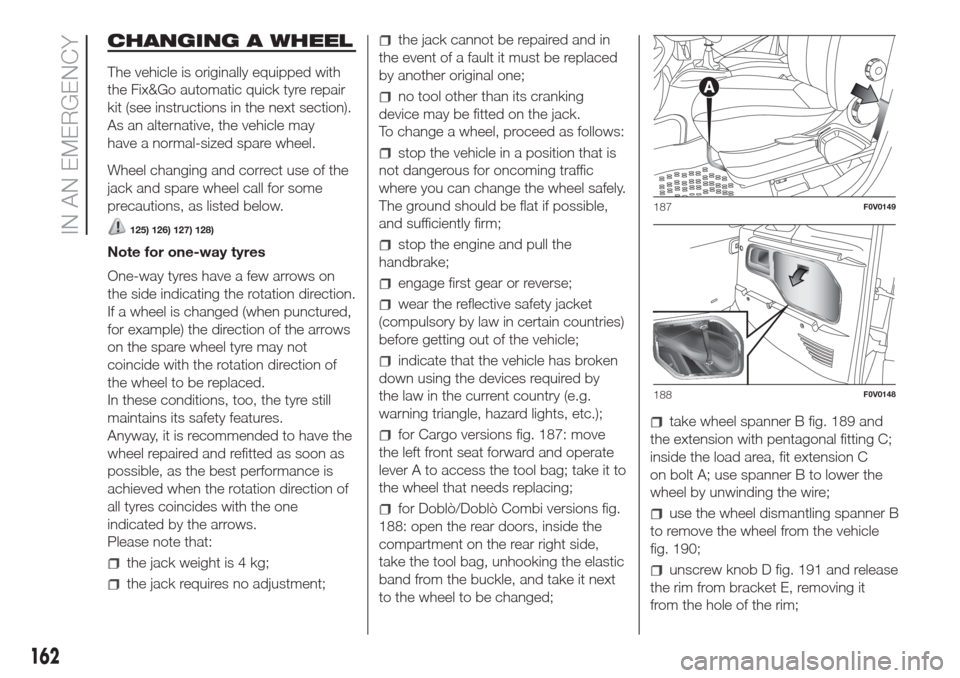
for Cargo versions fig. 187: move
the left front seat forward and operate
lever A to access the tool bag; take it to
the wheel that needs replacing;
for Doblò/Doblò Combi versions fig.
188: open the rear doors, inside the
compartment on the rear right side,
take the tool bag, unhooking the elastic
band from the buckle, and take it next
to the wheel to be changed;
take wheel spanner B fig. 189 and
the extension with pentagonal fitting C;
inside the load area, fit extension C
on bolt A; use spanner B to lower the
wheel by unwinding the wire;
use the wheel dismantling spanner B
to remove the wheel from the vehicle
fig. 190;
unscrew knob D fig. 191 and release
the rim from bracket E, removing it
from the hole of the rim;
187F0V0149
188F0V0148
162
IN AN EMERGENCY
Page 172 of 300
CARTRIDGE
REPLACEMENT
Proceed as follows:
only use Fix&Go original cartridges,
which can be purchased at the
Dealership.
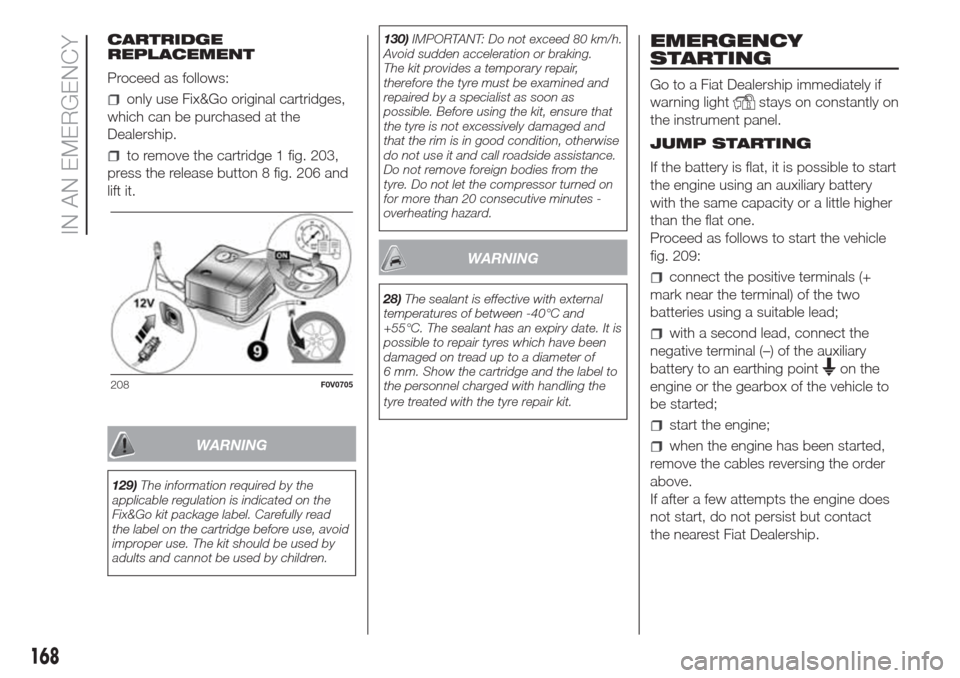
to remove the cartridge 1 fig. 203,
press the release button 8 fig. 206 and
lift it.
WARNING
129)The information required by the
applicable regulation is indicated on the
Fix&Go kit package label. Carefully read
the label on the cartridge before use, avoid
improper use. The kit should be used by
adults and cannot be used by children.130)IMPORTANT: Do not exceed 80 km/h.
Avoid sudden acceleration or braking.
The kit provides a temporary repair,
therefore the tyre must be examined and
repaired by a specialist as soon as
possible. Before using the kit, ensure that
the tyre is not excessively damaged and
that the rim is in good condition, otherwise
do not use it and call roadside assistance.
Do not remove foreign bodies from the
tyre. Do not let the compressor turned on
for more than 20 consecutive minutes -
overheating hazard.
WARNING
28)The sealant is effective with external
temperatures of between -40°C and
+55°C. The sealant has an expiry date. It is
possible to repair tyres which have been
damaged on tread up to a diameter of
6 mm. Show the cartridge and the label to
the personnel charged with handling the
tyre treated with the tyre repair kit.
EMERGENCY
STARTING
Go to a Fiat Dealership immediately if
warning light
stays on constantly on
the instrument panel.
JUMP STARTING
If the battery is flat, it is possible to start
the engine using an auxiliary battery
with the same capacity or a little higher
than the flat one.
Proceed as follows to start the vehicle
fig. 209:
connect the positive terminals (+
mark near the terminal) of the two
batteries using a suitable lead;
with a second lead, connect the
negative terminal (–) of the auxiliary
battery to an earthing point
on the
engine or the gearbox of the vehicle to
be started;
start the engine;
when the engine has been started,
remove the cables reversing the order
above.
If after a few attempts the engine does
not start, do not persist but contact
the nearest Fiat Dealership.
208F0V0705
168
IN AN EMERGENCY
Page 178 of 300
SCHEDULED
SERVICING
Correct servicing is essential for
ensuring long vehicle life under the best
conditions.
This is why Fiat has planned a series of
checks and services every 30,000/
35,000 km (depending on the version).
It is, however, important to remember
that scheduled servicing does not
completely cover all the vehicle's
requirements: even in the initial period
before 30,000/35,000 km, and then
subsequently between one service and
another, ordinary care is always
required such as routine checks
involving topping up fluid levels,
checking tyre pressures etc...
IMPORTANT Scheduled Servicing
Coupons are required by the
manufacturer. Failure to have them
carried out may invalidate the warranty.
Scheduled Servicing can be carried
out by any Fiat Dealership, at
pre-established times.
If during each operation, in addition to
the ones scheduled, the need arises for
further replacements or repairs, these
may only be carried out with the
express agreement of the Customer.IMPORTANT It is advisable to contact a
Fiat Dealership in the event of any
minor operating failure, without waiting
for the next service coupon.
If your vehicle is used frequently for
trailer towing, the interval between
scheduled maintenance services must
be reduced.
174
SERVICING AND CARE
Page 179 of 300
SERVICE SCHEDULE
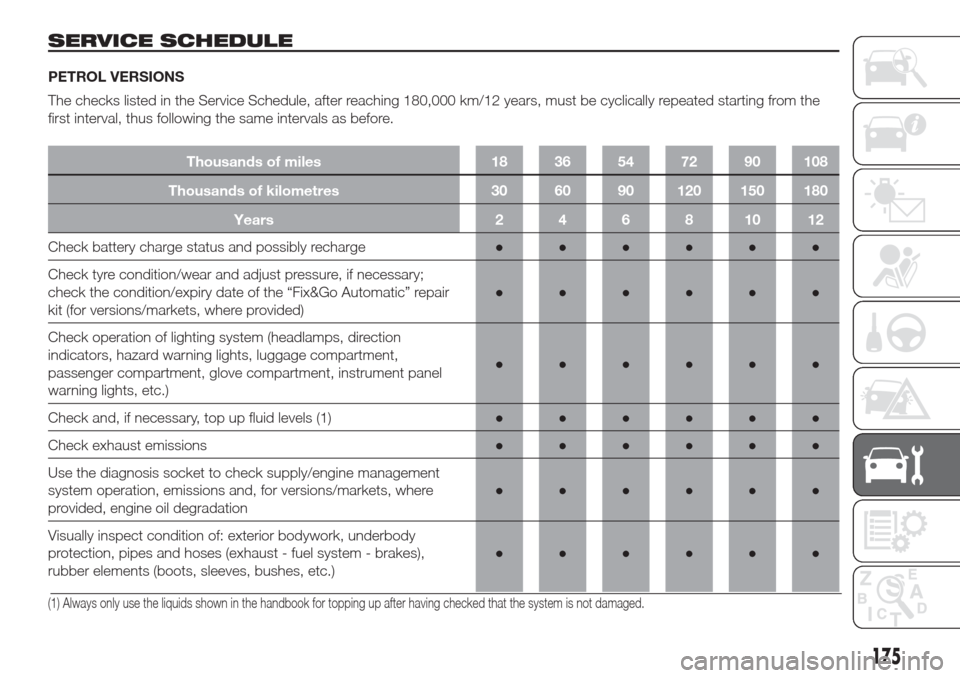
PETROL VERSIONS
The checks listed in the Service Schedule, after reaching 180,000 km/12 years, must be cyclically repeated starting from the
first interval, thus following the same intervals as before.
Thousands of miles 18 36 54 72 90 108
Thousands of kilometres 30 60 90 120 150 180
Years 2 4 6 8 10 12
Check battery charge status and possibly recharge●●●●●●
Check tyre condition/wear and adjust pressure, if necessary;
check the condition/expiry date of the “Fix&Go Automatic” repair
kit (for versions/markets, where provided)●●●●●●
Check operation of lighting system (headlamps, direction
indicators, hazard warning lights, luggage compartment,
passenger compartment, glove compartment, instrument panel
warning lights, etc.)●●●●●●
Check and, if necessary, top up fluid levels (1)●●●●●●
Check exhaust emissions●●●●●●
Use the diagnosis socket to check supply/engine management
system operation, emissions and, for versions/markets, where
provided, engine oil degradation●●●●●●
Visually inspect condition of: exterior bodywork, underbody
protection, pipes and hoses (exhaust - fuel system - brakes),
rubber elements (boots, sleeves, bushes, etc.)●●●●●●
(1) Always only use the liquids shown in the handbook for topping up after having checked that the system is not damaged.
175
Page 182 of 300
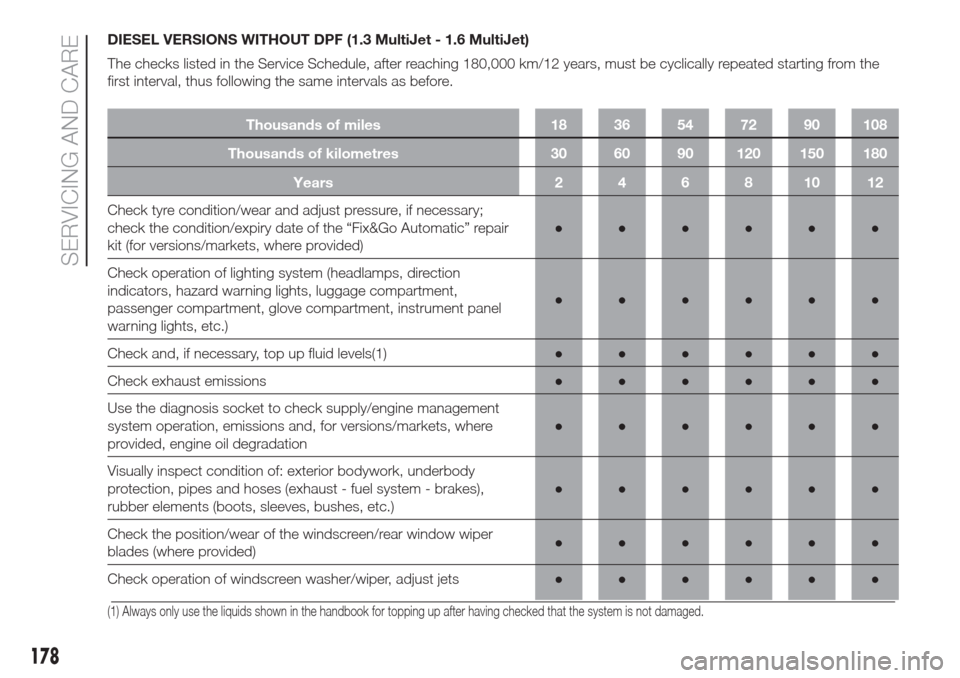
DIESEL VERSIONS WITHOUT DPF (1.3 MultiJet - 1.6 MultiJet)
The checks listed in the Service Schedule, after reaching 180,000 km/12 years, must be cyclically repeated starting from the
first interval, thus following the same intervals as before.
Thousands of miles 18 36 54 72 90 108
Thousands of kilometres 30 60 90 120 150 180
Years 2 4 6 8 10 12
Check tyre condition/wear and adjust pressure, if necessary;
check the condition/expiry date of the “Fix&Go Automatic” repair
kit (for versions/markets, where provided)●●●●●●
Check operation of lighting system (headlamps, direction
indicators, hazard warning lights, luggage compartment,
passenger compartment, glove compartment, instrument panel
warning lights, etc.)●●●●●●
Check and, if necessary, top up fluid levels(1)●●●●●●
Check exhaust emissions●●●●●●
Use the diagnosis socket to check supply/engine management
system operation, emissions and, for versions/markets, where
provided, engine oil degradation●●●●●●
Visually inspect condition of: exterior bodywork, underbody
protection, pipes and hoses (exhaust - fuel system - brakes),
rubber elements (boots, sleeves, bushes, etc.)●●●●●●
Check the position/wear of the windscreen/rear window wiper
blades (where provided)●●●●●●
Check operation of windscreen washer/wiper, adjust jets●●●●●●
(1) Always only use the liquids shown in the handbook for topping up after having checked that the system is not damaged.
178
SERVICING AND CARE
Page 183 of 300
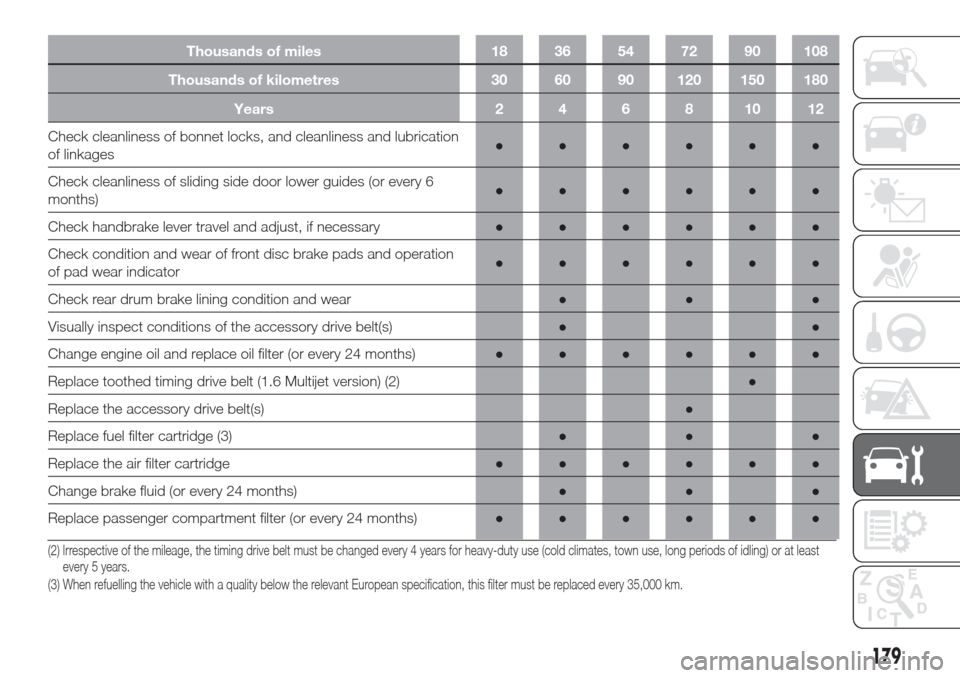
Thousands of miles 18 36 54 72 90 108
Thousands of kilometres 30 60 90 120 150 180
Years 2 4 6 8 10 12
Check cleanliness of bonnet locks, and cleanliness and lubrication
of linkages●●●●●●
Check cleanliness of sliding side door lower guides (or every 6
months)●●●●●●
Check handbrake lever travel and adjust, if necessary●●●●●●
Check condition and wear of front disc brake pads and operation
of pad wear indicator●●●●●●
Check rear drum brake lining condition and wear●●●
Visually inspect conditions of the accessory drive belt(s)●●
Change engine oil and replace oil filter (or every 24 months)●●●●●●
Replace toothed timing drive belt (1.6 Multijet version) (2)●
Replace the accessory drive belt(s)●
Replace fuel filter cartridge (3)●●●
Replace the air filter cartridge●●●●●●
Change brake fluid (or every 24 months)●●●
Replace passenger compartment filter (or every 24 months)●●●●●●
(2) Irrespective of the mileage, the timing drive belt must be changed every 4 years for heavy-duty use (cold climates, town use, long periods of idling) or at least
every 5 years.
(3) When refuelling the vehicle with a quality below the relevant European specification, this filter must be replaced every 35,000 km.
179