fuel consumption FIAT DOBLO COMBI 2017 2.G User Guide
[x] Cancel search | Manufacturer: FIAT, Model Year: 2017, Model line: DOBLO COMBI, Model: FIAT DOBLO COMBI 2017 2.GPages: 300, PDF Size: 24.91 MB
Page 148 of 300
Avoidpointless actionssuch as
revving up when at traffic lights or
before stopping the engine. The latter
action, like double-declutching, is
unnecessary and causes increased fuel
consumption and pollution.
Gear selection:select a high gear
as soon as possible (taking into
account normal engine operation and
traffic conditions) without pushing
the engine to high revs during
the intermediate gears. Using low gears
at high revs to get lively acceleration
increases fuel consumption, harmful
emissions and engine wear.
Vehicle speed:fuel consumption
increases exponentially as the speed of
the vehicle increases. Keep your speed
moderate and as even as possible,
avoiding unnecessary braking and
acceleration, which cause excessive
fuel consumption and increased
emissions. Keeping a safe distance
from the vehicle in front helps to
maintain a steady speed.
Acceleration:accelerating violently
severely affects consumption and
emissions. Acceleration should be
gradual and should not exceed the
maximum engine torque rate.CONDITIONS OF USE
Cold starting
Short journeys and frequent cold starts
do not allow the engine to reach
optimum operating temperature.
This results in a significant increase in
consumption levels (from +15 to +30%
on the urban cycle) and emissions.
Traffic and road conditions
Rather high consumption levels are
linked to situations with heavy traffic, for
instance when travelling in queues
with frequent use of the lower gears or
in cities with many traffic lights. Winding
mountain roads and rough road
surfaces also adversely affect
consumption.
Stops in traffic
During prolonged hold-ups (e.g. level
crossings) the engine should be
switched off.
TOWING TRAILERS
IMPORTANT
The vehicle must be equipped with a
type-approved tow hook and adequate
electrical system to tow trailers.
Installation should be carried out by
specialised personnel who will issue the
required papers for travelling on roads.
Install any specific and/or additional
door mirrors as specified by the
Highway Code.
Remember that when towing a trailer,
steep hills are harder to climb, braking
spaces increase and overtaking takes
longer depending on the overall weight.
Engage a low gear when driving
downhill, rather than constantly using
the brake.
The weight of the trailer on the vehicle
tow hook will reduce the loading
capacity of the vehicle by the same
amount.
To make sure that the maximum
towable weight is not exceeded (given
in the vehicle registration document)
account should be taken of the fully
laden trailer, including accessories and
luggage.
Do not exceed the speed limits specific
to each country you are driving in, in
the case of vehicles towing trailers.
In any case, the top speed must not
exceed 80 km/h.
144
STARTING AND DRIVING
116) 117)
Page 198 of 300
WARNING
4)Used engine oil and oil filters contain
substances which are harmful to the
environment. Contact a Fiat Dealership to
have the oil and filters changed. They
are equipped to dispose of the used oil
and filters respecting nature and the law.
5)Power steering fluid consumption is
extremely low; if another top-up is required
after only a short period of time, have the
system checked for leaks at a Fiat
Dealership.
AIR CLEANER/
POLLEN FILTER
Have the air cleaner or the pollen filter
replaced by a Fiat Dealership.
DIESEL FILTER
DRAINING
CONDENSATION
(MultiJet versions)
36)
WARNING
36)The presence of water in the supply
circuit may cause severe damage to the
injection system and irregular engine
operation. If the
warning light comes
on, go to a Fiat Dealership as soon as
possible to have the system bled. If this
problem is indicated immediately after
refuelling, water may have entered the fuel
tank. In this case, immediately turn off
the engine and contact a Fiat Dealership.
194
SERVICING AND CARE
Page 209 of 300
TECHNICAL DATA
Everything you may find useful for
understanding how your vehicle
is made and works is contained in this
chapter and illustrated with data, tables
and graphics. For the enthusiasts and
the technician, but also just for those
who want to know every detail of their
vehicle.IDENTIFICATION DATA....................206
ENGINE CODES - BODYWORK
VERSIONS ......................................208
ENGINE ..........................................210
SUPPLY ..........................................213
TRANSMISSION .............................213
BRAKES .........................................213
SUSPENSION .................................214
STEERING ......................................214
WHEELS .........................................215
DIMENSIONS ..................................220
WEIGHTS........................................225
REFUELLING ..................................254
FLUIDS AND LUBRICANTS ............256
PERFORMANCE .............................259
FUEL CONSUMPTION ....................260
CO2 EMISSIONS ...........................272
OFFICIAL TYPE APPROVALS .........281
PRESCRIPTIONS FOR HANDLING
THE VEHICLE AT THE END OF ITS
LIFE ................................................284
205
Page 260 of 300
FLUIDS AND LUBRICANTS
Your vehicle is equipped with an engine oil that has been thoroughly developed and tested in order to meet the requirements of
the Service Schedule. Constant use of the prescribed lubricants guarantees the fuel consumption and emission specifications.
Lubricant quality is crucial for engine operation and duration.
RECOMMENDED PRODUCTS AND THEIR SPECIFICATIONS
Use Features SpecificationOriginal fluids and
lubricantsReplacement interval
Lubricants for petrol
enginesSAE 5W-40
ACEA C3 / API SN9.55535-S2.SELENIA K P.E.
Contractual Technical
Reference N° F603.C07According to Service
Schedule
Diesel engine lubricants
41)
SAE 5W-30
ACEA C29.55535-S1.SELENIA WR P.E.
Contractual Technical
Reference No. F510.D07According to Service
Schedule
Lubricants for Euro 6
diesel engines
41)SAE 0W-30
ACEA C29.55535-DS1 or
MS90047.SELENIA WR
FORWARD
Contractual Technical
Reference No. F842.F13According to Service
Schedule
If lubricants conforming to the specific request are not available, products that meet the indicated specifications can be used to
top up; in this case optimal performance of the engine is not guaranteed.
256
TECHNICAL DATA
WARNING
41)The use of products with specifications other than those indicated above could cause damage to the engine not covered by the warranty.
Page 264 of 300
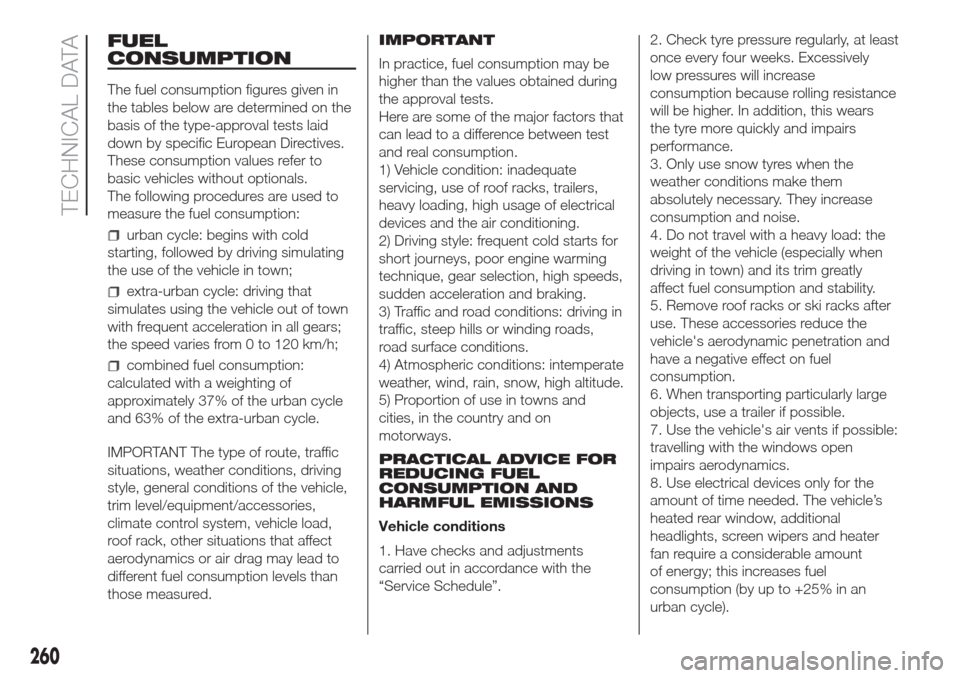
FUEL
CONSUMPTION
The fuel consumption figures given in
the tables below are determined on the
basis of the type-approval tests laid
down by specific European Directives.
These consumption values refer to
basic vehicles without optionals.
The following procedures are used to
measure the fuel consumption:
urban cycle: begins with cold
starting, followed by driving simulating
the use of the vehicle in town;
extra-urban cycle: driving that
simulates using the vehicle out of town
with frequent acceleration in all gears;
the speed varies from 0 to 120 km/h;
combined fuel consumption:
calculated with a weighting of
approximately 37% of the urban cycle
and 63% of the extra-urban cycle.
IMPORTANT The type of route, traffic
situations, weather conditions, driving
style, general conditions of the vehicle,
trim level/equipment/accessories,
climate control system, vehicle load,
roof rack, other situations that affect
aerodynamics or air drag may lead to
different fuel consumption levels than
those measured.IMPORTANT
In practice, fuel consumption may be
higher than the values obtained during
the approval tests.
Here are some of the major factors that
can lead to a difference between test
and real consumption.
1) Vehicle condition: inadequate
servicing, use of roof racks, trailers,
heavy loading, high usage of electrical
devices and the air conditioning.
2) Driving style: frequent cold starts for
short journeys, poor engine warming
technique, gear selection, high speeds,
sudden acceleration and braking.
3) Traffic and road conditions: driving in
traffic, steep hills or winding roads,
road surface conditions.
4) Atmospheric conditions: intemperate
weather, wind, rain, snow, high altitude.
5) Proportion of use in towns and
cities, in the country and on
motorways.
PRACTICAL ADVICE FOR
REDUCING FUEL
CONSUMPTION AND
HARMFUL EMISSIONS
Vehicle conditions
1. Have checks and adjustments
carried out in accordance with the
“Service Schedule”.2. Check tyre pressure regularly, at least
once every four weeks. Excessively
low pressures will increase
consumption because rolling resistance
will be higher. In addition, this wears
the tyre more quickly and impairs
performance.
3. Only use snow tyres when the
weather conditions make them
absolutely necessary. They increase
consumption and noise.
4. Do not travel with a heavy load: the
weight of the vehicle (especially when
driving in town) and its trim greatly
affect fuel consumption and stability.
5. Remove roof racks or ski racks after
use. These accessories reduce the
vehicle's aerodynamic penetration and
have a negative effect on fuel
consumption.
6. When transporting particularly large
objects, use a trailer if possible.
7. Use the vehicle's air vents if possible:
travelling with the windows open
impairs aerodynamics.
8. Use electrical devices only for the
amount of time needed. The vehicle’s
heated rear window, additional
headlights, screen wipers and heater
fan require a considerable amount
of energy; this increases fuel
consumption (by up to +25% in an
urban cycle).
260
TECHNICAL DATA
Page 265 of 300
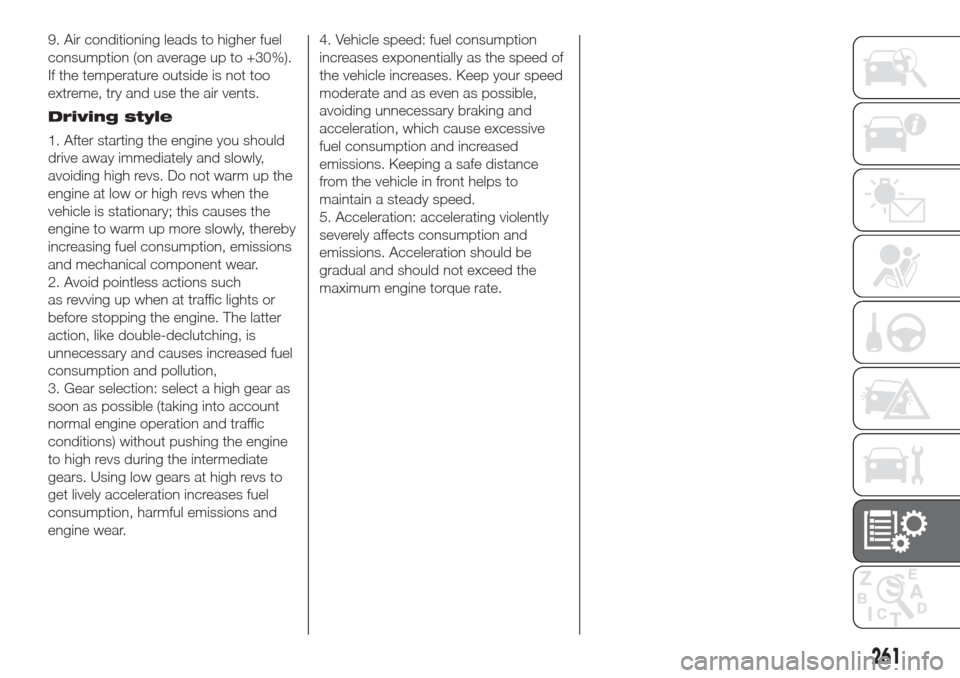
9. Air conditioning leads to higher fuel
consumption (on average up to +30%).
If the temperature outside is not too
extreme, try and use the air vents.
Driving style
1. After starting the engine you should
drive away immediately and slowly,
avoiding high revs. Do not warm up the
engine at low or high revs when the
vehicle is stationary; this causes the
engine to warm up more slowly, thereby
increasing fuel consumption, emissions
and mechanical component wear.
2. Avoid pointless actions such
as revving up when at traffic lights or
before stopping the engine. The latter
action, like double-declutching, is
unnecessary and causes increased fuel
consumption and pollution,
3. Gear selection: select a high gear as
soon as possible (taking into account
normal engine operation and traffic
conditions) without pushing the engine
to high revs during the intermediate
gears. Using low gears at high revs to
get lively acceleration increases fuel
consumption, harmful emissions and
engine wear.4. Vehicle speed: fuel consumption
increases exponentially as the speed of
the vehicle increases. Keep your speed
moderate and as even as possible,
avoiding unnecessary braking and
acceleration, which cause excessive
fuel consumption and increased
emissions. Keeping a safe distance
from the vehicle in front helps to
maintain a steady speed.
5. Acceleration: accelerating violently
severely affects consumption and
emissions. Acceleration should be
gradual and should not exceed the
maximum engine torque rate.
261
Page 266 of 300
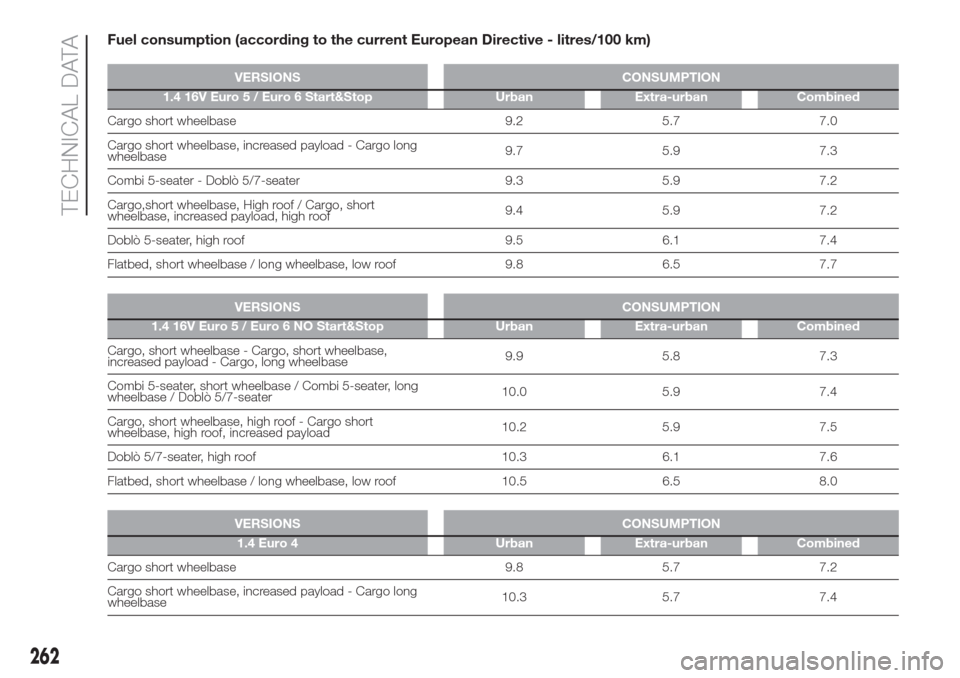
Fuel consumption (according to the current European Directive - litres/100 km)
VERSIONS CONSUMPTION
1.4 16V Euro 5 / Euro 6 Start&Stop Urban Extra-urban Combined
Cargo short wheelbase 9.2 5.7 7.0
Cargo short wheelbase, increased payload - Cargo long
wheelbase9.7 5.9 7.3
Combi 5-seater - Doblò 5/7-seater 9.3 5.9 7.2
Cargo,short wheelbase, High roof / Cargo, short
wheelbase, increased payload, high roof9.4 5.9 7.2
Doblò 5-seater, high roof 9.5 6.1 7.4
Flatbed, short wheelbase / long wheelbase, low roof 9.8 6.5 7.7
.
VERSIONS CONSUMPTION
1.4 16V Euro 5 / Euro 6 NO Start&Stop Urban Extra-urban Combined
Cargo, short wheelbase - Cargo, short wheelbase,
increased payload - Cargo, long wheelbase9.9 5.8 7.3
Combi 5-seater, short wheelbase / Combi 5-seater, long
wheelbase / Doblò 5/7-seater10.0 5.9 7.4
Cargo, short wheelbase, high roof - Cargo short
wheelbase, high roof, increased payload10.2 5.9 7.5
Doblò 5/7-seater, high roof 10.3 6.1 7.6
Flatbed, short wheelbase / long wheelbase, low roof 10.5 6.5 8.0
.
VERSIONS CONSUMPTION
1.4 Euro 4 Urban Extra-urban Combined
Cargo short wheelbase 9.8 5.7 7.2
Cargo short wheelbase, increased payload - Cargo long
wheelbase10.3 5.7 7.4
262
TECHNICAL DATA
Page 276 of 300
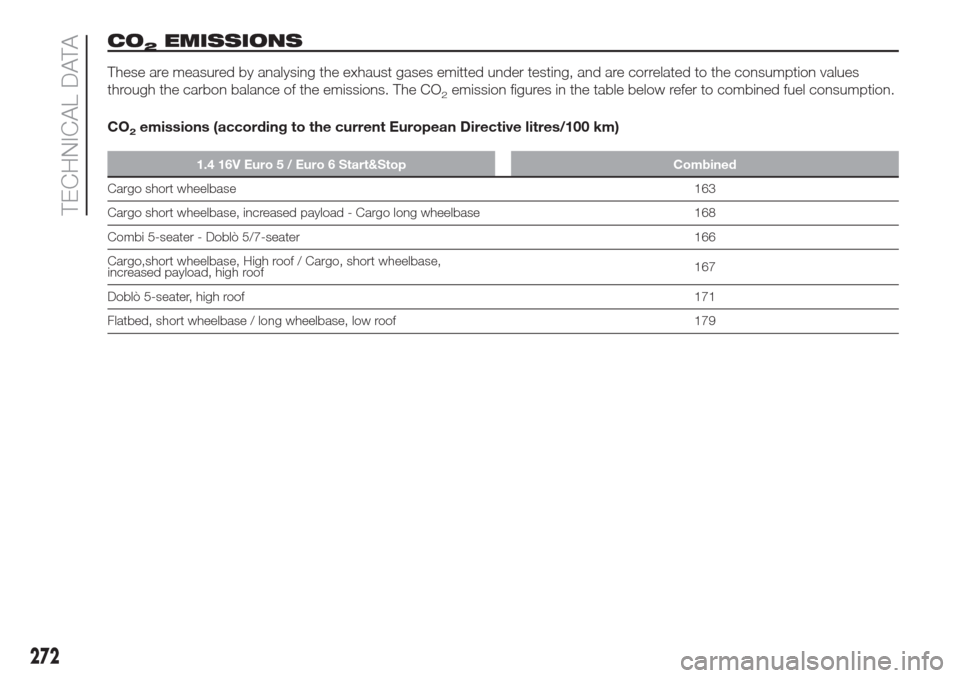
CO2EMISSIONS
These are measured by analysing the exhaust gases emitted under testing, and are correlated to the consumption values
through the carbon balance of the emissions. The CO
2emission figures in the table below refer to combined fuel consumption.
CO
2emissions (according to the current European Directive litres/100 km)
1.4 16V Euro 5 / Euro 6 Start&Stop Combined
Cargo short wheelbase163
Cargo short wheelbase, increased payload - Cargo long wheelbase 168
Combi 5-seater - Doblò 5/7-seater 166
Cargo,short wheelbase, High roof / Cargo, short wheelbase,
increased payload, high roof167
Doblò 5-seater, high roof171
Flatbed, short wheelbase / long wheelbase, low roof 179
272
TECHNICAL DATA
Page 295 of 300
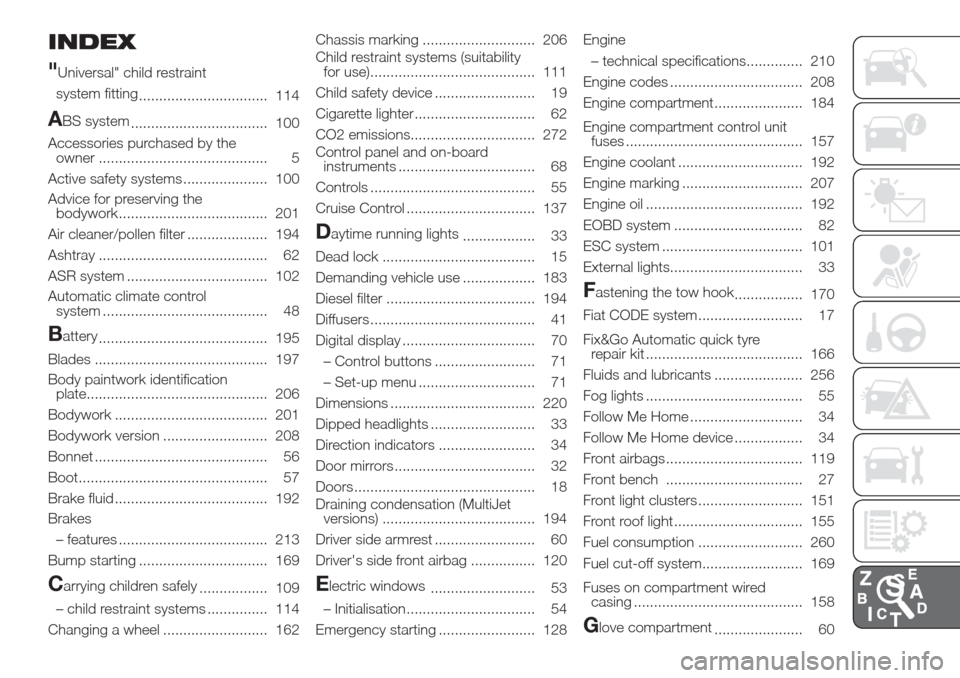
INDEX
"
Universal" child restraint
system fitting
................................ 114
ABS system
.................................. 100
Accessories purchased by the
owner .......................................... 5
Active safety systems ..................... 100
Advice for preserving the
bodywork..................................... 201
Air cleaner/pollen filter .................... 194
Ashtray .......................................... 62
ASR system ................................... 102
Automatic climate control
system ......................................... 48
Battery
.......................................... 195
Blades ........................................... 197
Body paintwork identification
plate............................................. 206
Bodywork ...................................... 201
Bodywork version .......................... 208
Bonnet ........................................... 56
Boot............................................... 57
Brake fluid ...................................... 192
Brakes
– features ..................................... 213
Bump starting ................................ 169
Carrying children safely
................. 109
– child restraint systems ............... 114
Changing a wheel .......................... 162Chassis marking ............................ 206
Child restraint systems (suitability
for use)......................................... 111
Child safety device ......................... 19
Cigarette lighter .............................. 62
CO2 emissions............................... 272
Control panel and on-board
instruments .................................. 68
Controls ......................................... 55
Cruise Control ................................ 137
Daytime running lights
.................. 33
Dead lock ...................................... 15
Demanding vehicle use .................. 183
Diesel filter ..................................... 194
Diffusers ......................................... 41
Digital display ................................. 70
– Control buttons ......................... 71
– Set-up menu ............................. 71
Dimensions .................................... 220
Dipped headlights .......................... 33
Direction indicators ........................ 34
Door mirrors ................................... 32
Doors ............................................. 18
Draining condensation (MultiJet
versions) ...................................... 194
Driver side armrest ......................... 60
Driver's side front airbag ................ 120
Electric windows
.......................... 53
– Initialisation................................ 54
Emergency starting ........................ 128Engine
– technical specifications.............. 210
Engine codes ................................. 208
Engine compartment...................... 184
Engine compartment control unit
fuses ............................................ 157
Engine coolant ............................... 192
Engine marking .............................. 207
Engine oil ....................................... 192
EOBD system ................................ 82
ESC system ................................... 101
External lights................................. 33
Fastening the tow hook
................. 170
Fiat CODE system.......................... 17
Fix&Go Automatic quick tyre
repair kit ....................................... 166
Fluids and lubricants ...................... 256
Fog lights ....................................... 55
Follow Me Home ............................ 34
Follow Me Home device ................. 34
Front airbags .................................. 119
Front bench .................................. 27
Front light clusters .......................... 151
Front roof light ................................ 155
Fuel consumption .......................... 260
Fuel cut-off system......................... 169
Fuses on compartment wired
casing .......................................... 158
Glove compartment
...................... 60
Page 296 of 300
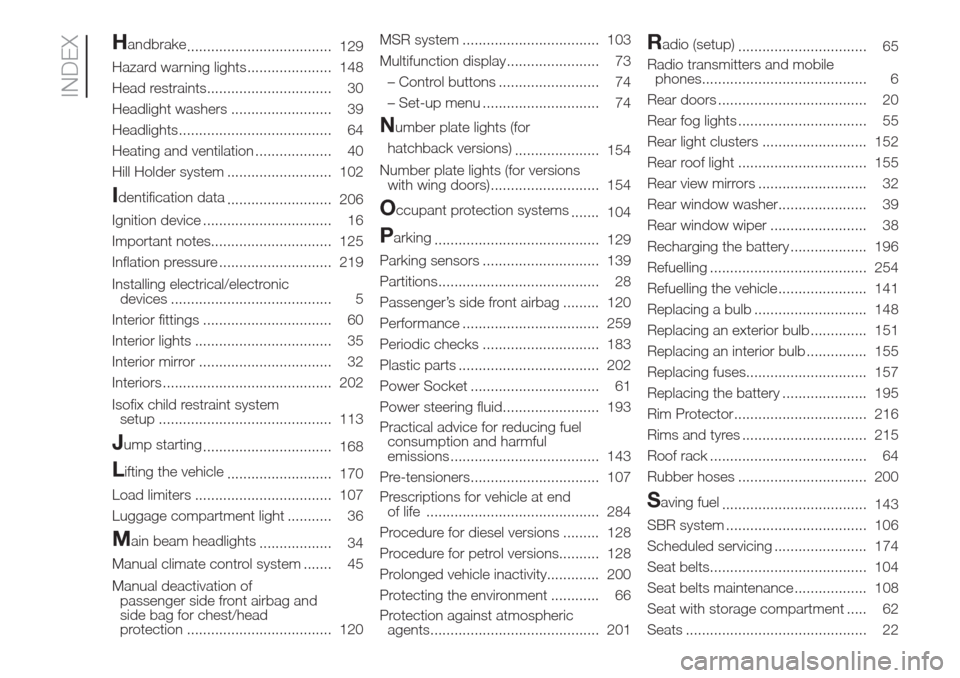
Handbrake
.................................... 129
Hazard warning lights..................... 148
Head restraints............................... 30
Headlight washers ......................... 39
Headlights...................................... 64
Heating and ventilation ................... 40
Hill Holder system .......................... 102
Identification data
.......................... 206
Ignition device ................................ 16
Important notes.............................. 125
Inflation pressure ............................ 219
Installing electrical/electronic
devices ........................................ 5
Interior fittings ................................ 60
Interior lights .................................. 35
Interior mirror ................................. 32
Interiors .......................................... 202
Isofix child restraint system
setup ........................................... 113
Jump starting
................................ 168
Lifting the vehicle
.......................... 170
Load limiters .................................. 107
Luggage compartment light ........... 36
Main beam headlights
.................. 34
Manual climate control system ....... 45
Manual deactivation of
passenger side front airbag and
side bag for chest/head
protection .................................... 120MSR system .................................. 103
Multifunction display....................... 73
– Control buttons ......................... 74
– Set-up menu ............................. 74
Number plate lights (for
hatchback versions)
..................... 154
Number plate lights (for versions
with wing doors)........................... 154
Occupant protection systems
....... 104
Parking
......................................... 129
Parking sensors ............................. 139
Partitions........................................ 28
Passenger’s side front airbag ......... 120
Performance .................................. 259
Periodic checks ............................. 183
Plastic parts ................................... 202
Power Socket ................................ 61
Power steering fluid........................ 193
Practical advice for reducing fuel
consumption and harmful
emissions ..................................... 143
Pre-tensioners................................ 107
Prescriptions for vehicle at end
of life ........................................... 284
Procedure for diesel versions ......... 128
Procedure for petrol versions.......... 128
Prolonged vehicle inactivity............. 200
Protecting the environment ............ 66
Protection against atmospheric
agents.......................................... 201
Radio (setup)
................................ 65
Radio transmitters and mobile
phones......................................... 6
Rear doors ..................................... 20
Rear fog lights ................................ 55
Rear light clusters .......................... 152
Rear roof light ................................ 155
Rear view mirrors ........................... 32
Rear window washer...................... 39
Rear window wiper ........................ 38
Recharging the battery ................... 196
Refuelling ....................................... 254
Refuelling the vehicle ...................... 141
Replacing a bulb ............................ 148
Replacing an exterior bulb .............. 151
Replacing an interior bulb ............... 155
Replacing fuses.............................. 157
Replacing the battery ..................... 195
Rim Protector................................. 216
Rims and tyres ............................... 215
Roof rack ....................................... 64
Rubber hoses ................................ 200
Saving fuel
.................................... 143
SBR system ................................... 106
Scheduled servicing ....................... 174
Seat belts....................................... 104
Seat belts maintenance .................. 108
Seat with storage compartment ..... 62
Seats ............................................. 22
INDEX