mirror FIAT DOBLO COMBI 2017 2.G User Guide
[x] Cancel search | Manufacturer: FIAT, Model Year: 2017, Model line: DOBLO COMBI, Model: FIAT DOBLO COMBI 2017 2.GPages: 300, PDF Size: 24.91 MB
Page 53 of 300
GENERAL INFORMATION
The automatic climate control system
adjusts the temperature, the quantity
and the distribution of the air in the
passenger compartment. The
temperature control is based on the
"equivalent temperature": in other
words, the system continuously works
to keep the comfort level inside the
vehicle constant and to compensate for
possible variations in outside
conditions, including the sun's rays
detected by a dedicated sensor. The
automatically controlled parameters
and functions are:
air temperature at the vents;
air distribution at the vents;
fan speed (continuous variation of
the air flow);
compressor engagement (for
cooling/dehumidifying the air);
air recirculation.
All functions may be changed manually.
In other words, you may select one or
more functions and change the
parameters as required. Automatic
control of the manually changed
functions will be suspended: the
system will override your settings only
for safety-related reasons (e.g. risk
of misting).Manual selections will always take
priority over automatic settings and will
be stored until the user switches the
system back to automatic operation by
pressing the AUTO button again except
for the cases in which the system will
intervene for particular, safety-related
reasons. You can adjust one function
manually without affecting the
automatic control of the others.
The temperature of the air sent is
always controlled automatically,
depending on the temperature set in
the display (except when the system is
off or in certain conditions when the
compressor is switched off).
The system allows the following
parameters and functions to be set or
altered manually: air temperature,
fan speed (continuous variation); air
distribution in seven positions;
compressor enablement; fast
defrosting/demisting function; air
recirculation; switching off the system.USING THE CLIMATE
CONTROL SYSTEM
The system can be started in different
ways, but it is advisable to start by
pressing the AUTO button and then
turning the knob to set the temperature
required on the display. The system
will start running automatically in this
way and the set temperature will be
reached as quickly as possible. The
system will adjust the temperature, the
quantity and the distribution of the air
introduced into the passenger
compartment and will manage the
recirculation function and the
compressor engagement. During fully
automatic operation, the only manual
intervention required is the possible
activation of the following functions:
air recirculation (to keep the
recirculation constantly on or constantly
off);
to speed up demisting/
defrosting of windscreen, rear window
and external rear view mirrors.
During fully automatic system
operation, you can change the set
temperature, air distribution and fan
speed at any time by using the relevant
buttons or knobs: the system will
automatically change its settings to
adjust to the new requirements.
49
Page 57 of 300
You can only adjust the fan speed and
switch off the heated rear window
manually when this function is active.
To restore the previous operating
conditions, simply press button B, air
recirculation button G, compressor
button F or AUTO button A.
Heated rear window and door
mirrors electric control demisting/
defrosting button (L)
(for versions/markets, where provided)
Push this button to activate the
demisting/defrosting of the heated rear
window and electric door mirrors
When this function is active, the button
LED is on.
This function switches off automatically
after about 20 minutes or when you
push the button again, or when the
engine is turned off. It will not be
switched on automatically when the
engine is restarted.
IMPORTANT Do not affix decals to the
inside of the heated rear window over
the heating filaments, to avoid damage
that might cause them to stop working
properly.
Switching off the system OFF (E)
Press button E to switch the climate
control system off. The display will go
out.With the system off, the climate control
system conditions are as follows:
display off, temperature setting not
display, air recirculation on thereby
insulating the passenger compartment
from the outside (recirculation LED
on), climate control compressor off, fan
off. Press the AUTO button to switch
the climate control system back on
in full automatic mode.
WARNING
3)The air conditioning system uses
refrigerant R134a or R1234yf compatible
with the current regulations in the countries
where the vehicle is marketed. When
charging, only use the gas indicated on the
dedicated plate in the engine compartment
. The use of other coolants affects the
efficiency and condition of the system. The
lubricant used for the compressor is also
strictly linked to the type of cooling gas,
please refer to a Fiat Dealership.
WINDOW WINDERS
ELECTRIC FRONT
WINDOWS
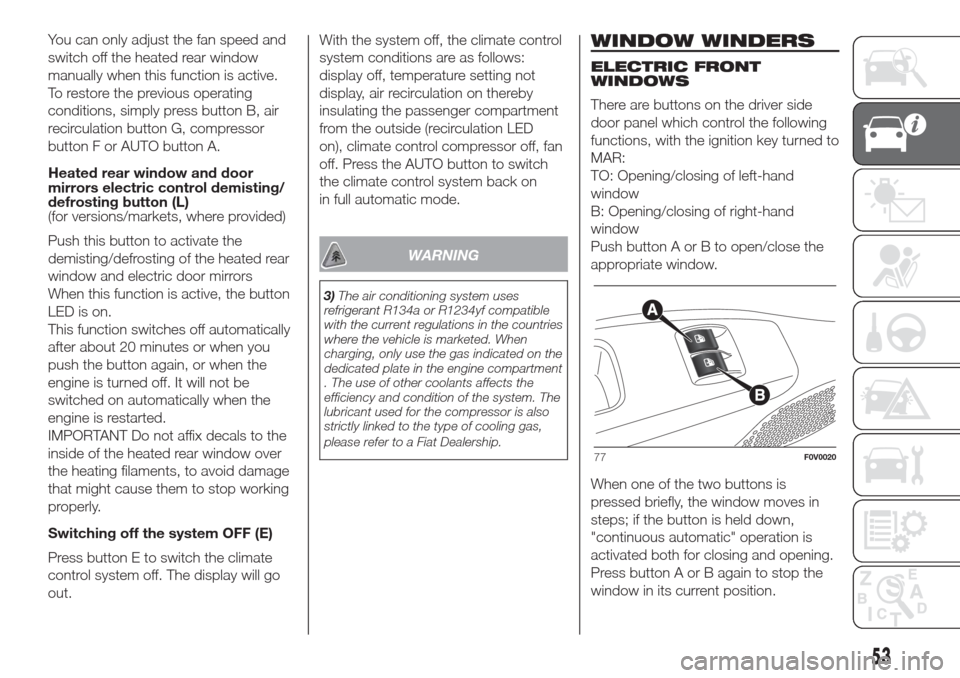
There are buttons on the driver side
door panel which control the following
functions, with the ignition key turned to
MAR:
TO: Opening/closing of left-hand
window
B: Opening/closing of right-hand
window
Push button A or B to open/close the
appropriate window.
When one of the two buttons is
pressed briefly, the window moves in
steps; if the button is held down,
"continuous automatic" operation is
activated both for closing and opening.
Press button A or B again to stop the
window in its current position.
77F0V0020
53
Page 67 of 300
SUN VISORS
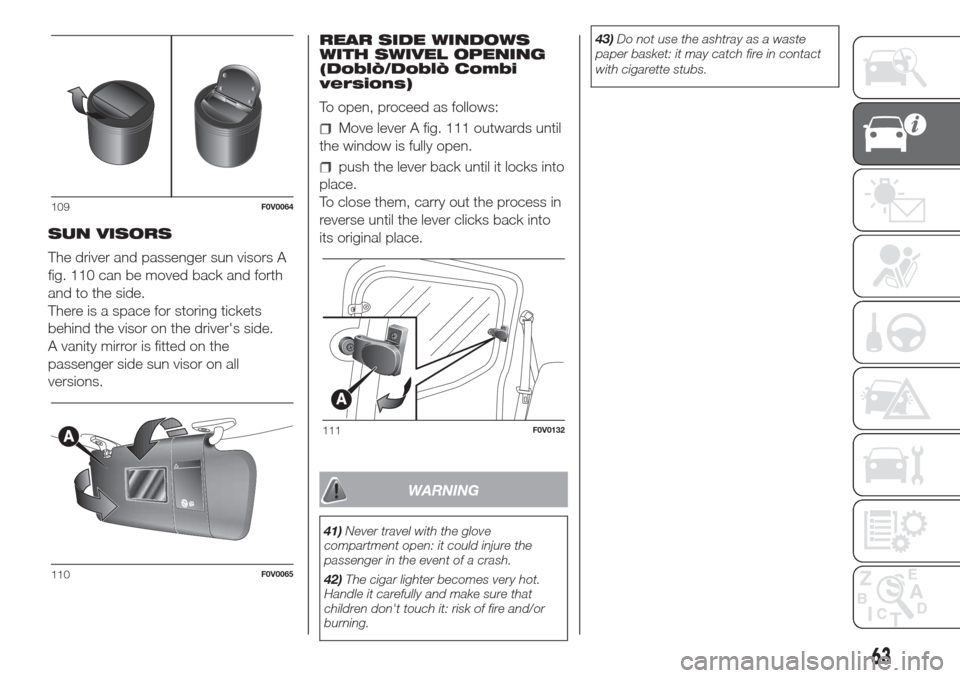
The driver and passenger sun visors A
fig. 110 can be moved back and forth
and to the side.
There is a space for storing tickets
behind the visor on the driver's side.
A vanity mirror is fitted on the
passenger side sun visor on all
versions.REAR SIDE WINDOWS
WITH SWIVEL OPENING
(Doblò/Doblò Combi
versions)
To open, proceed as follows:
Move lever A fig. 111 outwards until
the window is fully open.
push the lever back until it locks into
place.
To close them, carry out the process in
reverse until the lever clicks back into
its original place.
WARNING
41)Never travel with the glove
compartment open: it could injure the
passenger in the event of a crash.
42)The cigar lighter becomes very hot.
Handle it carefully and make sure that
children don't touch it: risk of fire and/or
burning.43)Do not use the ashtray as a waste
paper basket: it may catch fire in contact
with cigarette stubs.
109F0V0064
110F0V0065
111F0V0132
63
Page 69 of 300
Position 3 - driver + maximum
permitted load stowed in the luggage
compartment.
IMPORTANT Check the light beam
alignment every time the load
transported changes.FOG LIGHTS ALIGNMENT
(for versions/markets, where provided)
Contact a Fiat Dealership to have the
headlights checked and adjusted.
ADJUSTING THE
HEADLIGHTS ABROAD
The dipped beam headlights are
aligned for operation in the country
where the vehicle was originally
purchased. In countries where vehicles
are driven on the other side of the
road, the beams are aligned by
applying a specially designed adhesive
film in order not to dazzle the vehicles
travelling in the opposite direction.
Such film is provided by Lineaccessori
Fiat and is available at Fiat Dealerships.RADIO
(for versions/markets, where provided)
For the operation of the radio with
CD/MP3 player (for versions/markets
where provided), read the Supplement
attached to this Owner's Handbook.
WIRING FOR
LIGHTWEIGHT SYSTEM
The system consists of:
radio supply leads;
front speaker cables (on door
mirrors trims);
front door panel speaker cables;
rear speaker cables (on the side of
the parcel shelf) (for versions/markets,
where provided);
radio housing;
aerial lead:
aerial.
WIRING FOR
HEAVYWEIGHT SYSTEM
The system consists of:
radio supply leads;
rear speaker cables (on the side of
the parcel shelf) (for versions/markets,
where provided);
no. 2 tweeters on door mirror trims;
no. 2 midwoofers on front door
lower part;
113F0V0506
65
Page 110 of 300
SBR SYSTEM
This system comprises an acoustic
warning which, in conjunction with the
warning lights
flashing on the
instrument panel, warns the front seat
passengers if their seat belt has not
been fastened.
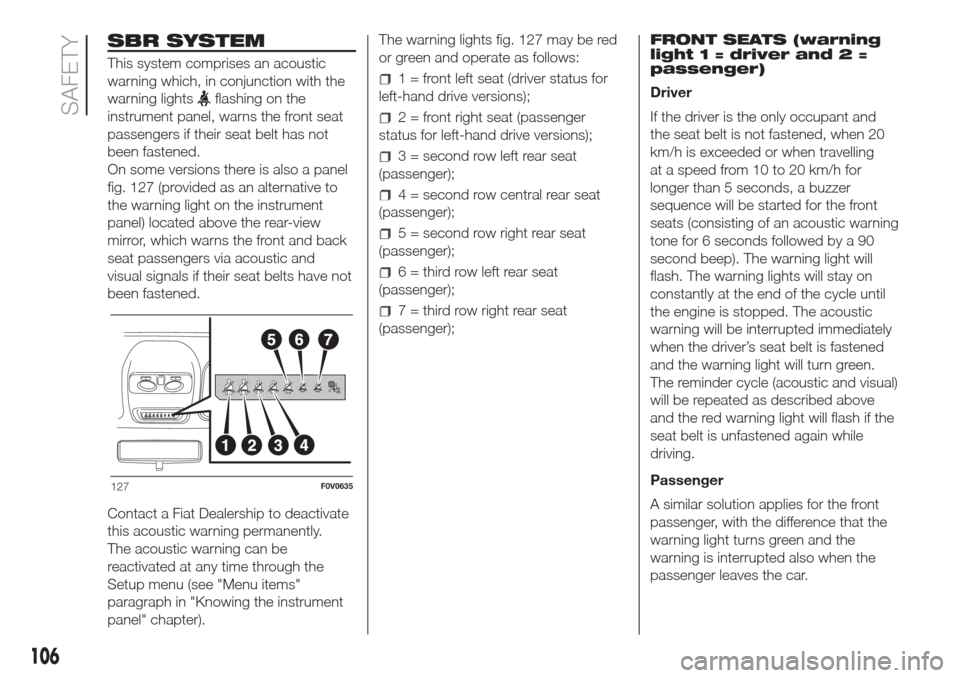
On some versions there is also a panel
fig. 127 (provided as an alternative to
the warning light on the instrument
panel) located above the rear-view
mirror, which warns the front and back
seat passengers via acoustic and
visual signals if their seat belts have not
been fastened.
Contact a Fiat Dealership to deactivate
this acoustic warning permanently.
The acoustic warning can be
reactivated at any time through the
Setup menu (see "Menu items"
paragraph in "Knowing the instrument
panel" chapter).The warning lights fig. 127 may be red
or green and operate as follows:
1 = front left seat (driver status for
left-hand drive versions);
2 = front right seat (passenger
status for left-hand drive versions);
3 = second row left rear seat
(passenger);
4 = second row central rear seat
(passenger);
5 = second row right rear seat
(passenger);
6 = third row left rear seat
(passenger);
7 = third row right rear seat
(passenger);FRONT SEATS (warning
light 1 = driver and 2 =
passenger)
Driver
If the driver is the only occupant and
the seat belt is not fastened, when 20
km/h is exceeded or when travelling
at a speed from 10 to 20 km/h for
longer than 5 seconds, a buzzer
sequence will be started for the front
seats (consisting of an acoustic warning
tone for 6 seconds followed by a 90
second beep). The warning light will
flash. The warning lights will stay on
constantly at the end of the cycle until
the engine is stopped. The acoustic
warning will be interrupted immediately
when the driver’s seat belt is fastened
and the warning light will turn green.
The reminder cycle (acoustic and visual)
will be repeated as described above
and the red warning light will flash if the
seat belt is unfastened again while
driving.
Passenger
A similar solution applies for the front
passenger, with the difference that the
warning light turns green and the
warning is interrupted also when the
passenger leaves the car.
127F0V0635
106
SAFETY
Page 148 of 300
Avoidpointless actionssuch as
revving up when at traffic lights or
before stopping the engine. The latter
action, like double-declutching, is
unnecessary and causes increased fuel
consumption and pollution.
Gear selection:select a high gear
as soon as possible (taking into
account normal engine operation and
traffic conditions) without pushing
the engine to high revs during
the intermediate gears. Using low gears
at high revs to get lively acceleration
increases fuel consumption, harmful
emissions and engine wear.
Vehicle speed:fuel consumption
increases exponentially as the speed of
the vehicle increases. Keep your speed
moderate and as even as possible,
avoiding unnecessary braking and
acceleration, which cause excessive
fuel consumption and increased
emissions. Keeping a safe distance
from the vehicle in front helps to
maintain a steady speed.
Acceleration:accelerating violently
severely affects consumption and
emissions. Acceleration should be
gradual and should not exceed the
maximum engine torque rate.CONDITIONS OF USE
Cold starting
Short journeys and frequent cold starts
do not allow the engine to reach
optimum operating temperature.
This results in a significant increase in
consumption levels (from +15 to +30%
on the urban cycle) and emissions.
Traffic and road conditions
Rather high consumption levels are
linked to situations with heavy traffic, for
instance when travelling in queues
with frequent use of the lower gears or
in cities with many traffic lights. Winding
mountain roads and rough road
surfaces also adversely affect
consumption.
Stops in traffic
During prolonged hold-ups (e.g. level
crossings) the engine should be
switched off.
TOWING TRAILERS
IMPORTANT
The vehicle must be equipped with a
type-approved tow hook and adequate
electrical system to tow trailers.
Installation should be carried out by
specialised personnel who will issue the
required papers for travelling on roads.
Install any specific and/or additional
door mirrors as specified by the
Highway Code.
Remember that when towing a trailer,
steep hills are harder to climb, braking
spaces increase and overtaking takes
longer depending on the overall weight.
Engage a low gear when driving
downhill, rather than constantly using
the brake.
The weight of the trailer on the vehicle
tow hook will reduce the loading
capacity of the vehicle by the same
amount.
To make sure that the maximum
towable weight is not exceeded (given
in the vehicle registration document)
account should be taken of the fully
laden trailer, including accessories and
luggage.
Do not exceed the speed limits specific
to each country you are driving in, in
the case of vehicles towing trailers.
In any case, the top speed must not
exceed 80 km/h.
144
STARTING AND DRIVING
116) 117)
Page 156 of 300
Side
IMPORTANT Go to a Fiat Dealership to
have bulbs for the side direction
indicators replaced, because they are
located inside the wing mirror.
MAIN BEAM HEADLIGHTS
To replace the bulb, proceed as
follows:
remove the protective cover A fig.
159;
disconnect the electrical connector;
release the bulb holder from the
side clips A fig. 163;
extract the bulb and replace it;
fit the new bulb, ensuring that the
outline of the metal part coincides with
the grooves on the curve of the
headlight, pressing to engage it with the
side clips A fig. 163; then reconnect
the electrical connector;
refit the protective cover A fig. 159.FOG LIGHTS
(for versions/markets, where provided)
IMPORTANT Go to a Fiat Dealership
to have the front fog light bulbs
replaced.
REAR LIGHT CLUSTERS
The rear light clusters contain the bulbs
for the side lights, direction indicators
and reversing/rear fog and brake lights.
To access the light clusters, proceed
as follows:
open the rear doors;
undo the fixing screws A fig. 164;
disconnect the electrical connector
and then remove the light cluster.
The bulbs are arranged inside the light
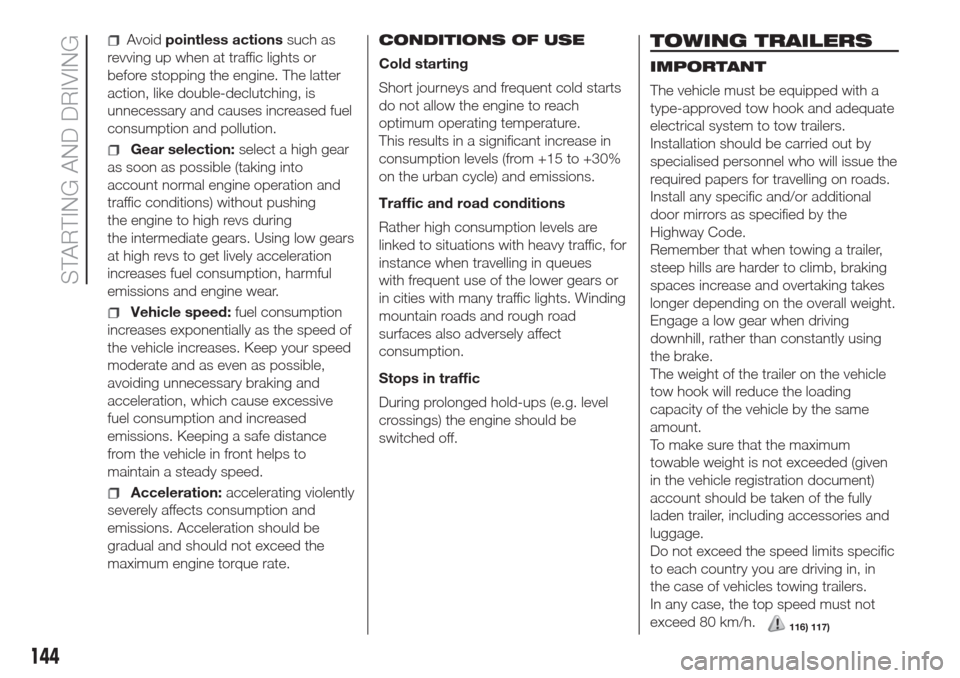
cluster fig. 165 as follows:
ABrake lights
BDirection indicators
CReverse lights
DSide/rear fog lights;To access the bulbs, undo the 6 fixing
screws E fig. 165 and remove the
bulb holder.
To change the bulb, push it in gently
and turn it anticlockwise (“bayonet”
type), then remove and replace it.
THIRD BRAKE LIGHTS
To replace the bulb proceed as follows:
for versions with tailgate, undo the
two fixing screws A fig. 166 and
remove the unit;
162F0V0523163F0V0524
164F0V0034
152
IN AN EMERGENCY
Page 295 of 300
INDEX
"
Universal" child restraint
system fitting
................................ 114
ABS system
.................................. 100
Accessories purchased by the
owner .......................................... 5
Active safety systems ..................... 100
Advice for preserving the
bodywork..................................... 201
Air cleaner/pollen filter .................... 194
Ashtray .......................................... 62
ASR system ................................... 102
Automatic climate control
system ......................................... 48
Battery
.......................................... 195
Blades ........................................... 197
Body paintwork identification
plate............................................. 206
Bodywork ...................................... 201
Bodywork version .......................... 208
Bonnet ........................................... 56
Boot............................................... 57
Brake fluid ...................................... 192
Brakes
– features ..................................... 213
Bump starting ................................ 169
Carrying children safely
................. 109
– child restraint systems ............... 114
Changing a wheel .......................... 162Chassis marking ............................ 206
Child restraint systems (suitability
for use)......................................... 111
Child safety device ......................... 19
Cigarette lighter .............................. 62
CO2 emissions............................... 272
Control panel and on-board
instruments .................................. 68
Controls ......................................... 55
Cruise Control ................................ 137
Daytime running lights
.................. 33
Dead lock ...................................... 15
Demanding vehicle use .................. 183
Diesel filter ..................................... 194
Diffusers ......................................... 41
Digital display ................................. 70
– Control buttons ......................... 71
– Set-up menu ............................. 71
Dimensions .................................... 220
Dipped headlights .......................... 33
Direction indicators ........................ 34
Door mirrors ................................... 32
Doors ............................................. 18
Draining condensation (MultiJet
versions) ...................................... 194
Driver side armrest ......................... 60
Driver's side front airbag ................ 120
Electric windows
.......................... 53
– Initialisation................................ 54
Emergency starting ........................ 128Engine
– technical specifications.............. 210
Engine codes ................................. 208
Engine compartment...................... 184
Engine compartment control unit
fuses ............................................ 157
Engine coolant ............................... 192
Engine marking .............................. 207
Engine oil ....................................... 192
EOBD system ................................ 82
ESC system ................................... 101
External lights................................. 33
Fastening the tow hook
................. 170
Fiat CODE system.......................... 17
Fix&Go Automatic quick tyre
repair kit ....................................... 166
Fluids and lubricants ...................... 256
Fog lights ....................................... 55
Follow Me Home ............................ 34
Follow Me Home device ................. 34
Front airbags .................................. 119
Front bench .................................. 27
Front light clusters .......................... 151
Front roof light ................................ 155
Fuel consumption .......................... 260
Fuel cut-off system......................... 169
Fuses on compartment wired
casing .......................................... 158
Glove compartment
...................... 60
Page 296 of 300
Handbrake
.................................... 129
Hazard warning lights..................... 148
Head restraints............................... 30
Headlight washers ......................... 39
Headlights...................................... 64
Heating and ventilation ................... 40
Hill Holder system .......................... 102
Identification data
.......................... 206
Ignition device ................................ 16
Important notes.............................. 125
Inflation pressure ............................ 219
Installing electrical/electronic
devices ........................................ 5
Interior fittings ................................ 60
Interior lights .................................. 35
Interior mirror ................................. 32
Interiors .......................................... 202
Isofix child restraint system
setup ........................................... 113
Jump starting
................................ 168
Lifting the vehicle
.......................... 170
Load limiters .................................. 107
Luggage compartment light ........... 36
Main beam headlights
.................. 34
Manual climate control system ....... 45
Manual deactivation of
passenger side front airbag and
side bag for chest/head
protection .................................... 120MSR system .................................. 103
Multifunction display....................... 73
– Control buttons ......................... 74
– Set-up menu ............................. 74
Number plate lights (for
hatchback versions)
..................... 154
Number plate lights (for versions
with wing doors)........................... 154
Occupant protection systems
....... 104
Parking
......................................... 129
Parking sensors ............................. 139
Partitions........................................ 28
Passenger’s side front airbag ......... 120
Performance .................................. 259
Periodic checks ............................. 183
Plastic parts ................................... 202
Power Socket ................................ 61
Power steering fluid........................ 193
Practical advice for reducing fuel
consumption and harmful
emissions ..................................... 143
Pre-tensioners................................ 107
Prescriptions for vehicle at end
of life ........................................... 284
Procedure for diesel versions ......... 128
Procedure for petrol versions.......... 128
Prolonged vehicle inactivity............. 200
Protecting the environment ............ 66
Protection against atmospheric
agents.......................................... 201
Radio (setup)
................................ 65
Radio transmitters and mobile
phones......................................... 6
Rear doors ..................................... 20
Rear fog lights ................................ 55
Rear light clusters .......................... 152
Rear roof light ................................ 155
Rear view mirrors ........................... 32
Rear window washer...................... 39
Rear window wiper ........................ 38
Recharging the battery ................... 196
Refuelling ....................................... 254
Refuelling the vehicle ...................... 141
Replacing a bulb ............................ 148
Replacing an exterior bulb .............. 151
Replacing an interior bulb ............... 155
Replacing fuses.............................. 157
Replacing the battery ..................... 195
Rim Protector................................. 216
Rims and tyres ............................... 215
Roof rack ....................................... 64
Rubber hoses ................................ 200
Saving fuel
.................................... 143
SBR system ................................... 106
Scheduled servicing ....................... 174
Seat belts....................................... 104
Seat belts maintenance .................. 108
Seat with storage compartment ..... 62
Seats ............................................. 22
INDEX