steering wheel FIAT DOBLO COMBI 2017 2.G User Guide
[x] Cancel search | Manufacturer: FIAT, Model Year: 2017, Model line: DOBLO COMBI, Model: FIAT DOBLO COMBI 2017 2.GPages: 300, PDF Size: 24.91 MB
Page 111 of 300
It both front seat belts are unfastened
while the car is travelling a few seconds
apart, the acoustic warning will refer
to the most recent event and the two
warning lights will proceed with the
visual indication independently.
REAR SEATS (warning
lights3—4—5—6—7)
The reminder cycle is run only when
any seat belt is unfastened (red
blinking). In this condition, the warning
light for the seat belt which has been
unfastened will turn red and blink for
approximately 30 seconds. An acoustic
warning is also emitted. The visual
indication (blinking red) will start and
end independently for each warning
light if several seat belts are unfastened.
The warning light will become green
when the relevant seat belt is fastened
again. The rear seat warning lights
will go out, if the front seat belts are
fastened, regardless of the state of the
belt (red or green) approximately 30
seconds after the last signal.
All the warning lights will come on when
at least one belt changes from
fastened to unfastened status or vice
versa.PRE-TENSIONERS
To increase the protective efficiency of
the front seat belts, the vehicle is fitted
with pretensioners. These devices, in
the event of a violent head-on crash or
side impact, rewind the seat belts a
few centimetres. In this way, they
ensure that the belts fit tightly to the
wearer before the restraining action
begins.
It is evident that the pretensioners have
been activated when the belt withdraws
toward the retractor. This car is also
equipped with a second pretensioner
(fitted in the kick plate area). Its
activation is signalled by the shortening
of the metal cable.
A slight discharge of smoke may be
produced during the activation of the
pretensioner which is not harmful and
does not involve any fire hazard.
The pretensioner does not require any
maintenance or lubrication. Any
changes to its original conditions will
invalidate its efficiency. If, due to
unusual natural events (floods, sea
storms, etc.), the device has been
affected by water and/or mud, contact
a Fiat Dealership to have it replaced.
IMPORTANT To obtain the highest
degree of protection from the action of
the pretensioner, wear the seat belt
tight to the chest and pelvis.
65)
16)
LOAD LIMITERS
(for versions/markets, where provided)
To increase passenger safety, the
front and rear seat belt retractors (for
versions/markets where provided)
contain a load limiter which controls the
force acting on the chest and
shoulders during the belt restraining
action in the event of a frontal collision.
GENERAL WARNINGS
FOR USING THE SEAT
BELTS
Seat belts must also be worn by
pregnant mothers: the risk of injury in
the event of an accident is greatly
reduced for them and the unborn child
if they are wearing a seat belt. Pregnant
women must position the lower part
of the belt very low down so that it
passes over the pelvis and under the
abdomen (see fig. 128).
While pregnancy progresses, the driver
must adjust both seat and steering
wheel to have full control over the car
(pedals and steering wheel must be
easy to access). The maximum
clearance should be kept between the
abdomen and the steering wheel.
107
Page 123 of 300
79)Do not use the same lower anchoring
to install more than one child restraint
system.
80)If a Universal ISOFIX child restraint
system is not fixed to all three anchorages,
it will not be able to protect the child
correctly. In an accident, the child could be
seriously or fatally injured.FRONT AIRBAGS
The vehicle is fitted with front airbag for
the driver and, for versions/markets
where provided, front airbag for the
passenger.
FRONT AIRBAGS
The front driver/passenger airbags (for
versions/markets where provided)
have been designed to protect the
front-seat occupants in the event of
head-on crashes of medium-high
severity, by placing the bag between
the occupant and the steering wheel or
dashboard.
Therefore, failure to deploy of the
airbags in other types of collisions (side
collisions, rear shunts, roll-overs, etc.)
is not a system malfunction.
An electronic control unit will make the
bag inflate in the event of a frontal
impact.
The bag will inflate instantaneously
placing itself between the front
occupants body and the structures
which could cause injury. It will deflate
immediately afterwards.Front driver/passenger airbags (for
versions/markets where provided) are
not a replacement for, but rather a
complement to, the seat belts, which
should be worn at all times as specified
by law in Europe and most non-
European countries.
In the event of an impact, those not
wearing a seat belt are projected
forwards, and may come into contact
with the bag which is still inflating.
The protection offered by the cushion is
compromised in such a case.
Front airbags may not activate in the
following situations:
frontal impacts against highly
deformable objects not involving the
front surface of the vehicle (e.g. wing
collision against guard rail, etc.);
vehicle wedging under other vehicles
or protective barriers (e.g. trucks or
guard rails);
they may not provide any additional
protection compared with seat belts, so
their activation would not be
appropriate. In these cases, non-
deployment does not indicate a system
malfunction.
81) 82) 82) 84) 85)
The driver's and passenger's front
airbags have been designed and
calibrated to protect front seat
occupants wearing seat belts.
119
Page 124 of 300
At their maximum inflation, their volume
fills most of the space between the
steering wheel and the driver and
between the dashboard and the
passenger.
The airbags are not deployed in the
event of minor frontal impacts (for
which the restraining action of the seat
belts is sufficient). It is therefore always
necessary to wear seat belts.
DRIVER SIDE FRONT
AIRBAG
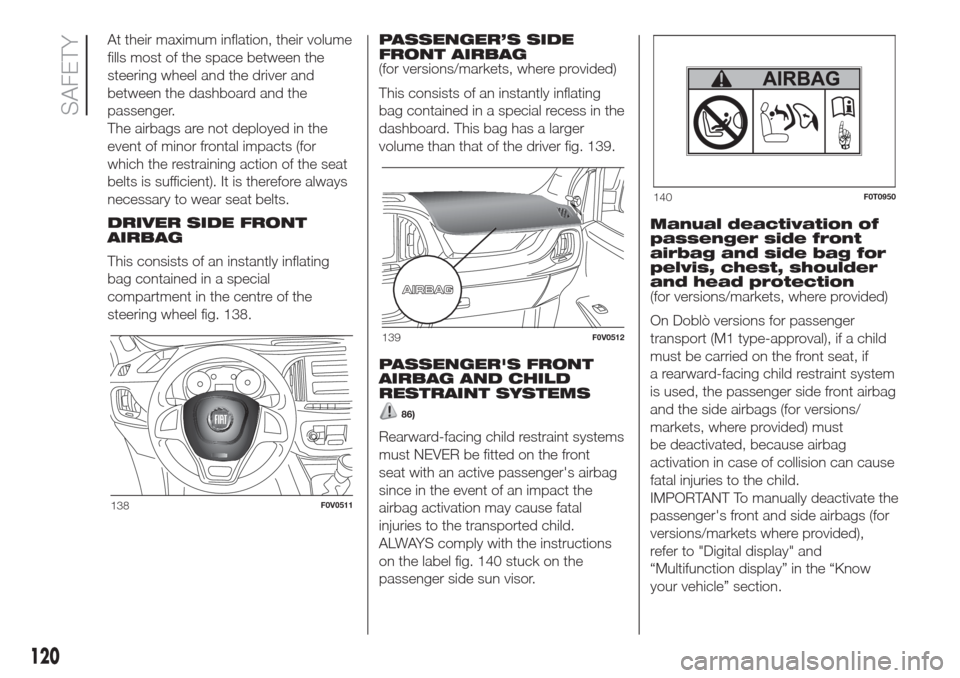
This consists of an instantly inflating
bag contained in a special
compartment in the centre of the
steering wheel fig. 138.PASSENGER’S SIDE
FRONT AIRBAG
(for versions/markets, where provided)
This consists of an instantly inflating
bag contained in a special recess in the
dashboard. This bag has a larger
volume than that of the driver fig. 139.
PASSENGER'S FRONT
AIRBAG AND CHILD
RESTRAINT SYSTEMS
86)
Rearward-facing child restraint systems
must NEVER be fitted on the front
seat with an active passenger's airbag
since in the event of an impact the
airbag activation may cause fatal
injuries to the transported child.
ALWAYS comply with the instructions
on the label fig. 140 stuck on the
passenger side sun visor.Manual deactivation of
passenger side front
airbag and side bag for
pelvis, chest, shoulder
and head protection
(for versions/markets, where provided)
On Doblò versions for passenger
transport (M1 type-approval), if a child
must be carried on the front seat, if
a rearward-facing child restraint system
is used, the passenger side front airbag
and the side airbags (for versions/
markets, where provided) must
be deactivated, because airbag
activation in case of collision can cause
fatal injuries to the child.
IMPORTANT To manually deactivate the
passenger's front and side airbags (for
versions/markets where provided),
refer to "Digital display" and
“Multifunction display” in the “Know
your vehicle” section.
138F0V0511
139F0V0512
140F0T0950
120
SAFETY
Page 127 of 300
WARNING
81)Do not apply stickers or other objects to the steering wheel, the dashboard in the passenger side airbag area and the seats. Never put
objects (e.g. mobile phones) on the passenger side of the dashboard since they could interfere with correct inflation of the passenger airbag
and also cause serious injury to the passengers.
82)Always drive with your hands on the rim of the steering wheel so that the airbag can inflate freely if required. Do not drive with your body
bent forward. Keep your back straight against the backrest.
83)The front airbag deployment threshold is higher than that of the pretensioners. For collisions in the range between the two thresholds, it is
normal for only the pretensioners to be activated.
84)The airbag does not replace seat belts but increases their efficiency. Because front airbags are not deployed for low-speed crashes, side
collisions, rear-end shunts or rollovers, occupants are protected, in addition to any side bags, only by their seat belts, which must therefore
always be fastened.
85)In some versions, in the event of a failure of the
LED (located on the front ceiling light), thewarning light on the instrument panel
turns on and the passenger side airbags are deactivated.
86)When there is an active passenger airbag, DO NOT install rearward facing child restraint systems on the front seat. Deployment of the
airbag in a crash could cause fatal injuries to the child regardless of the severity of the collision. Therefore, always deactivate the passenger
side airbag when a rearward facing child restraint system is installed on the front passenger seat. The front passenger seat must also be
positioned back as far as possible in order to prevent the child restraint system from coming into contact with the dashboard. Immediately
reactivate the passenger airbag as soon as the child restraint system has been removed.
123
Page 140 of 300
Space-saver wheel (for versions/
markets, where provided): the
space-saver wheel is not equipped with
a TPMS sensor. Once fitted, while
driving normally, the warning light
comes on (flashing for about 75
seconds, and then constantly). This
condition lasts until a wheel equipped
with an original TPMS sensor is fitted
on the vehicle.
Normal spare wheel (without TPMS
sensor): once fitted, while driving
normally, the
warning light comes on
(flashing for about 75 seconds, and
then constantly). This condition lasts
until a wheel equipped with an original
TPMS sensor is fitted on the vehicle.
The system is then restored and the
warning light switches off.
Normal spare wheel (with TPMS
sensor): once fitted, while driving
normally, the
warning light switches
off.
IMPORTANT In all the above-mentioned
cases, it is advisable to check the
spare wheel tyre pressure before
starting driving.
NOTE If the tyres are replaced, driving
the vehicle for short stretches, some
time might be needed before the
system is restored.IMPORTANT
WARNING
103)The TPMS is optimised for the
original tyres and wheels provided. TPMS
pressures and alerts have been defined
according to the size of the tyres mounted
on the vehicle. Using equipment with
different size, type or kind may cause
irregular system operation or sensor
damage. Non-original spare wheels can
damage the sensor. Do not use tyre
sealant or balancing weights if the vehicle
is equipped with TPMS as these may
damage the sensors.
104)If the system signals a pressure
decrease on a specific tyre, it is
recommended to check the pressure on all
four tyres.
105)TPMS does not relieve the driver from
the obligation to check the tyre pressure
every month; it is not to be considered
a replacing system for maintenance or a
safety system.
106)Tyre pressure must be checked with
tyres cold. Should it become necessary for
whatever reason to check pressure with
warm tyres, do not reduce pressure even if
it is higher than the prescribed value, but
repeat the check when tyres are cold.
107)The TPMS cannot indicate sudden
tyre pressure drops (for example when
a tyre bursts). In this case, stop the vehicle,
braking with caution and avoiding abrupt
steering.108)The system only warns that the tyre
pressure is low: it is not able to inflate
them.
109)Insufficient tyre inflation increases fuel
consumption, reduces the tread duration
and may affect the capacity to drive safely.
110)Always refit the valve stem cap after
inspecting or adjusting tyre pressure.
This prevents dampness or dirt from
entering the valve stem and thus
the pressure control sensor from being
damaged.
111)The tyre repair kit (Fix&Go) provided
with the vehicle (for versions/markets,
where provided) is compatible with the
TPMS sensors; using sealants not
equivalent with that in the original kit may
adversely affect its operation. If sealants
not equivalent with the original one are
used, it is recommended to have the
TPMS sensor operation checked by a
qualified repair centre.
136
STARTING AND DRIVING
Page 173 of 300
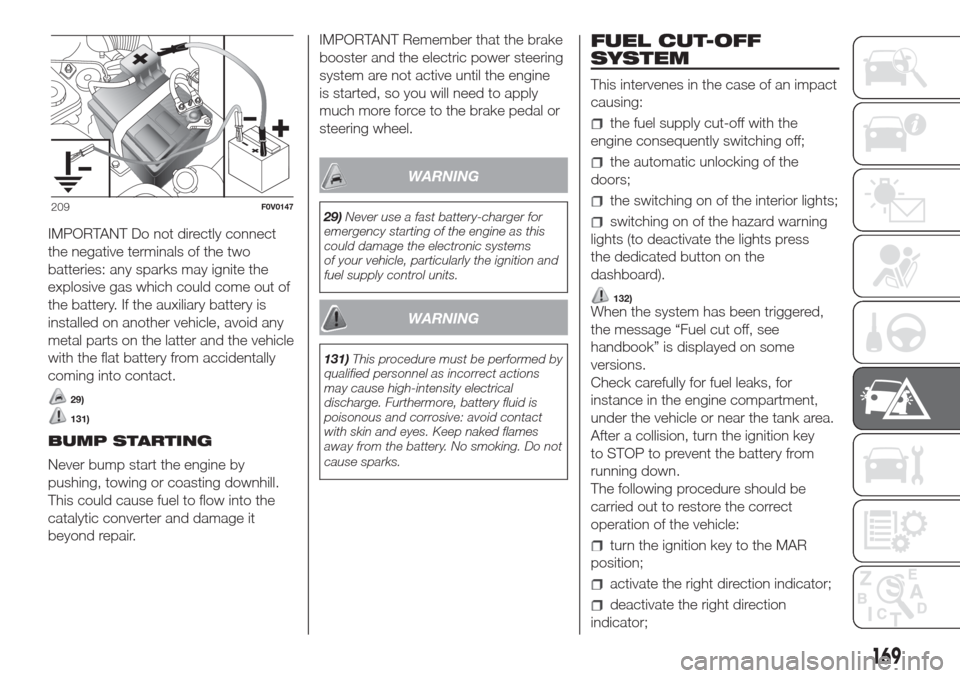
IMPORTANT Do not directly connect
the negative terminals of the two
batteries: any sparks may ignite the
explosive gas which could come out of
the battery. If the auxiliary battery is
installed on another vehicle, avoid any
metal parts on the latter and the vehicle
with the flat battery from accidentally
coming into contact.
29)
131)
BUMP STARTING
Never bump start the engine by
pushing, towing or coasting downhill.
This could cause fuel to flow into the
catalytic converter and damage it
beyond repair.IMPORTANT Remember that the brake
booster and the electric power steering
system are not active until the engine
is started, so you will need to apply
much more force to the brake pedal or
steering wheel.
WARNING
29)Never use a fast battery-charger for
emergency starting of the engine as this
could damage the electronic systems
of your vehicle, particularly the ignition and
fuel supply control units.
WARNING
131)This procedure must be performed by
qualified personnel as incorrect actions
may cause high-intensity electrical
discharge. Furthermore, battery fluid is
poisonous and corrosive: avoid contact
with skin and eyes. Keep naked flames
away from the battery. No smoking. Do not
cause sparks.
FUEL CUT-OFF
SYSTEM
This intervenes in the case of an impact
causing:
the fuel supply cut-off with the
engine consequently switching off;
the automatic unlocking of the
doors;
the switching on of the interior lights;
switching on of the hazard warning
lights (to deactivate the lights press
the dedicated button on the
dashboard).
132)When the system has been triggered,
the message “Fuel cut off, see
handbook” is displayed on some
versions.
Check carefully for fuel leaks, for
instance in the engine compartment,
under the vehicle or near the tank area.
After a collision, turn the ignition key
to STOP to prevent the battery from
running down.
The following procedure should be
carried out to restore the correct
operation of the vehicle:
turn the ignition key to the MAR
position;
activate the right direction indicator;
deactivate the right direction
indicator;
209F0V0147
169
Page 175 of 300
WARNING
133)Before starting towing operations,
turn the ignition key to MAR and then
to STOP, without extracting it. If the key is
extracted, the steering lock engages
automatically and it is consequently
impossible to steer the wheels.
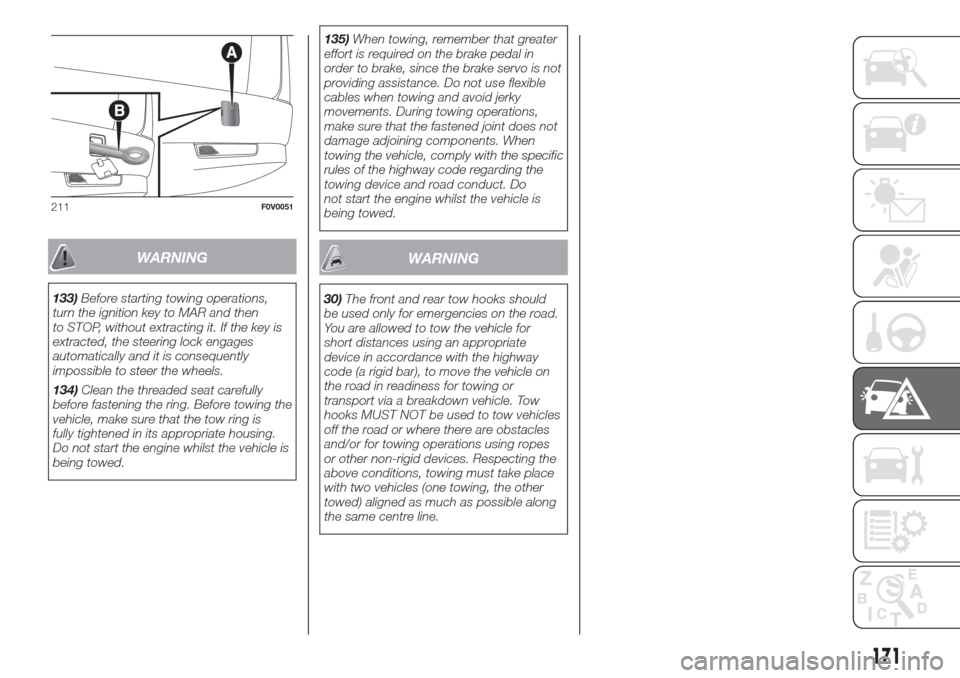
134)Clean the threaded seat carefully
before fastening the ring. Before towing the
vehicle, make sure that the tow ring is
fully tightened in its appropriate housing.
Do not start the engine whilst the vehicle is
being towed.135)When towing, remember that greater
effort is required on the brake pedal in
order to brake, since the brake servo is not
providing assistance. Do not use flexible
cables when towing and avoid jerky
movements. During towing operations,
make sure that the fastened joint does not
damage adjoining components. When
towing the vehicle, comply with the specific
rules of the highway code regarding the
towing device and road conduct. Do
not start the engine whilst the vehicle is
being towed.
WARNING
30)The front and rear tow hooks should
be used only for emergencies on the road.
You are allowed to tow the vehicle for
short distances using an appropriate
device in accordance with the highway
code (a rigid bar), to move the vehicle on
the road in readiness for towing or
transport via a breakdown vehicle. Tow
hooks MUST NOT be used to tow vehicles
off the road or where there are obstacles
and/or for towing operations using ropes
or other non-rigid devices. Respecting the
above conditions, towing must take place
with two vehicles (one towing, the other
towed) aligned as much as possible along
the same centre line.
211F0V0051
171
Page 203 of 300
WHEELS AND TYRES
Check the pressure of each tyre,
including the space-saver wheel,
approximately every two weeks and
before long journeys: the pressure
should be checked with the tyre rested
and cold.
It is normal for the pressure to increase
when the vehicle is used; for the correct
tyre inflation pressure, see “Wheels” in
the “Technical specifications” section.
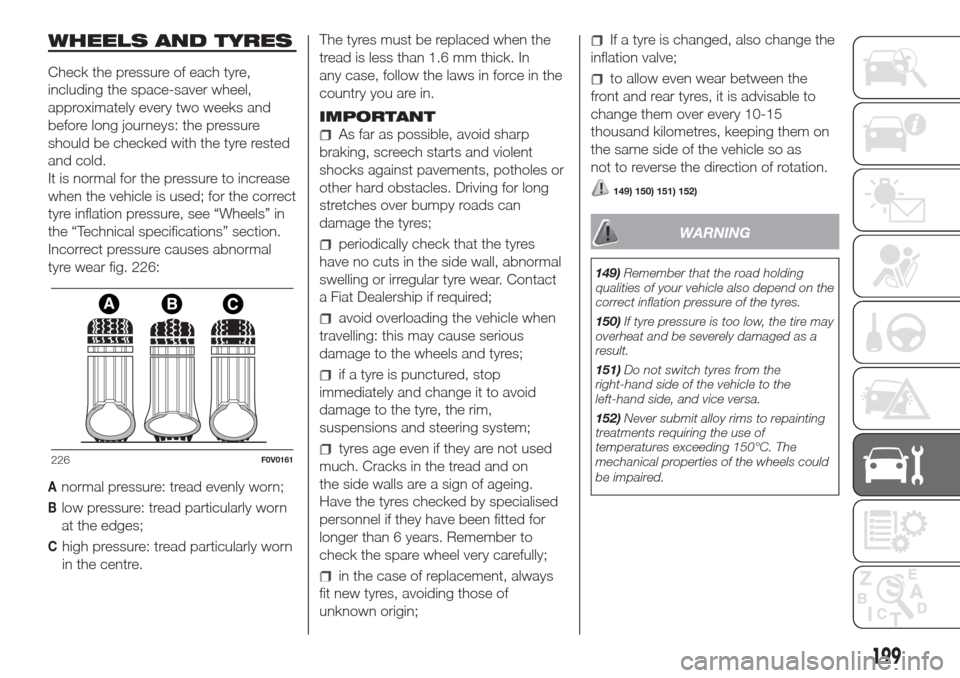
Incorrect pressure causes abnormal
tyre wear fig. 226:
Anormal pressure: tread evenly worn;
Blow pressure: tread particularly worn
at the edges;
Chigh pressure: tread particularly worn
in the centre.The tyres must be replaced when the
tread is less than 1.6 mm thick. In
any case, follow the laws in force in the
country you are in.
IMPORTANT
As far as possible, avoid sharp
braking, screech starts and violent
shocks against pavements, potholes or
other hard obstacles. Driving for long
stretches over bumpy roads can
damage the tyres;
periodically check that the tyres
have no cuts in the side wall, abnormal
swelling or irregular tyre wear. Contact
a Fiat Dealership if required;
avoid overloading the vehicle when
travelling: this may cause serious
damage to the wheels and tyres;
if a tyre is punctured, stop
immediately and change it to avoid
damage to the tyre, the rim,
suspensions and steering system;
tyres age even if they are not used
much. Cracks in the tread and on
the side walls are a sign of ageing.
Have the tyres checked by specialised
personnel if they have been fitted for
longer than 6 years. Remember to
check the spare wheel very carefully;
in the case of replacement, always
fit new tyres, avoiding those of
unknown origin;
If a tyre is changed, also change the
inflation valve;
to allow even wear between the
front and rear tyres, it is advisable to
change them over every 10-15
thousand kilometres, keeping them on
the same side of the vehicle so as
not to reverse the direction of rotation.
149) 150) 151) 152)
WARNING
149)Remember that the road holding
qualities of your vehicle also depend on the
correct inflation pressure of the tyres.
150)If tyre pressure is too low, the tire may
overheat and be severely damaged as a
result.
151)Do not switch tyres from the
righthand side of the vehicle to the
lefthand side, and vice versa.
152)Never submit alloy rims to repainting
treatments requiring the use of
temperatures exceeding 150°C. The
mechanical properties of the wheels could
be impaired.
226F0V0161
199
Page 207 of 300
LEATHER STEERING
WHEEL/GEAR
KNOB/HANDBRAKE
(for versions/markets, where provided)
These components must be cleaned
with mild soap and water only. Never
use alcohol or alcohol-based products.
Read the product label carefully before
using specific products for cleaning
the interiors: make sure the product
does not contain spirits or alcohol-
based substances.
If, when cleaning the windscreen with
special products, window cleaner
accidentally drips onto the leather of
the steering wheel/gear lever
knob/hand brake, wipe away
immediately and then wash the affected
area with mild soap and water.
IMPORTANT Be careful when using a
steering wheel locking device, to avoid
damaging the leather upholstery
through abrasion.
WARNING
153)Never use flammable products, such
as petroleum ether or modified petrol, to
clean the inside of the vehicle. The
electrostatic charges which are generated
by rubbing during the cleaning operation
may cause a fire.
154)Do not keep aerosol cans in the
vehicle: they might explode. Aerosol cans
must not be exposed to a temperature
exceeding 50°C. When the vehicle is
exposed to sunlight, the internal
temperature can greatly exceed this value.
203
Page 209 of 300
TECHNICAL DATA
Everything you may find useful for
understanding how your vehicle
is made and works is contained in this
chapter and illustrated with data, tables
and graphics. For the enthusiasts and
the technician, but also just for those
who want to know every detail of their
vehicle.IDENTIFICATION DATA....................206
ENGINE CODES - BODYWORK
VERSIONS ......................................208
ENGINE ..........................................210
SUPPLY ..........................................213
TRANSMISSION .............................213
BRAKES .........................................213
SUSPENSION .................................214
STEERING ......................................214
WHEELS .........................................215
DIMENSIONS ..................................220
WEIGHTS........................................225
REFUELLING ..................................254
FLUIDS AND LUBRICANTS ............256
PERFORMANCE .............................259
FUEL CONSUMPTION ....................260
CO2 EMISSIONS ...........................272
OFFICIAL TYPE APPROVALS .........281
PRESCRIPTIONS FOR HANDLING
THE VEHICLE AT THE END OF ITS
LIFE ................................................284
205